REVIEW 4 major objections 5 minor 1 cited by
MeshArt: Generating Articulated Meshes with Structure-Guided Transformers
T0 review · 4 major / 5 minor · reviewed 2026-08-11 · deepseek-v4-flash
Pith's one-line read MeshArt models articulated 3D generation as two linked sequences of quantized triangle tokens—one for the joint-and-part structure, one for the mesh faces—so that a pair of autoregressive transformers can write a movable object from…
desk verdict Solid incremental step for articulated mesh generation, but the self-annotated benchmark makes the headline numbers provisional. read the letter →
The pith
A machine-rendered reading of the paper's core claim, the machinery that carries it, and where it could break.
The reading
What carries the argument
The load-bearing mechanism is treating both hierarchy levels as sequences of quantized triangle embeddings. Object structures are converted into triangle meshes—each part bounding box becomes twelve triangles—so the structure and geometry stages share one discrete vocabulary, which is what lets a single pipeline generate both. Two machinery pieces carry the argument: residual vector quantization (RQ), which assigns $D$ codebook indices per triangle in learned codebooks $C_s$ (structure) and $C_g$ (geometry), making next-token prediction tractable; and junction-face conditioning, which prepends tokens for boundary-adjacent triangles of already-generated neighboring parts to the geometry transformer's input, aligning part boundaries for smooth transitions. A flexible positional embedding fixes the positional encoding of each part mesh's start token so that varying conditioning lengths do not corrupt the sequence, and a 1D-ResNet decoder turns the token stream back into triangles.
What would settle it
Re-annotate a random subset of the 3,612 Articulated PartNet objects with independent annotators, or against PartNet-Mobility labels where the objects overlap, and measure agreement on joint type, joint location, and orientation. If inter-annotator joint-location error is large relative to part size, or if models retrained on a corrected consensus annotation produce substantially different AID and ID scores, the reported improvements rest on annotation artifacts rather than on the generative method itself.
Extended reading notes
Core claim
The central claim is that articulation-aware structure and part geometry can be unified as the same kind of object—a sequence of quantized triangle embeddings—so that decoder-only transformers can generate both. At the structure level, each part's axis-aligned bounding box is itself triangulated into twelve faces and encoded together with joint type, joint existence, joint orientation, joint location, a semantic label, and a coarse geometry feature. At the geometry level, each part's actual mesh triangles are encoded, augmented by a per-triangle probability of being a junction face that sits close to a neighboring part. Two VQ-VAEs learn the structure and geometry codebooks, and two GPT-style transformers predict the codebook indices autoregressively, with the geometry transformer cross-attending to the predicted structure and reading nearby junction tokens before writing a part's faces. The paper reports that this part-by-part scheme raises structure coverage by 57.1% on average and improves mesh generation FID by 209 points over the baselines, while producing meshes that can be posed at different articulation states.
Load-bearing premise
The load-bearing premise is that the manually annotated joints in the new Articulated PartNet are accurate enough to serve as ground truth: joint locations come from automatic hypotheses manually selected, prismatic joints are canonicalized to the object origin, all revolute ranges are fixed to 90 degrees, and verification is by visual inspection of rendered motion, with no inter-annotator agreement or cross-check against existing PartNet-Mobility labels.
Editorial extensions
If this is right
- Articulated meshes can be generated directly as compact triangle geometry without part retrieval or implicit-field decoding, so the output is already a clean mesh that can be posed through its predicted joints.
- Because articulation is encoded at the structure level, the geometry stage is shared across categories, and conditioning tokens can be injected into the structure transformer to generate objects from point clouds or sketches without retraining the geometry model.
- The annotated Articulated PartNet extends available articulated-object training data roughly sixfold over PartNet-Mobility, which the authors argue is what makes per-category joint and structure learning tractable.
- Evaluation at ten synchronized articulation states makes motion quality a first-class metric: structure and mesh scores are computed not on a single resting pose but across the range of each joint's travel.
Reading between the lines
- A controlled comparison that trains the baselines on the exact same Articulated PartNet objects and measures how structure and mesh scores shift when joint annotations are perturbed would separate model gains from dataset gains; the paper reports the two together.
- The junction-face mechanism is a general recipe for coherence in part-wise mesh synthesis: conditioning the current part on boundary-adjacent triangles of already-written parts should transfer to static multi-part generation, scene assembly, or interactive mesh editing.
- The annotation choices—revolute ranges fixed at 90 degrees and prismatic joints canonicalized to the object origin—cap the motion complexity the model can express; adding per-object joint limits to the structure token stream would be a direct test of whether the architecture can learn richer articulation.
- Since the model never observes decoded surfaces during training, a limitation the authors state explicitly, physical plausibility at extreme poses is unenforced; measuring interpenetration volumes across the sampled articulation states would quantify how much post-hoc constraint is needed.
Signed reviews
Editorial analysis
A structured set of objections, weighed in public.
Referee Report
Summary. MeshArt is a hierarchical transformer-based method for generating articulated 3D objects as triangle meshes. The approach first generates a coarse object structure, represented as quantized triangle embeddings of part bounding boxes augmented with joint type, location, orientation, and part semantics; a second transformer then generates each part's mesh triangles conditioned on the structure and on 'junction faces' from neighboring parts. To train and evaluate the model, the authors annotate articulation information for chairs, tables, and storage furniture in PartNet, increasing the number of articulated objects by roughly 6x over PartNet-Mobility. Experiments on this new Articulated PartNet report consistent gains over NAP in structure and mesh generation, and over CAGE in structure generation, with large margins in AID coverage and mesh FID.
Significance. If the reported results hold, MeshArt would be a notable advance: it generates clean, compact, animatable triangle meshes rather than implicit or retrieved geometry, and the Articulated PartNet dataset is a potentially valuable resource for the community. The two-stage triangle-sequence formulation is clear and the ablations in Sec. 5.3 support the design choices of triangle-based structure parameterization, junction-face conditioning, and flexible positional embeddings. The paper does not release code, but the method is described in sufficient detail to be reproduced. However, the strength of the claims is currently limited by an incomplete baseline comparison (CAGE is missing from the mesh-generation table) and by the absence of independent validation of the newly annotated ground truth, so the significance cannot be fully assessed without revisions.
major comments (4)
- [Abstract / Sec. 5.2] The abstract claims a 57.1% improvement in structure coverage, but this number is computed relative to NAP only (averaging the per-category improvements in Table 2 over NAP), not relative to the stronger baseline: CAGE attains higher AID COV than NAP on Chair (32.9 vs. 28.3) and Storage (33.4 vs. 30.6), so the average improvement over CAGE is roughly 34.6%. The abstract should be rephrased to report the comparison against the best baseline or to state explicitly that the 57.1% figure is over NAP.
- [Table 3] CAGE is a primary baseline introduced in Section 5, but Table 3 reports only NAP and MeshArt for articulated mesh generation. Since the abstract claims a 209-point FID improvement over state of the art, omitting CAGE leaves the strongest competitor unmeasured on the headline metric. The authors should either add CAGE results (for example, by applying its retrieval post-processing to the generated articulation abstractions) or clearly justify the exclusion in the text.
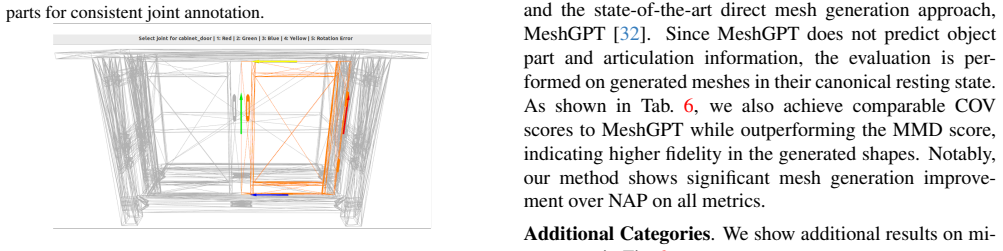
- [Sec. 4 / Supp. Sec. 8] The quality of the new Articulated PartNet annotations is load-bearing for every reported number, but the annotation pipeline is validated only by visual inspection. Supp. Sec. 8 states that revolute joint locations are chosen from four bounding-box hypotheses through an interactive viewer, prismatic joints are all canonicalized to the object origin, and revolute ranges are fixed to 90 degrees; there is no inter-annotator agreement, no quantitative comparison against existing PartNet-Mobility labels on overlapping objects, and no reported error bounds on joint parameters. Because the model is trained and evaluated on these same annotations, a systematic annotation bias would not be detectable from the reported metrics. The authors should provide independent evidence of annotation correctness, such as a subset labeled by multiple annotators or a joint-parameter correlation study against PartNet-Mobility.
- [Tables 2, 3, 5, 6] No error bars, confidence intervals, or significance tests are reported for any metric. In generative models, differences in MMD and 1-NNA of the magnitude shown in Tables 2 and 3 can easily fall within run-to-run variance. The authors should report results over multiple random seeds (or bootstrap confidence intervals) for at least the main comparisons, so the reader can judge whether the claimed improvements are statistically reliable.
minor comments (5)
- [Sec. 3.2] In the paragraph introducing junction faces, the word 'incorpoarate' is misspelled and should be 'incorporate'.
- [Sec. 5.2, Shape Novelty Analysis] The novelty analysis plots Chamfer distances but does not define a numeric criterion for 'novel' versus 'memorized'; please clarify how the plot supports the claim of generating novel shapes.
- [Sec. 5, Implementation] The paper does not state whether the 90/10 test split filters out parts with more than 700 faces, which could affect the comparability of metrics; please clarify the data filtering applied to the test set.
- [Sec. 5.1] The description of articulation-state synchronization for ID/AID evaluation is vague; please specify how the start and end positions are determined for generated objects without explicit joint ranges.
- [General] No statement about code or dataset release is provided; since the dataset is a contribution, please state the intended availability.
Circularity Check
No circular derivation: MeshArt's gains are empirical measurements on a held-out split of a self-annotated dataset; no reported quantity reduces to a fitted parameter or self-citation chain.
full rationale
MeshArt is an empirical generative-modeling paper, not a derivation, and I find no step at which a reported 'prediction' reduces by construction to a fitted input or to a self-citation. The structure tokenizer is trained with reconstruction cross-entropy/regression losses on PartNet bounding boxes and articulation attributes; the structure transformer is trained with next-token cross-entropy and sampled unconditionally; the geometry tokenizer and transformer are trained similarly. Evaluation (AID, ID, COV, 1-NNA, FID) is performed on a held-out 90/10 split of the authors' Articulated PartNet, which is a validity concern because the benchmark is self-annotated, but it is not circularity: the metrics compare generated outputs to held-out ground-truth annotations, and no evaluation quantity is itself a parameter fitted during training. The only self-citations (e.g., MeshGPT for triangle tokenization, and the authors' own prior works used as baselines) are architectural inspiration or comparison methods, not load-bearing evidence that forces the central result. The paper's own limitation statement notes that codebook selection is non-differentiable and physical plausibility is hard to enforce, which further confirms that the reported behavior is empirical rather than derived. No equation in the paper is shown to equal its input by construction, and no fitted constant is renamed as a prediction.
Assumptions & free parameters
free parameters (7)
- Revolute joint range =
90 degrees
- Junction face threshold =
Not specified numerically
- Part face cutoff for training =
700 faces
- Triangle coordinate discretization grid =
128^3 bins
- RQ depth / codes per face =
D=6 embeddings per face
- Codebook sizes =
8192 structure, 16384 geometry
- Articulation state sampling =
10 evenly spaced states
assumptions (6)
- domain assumption Fixed, revolute, and prismatic joint types are sufficient to describe the articulation of functional parts
- domain assumption Axis-aligned bounding boxes in canonical closed state plus joint parameters capture object structure
- domain assumption CLIP text features encode part semantics sufficiently
- ad hoc to paper Manual visual verification ensures annotation quality
- domain assumption Evaluation metrics (MMD, COV, 1-NNA, FID on rendered views) rank generation quality as intended
- standard math Standard transformer and VQ-VAE machinery behaves as expected
Cite this review
Pith. "Pith review of MeshArt: Generating Articulated Meshes with Structure-Guided Transformers." pith.science (2026). https://pith.science/paper/ZUHP3ZYZ
@misc{pith2026241211596,
  author       = {Pith},
  title        = {Pith review of: MeshArt: Generating Articulated Meshes with Structure-Guided Transformers},
  year         = {2026},
  howpublished = {\url{https://pith.science/paper/ZUHP3ZYZ}},
  note         = {Machine review of arXiv:2412.11596}
}
read the original abstract
Articulated 3D object generation is fundamental for creating realistic, functional, and interactable virtual assets which are not simply static. We introduce MeshArt, a hierarchical transformer-based approach to generate articulated 3D meshes with clean, compact geometry, reminiscent of human-crafted 3D models. We approach articulated mesh generation in a part-by-part fashion across two stages. First, we generate a high-level articulation-aware object structure; then, based on this structural information, we synthesize each part's mesh faces. Key to our approach is modeling both articulation structures and part meshes as sequences of quantized triangle embeddings, leading to a unified hierarchical framework with transformers for autoregressive generation. Object part structures are first generated as their bounding primitives and articulation modes; a second transformer, guided by these articulation structures, then generates each part's mesh triangles. To ensure coherency among generated parts, we introduce structure-guided conditioning that also incorporates local part mesh connectivity. MeshArt shows significant improvements over state of the art, with 57.1% improvement in structure coverage and a 209-point improvement in mesh generation FID.
Figures


Figures from the paper (8 more)




Forward citations
Cited by 1 Pith paper
-
Articulate3D: Holistic Understanding of 3D Scenes as Universal Scene Description
Articulate3D provides 280 real-world ScanNet++ scenes with 8 layers of part, connection, and motion annotations in USD format, plus USDNet, a Mask3D-based method that predicts part segmentation and articulation jointly.
Reference graph
Works this paper leans on
-
[1]
Polydiff: Generating 3d polygonal meshes with diffusion models
Antonio Alliegro, Yawar Siddiqui, Tatiana Tommasi, and Matthias Nießner. Polydiff: Generating 3d polygonal meshes with diffusion models. arXiv preprint arXiv:2312.11417 ,
-
[2]
Meshxl: Neural coordinate field for generative 3d foundation models
Sijin Chen, Xin Chen, Anqi Pang, Xianfang Zeng, Wei Cheng, Yijun Fu, Fukun Yin, Billzb Wang, Jingyi Yu, Gang Yu, et al. Meshxl: Neural coordinate field for generative 3d foundation models. Advances in Neural Information Pro- cessing Systems, 37:97141–97166, 2024. 2
work page 2024
-
[3]
Meshany- thing v2: Artist-created mesh generation with adjacent mesh tokenization
Yiwen Chen, Yikai Wang, Yihao Luo, Zhengyi Wang, Zilong Chen, Jun Zhu, Chi Zhang, and Guosheng Lin. Meshany- thing v2: Artist-created mesh generation with adjacent mesh tokenization. arXiv preprint arXiv:2408.02555, 2024. 2
arXiv 2024
-
[4]
Sdfusion: Multimodal 3d shape completion, reconstruction, and generation
Yen-Chi Cheng, Hsin-Ying Lee, Sergey Tulyakov, Alexan- der G Schwing, and Liang-Yan Gui. Sdfusion: Multimodal 3d shape completion, reconstruction, and generation. InPro- ceedings of the IEEE/CVF Conference on Computer Vision and Pattern Recognition, pages 4456–4465, 2023. 1
work page 2023
-
[5]
Scan2mesh: From un- structured range scans to 3d meshes
Angela Dai and Matthias Nießner. Scan2mesh: From un- structured range scans to 3d meshes. In Proceedings of the IEEE/CVF Conference on Computer Vision and Pattern Recognition, pages 5574–5583, 2019. 2
work page 2019
-
[6]
Hyperdiffusion: Generating implicit neu- ral fields with weight-space diffusion
Ziya Erkoc ¸, Fangchang Ma, Qi Shan, Matthias Nießner, and Angela Dai. Hyperdiffusion: Generating implicit neu- ral fields with weight-space diffusion. In Proceedings of the IEEE/CVF international conference on computer vision, pages 14300–14310, 2023. 1
work page 2023
-
[7]
Sdm-net: Deep generative net- work for structured deformable mesh
Lin Gao, Jie Yang, Tong Wu, Yu-Jie Yuan, Hongbo Fu, Yu- Kun Lai, and Hao Zhang. Sdm-net: Deep generative net- work for structured deformable mesh. ACM Transactions on Graphics (TOG), 38(6):1–15, 2019. 2
work page 2019
-
[8]
Haoran Geng, Helin Xu, Chengyang Zhao, Chao Xu, Li Yi, Siyuan Huang, and He Wang. Gapartnet: Cross-category domain-generalizable object perception and manipulation via generalizable and actionable parts. In Proceedings of the IEEE/CVF Conference on Computer Vision and Pattern Recognition, pages 7081–7091, 2023. 2
work page 2023
Show all 51 references
-
[9]
Inductive representation learning on large graphs
Will Hamilton, Zhitao Ying, and Jure Leskovec. Inductive representation learning on large graphs. Advances in neural information processing systems, 30, 2017. 4, 1
2017
-
[10]
Meshtron: High-fidelity, artist-like 3d mesh generation at scale
Zekun Hao, David W Romero, Tsung-Yi Lin, and Ming-Yu Liu. Meshtron: High-fidelity, artist-like 3d mesh generation at scale. arXiv preprint arXiv:2412.09548, 2024. 2
2024 arXiv
-
[11]
Deep residual learning for image recognition
Kaiming He, Xiangyu Zhang, Shaoqing Ren, and Jian Sun. Deep residual learning for image recognition. In Proceed- ings of the IEEE conference on computer vision and pattern recognition, pages 770–778, 2016. 4
2016
-
[12]
CARTO: Category and Joint Agnostic Reconstruction of ARTiculated Objects
Nick Heppert, Muhammad Zubair Irshad, Sergey Zakharov, Katherine Liu, Rares Andrei Ambrus, Jeannette Bohg, Ab- hinav Valada, and Thomas Kollar. CARTO: Category and Joint Agnostic Reconstruction of ARTiculated Objects. In Proc. IEEE Conf. Comput. Vis. Pattern Recog., pages 2120...
2023
-
[13]
Ditto: Building Digital Twins of Articulated Objects from Interac- tion
Zhenyu Jiang, Cheng-Chun Hsu, and Yuke Zhu. Ditto: Building Digital Twins of Articulated Objects from Interac- tion. In CVPR, pages 5606–5616, 2022. 2
2022
-
[14]
Adam: A method for stochastic optimization
Diederik P Kingma and Jimmy Ba. Adam: A method for stochastic optimization. arXiv preprint arXiv:1412.6980 ,
-
[15]
Nap: Neural 3d articulated object prior
Jiahui Lei, Congyue Deng, William B Shen, Leonidas J Guibas, and Kostas Daniilidis. Nap: Neural 3d articulated object prior. Advances in Neural Information Processing Systems, 36:31878–31894, 2023. 3, 5, 6, 7, 2
2023
-
[16]
Grass: Generative recursive autoencoders for shape structures
Jun Li, Kai Xu, Siddhartha Chaudhuri, Ersin Yumer, Hao Zhang, and Leonidas Guibas. Grass: Generative recursive autoencoders for shape structures. ACM Transactions on Graphics (TOG), 36(4):1–14, 2017. 2
2017
-
[17]
Paris: Part-level reconstruction and motion analysis for articulated objects
Jiayi Liu, Ali Mahdavi-Amiri, and Manolis Savva. Paris: Part-level reconstruction and motion analysis for articulated objects. In Proceedings of the IEEE/CVF International Con- ference on Computer Vision, pages 352–363, 2023. 3
2023
-
[18]
Cage: Controllable articulation generation
Jiayi Liu, Hou In Ivan Tam, Ali Mahdavi-Amiri, and Manolis Savva. Cage: Controllable articulation generation. In Pro- ceedings of the IEEE/CVF Conference on Computer Vision and Pattern Recognition, pages 17880–17889, 2024. 3, 5, 6
2024
-
[19]
Build- ing rearticulable models for arbitrary 3d objects from 4d point clouds
Shaowei Liu, Saurabh Gupta, and Shenlong Wang. Build- ing rearticulable models for arbitrary 3d objects from 4d point clouds. In Proceedings of the IEEE/CVF Conference on Computer Vision and Pattern Recognition, pages 21138– 21147, 2023. 3
2023
-
[20]
Marching cubes: A high resolution 3d surface construction algorithm
William E Lorensen and Harvey E Cline. Marching cubes: A high resolution 3d surface construction algorithm. InSem- inal graphics: pioneering efforts that shaped the field, pages 347–353. 1998. 7
1998
-
[21]
Stacked quantizers for compositional vector compression
Julieta Martinez, Holger H Hoos, and James J Little. Stacked quantizers for compositional vector compression. arXiv preprint arXiv:1411.2173, 2014. 4
2014 arXiv
-
[22]
Lt3sd: Latent trees for 3d scene diffusion
Quan Meng, Lei Li, Matthias Nießner, and Angela Dai. Lt3sd: Latent trees for 3d scene diffusion. arXiv preprint arXiv:2409.08215, 2024. 1
2024 arXiv
-
[23]
Structurenet: Hierarchi- cal graph networks for 3d shape generation
Kaichun Mo, Paul Guerrero, Li Yi, Hao Su, Peter Wonka, Niloy Mitra, and Leonidas J Guibas. Structurenet: Hierarchi- cal graph networks for 3d shape generation. arXiv preprint arXiv:1908.00575, 2019. 2
1908 arXiv
-
[24]
Partnet: A large- scale benchmark for fine-grained and hierarchical part-level 3d object understanding
Kaichun Mo, Shilin Zhu, Angel X Chang, Li Yi, Subarna Tripathi, Leonidas J Guibas, and Hao Su. Partnet: A large- scale benchmark for fine-grained and hierarchical part-level 3d object understanding. In Proceedings of the IEEE/CVF conference on computer vision and pattern recog...
2019
-
[25]
Polygen: An autoregressive generative model of 3d meshes
Charlie Nash, Yaroslav Ganin, SM Ali Eslami, and Peter Battaglia. Polygen: An autoregressive generative model of 3d meshes. In International conference on machine learning, pages 7220–7229. PMLR, 2020. 2, 4
2020
-
[26]
Pytorch: An imperative style, high-performance deep learning library
Adam Paszke, Sam Gross, Francisco Massa, Adam Lerer, James Bradbury, Gregory Chanan, Trevor Killeen, Zem- ing Lin, Natalia Gimelshein, Luca Antiga, Alban Desmai- son, Andreas Kopf, Edward Yang, Zachary DeVito, Mar- tin Raison, Alykhan Tejani, Sasank Chilamkurthy, Benoit Steine...
2019
-
[27]
Pointnet: Deep learning on point sets for 3d classification and segmentation
Charles R Qi, Hao Su, Kaichun Mo, and Leonidas J Guibas. Pointnet: Deep learning on point sets for 3d classification and segmentation. In Proceedings of the IEEE conference on computer vision and pattern recognition, pages 652–660,
-
[28]
Learning transferable visual models from natural language supervi- sion
Alec Radford, Jong Wook Kim, Chris Hallacy, Aditya Ramesh, Gabriel Goh, Sandhini Agarwal, Girish Sastry, Amanda Askell, Pamela Mishkin, Jack Clark, et al. Learning transferable visual models from natural language supervi- sion. In International conference on machine learning, ...
2021
-
[29]
Am-radio: Agglomerative vision foundation model reduce all domains into one
Mike Ranzinger, Greg Heinrich, Jan Kautz, and Pavlo Molchanov. Am-radio: Agglomerative vision foundation model reduce all domains into one. In Proceedings of the IEEE/CVF Conference on Computer Vision and Pattern Recognition, pages 12490–12500, 2024. 3
2024
-
[30]
L3dg: Latent 3d gaussian diffusion
Barbara Roessle, Norman M ¨uller, Lorenzo Porzi, Samuel Rota Bul `o, Peter Kontschieder, Angela Dai, and Matthias Nießner. L3dg: Latent 3d gaussian diffusion. In SIGGRAPH Asia 2024 Conference Papers, 2024. 1
2024
-
[31]
3d neural field generation using triplane diffusion
J Ryan Shue, Eric Ryan Chan, Ryan Po, Zachary Ankner, Jiajun Wu, and Gordon Wetzstein. 3d neural field generation using triplane diffusion. In Proceedings of the IEEE/CVF Conference on Computer Vision and Pattern Recognition , pages 20875–20886, 2023. 1
2023
-
[32]
Meshgpt: Generating triangle meshes with decoder-only transformers
Yawar Siddiqui, Antonio Alliegro, Alexey Artemov, Ta- tiana Tommasi, Daniele Sirigatti, Vladislav Rosov, Angela Dai, and Matthias Nießner. Meshgpt: Generating triangle meshes with decoder-only transformers. In Proceedings of the IEEE/CVF Conference on Computer Vision and Patte...
2024
-
[33]
Meta 3d assetgen: Text-to-mesh genera- tion with high-quality geometry, texture, and pbr materials
Yawar Siddiqui, Tom Monnier, Filippos Kokkinos, Mahen- dra Kariya, Yanir Kleiman, Emilien Garreau, Oran Gafni, Natalia Neverova, Andrea Vedaldi, Roman Shapovalov, and David Novotny. Meta 3d assetgen: Text-to-mesh genera- tion with high-quality geometry, texture, and pbr materi...
2024
-
[34]
Complementme: Weakly- supervised component suggestions for 3d modeling
Minhyuk Sung, Hao Su, Vladimir G Kim, Siddhartha Chaudhuri, and Leonidas Guibas. Complementme: Weakly- supervised component suggestions for 3d modeling. ACM Transactions on Graphics (TOG), 36(6):1–12, 2017. 3
2017
-
[35]
Edgerunner: Auto-regressive auto-encoder for artistic mesh generation
Jiaxiang Tang, Zhaoshuo Li, Zekun Hao, Xian Liu, Gang Zeng, Ming-Yu Liu, and Qinsheng Zhang. Edgerunner: Auto-regressive auto-encoder for artistic mesh generation. arXiv preprint arXiv:2409.18114, 2024. 2
2024 arXiv
-
[36]
Neural discrete representation learning
Aaron Van Den Oord, Oriol Vinyals, et al. Neural discrete representation learning. Advances in neural information pro- cessing systems, 30, 2017. 4
2017
-
[37]
Symme- try hierarchy of man-made objects
Yanzhen Wang, Kai Xu, Jun Li, Hao Zhang, Ariel Shamir, Ligang Liu, Zhiquan Cheng, and Yueshan Xiong. Symme- try hierarchy of man-made objects. In Computer graphics forum, pages 287–296. Wiley Online Library, 2011. 2
2011
-
[38]
Pivotmesh: Generic 3d mesh generation via pivot ver- tices guidance
Haohan Weng, Yikai Wang, Tong Zhang, CL Chen, and Jun Zhu. Pivotmesh: Generic 3d mesh generation via pivot ver- tices guidance. arXiv preprint arXiv:2405.16890, 2024. 2, 7
2024 arXiv
-
[39]
Neural implicit representation for building digital twins of unknown articulated objects
Yijia Weng, Bowen Wen, Jonathan Tremblay, Valts Blukis, Dieter Fox, Leonidas Guibas, and Stan Birchfield. Neural implicit representation for building digital twins of unknown articulated objects. In Proceedings of the IEEE/CVF Con- ference on Computer Vision and Pattern Recogn...
2024
-
[40]
Pq-net: A generative part seq2seq network for 3d shapes
Rundi Wu, Yixin Zhuang, Kai Xu, Hao Zhang, and Bao- quan Chen. Pq-net: A generative part seq2seq network for 3d shapes. In Proceedings of the IEEE/CVF Conference on Computer Vision and Pattern Recognition , pages 829–838,
-
[41]
Sagnet: Structure-aware gen- erative network for 3d-shape modeling
Zhijie Wu, Xiang Wang, Di Lin, Dani Lischinski, Daniel Cohen-Or, and Hui Huang. Sagnet: Structure-aware gen- erative network for 3d-shape modeling. ACM Transactions on Graphics (TOG), 38(4):1–14, 2019. 2
2019
-
[42]
Blockfusion: Expandable 3d scene gen- eration using latent tri-plane extrapolation
Zhennan Wu, Yang Li, Han Yan, Taizhang Shang, Weixuan Sun, Senbo Wang, Ruikai Cui, Weizhe Liu, Hiroyuki Sato, Hongdong Li, et al. Blockfusion: Expandable 3d scene gen- eration using latent tri-plane extrapolation. ACM Transac- tions on Graphics (TOG), 43(4):1–17, 2024. 1
2024
-
[43]
Sapien: A simulated part-based interactive environment
Fanbo Xiang, Yuzhe Qin, Kaichun Mo, Yikuan Xia, Hao Zhu, Fangchen Liu, Minghua Liu, Hanxiao Jiang, Yifu Yuan, He Wang, et al. Sapien: A simulated part-based interactive environment. In Proceedings of the IEEE/CVF conference on computer vision and pattern recognition , pages 11...
2020
-
[44]
Dsm-net: Disentangled structured mesh net for controllable generation of fine geometry
Jie Yang, Kaichun Mo, Yu-Kun Lai, Leonidas J Guibas, and Lin Gao. Dsm-net: Disentangled structured mesh net for controllable generation of fine geometry. arXiv preprint arXiv:2008.05440, 2(3), 2020. 2
2008 arXiv
-
[45]
Michelangelo: Conditional 3d shape generation based on shape-image-text aligned latent representation
Zibo Zhao, Wen Liu, Xin Chen, Xianfang Zeng, Rui Wang, Pei Cheng, Bin Fu, Tao Chen, Gang Yu, and Shenghua Gao. Michelangelo: Conditional 3d shape generation based on shape-image-text aligned latent representation. Advances in Neural Information Processing Systems, 36, 2024. 3
2024
-
[46]
3d shape generation and completion through point-voxel diffusion
Linqi Zhou, Yilun Du, and Jiajun Wu. 3d shape generation and completion through point-voxel diffusion. In Proceed- ings of the IEEE/CVF International Conference on Com- puter Vision, pages 5826–5835, 2021. 1
2021
-
[47]
3d-prnn: Generating shape primitives with recurrent neural networks
Chuhang Zou, Ersin Yumer, Jimei Yang, Duygu Ceylan, and Derek Hoiem. 3d-prnn: Generating shape primitives with recurrent neural networks. In Proceedings of the IEEE In- ternational Conference on Computer Vision, pages 900–909,
-
[49]
Method Details We use VQV AEs to model both part articulations and mesh geometries for our hierarchical transformers. Our structure VQV AE encodes extra part-level features (e.g., semantics, geometry feature, and articulation joint), alongside vertex locations, into a compact ...
-
[50]
This augmentation significantly increases the diversity of artic- ulated objects compared to the commonly used PartNet- Mobility [43]
Data Annotation To effectively learn the distribution of articulated objects, we extend PartNet [24], the largest dataset with object part annotations, by augmenting it with joint information. This augmentation significantly increases the diversity of artic- ulated objects com...
-
[51]
We compare the mesh generation quality of our method with NAP [15], and the state-of-the-art direct mesh generation approach, MeshGPT [32]
Additional Results Quantitative Comparison at Resting State. We compare the mesh generation quality of our method with NAP [15], and the state-of-the-art direct mesh generation approach, MeshGPT [32]. Since MeshGPT does not predict object part and articulation information, the...
-
[2017]
3 MeshArt: Generating Articulated Meshes with Structure-Guided Transformers Supplementary Material In this supplementary document, we provide additional details about MeshArt. In Sec. 7, we give more implementa- tion details of our method and loss functions. We elaborate our d...
Reviewed August 11, 2026 · model on record in the stance chip above.
Discussion (0). Continue with ORCID to comment.