REVIEW 3 major objections 5 minor 71 references
UA-PDFL: A Personalized Approach for Decentralized Federated Learning
T0 review · 3 major / 5 minor · reviewed 2026-08-11 · deepseek-v4-flash
Pith's one-line read UA-PDFL claims adaptive personalization guided by a fixed unit tensor makes decentralized federated learning robust to data skew without public data or a central server.
desk verdict A practical DFL personalization method with a genuinely new unit-representation trick and broad experiments, but the load-bearing proxy is under-validated and the convergence proof does not analyze the actual algorithm. read the letter →
The pith
A machine-rendered reading of the paper's core claim, the machinery that carries it, and where it could break.
The reading
What carries the argument
The load-bearing object is the unit representation $I_m = \sigma(f_m(w_m; X_{\mathrm{unit}}))$: the softmax output each client's model produces on the fixed unit tensor $X_{\mathrm{unit}}$, all entries equal to one. Pairwise Jensen-Shannon divergence $\mathrm{Div}(i,j)$ computed from these vectors drives every design choice: whether to drop clients when all divergences fall below threshold $th_I$, which classifiers to fuse, and which feature extractors to aggregate. A second auxiliary representation $I^{\mathrm{Aux}}_m = g_m(X_{\mathrm{unit}})$ from the feature extractor feeds a proximal regularizer $\mu\,\|I^{\mathrm{Aux}}_m - I^{\mathrm{Aux}}_{\mathrm{avg}}\|_2^2$ that pulls local extractors toward a shared feature space while classifiers stay personalized. The paper also justifies client-wise dropout as a Bayesian approximation, viewing each connected client as a neuron and the aggregation step as a linear combination.
What would settle it
Train two clients on the same data distribution with different random seeds or different architectures, then compute their unit representations and $\mathrm{Div}(i,j)$; if any such pair exceeds the paper's threshold $th_I$, the unit representation is not a faithful probe of true distribution similarity.
Extended reading notes
Core claim
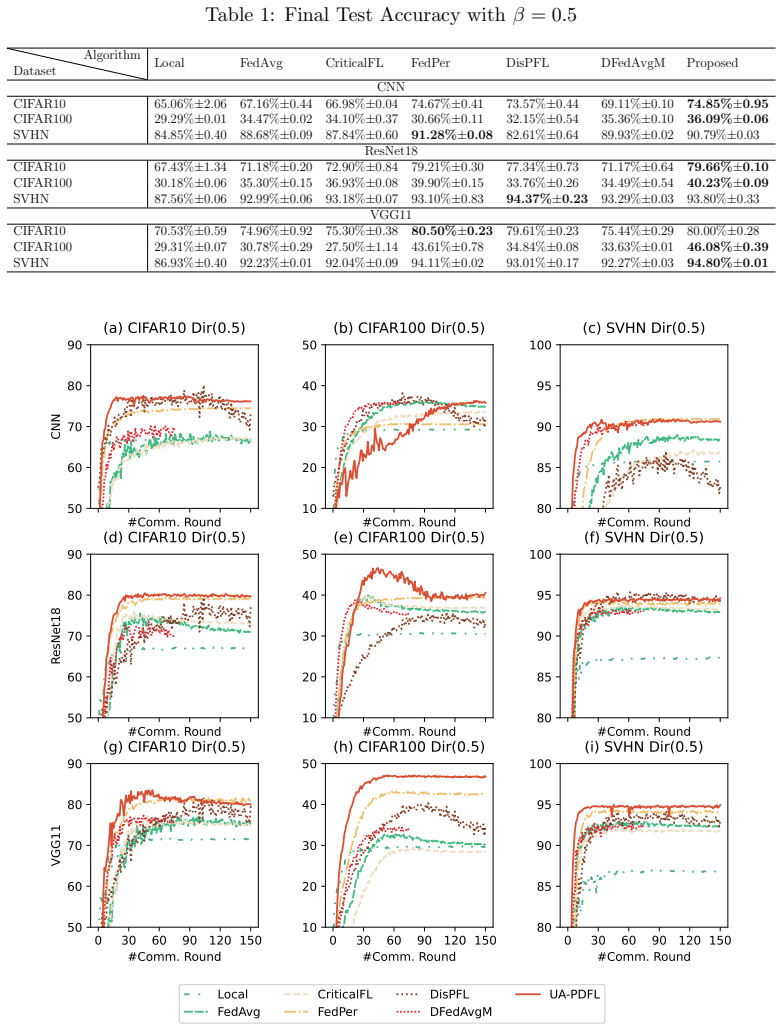
The paper's central claim is that a single hand-set input, the unit tensor, can act as a distribution probe: feeding $X_{\mathrm{unit}}$ with all entries equal to $1$ to each client model and comparing the resulting softmax outputs with Jensen-Shannon divergence yields a metric $\mathrm{Div}(i,j)$ that ranks client-pair similarity in line with their true data distributions. On top of this metric the paper builds two mechanisms: client-wise dropout, which replaces a client's model with a randomly chosen connected client's model when all divergences are below a threshold, and layer-wise personalization, which aggregates feature extractors among similar clients while keeping each client's final model a weighted combination of similar peers' classifiers. A proximal term on auxiliary representations from the feature extractor steers local extractors toward a common feature space. The experiments on CIFAR-10, CIFAR-100, SVHN, and PathMNIST show UA-PDFL matching or beating five baselines and converging faster in most settings, with the largest gains on the hardest skewed task, CIFAR-100.
Load-bearing premise
The entire method rests on the assumption that a fixed all-ones input, pushed through each client's model, produces a unit representation whose pairwise Jensen-Shannon divergence reliably tracks how different the clients' real data distributions are.
Editorial extensions
If this is right
- If UA-PDFL is right, decentralized federated learning no longer needs public data or a server to detect client similarity: a fixed dummy input and the Jensen-Shannon divergence between output vectors suffice.
- Adaptive personalization depth should outperform fixed personalization layers on both ends of the skew spectrum, since client-wise dropout handles near-IID clients while layer-wise personalization handles strong non-IID.
- The largest accuracy gains appear on the hardest heterogeneous tasks, CIFAR-100 and extreme PathMNIST non-IID, suggesting the mechanism is most valuable when client distributions overlap least.
- Communication volume is not consistently reduced: the paper's own measurements show UA-PDFL communicates more than DFedAvgM and DisPFL, with savings from client-wise dropout appearing mainly under more uniform data.
Reading between the lines
- Because $\mathrm{Div}$ lives in output-probability space, the method implicitly assumes all clients share the same label set and output layer; clients with different architectures or label spaces would need an agreed projection before the divergence is meaningful.
- The unit representation is a single fixed probe, so its reliability may depend on model calibration; a natural test is whether averaging over many random fixed probes or using feature-map statistics makes the divergence more stable across architectures.
- Client-wise dropout in the near-IID regime effectively turns training into mini-batch SGD on one random client per round, so for homogeneous data the method's benefit may reduce to communication savings rather than accuracy gains.
- A straightforward extension would replace the hand-set threshold $th_I$ with an adaptive or per-client threshold derived from the divergence distribution, removing the method's most sensitive hyperparameter.
Signed reviews
Editorial analysis
A structured set of objections, weighed in public.
Referee Report
Summary. The paper proposes UA-PDFL, a decentralized federated learning method in which each client computes a 'unit representation' by feeding a fixed all-ones tensor through its local model, uses Jensen-Shannon divergence between these representations to decide client-wise dropout and layer-wise personalization, and adds an auxiliary feature-representation regularization term to the local objective. The method is evaluated on CIFAR-10, CIFAR-100, SVHN, and PathMNIST with three architectures and two Dirichlet heterogeneity levels, and is compared against five baselines plus an ablation. The paper claims to be the first to adaptively adjust the number of personalization layers via unit representations without relying on public data.
Significance. If the empirical results hold, UA-PDFL would offer a serverless FL approach that adapts personalization structure to the degree of data skew, avoids public data, and reduces communication overhead under relatively IID conditions. The experimental breadth is a genuine strength: four datasets, three architectures, two heterogeneity regimes, an extreme non-IID case, communication-cost measurements, and an ablation study. However, the load-bearing unit-representation proxy is not validated beyond a toy example and an incomplete ablation, and the convergence analysis in Section 4 does not model the actual algorithm. The empirical claims are plausible but not yet backed by a rigorous mechanism analysis, so the paper needs substantial revision before the central claims are fully supported.
major comments (3)
- [Section 3.2, Eqs. (5)-(7)] The central premise that Div(i,j) computed from unit representations on the all-ones tensor Xunit is a faithful proxy for the similarity of client data distributions is not established. Eq. (3) explicitly concedes that p(Dm) is not equal to p(σ(fm(wm; Xu))), and the subsequent statement that 'as Xunit ∈ Xu, it can inherently and accurately represent the data distribution differences across clients' is asserted without proof. Div(i,j) is a function of the model's output vector for a single out-of-distribution input; it can be insensitive to changes in conditional input distributions when label marginals coincide, and it can be driven by initialization, architecture, or out-of-distribution behavior. Since Algorithm 2 gates both dropout and layer-wise personalization on this metric, a failure of this premise makes the mechanism noise-driven. The toy experiment in Fig. 4 and the ablation in Fig. 12 only compare disjoint-label versus identical distributions. I would require a direct validation against a ground-truth distributional divergence, a sensitivity analysis over the entries aij, and at least one partial-overlap or same-marginal/different-domain scenario.
- [Section 4, Eq. (19) and Eq. (28)] The convergence analysis does not analyze the algorithm presented in Algorithms 1-2. Eq. (19) asserts Var(ξr) ≤ σ²/M 'by applying client dropout' with no derivation, and no connection is made to the threshold thI or to the dropout rule in Algorithm 2, which replaces the model with a random client only when all divergences are below thI and is inactive under heterogeneous data, precisely the setting where the empirical gains are claimed. The auxiliary representation term is dropped by asserting ∥I_Aux_m − I_Aux_avg∥² → 0 without proof, even though Eq. (12) makes it part of the local objective. Furthermore, the derivation tracks a single global parameter w, whereas the method maintains per-client feature extractors and classifiers that are aggregated differently. As written, Eq. (28) is a standard SGD convergence bound for a different algorithm; please either supply a proof for the actual UA-PDFL updates or clearly label Section 4 as a simplified informal analysis that does not make claims about the full method.
- [Section 5.5 and Algorithm 2] The ablation does not demonstrate that the unit representation, rather than the mechanism structure, is responsible for the reported gains. Full UA-PDFL is compared only against removing client-wise dropout or removing layer-wise personalization; there is no control that replaces Div(i,j) with random client selection or with a different similarity metric, and no sensitivity analysis for the threshold thI or the coefficient µ. Since thI determines when dropout replaces the local model and when classifiers are aggregated, the central claim that the method 'adaptively adjusts' personalization to data skew is not supported without showing how performance varies with thI and with the unit tensor entries aij. This is fixable by adding a small sensitivity study and a random-proxy baseline.
minor comments (5)
- [Algorithms 1 and 2] The computation of I_Aux_avg is inconsistent: Algorithm 1 line 17 appears to use only clients satisfying Div(m,i) < thI, while Algorithm 2 line 28 uses every client in Qi regardless of divergence; please harmonize the pseudocode and the surrounding text.
- [Section 5.1.4] The tables report mean±std but the number of independent runs is not stated; please provide the seed count and evaluation protocol so the reader can assess the stability of the comparisons.
- [Figure 11] The communication-cost figure reports values in units of 1e11 but the text does not explain how parameter transmission volume is counted (e.g., number of parameters × rounds × clients); please clarify the metric.
- [Throughout] There are numerous typos and English errors, such as 'an Unit representation' in Section 3, 'mantains' in Section 3.4, 'the the local loss' near Eq. (12), 'governs governs' in Section 5.1.2, and 'Leaning momentum' in Section 5.1.4; these should be corrected.
- [Section 5.2, Tables 1-2] The claim that UA-PDFL is 'superior or comparable' is based on final accuracy differences that are often within one standard deviation; the authors should avoid overstating small differences and ideally report pairwise significance tests or effect sizes.
Circularity Check
No significant circularity: the unit-representation divergence is an unproven validity assumption, not an input-to-output reduction, and the empirical results are evaluated on held-out test data.
full rationale
The paper's central empirical claim is validated against held-out test accuracy on CIFAR10/100, SVHN, and PathMNIST relative to external baselines (FedAvg, CriticalFL, FedPer, DisPFL, DFedAvgM), so no fitted parameter is renamed as a prediction. The unit-representation divergence Div(i,j) (Eqs. 5-7) is the main methodological risk: the paper admits in Eq. (3) that p(Dm) is not equal to p(σ(fm(wm;Xu))), and the assertion that Xunit 'inherently and accurately' represents distribution differences is supported only by a toy experiment and an ablation. This is an unproven validity assumption rather than circularity, since the divergence is not fitted to a target divergence and the toy/ablation compare it to known label distributions. The convergence analysis in Section 4.2 asserts that client dropout bounds the gradient-noise variance by σ^2/M and that the auxiliary term vanishes; these are unproven hypotheses, but the final bound is a standard consequence of those stated assumptions, not an equation equivalent to the algorithm's input by construction, and the theorem is not used to derive the experimental results. The only same-author citation, [62], is used to mirror a CNN architecture and is not load-bearing. No circular step meeting the evidence bar was found.
Assumptions & free parameters
free parameters (5)
- divergence threshold thI =
not reported
- regularization coefficient mu =
not reported
- number of communicated clients Ncom =
5 (varied from 1 to 29 in Section 5.3)
- unit tensor entries aij =
1 (all entries)
- feature extractor layer count =
2 (CNN), 60 (ResNet18), 28 (VGG11)
assumptions (5)
- standard math Local loss functions are L-smooth and mu-strongly convex (Assumption 1)
- standard math Bounded stochastic gradient variance (Assumption 2)
- domain assumption Bounded divergence between clients, Div(i,j) ≤ Delta (Assumption 3)
- ad hoc to paper Model inference on a fixed unit tensor reflects the client data distribution
- ad hoc to paper Auxiliary representation term vanishes and client dropout bounds gradient noise variance by sigma^2/M
invented entities (2)
-
Unit representation I_m
-
Auxiliary representation I_aux_m
Cite this review
Pith. "Pith review of UA-PDFL: A Personalized Approach for Decentralized Federated Learning." pith.science (2026). https://pith.science/paper/UGSU3ORG
@misc{pith2026241211674,
  author       = {Pith},
  title        = {Pith review of: UA-PDFL: A Personalized Approach for Decentralized Federated Learning},
  year         = {2026},
  howpublished = {\url{https://pith.science/paper/UGSU3ORG}},
  note         = {Machine review of arXiv:2412.11674}
}
read the original abstract
Federated learning (FL) is a privacy preserving machine learning paradigm designed to collaboratively learn a global model without data leakage. Specifically, in a typical FL system, the central server solely functions as an coordinator to iteratively aggregate the collected local models trained by each client, potentially introducing single-point transmission bottleneck and security threats. To mitigate this issue, decentralized federated learning (DFL) has been proposed, where all participating clients engage in peer-to-peer communication without a central server. Nonetheless, DFL still suffers from training degradation as FL does due to the non-independent and identically distributed (non-IID) nature of client data. And incorporating personalization layers into DFL may be the most effective solutions to alleviate the side effects caused by non-IID data. Therefore, in this paper, we propose a novel unit representation aided personalized decentralized federated learning framework, named UA-PDFL, to deal with the non-IID challenge in DFL. By adaptively adjusting the level of personalization layers through the guidance of the unit representation, UA-PDFL is able to address the varying degrees of data skew. Based on this scheme, client-wise dropout and layer-wise personalization are proposed to further enhance the learning performance of DFL. Extensive experiments empirically prove the effectiveness of our proposed method.
Figures


Figures from the paper (10 more)




Reference graph
Works this paper leans on
-
[1]
Arivazhagan, M.G., Aggarwal, V., Singh, A.K., Choudhary, S.,
-
[2]
Incremental gradient, subgradient, and proximal methods for convex optimization: A survey
Bertsekas, D.P., 2011. Incremental gradient, subgradient, and proximal methods for convex optimization: A survey
work page 2011
-
[3]
Briggs, C., Fan, Z., Andras, P., 2020. Federated learning with hierar- chical clustering of local updates to improve training on non-iid data, in: 2020 International Joint Conference on Neural Networks (IJCNN), IEEE. pp. 1–9. 32
work page 2020
-
[4]
Cho, Y.J., Wang, J., Chirvolu, T., Joshi, G., 2023. Communication- efficient and model-heterogeneous personalized federated learning via clustered knowledge transfer. IEEE Journal of Selected Topics in Signal Processing 17, 234–247
work page 2023
-
[5]
Dai, R., Shen, L., He, F., Tian, X., Tao, D., 2022. Dispfl: Towards communication-efficient personalized federated learning via decentral- ized sparse training, in: International conference on machine learning, PMLR. pp. 4587–4604
work page 2022
-
[6]
Fallah, A., Mokhtari, A., Ozdaglar, A., 2020. Personalized federated learning with theoretical guarantees: A model-agnostic meta-learning approach, in: Larochelle, H., Ranzato, M., Hadsell, R., Balcan, M., Lin, H. (Eds.), Advances in Neural Information Processing Systems, Curran Associates, Inc.. pp. 3557–3568
work page 2020
-
[7]
Federated learning for iot devices: En- hancing tinyml with on-board training
Ficco, M., Guerriero, A., Milite, E., Palmieri, F., Pietrantuono, R., Russo, S., 2024. Federated learning for iot devices: En- hancing tinyml with on-board training. Information Fusion 104, 102189. URL: https://www.sciencedirect.com/science/article/ pii/S1566253523005055, doi: https://doi.org/10.1016/j.inffus. 2023.102189
arXiv 2024
-
[8]
Dropout as a bayesian approximation: Insights and applications, in: deep learning workshop, ICML, p
Gal, Y., Ghahramani, Z., 2015. Dropout as a bayesian approximation: Insights and applications, in: deep learning workshop, ICML, p. 2
work page 2015
Show all 71 references
-
[9]
Dropout as a bayesian approxima- tion: Representing model uncertainty in deep learning, in: Balcan, M.F., Weinberger, K.Q
Gal, Y., Ghahramani, Z., 2016. Dropout as a bayesian approxima- tion: Representing model uncertainty in deep learning, in: Balcan, M.F., Weinberger, K.Q. (Eds.), Proceedings of The 33rd International Con- ference on Machine Learning, PMLR, New York, New York, USA. pp. 1050–105...
2016
-
[10]
Trusted decentralized federated learning, in: 2022 IEEE 19th Annual Consumer Communica- tions & Networking Conference (CCNC), IEEE
Gholami, A., Torkzaban, N., Baras, J.S., 2022. Trusted decentralized federated learning, in: 2022 IEEE 19th Annual Consumer Communica- tions & Networking Conference (CCNC), IEEE. pp. 1–6
2022
-
[11]
An efficient framework for clustered federated learning
Ghosh, A., Chung, J., Yin, D., Ramchandran, K., 2022. An efficient framework for clustered federated learning. IEEE Transactions on In- formation Theory 68, 8076–8091. doi: 10.1109/TIT.2022.3192506. 33
2022
-
[12]
Fedmcsa: Personalized federated learning via model components self-attention
Guo, Q., Qi, Y., Qi, S., Wu, D., Li, Q., 2023. Fedmcsa: Personalized federated learning via model components self-attention. Neurocomput- ing 560, 126831. URL: https://www.sciencedirect.com/science/ article/pii/S0925231223009542, doi:https://doi.org/10.1016/j. neucom.2023.126831
2023
-
[13]
Personalized federated learning: A unified framework and universal optimization techniques
Hanzely, F., Zhao, B., et al., 2022. Personalized federated learning: A unified framework and universal optimization techniques. Transactions on Machine Learning Research
2022
-
[14]
Deep residual learning for image recognition, in: Proceedings of the IEEE conference on computer vision and pattern recognition, pp
He, K., Zhang, X., Ren, S., Sun, J., 2016. Deep residual learning for image recognition, in: Proceedings of the IEEE conference on computer vision and pattern recognition, pp. 770–778
2016
-
[15]
Ran- domization is all you need: A privacy-preserving federated learn- ing framework for news recommendation
Huang, X., Luo, Y., Liu, L., Zhao, W., Fu, S., 2023. Ran- domization is all you need: A privacy-preserving federated learn- ing framework for news recommendation. Information Sciences 637, 118943. URL: https://www.sciencedirect.com/science/ article/pii/S0020025523005121, doi:h...
2023
-
[16]
A review of deep transfer learning and recent advancements
Iman, M., Arabnia, H.R., Rasheed, K., 2023. A review of deep transfer learning and recent advancements. Technologies
2023
-
[17]
A survey on federated learning for resource-constrained iot devices
Imteaj, A., Thakker, U., Wang, S., Li, J., Amini, M.H., 2022. A survey on federated learning for resource-constrained iot devices. IEEE Internet of Things Journal 9, 1–24. doi: 10.1109/JIOT.2021.3095077
2022
-
[18]
URL: https://www.mdpi.com/2227-7080/11/2/40, doi: 10.3390/ technologies11020040
-
[19]
Decentralized federated learning through proxy model sharing
Kalra, S., Wen, J., Cresswell, J.C., Volkovs, M., Tizhoosh, H.R., 2023. Decentralized federated learning through proxy model sharing. Nature communications 14, 2899. 34
2023
-
[20]
Personalized decentralized federated learning with knowledge distillation, in: ICC 2023 - IEEE Interna- tional Conference on Communications, pp
Jeong, E., Kountouris, M., 2023. Personalized decentralized federated learning with knowledge distillation, in: ICC 2023 - IEEE Interna- tional Conference on Communications, pp. 1982–1987. doi: 10.1109/ ICC45041.2023.10279714
2023
-
[21]
On information and sufficiency
Kullback, S., Leibler, R.A., 1951. On information and sufficiency. The annals of mathematical statistics 22, 79–86
1951
-
[22]
Learning multiple layers of features from tiny images
Krizhevsky, A., Hinton, G., 2009. Learning multiple layers of features from tiny images. Master’s thesis, Department of Computer Science, University of Toronto
2009
-
[23]
Decentralized federated learning via mutual knowledge transfer
Li, C., Li, G., Varshney, P.K., 2021a. Decentralized federated learning via mutual knowledge transfer. IEEE Internet of Things Journal 9, 1136–1147
-
[24]
Fully de- centralized federated learning, in: Third workshop on bayesian deep learning (NeurIPS)
Lalitha, A., Shekhar, S., Javidi, T., Koushanfar, F., 2018. Fully de- centralized federated learning, in: Third workshop on bayesian deep learning (NeurIPS)
2018
-
[25]
Ditto: Fair and robust federated learning through personalization, in: International Conference on Machine Learning, PMLR
Li, T., Hu, S., Beirami, A., Smith, V., 2021c. Ditto: Fair and robust federated learning through personalization, in: International Conference on Machine Learning, PMLR. pp. 6357–6368
-
[26]
Model-contrastive federated learning, in: Proceedings of the IEEE/CVF conference on computer vision and pattern recognition, pp
Li, Q., He, B., Song, D., 2021b. Model-contrastive federated learning, in: Proceedings of the IEEE/CVF conference on computer vision and pattern recognition, pp. 10713–10722
-
[27]
Efficient decentral- ized optimization for edge-enabled smart manufacturing: A fed- erated learning-based framework
Liu, H., Li, S., Li, W., Sun, W., 2024. Efficient decentral- ized optimization for edge-enabled smart manufacturing: A fed- erated learning-based framework. Future Generation Computer Systems URL: https://www.sciencedirect.com/science/article/ pii/S0167739X24001146, doi: https...
2024 doi
-
[28]
Think locally, act globally: Federated learning with local and global representations
Liang, P.P., Liu, T., Ziyin, L., Allen, N.B., Auerbach, R.P., Brent, D., Salakhutdinov, R., Morency, L.P., 2020. Think locally, act globally: Federated learning with local and global representations. arXiv preprint arXiv:2001.01523
2020 arXiv
-
[29]
Multi- center federated learning: clients clustering for better personalization
Long, G., Xie, M., Shen, T., Zhou, T., Wang, X., Jiang, J., 2023. Multi- center federated learning: clients clustering for better personalization. World Wide Web 26, 481–500
2023
-
[30]
Fedcoin: A peer-to-peer payment system for federated learning, in: Federated learning: privacy and incentive
Liu, Y., Ai, Z., Sun, S., Zhang, S., Liu, Z., Yu, H., 2020. Fedcoin: A peer-to-peer payment system for federated learning, in: Federated learning: privacy and incentive. Springer, pp. 125–138. 35
2020
-
[31]
Decentralized federated learning: Fundamentals, state of the art, frameworks, trends, and challenges
Mart ´ ınez Beltr´ an, E.T., P´ erez, M.Q., S´ anchez, P.M.S., Bernal, S.L., Bovet, G., P´ erez, M.G., P´ erez, G.M., Celdr´ an, A.H., 2023. Decentralized federated learning: Fundamentals, state of the art, frameworks, trends, and challenges. IEEE Communications Surveys & Tuto...
2023
-
[32]
Like attracts like: Personalized federated learning in decentralized edge computing
Ma, Z., Xu, Y., Xu, H., Liu, J., Xue, Y., 2022. Like attracts like: Personalized federated learning in decentralized edge computing. IEEE Transactions on Mobile Computing
2022
-
[33]
The jensen- shannon divergence
Men´ endez, M., Pardo, J., Pardo, L., Pardo, M., 1997. The jensen- shannon divergence. Journal of the Franklin Institute 334, 307–318
1997
-
[34]
Flis: Clustered federated learning via inference similarity for non-iid data distribution
Morafah, M., Vahidian, S., Wang, W., Lin, B., 2023a. Flis: Clustered federated learning via inference similarity for non-iid data distribution. IEEE Open Journal of the Computer Society 4, 109–120. doi: 10.1109/ OJCS.2023.3262203
2023
-
[35]
McMahan, B., Moore, E., Ramage, D., Hampson, S., Arcas, B.A.y.,
-
[36]
A federated learning incen- tive mechanism in a non-monopoly market
Na, S., Liang, Y., Yiu, S.M., 2024. A federated learning incen- tive mechanism in a non-monopoly market. Neurocomputing 586, 127630. URL: https://www.sciencedirect.com/science/article/ pii/S0925231224004016, doi: https://doi.org/10.1016/j.neucom. 2024.127630
2024
-
[37]
Reading digits in natural images with unsupervised feature 36 learning, in: NIPS workshop on deep learning and unsupervised feature learning, Granada, Spain
Netzer, Y., Wang, T., Coates, A., Bissacco, A., Wu, B., Ng, A.Y., et al., 2011. Reading digits in natural images with unsupervised feature 36 learning, in: NIPS workshop on deep learning and unsupervised feature learning, Granada, Spain. p. 7
2011
-
[38]
Federated learning with partial model personalization, in: Chaudhuri, K., Jegelka, S., Song, L., Szepesvari, C., Niu, G., Sabato, S
Pillutla, K., Malik, K., Mohamed, A.R., Rabbat, M., Sanjabi, M., Xiao, L., 2022. Federated learning with partial model personalization, in: Chaudhuri, K., Jegelka, S., Song, L., Szepesvari, C., Niu, G., Sabato, S. (Eds.), Proceedings of the 39th International Conference on Mac...
2022
-
[39]
Flis: Clustered federated learning via inference similarity for non-iid data distribution
Morafah, M., Vahidian, S., Wang, W., Lin, B., 2023b. Flis: Clustered federated learning via inference similarity for non-iid data distribution. IEEE Open Journal of the Computer Society 4, 109–120
-
[40]
Braintorrent: A peer-to-peer environment for decentralized federated learning
Roy, A.G., Siddiqui, S., P¨ olsterl, S., Navab, N., Wachinger, C., 2019. Braintorrent: A peer-to-peer environment for decentralized federated learning. arXiv preprint arXiv:1905.06731
2019 arXiv
-
[41]
Clustered federated learn- ing: Model-agnostic distributed multitask optimization under privacy constraints
Sattler, F., M¨ uller, K.R., Samek, W., 2020. Clustered federated learn- ing: Model-agnostic distributed multitask optimization under privacy constraints. IEEE transactions on neural networks and learning sys- tems 32, 3710–3722
2020
-
[42]
Ef- ficient and privacy-preserving online diagnosis scheme based on federated learning in e-healthcare system
Shen, G., Fu, Z., Gui, Y., Susilo, W., Zhang, M., 2023. Ef- ficient and privacy-preserving online diagnosis scheme based on federated learning in e-healthcare system. Information Sciences 647, 119261. URL: https://www.sciencedirect.com/science/ article/pii/S0020025523008460, d...
2023
-
[43]
Qu, Y., Dai, H., Zhuang, Y., Chen, J., Dong, C., Wu, F., Guo, S.,
-
[44]
Dropout: a simple way to prevent neural networks from overfitting
Srivastava, N., Hinton, G., Krizhevsky, A., Sutskever, I., Salakhutdi- nov, R., 2014. Dropout: a simple way to prevent neural networks from overfitting. The journal of machine learning research 15, 1929–1958
2014
-
[45]
Decentralized federated averaging
Sun, T., Li, D., Wang, B., 2023. Decentralized federated averaging. IEEE Transactions on Pattern Analysis and Machine Intelligence 45, 4289–4301. doi: 10.1109/TPAMI.2022.3196503. 37
2023
-
[46]
Gossipfl: A decentralized fed- erated learning framework with sparsified and adaptive communication
Tang, Z., Shi, S., Li, B., Chu, X., 2022. Gossipfl: A decentralized fed- erated learning framework with sparsified and adaptive communication. IEEE Transactions on Parallel and Distributed Systems 34, 909–922
2022
-
[47]
Towards personalized federated learning via heterogeneous model re- assembly
Wang, J., Yang, X., Cui, S., Che, L., Lyu, L., Xu, D.D., Ma, F., 2024. Towards personalized federated learning via heterogeneous model re- assembly. Advances in Neural Information Processing Systems 36
2024
-
[48]
Very deep convolutional networks for large-scale image recognition
Simonyan, K., Zisserman, A., 2014. Very deep convolutional networks for large-scale image recognition. arXiv preprint arXiv:1409.1556
2014 arXiv
-
[49]
Weng, J., Weng, J., Zhang, J., Li, M., Zhang, Y., Luo, W.,
-
[50]
Decentral and incentivized federated learning frameworks: A systematic literature review
Witt, L., Heyer, M., Toyoda, K., Samek, W., Li, D., 2023. Decentral and incentivized federated learning frameworks: A systematic literature review. IEEE Internet of Things Journal 10, 3642–3663. doi: 10.1109/ JIOT.2022.3231363
2023
-
[51]
Communication- efficient federated learning via knowledge distillation
Wu, C., Wu, F., Lyu, L., Huang, Y., Xie, X., 2022. Communication- efficient federated learning via knowledge distillation. Nature communi- cations 13, 2032
2022
-
[52]
Feddk: Improving cyclic knowledge distillation for personalized healthcare federated learning
Xu, Y., Fan, H., 2023. Feddk: Improving cyclic knowledge distillation for personalized healthcare federated learning. IEEE Access 11, 72409– 72417. doi: 10.1109/ACCESS.2023.3294812
2023
-
[53]
Personalized federated learning via heterogeneous mod- ular networks, in: 2022 IEEE International Conference on Data Mining (ICDM), pp
Wang, T., Cheng, W., Luo, D., Yu, W., Ni, J., Tong, L., Chen, H., Zhang, X., 2022. Personalized federated learning via heterogeneous mod- ular networks, in: 2022 IEEE International Conference on Data Mining (ICDM), pp. 1197–1202. doi: 10.1109/ICDM54844.2022.00154
2022
-
[54]
Yang, J., Shi, R., Wei, D., Liu, Z., Zhao, L., Ke, B., Pfister, H., Ni, B.,
-
[55]
IEEE Transactions on Dependable and Se- cure Computing 18, 2438–2455
Deepchain: Auditable and privacy-preserving deep learning with blockchain-based incentive. IEEE Transactions on Dependable and Se- cure Computing 18, 2438–2455
-
[56]
Personalized and privacy-enhanced federated learning framework via knowledge distillation
Yu, F., Wang, L., Zeng, B., Zhao, K., Yu, R., 2024. Personalized and privacy-enhanced federated learning framework via knowledge distillation. Neurocomputing 575, 127290. URL: https://www. sciencedirect.com/science/article/pii/S0925231224000614, doi:https://doi.org/10.1016/j.n...
2024
-
[57]
Under- standing deep learning (still) requires rethinking generalization
Zhang, C., Bengio, S., Hardt, M., Recht, B., Vinyals, O., 2021. Under- standing deep learning (still) requires rethinking generalization. Com- mun. ACM 64, 107–115. URL: https://doi.org/10.1145/3446776, doi:10.1145/3446776
2021 doi
-
[58]
Fed- brain: A robust multi-site brain network analysis framework based on federated learning for brain disease diagnosis
Zhang, C., Meng, X., Liu, Q., Wu, S., Wang, L., Ning, H., 2023. Fed- brain: A robust multi-site brain network analysis framework based on federated learning for brain disease diagnosis. Neurocomput- ing 559, 126791. URL: https://www.sciencedirect.com/science/ article/pii/S0925...
2023
-
[59]
Yan, G., Wang, H., Yuan, X., Li, J., 2023. Criticalfl: A critical learn- ing periods augmented client selection framework for efficient federated learning, in: Proceedings of the 29th ACM SIGKDD Conference on Knowledge Discovery and Data Mining, pp. 2898–2907
2023
-
[60]
Blockchain challenges and opportunities: A survey
Zheng, Z., Xie, S., Dai, H.N., Chen, X., Wang, H., 2018. Blockchain challenges and opportunities: A survey. International journal of web and grid services 14, 352–375
2018
-
[61]
Comavg: Robust decentralized federated learning with random committees
Zhou, S., Huang, H., Li, R., Liu, J., Zheng, Z., 2023. Comavg: Robust decentralized federated learning with random committees. Computer Communications 211, 147–156
2023
-
[62]
Robust clustered federated learning, in: International Conference on Database Systems for Advanced Applications, Springer
Ye, T., Wei, S., Cui, J., Chen, C., Fu, Y., Gao, M., 2023. Robust clustered federated learning, in: International Conference on Database Systems for Advanced Applications, Springer. pp. 677–692
2023
-
[63]
Federated learn- ing on non-iid data: A survey
Zhu, H., Xu, J., Liu, S., Jin, Y., 2021. Federated learn- ing on non-iid data: A survey. Neurocomputing 465, 371–
2021
-
[66]
Personalized feder- ated learning via variational bayesian inference, in: International Con- ference on Machine Learning, PMLR
Zhang, X., Li, Y., Li, W., Guo, K., Shao, Y., 2022. Personalized feder- ated learning via variational bayesian inference, in: International Con- ference on Machine Learning, PMLR. pp. 26293–26310
2022
-
[69]
Federated two-stage decoupling with adaptive personalization layers
Zhu, H., Fan, Y., Xie, Z., 2024. Federated two-stage decoupling with adaptive personalization layers. Complex & Intelligent Sys- tems URL: https://doi.org/10.1007/s40747-024-01342-1 , doi:10. 1007/s40747-024-01342-1 . 39
2024 doi
-
[390]
URL: https://www.sciencedirect.com/science/article/pii/ S0925231221013254, doi:https://doi.org/10.1016/j.neucom.2021. 07.098. 40
2021 doi
-
[2017]
(Eds.), Proceedings of the 20th International Conference on Artificial Intelligence and Statistics, PMLR
Communication-efficient learning of deep networks from de- centralized data, in: Singh, A., Zhu, J. (Eds.), Proceedings of the 20th International Conference on Artificial Intelligence and Statistics, PMLR. pp. 1273–1282. URL: https://proceedings.mlr.press/v54/ mcmahan17a.html
-
[2019]
arXiv preprint arXiv:1912.00818
Federated learning with personalization layers. arXiv preprint arXiv:1912.00818
1912 arXiv
-
[2021]
IEEE Network 35, 156–162
Decentralized federated learning for uav networks: Architecture, challenges, and opportunities. IEEE Network 35, 156–162. doi:10.1109/ MNET.001.2100253
-
[2023]
Scientific Data 10, 41
Medmnist v2-a large-scale lightweight benchmark for 2d and 3d biomedical image classification. Scientific Data 10, 41. 38
-
[3013]
doi: 10.1109/COMST.2023.3315746
2023
Reviewed August 11, 2026 · model on record in the stance chip above.
Discussion (0). Continue with ORCID to comment.