REVIEW 3 major objections 6 minor 12 references
Beyond Dataset Creation: Critical View of Annotation Variation and Bias Probing of a Dataset for Online Radical Content Detection
T0 review · 3 major / 6 minor · reviewed 2026-08-11 · deepseek-v4-flash
Pith's one-line read Radical-content detection is shaped by who labels and who tests the model.
desk verdict The COUNTER dataset and annotation-aggregation experiments are the real contribution; the synthetic bias analysis is confounded and should be reframed as exploratory. read the letter →
The pith
A machine-rendered reading of the paper's core claim, the machinery that carries it, and where it could break.
The reading
What carries the argument
The load-bearing machinery is the COUNTER resource itself plus two controlled perturbations of it: (1) the multiple annotation views — prescriptive contractor labels, descriptive annotator labels, and MACE and majority aggregations — used to show that label construction changes what a model learns and how it scores; and (2) the synthetic persona-prompting setup, in which Wizard-Vicuna-13B-Uncensored generates posts from hand-written profiles varying gender, age, ethnicity, nationality, political view, religion, job, language register, and place of living, used to probe group-level performance with demographic parity and equalized odds.
What would settle it
Collect genuine extremist or radical posts whose authors' demographic attributes are known or reliably inferred, annotate them with the same guidelines, and measure the same Macro-F1 gaps across nationality, ethnicity, religion, and political view. If the real-data gaps do not reproduce the synthetic gaps — for example, if performance is roughly equal across groups once topic is controlled — the claimed sociodemographic influence on model outcomes would be an artifact of the generation process rather than a property of radical-content detection.
Extended reading notes
Core claim
The central claim is that the label a radical-content detector learns is co-produced by the annotation protocol and the annotators' socio-demographic positions, and that this propagates into model evaluation. The paper demonstrates this with an English, French, and Arabic corpus whose Call for Action and Radicalization Level labels come from a prescriptive contractor pass plus a descriptive double-annotation pass; inter-annotator agreement ranges from slight (English Call for Action, Fleiss' kappa 0.13) to moderate (French Radicalization Level, 0.50). Models trained and evaluated on different aggregation views of the same posts show large gaps, and in the synthetic persona experiment all tested models show uneven Macro-F1 across demographic attribute values, with XLM-T showing both the best overall performance and the largest disparities. The authors conclude that subjectivity in human annotations and sociodemographic variations measurably influence data and model outcomes, so robust radical-content detection requires reporting and accounting for these choices.
Load-bearing premise
The fairness conclusion rests on treating posts that an uncensored language model wrote from hand-crafted demographic profiles as representative of how real online radical content varies across demographic groups.
Editorial extensions
If this is right
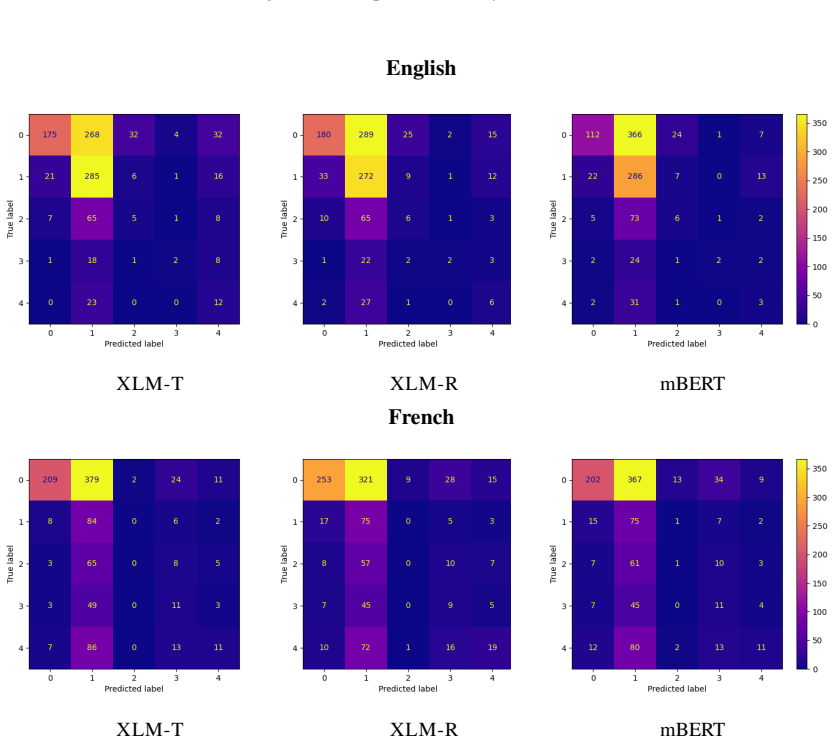
- Reported performance on radical-content detection is partly an artifact of label aggregation: models trained and tested on the same aggregation look best, and switching the test gold standard can drop French Macro-F1 by roughly 15 points.
- Multi-task auxiliary signals such as radicalization level, ideology prediction, and named-entity recognition do not reliably improve Call for Action detection, while separate per-language classifiers consistently beat a shared classifier.
- A regression formulation on the ordinal Call for Action scale avoids distant misclassifications but earns lower Macro-F1, making the classification-versus-regression choice a trade-off between discrete accuracy and error severity.
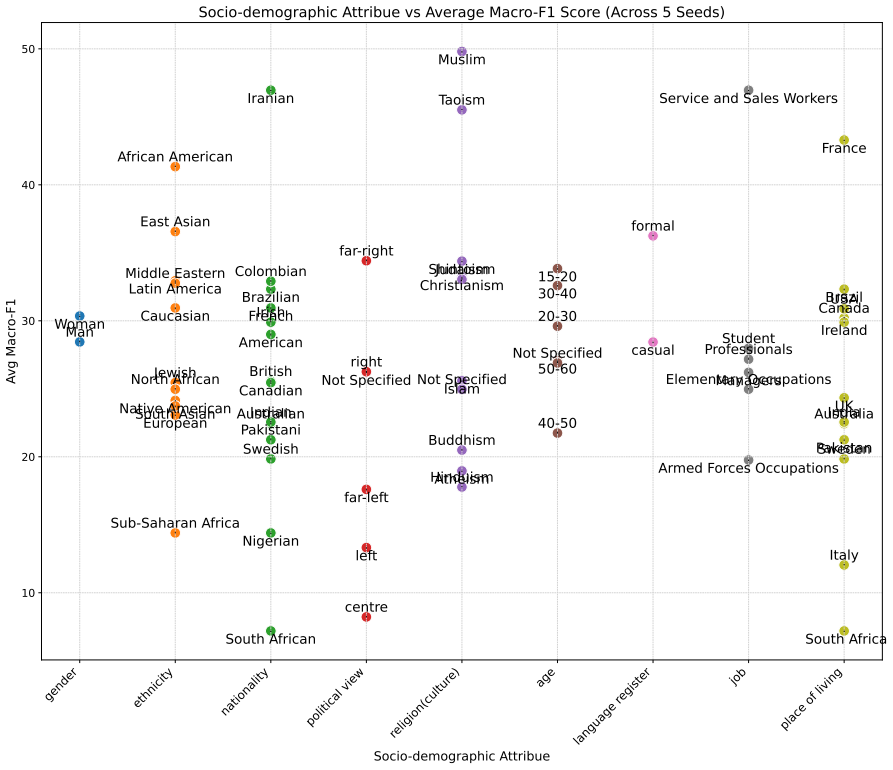
- Fairness audits on synthetic demographic profiles reveal large demographic-parity and equalized-odds differences for place of living, ethnicity, and nationality, with English nationality reaching an equalized-odds difference of 0.66 for XLM-T.
- Synthetic bias patterns are model-dependent: XLM-T attains higher overall scores but larger demographic disparities than XLM-R and mBERT, suggesting that social-media pretraining amplifies attribute-correlated errors.
Reading between the lines
- My reading: the synthetic-data evidence should be treated as an upper bound on sociodemographic bias, because the generator's own stereotypes may produce the attribute-correlated language; validating against real posts with known author demographics is the decisive test of the fairness claim.
- My reading: the kappa asymmetry between English (0.13–0.26) and French (0.43–0.50) may reflect differences in the annotators' cultural proximity to the two corpora; a controlled study varying annotator cultural background would separate task ambiguity from annotator subjectivity.
- My reading: for deployment, these results argue for reporting a performance range over aggregation methods and demographic slices, and for training on disagreement-aware objectives rather than a single aggregated gold label.
- My reading: the paper's release of multi-view labels invites predicting full label distributions, which would make moderation decisions more transparent about uncertainty than thresholding a single class.
Editorial analysis
A structured set of objections, weighed in public.
Referee Report
Summary. This paper introduces COUNTER, a pseudo-anonymized multilingual dataset (English, French, Arabic) annotated for radicalization level, call-for-action, and named entities, and uses it to study how annotation choices and socio-demographic variation affect radical-content detection. The paper reports (i) an annotation-variation experiment comparing contractor labels, MACE, majority voting, repeated labeling, and an annotator-classifier; (ii) multi-task training results; (iii) a synthetic bias analysis in which Wizard-Vicuna posts generated from persona profiles are used to measure model performance and fairness metrics across socio-demographic groups; and (iv) a comparison of classification and regression for the ordinal call-for-action label. The central conclusion is that the subjectivity of annotations and sociodemographic variations materially influence measured performance and fairness. The annotation-variation and dataset contributions are substantial, but the synthetic bias analysis has internal-validity problems that bear on the main fairness claims.
Significance. The dataset and annotation-variation experiments are valuable: COUNTER is a substantial multilingual resource with multiple annotations, inter-annotator agreement statistics, pseudonymization checks, and a transparent data statement. The label-aggregation comparison in Section 5.1 is carefully executed and gives a useful demonstration that gold-label choices change model evaluation. If the synthetic bias analysis were valid, the fairness findings would be a significant contribution. As written, however, the bias analysis confounds demographic attributes with the ideological content used to generate the test data and relies on a fairness metric that is not identifiable under group-dependent base rates, so its central fairness conclusions are not yet established. The regression-versus-classification analysis is a useful auxiliary result.
major comments (3)
- [Section 5.2, Appendix E.1 (Table 10)] The main fairness conclusion is not identified because the synthetic generation protocol varies the tested attribute jointly with the textual topic and ideology. Table 10 lists "Political view (e.g., Far-Right)" and "Religion/Culture" (e.g., "Islam (Jihadism)") as profile variables that are "crucial for producing radical content," so the generated posts for different political-view or religion groups are about different ideologies by construction. The Macro-F1 gaps in Figure 1 and the fairness gaps in Table 4 therefore conflate model bias with per-ideology classification difficulty. This confound is not removed by the acknowledged stereotypical generation limitation in Section 3.4; it is an internal-validity problem. To support the claim that socio-demographic attributes, rather than ideology or topic, drive the gaps, the authors need to control for ideology across groups (e.g., generate the same ideology/topic under different demographic profiles) or re-scope the claims to model sensitivity to generation prompts.
- [Section 5.2 and Appendix D] The demographic-parity calculation in Table 4 is not a valid bias diagnostic under the experimental setup. The authors treat class 0 as the favorable outcome and compute selection-rate differences across groups. If the base rate P(Y=0 | A=a) differs by group, even a perfectly calibrated Bayes-optimal classifier will exhibit nonzero demographic-parity difference, so the reported values cannot be read as evidence of model bias. The paper should report per-group base rates and either condition on the true label (as equalized odds does) or use a metric that accounts for label shift, and it should state that demographic parity is confounded with label distribution when base rates vary across groups.
- [Section 3.4, Limitations] The bias analysis rests on an unvalidated synthetic proxy: posts generated by Wizard-Vicuna-13B-Uncensored from hand-crafted persona profiles. The authors acknowledge in Section 3.4 that the generated posts "sometimes rely heavily on stereotypical keywords" and in the Limitations that synthetic data "might not accurately represent the complexity and diversity of radical content in the actual world," yet the conclusion in Section 6 that "sociodemographic variations influence data and model outcomes" depends on this proxy. There is no external validation that the generated posts have a label distribution, error structure, or demographic signal resembling real online radical content. Without such validation, or a re-scoping of the conclusions to "performance of models on LLM-generated persona-conditioned content," the fairness findings remain a property of the generation procedure as much as of the models.
minor comments (6)
- [Section 3.3] "Pseudononymization" is misspelled; it should be "Pseudonymization."
- [Figure 1 and Figures 8-9] The labels are extremely small and some are truncated (e.g., "T aoism"), making it difficult to assess the claimed differences; a zoomable or table-based version with per-group standard deviations would be clearer.
- [Section 5.1] The human-label-variation analysis is reported only for French (Table 3), but Section 3.3 states that a large English sample was also double-annotated; the authors should explain why English is excluded from this analysis and whether the same patterns hold.
- [Section 5.2, Table 4] No confidence intervals or significance tests are reported for the fairness differences, and some synthetic categories are very small (e.g., African American at 1% in Table 11), so the reported gaps may be unstable.
- [Section 5.3, Table 5] The regression models are compared using rounded predictions for Macro-F1, but the rounding threshold and the treatment of predictions outside the [0,4] range are not specified.
- [Appendix E] The full prompt template used for synthetic generation is not included; Section 3.4 refers to it, but the appendix only provides a screenshot and variable descriptions, which is insufficient for reproducibility.
Circularity Check
Synthetic bias analysis is self-referential: political-view and religion/culture are prompt conditions that generate the text, so per-group Macro-F1 and fairness gaps are built into the test set rather than independently measured model bias.
-
self definitional
[Section 3.4 (Synthetic Data for Bias Analysis), Section 5.2 (Bias Analysis), Appendix E.1, Table 10]
"Our approach is based on creating user profiles that include socio-demographic variables... These profiles were used to prompt an uncensored LLM called Wizard-Vicuna-13B-Uncensored... We compared the average Macro-F1 score per value for each socio-demographic attribute using our generated dataset to assess model bias. ... Political view (e.g., Far-Right) This variable is crucial for producing radical content and is often specified."
The attribute being probed (political view, religion/culture) is the prompt condition that generates the radical content. Table 10 states that political view is 'crucial for producing radical content' and that religion/culture is 'used to indicate if the person is radicalized.' Therefore, the generated texts differ across groups in topic, ideology, and label distribution by design. Reporting per-group Macro-F1 (Figure 1) and fairness disparities (Table 4) as evidence of model bias is a self-referential comparison: the variation in X across A is an input to generation, so any model with nonzero accuracy will show performance differences across A.
-
other
[Section 5.2 (Bias Analysis), Appendix D (Metrics Definitions)]
"We have a multi-class classification, so we considered class zero as the positive outcome. We use the demographic parity difference, also called disparate impact; it measures the ratio of favorable outcomes between different groups to assess whether the model treats different groups equally. ... Results in Table 4 show that overall Demographic Parity is generally smaller than Equalized Odds..."
Demographic parity requires h(X) to be independent of the protected attribute A, but the synthetic data were generated so that the distribution of the target label Y varies with A (e.g., far-right vs. far-left profiles are prompted to produce different radical content). With P(Y|A) varying by construction, any classifier h that predicts Y from X will have selection rates E[h|A] that differ across A; a nonzero demographic-parity difference is thus mathematically implied even for a Bayes-optimal model. Interpreting the Table 4 disparities as 'the model's predictive performance is less balanced across these groups' (Section 5.2) therefore conflates construction-induced label shift with model bias.
full rationale
The dataset contribution and the annotation-variation analysis (Section 5.1) are independent and empirically grounded: they rely on real annotations, inter-annotator agreement, and standard aggregation methods, and they do not reduce to their inputs. The self-citations (Riabi et al. 2024; Montariol et al. 2022) are methodological and not load-bearing. However, the synthetic bias analysis (Sections 3.4 and 5.2) is partially circular by design. The profiles used to prompt the LLM include the very attributes that are later tested for bias, and Table 10 explicitly says political view is 'crucial for producing radical content' and religion/culture is 'used to indicate if the person is radicalized.' Consequently, the per-group performance gaps and fairness-metric disparities reflect properties of the stimulus construction, not an independently measured model bias. The Limitations section acknowledges that synthetic data may not represent real-world complexity, but it does not address this internal confound: even a perfectly accurate model would exhibit nonzero demographic-parity differences on data where the label distribution varies across groups by construction. Therefore, the central 'sociodemographic variations influence model outcomes' claim is partly forced by the evaluation design, while the annotation-variation findings remain independent.
Assumptions & free parameters
free parameters (1)
- Synthetic profile attribute distributions =
Hand-set percentages in Table 11 (e.g., far-right 45%, left 12% in English; France 72% place-of-living in French)
assumptions (4)
- ad hoc to paper Synthetic posts from Wizard-Vicuna-13B-Uncensored with persona profiles are a valid proxy for real online radical content.
- domain assumption The two linguist annotators' labels on synthetic data are reliable enough to estimate model bias.
- domain assumption The contractor's annotations are treated as expert gold standard.
- domain assumption Models trained on COUNTER generalize to the synthetic distribution sufficiently for bias diagnostics.
Cite this review
Pith. "Pith review of Beyond Dataset Creation: Critical View of Annotation Variation and Bias Probing of a Dataset for Online Radical Content Detection." pith.science (2026). https://pith.science/paper/24BV6JBA
@misc{pith2026241211745,
  author       = {Pith},
  title        = {Pith review of: Beyond Dataset Creation: Critical View of Annotation Variation and Bias Probing of a Dataset for Online Radical Content Detection},
  year         = {2026},
  howpublished = {\url{https://pith.science/paper/24BV6JBA}},
  note         = {Machine review of arXiv:2412.11745}
}
read the original abstract
The proliferation of radical content on online platforms poses significant risks, including inciting violence and spreading extremist ideologies. Despite ongoing research, existing datasets and models often fail to address the complexities of multilingual and diverse data. To bridge this gap, we introduce a publicly available multilingual dataset annotated with radicalization levels, calls for action, and named entities in English, French, and Arabic. This dataset is pseudonymized to protect individual privacy while preserving contextual information. Beyond presenting our freely available dataset, we analyze the annotation process, highlighting biases and disagreements among annotators and their implications for model performance. Additionally, we use synthetic data to investigate the influence of socio-demographic traits on annotation patterns and model predictions. Our work offers a comprehensive examination of the challenges and opportunities in building robust datasets for radical content detection, emphasizing the importance of fairness and transparency in model development.
Figures


Figures from the paper (6 more)




Reference graph
Works this paper leans on
-
[2]
Political Analysis, 31(3):337–351
Out of one, many: Using language mod- els to simulate human samples. Political Analysis, 31(3):337–351. Michael Ashcroft, Ali Fisher, Lisa Kaati, Enghin Omer, and Nico Prucha. 2015. Detecting jihadist messages on twitter. In 2015 European intelligence and secu- rity informatics conference, pages 161–164. IEEE. Eytan Bakshy, Solomon Messing, and Lada A. Adamic
work page 2015
-
[4]
IEEE Access , 11:120463–120491
A comprehensive survey of detection and pre- vention approaches for online radicalization: Iden- tifying gaps and future directions. IEEE Access , 11:120463–120491. James Bisbee, Joshua Clinton, Cassy Dorff, Brenton Kenkel, and Jennifer Larson. 2023. Synthetic re- placements for human survey data? the perils of large language models. Lorraine Bowman-Griev...
arXiv 2023
-
[9]
Identifying Morality Frames in Political Tweets using Relational Learning
Understanding the radical mind: Identifying signals to detect extremist content on twitter. 2019 IEEE International Conference on Intelligence and Security Informatics (ISI), pages 98–103. Ossama Obeid, Nasser Zalmout, Salam Khalifa, Dima Taji, Mai Oudah, Bashar Alhafni, Go Inoue, Fadhl Eryani, Alexander Erdmann, and Nizar Habash. 2020. CAMeL tools: An op...
work page Pith review arXiv 2019
-
[10]
Automatic Detection of Online Jihadist Hate Speech
Automatic detection of online jihadist hate speech. Preprint, arXiv:1803.04596. Anna Sotnikova, Yang Trista Cao, Hal Daumé III, and Rachel Rudinger. 2021. Analyzing stereotypes in generative text inference tasks. In Findings of the Association for Computational Linguistics: ACL- IJCNLP 2021, pages 4052–4065, Online. Association for Computational Linguisti...
work page Pith review arXiv 2021
-
[12]
Interpretable Multi-Modal Hate Speech Detection
Learning from disagreement: A survey. J. Artif. Int. Res., 72:1385–1470. Rob van der Goot, Ahmet Üstün, Alan Ramponi, Ibrahim Sharaf, and Barbara Plank. 2021. Massive choice, ample tasks (MaChAmp): A toolkit for multi- task learning in NLP. In Proceedings of the 16th Conference of the European Chapter of the Associa- tion for Computational Linguistics: Sy...
work page Pith review arXiv 2011
-
[2003]
A survey on extremism analysis using Natural Language Processing
Introduction to the CoNLL-2003 shared task: Language-independent named entity recognition. In Proceedings of the Seventh Conference on Natural Language Learning at HLT-NAACL 2003, pages 142– 147. Javier Torregrosa, Gema Bello Orgaz, Eugenio Martínez Cámara, Javier Del Ser, and David Camacho. 2021. A survey on extremism analysis using natural lan- guage pr...
work page Pith review arXiv 2003
-
[2015]
Exposure to ideologically diverse news and opinion on facebook. Science, 348(6239):1130– 1132. Francesco Barbieri, Luis Espinosa Anke, and Jose Camacho-Collados. 2022. XLM-T: Multilingual language models in Twitter for sentiment analysis and beyond. In Proceedings of the Thirteenth Lan- guage Resources and Evaluation Conference, pages 258–266, Marseille, ...
work page 2022
-
[2016]
Public Opinion Quarterly, 80(S1):298–320
Filter Bubbles, Echo Chambers, and On- line News Consumption. Public Opinion Quarterly, 80(S1):298–320. Eve Fleisig, Rediet Abebe, and Dan Klein. 2023. When the majority is wrong: Modeling annotator disagree- ment for subjective tasks. In Proceedings of the 2023 Conference on Empirical Methods in Natural Lan- guage Processing, pages 6715–6726, Singapore. ...
work page 2023
Show all 12 references
-
[2018]
In Proceedings of the 10th ACM Conference on Web Science, WebSci ’18, page 1–10, New York, NY , USA
Understanding the roots of radicalisation on twitter. In Proceedings of the 10th ACM Conference on Web Science, WebSci ’18, page 1–10, New York, NY , USA. Association for Computing Machinery. Louis Fink. 2014. Understanding radicalisation and dynamics of terrorist networks thr...
2014
-
[2019]
Preprint, arXiv:1907.12368
Detecting radical text over online media using deep learning. Preprint, arXiv:1907.12368. Raúl Lara-Cabrera, Antonio González Pardo, Karim Be- nouaret, Noura Faci, Djamal Benslimane, and David Camacho. 2017. Measuring the radicalisation risk in social networks. IEEE Access, 5:...
1907 arXiv
-
[2022]
CrimRxiv
Linguistic radicalisation of right-wing and salafi jihadist groups in social media: a corpus-driven lexicometric analysis. CrimRxiv. Shynar Mussiraliyeva, Milana Bolatbek, Batyrkhan Omarov, Zhanar Medetbek, Gulshat Baispay, and Ruslan Ospanov. 2020. On detecting online radical...
2020
-
[2023]
In Proceedings of the 40th International Conference on Machine Learning, volume 202 of Proceedings of Machine Learning Research, pages 337–371
Using large language models to simulate mul- tiple humans and replicate human subject studies. In Proceedings of the 40th International Conference on Machine Learning, volume 202 of Proceedings of Machine Learning Research, pages 337–371. PMLR. Hind S. Alatawi, Areej M. Alhoth...
2021
Reviewed August 11, 2026 · model on record in the stance chip above.
Discussion (0). Continue with ORCID to comment.