REVIEW 4 major objections 6 minor 1 cited by
Integrated Sensing and Communications in Downlink FDD MIMO without CSI Feedback
T0 review · 4 major / 6 minor · reviewed 2026-08-11 · deepseek-v4-flash
Pith's one-line read FDD MIMO-ISAC precoding can run with zero downlink CSI feedback: reconstruct each user's channel from uplink training, estimate the reconstruction error's covariance from the uplink signal, and let RSMA manage the resulting interference.
desk verdict Solid integration of zero-feedback FDD channel reconstruction with RSMA and NEPv for ISAC, but the error covariance estimate omits the non-reciprocal DL gain term and may overstate the claimed robustness. read the letter →
The pith
A machine-rendered reading of the paper's core claim, the machinery that carries it, and where it could break.
The reading
What carries the argument
The load-bearing object is the estimated error covariance matrix $\hat{\boldsymbol{\Sigma}}_k$, obtained as the diagonal of $Q_k^H(f)\,I^{-1}(\hat{P}_k)\,Q_k(f)$, where $I(\hat{P}_k)$ is the observed Fisher information of the uplink channel parameters and $Q_k(f)$ is the Jacobian mapping uplink parameter errors to downlink channel errors. This matrix converts unknown CSI imperfection into a concrete quadratic penalty inside each user's SINR, making the imperfect-CSI precoding problem tractable. Two further mechanisms carry the optimization: rate-splitting multiple access (RSMA), whose common stream is decoded by every user and helps mitigate the interference caused by imperfect CSI and radar symbols, and the nonlinear-eigenvalue reformulation, which turns the KKT stationarity condition $L(\bar{p},\nu)\bar{p} = \zeta(\bar{p},\nu) R(\bar{p},\nu)\bar{p}$ into a fixed-point iteration for the leading eigenvector of $R^{-1}L$. The Lagrange multiplier $\nu$ acts as a dial between communication and sensing: small $\nu$ favors sum SE, large $\nu$ enforces the beam-pattern MSE constraint.
What would settle it
Take a measured FDD channel with strong spatial correlation and a larger UL-DL frequency gap, reconstruct the downlink channel with 2D-NOMP, and compare the true per-antenna error covariance against the diagonal $\hat{\boldsymbol{\Sigma}}_k$ from Eq. (63); if off-diagonal entries are non-negligible or the trace systematically misses the realized MSE, the RSMA precoder will misallocate power and the claimed SE gains should shrink in the corresponding simulations.
Extended reading notes
Core claim
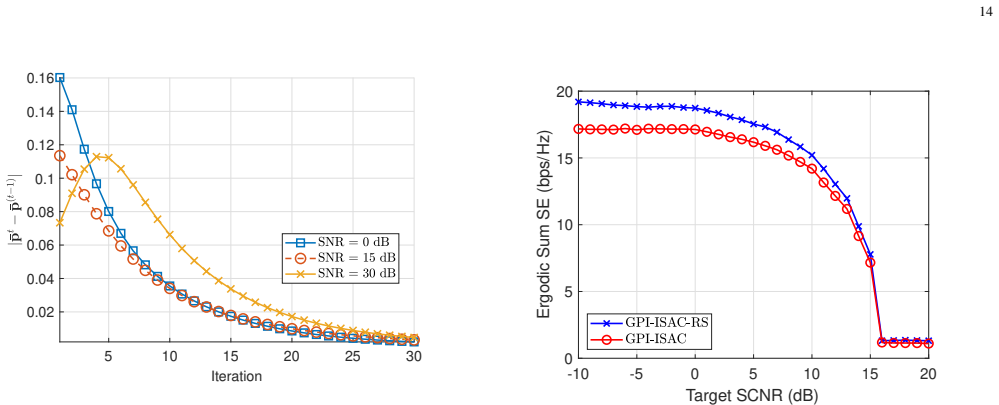
The central claim is that missing downlink channel error statistics—normally unavailable without feedback—can be synthesized from uplink observations alone. Because the 2D-NOMP uplink parameter estimator operates near the Cramér-Rao bound, the paper evaluates the negative Hessian of the uplink log-likelihood at the estimated parameters (the observed Fisher information), maps its inverse through the Jacobian to the downlink channel, and uses only its diagonal as the error covariance matrix $\hat{\boldsymbol{\Sigma}}_k$. Feeding this covariance into the SINR expressions turns the RSMA precoding problem into a nonlinear eigenvalue problem with eigenvector dependency; the proposed generalized power iteration updates the precoder and the Lagrange multiplier alternately, with the multiplier controlling how strictly the beam-pattern MSE constraint is enforced. The paper reports that this zero-feedback design achieves higher ergodic sum SE than the ISAC baselines across target MSE levels and SNRs, while matching or improving the achieved sensing beam-pattern MSE and sidelobe suppression.
Load-bearing premise
The whole scheme rests on the assumption that the base station can accurately guess how wrong its downlink channel reconstruction is—and that the guess needs no off-diagonal terms—using only the uplink training signal.
Editorial extensions
If this is right
- Downlink CSI feedback can be dropped entirely in FDD MIMO-ISAC, removing the multi-millisecond feedback loop and the overhead that scales with antenna and user count.
- The sensing beam pattern remains controllable to a prescribed MSE even though the precoder is built from reconstructed, imperfect CSI, and users see less sensing-induced interference than with the SDMA or SDR baselines.
- The same optimization machinery extends to other sensing metrics: the paper formulates an SCNR-constrained variant and shows the beam pattern steers toward targets and away from clutter.
- Precoder updates are a generalized power iteration, so per-iteration complexity scales as $O(N^3(K+M))$ rather than the semidefinite-programming cost of earlier ISAC designs.
- The relative SE advantage narrows as the number of antennas grows because channel vectors become more orthogonal, but the zero-feedback RSMA design still outperforms the GPI-ISAC baseline at 128 antennas.
Reading between the lines
- If the observed-Fisher-information estimate proves as faithful in hardware as in simulation, the same recipe could attach to any uplink estimator that operates near its Cramér-Rao bound, making it a general zero-feedback ISAC design pattern rather than a 2D-NOMP-specific fix.
- The diagonal-only covariance assumption is the most fragile piece: in spatially correlated channels, off-diagonal error terms could leak through the SINR bounds, and an extension to full covariance or a diagonal inflation factor would be a natural fix.
- The stated partial-reciprocity condition is tied to moderate UL-DL frequency separation; sweeping the frequency gap and locating where the SE advantage over feedback-based baselines disappears would map the method's operational range.
- A hybrid design could add a low-rate feedback link that only corrects the common-stream rate allocation, using the error-covariance estimate to decide when such correction is needed.
Editorial analysis
A structured set of objections, weighed in public.
Referee Report
Summary. The paper proposes a zero-feedback precoding framework for FDD MIMO-ISAC systems. The downlink channel is reconstructed from uplink training via 2D-NOMP, and an error covariance matrix (ECM) is estimated from the observed Fisher information of the uplink parameter estimates. This ECM is used in an RSMA-based precoder that maximizes a lower bound on the ergodic sum spectral efficiency under a beam-pattern MSE constraint. The precoder is obtained by a generalized power iteration derived from a nonlinear eigenvalue problem with eigenvector dependency (NEPv). The numerical results claim that the method provides precise beam pattern control, high SE, and a favorable sensing-communication trade-off without CSI feedback.
Significance. If the results are correct, the paper offers a meaningful advance: it removes CSI feedback overhead in FDD ISAC, which is a major practical barrier, and it combines RSMA with a Fisher-information-based error covariance estimate in a scalable NEPv framework. The paper gives a self-contained KKT derivation, a complexity analysis, and extensive simulations including detection probability, SCNR extension, and large-antenna regimes. However, the central component—the ECM estimation—has a modeling gap: the estimator in Eq. (63) omits the independent non-reciprocal DL gain component in Eq. (4). Because the RSMA precoder relies on this covariance to allocate power and whiten interference, the reported SE and trade-off improvements are not established for the stated channel model. The validation of the ECM refers to the authors' prior work [24], which does not cover the generalized non-reciprocal gain model.
major comments (4)
- [Section IV, Eq. (63)] The estimated ECM in Eq. (63) is biased low because it omits the independent non-reciprocal DL gain component β in Eq. (4). The reconstruction in Eq. (9) sets `\hat{α}^dl = η \hat{α}^ul`, but the true DL gain is η α^ul + sqrt(1−η²) β. The observed Fisher information I(\hat{P}_k) in Eq. (58) is computed from the UL likelihood and has no sensitivity to β, which is independent of α^ul and not observed from UL training. The Jacobian Q_k in Eq. (61) can only propagate the covariance of the UL parameter estimation errors; it cannot account for the variance of β. Consequently, Eq. (63) omits a contribution with per-path variance (1−η²)σ_path². Since the simulations set η=0.9, this is a non-negligible systematic under-estimate. Because the RSMA SINR expressions in Eqs. (40)–(43) and the precoder updates in Eqs. (66)–(73) depend directly on \Σhat, the SE gains shown in Figs. 3–4 and the claimed sensing–communication trade-off are not reliable for the model in Eq. (4). The validation via [24, Fig. 1] does not cover this generalized model.
- [Section IV, Eq. (63)] The diagonal approximation in Eq. (63) is inconsistent with the sparse geometric channel model. Even if the β components are independent across paths, after multiplication by the array response u(τ,θ) the antenna-domain error covariance has off-diagonal entries proportional to (1−η²)σ_path². The justification by reference to a 'rich scattering' environment [34] does not apply to the 2D-NOMP reconstruction error in Eqs. (1)–(10), which is based on a deterministic multipath model. Since the off-diagonal terms enter the RSMA interference terms through \Σhat in Eqs. (40)–(43), discarding them can systematically misallocate common/private power and distort the reported SE.
- [Section IV, Eq. (61)] The Jacobian matrix Q_k(f) is not derived; the paper only states that 'its derivation is straightforward' and refers to [22]. This step is load-bearing because the Jacobian must map the four UL parameters (real/imaginary gain, delay, angle) to the DL channel vector and must incorporate the partial-reciprocity scaling in Eq. (9). Without the explicit expression or a derivation, the reader cannot verify that the inverse observed Fisher information is transformed correctly, and the error propagation argument in Eq. (61) remains incomplete. Please provide the explicit form of Q_k(f) or a detailed derivation.
- [Section V, Proposition 1 and Algorithm 1] The convergence argument in Eqs. (74)–(81) is a perturbative analysis around a fixed point and assumes \bar{p}^{(t−1)} is already close to \bar{p}†. The paper does not provide a global convergence guarantee, and the initialization of \bar{p}^{(0)} is unspecified. In addition, the outer-loop condition in Algorithm 1 ('while |ν^{(n)}−ν^{(n−1)}|≥ε_ν or n≤n_max') appears to be a typo: with 'or' the loop always runs to n_max, making the first condition irrelevant. Please correct this condition and state precisely what convergence result is claimed.
minor comments (6)
- [Algorithm 1] The algorithm states 'Construct matrix L(\bar{p}^{(t−1)},ν^{(n)}) with (33); Construct matrix R(...) with (34);' but equations (33) and (34) are the MSE constraint and the norm constraint, not the matrix definitions. The intended references are likely Eqs. (67) and (68). Also, the variable \zeta_mse is not defined before it is used in the MSE feasibility check.
- [Notation] The symbol η is overloaded: in Eq. (4) it denotes the partial-reciprocity gain coefficient, while in Eq. (44) it is the LogSumExp smoothing parameter. Please rename one of them to avoid confusion.
- [Fig. 3 caption] The figure caption orders the subplots as '(a) Achieved MSE and (b) Ergodic sum SE', but the text refers to Fig. 3-(a) as the ergodic sum SE and Fig. 3-(b) as the achieved MSE. The caption and text should be made consistent.
- [Eq. (11)] In Eq. (10) and the following line, the reconstructed DL channel uses \hat{\phi}^{ul}_{k,ℓ,s}, which appears to be a typo: it should be \hat{\phi}^{dl}_{k,ℓ,s} or a notation that makes the DL frequency dependence explicit.
- [Simulation setup] The values of the LogSumExp smoothing parameter η and the bisection bounds (ν_min, ν_max) are not reported. Since these are user-specified free parameters, please provide their values and, ideally, a brief sensitivity study.
- [Remark 6] The complexity analysis refers to a matrix \Omega(\bar{p}) that is never defined. The statement should refer to the matrix inverted in the algorithm, presumably R(\bar{p},ν) or the matrix K(\bar{p},ν).
Circularity Check
Partial circularity: the central ECM-accuracy premise is imported from the authors' prior work [24] rather than validated under this paper's generalized channel model.
-
self citation load bearing
[Section IV (Error Covariance Matrix Estimation), after Eq. (62), around Eq. (63)]
"We note that the robustness of our ECM estimation method can be found in our prior work [24]. As shown in Fig. 1 of [24], the estimated ECM closely matches the actual MSE and outperforms the CRLB."
The precoder's claimed robustness under imperfect zero-feedback DL CSI—and the SE gains in Figs. 3–4—depend on the error covariance matrix 𝚺̂_k entering (40)–(43) being an accurate estimate of E[e_k e_k^H]. The only validation offered for this load-bearing estimate is Fig. 1 of [24], a prior paper whose first author (N. Kim) and advisor (J. Park) are authors of the present work. That prior result is not machine-checked, not reproduced in this paper, and is not shown to cover the generalized gain model (4) with η_kℓ=0.9 used in all simulations. The key support for the proposed method therefore reduces to a self-citation rather than to evidence generated independently in this paper.
full rationale
The main optimization pipeline—RSMA rate bounds in (20)–(27), the NEPv stationarity condition in Lemma 1, the GPI update in (73), and the Lagrange-multiplier search in Algorithm 1—is derived and simulated in this paper, and the SE/MSE curves are computed from independently generated channels rather than fitted to the outputs. Thus the central numerical claims are not circular in the sense of fitting a parameter and then predicting that same parameter. However, the most load-bearing component of the framework, the error covariance matrix 𝚺̂_k that shapes the SINR denominators in (40)–(43), is asserted to be accurate solely by reference to Fig. 1 of the authors' own prior paper [24]. That self-citation is the only support for the claim that Eq. (63) captures the realized DL reconstruction error, and the present paper contains no in-paper comparison of (63) with the true DL error under its own channel model (4). I also flag, as a non-circular correctness risk rather than a circularity, that Eq. (63) omits the statistically independent non-reciprocal gain term √(1−η²)β introduced in Eq. (4); this mismatch makes the estimator inconsistent with the stated model but does not by itself make the simulated SE values equal to the inputs. On balance, the derivation has substantial independent content, so the score reflects one load-bearing self-citation rather than a fully self-referential argument.
Assumptions & free parameters
free parameters (2)
- LogSumExp smoothing parameter eta =
not specified
- Bisection bounds for Lagrange multiplier nu (nu_min, nu_max) =
not specified
assumptions (8)
- domain assumption Partial reciprocity: UL and DL share propagation delay, angle, and path count (tau, theta, L).
- domain assumption DL channel gain obeys alpha_dl = eta alpha_ul + sqrt(1-eta^2) beta with eta != 1 allowed.
- domain assumption 2D-NOMP achieves near-CRLB estimation of UL parameters.
- standard math Inverse observed Fisher information provides optimal squared-error covariance estimate.
- domain assumption DL CSI error covariance is diagonal (uncorrelated across antennas).
- domain assumption Residual terms from imperfect CSI and sensing are treated as independent Gaussian noise.
- standard math Jensen's inequality gives valid lower bounds on ergodic rates.
- domain assumption Sparse multipath environment with path count less than product of antennas and subcarriers.
Cite this review
Pith. "Pith review of Integrated Sensing and Communications in Downlink FDD MIMO without CSI Feedback." pith.science (2026). https://pith.science/paper/EAJAIOAQ
@misc{pith2026241212590,
  author       = {Pith},
  title        = {Pith review of: Integrated Sensing and Communications in Downlink FDD MIMO without CSI Feedback},
  year         = {2026},
  howpublished = {\url{https://pith.science/paper/EAJAIOAQ}},
  note         = {Machine review of arXiv:2412.12590}
}
read the original abstract
In this paper, we propose a precoding framework for frequency division duplex (FDD) integrated sensing and communication (ISAC) systems with multiple-input multiple-output (MIMO). Specifically, we aim to maximize ergodic sum spectral efficiency (SE) while satisfying a sensing beam pattern constraint defined by the mean squared error (MSE). Our method reconstructs downlink (DL) channel state information (CSI) from uplink (UL) training signals using partial reciprocity, eliminating the need for CSI feedback. To obtain the error covariance matrix of the reconstructed DL CSI, we devise an observed Fisher information-based estimation technique. Leveraging this, to mitigate interference caused by imperfect DL CSI reconstruction and sensing operations, we propose a rate-splitting multiple access (RSMA) aided precoder optimization method. This method jointly updates the precoding vector and Lagrange multipliers by solving the nonlinear eigenvalue problem with eigenvector dependency to maximize SE. The numerical results show that the proposed design achieves precise beam pattern control, maximizes SE, and significantly improves the sensing-communication trade-off compared to the state-of-the-art methods in FDD ISAC scenarios.
Figures


Figures from the paper (4 more)



Forward citations
Cited by 1 Pith paper
-
Efficient RF Chain Selection for MIMO Integrated Sensing and Communications: A Greedy Approach
A greedy, mutual-information-based RF chain selection framework for MIMO integrated sensing and communications achieves near-optimal performance with much lower complexity than exhaustive search.
Reference graph
Works this paper leans on
-
[24]
N. Kim, I. P. Roberts, and J. Park, “Splitting messages in the dark- rate-splitting multiple access for FDD massive MIMO without CSI feedback,” IEEE Trans. Wireless Commun. , vol. 24, no. 4, pp. 3320– 3332, 2025
work page 2025
-
[34]
Massive MIMO with imperfect channel covariance information,
E. Bj ¨ornson, L. Sanguinetti, and M. Debbah, “Massive MIMO with imperfect channel covariance information,” in Proc. of Asilomar Conf. on Sign., Syst. and Computers , 2016, pp. 974–978
work page 2016
-
[22]
Performance analysis of channel extrapolation in FDD massive MIMO systems,
F. Rottenberg, T. Choi, P. Luo, C. J. Zhang, and A. F. Molisch, “Performance analysis of channel extrapolation in FDD massive MIMO systems,” IEEE Trans. Wireless Commun., vol. 19, no. 4, pp. 2728–2741, Apr. 2020
2020
-
[1]
A survey on fundamental limits of integrated sensing and communication,
A. Liu et al. , “A survey on fundamental limits of integrated sensing and communication,” IEEE Commun. Surv. Tutor. , vol. 24, no. 2, pp. 994–1034, 2022
work page 2022
-
[2]
Joint and robust beam- forming framework for integrated sensing and communication systems,
J. Choi, J. Park, N. Lee, and A. Alkhateeb, “Joint and robust beam- forming framework for integrated sensing and communication systems,” IEEE Trans. Wireless Commun. , vol. 23, no. 11, pp. 17 602–17 618, 2024
2024
-
[3]
Joint transmit beamforming for multiuser MIMO communications and MIMO radar,
X. Liu, T. Huang, N. Shlezinger, Y . Liu, J. Zhou, and Y . C. Eldar, “Joint transmit beamforming for multiuser MIMO communications and MIMO radar,” IEEE Trans. Signal Process. , vol. 68, pp. 3929–3944, 2020
2020
-
[4]
Rate-splitting multiple access for multi-antenna joint radar and communications,
C. Xu, B. Clerckx, S. Chen, Y . Mao, and J. Zhang, “Rate-splitting multiple access for multi-antenna joint radar and communications,”IEEE J. Sel. Topics Signal Process. , vol. 15, no. 6, pp. 1332–1347, 2021
2021
-
[5]
Bidirectional integrated sensing and communication: Full-duplex or half-duplex?
Z. Wang, X. Mu, and Y . Liu, “Bidirectional integrated sensing and communication: Full-duplex or half-duplex?” IEEE Trans. Wireless Commun., vol. 23, no. 8, pp. 8184–8199, Aug. 2024
2024
Show all 39 references
-
[6]
Networked sensing in 6G cellular networks: Opportunities and challenges,
L. Liu, S. Zhang, R. Du, T. X. Han, and S. Cui, “Networked sensing in 6G cellular networks: Opportunities and challenges,” ArXiv Preprint,
-
[7]
FDD massive MIMO channel training: Optimal rate-distortion bounds and the spectral efficiency of “One-Shot
M. B. Khalilsarai, Y . Song, T. Yang, and G. Caire, “FDD massive MIMO channel training: Optimal rate-distortion bounds and the spectral efficiency of “One-Shot” schemes,” IEEE Trans. Wireless Commun. , vol. 22, no. 9, pp. 6018–6032, 2023
2023
-
[8]
User grouping for massive MIMO in FDD systems: New design methods and analysis,
Y . Xu, G. Yue, and S. Mao, “User grouping for massive MIMO in FDD systems: New design methods and analysis,” IEEE Access , vol. 2, pp. 947–959, 2014
2014
-
[9]
To- ward dual-functional radar-communication systems: Optimal waveform design,
F. Liu, L. Zhou, C. Masouros, A. Li, W. Luo, and A. Petropulu, “To- ward dual-functional radar-communication systems: Optimal waveform design,” IEEE Trans. Signal Process. , vol. 66, no. 16, pp. 4264–4279, Aug. 2018
2018
-
[10]
Joint radar-communication transmission: A generalized Pareto optimization framework,
L. Chen, F. Liu, W. Wang, and C. Masouros, “Joint radar-communication transmission: A generalized Pareto optimization framework,” IEEE Trans. Signal Process., vol. 69, pp. 2752–2765, 2021
2021
-
[11]
On hybrid radar fusion for integrated sensing and communication,
A. Chowdary, A. Bazzi, and M. Chafii, “On hybrid radar fusion for integrated sensing and communication,” IEEE Trans. Wireless Commun., vol. 23, no. 8, pp. 8984–9000, 2024
2024
-
[12]
Multiuser MIMO achievable rates with downlink training and channel state feedback,
G. Caire, N. Jindal, M. Kobayashi, and N. Ravindran, “Multiuser MIMO achievable rates with downlink training and channel state feedback,” IEEE Trans. Inf. Theory , vol. 56, no. 6, pp. 2845–2866, 2010
2010
-
[13]
On the optimal feedback rate in interference-limited multi-antenna cellular systems,
J. Park, N. Lee, J. G. Andrews, and R. W. Heath Jr., “On the optimal feedback rate in interference-limited multi-antenna cellular systems,” IEEE Trans. Wireless Commun. , vol. 15, no. 8, pp. 5748–5762, 2016
2016
-
[14]
Time-division ISAC enabled connected automated vehicles cooperation algorithm design and performance evaluation,
Q. Zhang, H. Sun, X. Gao, X. Wang, and Z. Feng, “Time-division ISAC enabled connected automated vehicles cooperation algorithm design and performance evaluation,” IEEE J. Sel. Areas Commun. , vol. 40, no. 7, pp. 2206–2218, 2022
2022
-
[15]
Robust waveform design for integrated sensing and communication,
S. Wang, W. Dai, H. Wang, and G. Y . Li, “Robust waveform design for integrated sensing and communication,” IEEE Trans. Signal Process. , vol. 72, pp. 3122–3138, 2024
2024
-
[16]
Robust transmit beamforming for secure integrated sensing and communication,
Z. Ren, L. Qiu, J. Xu, and D. W. K. Ng, “Robust transmit beamforming for secure integrated sensing and communication,” IEEE J. Sel. Topics Signal Process., vol. 71, no. 9, pp. 5549–5564, 2023
2023
-
[17]
Robust beam- forming design for RIS-aided integrated sensing and communication system,
M. Luan, B. Wang, Z. Chang, T. H ¨am¨al¨ainen, and F. Hu, “Robust beam- forming design for RIS-aided integrated sensing and communication system,” IEEE Trans. Intell. Transp. Syst. , vol. 24, no. 6, pp. 6227– 6243, 2023
2023
-
[18]
Robust integrated sensing and communication beamforming for dual-functional radar and communications: Method and insights,
B. Ahmad and M. Chafii, “Robust integrated sensing and communication beamforming for dual-functional radar and communications: Method and insights,” ArXiv Preprint , 2023. [Online]. Available: https://arxiv.org/abs/2303.07652
2023 arXiv
-
[19]
Eliminating channel feedback in next-generation cellular networks,
D. Vasisht, S. Kumar, H. Rahul, and D. Katabi, “Eliminating channel feedback in next-generation cellular networks,” in Proc. of the ACM SIGCOMM Conf., 2016, pp. 398–411
2016
-
[20]
Experimental investigation of frequency domain channel extrapolation in massive MIMO systems for zero-feedback FDD,
T. Choi, F. Rottenberg, J. G ´omez-Ponce, A. Ramesh, P. Luo, C. J. Zhang, and A. F. Molisch, “Experimental investigation of frequency domain channel extrapolation in massive MIMO systems for zero-feedback FDD,” IEEE Trans. Wireless Commun. , vol. 20, no. 1, pp. 710–725, 2021
2021
-
[21]
Efficient downlink channel reconstruction for FDD multi-antenna systems,
Y . Han, T. H. Hsu, C. K. Wen, K. K. Wong, and S. Jin, “Efficient downlink channel reconstruction for FDD multi-antenna systems,” IEEE Trans. Wireless Commun., vol. 18, no. 6, pp. 3161–3176, June 2019
2019
-
[23]
Newtonized orthog- onal matching pursuit: Frequency estimation over the continuum,
B. Mamandipoor, D. Ramasamy, and U. Madhow, “Newtonized orthog- onal matching pursuit: Frequency estimation over the continuum,” IEEE Trans. Signal Process., vol. 64, no. 19, pp. 5066–5081, Oct. 2016
2016
-
[25]
Rate-splitting multiple access for downlink MIMO: A generalized power iteration approach,
J. Park, J. Choi, N. Lee, W. Shin, and H. V . Poor, “Rate-splitting multiple access for downlink MIMO: A generalized power iteration approach,” IEEE Trans. Wireless Commun. , vol. 22, no. 3, pp. 1588–1603, Mar. 2023
2023
-
[26]
FDD massive MIMO without CSI feedback,
D. Han, J. Park, and N. Lee, “FDD massive MIMO without CSI feedback,” IEEE Trans. Wireless Commun. , vol. 23, no. 5, pp. 4518– 4530, 2024
2024
-
[27]
FDD massive MIMO uplink and downlink channel reciprocity properties: Full or partial reciprocity?
Z. Zhong, L. Fan, and S. Ge, “FDD massive MIMO uplink and downlink channel reciprocity properties: Full or partial reciprocity?” Proc. IEEE Glob. Comm. Conf. , Dec. 2020
2020
-
[28]
Rate-splitting multiple access for 6G networks: Ten promising scenarios and applications,
J. Park et al. , “Rate-splitting multiple access for 6G networks: Ten promising scenarios and applications,” IEEE Network , vol. 38, no. 3, pp. 128–136, 2024
2024
-
[29]
Sum-rate maximization for linearly precoded downlink multiuser MISO systems with partial CSIT: A rate-splitting approach,
H. Joudeh and B. Clerckx, “Sum-rate maximization for linearly precoded downlink multiuser MISO systems with partial CSIT: A rate-splitting approach,” IEEE Trans. Commun., vol. 64, no. 11, pp. 4847–4861, 2016
2016
-
[30]
Urban outdoor propaga- tion measurements and channel models at 6.75 GHz FR1(C) and 16.95 GHz FR3 upper mid-band spectrum for 5G and 6G,
D. Shakya, M. Ying, T. S. Rappaport, P. Ma, I. Al-Wazani, Y . Wu, Y . Wang, D. Calin, H. Poddar, A. Bazziet al., “Urban outdoor propaga- tion measurements and channel models at 6.75 GHz FR1(C) and 16.95 GHz FR3 upper mid-band spectrum for 5G and 6G,” arXiv preprint arXiv:2410....
-
[31]
Mismatched decoding revisited: general alphabets, channels with memory, and the wide-band limit,
A. Ganti, A. Lapidoth, and I. Telatar, “Mismatched decoding revisited: general alphabets, channels with memory, and the wide-band limit,” IEEE Trans. Inf. Theory , vol. 46, no. 7, pp. 2315–2328, 2000
2000
-
[32]
Rate-splitting multiple access for 6G—part II: Interplay with integrated sensing and communi- cations,
L. Yin, Y . Mao, O. Dizdar, and B. Clerckx, “Rate-splitting multiple access for 6G—part II: Interplay with integrated sensing and communi- cations,” IEEE Communications Letters, vol. 26, no. 10, pp. 2237–2241, 2022
2022
-
[33]
Cram ´er-Rao bound optimization for joint radar-communication beamforming,
F. Liu, Y .-F. Liu, A. Li, C. Masouros, and Y . C. Eldar, “Cram ´er-Rao bound optimization for joint radar-communication beamforming,” IEEE Trans. Signal Process., vol. 70, pp. 240–253, 2022
2022
-
[35]
Statistical signal processing: estimation theory,
S. M. Kay, “Statistical signal processing: estimation theory,” Prentice Hall, vol. 1, pp. Chapter–3, 1993
1993
-
[36]
On second-order optimality of the observed Fisher information,
B. G. Lindsay and B. Li, “On second-order optimality of the observed Fisher information,” The Annals of Statistics , vol. 25, no. 5, pp. 2172– 2199, 1997
1997
-
[37]
Assessing the accuracy of the maximum likelihood estimator: Observed versus expected Fisher information,
B. Efron and D. V . Hinkley, “Assessing the accuracy of the maximum likelihood estimator: Observed versus expected Fisher information,” Biometrika, vol. 65, no. 3, pp. 457–483, 1978
1978
-
[38]
Code design to optimize radar detection performance under accuracy and similarity constraints,
A. De Maio, S. De Nicola, Y . Huang, S. Zhang, and A. Farina, “Code design to optimize radar detection performance under accuracy and similarity constraints,” IEEE Trans. Signal Process. , vol. 56, no. 11, pp. 5618–5629, 2008
2008
-
[2022]
Available: https://arxiv.org/abs/2206.00493
[Online]. Available: https://arxiv.org/abs/2206.00493
Reviewed August 11, 2026 · model on record in the stance chip above.
Discussion (0). Continue with ORCID to comment.