REVIEW 5 major objections 4 minor 36 references
Magnetism in EuAlSi and the Eu1-xSrxAlSi Solid Solution
T0 review · 5 major / 4 minor · reviewed 2026-08-11 · deepseek-v4-flash
Pith's one-line read The paper maps how strontium substitution in Eu1-xSrxAlSi drives a linear suppression of ferromagnetism and finds a possible quantum critical point near x ≈ 0.96, where the magnetic transition reaches zero temperature at the same…
desk verdict Solid first characterization of EuAlSi and its Sr solid solution, with a speculative QCP extrapolation that is honestly labeled; deserves referee time as a materials paper. read the letter →
The pith
A machine-rendered reading of the paper's core claim, the machinery that carries it, and where it could break.
The reading
What carries the argument
The load-bearing structural motif is the AlB2-type lattice (space group P6/mmm): Eu atoms on a triangular lattice with Al and Si disordered on a honeycomb lattice. Composition x replaces magnetic Eu2+ with isovalent, nonmagnetic Sr2+, which preserves the lattice and creates a chemically clean dilution that lowers TCurie linearly. The Curie-Weiss law and Arrott plots supply the effective moments and transition temperatures, and the resulting composition-temperature phase diagram carries the extrapolation that locates the putative quantum critical point near x ≈ 0.96.
What would settle it
Prepare fresh samples with x = 0.95, 0.96, 0.97, and 0.98 and measure magnetization, resistivity, and heat capacity down to millikelvin temperatures. If a sample in that window shows both magnetic ordering and superconductivity, or if TCurie continues decreasing but does not reach zero at a composition where superconductivity also appears, the simple quantum critical point scenario is falsified; observing a spin-glass transition or a first-order disappearance of magnetism instead would also contradict the linear-extrapolation picture.
Extended reading notes
Core claim
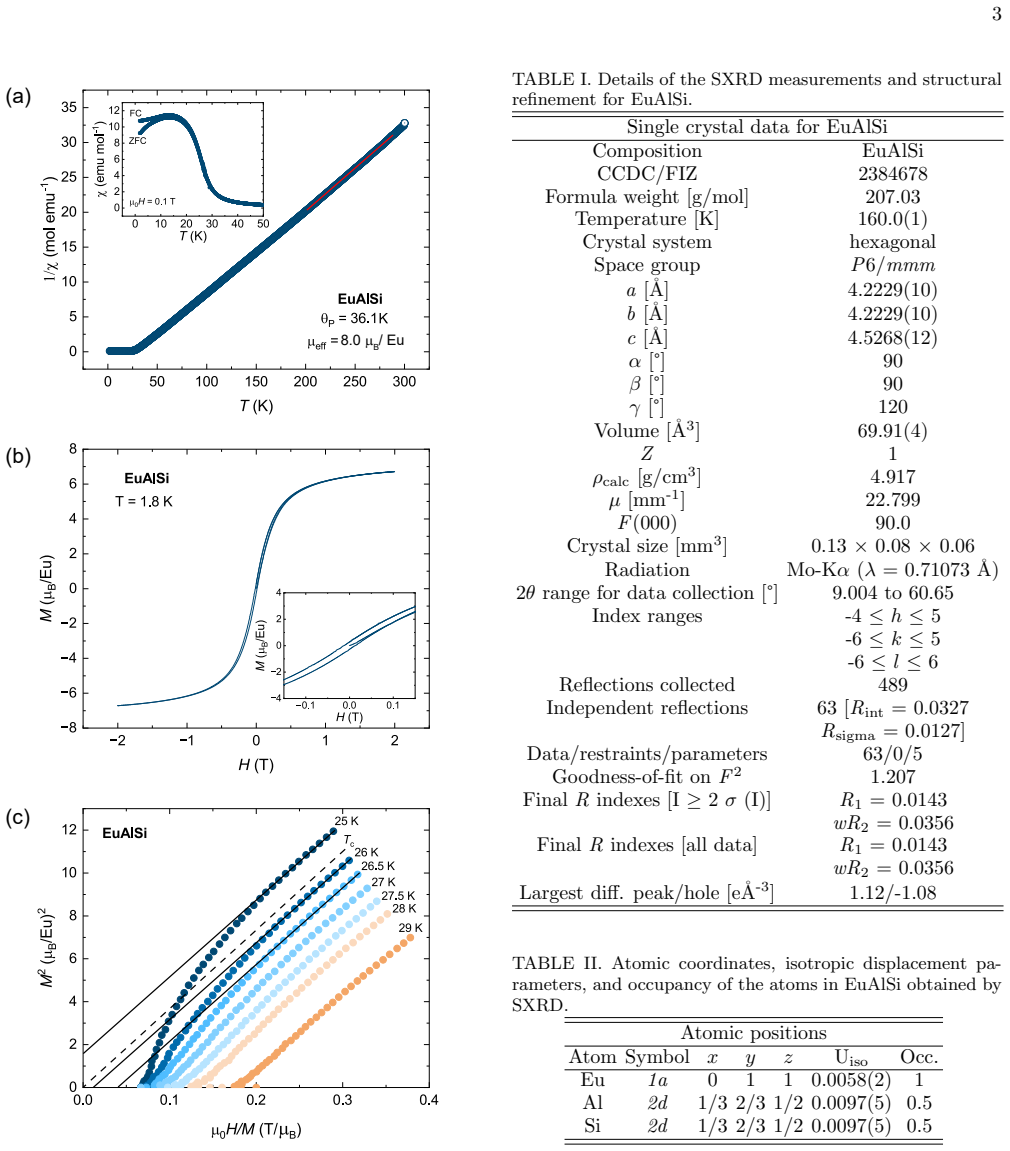
The paper presents the first detailed structural and magnetic characterization of EuAlSi, an AlB2-type compound (space group P6/mmm) with a triangular lattice of Eu atoms and a honeycomb lattice of Al and Si. EuAlSi is a soft ferromagnet with a Curie temperature near 26 K, a coercivity of only about 130 G, and an effective magnetic moment of 8.0 μB/Eu, matching the free-ion value for Eu2+. In the Eu1-xSrxAlSi solid solution, substitution of Eu by isovalent Sr preserves the crystal structure and obeys Vegard's law, while systematically reducing the effective moment and linearly suppressing TCurie from 26.8 K at x = 0 to 1.8 K at x = 0.9. Superconductivity appears only for x > 0.95, with Tc = 3.5 K at x = 0.99 and Tc = 4.6 K for SrAlSi, while the x = 0.97 sample is paramagnetic down to 1.8 K. The authors suggest that the linear suppression of ferromagnetism can be extrapolated to zero near x ≈ 0.96, where it coincides with the emergence of superconductivity, indicating a possible quantum critical point.
Load-bearing premise
The linear drop of the Curie temperature observed for x between 0 and 0.9 is extrapolated to hit zero near x = 0.96; if the trend bends, saturates, or becomes nonmonotonic between x = 0.9 and x = 0.98, the proposed quantum critical point is unsupported, especially since the x = 0.97 sample is neither magnetic nor superconducting down to 1.8 K.
Editorial extensions
If this is right
- If the quantum critical point exists near x ≈ 0.96, samples in that composition window should show non-Fermi-liquid signatures, such as a resistivity temperature dependence that departs from the conventional $T^2$ law, along with enhanced low-temperature magnetic fluctuations.
- Superconductivity in this family is fragile: as little as 3% europium destroys the superconducting state in SrAlSi, consistent with singlet pairing being rapidly suppressed by magnetic impurities.
- Because the unit cell parameters follow Vegard's law across the entire series, the composition dependence of the physical properties is intrinsic, making this solid solution a reliable benchmark for models of ferromagnet-superconductor competition.
- The phase diagram implies that quantum fluctuations, rather than classical thermal fluctuations, may dominate in a narrow composition window near x ≈ 0.96, motivating ultra-low-temperature transport, specific heat, and neutron scattering experiments there.
Reading between the lines
- A complementary tuning test: since Sr substitution mainly expands the c axis while barely changing a, applying hydrostatic pressure to EuAlSi should push the system in the opposite direction and could raise TCurie, a prediction the paper does not make.
- The x = 0.97 sample, which is neither magnetic nor superconducting down to 1.8 K, is a prime candidate for muon spin rotation and inelastic neutron scattering to determine whether its ground state is a spin glass, a disordered moment-free state, or a hidden ordered phase below the measurement floor.
- The very narrow superconducting window may indicate that residual Eu moments near x = 0.96 are strong pair breakers; if quantum critical fluctuations coexist there, the superconducting dome could be non-monotonic, a feature that would only appear in finer composition steps than the ones reported.
- Because the triangular Eu lattice is geometrically frustrated, any quantum criticality at x ≈ 0.96 could be accompanied by short-range spin textures or glassy dynamics, which might be probed by ac susceptibility or small-angle neutron scattering.
Editorial analysis
A structured set of objections, weighed in public.
Referee Report
Summary. The manuscript reports the synthesis, crystal structure, and magnetic properties of EuAlSi and its Eu1-xSrxAlSi solid solution. Single-crystal X-ray diffraction establishes the AlB2-type structure (P6/mmm), and magnetization and heat capacity measurements characterize EuAlSi as a soft ferromagnet with TCurie around 26–27 K, a Curie-Weiss effective moment of 8.0 µB/Eu, and a bulk heat capacity jump. Across the solid solution, Vegard-type linear lattice parameter changes are observed, TCurie decreases with Sr substitution, and superconductivity appears near the Sr-rich end. The paper suggests a possible quantum critical point at x≈0.96 where ferromagnetic order is extrapolated to vanish and superconductivity emerges.
Significance. If the QCP interpretation is correct, this system would join a small family of materials where ferromagnetic and superconducting instabilities meet, providing a platform for studying quantum criticality and unconventional pairing. The paper's strengths include careful structural characterization, a complete phase diagram down to 1.8 K, and clean Curie-Weiss and Arrott analyses for the parent compound. However, the central QCP claim is based on extrapolation across an unexplored composition range and on a transition temperature whose nature (ferromagnetic vs. spin glass) is not established for diluted samples. The work is a useful characterization study with a speculative but clearly labeled extension.
major comments (5)
- [Section III.D, Fig. 8] The putative QCP at x≈0.96 rests on linear extrapolation of TCurie(x) from data up to x=0.9 and of Tc(x) from x=0.98, 0.99, and 1.0. The x=0.97 sample is paramagnetic and non-superconducting down to 1.8 K, so no data constrain the phase boundaries in 0.9<x<0.98. A bend, tail, or first-order jump in the magnetic ordering line between x=0.9 and x=0.97 would move or eliminate the zero crossing. As the authors themselves call the lines 'guides to eyes', the QCP location is not experimentally determined.
- [Section III.D, text near Fig. 6] The paper states that 'the ground state of these samples hints towards a spin glass behavior' for the magnetic members of the solid solution. If the low-temperature state is a spin glass, the quantity labeled TCurie (determined from dχ/dT) is a freezing temperature, not a ferromagnetic ordering temperature. The QCP discussion, which invokes suppression of ferromagnetic order and ferromagnetic quantum fluctuations, would then not apply. The authors should provide evidence for long-range ferromagnetic order in the diluted samples (e.g., neutron diffraction, heat capacity anomalies) or substantially temper the QCP framing.
- [Section III.D, Fig. 7] The superconducting phase boundary is weakly constrained. The x=0.98 sample shows only a small diamagnetic downturn without saturation to χv=-1, which may indicate filamentary or partial superconductivity rather than bulk order. A bulk superconductor at x=0.98 should exhibit zero resistance or a heat capacity anomaly; neither is shown. The Tc(x) line drawn through three points and extrapolated to zero at x≈0.96 therefore has limited significance.
- [Abstract and Section IV] The abstract and conclusion state TCurie = 25.8 K for EuAlSi, while the main text reports TCurie = 26.8 K from dχ/dT and 27.5 K from heat capacity (Section III.B, Fig. 3). These values should be reconciled or the discrepancy acknowledged.
- [Abstract] The abstract says 'superconductivity is only observed for samples with x>0.95', but the text reports the x=0.97 sample is not superconducting. The superconducting compositions are x=0.98, 0.99, and 1.0. This factual inconsistency should be corrected.
minor comments (4)
- [Throughout] Typographical errors include 'paramgnet' (should be 'paramagnet'), 'Arrot' (should be 'Arrott'), 'respecting Rietveld' (should be 'respective Rietveld'), 'alligned' (should be 'aligned'), and an extra 'to' in 'in the vicinity of to x≈0.96'.
- [Section III.B] The Curie-Weiss fitting range is given as T=200–290 K for EuAlSi, but no fitting range is stated for the diluted samples shown in Fig. 6(b). Please specify the range and the resulting fit quality for each composition.
- [Fig. 8] The phase diagram would benefit from error bars on the TCurie and Tc points, and the gray bar indicating the inaccessible temperature range should be described in the figure caption.
- [Section III.C] The statement that Vegard's law behavior suggests the changes in physical properties are 'intrinsic' is reasonable, but it is a conjecture; disorder effects (e.g., random site occupation) could still affect magnetic properties, as the paper itself notes in the spin-glass context.
Circularity Check
No significant circularity: the QCP claim rests on measured data and is explicitly labeled an extrapolation, not on self-referential definitions or fitted-as-prediction steps.
full rationale
The paper's main results are new measurements: single-crystal and powder diffraction establish the structure; magnetization, Arrott plots, and heat capacity independently determine TCurie for EuAlSi; TCurie values for the solid solution are read from dχ/dT of measured M(T) data. No target quantity is defined in terms of another claimed output. The putative QCP at x ≈ 0.96 is obtained by extrapolating dashed guide lines in the phase diagram, with the paper explicitly saying 'Both lines could be extrapolated to 0 K at x around 0.96, which might suggest the existence of a potential quantum critical point' and with a gray bar marking the inaccessible temperature range. This is an extrapolation, not a circular reduction: the prediction is not statistically forced by fitting a parameter to the same data it pretends to predict, and the authors do not present the zero crossing as measured. Several references ([4], [6], [7], [26]) are self-citations from the same group, but they are used for structural context, prior superconductivity in related compounds, and as one of two citations for the Arrott-plot criterion; they are not load-bearing for the central claim. Removing them would not change the measured TCurie values or the superconducting transitions. The paper also honestly flags the speculative nature of the QCP and calls for ultra-low-temperature measurements, which is a correctness caveat rather than circularity. Thus the derivation chain is self-contained, with at most minor non-load-bearing self-citation.
Assumptions & free parameters
free parameters (2)
- Curie-Weiss parameters C and theta_P =
C ≈ 8 emu K/mol and theta_P = 36.1 K for EuAlSi; values for all compositions in Table S2
- Linear fit parameters for TCurie(x) trend =
Extrapolated intercept at x ≈ 0.96
assumptions (4)
- standard math Curie-Weiss law describes the high-temperature magnetic susceptibility
- domain assumption Europium is divalent (Eu2+, 4f7) and its moment is not quenched
- domain assumption Arrott plots follow the mean-field approximation near the transition
- domain assumption Nominal Sr content equals actual sample composition
Cite this review
Pith. "Pith review of Magnetism in EuAlSi and the Eu1-xSrxAlSi Solid Solution." pith.science (2026). https://pith.science/paper/IGDJFQ4U
@misc{pith2026241212795,
  author       = {Pith},
  title        = {Pith review of: Magnetism in EuAlSi and the Eu1-xSrxAlSi Solid Solution},
  year         = {2026},
  howpublished = {\url{https://pith.science/paper/IGDJFQ4U}},
  note         = {Machine review of arXiv:2412.12795}
}
read the original abstract
The magnetic properties of EuAlSi, a compound comprising a honeycomb lattice of Al and Si atoms and a triangular lattice of Eu atoms, are presented. Moreover, we have prepared the Eu1-xSrxAlSi solid solution, to study the evolution of the collective quantum properties from the ferromagnetic EuAlSi towards the superconducting SrAlSi. A possible quantum critical point is suggested to exist in the vicinity of to x of 0.96, at which the suppression of ferromagnetic order is concomitant with the emergence of superconductivity.
Figures


Figures from the paper (5 more)


Reference graph
Works this paper leans on
-
[1]
Y. Cao, V. Fatemi, S. Fang, K. Watanabe, T. Taniguchi, E. Kaxiras, and P. Jarillo-Herrero, Unconventional super- conductivity in magic-angle graphene superlattices, Na- ture 556, 43 (2018)
2018
-
[2]
Nagamatsu, N
J. Nagamatsu, N. Nakagawa, T. Muranaka, Y. Zenitani, and J. Akimitsu, Superconductivity at 39 K in magne- sium diboride, Nature 410, 63 (2001)
2001
-
[3]
M. J. Evans, Y. Wu, V. F. Kranak, N. Newman, A. Reller, F. J. Garcia-Garcia, and U. H¨ aussermann, Structural properties and superconductivity in the ternary intermetallic compounds MAB (M=Ca, Sr, Ba; A=Al, Ga, In; B=Si, Ge, Sn), Phys. Rev. B 80, 064514 (2009)
work page 2009
-
[4]
D. I. Walicka, Z. Guguchia, J. Lago, O. Blacque, K. Ma, H. Liu, R. Khasanov, and F. O. von Rohr, Two-gap to single-gap superconducting transition on a honeycomb lattice in Ca 1-xSrxAlSi, Phys. Rev. Research 3, 033192 (2021)
work page 2021
-
[5]
V. H. Tran, M. Sahakyan, and Z. Bukowski, Discovery of superconductivity in AlB2-type hexagonal YGa2, Journal of Physics: Condensed Matter 33, 315401 (2021)
work page 2021
-
[6]
D. I. Walicka, R. Lef` evre, O. Blacque, S. A. L´ opez-Paz, C. W. Rischau, A. Cervellino, C. A. Triana, and F. O. von Rohr, Structural phase transition and superconductiv- ity in 2H-BaGaGe with buckled honeycomb layers, Phys. Rev. Mater. 7, 074805 (2023)
work page 2023
-
[7]
D. I. Walicka, O. Blacque, T. Klimczuk, and F. O. von Rohr, From weak- to strong-coupling superconductivity in the AlB 2-type solid solution SrGa 1–xAlxGe with hon- eycomb layers, Journal of Physics: Condensed Matter 37, 045704 (2024)
work page 2024
-
[8]
Kurumaji, T
T. Kurumaji, T. Nakajima, M. Hirschberger, A. Kikkawa, Y. Yamasaki, H. Sagayama, H. Nakao, Y. Taguchi, T. hisa Arima, and Y. Tokura, Skyrmion lattice with a giant topological hall effect in a frustrated triangular-lattice magnet, Science 365, 914 (2019)
2019
Show all 36 references
-
[9]
Pan, C.-D
Z.-Y. Pan, C.-D. Cao, X.-J. Bai, R.-B. Song, J.-B. Zheng, and L.-B. Duan, Structures and physical proper- ties of R2TX3 compounds, Chinese Physics B 22, 056102 (2013)
2013
-
[10]
Mallik, E
R. Mallik, E. Sampathkumaran, M. Strecker, G. Wort- mann, P. Paulose, and Y. Ueda, Complex magnetism in a new alloy, Eu 2PdSi3, with two crystallographically in- equivalent sites, Journal of Magnetism and Magnetic Ma- terials 185, L135 (1998)
1998
-
[11]
Majumdar, R
S. Majumdar, R. Mallik, E. V. Sampathkumaran, K. Rupprecht, and G. Wortmann, Magnetic behavior of eu2cusi3 : large negative magnetoresistance above the curie temperature, Phys. Rev. B 60, 6770 (1999)
1999
-
[12]
C. D. Cao, R. Klingeler, H. Vinzelberg, N. Leps, W. L¨ oser, G. Behr, F. Muranyi, V. Kataev, and B. B¨ uchner, Magnetic anisotropy and ferromagnetic cor- relations above the curie temperature in Eu2CuSi3 single crystals, Phys. Rev. B 82, 134446 (2010)
2010
-
[13]
P¨ ottgen and D
R. P¨ ottgen and D. Johrendt, Equiatomic intermetal- lic europium compounds: syntheses, crystal chemistry, chemical bonding, and physical properties, Chemistry of Materials 12, 875 (2000)
2000
-
[14]
T.-S. You, Y. Grin, and G. J. Miller, Planar versus puck- ered nets in the polar intermetallic series eugatt (tt = si, ge, sn), Inorganic Chemistry 46, 8801 (2007)
2007
-
[15]
O. S. Zarechnyuk and T. I. Yanson, Ternary phase dia- gram for the system Al-Eu-Si for the concentration range 0-33 at.% Eu, Dopovidi Akademii Nauk Ukrains’koi RSR, Seriya B: Geologichni, Khimichni ta Biologichni Nauki 4, 31 (1982)
1982
-
[16]
were performed with the program suite CrysAlisPro [17]. Using Olex2 [18], the crystal structure was solved with the SHELXT [19] small molecule structure solution program and refined with the SHELXL program pack- age [20] by full-matrix least-squares minimization on F 2. PLATON...
-
[17]
R. C. Clark and J. S. Reid, The analytical calculation of absorption in multifaceted crystals, Acta Crystallogr. Sec. A 51, 887 (1995)
1995
-
[18]
1.171.42.75a; Rigaku Corporation, 2022,
CrysAlisPro Software System; Rigaku Oxford Diffrac- tion, vers. 1.171.42.75a; Rigaku Corporation, 2022,. 9
2022
-
[19]
O. V. Dolomanov, L. J. Bourhis, R. J. Gildea, J. A. Howard, and H. Puschmann, OLEX2: A complete struc- ture solution, refinement and analysis program, J. Appl. Crystallogr. 42, 339 (2009)
2009
-
[20]
G. M. Sheldrick, SHELXT - Integrated space-group and crystal-structure determination, Acta Crystallogr. Sec. A 71, 3 (2015)
2015
-
[21]
G. M. Sheldrick, Crystal structure refinement with SHELXL, Acta Crystallogr. Sec. C 71, 3 (2015)
2015
-
[22]
A. L. Spek, Structure validation in chemical crystallog- raphy, Acta Crystallographica Section D 65, 148 (2009)
2009
-
[23]
Salamakha, E
L. Salamakha, E. Bauer, G. Hilscher, H. Michor, O. So- logub, P. Rogl, and G. Giester, Structural and physical properties diversity of new CaCu5-type related europium platinum borides, Inorganic Chemistry 52, 4185 (2013)
2013
-
[24]
C.-K. Tian, C. Wang, W. Ji, J.-C. Wang, T.-L. Xia, L. Wang, J.-J. Liu, H.-X. Zhang, and P. Cheng, Domain wall pinning and hard magnetic phase in co-doped bulk single crystalline Fe 3GeTe2, Phys. Rev. B 99, 184428 (2019)
2019
-
[25]
G´ ornicka, W
K. G´ ornicka, W. Xie, E. M. Carnicom, R. J. Cava, and T. Klimczuk, Synthesis and physical properties of the 10.6 K ferromagnet NdIr 3, Phys. Rev. B 99, 104430 (2019)
2019
-
[26]
Arrott, Criterion for ferromagnetism from observa- tions of magnetic isotherms, Phys
A. Arrott, Criterion for ferromagnetism from observa- tions of magnetic isotherms, Phys. Rev.108, 1394 (1957)
1957
-
[27]
Lef` evre and F
R. Lef` evre and F. O. von Rohr, A heavy fermion zn- deficient CaBe 2Ge2-type phase with rare Ce-based fer- romagnetism and large magnetoresistance, Chemistry of Materials 34, 2352 (2022)
2022
-
[28]
A. K. Pramanik and A. Banerjee, Critical behavior at paramagnetic to ferromagnetic phase transition in Pr0.5Sr0.5MnO3: A bulk magnetization study, Phys. Rev. B 79, 214426 (2009)
2009
-
[29]
Z. Fu, L. Qin, K. Sun, L. Hao, Y.-Z. Zheng, W. Lohstroh, G. G¨ unther, M. Russina, Y. Liu, Y. Xiao, W. Jin, and D. Chen, Low-temperature spin dynamics of ferro- magnetic molecular ring Cr 8Y8, npj Quantum Mater. 5 (2020)
2020
-
[30]
R. B. Adhikari, P. Shen, D. L. Kunwar, I. Jeon, M. B. Maple, M. Dzero, and C. C. Almasan, Magnetic field de- pendence of the schottky anomaly in filled skutterudites Pr1-xEuxPt4Ge12, Phys. Rev. B 100, 174509 (2019)
2019
-
[31]
Kaczorowski, B
D. Kaczorowski, B. Belan, and R. Gladyshevskii, Mag- netic and electrical properties of EuPdGe 3, Solid State Communications 152, 839 (2012)
2012
-
[32]
Kumar, P
N. Kumar, P. K. Das, R. Kulkarni, A. Thamizhavel, S. K. Dhar, and P. Bonville, Antiferromagnetic order- ing in EuPtGe 3, Journal of Physics: Condensed Matter 24, 036005 (2011)
2011
-
[33]
Tari, The Specific Heat of Matter at Low Temperatures (Imperial Collage Press, 2003)
A. Tari, The Specific Heat of Matter at Low Temperatures (Imperial Collage Press, 2003)
2003
-
[34]
Blundell, Magnetism in Condensed Matter (Oxford Master Series in Physics, 2001)
S. Blundell, Magnetism in Condensed Matter (Oxford Master Series in Physics, 2001)
2001
-
[35]
R. S. D. Mudiyanselage, T. Klimczuk, and W. Xie, Crit- ical charge transfer pairs in intermetallic superconduc- tors, in Comprehensive Inorganic Chemistry III (Else- vier, 2023) pp. 217–235
2023
-
[36]
B. T. Matthias, H. Suhl, and E. Corenzwit, Spin ex- change in superconductors, Phys. Rev. Lett.1, 92 (1958)
1958
Reviewed August 11, 2026 · model on record in the stance chip above.
Discussion (0). Continue with ORCID to comment.