REVIEW 4 major objections 5 minor 2 cited by
In-Context Learning Distillation for Efficient Few-Shot Fine-Tuning
T0 review · 4 major / 5 minor · reviewed 2026-08-11 · deepseek-v4-flash
Pith's one-line read Distilling in-context learning from a 1.3B teacher into a 125M student raises out-of-domain accuracy by roughly half while cutting memory up to 60% compared with pattern-based fine-tuning.
desk verdict Routine application of existing context distillation with a circular OOD selection procedure and confounded baselines; the headline gains are not supported. read the letter →
The pith
A machine-rendered reading of the paper's core claim, the machinery that carries it, and where it could break.
The reading
What carries the argument
The central mechanism is context distillation: a teacher model (OPT-1.3B) is given a few-shot prompt and produces soft logits over the yes/no verbalizer vocabulary; those logits, together with the true labels, supervise a student model (OPT-125M) through a weighted combination of KL-divergence and cross-entropy losses. The balancing factor $\alpha$ interpolates between pure fine-tuning ($\alpha=0$) and pure knowledge distillation ($\alpha=1$), and the paper finds $\alpha=0.5$ optimal for out-of-domain accuracy. The method is combined with parameter-efficient fine-tuning techniques LoRA (low-rank adaptation of query and value projections) and BitFit (bias-only training) to further reduce trainable parameters and memory.
What would settle it
Run in-context learning on the OPT-1.3B teacher using the same few-shot prompts and evaluate on the same out-of-domain MNLI-mismatched split. If the teacher's ICL accuracy is already near or above the distilled student's reported 0.6-0.65, then the 50% improvement over ICL is merely a consequence of using a larger model for prompting, not of distilling context into parameters. Alternatively, distill an OPT-125M teacher into an OPT-125M student with identical soft-label supervision; if the student then fails to beat ICL on the same-size model, the distillation mechanism itself is not responsible for the observed gains.
Extended reading notes
Core claim
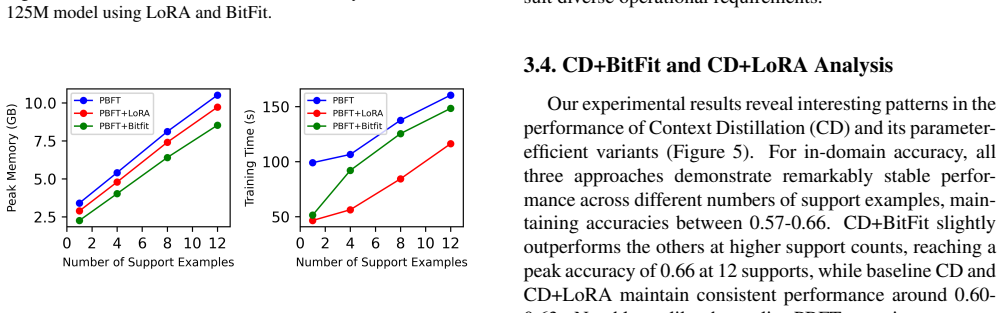
The paper's central claim is that prompting a large model with few-shot examples produces soft label distributions that encode the task adaptation normally carried by the prompt, and that a smaller model fine-tuned to match those soft labels internalizes the task so that the prompt can be discarded at inference time. Concretely, the authors distill an OPT-1.3B teacher into an OPT-125M student on a binary version of MNLI, using the loss $L = \alpha L_{KL} + (1-\alpha) L_{CE}$ with $\alpha=0.5$, and observe that the student reaches about 0.6-0.65 out-of-domain accuracy across support set sizes, while in-context learning on the 125M model hovers around 0.4-0.5 and pattern-based fine-tuning drops to about 0.4. The student's memory footprint stays nearly constant at roughly 1.5-2GB for the distillation fine-tuning, compared with a linear growth to over 10GB for pattern-based fine-tuning, and the final deployed model is 0.25GB versus the teacher's 2.5GB.
Load-bearing premise
The paper assumes that comparing the distilled 125M student to in-context learning run directly on a 125M model isolates the benefit of distillation, but the student was trained on a 1.3B teacher's outputs, so any accuracy gain could come from the teacher's extra capacity rather than from the distillation mechanism itself.
Editorial extensions
If this is right
- If context distillation works as claimed, few-shot adaptation can be separated from deployment: a small student can be trained once on a teacher's soft labels and then run without any support examples in the prompt, freeing the context window for long queries or documents.
- Memory requirements become nearly independent of the number of support examples, which would make the approach practical for on-device and resource-constrained settings where few-shot prompting of large models is infeasible.
- The reported 20% out-of-domain accuracy improvement over pattern-based fine-tuning, combined with up to 60% memory savings, suggests that distillation from a prompted teacher is a stronger and cheaper few-shot adaptation strategy than fine-tuning on raw labels alone.
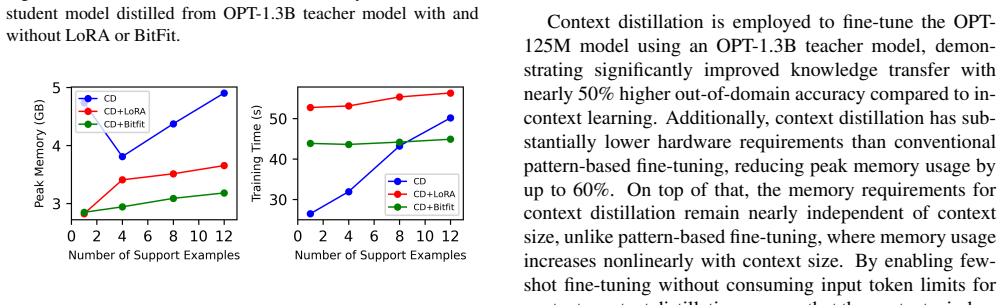
- Parameter-efficient variants, especially CD+LoRA, appear to preserve the out-of-domain generalization benefit while further reducing memory and training time, pointing toward a scalable recipe for deploying adapted small models.
- Because the student never sees the support set at inference, the approach may also reduce inference latency compared with in-context learning, where each query must be accompanied by multiple support examples.
Reading between the lines
- The headline 50% gain over in-context learning is likely not attributable solely to the distillation mechanism: the student is trained on soft labels produced by a 1.3B teacher, whereas the ICL baseline runs on a 125M model, so part or all of the gain could reflect the teacher's larger capacity and better few-shot performance. A teacher-matched control (ICL on OPT-1.3B, or distilling from a 125M t
- The paper reduces MNLI to a binary entailment/contradiction task by dropping neutral examples, which changes the difficulty and the decision boundary; out-of-domain accuracy gains on this binary formulation may not transfer to the original three-way NLI setting.
- A direct testable extension is to apply the same context distillation procedure to other tasks (e.g., sentiment classification, multi-choice QA, or summarization) to see if the out-of-domain generalization advantage persists beyond the single NLI task studied here.
- The reported deviation of approximately ±15% across five random seeds, combined with fixed-seed evaluation in later analyses, suggests the headline numbers may be sensitive to initialization; reporting confidence intervals or significance tests would clarify whether the observed differences are stable.
Signed reviews
Editorial analysis
A structured set of objections, weighed in public.
Referee Report
Summary. The paper proposes Context Distillation (CD) for few-shot fine-tuning: an OPT-1.3B teacher is prompted in-context on binary MNLI and its soft logits are used to distill task knowledge into an OPT-125M student, optionally with LoRA or BitFit. The authors compare CD against in-context learning (ICL) and pattern-based fine-tuning (PBFT) on the same 125M model, reporting a nearly 50% out-of-domain accuracy improvement over ICL, a 20% improvement over PBFT, and memory savings of up to 60%.
Significance. If the reported numbers were unbiased, the paper would demonstrate a practically useful recipe for compressing ICL behavior into a small fine-tuned model with modest memory overhead. The study is also commendable for exploring multiple PEFT variants, reporting memory and time alongside accuracy, and explicitly discussing limitations such as mixed-precision issues and single-task evaluation. However, the headline OOD comparisons are compromised by in-sample hyperparameter selection and by confounding teacher capacity with the distillation method, so the central quantitative claims are not currently supported.
major comments (4)
- [§2.2, §2.4, §3.2] The learning rate, epoch count, batch size, and distillation balance α were all selected by "maximizing out-of-domain accuracy" on MNLI-mismatched (Sections 2.2 and 2.4), and the resulting OOD accuracy on that same split is the basis of the headline comparison in Figure 1 and Section 3.2 (CD ≈0.6–0.65 vs. ICL ≈0.4–0.5). These numbers are therefore the outcome of in-sample selection, not a held-out evaluation. The "nearly 50% improvement" claim would require a proper validation split (or nested cross-validation) and an independent test evaluation.
- [§3.2, Figure 1] The CD vs. ICL comparison confounds method with teacher capacity. ICL is run directly on OPT-125M, whereas the CD student is trained on soft labels generated by an OPT-1.3B teacher. Any OOD gain may reflect the teacher's larger capacity rather than the distillation mechanism. A fair control would include ICL on the OPT-1.3B teacher (as an upper bound) or a CD variant whose teacher is also 125M; without such a control, the central knowledge-transfer claim is not identified.
- [§2.3] Section 2.3 reports "deviations of approximately ±15%" across random seeds and then states that a fixed seed is used for all subsequent analyses, yet no confidence intervals or error bars accompany any comparison in Figures 1, 2, 3, or 5. With a reported ±15% spread, the observed OOD differences (e.g., 0.60 vs. 0.45) may not be statistically reliable. The paper should report variance across seeds for the main comparisons, or at least justify that a single seed is representative.
- [§2.6, §3.4, Figure 2 vs. Figure 6] There is an internal inconsistency in the reported memory numbers. Figure 2 (left) states that CD peak memory stabilizes between 1.5–2 GB, while Section 3.4 and Figure 6 (left) report baseline CD memory of approximately 3.8–4.9 GB; Section 2.6 states that CD with a 1.3B teacher and 125M student was infeasible on a 24 GB GPU without BF16. The abstract's "reduced memory consumption by up to 60%" depends on which measurement is correct. Please clarify what exactly is measured (teacher+student vs. student-only, training vs. inference) and reconcile the discrepancy.
minor comments (5)
- [§3.4] Typo: "By constrast" should be "By contrast."
- [References] The paper uses the OPT model family, pattern-based fine-tuning, and verbalizers without citing the original sources (Zhang et al. 2022 for OPT; Schick and Schütze for pattern-based fine-tuning and verbalizers). Please add the missing references.
- [§2.3] The phrase "deviations of approximately ±15%" is ambiguous: is this an absolute or relative deviation in accuracy, and does it apply to all methods or only some? Clarify and consider reporting standard errors.
- [§1] The contribution list mentions studying "model sizes horizontally and vertically," but the paper does not define what horizontal versus vertical scaling means; please clarify or remove this phrase.
- [§3.2, Figure 1] The caption of Figure 1 says "applied to OPT-125M model," but CD uses an OPT-1.3B teacher; please make explicit in the caption that the plotted CD results are for the 125M student distilled from a 1.3B teacher.
Circularity Check
Reported out-of-domain gains are selected on the evaluation split: CD-specific hyperparameters (α, LR, epochs) are chosen to maximize MNLI-mismatched accuracy, so the headline 50%/20% OOD improvements are in-sample selection results, not independent predictions.
-
fitted input called prediction
[Section 2.4 (Loss imbalance in context distillation); also Section 2.2 (Few-shot fine-tuning overfitting); reported in Abstract and Figure 1]
"Our experiments reveal that out-of-domain accuracy initially increases with α but subsequently decreases beyond a certain point. Based on these observations, we determined that α = 0.5 provides the best trade-off, yielding optimal performance by harmonizing the contributions of the teacher’s predictions and the true labels."
The CD-specific loss weight α is selected by inspecting out-of-domain accuracy on the MNLI-mismatched split, and Section 2.2 does the same for learning rate and epochs ('The optimal configuration of these hyperparameters was selected based on maximizing out-of-domain accuracy'). The final OOD accuracy of CD (Figure 1; abstract's 'nearly 50% improvement' over ICL and '20% improvement' over PBFT) is then measured under these selected settings on that same mismatched split. The reported OOD gain is therefore not an unbiased held-out prediction but the optimized value of the very objective used for model selection; the claim of superior knowledge transfer is partly encoded in the experimental design rather than independently tested.
full rationale
The paper's central accuracy claim is partially circular under the 'fitted input called prediction' pattern: the out-of-domain metric that appears in the abstract and Figure 1 is also the criterion for selecting α, learning rate, and epoch count (Sections 2.2 and 2.4). Thus the headline 'nearly 50% improvement' and '20% improvement' are in-sample selection results, and the ±15% seed deviations reported in Section 2.3 are not propagated into error bars. No load-bearing self-citation chain exists: the method is attributed to the external prior work of Snell et al. [4], and the LoRA/BitFit baselines are standard external methods. The teacher-capacity confound (distilling from OPT-1.3B and comparing ICL on OPT-125M) is a correctness risk rather than a circularity, since it does not reduce the conclusion to the paper's own equations or definitions. Overall, one fitted-input-called-prediction step makes the stated OOD improvements partially forced, meriting a score of 6.
Assumptions & free parameters
free parameters (4)
- context distillation balancing factor alpha =
0.5
- learning rate =
1e-5
- number of training epochs =
40
- LoRA rank, alpha, dropout =
rank 8, lora_alpha 32, dropout 0.05
assumptions (4)
- domain assumption MNLI-mismatched accuracy is a valid measure of out-of-domain generalization for NLI
- domain assumption The teacher's ICL predictions on the support set are a good soft-label target for the student
- domain assumption Binary entailment/contradiction after removing neutral preserves the NLI task structure
- domain assumption Bias-only and low-rank adaptation do not distort the distillation signal
Cite this review
Pith. "Pith review of In-Context Learning Distillation for Efficient Few-Shot Fine-Tuning." pith.science (2026). https://pith.science/paper/R524UWGT
@misc{pith2026241213243,
  author       = {Pith},
  title        = {Pith review of: In-Context Learning Distillation for Efficient Few-Shot Fine-Tuning},
  year         = {2026},
  howpublished = {\url{https://pith.science/paper/R524UWGT}},
  note         = {Machine review of arXiv:2412.13243}
}
read the original abstract
We applied few-shot in-context learning on the OPT-1.3B model for the natural language inference task and employed knowledge distillation to internalize the context information, reducing model parameter from 1.3B to 125M and achieving a size reduction from 2.5GB to 0.25GB. Compared to using in-context learning alone on similarly sized models, this context distillation approach achieved a nearly 50% improvement in out-of-domain accuracy, demonstrating superior knowledge transfer capabilities over prompt-based methods. Furthermore, this approach reduced memory consumption by up to 60% while delivering a 20% improvement in out-of-domain accuracy compared to conventional pattern-based fine-tuning.
Figures


Figures from the paper (3 more)

Forward citations
Cited by 2 Pith papers
-
Sample-Efficient Learning from Agent Experience
Agents can consolidate in-context trial-and-error learning into their weights by distilling one-step teacher decisions at recorded histories, needing no additional environment interaction.
-
AgentDistill: Training-Free Agent Distillation with Generalizable MCP Boxes
AgentDistill distills agent capabilities without any training by having a teacher generate reusable MCP tool boxes that small-model students invoke at inference time.
Reference graph
Works this paper leans on
-
[1]
write newline
" write newline "" before.all 'output.state := FUNCTION fin.entry add.period write newline FUNCTION new.block output.state before.all = 'skip after.block 'output.state := if FUNCTION new.sentence output.state after.block = 'skip output.state before.all = 'skip after.sentence 'output.state := if if FUNCTION not #0 #1 if FUNCTION and 'skip pop #0 if FUNCTIO...
-
[2]
Lora: Low-rank adaptation of large language models
Edward J Hu, Yelong Shen, Phillip Wallis, Zeyuan Allen-Zhu, Yuanzhi Li, Shean Wang, Lu Wang, and Weizhu Chen. Lora: Low-rank adaptation of large language models. arXiv preprint arXiv:2106.09685 , 2021
arXiv 2021
-
[3]
Full parameter fine-tuning for large language models with limited resources
Kai Lv, Yuqing Yang, Tengxiao Liu, Qinghui Gao, Qipeng Guo, and Xipeng Qiu. Full parameter fine-tuning for large language models with limited resources. arXiv preprint arXiv:2306.09782 , 2023
arXiv 2023
-
[4]
Marius Mosbach, Tiago Pimentel, Shauli Ravfogel, Dietrich Klakow, and Yanai Elazar. Few-shot fine-tuning vs. in-context learning: A fair comparison and evaluation. arXiv preprint arXiv:2305.16938 , 2023
arXiv 2023
-
[5]
Learning by distilling context
Charlie Snell, Dan Klein, and Ruiqi Zhong. Learning by distilling context. arXiv preprint arXiv:2209.15189 , 2022
arXiv 2022
-
[6]
A broad-coverage challenge corpus for sentence understanding through inference
Adina Williams, Nikita Nangia, and Samuel R Bowman. A broad-coverage challenge corpus for sentence understanding through inference. arXiv preprint arXiv:1704.05426 , 2017
arXiv 2017
-
[7]
Bitfit: Simple parameter-efficient fine-tuning for transformer-based masked language-models
Elad Ben Zaken, Shauli Ravfogel, and Yoav Goldberg. Bitfit: Simple parameter-efficient fine-tuning for transformer-based masked language-models. arXiv preprint arXiv:2106.10199 , 2021
arXiv 2021
Reviewed August 11, 2026 · model on record in the stance chip above.
Discussion (0). Continue with ORCID to comment.