REVIEW 4 major objections 5 minor 80 references
Nods of Agreement: Webcam-Driven Avatars Improve Meeting Outcomes and Avatar Satisfaction Over Audio-Driven or Static Avatars in All-Avatar Work Videoconferencing
T0 review · 4 major / 5 minor · reviewed 2026-08-11 · deepseek-v4-flash
Pith's one-line read In an all-avatar work meeting study, webcam-animated avatars improved perceived effectiveness over static pictures and were rated more comfortable, inclusive, and satisfying than audio-animated or static avatars.
desk verdict Useful and novel empirical comparison, but the abstract overstates effectiveness because the key analysis treats a group-level outcome as 68 independent responses. read the letter →
The pith
A machine-rendered reading of the paper's core claim, the machinery that carries it, and where it could break.
The reading
What carries the argument
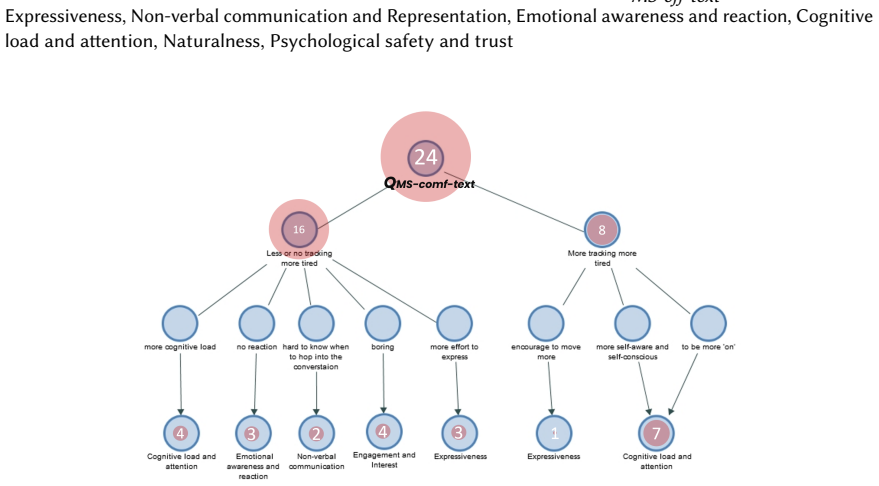
The experimental machinery is a three-condition within-subjects design with personalized 3D avatars. Each participant's avatar was generated from photos and video using 3D face reconstruction with dense landmarks and blendshapes, then presented under three animation modalities: a static picture, audio-driven visemes, and full webcam-driven animation including head motion and facial expressions. The webcam-driven condition is the only one adding head movement and expressive facial dynamics, and the paper isolates that difference as the driver of the observed outcomes. Quantitatively, the load-bearing comparison is the proportion of participants reporting group agreement, tested with a two-proportion z-test. Qualitatively, the authors build a ten-factor thematic framework showing that the themes spanning preference, effectiveness, and comfort—expressiveness, non-verbal communication, emotional awareness and reaction, and cognitive load and attention—are all about motion rather than appearance.
What would settle it
Reanalyze the effectiveness data with a logistic mixed-effects model that includes meeting group as a random effect; if the webcam-versus-static difference (z = 2.85, p = 0.004) becomes non-significant, the core claim would fail. Alternatively, run the same tasks with a real-video condition; if webcam-driven avatars do not match video on effectiveness or comfort, the 'plausible alternative' conclusion would not hold.
Extended reading notes
Core claim
The central claim is that webcam-animated avatars produce better work-meeting experiences than static pictures or audio-driven lip-sync avatars. In the study, 65 of 68 participants (96%) reported reaching group agreement with the webcam modality, versus 59 (87%) with audio animation and 54 (79%) with static pictures; a test of proportions found the webcam-versus-static gap significant (p = 0.004), while webcam-versus-audio (p = 0.070) and audio-versus-static (p = 0.25) gaps did not reach significance. Comfort and inclusivity were rated significantly higher for webcam than for either alternative, and both self- and other-expression were rated highest for webcam. Alignment was the one outcome with no significant differences across conditions. The authors interpret the qualitative data as showing that meaningful movement—expressiveness, non-verbal communication, emotional awareness, and cognitive load—outweighs visual realism for meeting outcomes.
Load-bearing premise
The load-bearing premise is that the 68 participants' answers can be treated as statistically independent even though they worked in 16 groups that reached joint decisions; a second, related assumption is that prior work on motion fidelity can stand in for a direct video baseline that the experiment never ran.
Editorial extensions
If this is right
- Videoconferencing platforms should treat webcam-driven head and face motion as a core feature of avatar systems, not an optional extra, since the qualitative data tie meeting outcomes to motion rather than visual realism.
- Organizations can offer webcam-animated avatars as a viable video-off option for employees who want privacy or cannot use cameras, without sacrificing perceived meeting effectiveness.
- Audio-only lip-sync animation may deliver only modest gains over a static picture for meeting outcomes; the significant differences in the study appeared in self- and other-expression, not in effectiveness or comfort.
- The 95.6% preference for webcam animation suggests that once users experience the modality, adoption in all-avatar meetings is likely to be high.
- Future avatar systems should explore adding hand gestures, which participants explicitly requested, if motion fidelity is the mechanism behind the observed benefits.
Reading between the lines
- The paper's conclusion that webcam-animated avatars are a plausible alternative to video goes beyond the measured data: no real-video condition was run, so equivalence with video is an extrapolation from prior findings on motion fidelity rather than a directly tested result.
- If the effectiveness benefit is real, the likely mechanism is conversational cueing—head nods and smiles signal turn-taking and agreement—so the benefit should be strongest in meetings with ambiguous turn-taking, such as brainstorming, and weakest in structured presentations.
- The statistical analysis treats each participant's binary response as independent despite 68 participants nested in 16 groups that made decisions together; a multilevel re-analysis could either strengthen or temper the headline result.
- A direct testable extension would compare webcam-driven avatars against real webcam video in the same decision-making task; if avatars match video on effectiveness and comfort, the 'plausible alternative' claim would become a measured equivalence.
Editorial analysis
A structured set of objections, weighed in public.
Referee Report
Summary. The paper reports a within-subjects, mixed-methods experiment with 68 employees of one technology company, organized into 16 groups, comparing three avatar animation modalities in all-avatar work videoconferencing: static picture, audio-driven animation, and webcam-driven animation. The quantitative measures are meeting outcome factors (effectiveness, alignment, comfort, inclusivity) and avatar satisfaction factors (self-expressive perception, other-expression perception, preference), analyzed with a two-proportion z-test for effectiveness and Wilcoxon signed-rank tests for the ordinal outcomes. The qualitative component is a thematic analysis of open-ended questionnaire responses. The authors claim that webcam-animated avatars improve meeting effectiveness, comfort, inclusivity, and avatar satisfaction relative to the other two modalities, and they conclude that webcam-animated avatars are a plausible alternative to video in work meetings.
Significance. If the headline effectiveness result survives appropriate statistical modeling, this would be a valuable contribution: the study uses real distributed work teams, within-subject counterbalancing, personalized avatars, and a systematic qualitative framework, which are genuine strengths relative to much prior avatar research. The qualitative thematic structure and the distinction between preference-related and outcome-related factors are also useful for future design work. However, the central quantitative claim that webcam animation 'improved meeting effectiveness' currently rests on an analysis that ignores the nesting of participants in groups, and the paper contains internal inconsistencies about alignment and an unsupported 'alternative to video' conclusion. The paper's contribution is therefore conditional on a statistical reanalysis and a recalibration of the claims.
major comments (4)
- [§4.1.1, Table 2, Supplementary Eq. (1)] The effectiveness contrast is analyzed with a two-proportion z-test that treats each participant's binary response as independent, but the measure QMO-eff asks 'Did the group make a final decision?', so all members of a given group share the same outcome. With 68 participants nested in 16 groups, the effective sample for this contrast is at most 16 groups, and within-group responses are strongly correlated. A group-level analysis (e.g., 16/16 vs. 13/16, a plausible reading of the reported 96% vs. 79%) would not reach conventional significance, so the reported p = 0.004 is likely anti-conservative. Please reanalyze the effectiveness data with the group as the unit of analysis or with a mixed-effects logistic regression that includes a random intercept for group, and report the intraclass correlation. Until this is done, the abstract's claim that webcam-animated avatars 'improved meeting effectiveness' is not established.
- [§4.1.1, H1a summary] The text states that 'our meeting outcome factors results supported H1a, in terms of comfort, alignment, and sense of inclusivity,' but the immediately preceding sentences and Table 2 report no significant differences for alignment (e.g., webcam vs. static: T = 372, z = .96, p = .339). This is an internal inconsistency, and the Conclusion repeats it by claiming quantitative support 'in reports on alignment.' Alignment should be removed from the list of supported H1a outcomes unless the analysis is corrected.
- [§5.4, §6, Abstract] The paper concludes that webcam-animated avatars are 'a plausible alternative to video in work meetings,' but the experiment contains no real-video condition; the only video-related evidence is qualitative participant comments. Prior literature, such as the Bente et al. study cited in Section 5.1, cannot substitute for a direct comparison in this experimental design. Please either add a video condition or explicitly restrict the conclusion to comparisons among static, audio-animated, and webcam-animated avatars. As written, the title claim and the abstract's 'alternative to video' framing go beyond what the data can support.
- [§4.1, Table 2] All ordinal outcomes are tested with pairwise Wilcoxon signed-rank tests without correction for multiple comparisons across the three pairwise contrasts or across the five outcome measures, and no effect sizes or confidence intervals are reported. Some of the 'significant' differences may not survive an FDR or Bonferroni adjustment, and the 'marginally better' (p = .076) audio vs. static comfort contrast is described inconsistently in the text. A multilevel model with participant and group random effects, or at least adjusted p-values and effect sizes, would make the secondary claims more robust.
minor comments (5)
- [Table 2, effectiveness row] The label 'Proportion of effective meetings' is misleading because QMO-eff is each participant's report of whether the group reached a decision; please clarify that the unit of measurement is the participant's perception, not an independently verified group outcome.
- [Table 2, header formatting] The table contains formatting errors such as 'z = .4.94' and 'z = .5.16', with stray periods; these should be corrected.
- [Supplementary Table 2] The demographic breakdown sums to 67 participants, while the main text reports 68; this discrepancy should be reconciled.
- [§4.2.2] There is a typo, 'becuase', in the sentence about tertiary themes; the same section also uses 'QMS' in the supplementary materials while the main text uses 'QMO', so the notation should be standardized.
- [Table 1] The table text has missing spaces in 'Forcomfort' and 'Forinclusivity'; these are minor display issues.
Circularity Check
No significant circularity: the paper's quantitative claims are direct empirical comparisons, and its self-citations are background support rather than load-bearing reductions.
full rationale
This is an empirical comparison study with no fitted parameters, no mathematical derivation, and no quantity that is defined in terms of the outcome it is used to predict. The quantitative results (QMO-eff, QMO-comf, QMO-incl, QAS-self, QAS-other, QAS-pref) are direct participant responses compared across three conditions via a Test of Proportions and Wilcoxon signed-rank tests; these are standard frequentist comparisons of measured outcomes, not predictions derived from the inputs. The qualitative thematic framework is transparently described: themes were first induced from preference text (QAS-pref-text) and then applied deductively to effectiveness and comfort text (Section 3.5.2, Section 4.2.2), which is a standard qualitative coding procedure and does not make the quantitative results depend on the themes. The paper's self-citations, such as [49] and [23], are used as background evidence about motion fidelity and avatar acceptance, but the central claims about webcam-animated avatars improving meeting outcomes and avatar satisfaction rest on the new experimental data, not on those citations. The conclusion that webcam-animated avatars are a "plausible alternative to video" is not directly tested because no real-video condition was included (Section 5.4), but that is an external-validity limitation rather than a circular step. No specific equation or argument in the paper reduces a claimed result to its own inputs by construction, so no circular step can be identified from the text.
Assumptions & free parameters
assumptions (5)
- domain assumption Self-reported agreement, comfort, inclusivity, and expressiveness are valid measures of meeting outcomes.
- domain assumption The three tasks are equivalent enough that counterbalancing modality order across tasks isolates modality effects.
- domain assumption Participant responses within a meeting group can be treated as statistically independent.
- domain assumption Teammate familiarity is constant across conditions and does not suppress modality differences.
- domain assumption Prior literature on video communication is sufficient to support the conclusion about video alternatives without a direct video condition.
Cite this review
Pith. "Pith review of Nods of Agreement: Webcam-Driven Avatars Improve Meeting Outcomes and Avatar Satisfaction Over Audio-Driven or Static Avatars in All-Avatar Work Videoconferencing." pith.science (2026). https://pith.science/paper/NMUXXAHM
@misc{pith2026241213265,
  author       = {Pith},
  title        = {Pith review of: Nods of Agreement: Webcam-Driven Avatars Improve Meeting Outcomes and Avatar Satisfaction Over Audio-Driven or Static Avatars in All-Avatar Work Videoconferencing},
  year         = {2026},
  howpublished = {\url{https://pith.science/paper/NMUXXAHM}},
  note         = {Machine review of arXiv:2412.13265}
}
read the original abstract
Avatars are edging into mainstream videoconferencing, but evaluation of how avatar animation modalities contribute to work meeting outcomes has been limited. We report a within-group videoconferencing experiment in which 68 employees of a global technology company, in 16 groups, used the same stylized avatars in three modalities (static picture, audio-animation, and webcam-animation) to complete collaborative decision-making tasks. Quantitatively, for meeting outcomes, webcam-animated avatars improved meeting effectiveness over the picture modality and were also reported to be more comfortable and inclusive than both other modalities. In terms of avatar satisfaction, there was a similar preference for webcam animation as compared to both other modalities. Our qualitative analysis shows participants expressing a preference for the holistic motion of webcam animation, and that meaningful movement outweighs realism for meeting outcomes, as evidenced through a systematic overview of ten thematic factors. We discuss implications for research and commercial deployment and conclude that webcam-animated avatars are a plausible alternative to video in work meetings.
Figures


Figures from the paper (8 more)


Reference graph
Works this paper leans on
-
[1]
Safurah Binti Abdul Jalil, Brabbyn Osburn, Jingwen Huang, Mike Barley, Marin Markovich, and Robert Amor. 2012. Avatars at a Meeting. In Proceedings of the 13th International Conference of the NZ Chapter of the ACM’s Special Interest Group on Human-Computer Interaction (Dunedin, New Zealand) (CHINZ ’12). Association for Computing Machinery, New York, NY, U...
-
[2]
Ahsan Abdullah, Jan Kolkmeier, Vivian Lo, and Michael Neff. 2021. Videoconference and Embodied VR: Communication Patterns Across Task and Medium. 5 (2021), 1–29. doi:10.1145/3479597
-
[3]
Allen and Nale Lehmann-Willenbrock
Joseph A. Allen and Nale Lehmann-Willenbrock. 2022. The key features of workplace meetings: Conceptualizing the why, how, and what of meetings at work. Organizational Psychology Review (2022), 20413866221129231. doi:10.1177/ 20413866221129231 arXiv:https://doi.org/10.1177/20413866221129231
-
[4]
Chee Siang Ang, Ania Bobrowicz, Panote Siriaraya, Joshua Trickey, and Kate Winspear. 2013. Effects of gesture-based avatar-mediated communication on brainstorming and negotiation tasks among younger users. 29, 3 (2013), 1204–1211. doi:10.1016/j.chb.2012.10.013
- [5]
-
[6]
Jeremy N Bailenson. 2021. Nonverbal overload: A theoretical argument for the causes of Zoom fatigue. Technology, mind, and behavior 2, 1 (Feb 2021). doi:10.1037/tmb0000030
-
[7]
Jeremy N. Bailenson, Andrew C. Beall, and Jim Blascovich. 2002. Gaze and task performance in shared virtual environments. The Journal of Visualization and Computer Animation 13, 5 (2002), 313–320. doi:10.1002/vis.297 _eprint: https://onlinelibrary.wiley.com/doi/pdf/10.1002/vis.297
-
[8]
Sabrina Barr. 2020. Boss accidentally transforms into a potato during hilarious video team meeting. The Independent (April 2020). https://www.independent.co.uk/life-style/coronavirus-video-chat-potato-snapchat-microsoft-meeting- boss-twitter-a9440076.html Section: Lifestyle
work page 2020
Show all 80 references
-
[9]
Krämer, and Felix Eschenburg
Gary Bente, Sabine Rüggenberg, Nicole C. Krämer, and Felix Eschenburg. 2008. Avatar-Mediated Networking: Increasing Social Presence and Interpersonal Trust in Net-Based Collaborations. Human Communication Re- search 34, 2 (04 2008), 287–318. doi:10.1111/j.1468-2958.2008.00322....
2008
-
[10]
Rachel Bergmann, Sean Rintel, Nancy Baym, Advait Sarkar, Damian Borowiec, Priscilla Wong, and Abigail Sellen. 2023. Meeting (the) Pandemic: Videoconferencing Fatigue and Evolving Tensions of Sociality in Enterprise Video Meetings During COVID-19. Computer Supported Cooperative...
2023 doi
-
[11]
Allen Bluedorn, Daniel Turban, and Mary Love. 1999. The effects of stand-up and sit-down meeting formats on meeting outcomes. Journal of Applied Psychology 84 (04 1999), 277–285. doi:10.1037/0021-9010.84.2.277
1999 doi
-
[12]
James V. Bradley. 1958. Complete Counterbalancing of Immediate Sequential Effects in a Latin Square Design. J. Amer. Statist. Assoc. 53 (1958), 525–528. https://api.semanticscholar.org/CorpusID:121947016
1958
-
[13]
Brubaker, Gina Venolia, and John C
Jed R. Brubaker, Gina Venolia, and John C. Tang. 2012. Focusing on Shared Experiences: Moving beyond the Camera in Video Communication. In Proceedings of the Designing Interactive Systems Conference (Newcastle Upon Tyne, United Kingdom) (DIS ’12). Association for Computing Mac...
2012
-
[14]
Judee K Burgoon, Valerie Manusov, and Laura K Guerrero. 2021. Nonverbal communication. Routledge
2021
-
[15]
Cardon, Haibing Ma, and Carolin Fleischmann
Peter W. Cardon, Haibing Ma, and Carolin Fleischmann. 2023. Recorded Business Meetings and AI Algorithmic Tools: Negotiating Privacy Concerns, Psychological Safety, and Control. 60, 4 (2023), 1095–1122. doi:10.1177/ 23294884211037009
2023
-
[16]
Castelli and Mark A
Frank R. Castelli and Mark A. Sarvary. 2021. Why students do not turn on their video cameras during online classes and an equitable and inclusive plan to encourage them to do so. Ecology and Evolution 11, 8 (2021), 3565–3576. Proc. ACM Hum.-Comput. Interact., Vol. 9, No. 2, Ar...
2021 doi
-
[17]
Victoria Clarke and Virginia Braun. 2013. Successful Qualitative Research: A Practical Guide for Beginners . Sage
2013
-
[19]
Ross Cutler, Yasaman Hosseinkashi, Jamie Pool, Senja Filipi, Robert Aichner, Yuan Tu, and Johannes Gehrke. 2021. Meeting Effectiveness and Inclusiveness in Remote Collaboration. Proceedings of the ACM on Human-Computer Interaction 5 (04 2021), 1–29. doi:10.1145/3449247
2021 doi
-
[20]
Maitraye Das, John Tang, Kathryne Ringland, and Anne Marie Piper. 2021. Towards Accessible Remote Work: Understanding the Practices of Neurodivergent Professionals in Working from Home. In Proceedings of the 2021 CHI Conference on Human Factors in Computing Systems (CHI ’21) ....
2021
-
[21]
Alanah Davis, John Murphy, Dawn Owens, Deepak Khazanchi, and Ilze Zigurs. 2009. Avatars, People, and Virtual Worlds: Foundations for Research in Metaverses. Journal of the Association for Information Systems 10, 2 (Feb. 2009). doi:10.17705/1jais.00183
2009 doi
-
[22]
Marianny Jessica de Brito Silva, Lorena de Oliveira Ramos Delfino, Kaetana Alves Cerqueira, and Patrícia de Oliveira Campos. 2022. Avatar marketing: a study on the engagement and authenticity of virtual influencers on Instagram. Social Network Analysis and Mining 12, 1 (Sept. ...
2022 doi
-
[23]
Georgiana Cristina Dobre, Marta Wilczkowiak, Marco Gillies, Xueni Pan, and Sean Rintel. 2022. Nice is Different than Good: Longitudinal Communicative Effects of Realistic and Cartoon Avatars in Real Mixed Reality Work Meetings. In Extended Abstracts of the 2022 CHI Conference ...
2022
-
[24]
Queiroz, Jeremy Bailenson, and Jeff Hancock
Géraldine Fauville, Mufan Luo, Anna C. Queiroz, Jeremy Bailenson, and Jeff Hancock. 2021. Zoom Exhaustion & Fatigue Scale. SSRN Electronic Journal (01 2021). doi:10.2139/ssrn.3786329
2021 doi
-
[25]
Guo Freeman and Divine Maloney. 2021. Body, Avatar, and Me: The Presentation and Perception of Self in Social Virtual Reality. Proc. ACM Hum.-Comput. Interact. 4, CSCW3, Article 239 (jan 2021), 27 pages. doi:10.1145/3432938
2021 doi
-
[26]
Funder and C
David C. Funder and C. Randall Colvin. 1988. Friends and strangers: Acquaintanceship, agreement, and the accuracy of personality judgment. Journal of Personality and Social Psychology 55, 1 (1988), 149–158. doi:10.1037/0022-3514.55.1.149 Place: US Publisher: American Psycholog...
1988 doi
-
[27]
Mar Gonzalez-Franco, Anthony Steed, Steve Hoogendyk, and Eyal Ofek. 2020. Using Facial Animation to Increase the Enfacement Illusion and Avatar Self-Identification. IEEE Transactions on Visualization and Computer Graphics 26, 5 (2020), 2023–2029. doi:10.1109/TVCG.2020.2973075
2020
-
[28]
Simon Harrison. 2014. Head shakes: Variation in form, function, and cultural distribution of a head movement related to “no”. In Volume 2, Cornelia Müller, Alan Cienki, Ellen Fricke, Silva Ladewig, David McNeill, and Jana Bressem (Eds.). De Gruyter Mouton, Berlin, München, Bos...
2014
-
[29]
Yasaman Hosseinkashi, Lev Tankelevitch, Jamie Pool, Ross Cutler, and Chinmaya Madan. 2024. Meeting Effectiveness and Inclusiveness: Large-scale Measurement, Identification of Key Features, and Prediction in Real-world Remote Meetings. Proc. ACM Hum.-Comput. Interact. 8, CSCW1,...
2024 doi
-
[30]
Inkpen and Mara Sedlins
Kori M. Inkpen and Mara Sedlins. 2011. Me and My Avatar: Exploring Users’ Comfort with Avatars for Workplace Communication. In Proceedings of the ACM 2011 Conference on Computer Supported Cooperative Work (Hangzhou, China) (CSCW ’11). Association for Computing Machinery, New Y...
2011
-
[31]
Isaacs and John C
Ellen A. Isaacs and John C. Tang. 1994. What video can and cannot do for collaboration: A case study. Multimedia Systems 2, 2 (Aug. 1994), 63–73. doi:10.1007/BF01274181
1994 doi
-
[32]
Sasa Junuzovic, Kori Inkpen, John Tang, Mara Sedlins, and Kristie Fisher. 2012. To See or Not to See: A Study Comparing Four-Way Avatar, Video, and Audio Conferencing for Work. InProceedings of the 2012 ACM International Conference on Supporting Group Work (Sanibel Island, Flo...
2012
-
[33]
Karl, Joy V
Katherine A. Karl, Joy V. Peluchette, and Navid Aghakhani. 2022. Virtual Work Meetings During the COVID-19 Pandemic: The Good, Bad, and Ugly. Small Group Research 53, 3 (2022), 343–365. doi:10.1177/10464964211015286 arXiv:https://doi.org/10.1177/10464964211015286
2022 doi
-
[34]
Suzanne Kieffer. 2017. ECOVAL: Ecological Validity of Cues and Representative Design in User Experience Evaluations. AIS Transactions on Human-Computer Interaction 9, 2 (June 2017), 149–172. https://aisel.aisnet.org/thci/vol9/iss2/4
2017
-
[35]
Kristine M. Kuhn. 2022. The constant mirror: Self-view and attitudes to virtual meetings.Computers in Human Behavior 128 (2022), 107110. doi:10.1016/j.chb.2021.107110
2022
-
[36]
Anastasia Kuzminykh and Sean Rintel. 2020. Low Engagement As a Deliberate Practice of Remote Participants in Video Meetings. In Extended Abstracts of the 2020 CHI Conference on Human Factors in Computing Systems (Honolulu, HI, USA) (CHI EA ’20). Association for Computing Machi...
2020
-
[37]
Tine Köhler and Markus Gölz. 2015. Meetings across cultures: Cultural differences in meeting expectations and processes. In The Cambridge handbook of meeting science . Cambridge University Press, New York, NY, US, 119–149. doi:10.1017/CBO9781107589735.007
2015 doi
-
[38]
Marc Erich Latoschik, Daniel Roth, Dominik Gall, Jascha Achenbach, Thomas Waltemate, and Mario Botsch. 2017. The Effect of Avatar Realism in Immersive Social Virtual Realities. In Proceedings of the 23rd ACM Symposium on Virtual Reality Software and Technology (Gothenburg, Swe...
2017
-
[39]
Meinecke
Nale Lehmann-Willenbrock and Annika L. Meinecke. 2017. Team-Meeting Behaviors in Germany and the United States. In The International Encyclopedia of Intercultural Communication . John Wiley & Sons, Ltd, 1–6. doi:10.1002/ 9781118783665.ieicc0262 _eprint: https://onlinelibrary.w...
2017 doi
-
[40]
Yuxuan Li, Han Zhang, Shaozhong Cao, Dan Jiang, Meng Wang, and Weiqi Wang. 2023. Literature Review of Audio- Driven 2D Avatar Video Generation Algorithms. InIEIS 2022, Menggang Li, Guowei Hua, Xiaowen Fu, Anqiang Huang, and Dan Chang (Eds.). Springer Nature Singapore, Singapore, 85–96
2023
-
[41]
Zhe Li, Zerong Zheng, Yuxiao Liu, Boyao Zhou, and Yebin Liu. 2023. PoseVocab: Learning Joint-Structured Pose Embeddings for Human Avatar Modeling. In ACM SIGGRAPH 2023 Conference Proceedings (Los Angeles, CA, USA) (SIGGRAPH ’23). Association for Computing Machinery, New York, ...
2023 doi
-
[42]
Matthew Lombard and Theresa Ditton. 1997. At the Heart of It All: The Concept of Presence. Journal of Computer- Mediated Communication 3, 2 (Sept. 1997), JCMC321. doi:10.1111/j.1083-6101.1997.tb00072.x
1997
-
[43]
Zhicong Lu, Chenxinran Shen, Jiannan Li, Hong Shen, and Daniel Wigdor. 2021. More Kawaii than a Real-Person Live Streamer: Understanding How the Otaku Community Engages with and Perceives Virtual YouTubers. In Pro- ceedings of the 2021 CHI Conference on Human Factors in Comput...
2021
-
[44]
Microsoft. 2023. Join a meeting as an avatar in Microsoft Teams - Microsoft Support. https://support.microsoft.com/en- us/office/join-a-meeting-as-an-avatar-in-microsoft-teams-5384e7b7-30c7-4bcb-8065-0c9e830cc8ad
2023
-
[45]
K. G. Munhall, Jeffery A. Jones, Daniel E. Callan, Takaaki Kuratate, and Eric Vatikiotis-Bateson. 2004. Visual Prosody and Speech Intelligibility: Head Movement Improves Auditory Speech Perception. Psychological Science 15, 2 (2004), 133–137. doi:10.1111/j.0963-7214.2004.01502...
2004
-
[46]
Nixon and Glenn E
Carol T. Nixon and Glenn E. Littlepage. 1992. Impact of meeting procedures on meeting effectiveness. Journal of Business and Psychology 6, 3 (1992), 361–369. doi:10.1007/BF01126771
1992 doi
-
[47]
Nowak and Jesse Fox
Kristine L. Nowak and Jesse Fox. 2018. Avatars and Computer-Mediated Communication: A Review of the Uses and Effects of Virtual Representations. Review of Communication Research 6 (2018), 30–53. https://rcommunicationr.org/ index.php/rcr/article/view/39
2018
-
[48]
Nowak and Christian Rauh
Kristine L. Nowak and Christian Rauh. 2005. The Influence of the Avatar on Online Perceptions of Anthropomorphism, Androgyny, Credibility, Homophily, and Attraction. Journal of Computer-Mediated Communication 11, 1 (Nov. 2005), 153–178. doi:10.1111/j.1083-6101.2006.tb00308.x
2005
-
[49]
Payod Panda, Molly Jane Nicholas, Mar Gonzalez-Franco, Kori Inkpen, Eyal Ofek, Ross Cutler, Ken Hinckley, and Jaron Lanier. 2022. AllTogether: Effect of Avatars in Mixed-Modality Conferencing Environments. In 2022 Symposium on Human-Computer Interaction for Work (Durham, NH, U...
2022
-
[50]
Payod Panda, Molly Jane Nicholas, David Nguyen, Eyal Ofek, Michel Pahud, Sean Rintel, Mar Gonzalez-Franco, Ken Hinckley, and Jaron Lanier. 2023. Beyond Audio: Towards a Design Space of Headphones as a Site for Interaction and Sensing. In DIS 2023 - Proceedings of the 2023 ACM ...
2023
-
[51]
Hanqing Pang, Shiyu Tang, Jia Yi Han, and Fun Man Fung. 2023. Exploring the Use of an Avatar-Based Online Platform to Facilitate Social Interaction in Laboratory Sessions.Journal of Chemical Education 100, 10 (2023), 3832–3840. doi:10.1021/acs.jchemed.3c00093 arXiv:https://doi...
2023 doi
-
[52]
Vrushank Phadnis, Kristin Moore, and Mar Gonzalez Franco. 2023. Avatars in Work Meetings: Correlation Between Photorealism and Appeal. arXiv:2304.01405 [cs.HC]
2023 arXiv
-
[53]
Miller, and Jeremy N
Rabindra Ratan, Dave B. Miller, and Jeremy N. Bailenson. 2022. Facial Appearance Dissatisfaction Explains Differences in Zoom Fatigue. Cyberpsychology, Behavior, and Social Networking 25, 2 (Feb. 2022), 124–129. doi:10.1089/cyber.2021.0112
2022
-
[54]
Bruce A Reinig. 2003. Toward an understanding of satisfaction with the process and outcomes of teamwork. Journal of Management Information Systems 19, 4 (2003), 65–83
2003
-
[55]
René Riedl. 2022. On the stress potential of videoconferencing: definition and root causes of Zoom fatigue. Electronic Markets 32, 1 (March 2022), 153–177. doi:10.1007/s12525-021-00501-3 Proc. ACM Hum.-Comput. Interact., Vol. 9, No. 2, Article CSCW142. Publication date: April ...
2022 doi
-
[56]
Sean Rintel
E. Sean Rintel. 2010. Conversational management of network trouble perturbations in personal videoconferencing. In Proceedings of the 22nd Conference of the Computer-Human Interaction Special Interest Group of Australia on Computer- Human Interaction (OZCHI ’10) . Association ...
2010
-
[57]
Sean Rintel. 2007. Maximizing environmental validity: remote recording of desktop videoconferencing. Springer-Verlag, 1772593, 911–920
2007
-
[58]
Hiroshi Sakuma, Ao Hori, Minami Murashita, Chisa Kondo, and Yoshinori Hijikata. 2023. YouTubers vs. VTubers: Persuasiveness of human and virtual presenters in promotional videos. Frontiers in Computer Science 5 (2023). doi:10.3389/fcomp.2023.1043342
2023
-
[59]
Jack Saunders and Vinay Namboodiri. 2023. READ Avatars: Realistic Emotion-controllable Audio Driven Avatars. arXiv:2303.00744 [cs.CV]
2023 arXiv
-
[60]
Martin Schilling, Nadine Oeser, and Cornelius Schaub. 2007. How Effective Are Decision Analyses? Assessing Decision Process and Group Alignment Effects. Decision Analysis 4 (12 2007), 227–242. doi:10.1287/deca.1070.0101
2007
-
[61]
Sadat Shami, Li-Te Cheng, Steven Rohall, Andrew Sempere, and John Patterson
N. Sadat Shami, Li-Te Cheng, Steven Rohall, Andrew Sempere, and John Patterson. 2010. Enhancing Distributed Corporate Meetings with Lightweight Avatars. In CHI ’10 Extended Abstracts on Human Factors in Computing Systems (Atlanta, Georgia, USA) (CHI EA ’10). Association for Co...
2010
-
[62]
Shockley, Allison S
Kristen M. Shockley, Allison S. Gabriel, Daron Robertson, Christopher C. Rosen, Nitya Chawla, Mahira L. Ganster, and Maira E. Ezerins. 2021. The fatiguing effects of camera use in virtual meetings: A within-person field experiment.Journal of Applied Psychology 106, 8 (2021), 1...
2021 doi
-
[63]
Snapchat. 2023. How to use Snap Camera to transform yourself in Zoom, Skype, and Teams calls. https://www. pcworld.com/article/399015/how-to-use-snap-camera-in-zoom-skype-and-teams-calls.html
2023
-
[64]
Willem Standaert, Steve Muylle, and Amit Basu. 2021. How shall we meet? Understanding the importance of meeting mode capabilities for different meeting objectives. Information & Management 58, 1 (Jan. 2021), 103393. doi:10.1016/j.im.2020.103393
2021
-
[65]
Hao Tang, Yuxiao Hu, Yun Fu, Mark Hasegawa-Johnson, and Thomas S. Huang. 2008. Real-time conversion from a single 2D face image to a 3D text-driven emotive audio-visual avatar. In 2008 IEEE International Conference on Multimedia and Expo. 1205–1208. doi:10.1109/ICME.2008.4607657
2008
-
[66]
John Tang. 2021. Understanding the Telework Experience of People with Disabilities. Proceedings of the ACM on Human-Computer Interaction 5, CSCW1 (April 2021), 30:1–30:27. doi:10.1145/3449104
2021 doi
-
[67]
Karine Toupin-April, Jennifer Barton, Liana Fraenkel, Linda C. Li, Peter Brooks, Maarten De Wit, Dawn Stacey, France Légaré, Alexa Meara, Beverley Shea, Anne Lyddiatt, Cathie Hofstetter, Laure Gossec, Robin Christensen, Marieke Scholte-Voshaar, Maria E. Suarez-Almazor, Annelie...
2017
-
[68]
Asimina Vasalou, Adam Joinson, Tanja Bänziger, Peter Goldie, and Jeremy Pitt. 2008. Avatars in social media: Balancing accuracy, playfulness and embodied messages. International Journal of Human-Computer Studies 66, 11 (2008), 801–811. doi:10.1016/j.ijhcs.2008.08.002
2008 doi
-
[69]
Jane Wakefield. 2021. Viral ’I’m not a cat’ filter is decades-old software. BBC News (Feb. 2021). https://www.bbc.com/ news/technology-56010156
2021
-
[70]
Lilienfeld, and Philippe Rochat
Shensheng Wang, Scott O. Lilienfeld, and Philippe Rochat. 2015. The Uncanny Valley: Existence and Explanations. Review of General Psychology 19, 4 (2015), 393–407. doi:10.1037/gpr0000056 arXiv:https://doi.org/10.1037/gpr0000056
2015 doi
-
[71]
Angela Sasse
Anna Watson and M. Angela Sasse. 2000. The good, the bad, and the muffled: the impact of different degradations on Internet speech. In Proceedings of the eighth ACM international conference on Multimedia (MULTIMEDIA ’00) . Association for Computing Machinery, New York, NY, USA...
2000
-
[72]
Florian Weidner, Gerd Boettcher, Stephanie Arevalo Arboleda, Chenyao Diao, Luljeta Sinani, Christian Kunert, Christoph Gerhardt, Wolfgang Broll, and Alexander Raake. 2023. A Systematic Review on the Visualization of Avatars and Agents in AR & VR displayed using Head-Mounted Di...
2023
-
[73]
Susie Weller. 2017. Using internet video calls in qualitative (longitudinal) interviews: some implications for rap- port. International Journal of Social Research Methodology 20, 6 (2017), 613–625. doi:10.1080/13645579.2016.1269505 arXiv:https://doi.org/10.1080/13645579.2016.1...
2017
-
[74]
Wells and Richard E
Gary L. Wells and Richard E. Petty. 1980. The Effects of Over Head Movements on Persuasion: Compatibility and Incompatibility of Responses. Basic and Applied Social Psychology 1, 3 (1980), 219–230. doi:10.1207/s15324834basp0103_2 Publisher: Routledge _eprint: https://doi.org/1...
1980 doi
-
[75]
Erroll Wood, Tadas Baltrušaitis, Charlie Hewitt, Matthew Johnson, Jingjing Shen, Nikola Milosavljević, Daniel Wilde, Stephan Garbin, Toby Sharp, Ivan Stojiljković, Tom Cashman, and Julien Valentin. 2022. 3D Face Reconstruction with Dense Landmarks. In Computer Vision – ECCV 20...
2022
-
[76]
Chi-Lan Yang, Shigeo Yoshida, Hideaki Kuzuoka, Takuji Narumi, and Naomi Yamashita. 2023. Affective Profile Pictures: Exploring the Effects of Changing Facial Expressions in Profile Pictures on Text-Based Communication. In Proceedings of the 2023 CHI Conference on Human Factors...
2023
-
[77]
It Feels Like I am Talking into a Void
Matin Yarmand, Jaemarie Solyst, Scott Klemmer, and Nadir Weibel. 2021. “It Feels Like I am Talking into a Void”: Understanding Interaction Gaps in Synchronous Online Classrooms. In Proceedings of the 2021 CHI Conference on Human Factors in Computing Systems (Yokohama Japan). A...
2021
-
[78]
Mika Yasuoka, Marko Zivko, Hiroshi Ishiguro, Yuichiro Yoshikawa, and Kazuki Sakai. 2022. Effects of Digital Avatar on Perceived Social Presence and Co-presence in Business Meetings Between the Managers and Their Co-workers. In Collaboration Technologies and Social Computing: 2...
2022 doi
-
[79]
Bailenson, and Nicolas Ducheneaut
Nick Yee, Jeremy N. Bailenson, and Nicolas Ducheneaut. 2009. The Proteus Effect: Implications of Transformed Digital Self-Representation on Online and Offline Behavior. Communication Research 36, 2 (2009), 285–312. doi:10.1177/ 0093650208330254 arXiv:https://doi.org/10.1177/00...
2009 doi
-
[80]
Ce Zheng, Wenhan Wu, Chen Chen, Taojiannan Yang, Sijie Zhu, Ju Shen, Nasser Kehtarnavaz, and Mubarak Shah. 2023. Deep Learning-Based Human Pose Estimation: A Survey. ACM Comput. Surv. 56, 1, Article 11 (aug 2023), 37 pages. doi:10.1145/3603618
2023 doi
-
[81]
most life-like“,
Zoom. 2023. Using Avatars in meetings and webinars. https://support.zoom.us/hc/en-us/articles/4642184011917- Using-Avatars-in-meetings-and-webinars Received January 2024; revised July 2024; accepted October 2024 Proc. ACM Hum.-Comput. Interact., Vol. 9, No. 2, Article CSCW142....
2023
Reviewed August 11, 2026 · model on record in the stance chip above.
Discussion (0). Continue with ORCID to comment.