REVIEW 3 major objections 6 minor 1 cited by
Inverse design of anisotropic microstructures using physics-augmented neural networks
T0 review · 3 major / 6 minor · reviewed 2026-08-11 · deepseek-v4-flash
Pith's one-line read A physics-augmented neural network trained on macroscopic stress-strain data learns the anisotropy class and preferred directions of a composite, and then solves the inverse design problem of recovering the microstructure parameters that…
desk verdict A solid forward-inverse pipeline for anisotropic microstructure design, with the main caveat being an unverified symmetry assumption in the homogenized-data validation and no quantitative error reporting. read the letter →
The pith
A machine-rendered reading of the paper's core claim, the machinery that carries it, and where it could break.
The reading
What carries the argument
The central object is the partially Input Convex Neural Network (pICNN) strain-energy representation $\Psi(\mathbf{I},\mathbf{D})$, convex and monotonically non-decreasing in the invariants $\mathbf{I}$ of $\mathbf{C}=\mathbf{F}^T\mathbf{F}$ and arbitrary in the design parameters $\mathbf{D}$. Anisotropy enters through structure tensors $\mathbf{N}_i(R)=\mathbf{n}_i\otimes\mathbf{n}_i$ built from trainable rotations, and through sigmoid-gated coefficients $\alpha_1,\alpha_2$ that an $L^p$ penalty drives to zero unless the data require them. Polyconvexity is enforced by the convex monotone network; volumetric growth and normalization terms ensure coercivity, zero energy, and zero stress at the undeformed state. Stresses are obtained by differentiating the energy with respect to $\mathbf{C}$, and the inverse problem is solved with CMA-ES over the design variables plus the orientation parameters. This machinery is what lets a single surrogate perform symmetry classification, forward prediction, and inverse design.
What would settle it
Take the single-spherical-inclusion RVE at parameter pairs inside the sampled range rather than only the four corners, apply pure shear along several material directions at small strain, and compute the full anisotropic tangent; if the directional shear responses separate measurably, the isotropy-filtered training set has dropped relevant deformation modes and the inverse predictions from the surrogate would be systematically wrong.
Extended reading notes
Core claim
The paper's central claim is that an invariant-based partially input convex neural network can serve as a complete forward-inverse pipeline for anisotropic hyperelastic microstructures: trained on homogenized stress-strain data, it learns a polyconvex strain energy that is convex in the deformation invariants and arbitrary in the design parameters, identifies the anisotropy class through sparse regularization of two anisotropy coefficients, recovers the preferred direction(s) through a rotation parametrization, and then—via CMA-ES—inverts both design parameters and orientation for target stress-strain data, including data with a preferred direction different from the training set. The framework is demonstrated on synthetic isotropic, transversely isotropic, and orthotropic datasets, on two homogenized microstructures (a single spherical inclusion and aligned fibers), and inside a finite element beam optimization that finds the fiber orientation minimizing peak von Mises stress. For homogenized data where polyconvexity may be lost, the paper proposes an alternate formulation that keeps the tangent modulus positive definite while relaxing polyconvexity through the stress-normalization term.
Load-bearing premise
The homogenized RVE data are generated under an assumed symmetry class—isotropic for the spherical-inclusion RVE and transversely isotropic for the fiber RVE—so if a real microstructure's effective symmetry is lower than assumed, the omitted deformation modes would bias both the surrogate and the inverse design.
Editorial extensions
If this is right
- A surrogate trained on one set of preferred directions can invert target stress-strain data with a different orientation, recovering both the design parameters and the new orientation.
- The anisotropy class is discovered rather than assumed: the anisotropy coefficients are driven to zero unless the stress data require them.
- The learned polyconvex energy supplies stresses and a positive semi-definite tangent modulus, making it usable inside a finite element solver for structural inverse problems.
- For homogenized data that break polyconvexity, the framework offers an alternate stress-normalization formulation that preserves positive definiteness of the tangent modulus.
- The inverse procedure recovers material parameters outside the training range and solves a beam-level fiber-orientation optimization for minimum maximum von Mises stress.
Reading between the lines
- If orientation inversion works as reported, the surrogate implicitly learns a rotation-equivariant material map; a natural stress test is to interpolate between two orientations and check that inverted parameters vary smoothly.
- The invariant-space sorting used to build the homogenized training sets is a general data-reduction idea that could benefit other surrogate constitutive models, not only pICNNs.
- The same forward-inverse split might extend to inelastic behavior or higher-order anisotropy, but the structure tensors and invariant set would need generalizing beyond the transverse-isotropy and orthotropy cases treated here.
- The ability to invert orientation from stress-strain data in a finite element context suggests a practical design loop for additively manufactured composites: specify a target peak-stress response and read off the fiber angle directly.
Editorial analysis
A structured set of objections, weighed in public.
Referee Report
Summary. The manuscript presents a physics-augmented neural-network framework for the inverse design of anisotropic hyperelastic microstructures. A partially input-convex neural network (pICNN) maps deformation invariants and design parameters to a polyconvex strain-energy potential, from which stresses and tangents are obtained by automatic differentiation. The anisotropy class and preferred directions are learned during training through regularized coefficients α1, α2 and a rotation-parameterized structural tensor. After training on stress-strain data from synthetic constitutive laws and from FE homogenization of inclusion and fiber RVEs, the design parameters and preferred directions are recovered with CMA-ES. The trained fiber-RVE surrogate is also embedded in an FE solver to invert fiber orientation from a target maximum von Mises stress. Results are presented for isotropic, transversely isotropic, and orthotropic cases, including extrapolation to unseen parameters and preferred directions.
Significance. If the claims hold, the framework is a valuable step toward a complete forward-inverse pipeline for anisotropic microstructure design: it combines automatic anisotropy-class/orientation detection, a polyconvex surrogate construction, and parameter/orientation inversion, and it demonstrates extrapolation to preferred directions not seen in training. The architectural choices—invariant-based inputs, monotone convex activations, stress normalization, and derivative-free inverse optimization—are well motivated and build sensibly on prior work. The central limitation is that the evidence is largely qualitative: the paper reports no quantitative error metrics, and the homogenized-data demonstrations rest on a symmetry-assumption check that is incomplete and partly outside the sampled parameter range. These issues are addressable, and with quantitative reporting and symmetry verification the contribution would be significant for the computational mechanics community.
major comments (3)
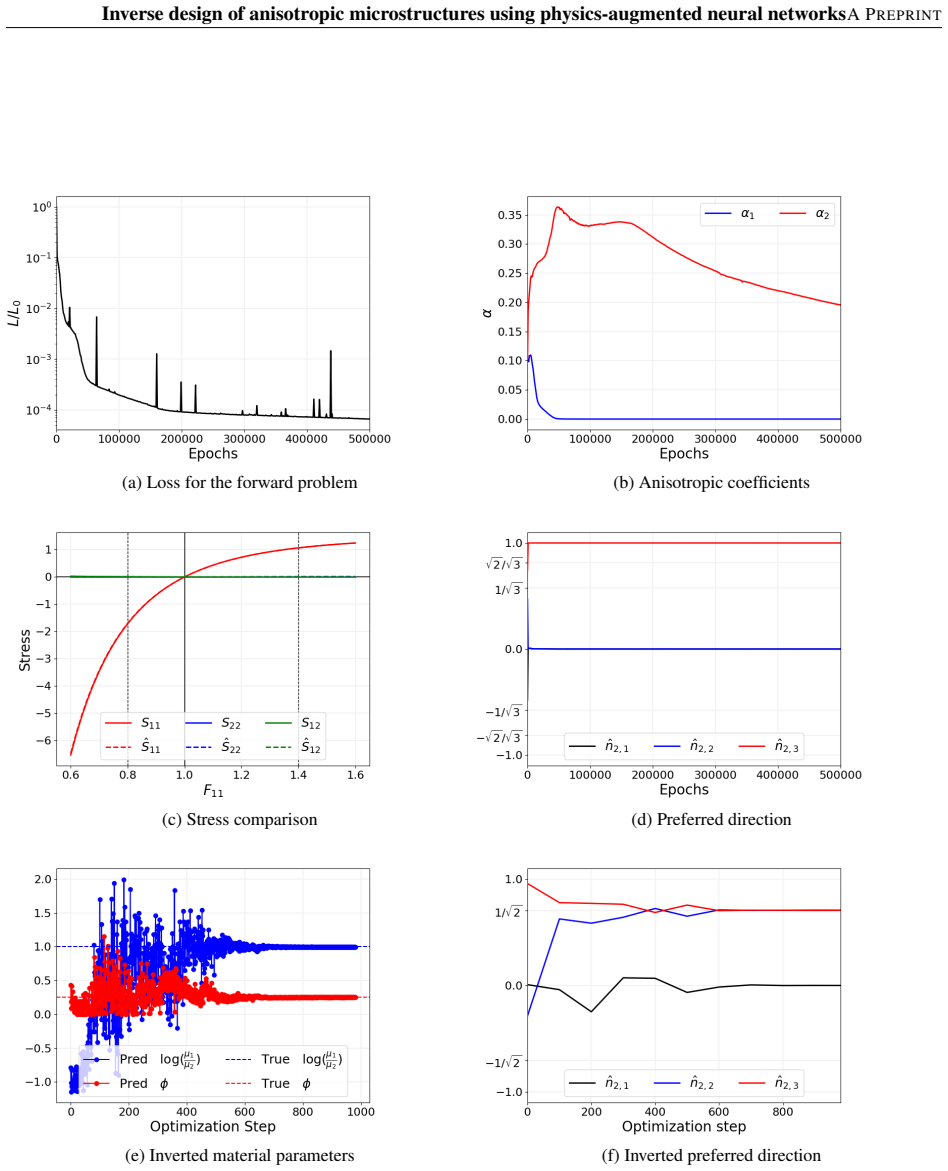
- [Section 6, Figures 6-14] The central inverse-design claims are supported only by visual inspection of stress-strain overlays and parameter-trajectory plots; no quantitative error metric (e.g., relative error of recovered design parameters, stress residuals, or an accepted tolerance for "correct" recovery) is reported anywhere. The reader cannot judge whether the recovered parameters in Figures 6c, 8e, 10e, 13d, and 14e are within, say, 1% or 20% of the truth. Please report, for every inverse problem, the relative L2 error in the recovered design parameters and the forward stress error on the target dataset, and state the convergence criterion used for the CMA-ES runs.
- [Section 5.2 and Appendix D] The homogenized datasets are pruned in invariant space under an assumed symmetry class (isotropic for the single-inclusion RVE, transversely isotropic for the fiber RVE), but the symmetry verification is incomplete and partly outside the sampled parameter range. The isotropy check in Appendix D uses R=0.1 and R=0.5, which for the unit-cell RVE correspond to volume fractions of about 0.004 and 0.52, outside the training range φ∈[0.15,0.35]; no symmetry check is reported for the fiber RVE. Section 6.2.1 itself cites [83] noting that single-inclusion RVEs often show effective cubic properties in the small-strain context, so the possibility that the true effective symmetry is lower than assumed cannot be dismissed. Because the invariant-space filtering removes the deformation modes that would reveal lower symmetry, the surrogate and any inverse-design conclusion drawn from it would be biased. Please verify the effective symmetry of both RVEs over the full sampled parameter range using deformation modes that discriminate between the assumed and lower symmetry classes, and show that the filtering does not discard symmetry-breaking information.
- [Section 6.3, Figure 16] The five FE inverse runs converge to two different fiber orientations with almost identical maximum von Mises stress, and the authors attribute this to symmetry in the design space. The same observation would result from a surrogate that is insensitive to in-plane lattice orientation because the fiber-RVE training data were filtered under the transverse-isotropy assumption; the current experiment cannot distinguish these explanations. Figure 16a shows only the stress evolution, not the orientation evolution, so the claimed convergence to two distinct orientations is not actually visible. Please compare the surrogate's predicted response for orientations that are not equivalent under the assumed symmetry group (e.g., an in-plane rotation of the fiber lattice) against direct FE homogenization, and report whether the surrogate distinguishes them.
minor comments (6)
- [Equation (27a)] The displayed set for \bar{I}_{iso} contains an extra closing brace; this appears to be a typo.
- [Sections 4 and 6.3] The text contains several typos that should be corrected: "V on Mises" should be "von Mises", "Covariant Matrix Adaptation" should be "Covariance Matrix Adaptation", and "modulii" should be "moduli"; in Appendix C, "nice-dimensional" should be "nine-dimensional".
- [Section 3] The convex, monotone activation function Θc is never specified concretely (e.g., softplus); specifying the exact activation and initialization would improve reproducibility.
- [Section 6.2.1 and Appendix D] Figure 22 does not label its axes or clarify which stress component and loading path are shown; please add axis labels and a description of the deformation mode, and align the tested R and μ1/μ2 values with the sampled parameter ranges.
- [Section 4, Eq. (32)] The notation "s.t. arg min_θ ..." is unusual because the forward problem is solved before the inverse problem rather than being a constraint in the optimization; please clarify that this is a sequential two-stage procedure.
- [Data availability] The statement that code will be made available only after acceptance limits reproducibility of the reported experiments; please provide at least the datasets and a reference implementation in a public repository or in the supplementary material.
Circularity Check
No significant circularity: the inverse-design tests use parameter combinations and preferred directions held out from training, so the central claims are extrapolation tests rather than restatements of training data.
full rationale
The paper's forward problem trains a pICNN on stress-strain tuples and the inverse problem minimizes Eq. (32) over design variables with CMA-ES. The key inverse claims are tested on targets that were not used in training: synthetic anisotropic targets use different preferred directions than the trained model saw (Section 6.1), and the fiber-RVE inverse problem uses design parameters not in the training set plus a different preferred direction (Section 6.2.2). Parameter recovery on unseen inputs is therefore a genuine extrapolation test, not a statistical re-statement of the training data. Appendix B, which inverts training parameters, is explicitly a sanity check and is not the basis of the main claims. The only structural assumption is the symmetry filtering used in homogenized-data generation (footnote 2), but this is disclosed and is independently checked in Appendix D by pure-shear tests at extreme parameter combinations; it is a correctness/limitation concern rather than a circular derivation. Self-citations such as [48], [77], and [84] are methodological references to prior published work, not load-bearing replacements for the present derivation, and no uniqueness theorem or fitted parameter is renamed as a prediction. Accordingly, no circular step is exhibited.
Assumptions & free parameters
free parameters (2)
- ε (anisotropy penalty weight)
- γ (volumetric growth weight)
assumptions (6)
- domain assumption The invariant set I1..I8 with two orthogonal preferred directions is a complete representation for the transversely isotropic and orthotropic symmetry classes considered.
- standard math A pICNN with non-negative convex-chain weights and a convex non-decreasing activation is convex and monotonically non-decreasing in the invariants.
- standard math Stress normalization terms in Eq. (30) preserve polyconvexity: p,q,r,s are non-negative because the network is monotone, and the o-term is linear in J.
- domain assumption The spherical-inclusion RVE has an isotropic effective response over the sampled parameter range.
- domain assumption The fiber RVE has a transversely isotropic effective response with preferred direction along the fibers.
- domain assumption Scale separation and periodic boundary conditions make the RVE response representative of the macroscopic material.
Cite this review
Pith. "Pith review of Inverse design of anisotropic microstructures using physics-augmented neural networks." pith.science (2026). https://pith.science/paper/URSJIECY
@misc{pith2026241213370,
  author       = {Pith},
  title        = {Pith review of: Inverse design of anisotropic microstructures using physics-augmented neural networks},
  year         = {2026},
  howpublished = {\url{https://pith.science/paper/URSJIECY}},
  note         = {Machine review of arXiv:2412.13370}
}
read the original abstract
Composite materials often exhibit mechanical anisotropy owing to the material properties or geometrical configurations of the microstructure. This makes their inverse design a two-fold problem. First, we must learn the type and orientation of anisotropy and then find the optimal design parameters to achieve the desired mechanical response. In our work, we solve this challenge by first training a forward surrogate model based on the macroscopic stress-strain data obtained via computational homogenization for a given multiscale material. To this end, we use partially Input Convex Neural Networks (pICNNs) to obtain a polyconvex representation of the strain energy in terms of the invariants of the Cauchy-Green deformation tensor. The network architecture and the strain energy function are modified to incorporate, by construction, physics and mechanistic assumptions into the framework. While training the neural network, we find the type of anisotropy, if any, along with the preferred directions. Once the model is trained, we solve the inverse problem using an evolution strategy to obtain the design parameters that give a desired mechanical response. We test the framework against synthetic macroscale and also homogenized data. For cases where polyconvexity might be violated during the homogenization process, we present viable alternate formulations. The trained model is also integrated into a finite element framework to invert design parameters that result in a desired macroscopic response. We show that the invariant-based model is able to solve the inverse problem for a stress-strain dataset with a different preferred direction than the one it was trained on and is able to not only learn the polyconvex potentials of hyperelastic materials but also recover the correct parameters for the inverse design problem.
Figures


Figures from the paper (21 more)




Forward citations
Cited by 1 Pith paper
-
Physics Augmented Machine Learning Discovery of Composition-Dependent Constitutive Laws for 3D Printed Digital Materials
A physics-augmented neural network learns composition-dependent, rate-dependent stress-strain behavior of PolyJet digital materials, interpolating well to held-out blends but extrapolating poorly.
Reference graph
Works this paper leans on
-
[83]
Mechanical analysis of heterogeneous materials with higher-order parameters
Bozo Vazic, Bilen Emek Abali, Hua Yang, and Pania Newell. Mechanical analysis of heterogeneous materials with higher-order parameters. Engineering with Computers, pages 1–17, 2022
work page 2022
-
[1]
Modeling the anisotropic finite-deformation viscoelastic behavior of soft fiber-reinforced composites
TD Nguyen, RE Jones, and BL Boyce. Modeling the anisotropic finite-deformation viscoelastic behavior of soft fiber-reinforced composites. International Journal of Solids and Structures , 44(25-26):8366–8389, 2007
2007
-
[2]
Mechanical properties of anisotropic fiber-reinforced composites
CH Chen and Shun Cheng. Mechanical properties of anisotropic fiber-reinforced composites. Journal of Applied Mechanics, 37(1):186, 1970
1970
-
[3]
Effects of fiber orientation and anisotropy on tensile strength and elastic modulus of short fiber reinforced polymer composites
Seyyedvahid Mortazavian and Ali Fatemi. Effects of fiber orientation and anisotropy on tensile strength and elastic modulus of short fiber reinforced polymer composites. Composites part B: engineering , 72:116–129, 2015
2015
-
[4]
The anisotropic hooke’s law for cancellous bone and wood
Guoyu Yang, Jesper Kabel, Bert Van Rietbergen, Anders Odgaard, RIK Huiskes, and Stephen C Cown. The anisotropic hooke’s law for cancellous bone and wood. Journal of elasticity, 53(2):125–146, 1998
1998
-
[5]
Computational modeling of mechanical anisotropy in the cornea and sclera
Peter M Pinsky, Dolf Van Der Heide, and Dimitri Chernyak. Computational modeling of mechanical anisotropy in the cornea and sclera. Journal of Cataract & Refractive Surgery , 31(1):136–145, 2005
2005
-
[6]
Anisotropy properties of tissues: a basis for fabrication of biomimetic anisotropic scaffolds for tissue engineering
Pallab Datta, Veena Vyas, Santanu Dhara, Amit Roy Chowdhury, and Ananya Barui. Anisotropy properties of tissues: a basis for fabrication of biomimetic anisotropic scaffolds for tissue engineering. Journal of Bionic Engineering, 16(5):842–868, 2019
2019
-
[7]
Mechanical behavior of materials
Thomas H Courtney. Mechanical behavior of materials . Waveland Press, 2005
2005
Show all 92 references
-
[8]
Aspects of computational homogenization at finite deformations: a unifying review from reuss’ to voigt’s bound
Saba Saeb, Paul Steinmann, and Ali Javili. Aspects of computational homogenization at finite deformations: a unifying review from reuss’ to voigt’s bound. Applied Mechanics Reviews, 68(5):050801, 2016
2016
-
[9]
Bickel, Jan Rys, Steve Marschner, Chiara Daraio, and Markus H
Christian Schumacher, B. Bickel, Jan Rys, Steve Marschner, Chiara Daraio, and Markus H. Gross. Microstruc- tures to control elasticity in 3d printing. ACM Transactions on Graphics (TOG), 34:1 – 13, 2015
2015
-
[10]
Mechanical metamaterials and their engineering applications
James Utama Surjadi, Libo Gao, Huifeng Du, Xiang Li, Xiang Xiong, Nicholas Xuanlai Fang, and Yang Lu. Mechanical metamaterials and their engineering applications. Advanced Engineering Materials, 21(3):1800864, 2019
2019
-
[11]
Anisotropy and heterogeneity of microstructure and mechanical properties in metal additive manufacturing: A critical review
Yihong Kok, Xi Peng Tan, Pan Wang, MLS Nai, Ngiap Hiang Loh, Erjia Liu, and Shu Beng Tor. Anisotropy and heterogeneity of microstructure and mechanical properties in metal additive manufacturing: A critical review. Materials & Design, 139:565–586, 2018
2018
-
[12]
Properties of materials: anisotropy, symmetry, structure
Robert E Newnham. Properties of materials: anisotropy, symmetry, structure. Oxford university press, 2005
2005
-
[13]
Microstructural image analysis applied to fibre composite materials: a review
FJ Guild and J Summerscales. Microstructural image analysis applied to fibre composite materials: a review. Composites, 24(5):383–393, 1993
1993
-
[14]
Microstructural imaging techniques: a comparison between light and scanning electron microscopy
Patrick W Trimby and David J Prior. Microstructural imaging techniques: a comparison between light and scanning electron microscopy. Tectonophysics, 303(1-4):71–81, 1999
1999
-
[15]
Multiscale modeling: a review
Mark F Horstemeyer. Multiscale modeling: a review. Practical aspects of computational chemistry: methods, concepts and applications, pages 87–135, 2010
2010
-
[16]
Principles of multiscale modeling
E Weinan. Principles of multiscale modeling . Cambridge University Press, 2011
2011
-
[17]
A numerical two-scale homogenization scheme: the fe2-method
J ¨org Schr ¨oder. A numerical two-scale homogenization scheme: the fe2-method. In Plasticity and beyond: microstructures, crystal-plasticity and phase transitions, pages 1–64. Springer, 2014
2014
-
[18]
W. V oigt. Ueber die beziehung zwischen den beiden elasticit¨atsconstanten isotroper k¨orper. Annalen der Physik, 274(12):573–587, January 1889
-
[19]
A. Reuss. Berechnung der fließgrenze von mischkristallen auf grund der plastizit ¨atsbedingung f¨ur einkristalle . ZAMM - Journal of Applied Mathematics and Mechanics / Zeitschrift f¨ur Angewandte Mathematik und Mechanik, 9(1):49–58, January 1929
1929
-
[20]
G. I. Taylor. Plastic strain in metals. 28th May-Lecture of the Institute of Metals , 62:307–325, 1938
1938
-
[21]
G. Sachs. Zur Ableitung einer Fließbedingung , pages 94–97. Springer Berlin Heidelberg, Berlin, Heidelberg, 1929
1929
-
[22]
A variational approach to the theory of the elastic behaviour of multiphase materials
Zvi Hashin and Shmuel Shtrikman. A variational approach to the theory of the elastic behaviour of multiphase materials. Journal of the Mechanics and Physics of Solids , 11(2):127–140, 1963
1963
-
[23]
Variational bounds on the effective moduli of anisotropic composites
Graeme W Milton and Robert V Kohn. Variational bounds on the effective moduli of anisotropic composites. Journal of the Mechanics and Physics of Solids , 36(6):597–629, 1988
1988
-
[24]
Homogenization approach in engineering
Ivo Babu ˇska. Homogenization approach in engineering. In Computing Methods in Applied Sciences and Engi- neering: Second International Symposium December 15–19, 1975 , pages 137–153. Springer, 1976. 23 Inverse design of anisotropic microstructures using physics-augmented neur...
1975
-
[25]
The determination of the elastic field of an ellipsoidal inclusion, and related problems
John Douglas Eshelby. The determination of the elastic field of an ellipsoidal inclusion, and related problems. Proceedings of the royal society of London. Series A. Mathematical and physical sciences , 241(1226):376–396, 1957
1957
-
[26]
T. I. Zohdi and P. Wriggers. Computational micro-macro material testing. Archives of Computational Methods in Engineering, 8(2):131–228, June 2001
2001
-
[27]
Average stress in matrix and average elastic energy of materials with misfitting inclusions
T Mori and K Tanaka. Average stress in matrix and average elastic energy of materials with misfitting inclusions. Acta Metallurgica, 21(5):571–574, 1973
1973
-
[28]
Luo and G.J
H.A. Luo and G.J. Weng. On eshelby’s inclusion problem in a three-phase spherically concentric solid, and a modification of mori-tanaka’s method. Mechanics of Materials, 6(4):347–361, 1987
1987
-
[29]
On the elastic moduli of some heterogeneous materials
Bernard Budiansky. On the elastic moduli of some heterogeneous materials. Journal of the Mechanics and Physics of Solids, 13(4):223–227, 1965
1965
-
[30]
J.R. Willis. Bounds and self-consistent estimates for the overall properties of anisotropic composites. Journal of the Mechanics and Physics of Solids , 25(3):185–202, 1977
1977
-
[31]
On constitutive macro-variables for heterogeneous solids at finite strain
Rodney Hill. On constitutive macro-variables for heterogeneous solids at finite strain. Proceedings of the Royal Society of London. A. Mathematical and Physical Sciences , 326(1565):131–147, 1972
1972
-
[32]
R.W. Ogden. On the overall moduli of non-linear elastic composite materials. Journal of the Mechanics and Physics of Solids, 22(6):541–553, 1974
1974
-
[33]
Geers, V .G
M.G.D. Geers, V .G. Kouznetsova, and W.A.M. Brekelmans. Multi-scale computational homogenization: Trends and challenges. Journal of Computational and Applied Mathematics , 234(7):2175–2182, 2010. Fourth Interna- tional Conference on Advanced COmputational Methods in ENgineerin...
2010
-
[34]
Marc G. D. Geers, Varvara G. Kouznetsova, Karel Matou ˇs, and Julien Yvonnet. Homogenization methods and multiscale modeling: Nonlinear problems, December 2017
2017
-
[35]
Two scale analysis of heterogeneous elastic-plastic materials with asymptotic homogenization and voronoi cell finite element model
Somnath Ghosh, Kyunghoon Lee, and Suresh Moorthy. Two scale analysis of heterogeneous elastic-plastic materials with asymptotic homogenization and voronoi cell finite element model. Computer methods in applied mechanics and engineering, 132(1-2):63–116, 1996
1996
-
[36]
Multiscale modeling of microstructure–property relations
MGD Geers and Julien Yvonnet. Multiscale modeling of microstructure–property relations. MRS Bulletin , 41(8):610–616, 2016
2016
-
[37]
Multiscale fe2 elastoviscoplastic analysis of composite structures
Fr ´ed´eric Feyel. Multiscale fe2 elastoviscoplastic analysis of composite structures. Computational Materials Science, 16(1-4):344–354, 1999
1999
-
[38]
A review of the fe 2 method for composites
Karthikayen Raju, Tong-Earn Tay, and Vincent Beng Chye Tan. A review of the fe 2 method for composites. Multiscale and Multidisciplinary Modeling, Experiments and Design , 4:1–24, 2021
2021
-
[39]
Local approximate gaussian process regression for data- driven constitutive models: development and comparison with neural networks
Jan N Fuhg, Michele Marino, and Nikolaos Bouklas. Local approximate gaussian process regression for data- driven constitutive models: development and comparison with neural networks. Computer Methods in Applied Mechanics and Engineering, 388:114217, 2022
2022
-
[40]
A review on data-driven constitutive laws for solids
Jan N Fuhg, Govinda Anantha Padmanabha, Nikolaos Bouklas, Bahador Bahmani, WaiChing Sun, Nikolaos N Vlassis, Moritz Flaschel, Pietro Carrara, and Laura De Lorenzis. A review on data-driven constitutive laws for solids. Archives of Computational Methods in Engineering , pages 1...
2024
-
[41]
Representations for isotropic and anisotropic non-polynomial tensor functions
Jean-Paul Boehler. Representations for isotropic and anisotropic non-polynomial tensor functions. In Applica- tions of tensor functions in solid mechanics , pages 31–53. Springer, 1987
1987
-
[42]
A class of orthotropic and transversely isotropic hyperelastic constitutive models based on a polyconvex strain energy function
Mikhail Itskov and Nuri Aksel. A class of orthotropic and transversely isotropic hyperelastic constitutive models based on a polyconvex strain energy function. International journal of solids and structures , 41(14):3833–3848, 2004
2004
-
[43]
Multilayer feedforward networks are universal approx- imators
Kurt Hornik, Maxwell Stinchcombe, and Halbert White. Multilayer feedforward networks are universal approx- imators. Neural networks, 2(5):359–366, 1989
1989
-
[44]
Tensor basis gaussian process models of hyperelastic materials
Ari L Frankel, Reese E Jones, and Laura P Swiler. Tensor basis gaussian process models of hyperelastic materials. Journal of Machine Learning for Modeling and Computing , 1(1), 2020
2020
-
[45]
On physics-informed data-driven isotropic and anisotropic constitutive mod- els through probabilistic machine learning and space-filling sampling
Jan N Fuhg and Nikolaos Bouklas. On physics-informed data-driven isotropic and anisotropic constitutive mod- els through probabilistic machine learning and space-filling sampling. Computer Methods in Applied Mechanics and Engineering, 394:114915, 2022
2022
-
[46]
Neural networks meet hyperelasticity: A guide to enforcing physics
Lennart Linden, Dominik K Klein, Karl A Kalina, J ¨org Brummund, Oliver Weeger, and Markus K¨astner. Neural networks meet hyperelasticity: A guide to enforcing physics. Journal of the Mechanics and Physics of Solids , 179:105363, 2023. 24 Inverse design of anisotropic microstr...
2023
-
[47]
Polyconvex anisotropic hyperelasticity with neural networks
Dominik K Klein, Mauricio Fern ´andez, Robert J Martin, Patrizio Neff, and Oliver Weeger. Polyconvex anisotropic hyperelasticity with neural networks. Journal of the Mechanics and Physics of Solids , 159:104703, 2022
2022
-
[48]
Learning hyperelastic anisotropy from data via a tensor basis neural network
Jan N Fuhg, Nikolaos Bouklas, and Reese E Jones. Learning hyperelastic anisotropy from data via a tensor basis neural network. Journal of the Mechanics and Physics of Solids , 168:105022, 2022
2022
-
[49]
A new family of constitutive artificial neural networks towards automated model discovery
Kevin Linka and Ellen Kuhl. A new family of constitutive artificial neural networks towards automated model discovery. Computer Methods in Applied Mechanics and Engineering , 403:115731, 2023
2023
-
[50]
Klein, Fabian J
Dominik K. Klein, Fabian J. Roth, Iman Valizadeh, and Oliver Weeger. Parametrized polyconvex hyperelasticity with physics-augmented neural networks. Data-Centric Engineering, 4:e25, 2023
2023
-
[51]
Non-linear elastic deformations
Raymond W Ogden. Non-linear elastic deformations. Courier Corporation, 1997
1997
-
[52]
Structural tensors for anisotropic solids
JM Zhang and J Rychlewski. Structural tensors for anisotropic solids. Arch. Mech, 42(3):267–277, 1990
1990
-
[53]
On the representation of constitutive relations using structure tensors
Bob Svendsen. On the representation of constitutive relations using structure tensors. International journal of engineering science, 32(12):1889–1892, 1994
1994
-
[54]
Kalina, J ¨org Brummund, WaiChing Sun, and Markus K¨astner
Karl A. Kalina, J ¨org Brummund, WaiChing Sun, and Markus K¨astner. Neural networks meet anisotropic hyper- elasticity: A framework based on generalized structure tensors and isotropic tensor functions, 2024
2024
-
[55]
An introduction to continuum mechanics , volume 158
Morton E Gurtin. An introduction to continuum mechanics , volume 158. Academic press, 1982
1982
-
[56]
Ordinary and strong ellipticity in the equilibrium theory of incompressible hyper- elastic solids
Layne Zee and Eli Sternberg. Ordinary and strong ellipticity in the equilibrium theory of incompressible hyper- elastic solids. Arch. Ration. Mech. Anal., 83(1):53–90, 1983
1983
-
[57]
Convexity conditions and existence theorems in nonlinear elasticity.Archive for rational mechanics and Analysis, 63(4):337–403, 1976
John M Ball. Convexity conditions and existence theorems in nonlinear elasticity.Archive for rational mechanics and Analysis, 63(4):337–403, 1976
1976
-
[58]
An example of a quasiconvex function that is not polyconvex in two dimensions
Jean Jacques Alibert and Bernard Dacorogna. An example of a quasiconvex function that is not polyconvex in two dimensions. Archive for Rational Mechanics and Analysis , 117(2):155–166, 1992
1992
-
[59]
G. Aubert. On a counterexample of a rank 1 convex function which is not polyconvex in the case n = 2. Pro- ceedings of the Royal Society of Edinburgh: Section A Mathematics , 106(3–4):237–240, 1987
1987
-
[60]
Boyd and Lieven Vandenberghe
Stephen P. Boyd and Lieven Vandenberghe. Convex optimization. Cambridge Univ. Pr., 2004
2004
-
[61]
Input convex neural networks
Brandon Amos, Lei Xu, and J Zico Kolter. Input convex neural networks. In International Conference on Machine Learning, pages 146–155. PMLR, 2017
2017
-
[62]
Mathematical methods in continuum mechanics of solids
Martin Kru ˇz´ık and Tom´aˇs Roub´ıˇcek. Mathematical methods in continuum mechanics of solids . Springer, 2019
2019
-
[63]
Nonlinear solid mechanics: a continuum approach for engineering science
Gerhard A Holzapfel. Nonlinear solid mechanics: a continuum approach for engineering science. Meccanica, 37(4):489–490, 2002
2002
-
[64]
Polyconvexity of generalized polynomial-type hyperelastic strain energy functions for near-incompressibility
Stefan Hartmann and Patrizio Neff. Polyconvexity of generalized polynomial-type hyperelastic strain energy functions for near-incompressibility. International Journal of Solids and Structures , 40(11):2767–2791, 2003
2003
-
[65]
Unsupervised discovery of interpretable hyperelastic constitutive laws
Moritz Flaschel, Siddhant Kumar, and Laura De Lorenzis. Unsupervised discovery of interpretable hyperelastic constitutive laws. Computer Methods in Applied Mechanics and Engineering , 381:113852, 2021
2021
-
[66]
Pytorch: An imperative style, high-performance deep learning library
Adam Paszke, Sam Gross, Francisco Massa, Adam Lerer, James Bradbury, Gregory Chanan, Trevor Killeen, Zeming Lin, Natalia Gimelshein, Luca Antiga, Alban Desmaison, Andreas Kopf, Edward Yang, Zachary De- Vito, Martin Raison, Alykhan Tejani, Sasank Chilamkurthy, Benoit Steiner, L...
2019
-
[67]
Adam: A method for stochastic optimization
Diederik P Kingma and Jimmy Ba. Adam: A method for stochastic optimization. arXiv preprint arXiv:1412.6980, 2014
2014 arXiv
-
[68]
A simplex method for function minimization
John A Nelder and Roger Mead. A simplex method for function minimization. The computer journal, 7(4):308– 313, 1965
1965
-
[69]
Implementing the nelder-mead simplex algorithm with adaptive parameters
Fuchang Gao and Lixing Han. Implementing the nelder-mead simplex algorithm with adaptive parameters. Computational Optimization and Applications , 51(1):259–277, 2012
2012
-
[70]
M ¨uller, and Petros Koumoutsakos
Nikolaus Hansen, Sibylle D. M ¨uller, and Petros Koumoutsakos. Reducing the time complexity of the deran- domized evolution strategy with covariance matrix adaptation (cma-es). Evolutionary Computation, 11(1):1–18, 2003
2003
-
[71]
The CMA evolution strategy: A tutorial
Nikolaus Hansen. The CMA evolution strategy: A tutorial. CoRR, abs/1604.00772, 2016. 25 Inverse design of anisotropic microstructures using physics-augmented neural networksA PREPRINT
2016 arXiv
-
[72]
Large sample properties of simulations using latin hypercube sampling
Michael Stein. Large sample properties of simulations using latin hypercube sampling. Technometrics, 29(2):143–151, 1987
1987
-
[73]
Mathematical elasticity: Three-dimensional elasticity
Philippe G Ciarlet. Mathematical elasticity: Three-dimensional elasticity . SIAM, 1988
1988
-
[74]
A simple orthotropic, transversely isotropic hyperelastic constitutive equation for large strain computations
J Bonet and AJ Burton. A simple orthotropic, transversely isotropic hyperelastic constitutive equation for large strain computations. Computer methods in applied mechanics and engineering , 162(1-4):151–164, 1998
1998
-
[75]
A new constitutive framework for arterial wall mechanics and a comparative study of material models
Gerhard A Holzapfel, Thomas C Gasser, and Ray W Ogden. A new constitutive framework for arterial wall mechanics and a comparative study of material models. Journal of elasticity and the physical science of solids , 61(1):1–48, 2000
2000
-
[76]
Model- data-driven constitutive responses: application to a multiscale computational framework
Jan Niklas Fuhg, Christoph B ¨ohm, Nikolaos Bouklas, Amelie Fau, Peter Wriggers, and Michele Marino. Model- data-driven constitutive responses: application to a multiscale computational framework. International Journal of Engineering Science, 167:103522, 2021
2021
-
[77]
Neural network-based multiscale modeling of finite strain magneto-elasticity with relaxed convexity criteria
Karl A Kalina, Philipp Gebhart, J ¨org Brummund, Lennart Linden, WaiChing Sun, and Markus K ¨astner. Neural network-based multiscale modeling of finite strain magneto-elasticity with relaxed convexity criteria. Computer Methods in Applied Mechanics and Engineering , 421:116739, 2024
2024
-
[78]
C. Zener. Elasticity and Anelasticity of Metals . Chicago University Committee on Publications in the Physical Sciences. University of Chicago Press, 1948
1948
-
[79]
Ranganathan and Martin Ostoja-Starzewski
Shivakumar I. Ranganathan and Martin Ostoja-Starzewski. Universal elastic anisotropy index. Phys. Rev. Lett., 101:055504, Aug 2008
2008
-
[80]
Homogenization of carbon/polymer composites with anisotropic distribution of particles and stochastic interface defects
Damian Sokołowski and Marcin Kami ´nski. Homogenization of carbon/polymer composites with anisotropic distribution of particles and stochastic interface defects. Acta Mech., 229(9):3727–3765, September 2018
2018
-
[81]
Vlassis, Puhan Zhao, Ran Ma, Tommy Sewell, and WaiChing Sun
Nikolaos N. Vlassis, Puhan Zhao, Ran Ma, Tommy Sewell, and WaiChing Sun. Molecular dynamics inferred transfer learning models for finite-strain hyperelasticity of monoclinic crystals: Sobolev training and validations against physical constraints. International Journal for Nume...
2022
-
[82]
Hyperelastic behaviors of closed-cell porous materials at a wide porosity range
Pingping Yang, Zaoyang Guo, Ning Hu, Weifu Sun, and Yang Chen. Hyperelastic behaviors of closed-cell porous materials at a wide porosity range. Composite Structures, 294:115792, 05 2022
2022
-
[84]
Fe ann: an efficient data-driven multiscale approach based on physics-constrained neural networks and automated data mining
Karl A Kalina, Lennart Linden, J ¨org Brummund, and Markus K¨astner. Fe ann: an efficient data-driven multiscale approach based on physics-constrained neural networks and automated data mining. Computational Mechanics, 71(5):827–851, 2023
2023
-
[85]
Loss of polyconvexity by homogenization: a new example
Marco Barchiesi. Loss of polyconvexity by homogenization: a new example. Calculus of V ariations and Partial Differential Equations, 30(2):215–230, 2007
2007
-
[86]
Loss of polyconvexity by homogenization
Andrea Braides. Loss of polyconvexity by homogenization. Archive for rational mechanics and analysis , 127:183–190, 1994
1994
-
[87]
Parameter identification for viscoplastic models based on analytical derivatives of a least-squares functional and stability investigations
Rolf Mahnken and Erwin Stein. Parameter identification for viscoplastic models based on analytical derivatives of a least-squares functional and stability investigations. International Journal of Plasticity , 12(4):451–479, 1996
1996
-
[88]
Identification of material parameters for constitutive equations
Rolf Mahnken. Identification of material parameters for constitutive equations. Encyclopedia of computational mechanics, 2004
2004
-
[89]
Viscoelasticty with physics-augmented neural networks: Model formulation and training methods without prescribed internal vari- ables
Max Rosenkranz, Karl A Kalina, J ¨org Brummund, WaiChing Sun, and Markus K ¨astner. Viscoelasticty with physics-augmented neural networks: Model formulation and training methods without prescribed internal vari- ables. Computational Mechanics, pages 1–23, 2024
2024
-
[90]
Automated model discovery of finite strain elastoplasticity from uniaxial experiments
Asghar A Jadoon, Knut A Meyer, and Jan N Fuhg. Automated model discovery of finite strain elastoplasticity from uniaxial experiments. arXiv preprint arXiv:2408.14615, 2024
2024 arXiv
-
[91]
Fuhg, Asghar Jadoon, Oliver Weeger, D
Jan N. Fuhg, Asghar Jadoon, Oliver Weeger, D. Thomas Seidl, and Reese E. Jones. Polyconvex neural network models of thermoelasticity. Journal of the Mechanics and Physics of Solids , 192:105837, 2024
2024
-
[92]
Russ, Glaucio H
Harikrishnan Vijayakumaran, Jonathan B. Russ, Glaucio H. Paulino, and Miguel A. Bessa. Consistent machine learning for topology optimization with microstructure-dependent neural network material models, 2024. 26 Inverse design of anisotropic microstructures using physics-augme...
2024
Reviewed August 11, 2026 · model on record in the stance chip above.
Discussion (0). Continue with ORCID to comment.