REVIEW 4 major objections 5 minor 22 references
SummExecEdit: A Factual Consistency Benchmark in Summarization with Executable Edits
T0 review · 4 major / 5 minor · reviewed 2026-08-11 · deepseek-v4-flash
Pith's one-line read The paper claims that executable edits, which isolate a single substring replacement and its explanation, produce a harder and more interpretable factual-consistency benchmark for summarization, and that the best model scores only 0.49 on…
desk verdict A genuinely useful benchmark with a real design idea, but the headline difficulty numbers rest on ground truth that was only partially validated. read the letter →
The pith
A machine-rendered reading of the paper's core claim, the machinery that carries it, and where it could break.
The reading
What carries the argument
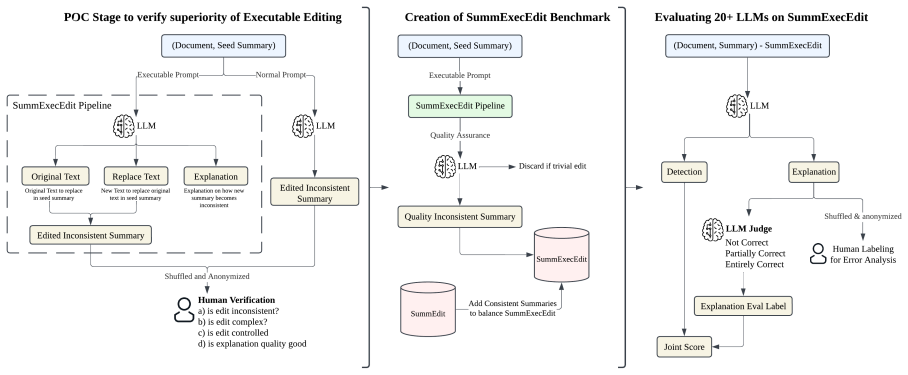
The central object is the executable edit: an editing operation that names the exact substring of the original summary to be replaced, the replacement substring, and a short explanation of the resulting inconsistency. By making the edit a program that can be applied directly, the pipeline keeps the original summary mostly intact, forces the model to locate a single granular change, and produces a structured reference explanation for each edit. This is what makes the benchmark both more controlled (fewer broad, sweeping changes) and more interpretable (each sample carries an explanation of the intended error). The benchmark construction also relies on a trivial-edit filter (a GPT4-Turbo classifier that removes date, number, and antonym changes) and on reference explanations generated at edit time.
What would settle it
Randomly sample 200 of the 2,121 'inconsistent' summaries from SummExecEdit and have independent annotators (not the authors) judge whether each one is truly inconsistent with its document. If the rate of true inconsistency is well below 100% — for instance, below 80% — then the reported detection and joint scores are partly measuring label noise rather than model ability.
Extended reading notes
Core claim
The central claim is that executable edits — having a language model output a specific span to replace, the replacement text, and an explanation, instead of rewriting the whole summary — yield a factual-consistency benchmark that is both harder and more interpretable than prior direct-edit benchmarks. The paper demonstrates this in a small proof-of-concept with human annotation (executable edits produce 18–25% more complex, controlled edits with better explanations), then scales up to create SummExecEdit from the SummEdits corpus, filtering out trivial date, number, and antonym changes with GPT4-Turbo. On this benchmark, the strongest tested model, Claude3-Opus, achieves a joint detection-and-explanation score of 0.49 (detection 0.67, explanation 0.73 on inconsistent summaries), and most of the 20+ evaluated LLMs perform substantially worse, with over half struggling on more than 30% of the samples. The paper further shows that explanation evaluation works best when a reference explanation is provided, and that model explanations fail in four recurring ways, the most common (45.4%) being misattribution of the error to an unrelated part of the summary.
Load-bearing premise
The benchmark assumes that each LLM-generated replacement genuinely makes the edited summary inconsistent with its document and that the accompanying reference explanation is correct, but only a few hundred of the thousands of edits were manually verified, and the two annotators disagreed substantially on explanation quality.
Editorial extensions
If this is right
- If executable edits produce harder, more interpretable inconsistencies, benchmark creators can generate challenging factuality tests at scale without human editing, at least when ground-truth document-summary pairs exist.
- Current LLMs are far from reliable at the joint task of detecting and explaining inconsistencies; the best joint score of 0.49 suggests deployment of summary-consistency checking in real systems should not rely on a single model.
- The finding that reference explanations improve LLM-as-judge evaluation (EvalV4) implies that benchmarks for hallucination explanation should include reference explanations to get reliable automatic scoring.
- The four explanation error types (misattribution, extra irrelevant explanation, completeness focus, vague explanation) give concrete targets for improving model reasoning over facts.
- The large gap between detection and explanation scores for some models (e.g., Llama3.1-8b detects well but explains poorly) shows these abilities are dissociable and should be evaluated separately.
Reading between the lines
- The benchmark's reliance on a GPT4-Turbo trivial-edit filter without reported accuracy leaves open the possibility that some easy edits survive, which would inflate the challenge gap; auditing the filtered-out and kept edits would settle this.
- The low inter-annotator agreement on explanation quality (Cohen's Kappa 0.49) suggests the reference explanations themselves are noisy; if so, the reported explanation and joint scores may underestimate model capability on cleaner labels.
- Executable editing could transfer to other generation tasks where inconsistency is defined against a source, such as data-to-text generation, dialogue state tracking, or fact-checking of model outputs, since the same substring-replacement-plus-explanation structure applies.
- The 45.4% misattribution rate hints that models often locate errors in the wrong span even when they flag the right summary, so explanation quality may be a better probe of reasoning than binary detection.
Editorial analysis
A structured set of objections, weighed in public.
Referee Report
Summary. The paper introduces SummExecEdit, a benchmark for detecting and explaining factual inconsistencies in summarization. The authors propose executable edits, in which an LLM isolates a substring of an original summary, replaces it with an inconsistent alternative, and provides a reference explanation. They compare executable vs. non-executable editing in a proof-of-concept with manual annotation, filter generated edits by removing trivial date, number, and antonym changes with GPT4-Turbo, and evaluate 20+ LLMs under two prompts (detect-and-explain, and explain-given-detection). The best-reported joint score is Claude3-Opus at 0.49, with 0.67 detection and 0.733 explanation, and the paper provides an error taxonomy for incorrect explanations.
Significance. If the benchmark ground truth is reliable, SummExecEdit is a useful resource: it provides controlled phrase-level edits with reference explanations, releases the data, includes a proof-of-concept human annotation and explanation-judge validation, and offers a clear error taxonomy. The finding that top LLMs achieve only moderate joint scores would be a meaningful challenge result for the community. However, the central evaluation claim rests on the unvalidated quality of the final benchmark's inconsistency labels and reference explanations; the paper's own proof-of-concept numbers and low explanation inter-annotator agreement indicate that this risk is substantial. The contribution is real but requires additional validation before the headline numbers can be taken at face value.
major comments (4)
- [Section 4, Prompt F.5] The final 2,121 'inconsistent' summaries are filtered only by GPT4-Turbo's category assignment (DATE_CHANGE, NUMBER_CHANGE, ANTONYM_CHANGE, OTHER), which does not verify that the edited summary is actually inconsistent with the document, that the edit is non-trivial, or that the paired reference explanation is correct. The proof-of-concept manual annotation in Table 1 shows that under the best executable condition only 48.55% (Claude3-Opus) and 44.44% (GPT4-Turbo) of generated edits receive a positive judgment on explanation quality, with inconsistency rates of 84.78% and 81.25% and complexity rates of 49.28% and 45.83%. If a substantial fraction of the 2,121 samples are actually consistent, trivially edited, or paired with incorrect reference explanations, then the reported DS, ES, and JS values in Table 4 do not measure the paper's stated construct. The authors should report a human validation study on a random sample of the final benchmark with precision of the inconsistency labels and explanation correctness, and re-estimate the scores on the validated subset.
- [Section 5.2, Table 5] The ground-truth reference explanations are not sufficiently validated. Only 40 reference explanations were manually checked, and the inter-annotator agreement for explanation-quality is Cohen's Kappa 0.49, which is low. Because ES and JS are computed against these reference explanations using EvalV4 with GPT4o as judge, unreliable references could substantially change the model ranking and the claim that the best JS is only 0.49. The paper should provide a larger manual validation of reference explanations and report the judge's agreement with human judgments on the final benchmark, not only on the 887-example explanation-evaluation subset.
- [Sections 3-4, Table 4] The benchmark's edits and reference explanations are generated by GPT4-Turbo and Claude3-Opus, and Claude3-Opus is the top-scoring model on the joint task. The paper does not include a cross-generation control. A model may be advantaged when evaluating edits and reference explanations produced by the same generation pipeline or family. To make the ranking claim robust, the authors should partition results by the generator of each sample (e.g., GPT4-Turbo-generated vs. Claude3-Opus-generated edits) and, ideally, evaluate a held-out model family not used in generation. This would also address whether the reported 0.49 JS is an artifact of generator identity.
- [Section 3, Table 1] The description of Table 1 is internally ambiguous. The text says 'each subsequent column filters out the edits deemed inappropriate by either of the annotators in the previous column,' while the caption says each column 'does not consider the edits filtered out in its previous columns.' These readings lead to very different cumulative pass rates (e.g., under an independent-column reading, the product of the four rates is roughly 14% for GPT4-Turbo Exec and 19% for Claude3-Opus Exec). Since the superiority of executable edits is a central motivating claim, the authors should clarify the exact computation of each column and report the cumulative pass rate after all four filters.
minor comments (5)
- [Section 6 / Table 4] The conclusion states 'Claude3.7-Sonnet achieves an accuracy of 73%' but Table 4 reports 'claude3.5-sonnet' with DA 0.737; please correct the model name or number.
- [Section 5.1] The text first says 65 samples were misclassified by all LLMs and then says 'Among these, 60 samples belonged to the category of inconsistent summaries'; earlier it mentions 60 inconsistent summaries. Please reconcile the 60/65 counts.
- [Prompt F.1] The instruction for explanations reads 'The document says X but the document says Y,' which should presumably be 'but the summary says Y.'
- [Prompt F.2] The guidelines say 'You can generate only one error per edited you generate' and 'For each of the three edits' while requesting six edits; please standardize the wording.
- [Section 5.4 / Table 6] The number 350 manually annotated incorrect explanations should be reconciled with the 887 explanations in Table 6 and the 'around 1200' explanations mentioned in Section 5.2.
Circularity Check
No significant circularity: the paper reports empirical benchmark measurements; the main concerns are ground-truth validity, not derivation circularity.
full rationale
SummExecEdit is constructed by generating executable edits with GPT4-Turbo and Claude3-Opus, filtering trivial edits with GPT4-Turbo, and then measuring LLM detection and explanation performance on the resulting fixed benchmark. No parameter is fitted to a subset and then used to predict the same or a closely related quantity; no load-bearing claim is justified by an unverified self-citation; and no result reduces by definition to its own inputs. The paper's comparison of executable versus non-executable edits is supported by manual annotation (Table 1), and the explanation-evaluation protocol is calibrated against human annotations (Table 3). The most serious issues are empirical validity concerns: the final 2,121 'inconsistent' summaries are not individually human-validated for factual inconsistency or explanation correctness, and the trivial-edit filter (Prompt F.5) checks only edit-type categories rather than document-grounded inconsistency. Such concerns bear on whether the reported scores measure what the paper claims, but they are not circularity in the derivation-chain sense. The paper also builds on the authors' prior SummEdits and executable-editing work, but those are concrete prior datasets and methods rather than self-referential justifications, so they do not raise the circularity score.
Assumptions & free parameters
assumptions (3)
- domain assumption The source (document, summary) pairs in SummEdits are trustworthy, and the 2,120 consistent summaries used as negative labels are factually consistent with their documents.
- domain assumption A substring replacement generated under the executable-edit prompt, with an explanation and not filtered as date/number/antonym, reliably produces a summary that is factually inconsistent with the document.
- domain assumption The LLM-as-judge explanation scores, especially EvalV4 with GPT4o, are a valid proxy for human explanation quality across the full benchmark.
Cite this review
Pith. "Pith review of SummExecEdit: A Factual Consistency Benchmark in Summarization with Executable Edits." pith.science (2026). https://pith.science/paper/MVL6Q7EF
@misc{pith2026241213378,
  author       = {Pith},
  title        = {Pith review of: SummExecEdit: A Factual Consistency Benchmark in Summarization with Executable Edits},
  year         = {2026},
  howpublished = {\url{https://pith.science/paper/MVL6Q7EF}},
  note         = {Machine review of arXiv:2412.13378}
}
read the original abstract
Detecting factual inconsistencies in summarization is critical, yet existing benchmarks lack the necessary challenge and interpretability for robust evaluation. In this paper, we introduce SummExecEdit, a novel pipeline and benchmark leveraging executable edits to assess models on their ability to both detect factual errors and provide accurate explanations. The top-performing model, Claude3-Opus, achieves a joint detection and explanation score of only 0.49 in our benchmark, with individual scores of 0.67 for detection and 0.73 for explanation. We conduct detailed evaluations to assess the current state of models in this field and find that more than half of the 20+ LLMs in our study struggle with over 30% of the SummExecEdit benchmark. Additionally, we identify four primary types of explanation errors, with 45.4% of them involving a focus on completely unrelated parts of the summary.
Figures


Figures from the paper (4 more)


Reference graph
Works this paper leans on
-
[1]
Gurucharan, Kripabandhu Ghosh, and Abhijnan Chakraborty
Garima Chhikara, Anurag Sharma, V. Gurucharan, Kripabandhu Ghosh, and Abhijnan Chakraborty. 2024. https://arxiv.org/abs/2406.15809 Lamsum: Creating extractive summaries of user generated content using llms . Preprint, arXiv:2406.15809
arXiv 2024
-
[2]
Fabbri, Wojciech Kryściński, Bryan McCann, Caiming Xiong, Richard Socher, and Dragomir Radev
Alexander R. Fabbri, Wojciech Kryściński, Bryan McCann, Caiming Xiong, Richard Socher, and Dragomir Radev. 2021. https://doi.org/10.1162/tacl_a_00373 Summeval: Re-evaluating summarization evaluation . Transactions of the Association for Computational Linguistics, 9:391--409
-
[3]
Fabbri, Chien-Sheng Wu, Wenhao Liu, and Caiming Xiong
Alexander R. Fabbri, Chien-Sheng Wu, Wenhao Liu, and Caiming Xiong. 2022. https://arxiv.org/abs/2112.08542 Qafacteval: Improved qa-based factual consistency evaluation for summarization . Preprint, arXiv:2112.08542
arXiv 2022
-
[4]
Tobias Falke, Leonardo F. R. Ribeiro, Prasetya Ajie Utama, Ido Dagan, and Iryna Gurevych. 2019. https://doi.org/10.18653/v1/P19-1213 Ranking generated summaries by correctness: An interesting but challenging application for natural language inference . In Proceedings of the 57th Annual Meeting of the Association for Computational Linguistics, pages 2214--...
-
[5]
Zorik Gekhman, Jonathan Herzig, Roee Aharoni, Chen Elkind, and Idan Szpektor. 2023. https://arxiv.org/abs/2305.11171 Trueteacher: Learning factual consistency evaluation with large language models . Preprint, arXiv:2305.11171
arXiv 2023
-
[6]
Lei Huang, Weijiang Yu, Weitao Ma, Weihong Zhong, Zhangyin Feng, Haotian Wang, Qianglong Chen, Weihua Peng, Xiaocheng Feng, Bing Qin, and Ting Liu. 2024. https://doi.org/10.1145/3703155 A survey on hallucination in large language models: Principles, taxonomy, challenges, and open questions . ACM Trans. Inf. Syst. Just Accepted
doi:10.1145/3703155 2024
-
[7]
Yekyung Kim, Yapei Chang, Marzena Karpinska, Aparna Garimella, Varun Manjunatha, Kyle Lo, Tanya Goyal, and Mohit Iyyer. 2024. https://arxiv.org/abs/2404.01261 Fables: Evaluating faithfulness and content selection in book-length summarization . Preprint, arXiv:2404.01261
arXiv 2024
-
[8]
Philippe Laban, Wojciech Kryscinski, Divyansh Agarwal, Alexander Fabbri, Caiming Xiong, Shafiq Joty, and Chien-Sheng Wu. 2023. https://doi.org/10.18653/v1/2023.emnlp-main.600 S umm E dits: Measuring LLM ability at factual reasoning through the lens of summarization . In Proceedings of the 2023 Conference on Empirical Methods in Natural Language Processing...
Show all 22 references
-
[9]
Bennett, and Marti A
Philippe Laban, Tobias Schnabel, Paul N. Bennett, and Marti A. Hearst. 2022. https://doi.org/10.1162/tacl_a_00453 Summac: Re-visiting nli-based models for inconsistency detection in summarization . Transactions of the Association for Computational Linguistics, 10:163--177
2022 doi
-
[10]
Philippe Laban, Jesse Vig, Marti Hearst, Caiming Xiong, and Chien-Sheng Wu. 2024. Beyond the chat: Executable and verifiable text-editing with llms. In Proceedings of the 37th Annual ACM Symposium on User Interface Software and Technology, pages 1--23
2024
-
[11]
Chin-Yew Lin. 2004. Rouge: A package for automatic evaluation of summaries. In Text summarization branches out, pages 74--81
2004
-
[12]
Zheheng Luo, Qianqian Xie, and Sophia Ananiadou. 2023. https://arxiv.org/abs/2303.15621 Chatgpt as a factual inconsistency evaluator for text summarization . Preprint, arXiv:2303.15621
2023 arXiv
-
[13]
o rg Schl \
Van Bach Nguyen, Paul Youssef, Christin Seifert, and J \"o rg Schl \"o tterer. 2024. https://doi.org/10.18653/v1/2024.findings-emnlp.870 LLM s for generating and evaluating counterfactuals: A comprehensive study . In Findings of the Association for Computational Linguistics: E...
2024 doi
-
[14]
Kishore Papineni, Salim Roukos, Todd Ward, and Wei-Jing Zhu. 2002. Bleu: a method for automatic evaluation of machine translation. In Proceedings of the 40th annual meeting of the Association for Computational Linguistics, pages 311--318
2002
-
[15]
Fabbri, Philippe Laban, Jiacheng Xu, Semih Yavuz, Wojciech Kryściński, Justin F
Liyan Tang, Tanya Goyal, Alexander R. Fabbri, Philippe Laban, Jiacheng Xu, Semih Yavuz, Wojciech Kryściński, Justin F. Rousseau, and Greg Durrett. 2023. https://arxiv.org/abs/2205.12854 Understanding factual errors in summarization: Errors, summarizers, datasets, error detecto...
2023 arXiv
-
[16]
Liyan Tang, Philippe Laban, and Greg Durrett. 2024 a . https://arxiv.org/abs/2404.10774 Minicheck: Efficient fact-checking of llms on grounding documents . Preprint, arXiv:2404.10774
2024 arXiv
-
[17]
Vincent, Yu'an Yang, Siffi Singh, Song Feng, Hwanjun Song, Hang Su, Lijia Sun, Yi Zhang, Saab Mansour, and Kathleen McKeown
Liyan Tang, Igor Shalyminov, Amy Wing mei Wong, Jon Burnsky, Jake W. Vincent, Yu'an Yang, Siffi Singh, Song Feng, Hwanjun Song, Hang Su, Lijia Sun, Yi Zhang, Saab Mansour, and Kathleen McKeown. 2024 b . https://arxiv.org/abs/2402.13249 Tofueval: Evaluating hallucinations of ll...
2024 arXiv
-
[18]
Jiuding Yang, Hui Liu, Weidong Guo, Zhuwei Rao, Yu Xu, and Di Niu. 2024. https://arxiv.org/abs/2403.07557 Sifid: Reassess summary factual inconsistency detection with llm . Preprint, arXiv:2403.07557
2024 arXiv
-
[19]
Yuheng Zha, Yichi Yang, Ruichen Li, and Zhiting Hu. 2023. https://doi.org/10.18653/v1/2023.acl-long.634 A lign S core: Evaluating factual consistency with a unified alignment function . In Proceedings of the 61st Annual Meeting of the Association for Computational Linguistics ...
2023 doi
-
[20]
Lianmin Zheng, Wei-Lin Chiang, Ying Sheng, Siyuan Zhuang, Zhanghao Wu, Yonghao Zhuang, Zi Lin, Zhuohan Li, Dacheng Li, Eric Xing, Hao Zhang, Joseph E Gonzalez, and Ion Stoica. 2023. https://proceedings.neurips.cc/paper_files/paper/2023/file/91f18a1287b398d378ef22505bf41832-Pap...
2023
-
[21]
online" 'onlinestring :=
ENTRY address archivePrefix author booktitle chapter edition editor eid eprint eprinttype howpublished institution journal key month note number organization pages publisher school series title type volume year doi pubmed url lastchecked label extra.label sort.label short.list...
-
[22]
write newline
" write newline "" before.all 'output.state := FUNCTION n.dashify 't := "" t empty not t #1 #1 substring "-" = t #1 #2 substring "--" = not "--" * t #2 global.max substring 't := t #1 #1 substring "-" = "-" * t #2 global.max substring 't := while if t #1 #1 substring * t #2 gl...
Reviewed August 11, 2026 · model on record in the stance chip above.
Discussion (0). Continue with ORCID to comment.