REVIEW 4 major objections 6 minor 2 cited by
Event-assisted 12-stop HDR Imaging of Dynamic Scene
T0 review · 4 major / 6 minor · reviewed 2026-08-11 · deepseek-v4-flash
Pith's one-line read An event camera next to an RGB camera allows 12-stop HDR reconstruction of moving scenes, with no ghosting from large motion.
desk verdict The ESHDR dataset and 12-stop dynamic HDR task are a real step forward, but the real-world evidence is too thin to support the headline claim. read the letter →
The pith
A machine-rendered reading of the paper's core claim, the machinery that carries it, and where it could break.
The reading
What carries the argument
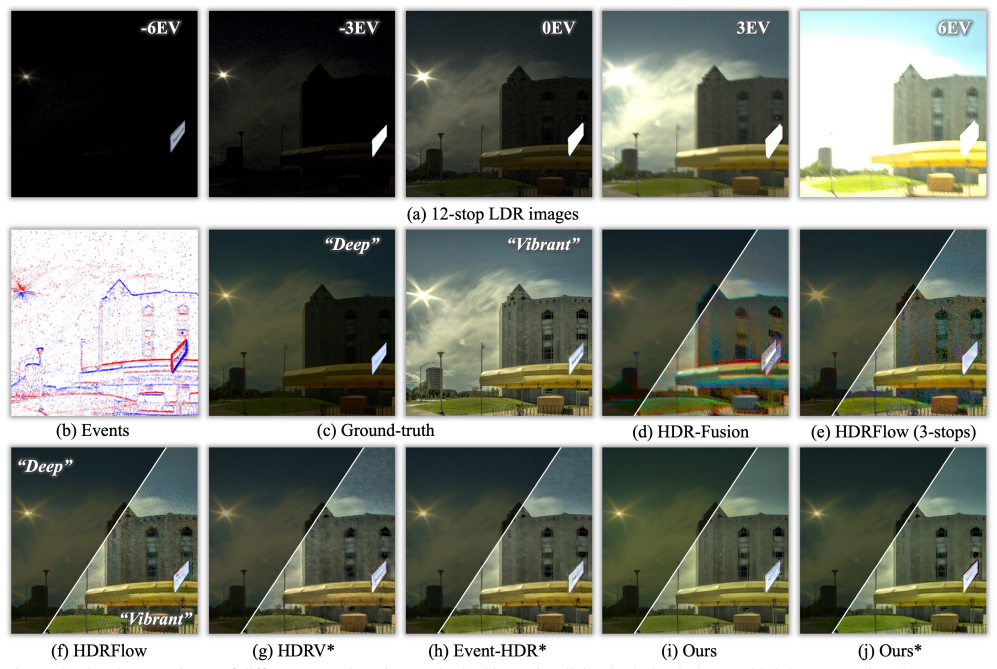
The load-bearing mechanism is the event-assisted explicit alignment module paired with a diffusion-based fusion module. Events are triggered when log-intensity change exceeds a contrast threshold, and because they encode change rather than absolute radiance, they stay informative in regions that are over- or underexposed in the RGB frames. The alignment module extracts features from the reference and moving LDR frames, initializes optical flow with RAFT, and then refines that flow using the event stream between the two timestamps before warping the moving frame into the reference geometry. The fusion stage feeds the aligned LDRs through a ControlNet, a trainable copy of the encoder that injects conditioning into a frozen latent diffusion model, which denoises a latent of the tone-mapped HDR candidate; a small color-correction layer is added so the output matches ground-truth color. Together the two stages convert a five-frame -6 EV to +6 EV bracket into a single HDR image intended to be free of ghosting artifacts.
What would settle it
Capture a dynamic 12-stop scene with the same dual-camera rig while also recording a static ground-truth HDR of the same scene, then compare per-pixel radiance in the tone-mapped domain; if the method's output deviates from the reference in bright or dark regions beyond alignment tolerance, the ghost-free 12-stop claim is refuted.
Extended reading notes
Core claim
The paper's central claim is that 12-stop HDR reconstruction of a dynamic scene becomes tractable when the RGB bracket is accompanied by an event stream. Events record log-intensity changes at microsecond resolution across roughly 140 dB, so they retain the same motion information in a -6 EV frame and a +6 EV frame; the authors exploit this by estimating optical flow explicitly between LDR frames from event streams, rather than letting a network discover alignment implicitly. They then fuse the aligned frames with a latent diffusion model conditioned on the aligned LDRs, so pretrained natural-image priors fill in compressed details and absorb residual alignment errors. To support the claim they build the ESHDR simulated dataset, a synchronized dual-camera rig, and a real-world fine-tuning step for the alignment module, and report that the full pipeline outperforms previous RGB-based and event-based HDR methods on simulated fidelity metrics and on non-reference quality metrics for 16 real scenes.
Load-bearing premise
The load-bearing premise is that the 16 real-world scenes and the non-reference quality metrics used to validate the method genuinely reflect HDR fidelity; if those scenes are unrepresentative or the metrics reward smoothing over radiometric correctness, the claim that the method works in real dynamic scenes is not established.
Editorial extensions
If this is right
- If the central claim holds, the practical capture range for hand-held dynamic HDR rises from ±3 EV to ±6 EV with a five-frame bracket, so scenes containing both a bright light source and deep shadows can be recovered in one shot.
- Event streams become a standard component of HDR pipelines: any bracket with exposure differences large enough to defeat RGB-only flow can be aligned by events, which record motion in the log-intensity domain rather than in absolute brightness.
- Pretrained diffusion priors are shown to serve a fidelity task rather than only generation: the fusion module uses them to repair compressed-detail artifacts and residual alignment errors in the HDR output.
- The ESHDR dataset provides a first 12-stop event-assisted HDR benchmark, making it possible to train and compare methods on this harder setting rather than the previous 6-stop standard.
- Fine-tuning on easier real-world interpolation data narrows the simulated-to-real event gap, suggesting the alignment module generalizes beyond purely synthetic training.
Reading between the lines
- Editorial inference: if the alignment module's real-world transfer is genuine, the same fine-tuning recipe should improve other event-assisted multi-frame tasks such as burst denoising and event-based frame interpolation; measuring transfer there would isolate the alignment gain from the diffusion fusion gain.
- Editorial inference: because the real-world evaluation uses only non-reference metrics, the paper leaves open the possibility that the reported gains reflect perceptual smoothness rather than radiometric accuracy; a comparison against a calibrated high-dynamic-range reference would settle that.
- Editorial inference: the explicit event-flow design implies that a simpler pipeline, event-based flow plus a strong conventional fusion network, might capture much of the alignment benefit; an ablation with a CNN fusion under reference-based metrics would reveal how much of the final gain comes from generative priors.
- Editorial inference: the beam-splitter dual-camera hardware is the main practical obstacle, so the result points directly at hybrid event-RGB sensors; if those reach consumer cameras, 12-stop dynamic HDR could become a single-sensor feature.
Signed reviews
Editorial analysis
A structured set of objections, weighed in public.
Referee Report
Summary. This paper proposes a 12-stop dynamic HDR imaging pipeline built around a dual-camera RGB-event system. Five LDR images spanning -6EV to +6EV are first pre-processed by a UNet, then explicitly aligned by an event-assisted flow module that combines a RAFT initialization with event streams, and finally fused by a latent diffusion model with ControlNet conditioning. The authors introduce the ESHDR simulated dataset with synchronized events, a real-world dual-camera dataset of 16 scenes, and report state-of-the-art results on simulated and real-world benchmarks. The central claim is that the method produces ghost-free 12-stop HDR reconstructions in real dynamic scenes, going beyond the 6-stop range of prior event-RGB HDR methods.
Significance. If validated, this would be a meaningful advance: the paper introduces the first simulated dataset for 12-stop event-HDR imaging, a practical dual-camera capture system, an explicit event-assisted alignment design, and a diffusion-prior fusion module. The simulated evaluation shows a large margin over the best event baseline (PSNR 38.25 vs 33.85), and the ablations in Fig. 3 are informative about the contribution of the alignment and fusion modules. However, the real-world generalization claim is currently supported only by non-reference metrics on 16 self-captured scenes, and the simulated comparison is partly asymmetric. The reported Ours* numbers also rely on a benchmark-specific color-correction fine-tune that is not part of the core method. The core idea is sound and the dataset contribution is useful, but the headline claim of full 12-stop real-world performance needs stronger evidence before publication.
major comments (4)
- [Sec. 5.4, Table 2] The real-world evaluation that supports the headline claim ('capturing the full 12-stop range' in dynamic scenes) consists of 16 self-captured scenes measured only with the no-reference metrics MUSIQ, MANIQA, and HyperIQA. These metrics can reward perceptually clean, often smoothed, outputs and do not verify radiometric fidelity, alignment accuracy, or whether the reconstructed HDR actually spans 12 stops. With no ground-truth HDR or calibrated reference on the real set, the reported superiority in Table 2 does not establish the real-world generalization claimed in the abstract and conclusion. Please add a reference-based real-world validation, for example a static HDR reference captured with a calibrated target or a denser exposure bracket, or explicitly restrict the real-world claim to qualitative demonstration.
- [Sec. 5.2, Table 1] The main simulated comparison is asymmetric: HDRFlow and HDR-Transformer are not retrained on the ESHDR training set, while HDRV* and Event-HDR* are retrained on it. The RGB baselines are also evaluated with exposure ranges (3 or 6 stops) different from the 12-stop input, and all results are color-aligned to ground truth with a 3D bilateral grid. This makes the large margin over RGB baselines difficult to attribute to the proposed alignment and fusion modules rather than to training-domain mismatch or input range. Please retrain the RGB baselines on the same ESHDR split (or report their native-domain performance alongside), and state explicitly which color-alignment procedure is applied to each method.
- [Supplementary A.2; Table 1] Table 1 reports results for 'Ours*', but this variant includes a VAE-decoder color-correction layer that is fine-tuned specifically to improve scores on the ESHDR evaluation set, and the paper states this step is not part of the core method described in Section 3. Because only the color-correction module is updated during fine-tuning and all other parameters are frozen, part of the reported gain may come from a benchmark-specific post-hoc correction rather than from the event-assisted alignment and diffusion fusion. Please report the unmodified 'Ours' in Table 1 as well, describe the exact training data used for the color-correction fine-tuning, and analyze the contribution of this module separately.
- [Sec. 3.2, Real-world fine-tuning] The real-world fine-tuning uses frame-interpolation datasets [8,35] and randomly converts each frame to an LDR image with an exposure time between -6EV and 6EV, then supervises alignment toward the converted second frame. This provides real event statistics, but the supervision is still a single-exposure LDR frame, not a 12-stop HDR ground truth. It therefore does not directly validate whether the alignment module preserves information across the full exposure range in real scenes. Please provide an additional real-world alignment evaluation, such as flow error on a known motion pattern or a small set of real bracketed HDR references, to close this gap.
minor comments (6)
- [Table 2] The column header 'MUSID' should be 'MUSIQ'.
- [Table 2] The row label 'HDR-Event*' is inconsistent with 'Event-HDR*' used elsewhere in the paper; please unify the notation.
- [Sec. 3.2] The phrase 'previous event-based HDR [2,47]' cites event camera hardware papers; the relevant event-based HDR methods are Refs. [38,48].
- [Sec. 3.3, Eq. (5)] The conditioning representation is written as 'z_a = VAE-Decoder({I^a_n})'; in a latent diffusion pipeline the conditioning images should be encoded into latent space, so this is likely a typo for 'VAE-Encoder' and should be corrected or clarified.
- [Supplementary A.2] The section title 'Color correction for HSHDR dataset' appears to contain a typo and should read 'ESHDR'.
- [Sec. 5.4] The paper does not report the RGB camera's bit depth or the exact exposure times used for the -6EV to +6EV captures; these details are needed to judge whether the real-world captures actually cover the claimed 12 stops.
Circularity Check
No significant circularity: the method's components are external to the target result and the reported gains are measured on disjoint test data.
full rationale
The paper's central claim is an empirical system claim, not a derivation. The event-assisted alignment module uses an external pre-trained optical flow backbone (RAFT) plus a learned FlowNet conditioned on events; the fusion module uses a pre-trained Stable Diffusion prior with ControlNet conditioning; and the event simulator (v2e) is external. None of these reduce by construction to the target 12-stop HDR output. The ESHDR dataset is generated from external HDR sources (HDR Indoor, Outdoor, Objaverse) with disjoint train/test splits, so evaluation on it is not definitionally equivalent to the method's inputs. The real-world fine-tuning uses real interpolation datasets, including TimeLens-XL [35] with overlapping authors, but this is an empirical dataset resource rather than an unverified theorem, and the real-world evaluation is on separately captured 16 scenes with non-reference metrics. The only mild concern is the 'Ours*' VAE-decoder color-correction fine-tuning (Sec. A.2), which is explicitly motivated by improving ESHDR PSNR; however, it is trained on the training split and evaluated on the disjoint test split, so it does not make the reported metric a fitted parameter renamed as a prediction. The under-supported real-world generalization claim is a validity/evidence concern, not circularity. Score 0.
Assumptions & free parameters
free parameters (5)
- Exposure bracket set =
-6EV, -3EV, 0EV, 3EV, 6EV
- Number of input LDR frames =
5
- Charbonnier epsilon =
0.001
- Adam learning rate =
1e-4
- VAE decoder color-correction layer =
fine-tuned on ESHDR
assumptions (4)
- domain assumption Event signals from Eq. (1) capture reliable motion information across the full -6EV to +6EV range
- domain assumption The ESHDR simulation pipeline, with events generated by v2e from blended HDR sequences, is a sufficiently faithful proxy for real event-RGB data
- domain assumption Pre-trained Stable Diffusion v2.1 priors improve HDR fusion without introducing LDR-specific biases
- ad hoc to paper Real-world frame-interpolation datasets [8, 35] collected with the same event camera provide a valid fine-tuning signal for HDR alignment
Cite this review
Pith. "Pith review of Event-assisted 12-stop HDR Imaging of Dynamic Scene." pith.science (2026). https://pith.science/paper/IPEMBQRM
@misc{pith2026241214705,
  author       = {Pith},
  title        = {Pith review of: Event-assisted 12-stop HDR Imaging of Dynamic Scene},
  year         = {2026},
  howpublished = {\url{https://pith.science/paper/IPEMBQRM}},
  note         = {Machine review of arXiv:2412.14705}
}
read the original abstract
High dynamic range (HDR) imaging is a crucial task in computational photography, which captures details across diverse lighting conditions. Traditional HDR fusion methods face limitations in dynamic scenes with extreme exposure differences, as aligning low dynamic range (LDR) frames becomes challenging due to motion and brightness variation. In this work, we propose a novel 12-stop HDR imaging approach for dynamic scenes, leveraging a dual-camera system with an event camera and an RGB camera. The event camera provides temporally dense, high dynamic range signals that improve alignment between LDR frames with large exposure differences, reducing ghosting artifacts caused by motion. Also, a real-world finetuning strategy is proposed to increase the generalization of alignment module on real-world events. Additionally, we introduce a diffusion-based fusion module that incorporates image priors from pre-trained diffusion models to address artifacts in high-contrast regions and minimize errors from the alignment process. To support this work, we developed the ESHDR dataset, the first dataset for 12-stop HDR imaging with synchronized event signals, and validated our approach on both simulated and real-world data. Extensive experiments demonstrate that our method achieves state-of-the-art performance, successfully extending HDR imaging to 12 stops in dynamic scenes.
Figures


Figures from the paper (3 more)


Forward citations
Cited by 2 Pith papers
-
Dual-Exposure Imaging with Events
Event streams enable accurate alignment and fusion of short/long-exposure pairs via a dual-path deblurring-plus-enhancement network, outperforming frame-only DEI on synthetic and real data.
-
Event Camera Guided Visual Media Restoration & 3D Reconstruction: A Survey
A structured survey of event-camera-guided video restoration and 3D reconstruction, organized by temporal, spatial, and 3D tasks.
Reference graph
Works this paper leans on
-
[1]
Minimal-bracketing sets for high-dynamic-range image cap- ture
Neil Barakat, A Nicholas Hone, and Thomas E Darcie. Minimal-bracketing sets for high-dynamic-range image cap- ture. IEEE Transactions on Image Processing, 17(10):1864– 1875, 2008. 2
work page 2008
-
[2]
A 240×180 130 db 3 us latency global shutter spatiotemporal vision sensor
Christian Brandli, Raphael Berner, Minhao Yang, Shih-Chii Liu, and Tobi Delbruck. A 240×180 130 db 3 us latency global shutter spatiotemporal vision sensor. IEEE Journal of Solid-State Circuits, 49(10):2333–2341, 2014. 2, 3, 4
work page 2014
-
[3]
Unprocessing images for learned raw denoising
Tim Brooks, Ben Mildenhall, Tianfan Xue, Jiawen Chen, Dillon Sharlet, and Jonathan T Barron. Unprocessing images for learned raw denoising. In Proceedings of the IEEE/CVF conference on computer vision and pattern recognition , pages 11036–11045, 2019. 5
2019
-
[4]
Understanding deformable alignment in video super-resolution
Kelvin CK Chan, Xintao Wang, Ke Yu, Chao Dong, and Chen Change Loy. Understanding deformable alignment in video super-resolution. In Proceedings of the AAAI confer- ence on artificial intelligence, pages 973–981, 2021. 4
work page 2021
-
[5]
Hdr video reconstruc- tion: A coarse-to-fine network and a real-world benchmark dataset
Guanying Chen, Chaofeng Chen, Shi Guo, Zhetong Liang, Kwan-Yee K Wong, and Lei Zhang. Hdr video reconstruc- tion: A coarse-to-fine network and a real-world benchmark dataset. In Proceedings of the IEEE/CVF international con- ference on computer vision , pages 2502–2511, 2021. 2, 3, 5
work page 2021
-
[6]
Attention-guided progressive neural tex- ture fusion for high dynamic range image restoration
Jie Chen, Zaifeng Yang, Tsz Nam Chan, Hui Li, Junhui Hou, and Lap-Pui Chau. Attention-guided progressive neural tex- ture fusion for high dynamic range image restoration. IEEE Transactions on Image Processing, 31:2661–2672, 2022. 2
work page 2022
-
[7]
Event-Based Motion Magnification
Yutian Chen, Shi Guo, Fangzheng Yu, Feng Zhang, Jinwei Gu, and Tianfan Xue. Event-based motion magnification. arXiv preprint arXiv:2402.11957, 2024. 2
work page Pith review arXiv 2024
-
[8]
Hoonhee Cho, Taewoo Kim, Yuhwan Jeong, and Kuk-Jin Yoon. Tta-evf: Test-time adaptation for event-based video frame interpolation via reliable pixel and sample estimation. In Proceedings of the IEEE/CVF Conference on Computer Vision and Pattern Recognition, pages 25701–25711, 2024. 4
work page 2024
Show all 67 references
-
[9]
Lan-hdr: Luminance-based alignment network for high dynamic range video reconstruc- tion
Haesoo Chung and Nam Ik Cho. Lan-hdr: Luminance-based alignment network for high dynamic range video reconstruc- tion. In Proceedings of the IEEE/CVF International Confer- ence on Computer Vision, pages 12760–12769, 2023. 2
2023
-
[10]
Recovering high dy- namic range radiance maps from photographs
Paul E Debevec and Jitendra Malik. Recovering high dy- namic range radiance maps from photographs. In Seminal Graphics Papers: Pushing the Boundaries, Volume 2, pages 643–652. 2023. 6
2023
-
[11]
Objaverse: A universe of annotated 3d objects
Matt Deitke, Dustin Schwenk, Jordi Salvador, Luca Weihs, Oscar Michel, Eli VanderBilt, Ludwig Schmidt, Kiana Ehsani, Aniruddha Kembhavi, and Ali Farhadi. Objaverse: A universe of annotated 3d objects. In Proceedings of the IEEE/CVF Conference on Computer Vision and Pattern Rec...
2023
-
[12]
Simoncelli
Keyan Ding, Kede Ma, Shiqi Wang, and Eero P. Simoncelli. Image quality assessment: Unifying structure and texture similarity. CoRR, abs/2004.07728, 2020. 6
2004 arXiv
-
[13]
Led: A large-scale real-world paired dataset for event camera denoising
Yuxing Duan. Led: A large-scale real-world paired dataset for event camera denoising. InProceedings of the IEEE/CVF Conference on Computer Vision and Pattern Recognition , pages 25637–25647, 2024. 4
2024
-
[14]
Learning to predict indoor illumina- tion from a single image
Marc-Andr ´e Gardner, Kalyan Sunkavalli, Ersin Yumer, Xi- aohui Shen, Emiliano Gambaretto, Christian Gagn ´e, and Jean-Franc ¸ois Lalonde. Learning to predict indoor illumina- tion from a single image. arXiv preprint arXiv:1704.00090,
-
[15]
A 3-wafer- stacked hybrid 15mpixel cis+ 1 mpixel evs with 4.6 gevent/s readout, in-pixel tdc and on-chip isp and esp function
Menghan Guo, Shoushun Chen, Zhe Gao, Wenlei Yang, Peter Bartkovjak, Qing Qin, Xiaoqin Hu, Dahei Zhou, Masayuki Uchiyama, Yoshiharu Kudo, et al. A 3-wafer- stacked hybrid 15mpixel cis+ 1 mpixel evs with 4.6 gevent/s readout, in-pixel tdc and on-chip isp and esp function. In 202...
2023
-
[16]
Toward convolutional blind denoising of real pho- tographs
Shi Guo, Zifei Yan, Kai Zhang, Wangmeng Zuo, and Lei Zhang. Toward convolutional blind denoising of real pho- tographs. In Proceedings of the IEEE/CVF conference on computer vision and pattern recognition, pages 1712–1722,
-
[17]
A differentiable two-stage alignment scheme for burst im- age reconstruction with large shift
Shi Guo, Xi Yang, Jianqi Ma, Gaofeng Ren, and Lei Zhang. A differentiable two-stage alignment scheme for burst im- age reconstruction with large shift. In Proceedings of the IEEE/CVF Conference on Computer Vision and Pattern Recognition, pages 17472–17481, 2022. 4
2022
-
[18]
Deep sky modeling for single image out- door lighting estimation
Yannick Hold-Geoffroy, Akshaya Athawale, and Jean- Franc ¸ois Lalonde. Deep sky modeling for single image out- door lighting estimation. In Proceedings of the IEEE/CVF conference on computer vision and pattern recognition , pages 6927–6935, 2019. 2, 5
2019
-
[19]
Hdr deghosting: How to deal with saturation? In Proceedings of the IEEE conference on computer vision and pattern recog- nition, pages 1163–1170, 2013
Jun Hu, Orazio Gallo, Kari Pulli, and Xiaobai Sun. Hdr deghosting: How to deal with saturation? In Proceedings of the IEEE conference on computer vision and pattern recog- nition, pages 1163–1170, 2013. 2
2013
-
[20]
v2e: From video frames to realistic dvs events
Yuhuang Hu, Shih-Chii Liu, and Tobi Delbruck. v2e: From video frames to realistic dvs events. In Proceedings of the IEEE/CVF Conference on Computer Vision and Pattern Recognition, pages 1312–1321, 2021. 4, 5
2021
-
[21]
Deep hdr video from sequences with alternating exposures
Nima Khademi Kalantari and Ravi Ramamoorthi. Deep hdr video from sequences with alternating exposures. In Com- puter graphics forum, pages 193–205. Wiley Online Library,
-
[22]
Patch- based high dynamic range video
Nima Khademi Kalantari, Eli Shechtman, Connelly Barnes, Soheil Darabi, Dan B Goldman, and Pradeep Sen. Patch- based high dynamic range video. ACM Trans. Graph., 32 (6):202–1, 2013. 2
2013
-
[23]
Musiq: Multi-scale image quality transformer
Junjie Ke, Qifei Wang, Yilin Wang, Peyman Milanfar, and Feng Yang. Musiq: Multi-scale image quality transformer. In Proceedings of the IEEE/CVF international conference on computer vision, pages 5148–5157, 2021. 8
2021
-
[24]
Frequency- aware event-based video deblurring for real-world motion blur
Taewoo Kim, Hoonhee Cho, and Kuk-Jin Yoon. Frequency- aware event-based video deblurring for real-world motion blur. In Proceedings of the IEEE/CVF Conference on Com- 9 puter Vision and Pattern Recognition , pages 24966–24976,
-
[25]
Auto-encoding variational bayes
Diederik P Kingma. Auto-encoding variational bayes. arXiv preprint arXiv:1312.6114, 2013. 5
2013 arXiv
-
[26]
Kingma and Jimmy Ba
Diederik P. Kingma and Jimmy Ba. Adam: A method for stochastic optimization. CoRR, abs/1412.6980, 2014. 5
2014 arXiv
-
[27]
1.22 µm 35.6 mpixel rgb hybrid event-based vision sensor with 4.88 µm-pitch event pixels and up to 10k event frame rate by adaptive control on event sparsity
Kazutoshi Kodama, Yusuke Sato, Yuhi Yorikado, Raphael Berner, Kyoji Mizoguchi, Takahiro Miyazaki, Masahiro Tsukamoto, Yoshihisa Matoba, Hirotaka Shinozaki, Atsumi Niwa, et al. 1.22 µm 35.6 mpixel rgb hybrid event-based vision sensor with 4.88 µm-pitch event pixels and up to 10...
2023
-
[28]
Multi-scale exposure fusion via gradient domain guided im- age filtering
Fei Kou, Zhengguo Li, Changyun Wen, and Weihai Chen. Multi-scale exposure fusion via gradient domain guided im- age filtering. In 2017 IEEE international conference on mul- timedia and expo (ICME), pages 1105–1110. IEEE, 2017. 2, 3
2017
-
[29]
Joint hdr denoising and fusion: A real-world mobile hdr image dataset
Shuaizheng Liu, Xindong Zhang, Lingchen Sun, Zhetong Liang, Hui Zeng, and Lei Zhang. Joint hdr denoising and fusion: A real-world mobile hdr image dataset. In Proceed- ings of the IEEE/CVF Conference on Computer Vision and Pattern Recognition, pages 13966–13975, 2023. 2, 3, 5
2023
-
[30]
Adnet: Attention-guided deformable convolutional net- work for high dynamic range imaging
Zhen Liu, Wenjie Lin, Xinpeng Li, Qing Rao, Ting Jiang, Mingyan Han, Haoqiang Fan, Jian Sun, and Shuaicheng Liu. Adnet: Attention-guided deformable convolutional net- work for high dynamic range imaging. In Proceedings of the IEEE/CVF Conference on Computer Vision and Pattern ...
2021
-
[31]
Ghost-free high dynamic range imaging with context-aware transformer
Zhen Liu, Yinglong Wang, Bing Zeng, and Shuaicheng Liu. Ghost-free high dynamic range imaging with context-aware transformer. In European Conference on Computer Vision , pages 344–360. Springer, 2022. 2, 6
2022
-
[32]
Multi-exposure image fusion: A patch-wise approach
Kede Ma and Zhou Wang. Multi-exposure image fusion: A patch-wise approach. In 2015 IEEE International Confer- ence on Image Processing (ICIP) , pages 1717–1721. IEEE,
2015
-
[33]
Robust multi-exposure image fusion: a struc- tural patch decomposition approach
Kede Ma, Hui Li, Hongwei Yong, Zhou Wang, Deyu Meng, and Lei Zhang. Robust multi-exposure image fusion: a struc- tural patch decomposition approach. IEEE Transactions on Image Processing, 26(5):2519–2532, 2017. 2
2017
-
[34]
Deep guided learning for fast multi- exposure image fusion
Kede Ma, Zhengfang Duanmu, Hanwei Zhu, Yuming Fang, and Zhou Wang. Deep guided learning for fast multi- exposure image fusion. IEEE Transactions on Image Pro- cessing, 29:2808–2819, 2019. 2, 3
2019
-
[35]
Timelens-xl: Real-time event-based video frame interpolation with large motion
Yongrui Ma, Shi Guo, Yutian Chen, Tianfan Xue, and Jin- wei Gu. Timelens-xl: Real-time event-based video frame interpolation with large motion. In European Conference on Computer Vision, pages 178–194. Springer, 2025. 4
2025
-
[36]
High dynamic range video with ghost removal
Stephen Mangiat and Jerry Gibson. High dynamic range video with ghost removal. In Applications of digital image processing XXXIII, pages 307–314. SPIE, 2010. 2
2010
-
[37]
Exposure fusion
Tom Mertens, Jan Kautz, and Frank Van Reeth. Exposure fusion. In 15th Pacific Conference on Computer Graphics and Applications (PG’07), pages 382–390. IEEE, 2007. 2, 3
2007
-
[38]
Multi-bracket high dynamic range imaging with event cameras
Nico Messikommer, Stamatios Georgoulis, Daniel Gehrig, Stepan Tulyakov, Julius Erbach, Alfredo Bochicchio, Yuanyou Li, and Davide Scaramuzza. Multi-bracket high dynamic range imaging with event cameras. In Proceedings of the IEEE/CVF conference on computer vision and pattern r...
2022
-
[39]
Burst denoising with kernel prediction networks
Ben Mildenhall, Jonathan T Barron, Jiawen Chen, Dillon Sharlet, Ren Ng, and Robert Carroll. Burst denoising with kernel prediction networks. In Proceedings of the IEEE con- ference on computer vision and pattern recognition , pages 2502–2510, 2018. 4
2018
-
[40]
Robust high dynamic range imaging by rank min- imization
Tae-Hyun Oh, Joon-Young Lee, Yu-Wing Tai, and In So Kweon. Robust high dynamic range imaging by rank min- imization. IEEE transactions on pattern analysis and ma- chine intelligence, 37(6):1219–1232, 2014. 2
2014
-
[41]
A multiscale model of adaptation and spatial vision for realistic image display
Sumanta N Pattanaik, James A Ferwerda, Mark D Fairchild, and Donald P Greenberg. A multiscale model of adaptation and spatial vision for realistic image display. In Proceedings of the 25th annual conference on Computer graphics and in- teractive techniques, pages 287–298, 1998. 1
1998
-
[42]
Esim: an open event camera simulator
Henri Rebecq, Daniel Gehrig, and Davide Scaramuzza. Esim: an open event camera simulator. In Conference on robot learning, pages 969–982. PMLR, 2018. 4
2018
-
[43]
High speed and high dynamic range video with an event camera
Henri Rebecq, Ren ´e Ranftl, Vladlen Koltun, and Davide Scaramuzza. High speed and high dynamic range video with an event camera. IEEE transactions on pattern analysis and machine intelligence, 43(6):1964–1980, 2019. 3
1964
-
[44]
High-resolution image synthesis with latent diffusion models
Robin Rombach, Andreas Blattmann, Dominik Lorenz, Patrick Esser, and Bj ¨orn Ommer. High-resolution image synthesis with latent diffusion models. In Proceedings of the IEEE/CVF Conference on Computer Vision and Pattern Recognition (CVPR), pages 10684–10695, 2022. 4
2022
-
[45]
U- net: Convolutional networks for biomedical image segmen- tation
Olaf Ronneberger, Philipp Fischer, and Thomas Brox. U- net: Convolutional networks for biomedical image segmen- tation. In Medical image computing and computer-assisted intervention–MICCAI 2015: 18th international conference, Munich, Germany, October 5-9, 2015, proceedings, pa...
2015
-
[46]
Ro- bust patch-based hdr reconstruction of dynamic scenes.ACM Trans
Pradeep Sen, Nima Khademi Kalantari, Maziar Yaesoubi, Soheil Darabi, Dan B Goldman, and Eli Shechtman. Ro- bust patch-based hdr reconstruction of dynamic scenes.ACM Trans. Graph., 31(6):203–1, 2012. 2
2012
-
[47]
A 128×128 1.5% contrast sensitivity 0.9% fpn 3us latency 4 mw asynchronous frame-free dynamic vision sensor using transimpedance preamplifiers
Teresa Serrano-Gotarredona and Bernab ´e Linares-Barranco. A 128×128 1.5% contrast sensitivity 0.9% fpn 3us latency 4 mw asynchronous frame-free dynamic vision sensor using transimpedance preamplifiers. IEEE Journal of Solid-State Circuits, 48(3):827–838, 2013. 2, 3, 4
2013
-
[48]
Hdr reconstruction from bracketed ex- posures and events
Richard Shaw, Sibi Catley-Chandar, Ales Leonardis, and Ed- uardo Perez-Pellitero. Hdr reconstruction from bracketed ex- posures and events. arXiv preprint arXiv:2203.14825, 2022. 2, 3
2022 arXiv
-
[49]
Blindly assess image qual- ity in the wild guided by a self-adaptive hyper network
Shaolin Su, Qingsen Yan, Yu Zhu, Cheng Zhang, Xin Ge, Jinqiu Sun, and Yanning Zhang. Blindly assess image qual- ity in the wild guided by a self-adaptive hyper network. In Proceedings of the IEEE/CVF conference on computer vi- sion and pattern recognition, pages 3667–3676, 2020. 8
2020
-
[50]
Raft: Recurrent all-pairs field transforms for optical flow
Zachary Teed and Jia Deng. Raft: Recurrent all-pairs field transforms for optical flow. In Computer Vision–ECCV 2020: 16th European Conference, Glasgow, UK, August 23– 10 28, 2020, Proceedings, Part II 16, pages 402–419. Springer,
2020
-
[51]
Time lens: Event-based video frame interpo- lation
Stepan Tulyakov, Daniel Gehrig, Stamatios Georgoulis, Julius Erbach, Mathias Gehrig, Yuanyou Li, and Davide Scaramuzza. Time lens: Event-based video frame interpo- lation. In Proceedings of the IEEE/CVF conference on com- puter vision and pattern recognition , pages 16155–16164,
-
[52]
Event- based high dynamic range image and very high frame rate video generation using conditional generative adversarial networks
Lin Wang, Yo-Sung Ho, Kuk-Jin Yoon, et al. Event- based high dynamic range image and very high frame rate video generation using conditional generative adversarial networks. In Proceedings of the IEEE/CVF Conference on Computer Vision and Pattern Recognition , pages 10081– 100...
2019
-
[53]
Edvr: Video restoration with enhanced deformable convolutional networks
Xintao Wang, Kelvin CK Chan, Ke Yu, Chao Dong, and Chen Change Loy. Edvr: Video restoration with enhanced deformable convolutional networks. In Proceedings of the IEEE/CVF conference on computer vision and pattern recognition workshops, pages 0–0, 2019. 4
2019
-
[54]
Bilateral guided radiance field processing
Yuehao Wang, Chaoyi Wang, Bingchen Gong, and Tianfan Xue. Bilateral guided radiance field processing. ACM Trans- actions on Graphics (TOG), 43(4):1–13, 2024. 6
2024
-
[55]
Deep high dynamic range imaging with large foreground motions
Shangzhe Wu, Jiarui Xu, Yu-Wing Tai, and Chi-Keung Tang. Deep high dynamic range imaging with large foreground motions. In Proceedings of the European Conference on Computer Vision (ECCV), pages 117–132, 2018. 2
2018
-
[56]
High dynamic range imaging of natural scenes
Feng Xiao, Jeffrey M DiCarlo, Peter B Catrysse, and Brian A Wandell. High dynamic range imaging of natural scenes. In Color and imaging conference , pages 337–342. Society of Imaging Science and Technology, 2002. 1
2002
-
[57]
Hdr imaging for dynamic scenes with events
Li Xiaopeng, Zeng Zhaoyuan, Fan Cien, Zhao Chen, Deng Lei, and Yu Lei. Hdr imaging for dynamic scenes with events. arXiv preprint arXiv:2404.03210, 2024. 3
2024 arXiv
-
[58]
Hdrflow: Real-time hdr video reconstruction with large motions
Gangwei Xu, Yujin Wang, Jinwei Gu, Tianfan Xue, and Xin Yang. Hdrflow: Real-time hdr video reconstruction with large motions. In CVPR, 2024. 2, 3, 5, 6
2024
-
[59]
Attention- guided network for ghost-free high dynamic range imaging
Qingsen Yan, Dong Gong, Qinfeng Shi, Anton van den Hen- gel, Chunhua Shen, Ian Reid, and Yanning Zhang. Attention- guided network for ghost-free high dynamic range imaging. In Proceedings of the IEEE/CVF Conference on Computer Vision and Pattern Recognition, pages 1751–1760, 2019. 2
2019
-
[60]
Dual-attention-guided network for ghost-free high dynamic range imaging
Qingsen Yan, Dong Gong, Javen Qinfeng Shi, Anton Van Den Hengel, Chunhua Shen, Ian Reid, and Yanning Zhang. Dual-attention-guided network for ghost-free high dynamic range imaging. International Journal of Computer Vision , pages 1–19, 2022. 2
2022
-
[61]
A unified hdr imaging method with pixel and patch level
Qingsen Yan, Weiye Chen, Song Zhang, Yu Zhu, Jinqiu Sun, and Yanning Zhang. A unified hdr imaging method with pixel and patch level. In Proceedings of the IEEE/CVF Con- ference on Computer Vision and Pattern Recognition, pages 22211–22220, 2023. 2
2023
-
[62]
Maniqa: Multi-dimension attention network for no-reference image quality assessment
Sidi Yang, Tianhe Wu, Shuwei Shi, Shanshan Lao, Yuan Gong, Mingdeng Cao, Jiahao Wang, and Yujiu Yang. Maniqa: Multi-dimension attention network for no-reference image quality assessment. In Proceedings of the IEEE/CVF Conference on Computer Vision and Pattern Recognition , pag...
2022
-
[63]
Learning event guided high dynamic range video re- construction
Yixin Yang, Jin Han, Jinxiu Liang, Imari Sato, and Boxin Shi. Learning event guided high dynamic range video re- construction. In Proceedings of the IEEE/CVF Conference on Computer Vision and Pattern Recognition, pages 13924– 13934, 2023. 3, 6
2023
-
[64]
Adding conditional control to text-to-image diffusion models
Lvmin Zhang, Anyi Rao, and Maneesh Agrawala. Adding conditional control to text-to-image diffusion models. In Proceedings of the IEEE/CVF International Conference on Computer Vision, pages 3836–3847, 2023. 5
2023
-
[65]
The unreasonable effectiveness of deep features as a perceptual metric
Richard Zhang, Phillip Isola, Alexei A Efros, Eli Shechtman, and Oliver Wang. The unreasonable effectiveness of deep features as a perceptual metric. In CVPR, 2018. 6
2018
-
[66]
From sim-to-real: To- ward general event-based low-light frame interpolation with per-scene optimization
Ziran Zhang, Yongrui Ma, Yueting Chen, Feng Zhang, Jin- wei Gu, Tianfan Xue, and Shi Guo. From sim-to-real: To- ward general event-based low-light frame interpolation with per-scene optimization. arXiv preprint arXiv:2406.08090 ,
-
[2024]
#$ 𝑍% 𝑍%&' T steps HDR ImageWith Tone Mapping V AEEncoder ControlNet SD EncoderSD Decoder V AEDecoder 𝑍( Aligned LDR𝑍% 𝐼 !
4 11 Event-assisted 12-stop HDR Imaging of Dynamic Scene Supplementary Material A. More details and discussion A.1. Drawback of µ-law tone mapping Although the µ-law tone mapping is effective for standard HDR images, it proves insufficient for handling both bright and dark reg...
Reviewed August 11, 2026 · model on record in the stance chip above.
Discussion (0). Continue with ORCID to comment.