REVIEW 3 major objections 6 minor 1 cited by
Linking disks, spinning vortices and exponential networks of augmentation curves
T0 review · 3 major / 6 minor · reviewed 2026-08-11 · deepseek-v4-flash
Pith's one-line read The quiver of open topological strings can be computed from the exponential-network data of the augmentation curve: vertices are stabilized kinky vortex paths, fugacities are their central charges, and the adjacency matrix is their…
desk verdict A serious proposal with a real circularity: the central-charge map is solid, but the intersection-pairing conventions are fitted to known quivers, so the C_ij agreement is not independent evidence. read the letter →
The pith
A machine-rendered reading of the paper's core claim, the machinery that carries it, and where it could break.
The reading
What carries the argument
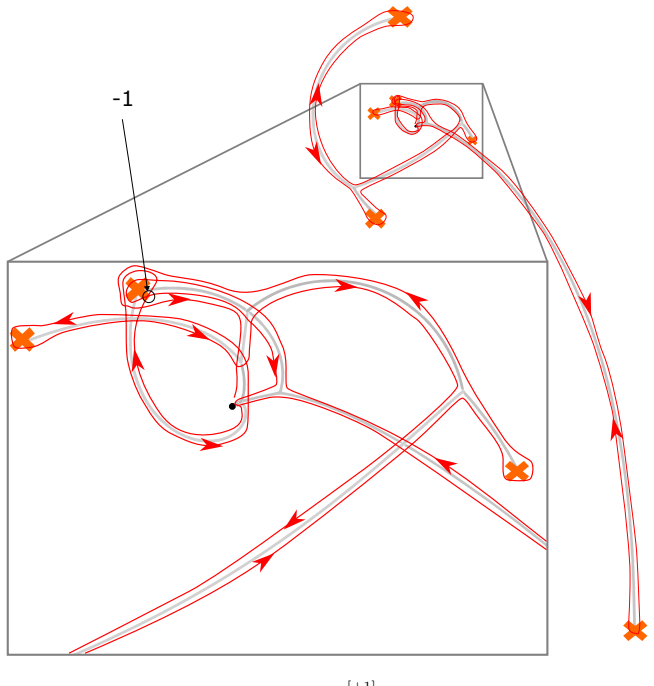
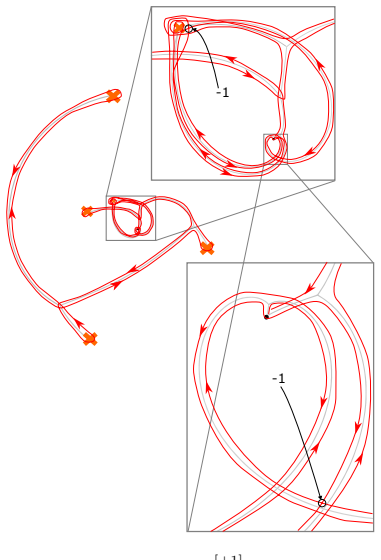
The machinery is the dictionary of Conjecture 1 together with the computational tool that produces its ingredients. An augmentation curve $\Sigma$ is the algebraic curve that describes the moduli space of an A-brane on the Lagrangian; its exponential network is a web of trajectories on the base $x$-plane that encodes the BPS spectrum of kinky vortices. Kinky vortices are BPS solitons on a cylinder that interpolate between two vacua and carry quantized flux; the (ii,1) sector consists of those with unit flux in a fixed vacuum. The algorithm stabilizes the spectrum near $x_{\mathrm{theory}}\to 0$, selects the basis paths $a_j$ with CFIV index (the integer-valued BPS counting index) of unit norm, computes fugacities from central charges, and defines $C_{ij}$ as the writhe difference $\langle a_i,a_j\rangle = \mathrm{wr}(a_i a_j)-\mathrm{wr}(a_i)-\mathrm{wr}(a_j)$ of resolved concatenated paths.
What would settle it
If the intersection matrix is computed for a quiver-presentable curve where two (ii,1) solitons have exactly equal phases at the stabilized theory point, and the two allowed concatenation orderings give different matrices, then the pairing is convention-dependent and Conjecture 1 would be false as stated; this check can be done directly on the exponential networks of the trefoil or figure-eight curves at a framing not discussed in the paper.
Extended reading notes
Core claim
Conjecture 1 states that for an augmentation curve $\Sigma=\{(x,y)\in(\mathbb{C}^*)^2: A(x,y,u)=0\}$ that admits a quiver presentation, the quiver is encoded in the exponential network of the curve. The vertices of the quiver are in one-to-one correspondence with a distinguished stabilized basis of (ii,1) kinky vortex paths $a_j$ on the logarithmic cover $\widetilde{\Sigma}$; the quiver fugacities are $c_j = \frac{1}{x_{\mathrm{theory}}}\exp\!\left(\frac{Z_{a_j}}{2\pi i}\right)$, where $Z_a=\frac{1}{2\pi R}\int_a \log y\, d\log x$; and the adjacency matrix is the intersection matrix $C_{ij} = \langle a_i,a_j\rangle$ computed by resolving, shifting, and concatenating the projected soliton paths. The authors interpret this as the mirror of the open-string statement that holomorphic disks with Lagrangian boundary generate the LMOV spectrum, with boundary linking given by the quiver adjacency matrix. They test the conjecture by explicit exponential-network computations for framed toric branes in $\mathbb{C}^3$ and the resolved conifold and for framed conormal Lagrangians of the trefoil and figure-eight knots, including Q-deformed curves, and recover the known quivers in every case.
Load-bearing premise
The load-bearing premise is that the counterclockwise concatenation rule and the writhe sign convention are the physically correct choices for defining intersections of paths, rather than choices tuned to reproduce the known quiver.
Editorial extensions
If this is right
- The exponential network of an augmentation curve determines the quiver data of the open topological string: vertex count, fugacities, and adjacency matrix, with no additional input.
- The linking matrix of basic holomorphic disks on the Lagrangian equals an intersection matrix of calibrated 1-chains on the curve, so the quiver becomes a geometric invariant of the augmentation curve once the resolution and concatenation conventions are fixed.
- The same algorithm applies to Q-deformed augmentation curves, so quivers can be computed in the deformed family and then specialized to the physical augmentation curve.
- For toric branes and the trefoil and figure-eight conormals, the recovered quivers agree with the known ones, supporting the identification of open-string disk instantons with the stabilized (ii,1) sector of kinky vortices.
Reading between the lines
- Editorial: Applied to augmentation curves whose quiver is not yet known, the algorithm would be a prediction machine; conormal Lagrangians for more complicated knots are the natural next test cases.
- Editorial: The counterclockwise concatenation rule carries most of the conceptual weight; turning it into a statement forced by the geometry of the logarithmic cover would elevate Conjecture 1 to a theorem.
- Editorial: Curves with higher-degree polynomial branch points have richer trajectory webs, so extending the worked examples there would stress the resolution and intersection rules beyond the current evidence.
Editorial analysis
A structured set of objections, weighed in public.
Referee Report
Summary. The paper proposes a mirror-theoretic derivation of the knots-quivers correspondence from exponential networks of augmentation curves. Conjecture 1 identifies the vertices of the quiver with a stabilized basis of (ii,1) kinky-vortex soliton paths a_j on the log-covering of the augmentation curve, identifies quiver fugacities via c_j = (1/x_theory) exp(Z_{a_j}/2πi) in Eq. (3.7), and identifies the quiver adjacency matrix with the intersection matrix C_ij = <a_i, a_j>. Section 3.2 gives a four-step algorithm for extracting vertices, fugacities, and intersections from exponential-network data, and Section 4 tests the conjecture on framed toric branes in C3 and the resolved conifold and on framed trefoil and figure-eight conormal branes, reporting perfect agreement with known quivers from the knots-quivers literature. The paper also develops appendices on Chern-Simons vortex angular momentum, resolution of projected paths, CFIV cancellations, and off-diagonal intersection computations.
Significance. If Conjecture 1 were established, it would give a genuinely new geometric handle on the quiver/linking structure of open topological strings, connecting M2-brane disks to calibrated 1-chains on augmentation curves and providing a constructive mirror-side algorithm for the knots-quivers correspondence. The paper has real strengths: the central-charge/fugacity part of the conjecture is computed directly from exponential-network integrals without tuning and matches the known specializations; the examples are worked in substantial detail; and the appendix material on branch-point resolutions and CFIV cancellations is useful. However, the intersection-pairing claim, which carries the quiver structure, is not yet independently established because the pairing conventions in Section 3.4 are calibrated against the very examples later used as evidence. The paper is best read as a strong and detailed computational proposal rather than as a derivation of the quiver from the curve alone.
major comments (3)
- [Section 3.4.2 and Eq. (3.25)] The pairing <a_i,a_j> is not shown to be an invariant of the augmentation curve alone. The choice of counterclockwise concatenation is justified by the statement that it is 'the correct choice for recovering the quiver' (Section 3.4.2, before Eq. (3.24)), and the writhe sign convention in Eq. (3.25) is said to be 'adapted to recover quiver adjacency matrices in examples discussed below.' Because the same examples (C3, resolved conifold, trefoil, figure-eight) are subsequently used as tests of Conjecture 1(3), the agreement of the computed C_ij is not an independent confirmation. The authors should either derive the concatenation and writhe-sign conventions from an a priori geometric or physical principle, or freeze the conventions and test them on a quiver that was not used in their calibration.
- [Remark 1, Section 3.3.3] The uniqueness argument for the basis paths a_k relies on deforming the Q-deformed curve from c_j -> 0 back to the original values and on tracking soliton-antisoliton pairs by CFIV invariance. However, the c_j are precisely the quiver fugacities that the algorithm is supposed to output, and the Q-deformation data (2.20) include the adjacency matrix and the fugacities. Using these data to select the unique path for each vertex makes Conjecture 1(1) depend on the very quiver data it claims to derive. The paper needs a definition of the stabilized basis that does not presuppose the quiver, or an explicit statement of which quiver data are treated as input at each stage of the algorithm.
- [Section 4.4] The figure-eight test is performed on the Q-deformed curve (4.30) with deformation parameters (4.32), not on the original augmentation curve (4.28); the text states that the original curve is degenerate and that both factors must be kept. This is a reasonable consistency check only if the deformation data are known independently, but in the present framework the deformation data are part of the output of Conjecture 1. The section should clarify what is assumed as input in this example and how the deformation parameters c_2, c_5 and the theory point are fixed without already knowing the quiver.
minor comments (6)
- [Section 3.3.3, Conjecture 1(1)] 'CIFV index' should read 'CFIV index.'
- [Section 3.4.3, after Eq. (3.25)] 'where the write of each path' should read 'where the writhe of each path.'
- [Section 4.2.3] The paragraph begins 'In framing f = 0' but the example is framing -1; this appears to be a typo.
- [Section 4.4.1] The sentence introducing the figure-eight curve says 'for the conormal brane of the trefoil knot' but the section concerns the figure-eight knot.
- [Section 2.2] The reference 'Figure fig:multi-cover-skein' is undefined; the figure label should be supplied.
- [Section 4.1.3] Ellipses appear in place of explicit central-charge expressions; these formulas should be filled in.
Circularity Check
Section 3.4's intersection-pairing conventions are chosen to reproduce known quiver matrices, and the same known quivers are then cited as confirming the adjacency-matrix part of Conjecture 1.
-
fitted input called prediction
[Section 3.4.2 (eq. 3.24) and Section 3.4.3 (eq. 3.25)]
"As it turns out, the correct choice for recovering the quiver is counterclockwise concatenation, which according to above also imposes the decreasing phase ordering of concatenation among projected paths. Therefore we define the concatenation of two paths of type (ii, 1) as follows (oriented from left to right) ajak if ϑaj < ϑak . ... This convention is adapted to recover quiver adjacency matrices in examples discussed below."
The intersection pairing ⟨a_i,a_j⟩ is not a uniquely defined geometric invariant before choosing a resolution, capping, and concatenation ordering, as Section 3.4 itself states. The authors fix the ordering and the writhe sign convention by explicitly requiring that they reproduce quiver adjacency matrices. The same known matrices from the knots-quivers literature are then used as the check in Section 4. Thus the computed C_ij is forced, at least in part, by conventions calibrated to the expected output, and the reported 'perfect agreement' is not independent evidence for Conjecture 1(3). The vertex and fugacity parts of the conjecture are less affected, since central charges are computed without this tuning.
-
self definitional
[Remark 1, Section 3.3.3]
"Suppose that Σ admits a quiver description ΣQ. Then it is possible to write it as an algebraic curve A(x, y, c1, . . . , cm) = 0 and by taking cj → 0 except for a distinguished value of j, turns the curve into 1 − y − cj(−y)Cjj x = 0 ... Next, we can turn back on the other cj̸=k ̸= 0 up to the original values that determine Σ as a specialization of ΣQ."
The algorithm needs a unique calibrated path a_k for each quiver vertex, but the selection of that path is made by deforming the Q-deformed curve whose parameters c_j are exactly the quiver fugacities that Conjecture 1(2) is supposed to output, and whose limit curve contains the self-linking C_jj. In the examples, these c_j and the matrix C are taken from the known quiver description. The choice of representative affects the concatenations and hence the computed intersection matrix, so part of the advertised derivation of C_ij presupposes the data it claims to derive.
full rationale
The paper does substantial independent work: the vertices are identified with stabilized (ii,1) exponential-network solitons, and the fugacities c_j are computed from central-charge integrals (3.7)-(3.9) without fitting. If only those parts were at issue, the circularity score would be low. However, the adjacency-matrix claim C_ij = ⟨a_i,a_j⟩ is the load-bearing part that converts network data into the quiver, and it is not a uniquely defined geometric pairing until the conventions of Section 3.4 are fixed. Section 3.4.2 chooses counterclockwise concatenation by declaring it 'the correct choice for recovering the quiver', and Section 3.4.3 adopts a sign rule 'adapted to recover quiver adjacency matrices in examples discussed below'. The same known quiver matrices from [6,7] are then used as the benchmarks in Section 4. Moreover, Remark 1 uses the Q-deformed curve, with fugacities c_j that are themselves outputs of the algorithm, to select the unique representative paths. Hence the agreement of the computed C_ij is not an independent confirmation of the intersection-matrix part of Conjecture 1; it is partially circular. A new prediction for a quiver not already used to tune the conventions would be needed to remove this circularity. The self-citation of [16] for the stabilization mechanism is not separately penalized: it is prior work rather than a definitional reduction of the present claim.
Assumptions & free parameters
assumptions (5)
- domain assumption The 3d-3d correspondence maps M5 branes wrapping L to a 3d N=2 QFT T[L], identifying open topological string Hilbert spaces with vortex Hilbert spaces.
- domain assumption Exponential networks compute the full BPS spectrum of kinky vortices through the nonabelianization map A(x,y,u) to {Z_a, mu_a}.
- domain assumption In the limit x to 0, the (ii,n) sector of kinky vortices reproduces standard BPS vortices.
- ad hoc to paper For a quiver-presentable augmentation curve, each quiver vertex corresponds to a unique (ii,1) soliton path with |mu| = 1 after cancellations.
- ad hoc to paper The intersection pairing <a_i,a_j> is well-defined via the chosen resolution, capping paths, and counterclockwise concatenation, and coincides with the quiver adjacency matrix.
Cite this review
Pith. "Pith review of Linking disks, spinning vortices and exponential networks of augmentation curves." pith.science (2026). https://pith.science/paper/7O2V5XA3
@misc{pith2026241214901,
  author       = {Pith},
  title        = {Pith review of: Linking disks, spinning vortices and exponential networks of augmentation curves},
  year         = {2026},
  howpublished = {\url{https://pith.science/paper/7O2V5XA3}},
  note         = {Machine review of arXiv:2412.14901}
}
read the original abstract
We propose a mirror derivation of the quiver description of open topological strings known as the knots-quivers correspondence, based on enumerative invariants of augmentation curves encoded by exponential networks. Quivers are obtained by studying M2 branes wrapping holomorphic disks with Lagrangian boundary conditions on an M5 brane, through their identification with a distinguished sector of BPS kinky vortices in the 3d-3d dual QFT. Our proposal suggests that holomorphic disks with Lagrangian boundary conditions are mirror to calibrated 1-chains on the associated augmentation curve, whose intersections encode the linking of boundaries.
Figures


Figures from the paper (33 more)





Forward citations
Cited by 1 Pith paper
-
Exact WKB of solutions by Borel summation and open TBA
Borel-summed WKB solutions of quantum Seiberg-Witten equations are matched, numerically, to GMN open TBA solutions for the Weber and modified Mathieu equations.
Reference graph
Works this paper leans on
-
[1]
M theory and topological strings
Rajesh Gopakumar and Cumrun Vafa. M theory and topological strings. 1. 9 1998
work page 1998
-
[2]
M theory and topological strings
Rajesh Gopakumar and Cumrun Vafa. M theory and topological strings. 2. 12 1998
work page 1998
-
[3]
Knot invariants and topological strings
Hirosi Ooguri and Cumrun Vafa. Knot invariants and topological strings. Nucl. Phys. B, 577:419–438, 2000
work page 2000
-
[4]
J. M. F. Labastida and Marcos Marino. Polynomial invariants for torus knots and topological strings. Commun. Math. Phys., 217:423–449, 2001
work page 2001
-
[5]
J. M. F. Labastida, Marcos Marino, and Cumrun Vafa. Knots, links and branes at large N.JHEP, 11:007, 2000
work page 2000
-
[6]
Piotr Kucharski, Markus Reineke, Marko Stosic, and Piotr Sułkowski. Knots-quivers correspondence. Adv. Theor. Math. Phys., 23(7):1849–1902, 2019
work page 1902
-
[7]
Physics and geometry of knots-quivers correspon- dence
Tobias Ekholm, Piotr Kucharski, and Pietro Longhi. Physics and geometry of knots-quivers correspon- dence. Commun. Math. Phys., 379(2):361–415, 2020
work page 2020
-
[8]
Multi-cover skeins, quivers, and 3d N = 2 duali- ties
Tobias Ekholm, Piotr Kucharski, and Pietro Longhi. Multi-cover skeins, quivers, and 3d N = 2 duali- ties. JHEP, 02:018, 2020
work page 2020
Show all 44 references
-
[9]
Topological Strings, D-Model, and Knot Contact Homology
Mina Aganagic, Tobias Ekholm, Lenhard Ng, and Cumrun Vafa. Topological Strings, D-Model, and Knot Contact Homology. Adv. Theor. Math. Phys., 18(4):827–956, 2014
2014
-
[10]
Exponential Networks and Represen- tations of Quivers
Richard Eager, Sam Alexandre Selmani, and Johannes Walcher. Exponential Networks and Represen- tations of Quivers. JHEP, 08:063, 2017
2017
-
[11]
Exploring 5d BPS Spectra with Exponential Networks
Sibasish Banerjee, Pietro Longhi, and Mauricio Romo. Exploring 5d BPS Spectra with Exponential Networks. Annales Henri Poincare, 20(12):4055–4162, 2019
2019
-
[12]
SL(2,R) Chern-Simons, Liouville, and Gauge Theory on Du- ality Walls
Yuji Terashima and Masahito Yamazaki. SL(2,R) Chern-Simons, Liouville, and Gauge Theory on Du- ality Walls. JHEP, 08:135, 2011
2011
-
[13]
Gauge Theories Labelled by Three-Manifolds
Tudor Dimofte, Davide Gaiotto, and Sergei Gukov. Gauge Theories Labelled by Three-Manifolds. Commun. Math. Phys., 325:367–419, 2014
2014
-
[14]
3-Manifolds and 3d Indices
Tudor Dimofte, Davide Gaiotto, and Sergei Gukov. 3-Manifolds and 3d Indices. Adv. Theor. Math. Phys., 17(5):975–1076, 2013
2013
-
[15]
Vortex Counting and Lagrangian 3-manifolds.Lett
Tudor Dimofte, Sergei Gukov, and Lotte Hollands. Vortex Counting and Lagrangian 3-manifolds.Lett. Math. Phys., 98:225–287, 2011
2011
-
[16]
Vortices on cylinders and warped exponential networks
Kunal Gupta and Pietro Longhi. Vortices on cylinders and warped exponential networks. Lett. Math. Phys., 114(5):123, 2024
2024
-
[17]
Seiberg and Edward Witten
N. Seiberg and Edward Witten. Electric - magnetic duality, monopole condensation, and confinement in N=2 supersymmetric Yang-Mills theory. Nucl. Phys. B, 426:19–52, 1994. [Erratum: Nucl.Phys.B 430, 485–486 (1994)]. 45
1994
-
[18]
Dmitry Galakhov, Pietro Longhi, and Gregory W. Moore. Spectral Networks with Spin. Commun. Math. Phys., 340(1):171–232, 2015
2015
-
[19]
Five-dimensional SUSY field theories, nontrivial fixed points and string dynamics
Nathan Seiberg. Five-dimensional SUSY field theories, nontrivial fixed points and string dynamics. Phys. Lett. B, 388:753–760, 1996
1996
-
[20]
Morrison and Nathan Seiberg
David R. Morrison and Nathan Seiberg. Extremal transitions and five-dimensional supersymmetric field theories. Nucl. Phys. B, 483:229–247, 1997
1997
-
[21]
Douglas, Sheldon H
Michael R. Douglas, Sheldon H. Katz, and Cumrun Vafa. Small instantons, Del Pezzo surfaces and type I-prime theory. Nucl. Phys. B, 497:155–172, 1997
1997
-
[22]
Intriligator, David R
Kenneth A. Intriligator, David R. Morrison, and Nathan Seiberg. Five-dimensional supersymmetric gauge theories and degenerations of Calabi-Yau spaces. Nucl. Phys. B, 497:56–100, 1997
1997
-
[23]
Aspects of 3d N=2 Chern-Simons-Matter Theories
Kenneth Intriligator and Nathan Seiberg. Aspects of 3d N=2 Chern-Simons-Matter Theories. JHEP, 07:079, 2013
2013
-
[24]
On classification of N=2 supersymmetric theories
Sergio Cecotti and Cumrun Vafa. On classification of N=2 supersymmetric theories. Commun. Math. Phys., 158:569–644, 1993
1993
-
[25]
Topological antitopological fusion
Sergio Cecotti and Cumrun Vafa. Topological antitopological fusion. Nucl. Phys. B, 367:359–461, 1991
1991
-
[26]
tt∗ geometry in 3 and 4 dimensions
Sergio Cecotti, Davide Gaiotto, and Cumrun Vafa. tt∗ geometry in 3 and 4 dimensions. JHEP, 05:055, 2014
2014
-
[27]
Albrecht Klemm, Wolfgang Lerche, Peter Mayr, Cumrun Vafa, and Nicholas P . Warner. Selfdual strings and N=2 supersymmetric field theory. Nucl. Phys. B, 477:746–766, 1996
1996
-
[28]
Moore, and Andrew Neitzke
Davide Gaiotto, Gregory W. Moore, and Andrew Neitzke. Wall-Crossing in Coupled 2d-4d Systems. JHEP, 12:082, 2012
2012
-
[29]
Moore, and Andrew Neitzke
Davide Gaiotto, Gregory W. Moore, and Andrew Neitzke. Spectral networks. Annales Henri Poincare, 14:1643–1731, 2013
2013
-
[30]
Resurgence of Faddeev’s quantum dilogarithm
Stavros Garoufalidis and Rinat Kashaev. Resurgence of Faddeev’s quantum dilogarithm. 8 2020
2020
-
[31]
Exponential Networks, WKB and Topological String
Alba Grassi, Qianyu Hao, and Andrew Neitzke. Exponential Networks, WKB and Topological String. SIGMA, 19:064, 2023
2023
-
[32]
Quantum Curves, Resurgence and Exact WKB
Murad Alim, Lotte Hollands, and Iván Tulli. Quantum Curves, Resurgence and Exact WKB. SIGMA, 19:009, 2023
2023
-
[33]
Moore, and Andrew Neitzke
Davide Gaiotto, Gregory W. Moore, and Andrew Neitzke. Wall-crossing, Hitchin systems, and the WKB approximation. Adv. Math., 234:239–403, 2013
2013
-
[34]
Mirror symmetry, D-branes and counting holomorphic discs
Mina Aganagic and Cumrun Vafa. Mirror symmetry, D-branes and counting holomorphic discs. 12 2000
2000
-
[35]
Disk instantons, mirror symmetry and the dual- ity web
Mina Aganagic, Albrecht Klemm, and Cumrun Vafa. Disk instantons, mirror symmetry and the dual- ity web. Z. Naturforsch. A, 57:1–28, 2002. 46
2002
-
[36]
The Vertex on a strip
Amer Iqbal and Amir-Kian Kashani-Poor. The Vertex on a strip. Adv. Theor. Math. Phys., 10(3):317–343, 2006
2006
-
[37]
Topological strings, strips and quivers
Miłosz Panfil and Piotr Sułkowski. Topological strings, strips and quivers. JHEP, 01:124, 2019
2019
-
[38]
Branches, quivers, and ideals for knot complements
Tobias Ekholm, Angus Gruen, Sergei Gukov, Piotr Kucharski, Sunghyuk Park, Marko Stoši´ c, and Piotr Sułkowski. Branches, quivers, and ideals for knot complements. J. Geom. Phys., 177:104520, 2022
2022
-
[39]
Knot homologies and generalized quiver partition functions
Tobias Ekholm, Piotr Kucharski, and Pietro Longhi. Knot homologies and generalized quiver partition functions. Lett. Math. Phys., 113(6):117, 2023
2023
-
[40]
BPS states, knots, and quivers
Piotr Kucharski, Markus Reineke, Marko Stoši´ c, and Piotr Sułkowski. BPS states, knots, and quivers. Phys. Rev. D, 96:121902, Dec 2017
2017
-
[41]
Alexander I. Efimov. Cohomological Hall algebra of a symmetric quiver. arXiv e-prints , page arXiv:1103.2736, March 2011
2011 arXiv
-
[42]
L. D. Faddeev and R. M. Kashaev. Quantum Dilogarithm. Mod. Phys. Lett. A, 9:427–434, 1994
1994
-
[43]
Intriligator, and Cumrun Vafa
Sergio Cecotti, Paul Fendley, Kenneth A. Intriligator, and Cumrun Vafa. A New supersymmetric index. Nucl. Phys. B, 386:405–452, 1992
1992
-
[44]
Twisted Hilbert Spaces of 3d Supersymmetric Gauge Theories
Mathew Bullimore and Andrea Ferrari. Twisted Hilbert Spaces of 3d Supersymmetric Gauge Theories. JHEP, 08:018, 2018. 47
2018
Reviewed August 11, 2026 · model on record in the stance chip above.
Discussion (0). Continue with ORCID to comment.