Modified ECH capacities define simpler spectral invariants that establish periodic orbit existence for Reeb flows.
abstractclick to expand
We survey various recent results on the existence and properties of periodic orbits of Reeb vector fields in three dimensions. We give an introduction to the "elementary spectral invariants" of contact three-manifolds, and we explain how they can be used to prove some of these results. (The remaining results can be proved using spectral invariants from embedded contact homology, of which the elementary spectral invariants are a simplification.) We then review the "alternative ECH capacities" of symplectic four-manifolds, and explain how these can be modified to define the elementary spectral invariants.
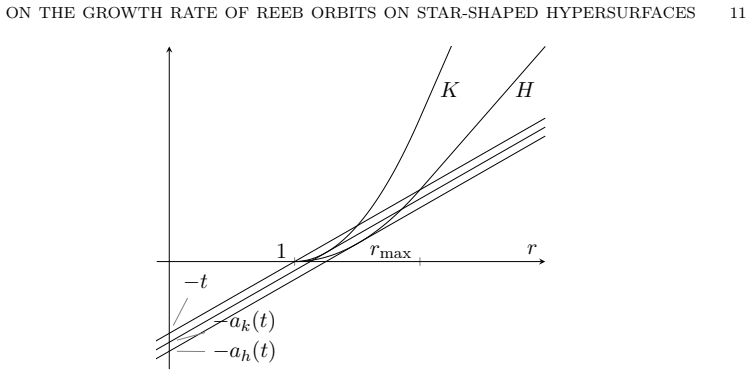
In this article, we study the growth rate of Reeb orbits on fiberwise star-shaped hypersurfaces in the cotangent bundle of a closed manifold. We prove that under a suitable topological condition on the base manifold the Reeb flow on any such hypersurface carries infinitely many simple closed orbits. Moreover, the number of simple Reeb orbits with period at most T grows at least like the prime numbers, that is, like T/log(T). The topological condition we assume is the existence of a non-nilpotent class in the homology of the free loop space of the manifold, with respect to the Chas-Sullivan product, lying in a connected component associated to a non-torsion class in the first homology of the manifold. In particular, for any Riemannian metric on a manifold satisfying such a topological condition, the number of geometrically distinct closed geodesics with length at most l grows at least like l/log(l). We also prove, using symplectic homology, that if a Liouville domain of dimension at least 4 with vanishing first Chern class admits a Reeb symplectically degenerate maximum representing a non-torsion first homology class of the domain, then the number of simple Reeb orbits with period at most T grows at least like T/log(T).
We study symplectic minimal resolutions of weighted projective planes $\mathbb{CP}(a,b,c)$ from the perspective of disconnected symplectic divisors with symplectic log Kodaira dimension $-\infty$. Building on the techniques developed in our previous work for connected divisors, we introduce the notion of exceptional gaps between distinct connected components of the divisor and use it to establish a Torelli-type theorem for certain configurations of three Hirzebruch--Jung strings. Motivated by Daigle--Russell's study of affine rulings on complete normal rational surfaces in algebraic context, we also establish a weighted version of Gromov--McDuff's characterization of symplectic $\mathbb{CP}^2$ by showing the existence of symplectic affine rulings implies certain divisor configuration to arise from the minimal resolution of $\mathbb{CP}(a,b,c)$.
A bracket on the one-jet bundle turns contact dynamics into a thermodynamically consistent system, demonstrated on the Duffing oscillator.
abstractclick to expand
Flows on symplectic, Poisson, contact, and metriplectic manifolds are reviewed in order to describe our main result, which is to associate a natural metriplectic dynamical system on the general one-jet bundle $J^1N=T^*N\times \mathbb{R}$, which is at once a (trivial) Poisson manifold and a contact manifold. Unlike the standard contact Hamiltonian system, our metriplectic system is thermodynamically consistent in that $$\dot{H} = 0 \quad\mathrm{and}\quad \dot{S} \geq 0$$ under the flow. Here $H$ is the Hamiltonian, while $S$ is the entropy function which is nothing but the $\mathbb{R}$ coordinate function of $J^1N$. As an example we derive the Duffing equation (autonomous and nonautonomous versions) either as a contact Hamiltonian system or as a metriplectic system. We show that for both systems the Duffing equation is a subsystem of three dimensional systems that contain a thermodynamic component, a form that facilitates asymptotic stability analysis of the relevant equilibrium state.
An augmentation of the Legendrian lift's algebra ensures they decompose into cocores inside Weinstein manifolds.
abstractclick to expand
We extend the generation theorem of Chantraine--Dimitroglou Rizell--Ghiggini--Golovko to exact Lagrangian immersions in Weinstein manifolds. We prove that an exact Lagrangian immersion equipped with an augmentation of the Chekanov--Eliashberg algebra of its Legendrian lift, or equivalently, equipped with a corresponding bounding cochain, is generated by the Lagrangian cocores.
We study Ginzburg dg algebras which appear at the intersection of representation theory and symplectic topology. First, we provide a collection of proper modules that generates all proper modules over a Ginzburg dg algebra, without assuming the Jacobi-finite condition. Using this generation result, we study the immersed compact Fukaya category of a general plumbing space. In particular, we prove a generation result for the compact Fukaya category and show that it is equivalent to the category of proper modules over the wrapped Fukaya category, and hence to the category of microlocal sheaves on the Lagrangian skeleton.
Equality via homotopy-coherent GRR yields a criterion for non-base-change lifts and detects non-trivial cobordism classes in relative GW-mod
abstractclick to expand
Given a Liouville manifold, we compute a Floer-homotopical invariant -- the complexification of the lift of symplectic cohomology to complex cobordism -- in terms of a classical Floer-theoretic invariant, namely, symplectic cohomology bulk-deformed by the Chern character. We do this by giving an explicit model for the complexified homotopy groups of the MU-module spectrum associated to a complex-oriented flow category and proving a ''homotopy coherent'' version of the classical Grothedieck-Riemann-Roch theorem.
Using the aforementioned relation, we establish a computable cohomological criterion, in terms of the pair-of-pants product and the BV operator on symplectic cohomology, for when this MU lift cannot be obtained via base change from the sphere spectrum; moreover, we give examples where this holds. Finally, we use this non-base change criterion to detect examples of non-trivial higher-dimensional complex cobordism classes of relative Gromov-Witten type moduli spaces in the context of a smooth complex projective variety relative to an ample smooth divisor.
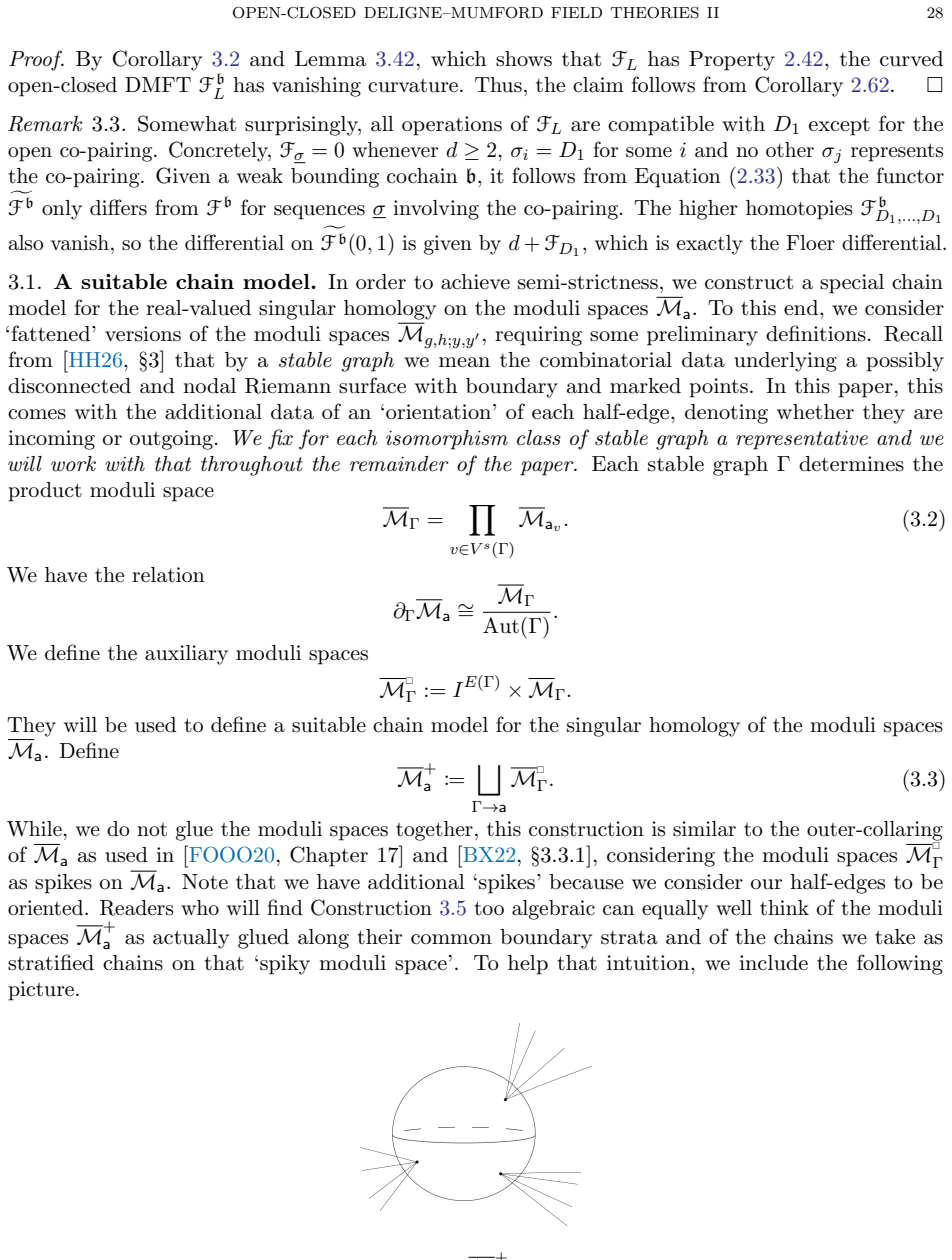
Open-closed Deligne--Mumford field theories are chain-level field theories based on moduli spaces of stable curves with boundary. We associate to a relatively spin embedded Lagrangian $L \subset (X,\omega)$ such an open-closed DMFT. It extends the Fukaya $A_\infty$ algebra to curves of arbitrarily high genus and with arbitrarily many boundary components and is unique up to homotopy. This is the first step in proving Kontsevich's conjecture that the Fukaya category determines the Gromov--Witten invariants of $X$, following a strategy delineated by Costello.
We study symplectic structures on four-dimensional small covers. Our main result shows that every symplectic four-dimensional small cover is aspherical. We then classify symplectic small covers over products of two polygons, proving that symplecticity is equivalent to factor-compatibility. We also classify them up to diffeomorphism. Finally, we construct a symplectic four-dimensional small cover whose orbit polytope is not combinatorially equivalent to a product of two polygons.
Signed Gauss words and visible polygons determine the A-infinity algebra of the curve inside the relative Fukaya category of a punctured sur
abstractclick to expand
Given an immersion of a circle in a punctured surface $\Sigma$, we give an explicit (and finite) computation of the $A_\infty$-algebra associated with this curve when viewed as an object in a (relative) Fukaya category of $\Sigma$ in terms of the signed Gauss word recording the double points in a traversal of the curve and the visible polygons that it bounds in $\Sigma$. We illustrate our computational technique by fully determining the $A_\infty$-products for immersions with up to three self-intersections. In particular, it is proved that, over an algebraically closed field, all associative algebras of dimension $\leq 4$, with one exception, can be realized as the (degree 0) endomorphism algebra of some Lagrangian immersion of a circle equipped with a bounding cochain computed in some relative Fukaya category $\mathcal{F}(\Sigma,D)$. We also note that any finite-dimensional algebra with radical square zero arises as the (degree 0) endomorphism algebra of an object in the Fukaya category $\mathcal{F}(\Sigma)$ of some punctured surface $\Sigma$.
Signed Gauss words and visible polygons show all but one algebra of dimension four or less arises as an endomorphism algebra in a relative 2
abstractclick to expand
Given an immersion of a circle in a punctured surface $\Sigma$, we give an explicit (and finite) computation of the $A_\infty$-algebra associated with this curve when viewed as an object in a (relative) Fukaya category of $\Sigma$ in terms of the signed Gauss word recording the double points in a traversal of the curve and the visible polygons that it bounds in $\Sigma$. We illustrate our computational technique by fully determining the $A_\infty$-products for immersions with up to three self-intersections. In particular, it is proved that, over an algebraically closed field, all associative algebras of dimension $\leq 4$, with one exception, can be realized as the (degree 0) endomorphism algebra of some Lagrangian immersion of a circle equipped with a bounding cochain computed in some relative Fukaya category $\mathcal{F}(\Sigma,D)$. We also note that any finite-dimensional algebra with radical square zero arises as the (degree 0) endomorphism algebra of an object in the Fukaya category $\mathcal{F}(\Sigma)$ of some punctured surface $\Sigma$.
The main theorem of the paper provides an existence criterion of holomorphic discs for higher $A_\infty$ operations. The key step is to show that if a minimal disc in a K\"ahler manifold with boundary in a sequence of Lagrangian submanifolds intersecting transversely such that its partial Maslov indices are either all no less than $1$ or all no larger than $-1$, then there is a holomorphic disc with the same image as this minimal disc. As a by-product, we show that all minimal discs in $\C\mathrm{P}^m$ with boundary on $\R\mathrm{P}^m$ are holomorphic.
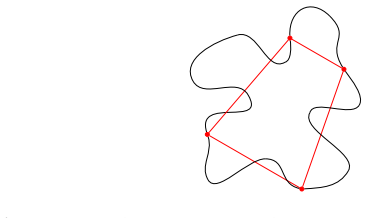
We construct a Lagrangian Floer homology whose chain complex is generically generated by the inscriptions of isosceles trapezoids in a smooth Jordan curve. This is an extension of Greene and Lobb's Jordan Floer homology (arXiv:2404.05179), which we also call Jordan Floer homology. Its non-triviality re-establishes that every smooth Jordan curve inscribes every isosceles trapezoid. By consideration of the spectral invariants associated with the real filtration known as the action filtration, we establish new cases of non-smooth Jordan curves which admit inscriptions of isosceles trapezoids.
Mirror symmetry predicts an action by the fundamental group of a conjectural stringy K\"ahler moduli space on the derived category of an algebraic variety. For a toric variety, a model for this space is understood, but constructing the action is still an open problem in general. We propose that this action can be studied on the $A$-side via a moduli space of Legendrians isotopic to the FLTZ Legendrian. For the $A_{n-1}$ singularity, we construct an annular braid-group action on the corresponding partially wrapped Fukaya category by exact autoequivalences. The standard braid subgroup recovers the Seidel--Thomas action on the derived category, while the additional annular generator corresponds to tensor product with $\mathcal O(-1)$.
We additionally extend the Floer theoretic approach to homological mirror symmetry for toric varities to the setting of semiprojective toric Deligne-Mumford stacks over an arbitrary field.
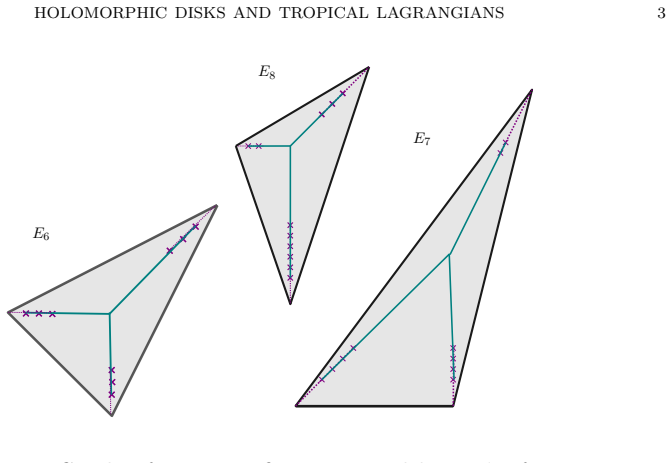
We develop a calculus for counting pseudoholomorphic disks with boundary in tropical Lagrangians contained in almost toric manifolds, using our previous work with Venugopalan. The results are mostly in dimension four under monotonicity assumptions although in principle the same technique works in any dimension and without monotonicity. The calculus is given as a sum over tropical graphs that interact with the tropical graph of the Lagrangian, generalizing results of Mikhalkin and Nishinou-Siebert for holomorphic spheres in toric varieties, and our previous result with Venugopalan which dealt with disks bounding almost toric moment fibers. The main contribution of this paper is the calculation of several multiplicities of vertices corresponding to disks, such as the holomorphic pant (half of the holomorphic pair of pants) and various univalent vertices occuring at trivalent vertices of the graph of the Lagrangian; a key tool is a Lagrangian isotopy from the Lagrangian pair of pants in the del Pezzo of degree seven to the inverse image of a diagonal, which is a special case of a results of Hind and Evans. We show that every integer eigenvalue of non-maximal modulus for quantum multiplication by the first Chern class is realized by such a sphere.
A shared witness ensures that reduction preserves the compatibility relation between two Dirac structures.
abstractclick to expand
The notion of \emph{concurrence} was recently proposed as the natural compatibility relation between Dirac structures, generalizing the commutativity of two Poisson structures. We address the question of when a reduction scheme -- that is, a way to induce a Dirac structure on a quotient of a submanifold -- respects this relation. After characterizing the minimal scheme of \emph{Dirac reduction}, we prove that two concurring Dirac structures have concurring reductions whenever they share a common \emph{witness}, extending to Dirac geometry the reduction of the Marsden-Ra\cb{t}iu theorem.
Two procedures for constructing such common witnesses are given, the second being the Dirac counterpart of Magri's original recipe in bihamiltonian geometry. Examples drawn from Hamiltonian actions, Dirac-Nijenhuis manifolds, and complex Dirac structures conclude the paper and illustrate our methods.
Gorenstein toric contact manifolds are good toric contact manifolds with zero first Chern class that are completely determined by certain integral convex polytopes called toric diagrams. The Ehrhart polynomial of these toric diagrams determines and is determined by the contact Betti numbers of the corresponding contact manifolds, i.e. the dimension of their cylindrical contact homology in eachdegree. In this paper we look into the following natural question: to what extent do these contact invariants determine the Gorenstein toric contact manifold? Flexibility is the norm and we illustrate it with the family of Gorenstein toric contact manifolds that arise as the prequantization of monotone iterated ${\mathbb P}^1$-bundles, i.e. monotone Bott manifolds. In each dimension, the Ehrhart polynomial of their toric diagrams is equal to the Ehrhart polynomial of the cross-polytope, corresponding to the monotone prequantization of ${\mathbb P}^1 \times \cdots \times {\mathbb P}^1$, and we describe the unimodular classification of these toric diagrams. On the rigidity side, we will show that the primitive prequantization of ${\mathbb P}^1 \times \cdots \times {\mathbb P}^1$ is rigid, i.e. completely determined as a Gorenstein toric contact manifold by its contact Betti numbers. More precisely, in each dimension, we show that its toric diagram, which we name small cross-polytope, is the unique toric diagram with its particular Ehrhart polynomial. We will also prove a rigidity result for a family of Gorenstein toric contact manifolds that arise as the primitive prequantization of monotone ${\mathbb P}^1$-bundles over ${\mathbb P}^{n-1}$.
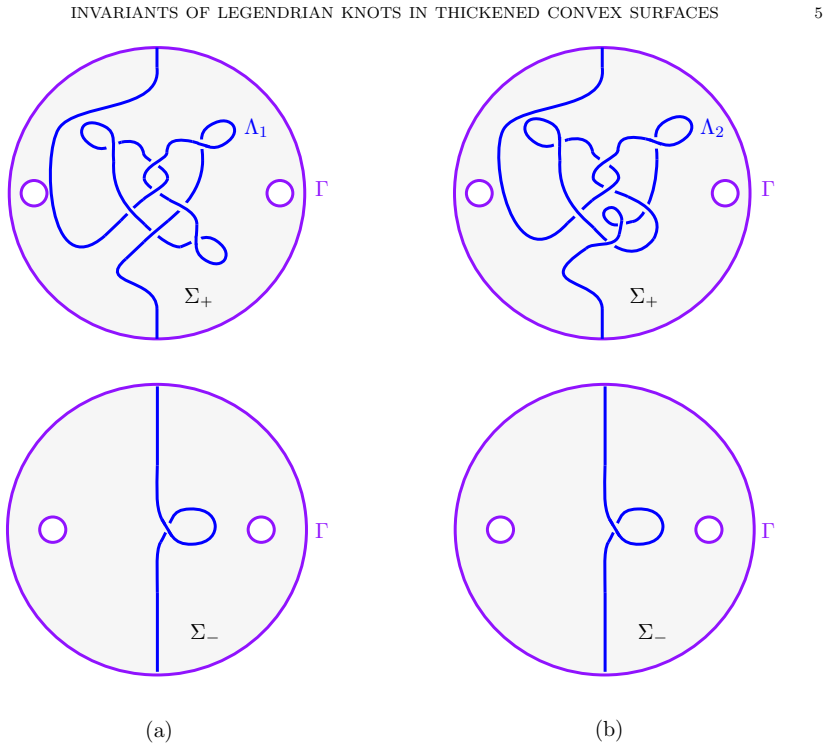
We define a differential graded algebra associated to Legendrian knots in thickened convex surfaces $\Sigma\times \mathbb{R}$. The algebra is defined in the same spirit as the Chekanov-Eliashberg DGA for Legendrians in $\mathbb{R}^3$, but makes use of the data of the dividing set $\Gamma$ of $\Sigma$. The algebra is generated by countably many Reeb chords of the Legendrian $\Lambda$, and its differential counts certain immersed polygons in the projection $\pi:\Sigma\times \mathbb{R}\to \Sigma\times \{0\}$ with boundary on $\pi(\Lambda)\cup \Gamma$. We show that the differential squares to zero and that the stable tame isomorphism type of the DGA is invariant under Legendrian isotopy. Finally, we compute several examples and use the invariant to distinguish Legendrian knots in thickened convex surfaces that cannot be distinguished by the classical invariants.
The authors address whether uncountably many Lagrangian submanifolds can be packed inside a single Hamiltonian isotopy class of a…
abstractclick to expand
Given a symplectic manifold, can one pack uncountably many Lagrangian submanifolds in a given Hamiltonian isotopy class of this symplectic manifold? We address $C^\infty$ and $C^0$ versions of this question.
We show that there is no universal upper bound for the systolic ratio of Bott-integrable contact forms on closed 3-manifolds, thus providing further evidence for the relative flexibility of integrable contact forms. For the proof, we study piecewise linear approximations of Lutz forms and establish integrability of a `plug' constructed by Abbondandolo, Bramham, Hryniewicz and Salom\~ao for pushing up the systolic ratio.
Given a thin torus $T_K$ around a knot $K\subset \mathbb{R}^3$, we construct Morse models of cord algebra $Cord(T_K)$ with $\mathbb{Z}$ and loop space coefficients. Using the Multiple time scale dynamics we identify $Cord(T_K; \mathbb{Z})$ with $Cord(K; \mathbb{Z})$. In combination with the works of Cieliebak-Ekholm-Latschev-Ng and Petrak this indirectly relates $Cord(T_K)$ to $0$-th degree Legendrian contact homology $LCH_0(\mathcal{L}^\ast_+ T_K)$ of one component of the unit conormal bundle over $T_K$. Our definition of $Cord(T_K)$ is motivated by $J$-holomorphic curves with boundary on the Lagrangian submanifold $L^\ast_+ T_K\cup\mathbb{R}^3$ with an arboreal singularity along the torus $T_K$.
Killing systems on contact manifolds give smooth transitions, symmetry integrals, and closure for totally magnetic submanifolds.
abstractclick to expand
This paper develops new links between contact geometry, magnetic dynamics, and symmetry in exact magnetic systems. First, we establish an interpolation property for Killing magnetic systems on contact manifolds under an additional condition. Specifically, we show that the corresponding magnetic geodesic flow interpolates smoothly between the sub-Riemannian geodesic flow on the contact distribution and the flow of the vector field associated with a primitive of the magnetic field. Second, we show that Hamiltonian group actions associated with the magnetomorphism group produce Poisson-commuting integrals of motion for the magnetic flow. Finally, we obtain new structural results on totally magnetic submanifolds, showing that fixed-point sets of magnetomorphisms and intersections of totally magnetic submanifolds are again totally magnetic. The latter two results may be viewed as extensions of classical phenomena from Riemannian geometry to magnetic geometry.
Multivalued perturbations on derived orbifold charts produce all-genus invariants for symplectic manifolds while bypassing earlier analytic,
abstractclick to expand
We give a definition of all-genus reduced Gromov-Witten invariants of symplectic manifolds by using effectively supported multivalued perturbations on derived orbifold/Kuranishi charts, which bypasses the hard analytical result of sharp compactification/ghost bubble censorship of Zinger and Ekholm-Shende.
The method generalizes the symplectic case using groupoid Toeplitz operators with Heisenberg fiber structure.
abstractclick to expand
We use Toeplitz operators to define a star-product on Poisson manifolds whose Poisson structure is induced by a symplectic Lie algebroid. The Toeplitz operators we consider are defined on groupoids whose algebroid can be endowed with a Heisenberg group structure on the fibers. This generalizes an approach due to Guillemin and Melrose in the symplectic case.
We study the topology of Lagrangian submanifolds in standard symplectic vector spaces $\mathbb{C}^n$ using ideas from open-closed string topology. Specifically, for a closed, oriented, spin Lagrangian $L$, we construct a (possibly curved) deformation of the dg associative algebra of chains on the based loop space of $L$. This is done via pushing forward moduli spaces of pseudo-holomorphic discs with boundaries on $L$, viewed as chains in the free loop space, along a string topology closed-open map. As an application, we prove that if $\pi_2(L)=0$, then $L$ has non-vanishing Maslov class, generalizing previous results due to Viterbo, Cieliebak-Mohnke, Fukaya, and Irie.
They exist, classify, and match the semiclassical corrections in Kontsevich's formula and linear cases.
abstractclick to expand
In this paper, we study half-densities enhancing the multiplication map on a symplectic groupoid and which satisfy a suitable associativity condition. This is structurally motivated by the expected complete semiclassical-analytic approximation to a star product for the underlying Poisson manifold. We show the existence and classification of such associative half-densities, and further apply this theory to the understanding of semiclassical factors in Kontsevich's quantization formula. In the particular case of a linear Poisson structure, we recover the factors appearing in the Duflo isomorphism and its Kashiwara-Vergne extensions as a canonical associative enhancement.
This forces almost Kähler structures in the magnetic case with constant corrected curvature and dynamically characterizes complex space form
abstractclick to expand
We study Hamiltonian systems near a compact symplectic Morse-Bott minimum. Our first result shows that if the flow is Zoll (that is, it induces a free circle action) along a sequence of energy levels converging to the minimum, then the Hessian of the Hamiltonian in the symplectic normal directions must be compatible with the restriction of the symplectic structure to the normal bundle (that is, its representing endomorphism is a complex structure of the symplectic normal bundle). For our second result, we specialize to magnetic systems on closed manifolds with symplectic magnetic form. In this setting, if the system is Zoll along a sequence of energy levels converging to the minimum, then the metric is compatible with the magnetic form and therefore defines an almost K\"ahler structure. We show that a natural curvature quantity, consisting of the holomorphic sectional curvature corrected by a term measuring the non-integrability of the almost complex structure, must be constant. In particular, we obtain a dynamical characterization of complex space forms among K\"ahler manifolds. Together, these results establish strong rigidity of systems which are Zoll at energies close to a Morse-Bott minimum, in the symplectic and in the magnetic settings.
Restricting to tt*-Toda equations turns the space of meromorphic connections into a real symplectic Lie groupoid linked to supersymmetric QF
abstractclick to expand
We investigate the geometry of a certain space of meromorphic connections with irregular singularities, and prove in particular that it is a (real) symplectic Lie groupoid. The connections have a physical meaning: they correspond to certain solutions of the topological-antitopological fusion (tt*) equations of Cecotti and Vafa, and hence to deformations of supersymmetric quantum field theories. The groupoid structure arises because we restrict ourselves to the tt* equations of Toda type, whose monodromy data has a Lie theoretic description. To obtain these results, we show first that the universal centralizer of a Lie group is a holomorphic symplectic groupoid over the Steinberg cross section.
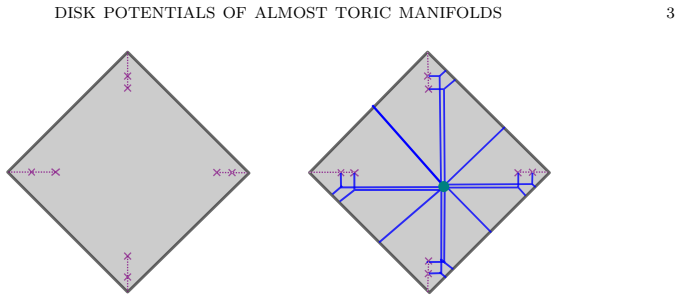
Using our previous work we give a tropical formula for disk potentials for Lagrangian tori in almost toric four-manifolds, that is, fibrations by Lagrangian tori with only toric and focus-focus singularities, generalizing results of Mikhalkin for holomorphic spheres in the projective plane. As examples, we directly compute potentials for Lagrangian tori in del Pezzo surfaces equipped with monotone symplectic forms. These formulas were established in the monotone case by different methods in Pascaleff-Tonkonog, and investigated from the point of view of the Gross-Siebert program in Carl-Pumperla-Siebert, Bardwell-Evans--Cheung--Hong--Lin and also Lau-Lee-Lin.
We prove a compactness result for gradient flow lines in a general set-up which comprises both the situation of Morse gradient flow lines as well as Floer cylinders converging to a critical submanifold respectively. For the compactness result we have to impose two conditions. Both are readily verified in the Morse case but establishing the second condition in the Floer case poses a technical challenge and relies on an exponential decay estimate for Floer cylinders, with coefficient function continuously depending on the initial loop. This is a result of independent interest.