REVIEW 2 major objections 4 minor 38 references
Topological Landau Theory
T0 review · 2 major / 4 minor · reviewed 2026-08-11 · deepseek-v4-flash
Pith's one-line read Multi-component Landau order parameters acquire a Berry phase when thermodynamic parameters are cycled adiabatically, and in the models presented this phase is π around a Dirac point and qΩ around a Weyl point, reversing a Josephson…
desk verdict A genuinely new and mostly sound extension of Landau theory to Berry phases of multicomponent order parameters, with a sloppy adiabatic derivation that needs a fix and a numerical TDGL check. read the letter →
The pith
A machine-rendered reading of the paper's core claim, the machinery that carries it, and where it could break.
The reading
What carries the argument
The central object is the quadratic free-energy matrix $A(\lambda)$, whose matrix elements $A_{\alpha\beta}$ are the second-order coefficients coupling order-parameter components that transform in the same irreducible representation. Because the free energy is $\sum_{\alpha\beta}\Delta_\alpha^* A_{\alpha\beta}\Delta_\beta$ to this order, the stable ordered state is the normalized eigenvector $\hat{\Delta}_-(\lambda)$ with the smallest eigenvalue, and the adiabatic dynamics of the time-dependent Ginzburg-Landau equation keeps the order parameter on this eigenvector. The Berry connection $A_{-,j} = i\hat{\Delta}_-^\dagger \partial_j \hat{\Delta}_-$ then encodes the geometric phase acquired over a loop, and the degeneracies of $A(\lambda)$, points where its two eigenvalues coincide, act as Dirac or Weyl points that source Berry curvature in parameter space. The derivation requires the hierarchy of relaxation timescales $\tau_+ \ll \tau_- \ll \tau$, where $\tau_\pm = \hbar\eta/|a_\pm|$ are the relaxation times along the two eigenvectors and $\tau$ is the timescale of parameter variation. This machinery converts a thermodynamic phase diagram into a synthetic band structure whose 'bands' are the eigenvectors of $A(\lambda)$ and whose gaps close at the diabolical points.
What would settle it
Numerically integrate the full time-dependent Ginzburg-Landau equation (Eq. 9) without the adiabatic ansatz for a closed loop encircling the Dirac point; if the phase change of the gap after one cycle differs from $\pi$ by more than the numerical error, the geometric-phase prediction is wrong. A complementary experimental falsifier: a Josephson junction starting from $\Delta^L_k = -i\Delta^R_k$ that cycles the right superconductor's parameters around the Dirac point and returns the current to its initial direction rather than reversing it would refute the claimed topological phase.
Extended reading notes
Core claim
The central claim is that under cyclic adiabatic variation of the thermodynamic parameters $\lambda$, the superconducting order parameter $\boldsymbol{\Delta}$ remains locked to the instantaneous lowest eigenvector $\hat{\Delta}_-(\lambda)$ of the quadratic Landau matrix $A(\lambda)$ and acquires the Berry phase $\varphi = \varphi_0 + \oint_C i\hat{\Delta}_-^\dagger d\hat{\Delta}_-$, the loop integral of the Berry connection (Eq. 13). In the time-reversal-symmetric model $V = V_0 I_2 + r(\cos\phi\,\sigma_z + \sin\phi\,\sigma_x)$, the phase diagram contains a Dirac point at $r = 0$; a loop encircling it yields a $\pi$ Berry phase, equivalently a sign change of the order parameter, while a contractible loop yields zero. In the time-reversal-breaking model $V = V_0 I_2 + r(\cos\theta\,\sigma_z + \sin\theta(\cos\phi\,\sigma_x + \sin\phi\,\sigma_y))$, the degeneracy is a Weyl point of monopole charge $q = -1/2$, and a loop subtending solid angle $\Omega$ yields the Berry phase $q\Omega$. In both models the geometric phase appears in the Josephson current: after one cycle around the non-contractible loop, the current reverses direction, while a contractible path leaves it unchanged. The paper thereby extends Landau's theory of phase transitions to include the topology of the order parameter.
Load-bearing premise
The argument stands on the assumption that the order parameter remains locked to the instantaneous lowest eigenvector $\hat{\Delta}_-(\lambda)$ of the quadratic matrix for the whole closed loop, which requires the high-energy eigenvector to stay negligible and the parameter evolution to be slow compared with the relaxation time $\tau_-$; near the critical point $\tau_-$ diverges, the quartic term can reorient the order parameter, and the Berry-phase formula (13) stops applying.
Editorial extensions
If this is right
- A multi-component order parameter in Landau theory is generically topologically nontrivial: its cyclic adiabatic evolution produces a geometric phase fixed by the loop's winding around degeneracies, not by the drive rate.
- The $\pi$ Berry phase from the Dirac point means two successive loops return the order parameter to itself, and one loop reverses the direction of the Josephson current; in the Weyl case the current reversal is controlled by the solid angle subtended.
- The mechanism generalizes beyond superconductivity: any continuous transition whose order parameter has several components transforming under the same irrep of the symmetry group will exhibit the same geometric phase under parameter cycling.
- The geometric phase is fixed by topology: for any loop that does not cross a critical surface or a degeneracy, the phase is determined by whether the loop encircles the point, so perturbations of the path do not change the result.
Reading between the lines
- A testable extension: if a loop is traversed faster than the relaxation time $\tau_-$, the order parameter will lag behind the eigenvector $\hat{\Delta}_-(\lambda)$ and the phase after one cycle should deviate from the geometric value; measuring this deviation would probe the breakdown of the adiabatic locking that the paper's derivation assumes.
- The same mechanism suggests that interaction-parameter loops could act as synthetic gauge-field sources in other tunable systems, such as ultracold atoms near a Feshbach resonance, to engineer arbitrary geometric phases on demand rather than only the specific $\pi$ and $q\Omega$ values computed here.
- The paper does not analyze the critical behavior at the diabolical points themselves; a natural next step would be to compute critical exponents at the Dirac and Weyl points of $A(\lambda)$, where two critical surfaces touch, to see whether they differ from ordinary Landau critical exponents.
- The Josephson reversal is one possible readout; another would be to embed the same superconductor in an interference device where the Berry phase appears as a shift in the critical-current interference pattern, providing an independent experimental route.
Signed reviews
Editorial analysis
A structured set of objections, weighed in public.
Referee Report
Summary. The paper proposes an extension of Landau theory, called "topological Landau theory," for multicomponent order parameters transforming under the same irreducible representation. In this framework, the quadratic Landau matrix A(λ) plays the role of a Hamiltonian, the stabilized order parameter is its lowest eigenvector Δ̂_-(λ), and a cyclic adiabatic variation of the thermodynamic parameters λ produces a Berry phase given by Eq. (13). The authors derive a BCS mean-field free energy and a time-dependent Ginzburg-Landau (TDGL) equation for a tetragonal superconductor with two attractive partial waves in the trivial representation. They analyze two models, one time-reversal symmetric with a thermodynamic Dirac point and one time-reversal breaking with a Weyl point, and compute a Josephson current signature of the Berry phase.
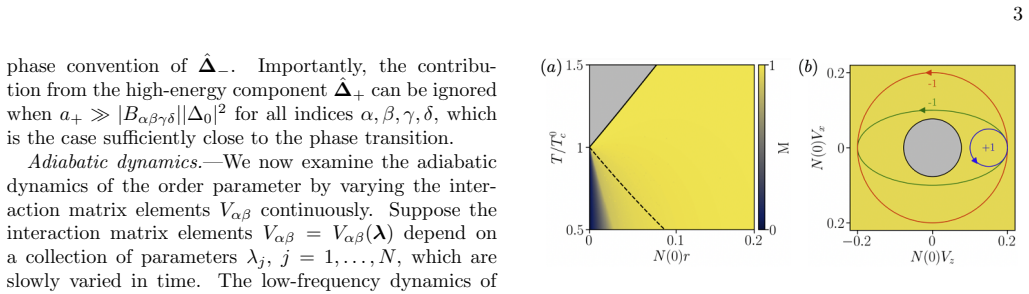
Significance. If the central claim holds, this is a genuinely useful conceptual extension of Landau theory: it identifies the quadratic Landau matrix as a parameter-space Hamiltonian and the order-parameter direction as a geometric object with Berry-phase content. The paper has real strengths: the Landau free energy and TDGL equation are derived from a microscopic BCS Hamiltonian; the Berry phase in Eq. (13) follows from the eigenvector of A without fitted parameters; the static prediction that the ground state is close to Δ̂_- near T_c is checked numerically by minimizing the full free energy (M≈1 near T_c); and the Josephson current reversal in Fig. 3 is a concrete, falsifiable signature. The main weakness is that the adiabatic elimination leading to Eq. (13) is not carried out rigorously, and the adiabatic conditions are not quantitatively verified for the loops used in the Josephson calculation.
major comments (2)
- [Adiabatic dynamics, Eqs. (10)-(12)] The derivation of the central result is not internally consistent. Substituting the quasistatic ansatz (10) into the TDGL equation (9) cannot produce Eq. (11), dΔ0/dt = 0, because Δ0(λ(t)) depends on time through λ and its derivative is generally nonzero. More seriously, if the state were exactly on the instantaneous minimum, the right-hand side of Eq. (9) would vanish (using Δ0^2 = -a_-/b_-), forcing dΔ/dt = 0, which is incompatible with the λ-dependence of Δ̂_-(λ) unless Δ0 is constant along the loop. The correct adiabatic elimination must keep the small lag of the magnitude behind the instantaneous minimum; the imaginary part of the projected equation then reproduces the leading-order phase equation (12), while the real part gives the relaxation of that lag rather than Eq. (11). As written, the passage from Eqs. (10)-(12) to the Berry phase (13) is incomplete and should be redone with an explicit expansion in τ_+/τ and τ_-/τ.
- [Topological Josephson effect, Fig. 3] The adiabatic hierarchy τ_+ ≪ τ_- ≪ τ and the condition a_+ ≫ |B_{αβγδ}| |Δ0|^2 are stated but never checked for the actual loops in Fig. 2(b) or for the Josephson current calculation in Fig. 3. Since τ_- diverges at the critical lines a_- = 0 and the topologically nontrivial loops encircle the metallic region at T > T_c^0, the paths may pass close to the critical surface, where the order parameter is not locked to the instantaneous lower eigenvector and Eq. (13) ceases to apply. Moreover, the current in Fig. 3 is computed from the instantaneous equilibrium gap at each parameter point, not from a solution of the TDGL equation, so it does not by itself validate the geometric-phase accumulation. I request a quantitative check of the hierarchy for the paths used, or a direct numerical integration of Eq. (9) along at least one nontrivial loop confirming the accumulated phase and the current reversal.
minor comments (4)
- [Dirac and Weyl points, after Eqs. (14) and (15)] The statement that Δ̂_- has the lower critical temperature is reversed. From Eq. (7), the eigenvector of V with the larger attractive eigenvalue V0+r has the higher T_c, and that eigenvector is Δ̂_-, the lower eigenvector of A. The same mislabeling appears in the Weyl paragraph, where Δ̂_- is called the less attractive channel.
- [Dirac and Weyl points, TRS model] In the time-reversal symmetric model the Berry connection vanishes everywhere, so the π phase is a holonomy due to the double-valuedness of the real eigenvector on the circle rather than a loop integral of A. The text notes this, but the discussion should explicitly distinguish this branch holonomy from the connection-based Berry phase of Eq. (13), because the two mechanisms are conceptually different.
- [Figs. 2 and 3] The numerical parameters for Fig. 2 are given, but the temperature T at which M≈1 is evaluated, the radii of the red/green/blue loops, and the ramp time τ relative to τ_- are not specified. These values are needed to assess the adiabatic hierarchy and to make the Josephson prediction reproducible.
- [Supplementary Material II] In deriving the cubic contribution to the TDGL equation, the supplement assumes Δ_k(t1) ≃ Δ_k(t); the validity condition for this low-frequency approximation should be stated explicitly, since it is one of the assumptions behind the adiabatic dynamics.
Circularity Check
No significant circularity: the Berry-phase prediction follows from the stated Landau eigenvector problem without fitted inputs, and the self-citations are contextual.
full rationale
The derivation chain is self-contained. The quadratic matrix A(λ) is constructed from the microscopic interaction V and density of states N(0) via Eq. (7); the stabilized order parameter is obtained by minimizing the free energy, and the Berry phase in Eq. (13) is computed directly from the eigenvector Δ̂_−(λ) of A(λ), with no parameter fitted to the target result. The Dirac and Weyl examples use explicit interaction matrices, Eqs. (14) and (15), and the π and qΩ phases are elementary consequences of the stated eigenvectors, checked numerically against the full mean-field free energy in Fig. 2(a). The Josephson current reversal in Fig. 3 is a derived consequence of Eq. (16) evaluated with the adiabatically evolved gap, not an input. Citations to the authors' prior work are used only to contrast momentum-space monopole superconductivity and are not load-bearing; no uniqueness theorem is imported from those works. The only flagged issue is the internal consistency of the adiabatic magnitude equation Eq. (11), which states dΔ0/dt = 0 even though Δ0 depends on time through λ(t); this is a correctness concern about the adiabatic elimination, not a circularity. Therefore no circular step meets the evidentiary bar of reducing a prediction to its own input by construction.
Assumptions & free parameters
free parameters (4)
- V0 (isotropic interaction strength) =
N(0)V0 = 0.4 in the numerics
- r (anisotropic interaction strength) =
0 < r < V0; loop radii chosen by hand, for example N(0)r = 0.2 in Fig. 3
- phi and theta (interaction matrix angle parameters) =
phi = 2.7 in Fig. 2; theta and phi vary on the sphere in the Weyl model
- Lambda (BCS energy cutoff) =
Lambda = 10 in the numerics
assumptions (7)
- domain assumption Mean-field BCS approximation: the superconducting state is described by a quadratic Bogoliubov Hamiltonian with a complex gap function Delta_k, and the free energy is computed from non-interacting quasiparticles.
- domain assumption The pairing interaction is projected exactly onto two partial waves phi_1 = 1 and phi_2 = sqrt(5)[1 - 3(kx^2 + ky^2)/(2 k_F^2)] in the trivial irrep of D4h; all other pairing channels are absent.
- domain assumption The time-dependent Ginzburg-Landau equation -hbar eta dDelta/dt = df/dDelta^* with eta = pi N(0)/(8 k_B T) captures the low-frequency gap dynamics.
- domain assumption Adiabatic hierarchy tau_+ << tau_- << tau and neglect of the off-diagonal nonabelian connection between the two eigenstates.
- domain assumption The quartic term can be neglected when fixing the direction of the order parameter: a_+ >> |B_alpha beta gamma delta| |Delta_0|^2.
- domain assumption The system remains in the same superconducting phase during the entire parameter loop, with no crossing of a critical surface.
- standard math Standard quantum adiabatic and Berry phase theorem: an eigenstate of a slowly varying Hermitian matrix follows the instantaneous eigenvector and acquires the geometric phase equal to the loop integral of i times the inner product of the eigenvector with its differential.
Cite this review
Pith. "Pith review of Topological Landau Theory." pith.science (2026). https://pith.science/paper/YDLV7YFH
@misc{pith2026241215103,
  author       = {Pith},
  title        = {Pith review of: Topological Landau Theory},
  year         = {2026},
  howpublished = {\url{https://pith.science/paper/YDLV7YFH}},
  note         = {Machine review of arXiv:2412.15103}
}
read the original abstract
We present an extension of Landau's theory of phase transitions by incorporating the topology of the order parameter. When the order parameter comprises several components arising from multiplicity in the same irreducible representation of symmetry, it can possess a nontrivial topology and acquire a Berry phase under the variation of thermodynamic parameters. To illustrate this idea, we investigate the superconducting phase transition of an electronic system with tetragonal symmetry and an attractive interaction involving two partial waves, both transforming in the trivial representation. By analyzing the time-dependent Ginzburg-Landau equation in the adiabatic limit, we show that the order parameter acquires a Berry phase after a cyclic evolution of parameters. We study two concrete models -- one preserving time-reversal symmetry and one breaking it -- and demonstrate that the nontrivial topology of the order parameter originates from thermodynamic analogs of gapless Dirac and Weyl points in the phase diagram. Finally, we identify an experimental signature of the topological Berry phase in a Josephson junction.
Figures


Figures from the paper (1 more)

Reference graph
Works this paper leans on
-
[1]
L. D. Landau, 29. On the Theory of Phase Transitions, in Collected Papers of L.D. Landau(Pergamon, 1965) pp. 193–216
work page 1965
-
[2]
L. D. Landau and E. M. Lifshitz, Statistical Physics, Vol. 5 (Elsevier, 2013)
work page 2013
-
[3]
L. D. Landau, E. M. Lifshitz, E. M. Lifshits, and L. Pitaevskii, Statistical Physics: Theory of the Con- densed State, Vol. 9 (Butterworth-Heinemann, 1980)
work page 1980
-
[4]
V. L. Ginzburg and L. Landau, 73. On the Theory of Superconductivity, in Collected Papers of L.D. Landau, edited by D. ter Haar (Pergamon, 1965) pp. 546–568
work page 1965
-
[5]
M. S. Dresselhaus, G. Dresselhaus, and A. Jorio, Group theory: application to the physics of condensed matter (Springer Science & Business Media, 2007)
2007
-
[6]
Sigrist and K
M. Sigrist and K. Ueda, Phenomenological theory of un- conventional superconductivity, Rev. Mod. Phys.63, 239 (1991)
1991
-
[7]
While in Landau theory, “competing orders” typically refers to symmetry-distinct orders ϕ1, ϕ2 with a (re- pulsive) biquadratic coupling ∼ |ϕ1|2|ϕ2|2 in the free energy [37], here we mean distinct but symmetry- compatible orders that are allowed to mix at the bilinear (quadratic) level
-
[8]
M. Z. Hasan and C. L. Kane, Colloquium: Topological insulators, Rev. Mod. Phys. 82, 3045 (2010)
2010
Show all 38 references
-
[9]
Qi and S.-C
X.-L. Qi and S.-C. Zhang, Topological insulators and su- perconductors, Rev. Mod. Phys. 83, 1057 (2011)
2011
-
[10]
C.-K. Chiu, J. C. Y. Teo, A. P. Schnyder, and S. Ryu, Classification of topological quantum matter with sym- metries, Rev. Mod. Phys. 88, 035005 (2016)
2016
-
[11]
L. D. Landau and I. M. Khalatnikov, On the Anomalous Absorption of Sound Near a Second-Order Phase Tran- sition Point, Dokl. Akad. Nauk SSSR 96, 469 (1954)
1954
-
[12]
Schmid, A time dependent Ginzburg-Landau equation and its application to the problem of resistivity in the 6 mixed state, Phys
A. Schmid, A time dependent Ginzburg-Landau equation and its application to the problem of resistivity in the 6 mixed state, Phys. Kondens. Mater. 5, 302 (1966)
1966
-
[13]
Abrahams and T
E. Abrahams and T. Tsuneto, Time Variation of the Ginzburg-Landau Order Parameter, Phys. Rev. 152, 416 (1966)
1966
-
[14]
L. P. Gor’kov and G. M. Eliashberg, Generalization of the Ginzburg-Landau Equations for Non-Stationary Prob- lems in the Case of Alloys with Paramagnetic Impurities, Sov. Phys. JETP 27, 328 (1968)
1968
-
[15]
H. T. C. Stoof, Time-dependent Ginzburg-Landau theory for a weak-coupling superconductor, Phys. Rev. B 47, 7979 (1993)
1993
-
[16]
Vanderbilt, Berry Phases in Electronic Structure Theory: Electric Polarization, Orbital Magnetization and Topological Insulators(Cambridge University Press, 2018)
D. Vanderbilt, Berry Phases in Electronic Structure Theory: Electric Polarization, Orbital Magnetization and Topological Insulators(Cambridge University Press, 2018)
2018
-
[17]
Murakami and N
S. Murakami and N. Nagaosa, Berry Phase in Magnetic Superconductors, Phys. Rev. Lett. 90, 057002 (2003)
2003
-
[18]
Li and F
Y. Li and F. D. M. Haldane, Topological Nodal Cooper Pairing in Doped Weyl Metals, Phys. Rev. Lett. 120, 067003 (2018)
2018
-
[19]
Sun, S.-P
C. Sun, S.-P. Lee, and Y. Li, Vortices in a Monopole Superconducting Weyl Semi-metal, arXiv:1909.04179 (2019)
2019 arXiv
-
[20]
Sun and Y
C. Sun and Y. Li, Z2 Topologically Obstructed Super- conducting Order, arXiv:2009.07263 (2020)
2020 arXiv
-
[21]
Bobrow and Y
E. Bobrow and Y. Li, Monopole Superconductivity in Magnetically Doped Cd 3As2, arXiv:2204.04249 (2022)
2022 arXiv
-
[22]
Li and G
Y. Li and G. R. Frazier, Berry Phase Enforced Spinor Pairing Order, arXiv:2409.09579 (2024)
2024 arXiv
-
[23]
G. R. Frazier, J. Zhang, J. Zhang, X. Sun, and Y. Li, Designing phase sensitive probes of monopole supercon- ducting order, Phys. Rev. Research 6, 043189 (2024)
2024
-
[24]
Bobrow, C
E. Bobrow, C. Sun, and Y. Li, Monopole charge density wave states in Weyl semimetals, Phys. Rev. Research 2, 012078 (2020)
2020
-
[25]
A. A. Abrikosov, Fundamentals of the Theory of Metals (Courier Dover Publications, 2017)
2017
-
[26]
R. A. Barankov, L. S. Levitov, and B. Z. Spivak, Collec- tive Rabi Oscillations and Solitons in a Time-Dependent BCS Pairing Problem, Phys. Rev. Lett. 93, 160401 (2004)
2004
-
[27]
R. A. Barankov and L. S. Levitov, Synchronization in the BCS Pairing Dynamics as a Critical Phenomenon, Phys. Rev. Lett. 96, 230403 (2006)
2006
-
[28]
R. A. Barankov and L. S. Levitov, Dynamical selection in developing fermionic pairing, Phys. Rev. A 73, 033614 (2006)
2006
-
[29]
J. L. Bohn, Cooper pairing in ultracold 40K using Fesh- bach resonances, Phys. Rev. A 61, 053409 (2000)
2000
-
[30]
Holland, S
M. Holland, S. J. J. M. F. Kokkelmans, M. L. Chio- falo, and R. Walser, Resonance Superfluidity in a Quan- tum Degenerate Fermi Gas, Phys. Rev. Lett. 87, 120406 (2001)
2001
-
[31]
S. J. J. M. F. Kokkelmans, J. N. Milstein, M. L. Chio- falo, R. Walser, and M. J. Holland, Resonance super- fluidity: Renormalization of resonance scattering theory, Phys. Rev. A 65, 053617 (2002)
2002
-
[32]
J. N. Milstein, S. J. J. M. F. Kokkelmans, and M. J. Hol- land, Resonance theory of the crossover from Bardeen- Cooper-Schrieffer superfluidity to Bose-Einstein conden- sation in a dilute Fermi gas, Phys. Rev. A 66, 043604 (2002)
2002
-
[33]
Ohashi and A
Y. Ohashi and A. Griffin, BCS-BEC Crossover in a Gas of Fermi Atoms with a Feshbach Resonance, Phys. Rev. Lett. 89, 130402 (2002)
2002
-
[34]
Ohashi and A
Y. Ohashi and A. Griffin, Superfluid transition temper- ature in a trapped gas of Fermi atoms with a Feshbach resonance, Phys. Rev. A 67, 033603 (2003)
2003
-
[35]
Ohashi and A
Y. Ohashi and A. Griffin, Superfluidity and collective modes in a uniform gas of Fermi atoms with a Feshbach resonance, Phys. Rev. A 67, 063612 (2003)
2003
-
[36]
Stajic, J
J. Stajic, J. N. Milstein, Q. Chen, M. L. Chiofalo, M. J. Holland, and K. Levin, Nature of superfluidity in ultra- cold Fermi gases near Feshbach resonances, Phys. Rev. A 69, 063610 (2004)
2004
-
[37]
S. A. Kivelson, J. M. Jiang, and J. Chang, Statistical Mechanics of Phases and Phase Transitions(Princeton University Press, Princeton, 2024)
2024
-
[38]
T opological Landau Theory
H. J. W. Haug and A.-P. Jauho, Quantum Kinetics in Transport and Optics of Semiconductors (Springer, Frankfurt, 1997). 7 Supplemental Material for “T opological Landau Theory” I. Mean-field free energy In this supplementary material, we derive the mean-field free energy used t...
1997
Reviewed August 11, 2026 · model on record in the stance chip above.
Discussion (0). Continue with ORCID to comment.