pith. machine review for the scientific record. sign in

cond-mat.other

Other Condensed Matter

Work in condensed matter that does not fit into the other cond-mat classifications

0
cond-mat.other 2026-05-13 Recognition

Trap engineering pushes organic photodetector EQE above 1100%

Enhanced Photomultiplication Effect by Synergistic Integration of Hole-Blocking Layers and Trap Engineering in PM-OPDs

Isolated 0.5 wt% hole traps and blocking layers deliver high gain, 4x10^12 Jones detectivity, and 22 kHz speed at low dark current.

Figure from the paper full image
abstract click to expand
Photomultiplication-type organic photodetectors (PM-OPDs) promise exceptional sensitivity for weak-light detection but typically suffer from a gain-bandwidth trade-off where high external quantum efficiency (EQE) incurs large dark current and slow response times. Here, we demonstrate a fully vacuum-deposited PM-OPD architecture that mitigates these limitations by integrating hole-blocking layers low-stoichiometry molecular trap engineering. We isolate discrete trapping sites that maximize positive space-charge accumulation by introducing m-MTDATA as a dedicated hole-trapping site at a low concentration (0.5 wt\%) into a BDP-OMe:C60 bulk heterojunction. This engineered charge confinement triggers efficient field-assisted electron injection from the anode while remaining strictly below the threshold for localized percolation, effectively decoupling the photocurrent multiplication mechanism from trap-mediated dark current shunts. Consequently, the optimized device achieves a peak EQE exceeding 1100% at a reverse bias of -4 V. The optimized device exhibits a specific detectivity of 4x10^{12} Jones under -2 V reverse bias along with a cutoff frequency (f-3dB) of 22 kHz.
0
0
cond-mat.other 2026-05-12 Recognition

Polariton fluids create ultrafast spiraling vortices

Pulse, polarization and topology shaping of polariton fuids

Vortex splitting into upper and lower modes yields oscillating topology states with spiraling singularities and structured photonic packets.

Figure from the paper full image
abstract click to expand
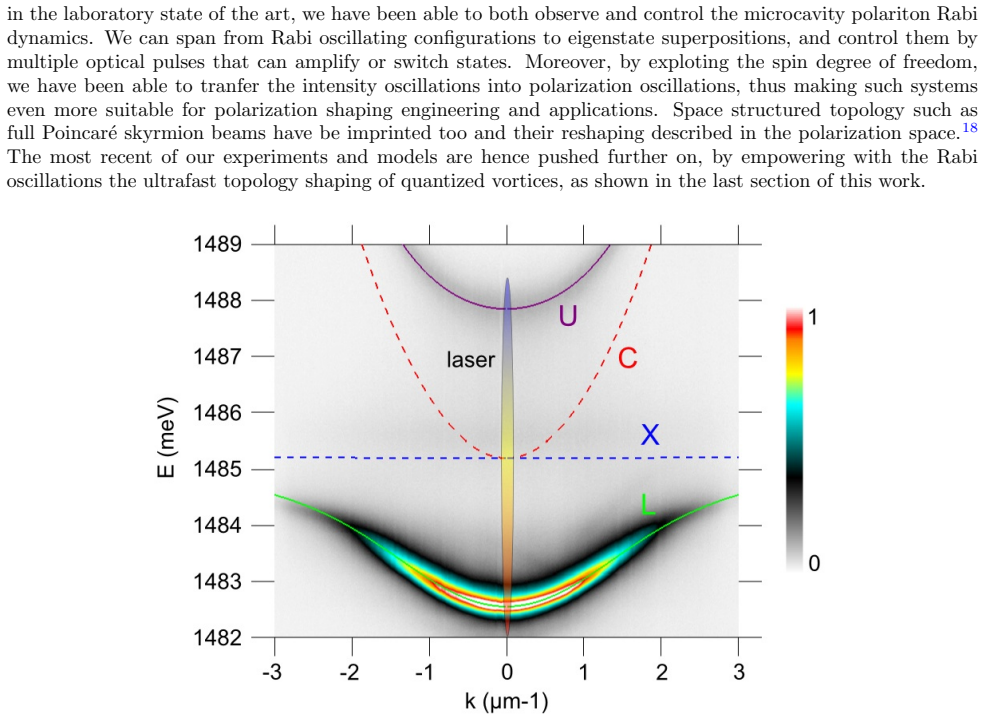
Here we present different approaches to ultrafast pulse and polarization shaping, based on a ``quantum fluid'' platform of polaritons. Indeed we exploit the normal modes of two dimensional polariton fluids made of strong coupled quantum well excitons and microcavity photons, by rooting different polarization and topological states into their sub-picosecond Rabi oscillations. Coherent control of two resonant excitation pulses allows us to prepare the desired state of the polariton, taking benefit from its four-component features given by the combination of the two normal modes with the two degrees of polarization. An ultrafast imaging based on the digital off-axis holography technique is implemented to study the polariton complex wavefunction with time and space resolution. We show in order coherent control of the polariton state on the Bloch sphere, an ultrafast polarization sweeping of the Poincar\'{e} sphere, and the dynamical twist of full Poincar\'{e} states such as the skyrmion on the sphere itself. Finally, we realize a new kind of ultrafast swirling vortices by adding the angular momentum degree of freedom to the two-pulse scheme. These oscillating topology states are characterized by one or more inner phase singularities tubes which spirals around the axis of propagation. The mechanism is devised in the splitting of the vortex into the upper and lower polaritons, resulting in an oscillatory exchange of energy and angular momentum and in the emitted time and space structured photonic packets.
0
0
cond-mat.other 2026-05-12 2 theorems

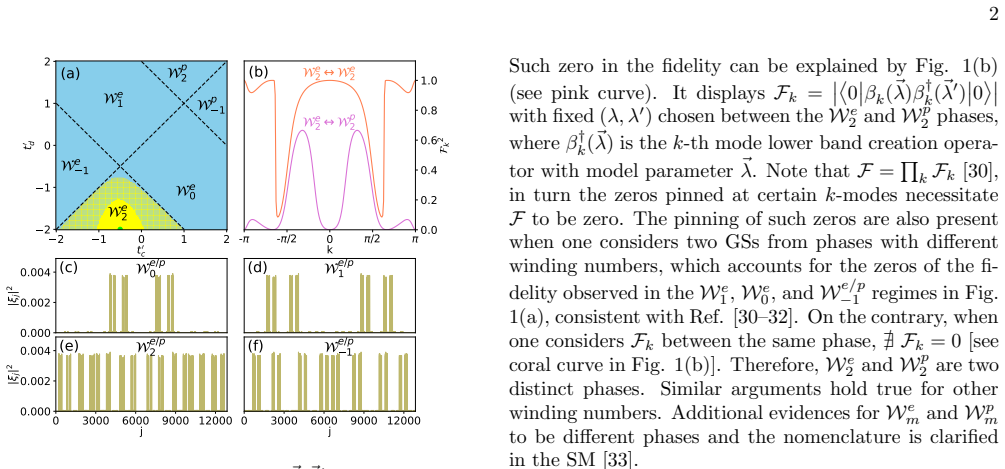
Fock-state patterns split each topological sector into two phases

Beyond Topological Invariants: Order Parameters from Dominant Fock-state Patterns

New order parameters from dominant configurations distinguish finer structure in the extended SSH model and locate the BKT transition in the

Figure from the paper full image
abstract click to expand
We introduce a general scheme for constructing order parameters (OPs) by extracting generic patterns from the dominant Fock states of many-body ground states. While topological phases are traditionally characterized by non-local invariants, we demonstrate that our real-space OPs provide a more refined classification. In the extended Su-Schrieffer-Heeger model, we show that the standard winding number is insufficient to fully distinguish all phases; our OPs reveal a hidden sub-structure where each topological sector splits into two distinct phases. Beyond identifying the phase boundaries, these OPs quantify the depth of a phase, and remain robust in characterizing transitions in disordered systems. Furthermore, our approach provides a practical finite-size diagnostic for the Berezinskii-Kosterlitz-Thouless transition in the interacting spin-1/2 XXZ model. The presented framework offers a broadly applicable tool for uncovering the phase diagrams of diverse interacting and non-interacting quantum many-body systems.
0
0
cond-mat.other 2026-05-11 2 theorems

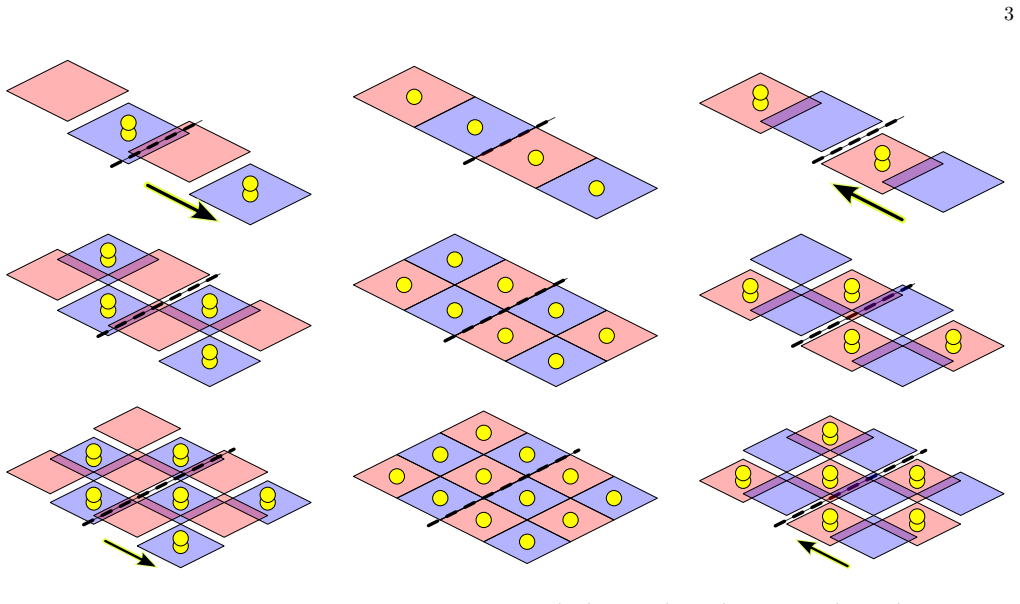
Sublattice bias makes checkerboard superfluid accessible

Checkerboard Bose Hubbard Ladders using Transmon Arrays

The bias in transmon arrays brings the commensurate Bose-Hubbard superfluid into an experimental regime and adds probes for its phases.

Figure from the paper full image
abstract click to expand
Adding a sublattice bias to the two dimensional Bose Hubbard model greatly enriches the available physics, and introduces knobs which can be used to control and interrogate the quantum state. We describe the physics of this checkerboard Bose Hubbard model and how it can be explored using transmon arrays. We show that the sublattice bias brings the commensurate superfluid phase into an experimentally accessible regime, and gives new probes. We characterize the superfluid and insulating phases, with careful attention to finite size effects.
0
0
cond-mat.other 2026-05-11 2 theorems

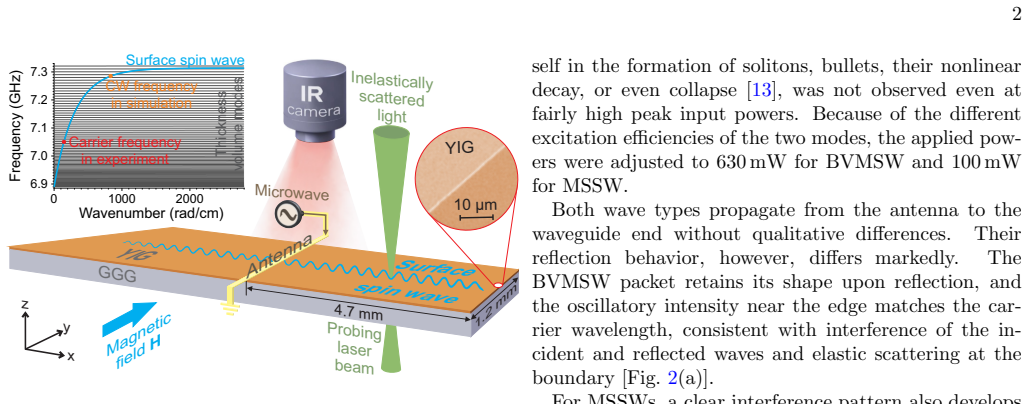
Chiral spin waves reflect by exciting bulk modes

Bulk-mediated reflection of chirality-protected surface spin waves

In thick magnetic films, surface waves reverse via localized bulk excitations rather than elastic bounce, limiting chirality protection.

Figure from the paper full image
abstract click to expand
Surface spin waves of the Damon-Eshbach type exhibit intrinsically nonreciprocal transport properties with a chiral dynamical field structure that localizes counterpropagating waves at opposite film surfaces. Such chirality has been predicted to suppress direct backscattering in thin films within frequency ranges free of bulk modes. However, how chirality influences reflection in thicker three-dimensional magnetic media, where a dense spectrum of bulk excitations overlaps with surface waves, remains unclear. Here we demonstrate that, in micrometer-thick yttrium iron garnet films, reflection of the chiral Damon-Eshbach wave from the boundary of the magnetic medium is accompanied by excitation of spatially localized thickness-quantized bulk modes, whereas reciprocal backward-volume waves reflect nearly elastically. Brillouin light scattering spectroscopy, infrared thermography, and micromagnetic simulations reveal standing bulk excitations at the reflecting boundary and quantify the associated magnon energy accumulation and dissipation. These results identify bulk-mode excitations as the physical pathway enabling reversal of chirally localized surface waves in thick films, thereby defining the limits of chirality-based backscattering immunity and providing a general framework for wave transport in nonreciprocal magnetic media.
0
0
cond-mat.other 2026-05-07

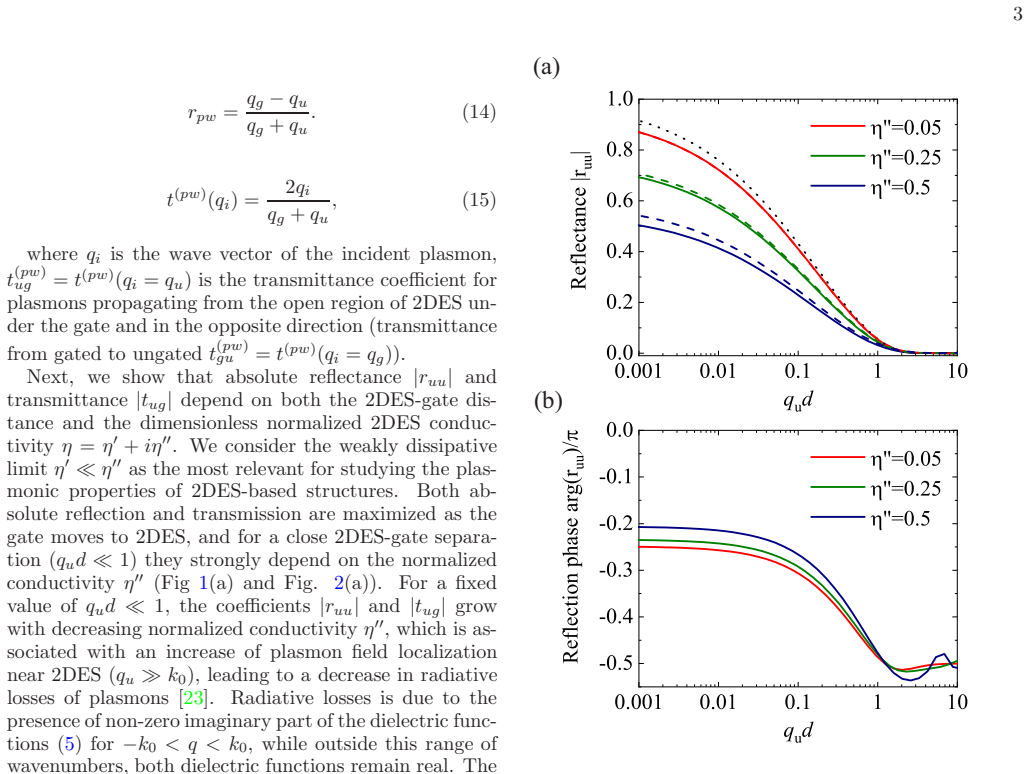
Exact formulas for plasmon reflection at 2DES gate boundaries

Exact theory of plasmon reflection and transmission in partially gated two-dimensional system

Analytical coefficients from Wiener-Hopf method include evanescent fields and radiation for accurate THz modeling.

Figure from the paper full image
abstract click to expand
We develop an exact theory of plasmon scattering at the boundary between gated and ungated regions of a two-dimensional electron system (2DES). Using the Wiener-Hopf technique, we derive analytical expressions for the complex reflection and transmission coefficients of plasmons incident from both sides of the interface. The theory fully accounts for evanescent fields at the gate edge and radiative losses into free-space electromagnetic waves. In the non-retarded limit and for small gate-2DES separation, the reflected plasmon dominates the total electric field, while radiative losses are negligible when plasmon scattering. The amplitudes and phases of the reflection and transmission coefficients for plasmons incident from both sides have a complex dependence from 2DES-gate separation and conductivity of 2DES. Our results provide a rigorous foundation for modeling tunable plasmonic crystals based on 2DES for terahertz detection and modulation.
0
0
cond-mat.other 2026-05-07

Birefringence oscillations show squeezed quasiparticles in helium

Squeezed Vibrational States in Superfluid Helium

Ultrafast measurements in superfluid helium link observed oscillations to anisotropic squeezing of vibrational mode pairs, with dominant ro-

Figure from the paper full image
abstract click to expand
Ultrafast birefringence oscillations observed in superfluid helium provide evidence for anisotropic quantum squeezing of quasiparticle pairs. The measured response is a superposition of contributions from all vibrational modes, with dominant contributions from rotons, maxons, and Pitaevskii's plateau. The nonzero initial phase follows naturally from multimode interference.
0
0
cond-mat.other 2026-05-04

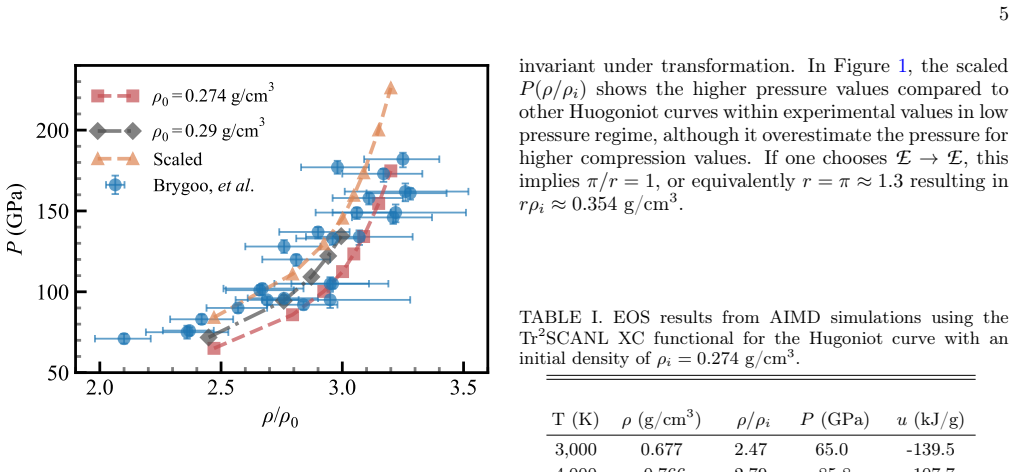
H-He shock simulations find no reflectivity jump from demixing

First-principles simulation of shocked H-He mixture along the principal Hugoniot

First-principles calculations match laser-shock data but show continuous reflectivity, questioning phase-separation diagnostics.

Figure from the paper full image
abstract click to expand
Recent laser-shock experiments on an H--He mixture containing 11~$\%$ helium (atomic fraction) have suggested the presence of an immiscibility region inside Jupiter. Reflectivity measurements were used as the primary diagnostic of H--He demixing, with discontinuities in the optical reflectivity proposed as a signature of phase separation under conditions relevant to Jupiter's interior. Here, we investigate shock-compressed H--He using \textit{ab initio} molecular dynamics simulations with optical properties evaluated within the Kubo--Greenwood formalism. The equation of state and ionic configurations were obtained using the thermal Tr$^2$SCANL meta-GGA exchange--correlation (XC) functional, while optical properties were computed using the recently developed RS-KDT0 range-separated thermal hybrid XC, which provides state-of-the-art accuracy for band-gap predictions in the warm dense matter regime. The calculated reflectivity shows overall good agreement with experimental measurements; however, no discontinuity is observed at elevated temperatures. Moreover, the reflectivity predictions for the mixed system are consistent with the experimental measurements in the temperature range where the mixture is inferred to be demixed. These results suggest that reflectivity alone may not provide a unique or sensitive diagnostic of H-He demixing at low helium concentrations under these conditions.
0
0
cond-mat.other 2026-05-01

Nanoionic diode reaches stable 10^7 on-off ratio without drift

A nanoionic diode: Equilibrium rectifying junction enabling large and stable resistance variations

Mobile lithium dopants adjust the doping profile in real time, eliminating drift that limits conventional diodes at small scales.

Figure from the paper full image
abstract click to expand
We report on a new type of rectifier which is in full contact equilibrium and thus, if down-sized to the nanoscale, shows no drift even if exposed to elevated temperatures and/or extreme waiting times. This is in contrast to existing diodes which rely on frozen doping profiles and are hence non-equilibrium devices. Our rectifiers are related to Schottky diodes but employ "dopants" whose mobilities are high enough to follow the electrical field quickly but low enough to not compete with the electrons in terms of conductivities. In order to realize such a device based on mixed conductors, we use nanosized TiO2 films on Ru as a substrate which can store Li at the interface according to a job-sharing mechanism (Li-ions on the TiO2 side, electrons on the Ru side). The excellent functionality of this nanoionic device is demonstrated (e.g., current on-off ratio can exceed 6-7 orders of magnitude) and the additional advantages stressed (such as ease of preparation and tuning the characteristics electrochemically).
0
0
cond-mat.other 2026-04-30

Two α-MoO3 slabs split phonon-polariton dispersion into distinct branches

Dispersion Splitting of Phonon Polaritons in van der Waals Heterostructure

Eigenmode hybridization in a van der Waals stack produces two momentum branches with opposite field symmetry in the low-loss Type-I band.

Figure from the paper full image
abstract click to expand
The biaxial van der Waals crystal {\alpha}-phase molybdenum trioxide ({\alpha}-MoO3) supports hyperbolic phonon-polaritons with anomalous dispersion in the Type-I Reststrahlen band (RB-I). Despite the low loss and long lifetime of these polaritons, dispersion engineering in this regime has remained largely unexplored. In this work, we show that when two {\alpha}-MoO3 slabs are placed in close proximity, their eigenmodes hybridize and the dispersion splits into two branches with different momenta and field symmetry, providing a powerful platform for dispersion manipulation. We experimentally demonstrate the polaritonic mode splitting in {\alpha}-MoO3 within a heterostructure with hexagonal boron nitride (hBN) employed as a spacer, probed by a scattering-type scanning near-field optical microscope. Furthermore, we propose a design framework for active and mode-selective tailoring of the polaritonic dispersion in the heterostructure incorporating graphene, achieved through tuning its Fermi energy. Our work experimentally demonstrates the feasibility of phonon-polariton mode splitting in the RB-I and suggests a new platform for dispersion engineering of hyperbolic phonon-polaritons in general.
0
0
cond-mat.other 2026-04-29

Laser halves nuclear spin T1 in lead crystals

Control of relaxation properties of a macroscopic nuclear spin ensemble

Photoinduced paramagnetic centers supply optical control over relaxation for faster NMR polarization.

Figure from the paper full image
abstract click to expand
Macroscopic spin ensembles in solids are powerful platforms for quantum sensing and precision metrology. A key challenge is controlling the nuclear spin population relaxation time $T_1$, which can become prohibitively long at cryogenic temperatures due to phonon freeze-out. We demonstrate optical control of the $T_1$ relaxation time of the $^{207}$Pb nuclear spin ensemble in lead-containing ferroelectric crystals PbTiO$_3$ (PT) and (PbMg$_{1/3}$Nb$_{2/3}$O$_3$)$_{2/3}$-(PbTiO$_3$)$_{1/3}$ (PMN-PT). Using X-band electron paramagnetic resonance (EPR) spectroscopy at 10 K, we characterize light-induced paramagnetic centers created by 405 nm laser illumination. In PT, we observe paramagnetic Pb$^{3+}$ centers and their hyperfine interaction with nearby nuclear spins. In PMN-PT, we identify two populations: isotropic Pb$^{3+}$ centers and anisotropic Ti$^{3+}$ centers occupying $d$-orbitals, with spin number densities of $(2.5 \pm 1.0) \times 10^{17}$ cm$^{-3}$ and $(4.1 \pm 1.7) \times 10^{17}$ cm$^{-3}$, respectively. Power-dependent EPR measurements enable extraction of spin relaxation times. We investigate the ionization and recombination dynamics of these transient paramagnetic centers. Using saturation-recovery nuclear magnetic resonance, we demonstrate that laser illumination reduces the $^{207}$Pb nuclear $T_1$ by approximately a factor of two, from $(17 \pm 2)$ s to $(7 \pm 1)$ s at 4.6 MHz, and from $(1550 \pm 40)$ s to $(850 \pm 70)$ s at 40 MHz. We develop a model relating the nuclear relaxation rate to the density of photoinduced paramagnetic centers. This optical control of nuclear spin relaxation provides a pathway toward accelerated thermal polarization and dynamic nuclear polarization in solid-state NMR-based precision measurements, including searches for axion-like dark matter.
0
0
cond-mat.other 2026-04-29

Chiral phonons transfer orbital angular momentum to electrons

Microscopic Theory of Chiral-Phonon-Induced Orbital Selectivity in Helical Crystals

Microscopic theory shows transfers obey crystal angular momentum conservation, with orbital response enhanced at intermediate wave vectors.

Figure from the paper full image
abstract click to expand
We present a microscopic theory of chirality-induced orbital selectivity (CIOS) in helical crystals, in which truly chiral phonons selectively transfer angular momentum to electronic orbital degrees of freedom. For a threefold helical crystal with line-group symmetry $L3_1$, we show that phonon-induced local rotations generate a rotational electron-phonon interaction proportional to $\hat{L}^{\pm}$, which drives the orbital transfer $m_{\ell}\to m_{\ell}-m_{s}$ in accordance with crystal angular momentum (CAM) conservation, where $m_{s}=\pm 1$ denotes the eigenvalue of the phonon rotational mode. Evaluating $\langle\hat{L}^{z}\rangle$ to leading order in perturbation theory, we find that the orbital response is suppressed near the $\Gamma$ point and the BZ boundary, and enhanced at intermediate wave vectors -- a feature intimately tied to the degeneracy structure of the phonon bands.
0
0
cond-mat.other 2026-04-27

Tensor gyromagnetic ratio adds new polarization in spin orders

Spin-current model of electric polarization with the tensor gyromagnetic ratio

Off-diagonal g-factor components generate extra electric polarization in cycloidal and helicoidal magnetic structures.

Figure from the paper full image
abstract click to expand
The spin-current model of electric polarization of spin origin is developed for a magnetic structure with anisotropic tensor gyromagnetic ratio (g-factor). Three mechanisms of the magnetoelectric effect are proposed, caused by the symmetric Heisenberg exchange interaction, the Dzyaloshinsky-Moriya interaction, and the spin-spin interaction related to the odd anisotropy of the symmetric exchange interaction of magnetic ions via nonmagnetic ion. The dependence of electric polarization on the spin density and tensor g-factor in the generalized spin-current model is derived. New solutions for macroscopic electric polarization, that arise in the cycloidal and helicoidal spin orders and are caused by the non-diagonal components of the gyromagnetic ratio, are predicted. The extended of the spin-current model to including a tensor g-factor can be important for the magnetic ferroelectrics with heavy ions which take part in the formation of magnetoelectric effect.
0
0
cond-mat.other 2026-04-27

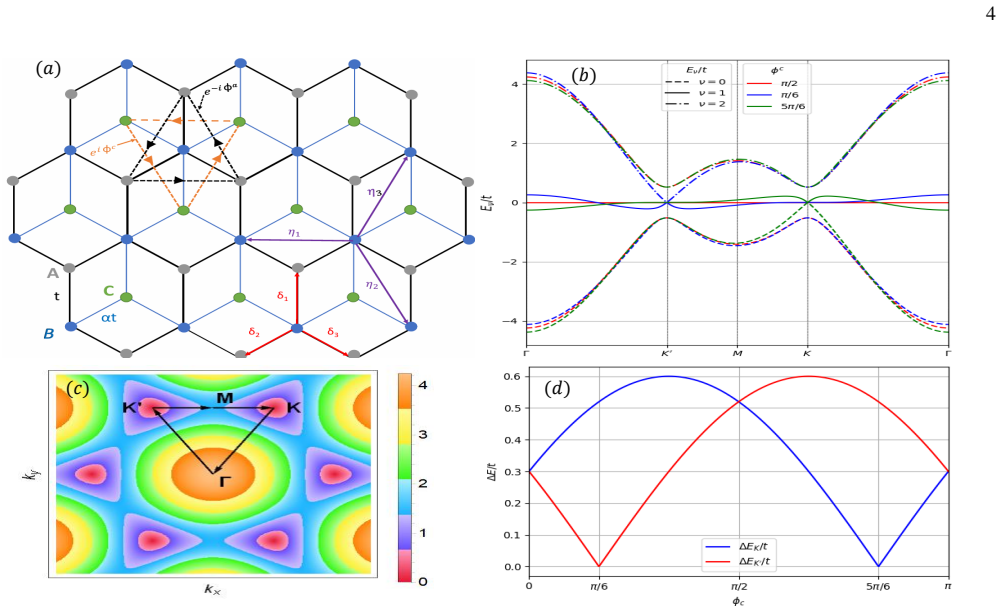
Haldane fluxes induce flat-band topological transitions in dice lattice

Extended Haldane Model in The Dice Lattice: Multiple Flat-Band-Induced topological Transitions Revealed

At critical points π/6 and 5π/6 gaps close and Chern numbers of all bands switch, producing Hall conductivity plateaus.

Figure from the paper full image
abstract click to expand
In this study, we examine the introduction of the Haldane model into the dice lattice by altering the flow between the next-nearest-neighbour sites. This breaks the lattice's inversion and time-reversal symmetries. We demonstrate the presence of point-charge particle symmetries at $\phi^c=\pi/6$ and $5\pi/6$ and derive the analytical expression for quasi-energies. We demonstrate that a gap closure occurs at these critical points, inducing a topological transition. This is confirmed by calculating the Berry curvature and orbital magnetic moment. A topological analysis shows that the Chern numbers of the valence band $(\nu=0)$, the flat band $(\nu=1)$ and the conduction band $(\nu=2)$ depend strongly on the relationship between the fluxes $\phi^a $ and $\phi^c$. When $\phi^c = \phi^a$, the Chern numbers are $(C_0, C_1, C_2) = (2, -2, 0)$ in the region $\phi^c \in [0, \pi/6[$, and (0, 2, -2) in the region $\phi^c\in ]5\pi/6, \pi]$. Conversely, when $\phi^c \neq \phi^a$, the topological invariants become $ (C_1, C_2) = (-1, -1)$ for $\phi^c \in [0, \pi/6[$, and $(C_0, C_1, )= (1, 1)$ for $\phi^c\in ]5\pi/6, \pi]$. These variations reflect topological phase transitions at the critical points $\phi^c=\pi/6$ and $5\pi/6$, affecting all of the system's bands. Furthermore, the anomalous Hall conductivity exhibits a quantized plateau of 2$\sigma_{0}$, as well as an unquantized tilted plateau evolving from 1.50$\sigma_{0}$ to 1.25$\sigma_{0}$ at the same transition points. Controlling the flux allows topological transitions to be engineered and quantum transport in the dice lattice to be optimised, offering promising prospects for reconfigurable topological devices with low dissipation and robust quantum transport.
0
0
cond-mat.other 2026-04-24

Plants compute via growth, mechanics, and noise without a brain

Physics of Computation and Behavior in Plants

A physical framework shows how distributed signals, material properties, and useful fluctuations produce tropisms and circumnutations as the

abstract click to expand
Plants solve complex problems without centralized control, relying instead on growth-driven dynamics to sense, navigate, and optimize resource acquisition. This review presents a unified physical framework for understanding plant behavior through three complementary principles: distributed physical computation, embodied mechanical intelligence, and functional stochasticity. Tropic responses and circumnutations are interpreted as spatio-temporal dynamical systems in which information is encoded in biochemical and mechanical fields, integrated over space and time, and translated into differential growth. Mechanical interactions couple morphology to environmental constraints, enabling computation through material properties. Stochastic fluctuations, from molecular to organismal scales, act as functional resources that enhance sensing, exploration, and collective organization. Together, these processes position plants as a model system for decentralized computation in active matter, where behavior and structure emerge from the interplay of growth, transport, mechanics, and noise.
0
0
cond-mat.other 2026-04-23

DCD high harmonics separate bulk and edge photocurrents

Double circular dichroism high harmonic spectroscopy: An ultrafast probe for topological photocurrents

Opposite signs and scalings in double circular dichroism let the method isolate each contribution in topological matter.

Figure from the paper full image
abstract click to expand
Understanding optical responses of topological matter is a central problem for enabling optoelectronic applications based on topological physics, which is of fundamental concern for photocurrents control and spectroscopy. Currently, schemes for sensing ultrafast photocurrents and separating their bulk/surface contributions are lacking. We introduce here double circular dichroism (DCD) harmonic spectroscopy as an all-optical probe of ultrafast dynamics in topological materials. In this scheme, pump and probe pulses are circular with helicities that are independently controlled, yielding the circular dichroism of the circular dichroism -- a time-resolved response evaluating how probe-induced dichroism depends on pump helicity. While DCD vanishes in symmetric systems, it survives in broken time-reversal symmetry materials including Chern insulators. We theoretically demonstrate this concept through simulations in a Haldane nanoflake, where a pump laser manipulates chiral current-carrying states, and intense probe pulses drive harmonic emission. We show that DCD originates from both bulk and edge-localized states, but these have opposite signs, similar magnitudes, and a different amplitude scaling. Hence, DCD could allow efficient separation of bulk/edge contributions to photocurrents. Variation of the electronic structure and laser parameters further reveals anomalies that might be useful for probing topological attributes of photocurrents in select harmonics. Overall, our work introduces DCD as a potentially powerful approach for disentangling bulk/boundary photo-responses in broken-symmetry quantum matter, and could also be implemented in other pump-probe spectroscopies based on photoelectrons and absorption, as well as other chiral systems.
0
0
cond-mat.other 2026-04-23

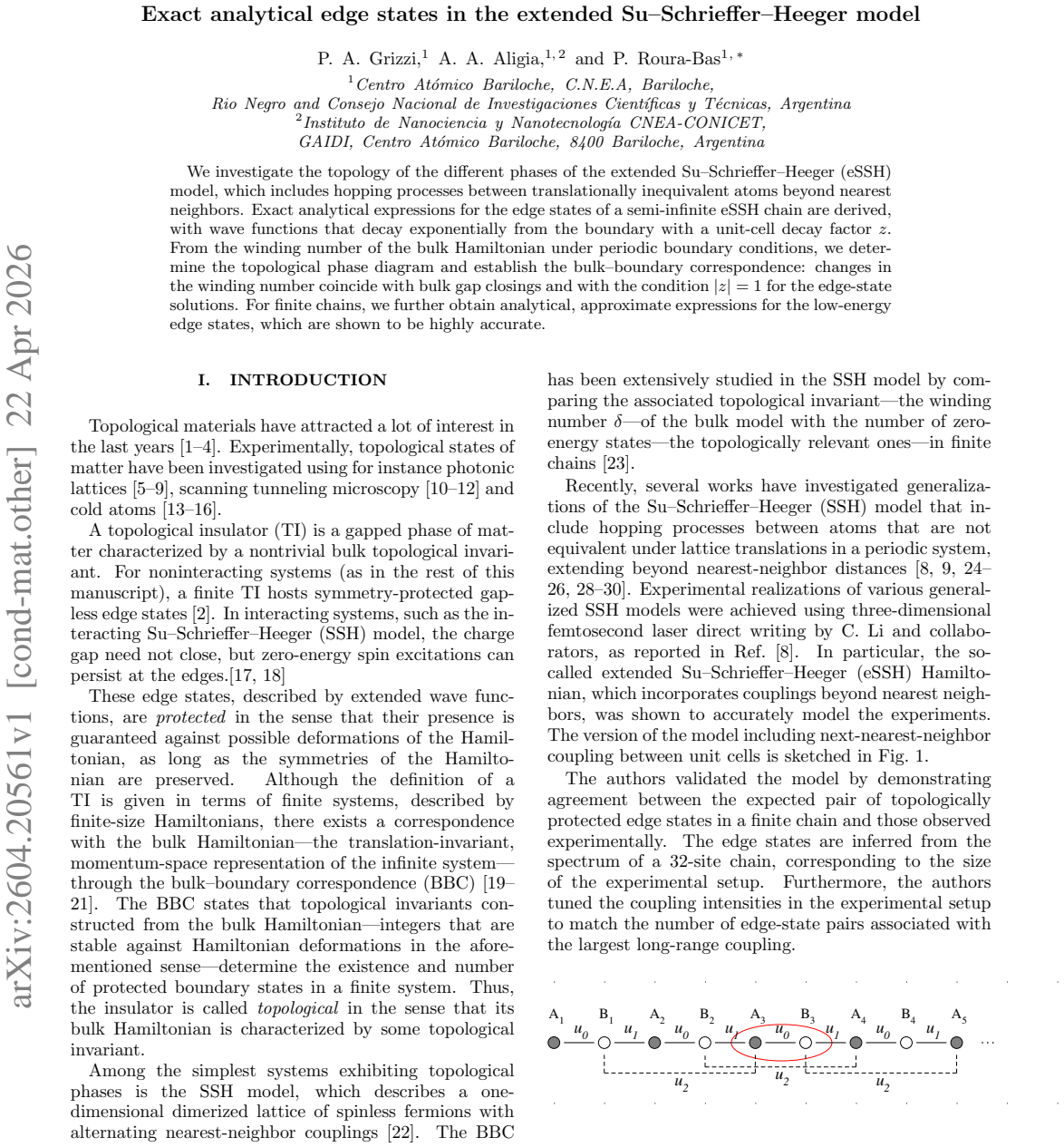
Exact analytical edge states derived for extended SSH model

Exact analytical edge states in the extended Su-Schrieffer-Heeger model

Decay factor z per unit cell ties bulk winding number directly to boundary modes, confirming topological correspondence in chains with added

Figure from the paper full image
abstract click to expand
We investigate the topology of the different phases of the extended Su-Schrieffer-Heeger (eSSH) model, which includes hopping processes between translationally inequivalent atoms beyond nearest neighbors. Exact analytical expressions for the edge states of a semi-infinite eSSH chain are derived, with wave functions that decay exponentially from the boundary with a unit-cell decay factor z. From the winding number of the bulk Hamiltonian under periodic boundary conditions, we determine the topological phase diagram and establish the bulk-boundary correspondence: changes in the winding number coincide with bulk gap closings and with the condition |z|=1 for the edge-state solutions. For finite chains, we further obtain analytical, approximate expressions for the low-energy edge states, which are shown to be highly accurate.
0
0
cond-mat.other 2026-04-17

STM tip heterogeneity mimics α=1 power laws in molecular bursts

Static heterogeneity generates apparent universality in first-passage bursty dynamics

Apparent universality in 2D diffusion inter-pulse times arises from fixed spatial rate variations, not scale invariance, as shown by data-fm

abstract click to expand
Processes involving bursts of activity separated by quiescent periods occur across diverse systems and scales. In human dynamics, these phenomena have been described by power-law inter-event time distributions, $P(t)\sim t^{-\alpha}$, with putative universality classes $\alpha=1$ and $\alpha=\frac{3}{2}$ having been proposed. Whether the observed $\alpha = 1$ scaling reflects intrinsic scale-free dynamics or instead emerges from heterogeneous underlying rates has been debated at length. We address this question in a canonical physical system for first-passage dynamics: two-dimensional molecular diffusion detected by the tip of a scanning tunnelling microscope. The resulting inter-pulse time distributions exhibit the same apparent truncated power-law form reported for human activities such as email communication, web browsing, and library loans. Maximum-likelihood estimation and model comparison decisively favor a Kohlrausch-Williams-Watts--tempered power law, $P(t)\propto t^{-\alpha}\exp\left(-(t/t_c)^\beta\right)$, with $\alpha \sim 1$. Kinetic Monte Carlo simulations reproduce this behavior, showing that the apparent $\alpha \sim 1$ scaling is confined to a finite time window and arises from tip-induced spatial heterogeneity, not scale invariance.
0
0
cond-mat.other 2026-04-17

The paper proposes that phonons can mediate long-range interactions between localized…

Phonon mediated spin-spin interactions

Phonon-mediated spin-spin interactions in insulators produce temperature-dependent anisotropic couplings with oscillatory spatial decay…

Figure from the paper full image
abstract click to expand
Indirect long range interactions between localized magnetic moments are in metals mediated by itinerant electrons. In insulators and semi-conductor, such interactions need to be small, if not negligible, due to the absence of mediating carriers. The existence of magnetically ordered insulators, for instance, metal-oxides, is therefore an everlasting source for proposals of various mechanisms that may support the order. Here, phonon mediated interactions between localized magnetic moments is considered as a mechanism that can provide quantifiable symmetric and anti-symmetric anisotropic spin-spin interactions. It is demonstrated that while a symmetric anisotropic interaction exists for all types of phonons, the existence of anti-symmetric anisotropic interactions requires broken inversion symmetry. The latter mechanism may explain the weak ferromagnetic order observed in chiral, e.g., CuO and CoO compounds. Furthermore, the interaction is nearly independent of the temperature at low temperature while approaches a linear growth at high. Spatially, the interactions have an oscillatory power law decay with the inter-nuclei distance.
0
0
cond-mat.other 2026-04-16

Phonon drag delays and shapes terahertz pulses from metals

Phonon drag as a mechanism of delayed terahertz response of metals

Femtosecond laser heating builds a slow electron drag force whose timing matches observed waveforms and spectra.

Figure from the paper full image
abstract click to expand
We show that electron drag by nonequilibrium phonons describes the actual waveform and spectrum of terahertz pulses generated during femtosecond laser irradiation of metals. In contrast to previous models, there is a picosecond delay in the drag force development due to the relatively slow lattice heating and finite phonon lifetime. We also predict that, at high pump fluences, a macroscopic deformation wave enhances nonlinearly the drag force and terahertz response. Our results establish the terahertz pulse waveform as a direct probe of ultrafast lattice dynamics in metals.
0
0
cond-mat.other 2026-04-15

NiCu alloys emit THz nearly as well as Pt and Co

Spintronic THz emitters based on NiCu alloys

Paramagnetic and ferromagnetic versions achieve high efficiency without heavy metals and support temperature tuning

Figure from the paper full image
abstract click to expand
We study THz emission from ferromagnet / nonmagnetic material (FM/NM) spintronic nanostructures in which the $Ni_xCu_{1-x}$ alloy with different $x$ is used as an FM, an NM, or both layers. The stoichiometric composition of the NiCu alloys standing at two positions (we denote it as [FM] or [PM]) is chosen so that it is ferromagnetic at room temperature in the case it is used as the FM layer, and is paramagnetic at room temperature for the NM layer. Besides, we choose the nickel ratio $x$ close to each other for both [FM] and [PM] types of the alloy (the difference is only $10\%$). We show that although NiCu[PM] does not contain heavy metal it acts as an effective converter of spin current into the electric one in our structure showing only 2.8 times smaller efficiency than Pt. Besides, the NiCu[FM] alloy, despite having quite small Curie temperature (approximately $65 ^\circ C$), acts as an effective spin source having the efficiency only 2 times smaller than Co in similar structures. This shows up the importance of boundary matching in the spintronic THz sources. Our NiCu-based THz sources reveal a possibility of effective thermally induced control of emission of THz radiation due to a unique combination of high emission rate and relatively small Curie temperature.
0
0
cond-mat.other 2026-04-15

CDW gap opens only on one quasi-1D Fermi surface segment

Momentum-dependent charge-density-wave gap formation in ZrTe_{2.98}Se_{0.02}

Intensity maps in ZrTe_{2.98}Se_{0.02} confine the gap to 0.25–0.8 Å^{-1} along B-D, showing both nesting and band-specific coupling are at

abstract click to expand
We investigated the energy gap formation across the charge density wave (CDW) transition inof ZrTe_{2.98}Se_{0.02}. By employing a laser photoemission microscopy, we clearly resolved one elliptical Fermi surface (FS) around the Brillouin zone (BZ) center, and two quasi-one-dimensional FSs along the BZ boundary. We further mapped the intensity difference between the FSs below and above the CDW transition temperature. We found that the energy CDW gap formation is limited to the momentum region 0.25 {\AA}^{-1} < ky < 0.8 {\AA}^{-1} along \bar{B}-\bar{D} line, which coincides with the location of one of the quasi-one-dimensional FSs. Characteristic momentum dependence in the energy CDW gap suggests the importance of both FS nesting and band-dependent electron-phonon coupling for understanding the CDW state in ZrTe_{3} system.
0
0
cond-mat.other 2026-04-10 2 theorems

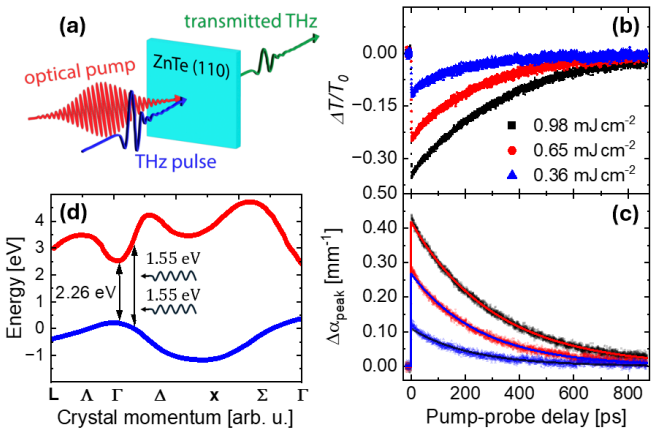
ZnTe THz dielectric function shifts under 800 nm pumping

Time-dependent THz dielectric function of ZnTe under two-photon optical excitation at 800 nm wavelength

Two-photon absorption generates free carriers and activates phonons, making the response time-dependent at typical fluences for THz sources.

Figure from the paper full image
abstract click to expand
ZnTe is arguably the most widely used nonlinear crystal for the generation and detection of THz radiation, used in conjunction with sub-bandgap optical excitation by femtosecond lasers operating near 800 nm. The THz dielectric function of ZnTe is the key parameter defining the efficiency and bandwidth of THz generation and detection. Here, we demonstrate that the THz dielectric function of ZnTe undergoes substantial transient modification at 800 nm sub-bandgap excitation under conditions typical for THz generation. These modifications arise from significant free-carrier generation via two-photon absorption of the 800 nm pump, accompanied by the pump-driven activation of the THz-active phonon modes. Using optical pump-THz probe spectroscopy, we characterized the THz dielectric function of ZnTe under 800 nm excitation as a function of pump fluence and pump-probe delay. Analysis of the experimental data within the Drude-Lorentz model provided the generated free carrier density and momentum scattering time, and oscillator strength of the pump activated THz phonon modes, revealing their transient evolution in dependence on the excitation conditions.
0
0
cond-mat.other 2026-04-09

Rydberg excitons in WSe2 relax spin 37 times slower than ground states

Spin-Valley Relaxation of Rydberg Excitons

Relaxation time grows from 2 ps for the 1s exciton to 75 ps for the 3s state, reproduced by a model of electron-hole exchange.

abstract click to expand
Rydberg excitons, characterized by large spatial extension and reduced electron-hole overlap, must have a spin-valley dynamics different from that of ground state excitons. Here we report a direct measurement of spin relaxation of Rydberg excitons in high-quality WSe2 monolayer using continuous-wave and time-resolved optical orientation experiments. Excited excitonic states exhibit exceptionally large photoluminescence circular polarization, approaching 90% for the 3s state. Time-resolved measurements reveal a strong increase of the spin relaxation time with the principal quantum number, from ~2 ps for the 1s exciton to ~75 ps for the 3s exciton. A microscopic model based on electron-hole exchange-driven spin relaxation quantitatively reproduces the observed trend, demonstrating that Rydberg excitons enable tunable spin-valley dynamics in two-dimensional semiconductors.
0
0
cond-mat.other 2026-04-09

Multimodal model extracts non-Hermitian topological invariants

Identifying Topological Invariants of Non-Hermitian Systems via Domain-Adaptive Multimodal Model for Mathematics

Eigenvalues and eigenvectors fed into a Qwen Math-based architecture handle high-dimensional cases without custom algorithms.

abstract click to expand
The emergence of the non-Hermitian skin effect, distinguished by the exponential localization of bulk states onto boundaries in open systems, has redefined the conventional band theory. It can be established through the generalized Brillouin zone framework, the amoeba formulation or generalized Fermi surface in the different dimensions. However, its algorithmic implementation is still challenging in the high-dimensional cases. The large language models (LLM), functioning as the new paradigm in machine learning, can help to tack scientific problems. Here, we propose a framework composed by domain-adaptive Multimodal model for mathematics to identify topological invariants. We feed the eigenvalues and eigenvectors of the Hamiltonian in momentum space into our model as two input modalities. The Qwen Math is integrated as the backbone of the multimodal model, significantly enhancing its mathematical understanding capability and computational precision. Our results provide a paradigm for future studies on topological invariants identification via LLMs.
0
0
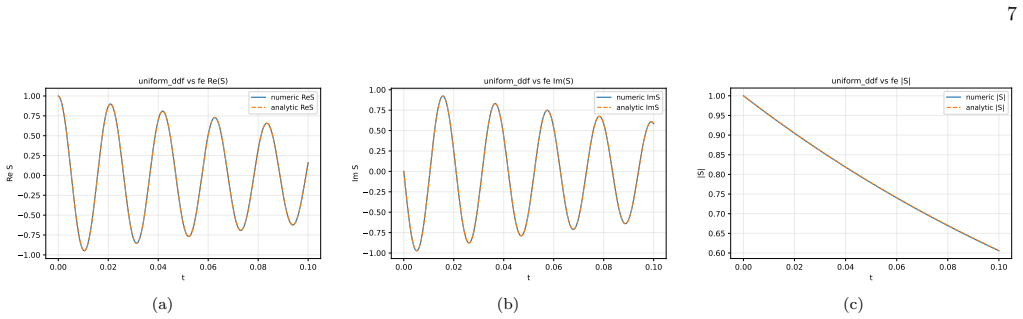
cond-mat.other 2026-04-07 Recognition

Regularized kernel gives well-posed Bloch-DDF equations on bounded domains

Weak Solutions to the Bloch Equations with Distant Dipolar Field

Proves boundedness of the operator, an L2 energy balance, and local existence for finite-element solutions under Neumann diffusion.

Figure from the paper full image
abstract click to expand
The distant dipolar field (DDF) is a long-range, nonlocal contribution to liquid-state spin dynamics that arises from intermolecular dipolar couplings and can generate multiple-quantum coherences and novel MRI contrast. Its sign-changing kernel makes Bloch-DDF dynamics strongly geometry dependent, and FFT-based dipolar convolutions naturally assume periodic or padded Cartesian domains rather than bounded samples with reflective diffusion boundaries. We study the Bloch equations with the DDF on bounded domains under homogeneous Neumann diffusion conditions. We derive a finite-element weak formulation that supports spatially varying diffusion and relaxation parameters and uses a short-distance regularization of the secular DDF kernel with length a>0. For fixed a we prove boundedness of the DDF operator, establish an L2 energy balance in which precession is neutral while diffusion and transverse relaxation are dissipative, and obtain local well-posedness with continuous dependence on the data, with global existence under energy-neutral transport. For the Galerkin semi-discretization we show a discrete energy identity mirroring the continuum estimate. For computation, we evaluate the DDF in real space with a matrix-free near/far scheme and advance in time using a second-order IMEX splitting method that treats diffusion and relaxation implicitly and precession explicitly. The explicit stage applies a Rodrigues rotation at DDF quadrature points followed by an L2 projection, enabling stable multi-cycle lab-frame simulations. We validate against three closed-form benchmarks and quantify curved-boundary effects by comparing mapped finite elements with a voxel-mask finite-difference baseline on spherical Neumann eigenmode decay. These results provide an analyzable and reproducible route for Bloch-DDF dynamics on bounded domains with complex geometry.
0

browse all of cond-mat.other → full archive · search · sub-categories