Use of Faulty States in Cat-Code Error Correction
Pith reviewed 2026-05-23 07:10 UTC · model grok-4.3
The pith
Cat code quantum error correction works with many-component bridge states outside the code space.
A machine-rendered reading of the paper's core claim, the machinery that carries it, and where it could break.
Core claim
The class of acceptable ancillary states for cat-code error correction is broader than typically acknowledged; many-component bridge states, though not in the cat code space, remain capable of syndrome extraction in the regime where nonlinear interactions are the limiting factor.
What carries the argument
The teleportation-based correction circuit using bridge states to perform syndrome extraction without requiring the full nonlinear strength needed for ideal cat-state preparation.
If this is right
- Syndrome extraction becomes possible in hardware where strong nonlinear interactions remain unavailable.
- Preparation of ancillary states can use weaker or different interactions than those required for cat states.
- The overall resource overhead for cat-code maintenance may decrease because fewer ideal states are needed.
- Fault-tolerant architectures built from cat codes become feasible at lower interaction strengths.
Where Pith is reading between the lines
- Similar relaxation of ancillary-state requirements might apply to other rotationally symmetric bosonic codes.
- Hardware experiments could test bridge-state performance by varying the number of components while measuring logical error rates.
- The approach may reduce the calibration burden on control systems that must generate precise cat states.
Load-bearing premise
The teleportation-based correction circuit can employ these bridge states for syndrome extraction without introducing uncorrectable errors or requiring the same nonlinear interactions.
What would settle it
An experiment or simulation in which bridge states are used in the teleportation circuit and produce logical errors that the cat code cannot correct.
Figures


read the original abstract
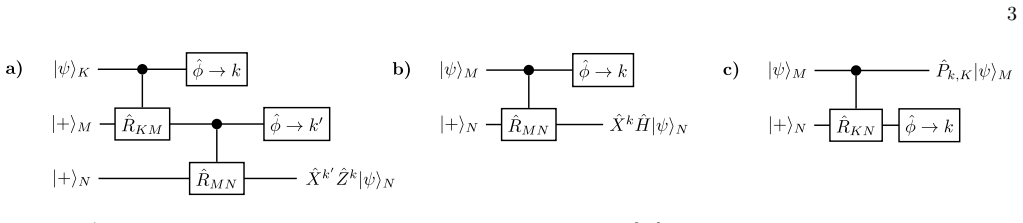
Bosonic codes have seen a resurgence in interest for applications as varied as fault tolerant quantum architectures, quantum enhanced sensing, and entanglement distribution. Cat codes have been proposed as low-level elements in larger architectures, and the theory of rotationally symmetric codes more generally has been significantly expanded in the recent literature. The fault-tolerant preparation and maintenance of cat code states as a stand-alone quantum error correction scheme remains however limited by the need for robust state preparation and strong inter-mode interactions. In this work, we consider the teleportation-based correction circuit for cat code quantum error correction. We show that the class of acceptable ancillary states is broader than is typically acknowledged, and exploit this to propose the use of many-component ``bridge'' states which, though not themselves in the cat code space, are nonetheless capable of syndrome extraction in the regime where non-linear interactions are a limiting factor.
Editorial analysis
A structured set of objections, weighed in public.
Referee Report
Summary. The manuscript examines the teleportation-based error-correction circuit for cat codes and argues that the class of usable ancillary states is larger than conventionally assumed. It introduces many-component 'bridge' states lying outside the cat-code space that are nevertheless claimed to enable syndrome extraction, thereby relaxing the requirement for strong nonlinear interactions.
Significance. If the error-propagation analysis is sound, the result would meaningfully widen the design space for ancillary-state preparation in bosonic QEC, reducing reliance on experimentally demanding nonlinear resources and potentially accelerating near-term demonstrations of cat-code fault tolerance.
major comments (2)
- [Abstract and main-text circuit analysis] The central claim that bridge states outside the rotational-symmetry subspace still map all deviations to correctable errors rests on an unstated assumption about the teleportation circuit. No explicit derivation of the effective error channel (interaction Hamiltonian plus measurement) is supplied showing that components outside the code space preserve the parity-extraction property without introducing uncorrectable errors on the data mode.
- [Section describing the proposed bridge-state protocol] The weakest assumption identified—that the teleportation circuit employing bridge states requires no additional nonlinear interactions—is not accompanied by a concrete Hamiltonian or Kraus-map calculation confirming that the syndrome extraction remains faithful.
minor comments (1)
- [Introduction] Notation for the bridge-state components is introduced without a clear definition of the rotational symmetry subspace they occupy; a short appendix tabulating the overlap with the cat-code basis would improve clarity.
Simulated Author's Rebuttal
Thank you for the opportunity to respond to the referee's report. We have carefully considered the major comments regarding the need for explicit derivations in our analysis of bridge states for cat-code error correction. Below, we provide point-by-point responses and commit to revisions that strengthen the manuscript.
read point-by-point responses
-
Referee: [Abstract and main-text circuit analysis] The central claim that bridge states outside the rotational-symmetry subspace still map all deviations to correctable errors rests on an unstated assumption about the teleportation circuit. No explicit derivation of the effective error channel (interaction Hamiltonian plus measurement) is supplied showing that components outside the code space preserve the parity-extraction property without introducing uncorrectable errors on the data mode.
Authors: We agree that an explicit derivation would strengthen the presentation. The original manuscript relies on the established properties of the teleportation-based circuit for cat codes, where the ancillary state interacts via a controlled-phase or similar gate to extract parity. However, to address this, we will add a new subsection deriving the effective error channel step by step, showing how the multi-component bridge states ensure that any deviation in the data mode is projected onto correctable error subspaces without uncorrectable leakage. This derivation will use the standard beam-splitter or dispersive interaction Hamiltonian appropriate for the circuit. revision: yes
-
Referee: [Section describing the proposed bridge-state protocol] The weakest assumption identified—that the teleportation circuit employing bridge states requires no additional nonlinear interactions—is not accompanied by a concrete Hamiltonian or Kraus-map calculation confirming that the syndrome extraction remains faithful.
Authors: The manuscript argues that bridge states can be prepared and used with linear optics or existing resources, avoiding strong nonlinearities for the syndrome extraction itself. To make this rigorous, the revised manuscript will include an explicit Hamiltonian for the interaction (e.g., a cross-Kerr or beam-splitter Hamiltonian between data and ancilla) and the corresponding Kraus operators post-measurement, verifying that the syndrome extraction fidelity is preserved for the bridge states. We believe this will confirm the claim without requiring additional nonlinear resources beyond those in standard cat-code protocols. revision: yes
Circularity Check
No circularity: independent extension of ancillary-state class
full rationale
The paper's central claim—that the acceptable ancillary states for teleportation-based cat-code correction include many-component bridge states outside the code space—is presented as an observation and proposal without reduction to self-definition, fitted inputs renamed as predictions, or load-bearing self-citations. No equations or derivation steps in the abstract or described content equate the output to the input by construction; the argument relies on an expanded class of states for syndrome extraction, which is treated as an independent broadening rather than a tautology or renamed prior result.
Axiom & Free-Parameter Ledger
axioms (1)
- standard math Standard quantum mechanics of bosonic modes and teleportation-based error correction circuits apply without modification.
invented entities (1)
-
bridge states
no independent evidence
Lean theorems connected to this paper
-
IndisputableMonolith/Foundation/RealityFromDistinction.leanreality_from_one_distinction unclear?
unclearRelation between the paper passage and the cited Recognition theorem.
We show that the class of acceptable ancillary states is broader than is typically acknowledged, and exploit this to propose the use of many-component “bridge” states which, though not themselves in the cat code space, are nonetheless capable of syndrome extraction
-
IndisputableMonolith/Cost/FunctionalEquation.leanwashburn_uniqueness_aczel unclear?
unclearRelation between the paper passage and the cited Recognition theorem.
tele-correction circuit for rotationally symmetric Bosonic codes [36], including cat codes
What do these tags mean?
- matches
- The paper's claim is directly supported by a theorem in the formal canon.
- supports
- The theorem supports part of the paper's argument, but the paper may add assumptions or extra steps.
- extends
- The paper goes beyond the formal theorem; the theorem is a base layer rather than the whole result.
- uses
- The paper appears to rely on the theorem as machinery.
- contradicts
- The paper's claim conflicts with a theorem or certificate in the canon.
- unclear
- Pith found a possible connection, but the passage is too broad, indirect, or ambiguous to say the theorem truly supports the claim.
Reference graph
Works this paper leans on
-
[1]
Modular Photon Number Measurement In the modular photon number measurement of Fig- ure 1 (c), we are able to account for relative phases be- tween coherent states in the probe subsystem. Using a coherent state |β⟩ as the target input subsystem and a YS state of amplitudeα as the probe, we have 1√ N NX m=1 eiξm e− |β| 2 ∞X n=0 βn √ n! |n⟩| − αeiϕme−i4π n K...
-
[2]
βan,µK/2 p (an,µK/2)! δbn′ ,ν K′/2 p (bn′,νK ′/2)! # |an,µK/2⟩ ⊗
Relative Phases in Tele-correction While the relative phases of the YS states can be cor- rected in modular photon number measurements, it may be expected that they would remain detrimental in tele- correction as these states do not have the photon number distribution of true cat code states. This turns out not to be the case; below we explore the perform...
work page 2024
-
[3]
Shor, inProceedings 35th Annual Symposium on Foun- dations of Computer Science (IEEE Comput
P. Shor, inProceedings 35th Annual Symposium on Foun- dations of Computer Science (IEEE Comput. Soc. Press, Santa Fe, NM, USA, 1994) pp. 124–134
work page 1994
-
[4]
D. Jennings, M. Lostaglio, R. B. Lowrie, S. Pallister, and A. T. Sornborger, The cost of solving linear differential equations on a quantum computer: Fast-forwarding to explicit resource counts (2023), arXiv:2309.07881 [quant- ph]
- [5]
- [6]
-
[7]
S. Pirandola, U. L. Andersen, L. Banchi, M. Berta, D. Bunandar, R. Colbeck, D. Englund, T. Gehring, C. Lupo, C. Ottaviani, J. L. Pereira, M. Razavi, J. Sham- sul Shaari, M. Tomamichel, V. C. Usenko, G. Vallone, P.Villoresi,andP.Wallden,AdvancesinOpticsandPho- tonics 12, 1012 (2020)
work page 2020
-
[8]
M. A. Taylor and W. P. Bowen, Physics Reports615, 1 (2016)
work page 2016
-
[9]
Y. Kim, A. Eddins, S. Anand, K. X. Wei, E. Van Den Berg, S. Rosenblatt, H. Nayfeh, Y. Wu, M. Zale- tel, K. Temme, and A. Kandala, Nature618, 500 (2023)
work page 2023
- [10]
- [11]
-
[12]
J. Tindall, M. Fishman, E. M. Stoudenmire, and D. Sels, PRX Quantum5, 010308 (2024)
work page 2024
- [13]
-
[14]
T. Begušić and G. K.-L. Chan, Fast classical simulation of evidence for the utility of quantum computing before fault tolerance (2023), arXiv:2306.16372 [quant-ph]
-
[15]
L. Clinton, T. Cubitt, B. Flynn, F. M. Gambetta, J. Klassen, A. Montanaro, S. Piddock, R. A. Santos, and E. Sheridan, Nature Communications15, 211 (2024)
work page 2024
-
[16]
N. C. Rubin, D. W. Berry, A. Kononov, F. D. Malone, T. Khattar, A. White, J. Lee, H. Neven, R. Babbush, and A. D. Baczewski, Proceedings of the National Academy of Sciences121, e2317772121 (2024)
work page 2024
- [17]
-
[18]
Limitations of Noisy Reversible Computation
D. Aharonov, M. Ben-Or, R. Impagliazzo, and N. Nisan, Limitations of Noisy Reversible Computation (1996), arXiv:quant-ph/9611028
work page internal anchor Pith review Pith/arXiv arXiv 1996
-
[19]
A. Müller-Hermes, D. Stilck França, and M. M. Wolf, Journal of Mathematical Physics57, 022202 (2016)
work page 2016
-
[20]
R. Raussendorf, Philosophical Transactions of the Royal Society A: Mathematical, Physical and Engineering Sci- ences 370, 4541 (2012)
work page 2012
-
[21]
Campbell, Nature Reviews Physics6, 160 (2024)
E. Campbell, Nature Reviews Physics6, 160 (2024)
work page 2024
-
[22]
C. Ryan-Anderson, J. G. Bohnet, K. Lee, D. Gresh, A. Hankin, J. P. Gaebler, D. Francois, A. Chernoguzov, D.Lucchetti, N.C.Brown, T.M.Gatterman, S.K.Halit, K. Gilmore, J. A. Gerber, B. Neyenhuis, D. Hayes, and R. P. Stutz, Physical Review X11, 041058 (2021)
work page 2021
-
[23]
N. Sundaresan, T. J. Yoder, Y. Kim, M. Li, E. H. Chen, G. Harper, T. Thorbeck, A. W. Cross, A. D. Córcoles, and M. Takita, Nature Communications14, 2852 (2023)
work page 2023
-
[24]
D. Bluvstein, S. J. Evered, A. A. Geim, S. H. Li, H. Zhou, T. Manovitz, S. Ebadi, M. Cain, M. Kalinowski, D. Hangleiter, J. P. B. Ataides, N. Maskara, I. Cong, X. Gao, P. S. Rodriguez, T. Karolyshyn, G. Semeghini, M. J. Gullans, M. Greiner, V. Vuletić, and M. D. Lukin, Nature 10.1038/s41586-023-06927-3 (2023)
-
[25]
Google Quantum AI, R. Acharya, I. Aleiner, R. Allen, T. I. Andersen, M. Ansmann, F. Arute, K. Arya, A. As- faw, J. Atalaya, R. Babbush, D. Bacon, J. C. Bardin, J. Basso, A. Bengtsson,et al., Nature614, 676 (2023)
work page 2023
-
[26]
R. K. Naik, N. Leung, S. Chakram, P. Groszkowski, Y. Lu, N. Earnest, D. C. McKay, J. Koch, and D. I. Schuster, Nature Communications8, 1904 (2017)
work page 1904
-
[27]
C. Duckering, J. M. Baker, D. I. Schuster, and F. T. Chong, in 2020 53rd Annual IEEE/ACM In- ternational Symposium on Microarchitecture (MICRO) (IEEE, Athens, Greece, 2020) pp. 173–185
work page 2020
-
[28]
C. Chamberland, K. Noh, P. Arrangoiz-Arriola, E. T. Campbell, C. T. Hann, J. Iverson, H. Putterman, T. C. Bohdanowicz, S. T. Flammia, A. Keller, G. Refael, J. Preskill, L. Jiang, A. H. Safavi-Naeini, O. Painter, and F. G. Brandão, PRX Quantum3, 010329 (2022)
work page 2022
-
[29]
K. Noh, C. Chamberland, and F. G. Brandão, PRX Quantum 3, 010315 (2022)
work page 2022
-
[30]
Y. Xu, Y. Wang, E.-J. Kuo, and V. V. Albert, PRX Quantum 4, 020342 (2023)
work page 2023
- [31]
-
[32]
F. Rozpędek, K. P. Seshadreesan, P. Polakos, L. Jiang, and S. Guha, Physical Review Research5, 043056 (2023)
work page 2023
-
[33]
P.-Z. Li, J. Dias, W. J. Munro, P. Van Loock, K. Nemoto, and N. Lo Piparo, Advanced Quantum Technologies7, 2300252 (2024)
work page 2024
-
[34]
S. L. Braunstein, Nature394, 47 (1998)
work page 1998
-
[35]
P. T. Cochrane, G. J. Milburn, and W. J. Munro, Phys- ical Review A59, 2631 (1999)
work page 1999
-
[36]
D. Gottesman, A. Kitaev, and J. Preskill, Physical Re- view A64, 012310 (2001)
work page 2001
-
[37]
G. Pantaleoni, B. Q. Baragiola, and N. C. Menicucci, Physical Review Letters125, 040501 (2020)
work page 2020
-
[38]
A.L.Grimsmo, J.Combes,andB.Q.Baragiola,Physical Review X10, 011058 (2020)
work page 2020
-
[39]
Y. Shi, C. Chamberland, and A. Cross, New Journal of Physics 21, 093007 (2019)
work page 2019
-
[40]
A. M. Steane, Nature399, 124 (1999)
work page 1999
-
[41]
Fault-Tolerant Postselected Quantum Computation: Schemes
E. Knill, Fault-Tolerant Postselected Quantum Compu- tation: Schemes (2004), arXiv:quant-ph/0402171
work page internal anchor Pith review Pith/arXiv arXiv 2004
-
[42]
W. J. Munro, G. J. Milburn, and B. C. Sanders, Physical Review A62, 052108 (2000)
work page 2000
- [43]
-
[44]
T. C. Ralph, A. Gilchrist, G. J. Milburn, W. J. Munro, and S. Glancy, Physical Review A68, 042319 (2003)
work page 2003
-
[45]
A. Ourjoumtsev, R. Tualle-Brouri, J. Laurat, and P. Grangier, Science312, 83 (2006)
work page 2006
-
[46]
A. Ourjoumtsev, H. Jeong, R. Tualle-Brouri, and P. Grangier, Nature448, 784 (2007)
work page 2007
-
[47]
M.TakeokaandM.Sasaki,PhysicalReviewA 75,064302 (2007)
work page 2007
-
[48]
A. P. Lund, T. C. Ralph, and H. L. Haselgrove, Physical Review Letters100, 030503 (2008)
work page 2008
-
[49]
H. Takahashi, K. Wakui, S. Suzuki, M. Takeoka, K. Hayasaka, A. Furusawa, and M. Sasaki, Physical Re- view Letters101, 233605 (2008)
work page 2008
- [50]
-
[51]
M. J. Everitt, T. P. Spiller, G. J. Milburn, R. D. Wilson, and A. M. Zagoskin, Frontiers in ICT 1, 10.3389/fict.2014.00001 (2014)
-
[52]
S. Puri, S. Boutin, and A. Blais, npj Quantum Informa- tion 3, 18 (2017)
work page 2017
- [53]
- [54]
-
[55]
B. M. Garraway, B. Sherman, H. Moya-Cessa, P. L. Knight, and G. Kurizki, Physical Review A 49, 535 (1994)
work page 1994
-
[56]
K. S. Lee, M. S. Kim, and V. B˘ uzek, Journal of the Op- tical Society of America B11, 1118 (1994)
work page 1994
-
[57]
G. S. Agarwal and P. K. Pathak, Physical Review A70, 053813 (2004)
work page 2004
-
[58]
J. Hastrup, J. S. Neergaard-Nielsen, and U. L. Andersen, Optics Letters45, 640 (2020)
work page 2020
- [59]
- [60]
- [61]
- [62]
-
[63]
J. Guillaud, J. Cohen, and M. Mirrahimi, SciPost Physics Lecture Notes , 72 (2023)
work page 2023
-
[64]
A. S. Darmawan, B. J. Brown, A. L. Grimsmo, D. K. Tuckett, and S. Puri, PRX Quantum2, 030345 (2021)
work page 2021
- [65]
-
[66]
C. Vuillot, H. Asasi, Y. Wang, L. P. Pryadko, and B. M. Terhal, Physical Review A99, 032344 (2019)
work page 2019
- [67]
-
[68]
M. V. Larsen, C. Chamberland, K. Noh, J. S. Neergaard- Nielsen, and U. L. Andersen, PRX Quantum2, 030325 (2021)
work page 2021
-
[69]
L. Hänggli, M. Heinze, and R. König, Physical Review A 102, 052408 (2020). 9
work page 2020
-
[70]
T. Itogawa, Y. Takada, Y. Hirano, and K. Fujii, Even more efficient magic state distillation by zero-level distil- lation (2024), arXiv:2403.03991 [quant-ph]
-
[71]
Magic state cultivation: growing T states as cheap as CNOT gates
C. Gidney, N. Shutty, and C. Jones, Magic state cultiva- tion: Growing T states as cheap as CNOT gates (2024), arXiv:2409.17595 [quant-ph]
work page internal anchor Pith review Pith/arXiv arXiv 2024
-
[72]
Z. Leghtas, G. Kirchmair, B. Vlastakis, R. J. Schoelkopf, M. H. Devoret, and M. Mirrahimi, Physical Review Let- ters 111, 120501 (2013)
work page 2013
-
[73]
M. Mirrahimi, Z. Leghtas, V. V. Albert, S. Touzard, R. J. Schoelkopf, L. Jiang, and M. H. Devoret, New Journal of Physics 16, 045014 (2014)
work page 2014
-
[74]
N. Ofek, A. Petrenko, R. Heeres, P. Reinhold, Z. Leghtas, B. Vlastakis, Y. Liu, L. Frunzio, S. M. Girvin, L. Jiang, M. Mirrahimi, M. H. Devoret, and R. J. Schoelkopf, Na- ture 536, 441 (2016)
work page 2016
- [75]
-
[76]
V. V. Albert, C. Shu, S. Krastanov, C. Shen, R.-B. Liu, Z.-B. Yang, R. J. Schoelkopf, M. Mirrahimi, M. H. De- voret, and L. Jiang, Physical Review Letters116, 140502 (2016)
work page 2016
-
[77]
T. Hillmann, F. Quijandría, A. L. Grimsmo, and G. Fer- rini, PRX Quantum3, 020334 (2022)
work page 2022
-
[78]
C. Oh, C. Lee, C. Rockstuhl, H. Jeong, J. Kim, H. Nha, and S.-Y. Lee, npj Quantum Information5, 10 (2019)
work page 2019
-
[79]
L. S. Martin, W. P. Livingston, S. Hacohen-Gourgy, H. M. Wiseman, and I. Siddiqi, Nature Physics16, 1046 (2020)
work page 2020
-
[80]
H. Schöpf and P. Supancic, The Mathematica Journal 16, 10.3888/tmj.16-11 (2014)
discussion (0)
Sign in with ORCID, Apple, or X to comment. Anyone can read and Pith papers without signing in.