REVIEW 3 major objections 6 minor 1 cited by
Local Divergence-Free Immersed Finite Element-Difference Method Using Composite B-Splines
T0 review · 3 major / 6 minor · reviewed 2026-08-11 · deepseek-v4-flash
Pith's one-line read This paper claims that composite B-spline regularized delta functions in the IFED method interpolate discretely divergence-free MAC-grid velocities to continuously divergence-free fields, cutting volume-conservation error by about two…
desk verdict CBS kernels deliver real volume-conservation improvements in IFED, but the advertised divergence-free mechanism doesn't survive the FE nodal update and the abstract oversells the theory. read the letter →
The pith
A machine-rendered reading of the paper's core claim, the machinery that carries it, and where it could break.
The reading
What carries the argument
The load-bearing object is the composite B-spline (CBS) regularized delta function: a tensor-product kernel that uses an order-$(n+1)$ B-spline in the direction of each velocity component and an order-$n$ B-spline in the transverse direction. Its defining identity is that the central difference of an order-$n$ B-spline equals the derivative of an order-$(n+1)$ B-spline, so the discrete divergence operator on the staggered marker-and-cell (MAC) grid commutes with interpolation: interpolating a discretely divergence-free velocity yields a continuously divergence-free field. The second element is the nodal quadrature scheme used for both force spreading and velocity interpolation, which makes the interpolation operator the discrete adjoint of spreading and avoids an extra projection step that could destroy the divergence-free property.
What would settle it
Run the pressurized-membrane benchmark with exactly divergence-free MAC velocities but replace the consistent nodal quadrature rule for spreading and interpolation with a different quadrature; if the enclosed-area error over one second rises to the level produced by isotropic kernels, the claim that the CBS divergence-free property survives IFED discretization is refuted. Equivalently, interpolate a discretely divergence-free MAC field with the CBS operator at arbitrary Lagrangian points and numerically compute the continuous divergence of the interpolant: nonzero values would refute the commuting property.
Extended reading notes
Core claim
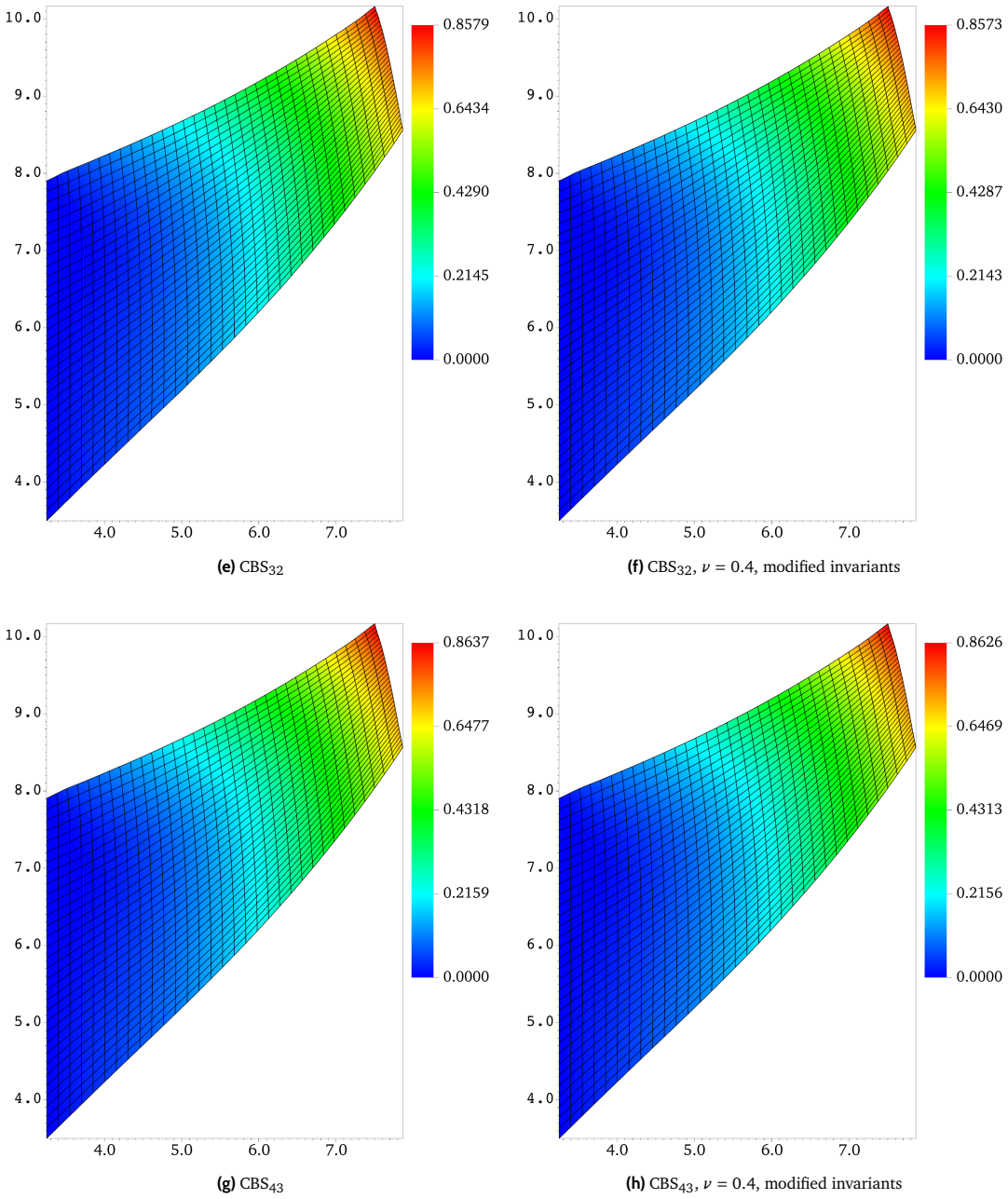
The central discovery is that the divergence-free interpolation property of composite B-spline regularized delta functions survives the IFED discretization when force spreading and velocity interpolation use consistent nodal quadrature, and that this property translates into large volume-conservation improvements. Expressed on the paper's own terms: because the central difference of an order-$n$ B-spline is the exact derivative of an order-$(n+1)$ B-spline, the componentwise asymmetric CBS interpolation maps a MAC vector field satisfying the discrete divergence equation to a continuously divergence-free interpolant. Inserting this kernel into the IFED spreading/interpolation pair makes the interpolated Lagrangian velocity divergence-free, so the solid elements are advected without spurious volume change, and the unbalanced compressive forces that generate spurious normal flows are suppressed. The paper shows this in benchmarks: pressurized membrane area error drops from roughly $10^{-5}$ to $10^{-7}$, the compressed block and Cook's membrane produce smooth displacement fields and near-unit Jacobians without volumetric energy or modified invariants, and the heart-valve model captures the same pressure and flow waveforms as stabilized isotropic kernels.
Load-bearing premise
The argument depends on the fluid solver delivering a velocity field whose discrete divergence is exactly zero on the staggered grid, and on the specific quadrature rule used to transfer quantities between grids preserving the mathematical pairing between spreading and interpolation; if either fails, the volume-conservation advantage would erode.
Editorial extensions
If this is right
- In pressurized-membrane tests, CBS kernels reduce volume-conservation errors by about two orders of magnitude relative to isotropic IB and B-spline kernels, with little sensitivity to kernel width.
- Without volumetric energy terms or modified invariants, CBS kernels match or beat stabilized isotropic kernels in the compressed-block and Cook's membrane benchmarks, producing near-unit Jacobians and smooth displacement fields.
- CBS kernels converge on coarser fluid grids than isotropic kernels, and they improve as the structural mesh is refined relative to the fluid grid, whereas isotropic kernels often perform better with coarser structural meshes.
- In the bioprosthetic heart-valve model, the wider CBS43 kernel captures high-frequency valve-flutter features comparably to or better than the isotropic B-spline kernel, while the lower-regularity CBS32 shows visible deviations during early diastole.
- For the IFED framework, the paper recommends the CBS32 kernel with a solid-to-fluid mesh ratio of about 0.5 as a balance of accuracy and computational cost.
Reading between the lines
- The commuting property the paper relies on should transfer to any staggered-grid discretization that shares the same discrete divergence stencil, so similar volume-conservation gains may be available in other finite-difference or finite-volume fluid solvers beyond the exact setup tested here.
- Because CBS kernels make volumetric stabilization unnecessary, unmodified constitutive invariants can be used directly, which may simplify implicit solvers and remove the artificial isotropic pressure response that modified invariants introduce into the material model.
- The reversed mesh-ratio trend suggests a practical tuning rule with CBS kernels: refine the structural mesh rather than widening the kernel, and keep the solid-to-fluid mesh ratio at or below 0.5 near pressure-loaded interfaces.
- A testable extension is to combine CBS kernels with higher-order structural finite elements in three dimensions; the quadrature adjointness used here was developed for nodal low-order discretizations and may need revisiting for P2 or higher bases.
Signed reviews
Editorial analysis
A structured set of objections, weighed in public.
Referee Report
Summary. This manuscript extends the composite B-spline (CBS) regularized delta functions of Gruninger and Griffith from the classical immersed boundary method to the immersed finite element/finite difference (IFED) method. It compares CBS kernels with isotropic IB and B-spline kernels on a suite of two-dimensional benchmarks—pressurized elastic band, pressurized membrane, compressed block, Cook's membrane, slanted channel, and a modified Turek-Hron problem—as well as a three-dimensional bioprosthetic heart valve model. The central reported findings are that CBS kernels reduce volume conservation errors by roughly two orders of magnitude in pressure-loaded cases, remove the need for volumetric stabilization terms and modified invariants, converge on coarser fluid/structural meshes than isotropic kernels, and exhibit a different (in fact opposite) sensitivity to the solid-fluid mesh ratio. The authors attribute these improvements to the property, inherited from prior work, that CBS kernels interpolate discretely divergence-free MAC velocity fields to continuously divergence-free fields.
Significance. If the empirical findings hold, the paper is a useful step toward simplifying IFED simulations of incompressible hyperelastic structures: it shows that a kernel choice can reduce spurious volume change without tuning stabilization parameters. Strengths include a broad benchmark suite, validation against an analytic Poiseuille solution, comparisons with previously published displacement values, a complex 3D heart-valve test, and use of the established IBAMR infrastructure. The main weakness is that the paper presents a mechanism—exact divergence-free solid velocity—that is not actually guaranteed by the CBS construction in the IFED finite-element update; the demonstrated volume-conservation advantage is empirical and needs qualification. With that framing corrected, the benchmarks would support a weaker but still valuable claim.
major comments (3)
- [§3.2.2, Eqs. (15), (35)-(36)] The abstract and Section 5 state that CBS kernels 'inherently maintain the discrete divergence-free property' and produce a 'divergence-free solid velocity field.' The CBS property established in prior work is that the interpolated Eulerian field is continuously divergence-free when the MAC velocities are discretely divergence-free. In the IFED update, the structure is advected by the finite-element velocity V_h(X,t) = Σ_l φ_l(X) U_l(t), not by that interpolated Eulerian field pointwise, and for the Q1 and P1 elements used throughout the paper, div_x V_h is not identically zero even when each U_l is sampled from a continuously divergence-free field. Consequently d/dt ∫_e J_e dX = ∫_e J_e div_x V_h dX is generally nonzero, so the improved element Jacobians in Sections 4.1.2 and 4.2 are empirical reductions in interpolation/spreading error rather than a direct consequence of the CBS divergence-free theorem. Please rephrase the central claim and add a diagnostic that directly measures div_x V_h or the exact evolution of element volumes to support the proposed mechanism.
- [§5, Tables 1 and 4] The conclusion that CBS kernels 'eliminate the need for stabilization techniques' is too broad. In the elastic band, CBS32 fails for MFAC ≥ 1.0 (Table 1), and in the Turek-Hron benchmark, CBS32 fails for MFAC > 1.0 (Table 4); the thin-band results in Section 4.1.2 also become unstable at MFAC ≥ 1.0. The claim should be scoped to resolved configurations (e.g., MFAC < 1) and to the particular test suite, and the text should acknowledge that at coarse structural meshes CBS kernels are less robust than some isotropic kernels.
- [§4.1.1, Fig. 3] The 'two orders of magnitude' improvement is reported for a single grid spacing (h = 1/128) and a single final time; no grid-convergence study demonstrates that the factor persists under refinement. Since the abstract generalizes this improvement to the full test suite, either add a convergence study of the volume error for the membrane or qualify the statement so that it refers only to the shown configuration.
minor comments (6)
- [§1] The word 'inatroduces' in the introduction should be 'introduces'.
- [§3] The text 'Grifftih and Luo' in Section 3 should be 'Griffith and Luo'.
- [§4.2.2, Fig. 19] The caption of Figure 19 refers to the 'top-mid point of the compressed block,' but the figure reports Cook's membrane results; the caption should be corrected.
- [§4.3.2] The setup description contains a stray '(2)' before 'and an elastic beam'; this appears to be a formatting error.
- [References] Reference 48, 'PJ128117 Flory', contains an apparent artefact in the author field and should be cleaned up.
- [§4.3.2, Table 4] The typesetting of BS3 in Table 4 uses an inconsistent mathematical italic font ('𝐵𝑆3') compared with the rest of the table.
Circularity Check
No significant circularity: the CBS volume-conservation advantage rests on benchmark tests and an independently stated B-spline identity, not on a fitted input or a self-citation chain.
full rationale
The claimed derivation chain is not circular. The CBS kernel is not fitted to the volume-conservation benchmarks; it is defined by a fixed B-spline composition rule (Eqs. 35-36), and its divergence-free interpolation property is presented as a consequence of the B-spline convolution/difference identity (Eqs. 32-33), with independent precedent in Handscomb (1984) and Schroeder et al. (2022), not merely in the same-group preprint. The paper's central IFED claims are tested against external references: the pressurized membrane's zero-vorticity equilibrium state, the slanted-channel analytic Poiseuille solution, the compressed-block and Cook's-membrane solid-mechanics benchmarks, the Turek-Hron FSI benchmark, and experimental heart-valve flow and pressure traces. No parameter is fitted to the target quantity and then renamed a prediction; the only tuned parameters (penalty stiffnesses, stable time steps, numerical bulk moduli for stabilized comparisons) come from stability constraints or prior work and are not used to define the CBS kernels. The skeptic's concern that the IFED finite-element velocity field, being a C0 interpolation of nodal velocities, is not exactly divergence-free even when each nodal sample comes from a divergence-free interpolant is a correctness and robustness caveat about the strength of the advertised mechanism, not a circularity: the paper's two-order-of-magnitude volume-error reduction is an empirical benchmark result and does not reduce by construction to the kernel property. There is heavy self-citation to Gruninger and Griffith and to the same group's IFED papers, but the load-bearing mathematical facts are parameter-free and independently stated, so this does not constitute circular reasoning.
Assumptions & free parameters
free parameters (3)
- Penalty stiffness kappa_S for boundary constraints =
2.5*2.5*dx/dt (compressed block), 0.125*dx/dt (Cook's membrane), 5e4*dx/dt^2 (Turek-Hron)
- Numerical bulk modulus kappa_stab and Poisson ratio nu_stab =
kappa_stab = 374.239 and 388.889 dyn/cm^2; nu_stab = 0.4
- Slanted channel penalty stiffness and damping =
Not reported; tuned per kernel
assumptions (5)
- standard math Derivative of an order-n B-spline equals the central difference of an order-(n-1) B-spline (Eq. 33).
- domain assumption Composite B-splines interpolate discretely divergence-free MAC-grid vector fields to continuously divergence-free fields.
- domain assumption The nodal quadrature scheme of Wells et al. makes the interpolation and spreading operators discrete adjoints and eliminates the need for a projection step.
- domain assumption Steady-state solutions of the FSI benchmarks match the corresponding pure solid mechanics solutions.
- domain assumption Equal fluid and structure densities do not affect steady-state solutions.
Cite this review
Pith. "Pith review of Local Divergence-Free Immersed Finite Element-Difference Method Using Composite B-Splines." pith.science (2026). https://pith.science/paper/GWBIPDRJ
@misc{pith2026241215408,
  author       = {Pith},
  title        = {Pith review of: Local Divergence-Free Immersed Finite Element-Difference Method Using Composite B-Splines},
  year         = {2026},
  howpublished = {\url{https://pith.science/paper/GWBIPDRJ}},
  note         = {Machine review of arXiv:2412.15408}
}
read the original abstract
In the class of immersed boundary (IB) methods, the choice of the delta function plays a crucial role in transferring information between fluid and solid domains. Most prior work has used isotropic kernels that do not preserve the divergence-free condition of the velocity field, leading to loss of incompressibility of the solid when interpolating velocity to Lagrangian markers. To address this issue, in simulations involving large deformations of incompressible hyperelastic structures immersed in fluid, researchers often use stabilization approaches such as adding a volumetric energy term. Composite B-spline (CBS) kernels offer an alternative by maintaining the discrete divergence-free property. This work evaluates CBS kernels in terms of volume conservation and accuracy, comparing them with isotropic kernel functions using a construction introduced by Peskin (IB kernels) and B-spline (BS) kernels. Benchmark tests include pressure-loaded and shear-dominated flows, such as an elastic band under pressure loads, a pressurized membrane, a compressed block, Cook's membrane, and a slanted channel flow. Additionally, we validate our methodology using a complex fluid-structure interaction model of bioprosthetic heart valve dynamics. Results demonstrate that CBS kernels achieve superior volume conservation compared to isotropic kernels, eliminating the need for stabilization techniques. Further, CBS kernels converge on coarser fluid grids, while IB and BS kernels need finer grids for comparable accuracy. Unlike IB and BS kernels, which perform better with larger mesh ratios, CBS kernels improve with smaller mesh ratios. Wider kernels provide more accurate results across all methods, but CBS kernels are less sensitive to grid spacing variations than isotropic kernels.
Figures


Figures from the paper (25 more)




Forward citations
Cited by 1 Pith paper
-
A Volumetrically Stabilized Mixed Formulation of the Finite Element Immersed Boundary Method for Fluid Structure Interaction with Fully Incompressible Hyperelastic Solids
A volumetrically stabilized mixed finite element immersed boundary formulation that enforces Lagrangian incompressibility in fully incompressible hyperelastic solids via a weak solid pressure field.
Reference graph
Works this paper leans on
-
[1]
C.S. Peskin. The immersed boundary method. Acta Numerica , 11:479--517, 2002
work page 2002
-
[2]
C.S. Peskin. Flow patterns around heart valves: A numerical method. Journal of Computational Physics , 10(2):252--271, 1972
work page 1972
-
[3]
B.E. Griffith and X.Y. Luo. Hybrid finite difference/finite element immersed boundary method . International Journal for Numerical Methods in Biomedical Engineering , 33(11):e2888, 2017
work page 2017
- [4]
-
[5]
A. Santhanakrishnan, S.K. Jones, W.B. Dickson, M. Peek, V.T. Kasoju, M.H. Dickinson, and L.A. Miller. Flow structure and force generation on flapping wings at low R eynolds numbers relevant to the flight of tiny insects. Fluids , 3(3), 2018
work page 2018
-
[6]
S. Alben, L.A. Miller, and J. Peng. Efficient kinematics for jet-propelled swimming. Journal of Fluid Mechanics , 733:100–133, 2013
work page 2013
- [7]
- [8]
Show all 58 references
-
[9]
Bale, I.D
R. Bale, I.D. Neveln, A.P.S. Bhalla, M.A. MacIver, and N.A. Patankar. Convergent evolution of mechanically optimal locomotion in aquatic invertebrates and vertebrates. PLOS Biology , 13(4):1--22, 04 2015
2015
-
[10]
Hoover, B.E
A.P. Hoover, B.E. Griffith, and L.A. Miller. Quantifying performance in the medusan mechanospace with an actively swimming three-dimensional jellyfish model. Journal of Fluid Mechanics , 813:1112–1155, 2017
2017
-
[11]
Nangia, R
N. Nangia, R. Bale, N. Chen, Y. Hanna, and N.A. Patankar. Optimal specific wavelength for maximum thrust production in undulatory propulsion. PLOS ONE , 12(6):1--23, 2017
2017
-
[12]
Griffith, X.Y
B.E. Griffith, X.Y. Luo, D.M. McQueen, and C.S. Peskin. Simulating the fluid dynamics of natural and prosthetic heart valves using the immersed boundary method. Int. Jour. of Applied Mech. , 01(01):137--177, 2009
2009
-
[13]
Hasan, E.M
A. Hasan, E.M. Kolahdouz, A. Enquobahrie, T.G. Caranasos, J.P. Vavalle, and B.E. Griffith. Image-based immersed boundary model of the aortic root. Medical Engineering & Physics , 47:72--84, 2017
2017
-
[14]
Griffith
B.E. Griffith. Immersed boundary model of aortic heart valve dynamics with physiological driving and loading conditions. International Journal for Numerical Methods in Biomedical Engineering , 28(3):317--345, 2012
2012
-
[15]
W.W. Chen, H. Gao, X.Y. Luo, and N.A. Hill. Study of cardiovascular function using a coupled left ventricle and systemic circulation model. Journal of Biomechanics , 49(12):2445--2454, 2016. Cardiovascular Biomechanics in Health and Disease
2016
-
[16]
Crowl and A.L
L. Crowl and A.L. Fogelson. Analysis of mechanisms for platelet near-wall excess under arterial blood flow conditions. Journal of Fluid Mechanics , 676:348–375, 2011
2011
-
[17]
Kaiser, D.M
A.D. Kaiser, D.M. McQueen, and C.S. Peskin. Modeling the mitral valve. International Journal for Numerical Methods in Biomedical Engineering , 35(11):e3240, 2019
2019
-
[18]
Davey, C
M. Davey, C. Puelz, S. Rossi, M.A. Smith, D.R. Wells, G.M. Sturgeon, W.P. Segars, J.P. Vavalle, C.S. Peskin, and B.E. Griffith. Simulating cardiac fluid dynamics in the human heart. PNAS Nexus , 3(10):pgae392, 09 2024
2024
-
[19]
Zhang, A
L. Zhang, A. Gerstenberger, X. Wang, and W.K. Liu. Immersed finite element method. Computer Methods in Applied Mechanics and Engineering , 193(21):2051--2067, 2004
2004
-
[20]
Wang and K.W
X. Wang and K.W. Wing Kam Liu. Extended immersed boundary method using fem and rkpm. Computer Methods in Applied Mechanics and Engineering , 193(12):1305--1321, 2004
2004
-
[21]
W.K. Liu, S. Jun, and Y.F. Zhang. Reproducing kernel particle methods. International Journal for Numerical Methods in Fluids , 20(8-9):1081--1106, 1995
1995
-
[22]
Boffi, L
D. Boffi, L. Gastaldi, L. Heltai, and C.S. Peskin. On the hyper-elastic formulation of the immersed boundary method . Computer Methods in Applied Mechanics and Engineering , 197(25--28):2210--2231, 2008
2008
-
[23]
Wells, B
D.R. Wells, B. Vadala-Roth, J.H. Lee, and B.E. Griffith. A nodal immersed finite element-finite difference method. Journal of Computational physics , 477:111890, 2023
2023
-
[24]
Vadala-Roth, S
B. Vadala-Roth, S. Acharya, N.A. Patankar, S. Rossi, and B.E. Griffith. Stabilization approaches for the hyperelastic immersed boundary method for problems of large-deformation incompressible elasticity. Computer Methods in Applied Mechanics and Engineering , 365:112978, 2020
2020
-
[25]
Lee and B.E
J.H. Lee and B.E. Griffith. On the lagrangian-eulerian coupling in the immersed finite element/difference method. Journal of Computational physics , 457:111042, 2022
2022
-
[26]
Peskin and B.F
C.S. Peskin and B.F. Printz. Improved volume conservation in the computation of flows with immersed elastic boundaries. Journal of Computational Physics , 105(1):33--46, 1993
1993
-
[27]
Gruninger and B.E
C. Gruninger and B.E. Griffith. Local divergence-free velocity interpolation for the immersed boundary method using composite B -splines. arXiv preprint arXiv:2408.08280 , 2024
2024
-
[28]
Cortez and M
R. Cortez and M. Minion. The blob projection method for immersed boundary problems. Journal of Computational Physics , 161(2):428--453, 2000
2000
-
[29]
Y. Bao, A. Donev, B.E. Griffith, D.M. McQueen, and C.S. Peskin. An immersed boundary method with divergence-free velocity interpolation and force spreading. Journal of Computational Physics , 347:183--206, 2017
2017
-
[30]
Griffith
B.E. Griffith. On the volume conservation of the immersed boundary method. Communications in Computational Physics , 12(2):401–432, 2012
2012
-
[31]
Lee and R.J
L. Lee and R.J. LeVeque. An immersed interface method for incompressible navier--stokes equations. SIAM Journal on Scientific Computing , 25(3):832--856, 2003
2003
-
[32]
Bonet and R.D
J. Bonet and R.D. Wood. Nonlinear Continuum Mechanics for Finite Element Analysis . Cambridge University Press, 2 edition, 2008
2008
-
[33]
Devendran and C
D. Devendran and C. S. Peskin. An immersed boundary energy-based method for incompressible viscoelasticity . Jounral of Computational Physics , 231:4613--4642, 2012
2012
-
[34]
Unser, A
M. Unser, A. Aldroubi, and M. Eden. On the asymptotic convergence of B -spline wavelets to gabor functions. IEEE Transactions on Information Theory , 38(2):864--872, 1992
1992
-
[35]
Schroeder, R
C. Schroeder, R. Roy Chowdhury, and T. Shinar. Local divergence-free polynomial interpolation on MAC grids. Journal of Computational Physics , 468:111500, 2022
2022
-
[36]
Handscomb
D.C. Handscomb. Spline Representation of Incompressible Flow . IMA Journal of Numerical Analysis , 4(4):491--502, 1984
1984
-
[37]
Harlow and J.E
F.H. Harlow and J.E. Welch. Numerical calculation of time-dependent viscous incompressible flow of fluid with free surface. Physics of Fluids , 8(12):2182--2189, 1965
1965
-
[38]
B. E. Griffith. An accurate and efficient method for the incompressible Navier-Stokes equations using the projection method as a preconditioner. Journal of Computational Physics , 228(20):7565--7595, 2009
2009
-
[39]
Rider, J.A
W.J. Rider, J.A. Greenough, and J.R. Kamm. Accurate monotonicity- and extrema-preserving methods through adaptive nonlinear hybridizations. Journal of Computational Physics , 225(2):1827--1848, 2007
2007
-
[40]
Colella and P.R
P. Colella and P.R. Woodward. The Piecewise Parabolic Method ( PPM ) for gas-dynamical simulations. Journal of Computational Physics , 54(1):174--201, 1984
1984
-
[41]
Y. Bao, J. Kaye, and C.S. Peskin. A gaussian-like immersed-boundary kernel with three continuous derivatives and improved translational invariance. Journal of Computational Physics , 316:139--144, 2016
2016
-
[42]
Roma, C.S
A.M. Roma, C.S. Peskin, and M.J. Berger. An adaptive version of the immersed boundary method. Journal of Computational Physics , 153(2):509--534, 1999
1999
-
[43]
Schoenberg
I.J. Schoenberg. Cardinal Spline Interpolation . Society for Industrial and Applied Mathematics, 1973
1973
-
[44]
Schoenberg
I.J. Schoenberg. Contributions to the problem of approximation of equidistant data by analytic functions. part a.- on the problem of smoothing or graduation. a first class of analytic approximation formulae. part b.- on the second problem of osculatory interpolation. a second ...
1946
-
[45]
C. de Boor. A Practical Guide to Splines , volume 27 of Applied Mathematical Sciences . Springer-Verlag, New York, 1978
1978
-
[46]
Gruninger, A
C. Gruninger, A. Barrett, F. Fang, M.G. Forest, and B.E. Griffith. Benchmarking the immersed boundary method for viscoelastic flows. Journal of Computational Physics , 506:112888, 2024
2024
-
[47]
Roy-Chowdhury, T
R. Roy-Chowdhury, T. Shinar, and C. Schroeder. Higher order divergence-free and curl-free interpolation on MAC grids. Journal of Computational Physics , 503:112831, 2024
2024
-
[48]
Thermodynamic relations for high elastic materials
PJ128117 Flory. Thermodynamic relations for high elastic materials. Transactions of the Faraday Society , 57:829--838, 1961
1961
-
[49]
Griffith, Richard D
Boyce E. Griffith, Richard D. Hornung, David M. McQueen, and Charles S. Peskin. An adaptive, formally second order accurate version of the immersed boundary method . J Comput Phys , 223(1):10--49, 2007
2007
-
[50]
Griffith, Richard D
Boyce E. Griffith, Richard D. Hornung, David M. McQueen, and Charles S. Peskin. Parallel and adaptive simulation of cardiac fluid dynamics. In Manish Parashar, Xiaolin Li, Sumir Chandra, and Albert Y. Zomaya, editors, Advanced Computational Infrastructures for Parallel and Dis...
2009
-
[51]
http://ibamr.github.io/
IBAMR W eb page. http://ibamr.github.io/
-
[52]
Hornung and Scott R
Richard D. Hornung and Scott R. Kohn. Managing application complexity in the SAMRAI object-oriented framework . Concurr Comp-Pract E , 14:347--368, 2002
2002
-
[53]
Adams, Steven Benson, Jed Brown, Peter Brune, Kris Buschelman, Emil M
Satish Balay, Shrirang Abhyankar, Mark F. Adams, Steven Benson, Jed Brown, Peter Brune, Kris Buschelman, Emil M. Constantinescu, Lisandro Dalcin, Alp Dener, Victor Eijkhout, Jacob Faibussowitsch, William D. Gropp, V\' a clav Hapla, Tobin Isaac, Pierre Jolivet, Dmitry Karpeev, ...
2024
-
[54]
Adams, Steven Benson, Jed Brown, Peter Brune, Kris Buschelman, Emil Constantinescu, Lisandro Dalcin, Alp Dener, Victor Eijkhout, Jacob Faibussowitsch, William D
Satish Balay, Shrirang Abhyankar, Mark F. Adams, Steven Benson, Jed Brown, Peter Brune, Kris Buschelman, Emil Constantinescu, Lisandro Dalcin, Alp Dener, Victor Eijkhout, Jacob Faibussowitsch, William D. Gropp, V\' a clav Hapla, Tobin Isaac, Pierre Jolivet, Dmitry Karpeev, Din...
2024
-
[55]
Gropp, Lois Curfman McInnes, and Barry F
Satish Balay, William D. Gropp, Lois Curfman McInnes, and Barry F. Smith. Efficient management of parallelism in object oriented numerical software libraries. In E. Arge, A. M. Bruaset, and H. P. Langtangen, editors, Modern Software Tools in Scientific Computing , pages 163--2...
1997
-
[56]
Turek and J
S. Turek and J. Hron. Proposal for numerical benchmarking of fluid-structure interaction between an elastic object and laminar incompressible flow. In Hans-Joachim Bungartz and Michael Sch \"a fer, editors, Fluid-Structure Interaction , pages 371--385, Berlin, Heidelberg, 2006...
2006
-
[57]
Lee, A.D
J.H. Lee, A.D. Rygg, E.M. Kolahdouz, S. Rossi, S.M. M. Retta, N. Duraiswamy, L.N. Scotten, B.A. Craven, and B.E. Griffith. Fluid--structure interaction models of bioprosthetic heart valve dynamics in an experimental pulse duplicator . Annals of Biomedical Engineering , 48(5):1...
2020
-
[58]
Gasser, R.W
C.T. Gasser, R.W. Ogden, and G.A. Holzapfel. Hyperelastic modelling of arterial layers with distributed collagen fibre orientations . Journal of The Royal Society Interface , 3(6):15--35, Feb 2006
2006
Reviewed August 11, 2026 · model on record in the stance chip above.
Discussion (0). Continue with ORCID to comment.