REVIEW 3 major objections 4 minor 26 references
Identifying Switching of Antiferromagnets by Spin-Orbit Torques
T0 review · 3 major / 4 minor · reviewed 2026-08-11 · deepseek-v4-flash
Pith's one-line read Nanosecond pulses switch Mn2Au's Néel vector by pure spin-orbit torque.
desk verdict A clever geometry trick separates thermomagnetoelastic from NSOT switching at long pulses; the nanosecond pure-NSOT claim is plausible but rests on an untested strain-direction assumption and qualitative domain imaging. read the letter →
The pith
A machine-rendered reading of the paper's core claim, the machinery that carries it, and where it could break.
The reading
What carries the argument
The load-bearing object is the staggered effective field produced by a current in a bulk antiferromagnet with inversion symmetry breaking: $\mathbf{B}_A \propto +\hat{z}\times \mathbf{J}$ and $\mathbf{B}_B \propto -\hat{z}\times \mathbf{J}$, where $\hat z$ is the film normal and $\mathbf J$ the in-plane current. These fields generate field-like torques that cant both sublattices the same way, and the resulting exchange torque rotates the Néel vector around the film normal; the torque is maximum when the Néel vector is parallel or antiparallel to $\mathbf J$ and vanishes when it is perpendicular. The argument is carried experimentally by comparing two cross geometries: in a 0° cross, the thermal-strain easy axis lies perpendicular to the current, while in a 45° cross it lies parallel, so any mechanism that follows the current direction (NSOT) can be distinguished from one that follows the strain axis (thermomagnetoelastic). NSOT also removes 180° domain walls because it drives both antiparallel orientations toward the same perpendicular direction, whereas strain only fixes an axis and leaves both directions populated.
What would settle it
Measure the transient strain and temperature in the Mn2Au crosses during a 2.5 ns, ~3×$10^{12}$ A/m² current pulse (for example by time-resolved x-ray diffraction) and compute the magnetoelastic anisotropy using measured elastic constants of Mn2Au. If the induced strain is large enough to rotate the Néel vector into the observed perpendicular direction, the claim of pure NSOT switching is falsified.
Extended reading notes
Core claim
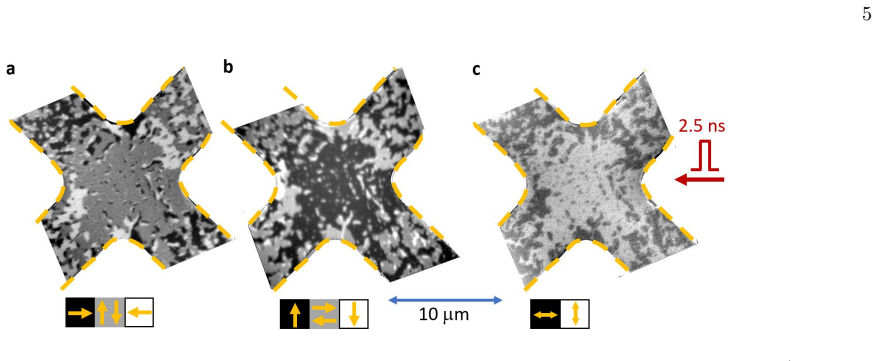
The central discovery is that the two known current-induced switching mechanisms in Mn2Au can be cleanly separated by geometry and pulse width. For 10 µs and 1 ms pulses, the final Néel vector orientation follows the anisotropic thermal strain pattern computed for the device: perpendicular to current in a 0°-oriented cross and parallel to current in a 45°-oriented cross, meaning the thermomagnetoelastic effect is the driver. For 2.5 ns pulses, both geometries show the Néel vector aligned perpendicular to the current, which matches the NSOT torque direction and not the strain axis; moreover, the switched area is one connected domain with only small residual 180° walls. Electrical transport measurements place the crossover near 100 ns and show complete NSOT switching at current densities of 2–3 × $10^{12}$ A/m², more than five times the density needed for thermomagnetoelastic switching. The authors conclude that bulk NSOT, predicted a decade earlier, is sufficient to switch Mn2Au and to create a single-domain state.
Load-bearing premise
The claim that nanosecond switching is purely NSOT rests on the assumption that current-induced thermal strain in the Mn2Au films is negligible at 2.5 ns pulse widths; the finite-element simulations supporting this use generic 'typical values for metals' because Mn2Au's thermal and elastic parameters are unpublished.
Editorial extensions
If this is right
- For pulse widths of 100 ns and below, Mn2Au devices can be switched by the bulk Néel spin-orbit torque alone, with no thermal-strain contribution at the switching current density.
- NSOT switching yields a deterministic single antiferromagnetic domain: the Néel vector points along a specific in-plane direction perpendicular to the applied current, not merely along an easy axis.
- Thermomagnetoelastic switching dominates for microsecond and millisecond pulses, so studies claiming SOT-driven switching in collinear antiferromagnets must rule it out using geometry or pulse-width dependence.
- The 100 ns crossover implies an operating window where NSOT switching occurs at lower current densities than thermal switching; at 100 ns the same sample shows NSOT first and thermomagnetoelastic switching only at higher current densities.
- Current densities around 2–3 × 10^12 A/m² are sufficient for complete NSOT switching in the nanosecond regime, establishing practical requirements for ultrafast antiferromagnetic memory writing.
Reading between the lines
- If the thermal-strain assumption holds, the 0°/45° cross comparison could be adopted as a general diagnostic for separating intrinsic spin-orbit torques from thermomagnetoelastic effects in other collinear antiferromagnets.
- The creation of a single connected AFM domain with a known Néel vector direction implies a memory bit that is not just axis-aligned but directionally encoded; exploiting it would require a readout that resolves antiparallel states, which XMLD contrast alone cannot do.
- A direct test would be to measure Mn2Au's thermal conductivity, heat capacity, thermal expansion, Young's modulus, and Poisson ratio, then rerun the finite-element strain calculation; if the computed strain at 2.5 ns is large enough to reorient the Néel vector, the pure-NSOT conclusion would need revision.
- The pulse-width dependence suggests a crossover scaling law: thermal switching should scale with deposited energy and heat diffusion time, while NSOT switching should scale with current density; mapping this crossover across pulse widths and device sizes could predict the fastest reliable NSOT switching point.
Editorial analysis
A structured set of objections, weighed in public.
Referee Report
Summary. The paper reports an experimental study of current-induced Néel vector switching in epitaxial Mn2Au(001) devices, distinguishing two mechanisms: bulk Néel spin-orbit torque (NSOT) and thermomagnetoelastic strain. Using 0° and 45° cross geometries, the authors show that 10 µs current pulses produce Néel vector alignment whose direction follows the simulated strain axis (perpendicular to current in the 0° cross, parallel in the 45° cross), consistent with thermomagnetoelastic switching. For 2.5 ns pulses, both geometries show alignment perpendicular to the current, which the authors attribute to purely NSOT-driven switching; they further observe a predominantly single domain after the nanosecond pulse, which they interpret as directional (rather than axis) alignment. The paper also presents transverse resistance measurements showing a crossover at 100 ns where both mechanisms can operate at different current densities.
Significance. If the conclusions hold, the paper provides a valuable experimental protocol for distinguishing NSOT from thermomagnetoelastic switching in antiferromagnets, and strong evidence that bulk NSOT in Mn2Au can drive complete directional Néel vector alignment on nanosecond timescales. The geometry-based discriminator and the single-domain observation are conceptually clear and potentially reproducible. The use of XMLD-PEEM imaging, exchange-coupled Py readout, and resistance measurements gives a multi-modal characterization. However, the central nanosecond claim depends on assumptions about the strain direction at pulse widths for which no simulations are presented, and on the interpretation of the domain structure; these are load-bearing and not fully resolved.
major comments (3)
- [Results and Discussion, Fig. 2] The conclusion that 2.5 ns switching is purely NSOT rests on the assumption that the thermomagnetoelastic strain in the 45° cross is parallel to the current at that pulse width, as it is at 10 µs. The COMSOL simulations shown in Fig. 2d–f are only for 10 µs pulses, and at 2.5 ns the thermal diffusion length in MgO and Mn2Au (using the Supplement's parameters) is approximately 0.2 µm and 0.7 µm, respectively, much smaller than the cross dimensions; the strain field therefore need not have the same anisotropy as the quasi-steady-state case. If the 45° cross strain at 2.5 ns were perpendicular to the current, the observed bright XMLD contrast would be consistent with thermomagnetoelastic switching rather than NSOT. The authors should provide transient COMSOL simulations at 2.5 ns, or a quantitative argument for the strain direction at that pulse width, before claiming a purely NSOT mechanism.
- [Fig. 4a and Summary] The abstract and summary state that for 'pulses shorter than 100 ns' switching is driven purely by NSOT, but Fig. 4a shows that for 100 ns pulses, NSOT switching at lower current densities is followed by thermomagnetoelastic switching at higher current densities. This indicates that the thermomagnetoelastic mechanism is not absent at 100 ns, and the phrase 'purely NSOT' should be qualified to the current-density range in which NSOT dominates. The manuscript should clarify the boundary of the NSOT-only regime and how the 100 ns crossover data relate to the abstract's claim.
- [Supplemental Material II and Fig. S3] The single-domain observation after 2.5 ns is used as evidence for NSOT because thermomagnetoelastic switching is argued to produce 180° domains. This argument assumes that a strong thermomagnetoelastic strain cannot select one of the two antiparallel directions along the strain axis, e.g., via inhomogeneous strain or a secondary torque. The authors should either provide a supporting calculation or explicitly state this symmetry assumption as a limitation, since the XMLD contrast alone cannot distinguish antiparallel directions except through the visibility of 180° domain walls.
minor comments (4)
- [Throughout] There are several typographical and grammatical errors, such as 'the compound investigate here' (Introduction) and 'could enabling novel applications' (Summary & Conclusion); these should be corrected.
- [Supplemental Material I] The text refers to 'Fig. 1g' of the main manuscript when describing the 10 µs switched domain configuration, but the corresponding image appears in Fig. 2g; please update the cross-reference.
- [References] Reference [26] is a placeholder ('URL will be inserted by publisher') and must be resolved before publication.
- [Fig. 2 caption] The caption for panel d says the current flows 'from both right arms to both left arms', which is initially confusing; consider adding a schematic with current arrows in the figure or a more explicit description.
Circularity Check
No significant circularity: NSOT direction is taken from external theory (Zelezny et al.) and the thermomagnetoelastic discriminator comes from COMSOL simulations, not from fitting the claimed result.
full rationale
The paper's central mechanism assignment is not circular. The NSOT final-orientation prediction is imported from an external, non-overlapping theoretical paper (Ref. [9], Zelezny et al.) and is tested against XMLD-PEEM images; no parameter is fitted to the observed contrast. The thermomagnetoelastic discriminator is established through COMSOL simulations using literature or 'typical values for metals' parameters, and the simulation's strain-direction prediction is independently validated at 10 µs by the opposite Néel-vector alignment in 0° versus 45° crosses before being used to interpret the 2.5 ns data. Self-citations appear for sample growth, as-grown domain structure, XMLD calibration, AMR sign, and the exchange-spring readout; the exchange-spring readout is additionally confirmed by direct Mn-edge XMLD in Fig. 3c, so the self-citation is not load-bearing alone. No equation or quantity is defined in terms of the target conclusion, and the 'purely NSOT' claim does not reduce to a fitted input or to a self-citation chain. The main caveat, that the 2.5 ns strain axis is not separately simulated, is a robustness/correctness concern rather than a circular reduction, because the strain direction is not derived from the observed switching outcome and the NSOT prediction comes from an independent source.
Assumptions & free parameters
free parameters (7)
- Mn2Au heat capacity c =
200 J/(kg K)
- Mn2Au thermal conductivity k =
400 W/(m K)
- Mn2Au thermal expansion coefficient alpha =
6e-6 /K
- Mn2Au Young's modulus E =
170 GPa
- Mn2Au Poisson ratio nu =
0.38
- Device-air heat transfer coefficient =
10 W/(m^2 K)
- Device-sample holder heat transfer coefficient =
500 W/(m^2 K)
assumptions (5)
- domain assumption NSOT effective fields are B_A proportional to +z x J and B_B proportional to -z x J, with field-like torques acting equally on both sublattices (Eqs. 1-2).
- domain assumption Mn2Au(001) has four equivalent easy <110> directions and a hard c-axis, with initially equally populated domains.
- ad hoc to paper Thermally generated strain modifies Mn2Au magnetic anisotropy and drives Néel vector reorientation, although the magnitude and sign of the magnetoelastic energy are unknown.
- domain assumption The AMR-based inhomogeneous heating mechanism can be excluded because Mn2Au AMR makes perpendicular alignment of Néel vector and current higher resistance, which is the final state observed.
- domain assumption Mn2Au/Ni80Fe20 forms an exchange spring with collinear coupling, so the Fe magnetization direction reports the Néel vector direction.
Cite this review
Pith. "Pith review of Identifying Switching of Antiferromagnets by Spin-Orbit Torques." pith.science (2026). https://pith.science/paper/FQGCFIR7
@misc{pith2026241215885,
  author       = {Pith},
  title        = {Pith review of: Identifying Switching of Antiferromagnets by Spin-Orbit Torques},
  year         = {2026},
  howpublished = {\url{https://pith.science/paper/FQGCFIR7}},
  note         = {Machine review of arXiv:2412.15885}
}
abstract
Antiferromagnets are promising candidates for ultrafast spintronic applications, leveraging current-induced spin-orbit torques. However, experimentally distinguishing between different switching mechanisms of the staggered magnetization (N\'eel vector) driven by current pulses remains a challenge. In an exemplary study of the collinear antiferromagnetic compound Mn$_2$Au, we demonstrate that slower thermomagnetoelastic effects predominantly govern switching over a wide parameter range. In the regime of short current pulses in the nanosecond range, however, we observe fully N\'eel spin-orbit torque driven switching. We show that this ultrafast mechanism enables the complete directional alignment of the N\'eel vector by current pulses in device structures.
Figures


Figures from the paper (5 more)


Reference graph
Works this paper leans on
-
[1]
MacDonald, A. H., and Tsoi, M. Antiferromagnetic Metal Spintronics.Philos. Trans. R. Soc. A369, 3098 (2011)
work page 2011
-
[2]
Baltz, V., Manchon, A., Tsoi, M., Moriyama, T., Ono, T., and Tserkovnyak, Y. Antiferromagnetic Spintronics. Rev. Mod. Phys.90, 015005 (2018)
work page 2018
-
[3]
Jungwirth, T., Sinova, J., Manchon, A., Marti, X., Wun- derlich, J. and Felser, C. The multiple directions of anti- ferromagnetic spintronics,Nat. Phys.14, 200 (2018)
work page 2018
-
[4]
B., Zhang, W., and Hoffmann, A
Jungfleisch, M. B., Zhang, W., and Hoffmann, A. Per- spectives of antiferromagnetic spintronics,Phys. Lett. A 382, 865 (2018)
work page 2018
-
[5]
Machado, F. L. A., Ribeiro, P. R. T., Holanda, J., Rodr ´ ıguez-Su´ arez, R. L., Azevedo, A., and Rezende, S. M. Spin-flop transition in the easy-plane antiferromag- net nickel oxide,Phys. Rev. B95, 104418 (2017)
work page 2017
-
[6]
M., Azevendo, A., Rodr ´ ıguez-Su´ arez, R
Rezende, S. M., Azevendo, A., Rodr ´ ıguez-Su´ arez, R. L. Introduction to antiferromagnetic magnons, J. Appl. Phys.126, 151101 (2019)
work page 2019
-
[7]
Sapozhnik, A. A., Filianina, M., Bodnar, S. Yu., Lami- rand, A., Mawass, M.-A., Skourski, Y., Elmers, H.-J., Zabel, H., Kl¨ aui, M., and Jourdan, M. Direct imaging of antiferromagnetic domains in Mn 2Au manipulated by high magnetic fields.Phys. Rev. B97, 134429 (2018)
work page 2018
-
[8]
Coherent terahertz control of antiferromagnetic spin waves,Nat
Kampfrath, T., Sell, A., Klatt, G., Pashkin, A., M¨ ahrlein, S., Dekorsy, T., Wolf, M., Fiebig, M., Leit- enstorfer, A., and Huber, R. Coherent terahertz control of antiferromagnetic spin waves,Nat. Photonics5, 31 (2011)
work page 2011
Show all 26 references
-
[9]
Relativistic N´ eel-Order Fields Induced by Elec- trical Current in Antiferromagnets,Phys
ˇZelezn´ y, J., Gao, H., V´ yborn´ y, K., Zemen, J., Mˇ asek, J., Manchon, A., Wunderlich, J., Sinova, J., and Jung- wirth, T. Relativistic N´ eel-Order Fields Induced by Elec- trical Current in Antiferromagnets,Phys. Rev. Lett.113, 157201 (2014)
2014
-
[10]
Salemi, L., Berritta, M., Nandy, A., K., Oppeneer, P. M. Orbitally dominated Rashba-Edelstein effect in noncen- trosymmetric antiferromagnets.Nat. Commun.10, 5201 (2019)
2019
-
[11]
Selzer, S., Salemi, L., De´ ak, A., Szunyogh, L., Oppe- neer, P., M., and Nowak, U., Current-induced switching of antiferromagnetic order in Mn 2Au from first princi- ples.Phys. Rev. B105, 174416 (2022)
2022
-
[12]
J., Andrews, C., Wang, M., Chauhan, J
Wadley, P., Reimers, S., Grzybowski, M. J., Andrews, C., Wang, M., Chauhan, J. S., Gallagher, B. L., Cam- pion, R. P., Edmonds, K. W., Dhesi, S. S., Maccherozzi, F., Nov´ ak, V., Wunderlich, J., and Jungwirth, T. Cur- rent polarity-dependent manipulation of antiferromag- netic...
2018
-
[13]
J., Reimers, S., Maccherozzi, F., Dhesi, S
Amin, O. J., Reimers, S., Maccherozzi, F., Dhesi, S. S., Nov´ ak, V., Campion, R. P., Edmonds, K. W., Wadley, P. Electrical control of 180 o domain walls in an antiferro- magnet.APL Materials11, 091112 (2023)
2023
-
[14]
R., Golias, 8 E., Sarpi, B., Veiga, L
Reimers, S., Lyvvynenko, Y., Niu, Y. R., Golias, 8 E., Sarpi, B., Veiga, L. S. I., Denneulin, T., Kov´ acs, A., Dunin-Borkowski, R. E., Kl¨ aui, M., Jourdan, M. Current-driven writing process in antiferromagnetic Mn2Au for memory applications.Nat. Commun.3630 1861 (2023)
2023
-
[15]
Spar- mann, T., Meer, H., Bednarz, B., Ramos, R., Nino, M
Schmitt, C., Rajan, A., Beneke, G., Kumar, A. Spar- mann, T., Meer, H., Bednarz, B., Ramos, R., Nino, M. A., Foerster, M., Saitoh, E., Kl¨ aui, M. Mechanisms of electrical switching of ultra-thin CoO/Pt bilayers.Nano Lett.24, 1471 (2024)
2024
-
[16]
Efficient Spin Torques in Antiferromagnetic CoO/Pt Quantified by Comparing Field- and Current-Induced Switching
Baldrati, L.; Schmitt, C.; Gomonay, O.; Lebrun, R.; Ramos, R.; Saitoh, E.; Sinova, J.; Klaeui, M. Efficient Spin Torques in Antiferromagnetic CoO/Pt Quantified by Comparing Field- and Current-Induced Switching. Phys. Rev. Lett.125, 077201 (2020)
2020
-
[17]
Direct Imaging of Current-Induced Antiferromag- netic Switching Revealing a Pure Thermomagnetoelastic Switching Mechanism in NiO.Nano Lett.21, 114 (2021)
Meer, H., Schreiber, F., Schmitt, C., Ramos, R., Saitoh, E., Gomonay, O., Sinova, J., Baldrati, L., and Kl¨ aui, M. Direct Imaging of Current-Induced Antiferromag- netic Switching Revealing a Pure Thermomagnetoelastic Switching Mechanism in NiO.Nano Lett.21, 114 (2021)
2021
-
[18]
Selzer, S., Atxitia, U., Ritzmann, U., Hinzke, D., Nowak, U., Inertia-Free Thermally Driven Domain-Wall Mo- tion in Antiferromagnets.Phys. Rev. Lett.117, 107201 (2016)
2016
-
[19]
Yu., Skourski, Y., Gomonay, O., Sinova, J., Kl¨ aui, M., and Jourdan, M.Phys
Bodnar,S. Yu., Skourski, Y., Gomonay, O., Sinova, J., Kl¨ aui, M., and Jourdan, M.Phys. Rev. Appl.14, 014004 (2020)
2020
-
[20]
Barthem, V. M. T. S., Colin, C. V., Mayaffre, H., Julien, M.-H., and Givord, D. Revealing the properties of Mn2Au for antiferromagnetic spintronics.Nat. Commun. 4, 2892 (2013)
2013
-
[21]
Mater.18, 931 (2019)
Chen, X., Zhou, X., Cheng, R., Song, C., Zhang, J., Wu, Y., Ba, Y., Li, H., Sun, Y., You, Y., Zhao, Y., and Pan, F., Electric field control of N´ eel spin–orbit torque in an antiferromagnet.Nat. Mater.18, 931 (2019)
2019
-
[22]
R., Lanz, A
Grigorev, V., Filianina, M., Lytvynenko, Y., Sobolev, S., Pokharel, A. R., Lanz, A. P., Sapozhnik, A., Kleibert, A., Bodnar, S., Grigorev, P., Skourski, Y., Kl¨ aui, M., Elmers, H.-J., Jourdan, M. and Demsar, J., Optically Triggered N´ eel Vector Manipulation of a Metallic Ant...
2022
-
[23]
P., Backes, D., Veiga, L
Bommanaboyena, S. P., Backes, D., Veiga, L. S. I., Dhesi, S. S., Niu, Y. R., Sarpi, B., Denneulin, T., Kov´ acs, A., Mashoff, T., Gomonay, O., Sinova, J., Everschor-Sitte, K., Sch¨ onke, D., Reeve, R. M., Kl¨ aui, M., Elmers, H.-J., and Jourdan, M., Readout of an antiferromagn...
2021
-
[25]
J., Krizek, F., Bar- ton, L
Reimers, S., Gomonay, O, Amin, O. J., Krizek, F., Bar- ton, L. X., Lytvynenko, Y., Poole, S. F., Nov´ ak, V., Cam- pion, R. P., Maccherozzi, F., Carbone, G. Bj¨ orling, A., Niu, Y., Golias, E., Kriegner, D., Sinova, J., Kl¨ aui, Jour- dan, M., Dhesi, S. S., Edmonds, K.W., Wadl...
2024
-
[27]
P., Bergfeldt, T., Heller, R., Kl¨ aui, M., and Jourdan, M
Bomammaboyena, S. P., Bergfeldt, T., Heller, R., Kl¨ aui, M., and Jourdan, M. High quality epitaxial Mn2Au (001) thin tilms grown by Molecular Beam Epitaxy.J. Appl. Phys.127, 243901 (2020)
2020
-
[28]
A., Abrudan, R., Skourski, Jourdan, M., Yu., Zabel, H., Kl¨ aui, Elmers, H
Sapozhnik, A. A., Abrudan, R., Skourski, Jourdan, M., Yu., Zabel, H., Kl¨ aui, Elmers, H. J. Manipulation of an- tiferromagnetic domain distribution in Mn 2Au by ultra- high magnetic fields and by strain.Phys. Stat. Sol. (RRL) 11, 1600438 (2017). 9 FIG. 5. S1: XMLD-PEEM image ...
2017
Reviewed August 11, 2026 · model on record in the stance chip above.
Discussion (0). Continue with ORCID to comment.