REVIEW 4 major objections 6 minor 20 references
Monkey Transfer Learning Can Improve Human Pose Estimation
T0 review · 4 major / 6 minor · reviewed 2026-08-11 · deepseek-v4-flash
Pith's one-line read A pose-estimation network pretrained on macaque monkeys and fine-tuned on 1,000 human images outperforms a human-only benchmark trained on 19,185 images, with F1 rising from 0.75 to 0.82.
desk verdict Plausible idea, but the headline comparison may be invalid because the paper never rules out training and test overlap on the same 1,000 MPII images. read the letter →
The pith
A machine-rendered reading of the paper's core claim, the machinery that carries it, and where it could break.
The reading
What carries the argument
The mechanism is macaque-to-human transfer learning implemented in DeepLabCut: the macaque network, originally trained on 14,697 monkey images, has its output keypoints replaced with the MPII human keypoint set, the deconvolutional weights are allowed to retrain, and the model is fine-tuned on 1,000 single-person images. The paper's argument is that the pretrained network has already learned general body-part relationships and a broad pose vocabulary from monkeys, so the human fine-tuning step needs far less human data to adapt that vocabulary to humans.
What would settle it
Inspect the MPII image identifiers used for fine-tuning and for evaluation; if any identifier appears in both sets, the reported precision, recall, and RMSE gains could be memorization rather than transfer, and a strict disjoint split would settle the claim.
Extended reading notes
Core claim
The paper's central claim is that pretraining a pose-estimation network on macaque monkey images, then fine-tuning it on human images, produces a better human pose estimator than training on human images alone. On 1,000 MPII single-person test images, the transfer model achieves higher precision, recall, and F1 and lower average RMSE than the DeeperCut-based human-only benchmark, while needing only 1,000 human training images instead of 19,185. The authors attribute the benefit to the macaque network's exposure to more diverse limb configurations and joint relationships, which transfers to human poses, including unusual ones that a human-only training set may miss.
Load-bearing premise
The reported comparison assumes the 1,000 fine-tuning MPII images are disjoint from the evaluation images and that the DeeperCut human-only model is a fair baseline for human-only training.
Editorial extensions
If this is right
- Cross-species pretraining could reduce the amount of human-labeled data needed for pose estimation, which is relevant where clinical datasets are small or hard to share.
- The high recall of the transfer model means missed keypoints are less likely, which matters for downstream kinematic-chain analysis in movement studies.
- The lower AUC of the transfer model indicates the advantage is threshold-specific rather than a global improvement in confidence ranking.
- The approach could be extended to clinical populations by fine-tuning the monkey-pretrained model on small sets of pathological-movement images.
Reading between the lines
- The paper does not isolate whether the benefit comes from the species or simply from a more pose-diverse pretraining corpus; a matched human pretraining set with unusual poses would test this.
- The transfer advantage is demonstrated inside one DeepLabCut pipeline; testing with a modern architecture with frozen feature layers would show whether the effect generalizes beyond this implementation.
- If the mechanism is pose diversity, then other non-human animal datasets, or synthetic pose augmentation, might deliver the same benefit with fewer ethical constraints.
Signed reviews
Editorial analysis
A structured set of objections, weighed in public.
Referee Report
Summary. The paper investigates whether transfer learning from a macaque monkey pose-estimation model can improve human pose estimation. The authors fine-tune a DeepLabCut macaque-pretrained network on 1,000 single-person MPII images and compare it with a DeeperCut-based human benchmark trained on 19,185 images. They report that the transfer model achieves higher precision (0.72 vs 0.69), recall (0.94 vs 0.83), F1 (0.82 vs 0.75), and lower RMSE (27.83 vs 40.25), while the benchmark has a higher AUC (0.84 vs 0.77). The paper argues that cross-species transfer can reduce the need for human training data, with potential implications for clinical pose estimation where labeled data are scarce.
Significance. If the central claim is upheld under a properly controlled evaluation, the result is interesting and practically relevant: it suggests that animal pose data could partially substitute for scarce human clinical data. The paper uses publicly available datasets and an existing pretrained model, and it reports a concrete head-to-head comparison. The main strengths are the clearly stated hypothesis and the use of established metrics. However, the evaluation protocol currently has unresolved confounds and ambiguities that prevent acceptance of the claim as stated.
major comments (4)
- [Section 2.3] The text states that the transfer model was trained on 1,000 randomly selected single-person images with a 95 percent training/validation split, and then evaluated using 'a test set (the same 1000 images that were used for the benchmark)'. Section 2.1 also describes selecting 1,000 single-person images from MPII for evaluation. As written, this leaves open the possibility that the 1,000 fine-tuning images and the 1,000 evaluation images are identical. If they overlap, the reported precision, recall, and RMSE in Table 1 measure training-set fit rather than generalization, and the central claim collapses. The authors must clarify whether the fine-tuning set and the evaluation set are disjoint and provide the exact split (e.g., image IDs or a split file).
- [Sections 2.2 and 2.3] The comparison is not controlled for architecture or training pipeline. The benchmark is the DLC human fullbody resnet 101 model (DeeperCut), while the transfer model is a resnet-based macaque network fine-tuned with DeepLabCut 2.2.0.6. The reported differences could be due to architecture, training schedule, data augmentation, or post-processing rather than to cross-species pretraining. To support the claim, the authors should compare models with the same architecture and training pipeline, differing only in the pretraining data.
- [Section 2.5 and Table 1] Precision, recall, F1, and RMSE are reported at a threshold chosen as the maximum F-score on the test set. This threshold selection uses the test set and can inflate the reported metrics. Additionally, no error bars, confidence intervals, or repeated-seed results are provided, so the reader cannot assess whether the observed differences (e.g., F1 0.75 vs 0.82) are statistically reliable. The authors should report metrics across multiple seeds with means and standard deviations, and use a validation set for threshold selection.
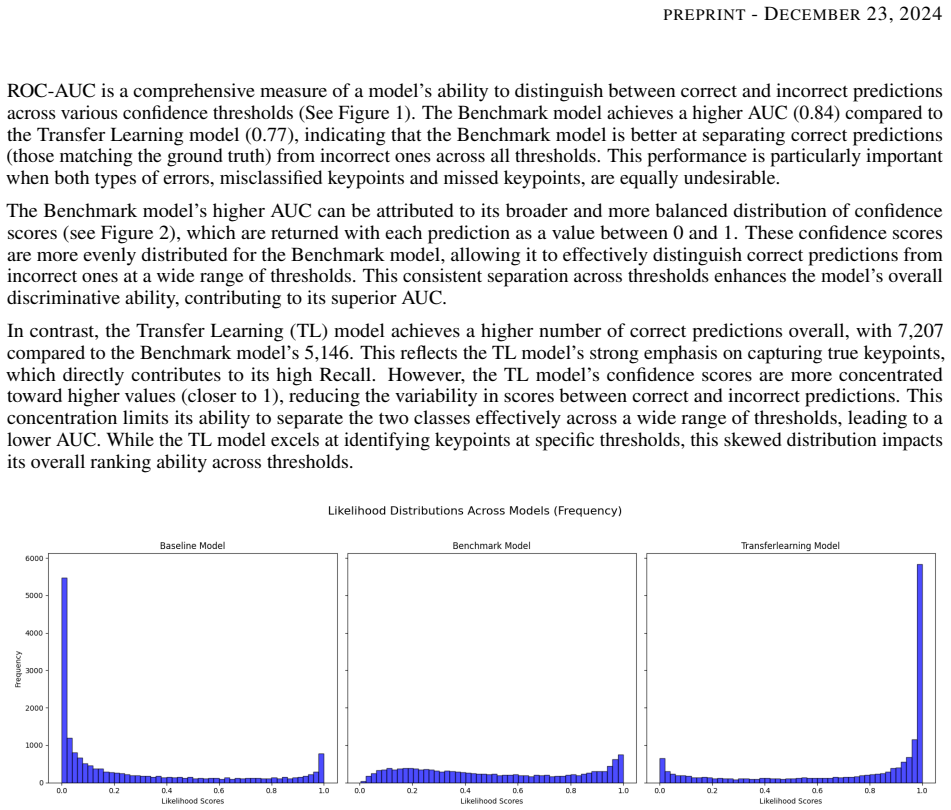
- [Table 1 and Section 3.1] The transfer model has lower AUC (0.77) than the benchmark (0.84). Since AUC is threshold-free, the central claim of 'improved human pose estimation' is only supported at a specific operating point (the maximum-F-score threshold), not across thresholds. The authors should temper the abstract and title or justify why the chosen operating point is the appropriate one for the intended clinical application.
minor comments (6)
- [Section 2.1] The word 'macacque' appears to be a typo and should be 'macaque'.
- [Section 2.3] The phrase 'the same 1000 images that were used for the benchmark' is ambiguous; the authors should explicitly specify which images were used for training, validation, and test, and whether the benchmark was evaluated on the same images.
- [Section 2.3] Training for 164,000 iterations with a batch size of 8 on about 950 training images implies many epochs; the paper should report the number of epochs and the exact stopping criterion for when the loss began to plateau.
- [Figures] Figure 1 and Figure 2 are referenced in the text but not included in the manuscript text provided; ensure they are legible, captioned, and placed near the relevant sections.
- [General] No code or data availability statement is provided; for reproducibility, the authors should release the fine-tuning code, configuration files, and the train/validation/test split.
- [Section 4] The Gestalt-theory discussion is speculative and not directly supported by the experiments; consider framing it as a hypothesis for future work rather than an explanation of the results.
Circularity Check
No circularity: the transfer-learning comparison is an empirical result supported by an external benchmark and external pretrained models, not a derivation that reduces to its inputs.
full rationale
The paper's central claim is empirical: fine-tuning a macaque-pose network on human images yields better precision, recall, and RMSE than a human-only benchmark on MPII single-person images. No equation, theorem, or formal derivation is involved, so none of the definitional circularity patterns apply. The pretrained macaque model originates from the external MacaquePose work [16], and the benchmark is the external DeepLabCut/ResNet-101 DeeperCut implementation [17], so there is no self-citation chain carrying the argument. The only potentially circular-looking passage is Section 2.3, which states the transfer model was trained on 1000 randomly selected single-person images and then evaluated on 'the same 1000 images that were used for the benchmark.' If the training set and evaluation set were literally identical, the reported metrics would be contaminated; however, the text does not explicitly equate the fine-tuning set with the evaluation set—'the same 1000 images that were used for the benchmark' plausibly refers to a benchmark evaluation subset rather than the transfer model's training subset. Because the paper does not exhibit the required reduction (training set = test set by construction), this is an experimental validity concern, not a demonstrated circularity under the rubric. No fitted parameter is renamed as a prediction, no uniqueness theorem is imported from the authors' prior work, and no ansatz is smuggled in via citation. The comparison's fairness and the disjointness of training and test images are legitimate external-benchmarking risks, but they do not make the derivation circular.
Assumptions & free parameters
free parameters (1)
- Evaluation threshold at maximum F-score =
per-model threshold, not reported
assumptions (3)
- domain assumption A macaque-pretrained pose network provides a useful initialization for human pose estimation.
- domain assumption The benchmark DeeperCut model trained on MPII represents a fair human-only comparison.
- domain assumption Precision, recall, and F1 at PCKh@0.5 are the appropriate measures of clinical utility.
Cite this review
Pith. "Pith review of Monkey Transfer Learning Can Improve Human Pose Estimation." pith.science (2026). https://pith.science/paper/KMITPZ5B
@misc{pith2026241215966,
  author       = {Pith},
  title        = {Pith review of: Monkey Transfer Learning Can Improve Human Pose Estimation},
  year         = {2026},
  howpublished = {\url{https://pith.science/paper/KMITPZ5B}},
  note         = {Machine review of arXiv:2412.15966}
}
read the original abstract
In this study, we investigated whether transfer learning from macaque monkeys could improve human pose estimation. Current state-of-the-art pose estimation techniques, often employing deep neural networks, can match human annotation in non-clinical datasets. However, they underperform in novel situations, limiting their generalisability to clinical populations with pathological movement patterns. Clinical datasets are not widely available for AI training due to ethical challenges and a lack of data collection. We observe that data from other species may be able to bridge this gap by exposing the network to a broader range of motion cues. We found that utilising data from other species and undertaking transfer learning improved human pose estimation in terms of precision and recall compared to the benchmark, which was trained on humans only. Compared to the benchmark, fewer human training examples were needed for the transfer learning approach (1,000 vs 19,185). These results suggest that macaque pose estimation can improve human pose estimation in clinical situations. Future work should further explore the utility of pose estimation trained with monkey data in clinical populations.
Figures

Reference graph
Works this paper leans on
-
[1]
Deep Learning-based Human Pose Estimation: A Survey
Ce Zheng, Wenhan Wu, Chen Chen, Taojiannan Yang, Sijie Zhu, Ju Shen, Nasser Kehtarnavaz, and Mubarak Shah. Deep Learning-based Human Pose Estimation: A Survey. ACM Comput. Surv., 56(1):11:1–11:37, August 2023
work page 2023
-
[2]
A review of 3D human pose estimation algorithms for markerless motion capture
Yann Desmarais, Denis Mottet, Pierre Slangen, and Philippe Montesinos. A review of 3D human pose estimation algorithms for markerless motion capture. Computer Vision and Image Understanding, 212:103275, November 2021
work page 2021
- [3]
-
[4]
2D Human Pose Estimation: New Benchmark and State of the Art Analysis
Mykhaylo Andriluka, Leonid Pishchulin, Peter Gehler, and Bernt Schiele. 2D Human Pose Estimation: New Benchmark and State of the Art Analysis. In 2014 IEEE Conference on Computer Vision and Pattern Recognition , pages 3686–3693, June 2014. ISSN: 1063-6919
work page 2014
-
[5]
Space-Time Representation of People Based on 3D Skeletal Data: A Review
Fei Han, Brian Reily, William Hoff, and Hao Zhang. Space-Time Representation of People Based on 3D Skeletal Data: A Review, February 2017. arXiv:1601.01006
work page Pith review arXiv 2017
-
[6]
Dolgoy, Stéphanie Bernard, Kerry Bayless, Robert Hirsche, Liz Dennett, and Puneeta Tandon
Matthew Pardell, Naomi D. Dolgoy, Stéphanie Bernard, Kerry Bayless, Robert Hirsche, Liz Dennett, and Puneeta Tandon. Movement Outcomes Acquired via Markerless Motion Capture Systems Compared with Marker-Based 6 PREPRINT - D ECEMBER 23, 2024 Systems for Adult Patient Populations: A Scoping Review. Biomechanics, 4(4):618–632, December 2024. Number: 4 Publis...
work page 2024
-
[7]
Accuracy of the Microsoft Kinect sensor for measuring movement in people with Parkinson’s disease
Brook Galna, Gillian Barry, Dan Jackson, Dadirayi Mhiripiri, Patrick Olivier, and Lynn Rochester. Accuracy of the Microsoft Kinect sensor for measuring movement in people with Parkinson’s disease. Gait & Posture, 39(4):1062–1068, April 2014
work page 2014
-
[8]
Brian Horsak, Anna Eichmann, Kerstin Lauer, Kerstin Prock, Philipp Krondorfer, Tarique Siragy, and Bernhard Dumphart. Concurrent validity of smartphone-based markerless motion capturing to quantify lower-limb joint kinematics in healthy and pathological gait. Journal of Biomechanics, 159:111801, October 2023
work page 2023
Show all 20 references
-
[9]
An international survey mapping practice and barriers for upper-limb assessments in movement analysis
Fraser Philp, Robert Freeman, and Caroline Stewart. An international survey mapping practice and barriers for upper-limb assessments in movement analysis. Gait & Posture, 96:93–101, July 2022
2022
-
[10]
Transfer Learning
Qiang Yang, Yu Zhang, Wenyuan Dai, and Sinno Jialin Pan. Transfer Learning. Cambridge University Press, Cambridge, 2020
2020
-
[11]
ImageNet: A large-scale hierarchical image database
Jia Deng, Wei Dong, Richard Socher, Li-Jia Li, Kai Li, and Li Fei-Fei. ImageNet: A large-scale hierarchical image database. In 2009 IEEE Conference on Computer Vision and Pattern Recognition , pages 248–255, June
2009
-
[12]
Minyoung Huh, Pulkit Agrawal, and Alexei A. Efros. What makes ImageNet good for transfer learning?, December 2016. arXiv:1608.08614 [cs]
2016 arXiv
-
[13]
A novel dataset and deep learning-based approach for marker-less motion capture during gait
Saman Vafadar, Wafa Skalli, Aurore Bonnet-Lebrun, Marc Khalifé, Mathis Renaudin, Amine Hamza, and Laurent Gajny. A novel dataset and deep learning-based approach for marker-less motion capture during gait. Gait & Posture, 86:70–76, May 2021
2021
-
[14]
SuperAnimal pretrained pose estimation models for behavioral analysis
Shaokai Ye, Anastasiia Filippova, Jessy Lauer, Steffen Schneider, Maxime Vidal, Tian Qiu, Alexander Mathis, and Mackenzie Weygandt Mathis. SuperAnimal pretrained pose estimation models for behavioral analysis. Nature Communications, 15(1):5165, June 2024. Publisher: Nature Pub...
2024
-
[15]
Panoptic Segmentation, April
Alexander Kirillov, Kaiming He, Ross Girshick, Carsten Rother, and Piotr Dollár. Panoptic Segmentation, April
-
[16]
In the Wild
Rollyn Labuguen, Jumpei Matsumoto, Salvador Blanco Negrete, Hiroshi Nishimaru, Hisao Nishijo, Masahiko Takada, Yasuhiro Go, Ken-ichi Inoue, and Tomohiro Shibata. MacaquePose: A Novel “In the Wild” Macaque Monkey Pose Dataset for Markerless Motion Capture. Frontiers in Behavior...
2021
-
[17]
DeeperCut: A Deeper, Stronger, and Faster Multi-Person Pose Estimation Model, May 2016
Eldar Insafutdinov, Leonid Pishchulin, Bjoern Andres, Mykhaylo Andriluka, and Bernt Schiele. DeeperCut: A Deeper, Stronger, and Faster Multi-Person Pose Estimation Model, May 2016
2016
-
[18]
Investigating the Gestalt Principle of Closure in Deep Convolutional Neural Networks, November 2024
Yuyan Zhang, Derya Soydaner, Fatemeh Behrad, Lisa Koßmann, and Johan Wagemans. Investigating the Gestalt Principle of Closure in Deep Convolutional Neural Networks, November 2024. arXiv:2411.00627
2024 arXiv
-
[19]
Been Kim, Emily Reif, Martin Wattenberg, Samy Bengio, and Michael C. Mozer. Neural Networks Trained on Natural Scenes Exhibit Gestalt Closure. Computational Brain & Behavior , 4(3):251–263, September 2021
2021
-
[20]
Understanding Deep Convolutional Networks through Gestalt Theory, October 2018
Angelos Amanatiadis, Vasileios Kaburlasos, and Elias Kosmatopoulos. Understanding Deep Convolutional Networks through Gestalt Theory, October 2018. arXiv:1810.08697. 7
2018 arXiv
Reviewed August 11, 2026 · model on record in the stance chip above.
Discussion (0). Continue with ORCID to comment.