REVIEW 1 major objections 5 minor 55 references
CoCoGaussian: Leveraging Circle of Confusion for Gaussian Splatting from Defocused Images
T0 review · 1 major / 5 minor · reviewed 2026-08-11 · deepseek-v4-flash
Pith's one-line read CoCoGaussian reconstructs sharp 3D scenes from defocused images by modeling each Gaussian's blur as a circle of confusion whose diameter comes from depth and a learned aperture scalar.
desk verdict Solid engineering that transfers DoF-NeRF's circle-of-confusion model into 3DGS with a useful adaptive scaling; the physical depth model is approximate, but the paper is honest about it and the results are strong. read the letter →
The pith
A machine-rendered reading of the paper's core claim, the machinery that carries it, and where it could break.
The reading
What carries the argument
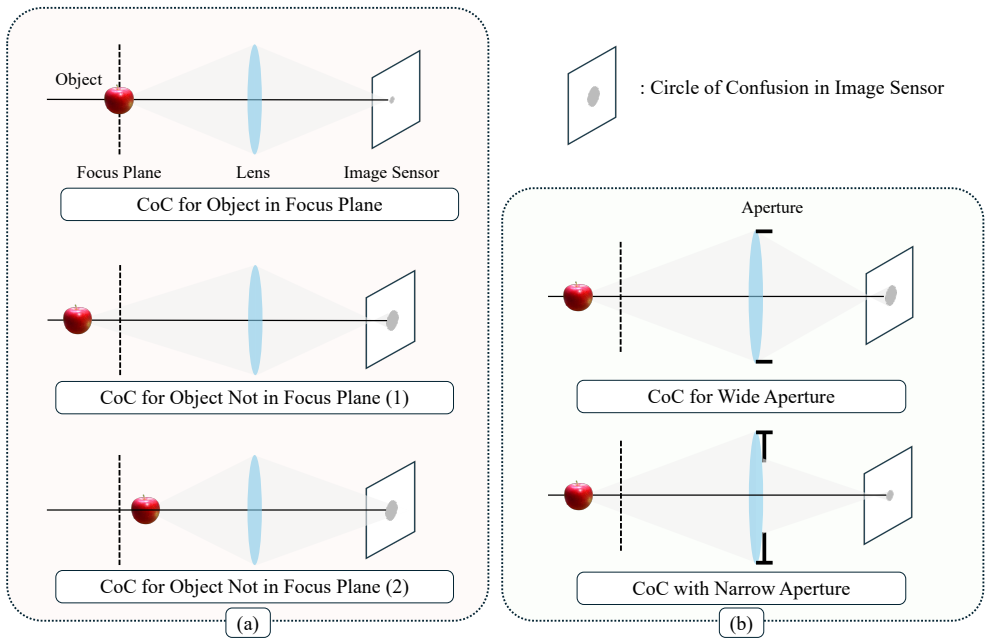
The central machinery is the generation of CoC Gaussian sets: a small MLP $h_\theta$ maps the camera position and base Gaussian parameters to the aperture scalar $K$, M direction vectors $d_m$, M scaling factors $\beta_m \in (0,1]$, and scale/quaternion deltas. The load-bearing identity is $\sigma(\mu_B) \approx K |1/d(\mu_B) - 1/d_F|$, which ties each Gaussian's depth to the diameter of its blur disk, and the offset rule $\mu_{\text{CoC};m} = \mu_B + (\sigma(\mu_B)/2)\,\beta_m d_m$, which places the spawned Gaussians inside that disk. This is what lets the model render defocus during training and simply omit it at inference.
What would settle it
Render a synthetic scene containing a planar target tilted about 45 degrees to the optical axis with a known thin-lens aperture, train CoCoGaussian on the resulting defocused views, and compare the recovered CoC diameters of off-axis Gaussians with the ground-truth lens equation: a systematic mismatch that grows with radial distance would confirm that the Euclidean-depth proxy, rather than the learned parameters, is driving the error.
Extended reading notes
Core claim
The central claim is that a defocused image can be decomposed into a sharp base set of 3D Gaussians plus M sets of circle-of-confusion Gaussians whose placement is dictated by photographic defocus geometry rather than by free-form kernel learning. For each base Gaussian with mean $\mu_B$, the CoC diameter is approximated as $\sigma(\mu_B) \approx K |1/d(\mu_B) - 1/d_F|$, where $d(\mu_B)$ is the camera-to-Gaussian depth, $d_F$ is a learnable focus-plane distance per image, and $K = f \times D$ is a learnable aperture scalar. Each CoC Gaussian mean is an offset $\mu_{\text{CoC}} = \mu_B + (\sigma(\mu_B)/2)\,\beta_m d_m$ with learned direction vectors and scaling factors, and the final defocused image is a softmax-weighted sum of images rendered from the base and CoC Gaussians. At inference the CoC Gaussians are set aside, so sharp novel views, aperture control, and focus-plane control all emerge from a model trained only on defocused images.
Load-bearing premise
The straight-line distance from the camera center to each Gaussian center is treated as the optical depth that sets the circle of confusion, so scene points away from the optical axis get blur sizes from a proxy that can be systematically wrong, and a single learned aperture scalar cannot correct that off-axis bias.
Editorial extensions
If this is right
- Rendering with only the base Gaussian set yields sharp images, turning the method into a render-time deblurring tool.
- Changing $K$ at inference produces shallower or deeper depth of field, and changing $d_F$ refocuses the image, without retraining.
- Because the CoC formula also describes sub-pixel blur, the model works on all-in-focus images and reports higher quality than plain 3DGS on the NeRF-LLFF benchmark.
- On the Deblur-NeRF synthetic and real datasets and the DoF-NeRF real dataset, the paper reports higher quantitative scores than the compared ray-tracing and rasterization baselines.
Reading between the lines
- The depth used in the CoC formula is Euclidean distance from the camera center to the Gaussian mean, which overestimates true optical depth for off-axis points; replacing it with ray-Gaussian intersection depth would be a direct testable extension.
- Because $\beta_m$ is bounded above by 1, the adaptive mechanism can shrink an overestimated CoC but cannot grow an underestimated one, so a two-sided scaling or a depth regularizer is a natural next step.
- The learned per-image focus plane suggests a post-hoc focal-stack application: refocused renders could be validated against images actually captured at different focus distances.
- The same CoC-Gaussian spawning strategy could be combined with motion-blur kernels to handle scenes with both defocus and camera shake.
Signed reviews
Editorial analysis
A structured set of objections, weighed in public.
Referee Report
Summary. The paper proposes CoCoGaussian, a 3D Gaussian Splatting method that reconstructs a sharp 3D scene from multi-view defocused images. For each base Gaussian, a Circle of Confusion (CoC) diameter is computed from the Euclidean distance between the camera center and the Gaussian mean, a learned aperture scalar K, and a per-image learned focus distance dF (Eq. 7). The method generates M additional 'CoC Gaussian' sets by offsetting the base Gaussian means along learned unit directions, with offsets scaled by the CoC diameter and learnable factors beta_m in (0,1] (Eq. 9). The base and CoC Gaussians are rasterized into M+1 images, which are combined by a CNN-computed pixel-wise weighted sum. At inference, rendering only the base Gaussians is claimed to produce sharp novel views, and K and dF can be adjusted for depth-of-field and focus-plane customization. Experiments on Deblur-NeRF synthetic and real datasets, DoF-NeRF real dataset, and NeRF-LLFF show state-of-the-art or competitive metrics, with ablations demonstrating the contribution of each component.
Significance. If the claims hold, CoCoGaussian is a practically valuable contribution: it extends 3DGS to defocused inputs while retaining real-time rendering, and it provides an interpretable, physically motivated mechanism for depth-of-field control. The paper is strong in its breadth of comparisons, reproduction of baseline codes, and explicit ablations of each proposed module. The central idea of generating CoC-shaped Gaussian copies from a per-Gaussian depth and a learned aperture is novel in the 3DGS literature and outperforms previous blur-agnostic Gaussian methods. The main risk is that the physical depth used in the CoC formula is not the axial depth required by the thin-lens model, which weakens the claim that the blur is 'accurately' modeled by the physical CoC; the empirical gains may partly come from the learned adaptive components rather than the physics.
major comments (1)
- [Sec. 4.2, Eq. (7); Sec. 4.3, Eq. (9); Sec. 6] The depth d(µ_B) in Eq. (7) is the Euclidean distance between the camera center x_cam and the Gaussian mean µ_B. In the thin-lens model underlying Eq. (6), the relevant object distance is the axial distance along the optical axis, not the radial distance. For a point at angular offset θ from the optical axis, radial distance overestimates axial distance by a factor of 1/cos θ, causing the CoC diameter to be systematically overestimated for points behind the focus surface and underestimated for points in front of it. Because the scaling factors β_m are constrained to (0,1] in Eq. (9), the model can shrink overestimated CoCs but cannot enlarge underestimated ones; the limitation discussion in Sec. 6 acknowledges only the over-estimation case. The learned direction vectors and CNN weights could in principle compensate, but then the sharp base-Gaussian output is produced by learned corrections rather than by the physical CoC model. Please either replace d(µ_B) with the axial depth in the camera coordinate frame, or provide a quantitative analysis of the angular bias on the tested datasets showing it is negligible.
minor comments (5)
- [Sec. 1] There is a typo in the sentence 'reduce dependence on estmiated depth'; 'estmiated' should be 'estimated'.
- [Sec. 4.3] The text says 'However, theses offsets ∆µCoC presents two potential issues'; 'theses' should be 'these' and the verb should agree.
- [Appendix Sec. 12] The sentence 'as demonstrated in Tab. 5 of the main paper' refers to the NeRF-LLFF results, which are in Table 4 of the main paper; the table number is incorrect.
- [Appendix Table 9] The reference numbers in the table header are inconsistent with the main text: 'DP-NeRF [18]' should be [11], 'Deblurring 3D-GS [25]' should be [10], and 'BAGS [11]' should be [26].
- [Appendix Sec. 10] In the sentence 'the C ISCO and C ORAL scenes have higher luminance', the scene names are broken by spaces; this appears to be a formatting artifact.
Circularity Check
No significant circularity: CoCoGaussian fits a structured CoC forward model to defocused views and validates sharp rendering against external all-in-focus ground truth.
full rationale
The derivation chain is not circular. Eq. (7) is the standard thin-lens CoC approximation, cited to Hecht and to DoF-NeRF, and while K, dF, beta, direction vectors, and CNN weights are learned from defocused training images, they are parameters of a forward blur model fitted by the reconstruction objective, not predictions derived from the target quantity. The sharp output is obtained by rendering only the base Gaussians (Appendix 13: 'CoCoGaussian renders sharp images using only the GB') and is evaluated on external all-in-focus ground truth from the DoF-NeRF and Deblur-NeRF benchmarks, so the sharp-view result is not a renamed training loss or a re-statement of the input. The self-citations (e.g., [10], [12], [26]) are implementation borrowings, such as weighted-sum blending and Gaussian perturbation, and are not load-bearing for the central reconstruction claim. The Euclidean-depth proxy and the one-sided beta limitation acknowledged in Sec. 6 are physical/correctness risks rather than circular reductions; nothing in the paper equates the CoC diameter to the fitted blur by definition or imports a conclusion solely from an author-overlapping citation.
Assumptions & free parameters
free parameters (6)
- K (aperture parameter f times D) =
learned, value not reported
- dF (focus plane distance) =
learned per input image, initialized from SfM average depth
- beta_m (CoC scaling factors) =
learned in (0, 1]
- d_m (CoC direction unit vectors) =
learned via h_theta, M by N by 3
- delta_s and delta_q (CoC covariance adjustments) =
learned in [1, 1.1]
- M (number of CoC Gaussian sets) =
5
assumptions (4)
- domain assumption The circle of confusion diameter follows Eq. 6 from Hecht with a single aperture scalar K, ignoring lens aberrations.
- ad hoc to paper For each base Gaussian, the depth relevant to defocus is the Euclidean distance between camera center x_cam and Gaussian mean mu_B.
- ad hoc to paper Defocus blur can be represented by M discrete 3D Gaussian copies plus a CNN-weighted sum of rasterized images.
- ad hoc to paper After training, rendering only the base Gaussians gives the sharp scene.
invented entities (1)
-
CoC Gaussians (G_CoC)
Cite this review
Pith. "Pith review of CoCoGaussian: Leveraging Circle of Confusion for Gaussian Splatting from Defocused Images." pith.science (2026). https://pith.science/paper/GLUQRQE3
@misc{pith2026241216028,
  author       = {Pith},
  title        = {Pith review of: CoCoGaussian: Leveraging Circle of Confusion for Gaussian Splatting from Defocused Images},
  year         = {2026},
  howpublished = {\url{https://pith.science/paper/GLUQRQE3}},
  note         = {Machine review of arXiv:2412.16028}
}
read the original abstract
3D Gaussian Splatting (3DGS) has attracted significant attention for its high-quality novel view rendering, inspiring research to address real-world challenges. While conventional methods depend on sharp images for accurate scene reconstruction, real-world scenarios are often affected by defocus blur due to finite depth of field, making it essential to account for realistic 3D scene representation. In this study, we propose CoCoGaussian, a Circle of Confusion-aware Gaussian Splatting that enables precise 3D scene representation using only defocused images. CoCoGaussian addresses the challenge of defocus blur by modeling the Circle of Confusion (CoC) through a physically grounded approach based on the principles of photographic defocus. Exploiting 3D Gaussians, we compute the CoC diameter from depth and learnable aperture information, generating multiple Gaussians to precisely capture the CoC shape. Furthermore, we introduce a learnable scaling factor to enhance robustness and provide more flexibility in handling unreliable depth in scenes with reflective or refractive surfaces. Experiments on both synthetic and real-world datasets demonstrate that CoCoGaussian achieves state-of-the-art performance across multiple benchmarks.
Figures


Figures from the paper (6 more)



Reference graph
Works this paper leans on
-
[1]
Mip-nerf: A multiscale representation for anti-aliasing neu- ral radiance fields
Jonathan T Barron, Ben Mildenhall, Matthew Tancik, Peter Hedman, Ricardo Martin-Brualla, and Pratul P Srinivasan. Mip-nerf: A multiscale representation for anti-aliasing neu- ral radiance fields. In Proceedings of the IEEE/CVF Inter- national Conference on Computer Vision, pages 5855–5864,
-
[2]
A neural approach to blind motion deblur- ring
Ayan Chakrabarti. A neural approach to blind motion deblur- ring. In Computer Vision–ECCV 2016: 14th European Con- ference, Amsterdam, The Netherlands, October 11-14, 2016, Proceedings, Part III 14, pages 221–235. Springer, 2016. 2, 3
work page 2016
-
[3]
Tensorf: Tensorial radiance fields
Anpei Chen, Zexiang Xu, Andreas Geiger, Jingyi Yu, and Hao Su. Tensorf: Tensorial radiance fields. In European Conference on Computer Vision , pages 333–350. Springer,
-
[4]
Deblur-gs: 3d gaussian splat- ting from camera motion blurred images
Wenbo Chen and Ligang Liu. Deblur-gs: 3d gaussian splat- ting from camera motion blurred images. Proceedings of the ACM on Computer Graphics and Interactive Techniques , 7 (1):1–15, 2024. 3
work page 2024
-
[5]
Blender - a 3D modelling and rendering package
Blender Online Community. Blender - a 3D modelling and rendering package. Blender Foundation, Stichting Blender Foundation, Amsterdam, 2018. 6
work page 2018
-
[6]
Plenoxels: Radiance fields without neural networks
Sara Fridovich-Keil, Alex Yu, Matthew Tancik, Qinhong Chen, Benjamin Recht, and Angjoo Kanazawa. Plenoxels: Radiance fields without neural networks. In Proceedings of the IEEE/CVF Conference on Computer Vision and Pattern Recognition, pages 5501–5510, 2022. 2
work page 2022
-
[7]
Eugene Hecht. Optics. Pearson Education India, 2012. 2, 4
work page 2012
-
[8]
Neuman: Neural human radiance field from a single video
Wei Jiang, Kwang Moo Yi, Golnoosh Samei, Oncel Tuzel, and Anurag Ranjan. Neuman: Neural human radiance field from a single video. In European Conference on Computer Vision, pages 402–418. Springer, 2022. 3
work page 2022
Show all 55 references
-
[9]
3d gaussian splatting for real-time radiance field rendering
Bernhard Kerbl, Georgios Kopanas, Thomas Leimk ¨uhler, and George Drettakis. 3d gaussian splatting for real-time radiance field rendering. ACM Transactions on Graphics, 42 (4):1–14, 2023. 2, 3, 6, 8, 11, 13, 14, 17
2023
-
[10]
Deblurring 3d gaussian splatting
Byeonghyeon Lee, Howoong Lee, Xiangyu Sun, Usman Ali, and Eunbyung Park. Deblurring 3d gaussian splatting. arXiv preprint arXiv:2401.00834, 2024. 2, 3, 4, 5, 6, 11, 17
2024 arXiv
-
[11]
Dp-nerf: Deblurred neural radiance field with physical scene priors
Dogyoon Lee, Minhyeok Lee, Chajin Shin, and Sangyoun Lee. Dp-nerf: Deblurred neural radiance field with physical scene priors. In Proceedings of the IEEE/CVF Conference on Computer Vision and Pattern Recognition, pages 12386– 12396, 2023. 3, 6, 17
2023
-
[12]
Crim-gs: Continuous rigid motion-aware gaussian splatting from motion blur images
Junghe Lee, Donghyeong Kim, Dogyoon Lee, Suhwan Cho, and Sangyoun Lee. Crim-gs: Continuous rigid motion-aware gaussian splatting from motion blur images. arXiv preprint arXiv:2407.03923, 2024. 4, 5
2024 arXiv
-
[13]
Smurf: Continuous dynam- ics for motion-deblurring radiance fields
Jungho Lee, Dogyoon Lee, Minhyeok Lee, Donghyung Kim, and Sangyoun Lee. Smurf: Continuous dynam- ics for motion-deblurring radiance fields. arXiv preprint arXiv:2403.07547, 2024. 2, 3
2024 arXiv
-
[14]
Neural 3d video synthesis from multi-view video
Tianye Li, Mira Slavcheva, Michael Zollhoefer, Simon Green, Christoph Lassner, Changil Kim, Tanner Schmidt, Steven Lovegrove, Michael Goesele, Richard Newcombe, et al. Neural 3d video synthesis from multi-view video. In Proceedings of the IEEE/CVF Conference on Computer Vi- si...
2022
-
[15]
Neural scene flow fields for space-time view synthesis of dy- namic scenes
Zhengqi Li, Simon Niklaus, Noah Snavely, and Oliver Wang. Neural scene flow fields for space-time view synthesis of dy- namic scenes. In Proceedings of the IEEE/CVF Conference on Computer Vision and Pattern Recognition , pages 6498– 6508, 2021. 3
2021
-
[16]
Neuralangelo: High-fidelity neural surface reconstruction
Zhaoshuo Li, Thomas M ¨uller, Alex Evans, Russell H Tay- lor, Mathias Unberath, Ming-Yu Liu, and Chen-Hsuan Lin. Neuralangelo: High-fidelity neural surface reconstruction. In Proceedings of the IEEE/CVF Conference on Computer Vi- sion and Pattern Recognition, pages 8456–8465, 2023. 3
2023
-
[17]
Modern robotics
Kevin M Lynch and Frank C Park. Modern robotics. Cam- bridge University Press, 2017. 3
2017
-
[18]
Deblur-nerf: Neural radiance fields from blurry images
Li Ma, Xiaoyu Li, Jing Liao, Qi Zhang, Xuan Wang, Jue Wang, and Pedro V Sander. Deblur-nerf: Neural radiance fields from blurry images. In Proceedings of the IEEE/CVF Conference on Computer Vision and Pattern Recognition , pages 12861–12870, 2022. 2, 3, 5, 6, 11, 13, 17
2022
-
[19]
Local light field fusion: Practical view syn- thesis with prescriptive sampling guidelines
Ben Mildenhall, Pratul P Srinivasan, Rodrigo Ortiz-Cayon, Nima Khademi Kalantari, Ravi Ramamoorthi, Ren Ng, and Abhishek Kar. Local light field fusion: Practical view syn- thesis with prescriptive sampling guidelines. ACM Transac- tions on Graphics (ToG), 38(4):1–14, 2019. 7, 8
2019
-
[20]
Nerf: Representing scenes as neural radiance fields for view syn- thesis
Ben Mildenhall, Pratul P Srinivasan, Matthew Tancik, Jonathan T Barron, Ravi Ramamoorthi, and Ren Ng. Nerf: Representing scenes as neural radiance fields for view syn- thesis. In Computer Vision–ECCV 2020: 16th European Conference, Glasgow, UK, August 23–28, 2020, Proceed- ing...
2020
-
[21]
Instant neural graphics primitives with a mul- tiresolution hash encoding
Thomas M ¨uller, Alex Evans, Christoph Schied, and Alexan- der Keller. Instant neural graphics primitives with a mul- tiresolution hash encoding. ACM Transactions on Graphics (ToG), 41(4):1–15, 2022. 2
2022
-
[22]
Reg- nerf: Regularizing neural radiance fields for view synthesis from sparse inputs
Michael Niemeyer, Jonathan T Barron, Ben Mildenhall, Mehdi SM Sajjadi, Andreas Geiger, and Noha Radwan. Reg- nerf: Regularizing neural radiance fields for view synthesis from sparse inputs. In Proceedings of the IEEE/CVF Con- ference on Computer Vision and Pattern Recognition,...
2022
-
[23]
Nerfies: Deformable neural radiance fields
Keunhong Park, Utkarsh Sinha, Jonathan T Barron, Sofien Bouaziz, Dan B Goldman, Steven M Seitz, and Ricardo Martin-Brualla. Nerfies: Deformable neural radiance fields. In Proceedings of the IEEE/CVF International Conference on Computer Vision, pages 5865–5874, 2021. 3
2021
-
[24]
Hypernerf: A higher- dimensional representation for topologically varying neural radiance fields
Keunhong Park, Utkarsh Sinha, Peter Hedman, Jonathan T Barron, Sofien Bouaziz, Dan B Goldman, Ricardo Martin- Brualla, and Steven M Seitz. Hypernerf: A higher- dimensional representation for topologically varying neural radiance fields. arXiv preprint arXiv:2106.13228, 2021. 3 9
2021 arXiv
-
[25]
Pdrf: progressively de- blurring radiance field for fast scene reconstruction from blurry images
Cheng Peng and Rama Chellappa. Pdrf: progressively de- blurring radiance field for fast scene reconstruction from blurry images. In Proceedings of the AAAI Conference on Artificial Intelligence, pages 2029–2037, 2023. 2, 3, 6, 17
2023
-
[26]
Bags: Blur agnos- tic gaussian splatting through multi-scale kernel modeling
Cheng Peng, Yutao Tang, Yifan Zhou, Nengyu Wang, Xijun Liu, Deming Li, and Rama Chellappa. Bags: Blur agnos- tic gaussian splatting through multi-scale kernel modeling. arXiv preprint arXiv:2403.04926, 2024. 2, 3, 4, 5, 6, 14, 17
2024 arXiv
-
[27]
Ani- matable neural radiance fields for modeling dynamic human bodies
Sida Peng, Junting Dong, Qianqian Wang, Shangzhan Zhang, Qing Shuai, Xiaowei Zhou, and Hujun Bao. Ani- matable neural radiance fields for modeling dynamic human bodies. In Proceedings of the IEEE/CVF International Con- ference on Computer Vision, pages 14314–14323, 2021. 3
2021
-
[28]
D-nerf: Neural radiance fields for dynamic scenes
Albert Pumarola, Enric Corona, Gerard Pons-Moll, and Francesc Moreno-Noguer. D-nerf: Neural radiance fields for dynamic scenes. In Proceedings of the IEEE/CVF Con- ference on Computer Vision and Pattern Recognition, pages 10318–10327, 2021. 3
2021
-
[29]
Pixelwise view selection for unstructured multi-view stereo
Johannes L Sch ¨onberger, Enliang Zheng, Jan-Michael Frahm, and Marc Pollefeys. Pixelwise view selection for unstructured multi-view stereo. In European conference on computer vision, pages 501–518. Springer, 2016. 3, 6
2016
-
[30]
High-quality mo- tion deblurring from a single image
Qi Shan, Jiaya Jia, and Aseem Agarwala. High-quality mo- tion deblurring from a single image. Acm transactions on graphics (tog), 27(3):1–10, 2008. 3, 6
2008
-
[31]
Light field blind motion deblurring
Pratul P Srinivasan, Ren Ng, and Ravi Ramamoorthi. Light field blind motion deblurring. In Proceedings of the IEEE Conference on Computer Vision and Pattern Recognition , pages 3958–3966, 2017. 2, 3
2017
-
[32]
Neuralrecon: Real-time coherent 3d reconstruc- tion from monocular video
Jiaming Sun, Yiming Xie, Linghao Chen, Xiaowei Zhou, and Hujun Bao. Neuralrecon: Real-time coherent 3d reconstruc- tion from monocular video. InProceedings of the IEEE/CVF Conference on Computer Vision and Pattern Recognition , pages 15598–15607, 2021. 3
2021
-
[33]
Non- rigid neural radiance fields: Reconstruction and novel view synthesis of a dynamic scene from monocular video
Edgar Tretschk, Ayush Tewari, Vladislav Golyanik, Michael Zollh¨ofer, Christoph Lassner, and Christian Theobalt. Non- rigid neural radiance fields: Reconstruction and novel view synthesis of a dynamic scene from monocular video. In Proceedings of the IEEE/CVF International Con...
2021
-
[34]
Sparsenerf: Distilling depth ranking for few-shot novel view synthesis
Guangcong Wang, Zhaoxi Chen, Chen Change Loy, and Zi- wei Liu. Sparsenerf: Distilling depth ranking for few-shot novel view synthesis. InProceedings of the IEEE/CVF Inter- national Conference on Computer Vision, pages 9065–9076,
-
[35]
Neuris: Neural reconstruction of indoor scenes using normal priors
Jiepeng Wang, Peng Wang, Xiaoxiao Long, Christian Theobalt, Taku Komura, Lingjie Liu, and Wenping Wang. Neuris: Neural reconstruction of indoor scenes using normal priors. In European Conference on Computer Vision, pages 139–155. Springer, 2022. 3
2022
-
[36]
Neus: Learning neural implicit surfaces by volume rendering for multi-view reconstruction
Peng Wang, Lingjie Liu, Yuan Liu, Christian Theobalt, Taku Komura, and Wenping Wang. Neus: Learning neural implicit surfaces by volume rendering for multi-view reconstruction. arXiv preprint arXiv:2106.10689, 2021. 3
2021 arXiv
-
[37]
Bad-nerf: Bundle adjusted deblur neural radiance fields
Peng Wang, Lingzhe Zhao, Ruijie Ma, and Peidong Liu. Bad-nerf: Bundle adjusted deblur neural radiance fields. In Proceedings of the IEEE/CVF Conference on Computer Vi- sion and Pattern Recognition , pages 4170–4179, 2023. 2, 3
2023
-
[38]
Image quality assessment: from error visibility to structural similarity
Zhou Wang, Alan C Bovik, Hamid R Sheikh, and Eero P Si- moncelli. Image quality assessment: from error visibility to structural similarity. IEEE transactions on image processing, 13(4):600–612, 2004. 6
2004
-
[39]
Hu- mannerf: Free-viewpoint rendering of moving people from monocular video
Chung-Yi Weng, Brian Curless, Pratul P Srinivasan, Jonathan T Barron, and Ira Kemelmacher-Shlizerman. Hu- mannerf: Free-viewpoint rendering of moving people from monocular video. In Proceedings of the IEEE/CVF con- ference on computer vision and pattern Recognition , pages 162...
2022
-
[40]
Non-uniform deblurring for shaken images
Oliver Whyte, Josef Sivic, Andrew Zisserman, and Jean Ponce. Non-uniform deblurring for shaken images. Inter- national journal of computer vision , 98:168–186, 2012. 2, 3
2012
-
[41]
Dof-nerf: Depth-of-field meets neural radi- ance fields
Zijin Wu, Xingyi Li, Juewen Peng, Hao Lu, Zhiguo Cao, and Weicai Zhong. Dof-nerf: Depth-of-field meets neural radi- ance fields. In Proceedings of the 30th ACM International Conference on Multimedia, pages 1718–1729, 2022. 2, 3, 5, 6, 11, 13, 17
2022
-
[42]
Diffusionerf: Regularizing neural radiance fields with denoising diffu- sion models
Jamie Wynn and Daniyar Turmukhambetov. Diffusionerf: Regularizing neural radiance fields with denoising diffu- sion models. In Proceedings of the IEEE/CVF Conference on Computer Vision and Pattern Recognition , pages 4180– 4189, 2023. 3
2023
-
[43]
Freenerf: Im- proving few-shot neural rendering with free frequency reg- ularization
Jiawei Yang, Marco Pavone, and Yue Wang. Freenerf: Im- proving few-shot neural rendering with free frequency reg- ularization. In Proceedings of the IEEE/CVF Conference on Computer Vision and Pattern Recognition , pages 8254– 8263, 2023. 3
2023
-
[44]
Differentiable surface splatting for point-based geometry processing
Wang Yifan, Felice Serena, Shihao Wu, Cengiz ¨Oztireli, and Olga Sorkine-Hornung. Differentiable surface splatting for point-based geometry processing. ACM Transactions on Graphics (TOG), 38(6):1–14, 2019. 3
2019
-
[45]
Mip-splatting: Alias-free 3d gaussian splat- ting
Zehao Yu, Anpei Chen, Binbin Huang, Torsten Sattler, and Andreas Geiger. Mip-splatting: Alias-free 3d gaussian splat- ting. In Proceedings of the IEEE/CVF Conference on Com- puter Vision and Pattern Recognition , pages 19447–19456,
-
[46]
The unreasonable effectiveness of deep features as a perceptual metric
Richard Zhang, Phillip Isola, Alexei A Efros, Eli Shecht- man, and Oliver Wang. The unreasonable effectiveness of deep features as a perceptual metric. In Proceedings of the IEEE conference on computer vision and pattern recogni- tion, pages 586–595, 2018. 6
2018
-
[47]
Bad-gaussians: Bundle adjusted deblur gaussian splatting
Lingzhe Zhao, Peng Wang, and Peidong Liu. Bad-gaussians: Bundle adjusted deblur gaussian splatting. arXiv preprint arXiv:2403.11831, 2024. 3 10 Appendix
2024 arXiv
-
[48]
For coarse geom- etry in the early training stages, hθ is not trained during the first 2k iterations and begins training afterward
Implementation Details CoCoGaussian is built upon 3DGS [9] and Deblurring 3DGS [10], trained with a total of 30k iterations with the number of CoC Gaussians, M, set to 5. For coarse geom- etry in the early training stages, hθ is not trained during the first 2k iterations and b...
-
[49]
acceptable CoC
Circle of Confusion In this section, we explain the principles behind the gener- ation of the Circle of Confusion (CoC) based on the focus plane and aperture size. As shown in Fig. 5 (a), when a subject is precisely located on the focus plane, the radiance emitted from a point...
-
[50]
Deblur-NeRF [18] Real-World Dataset As shown in Tab. 1 of the main paper, not only our method but also other methods on the Deblur-NeRF [18] Real-World dataset exhibit relatively poor PSNR and SSIM scores compared to their LPIPS performance. This discrep- ancy arises from inhe...
-
[51]
The first focuses on qualitative results related to the CoC scaling factor β, and the second evaluates the quantitative results based on the number of CoC Gaussian sets M
Additional Ablation Study In this section, we conduct two ablative experiments. The first focuses on qualitative results related to the CoC scaling factor β, and the second evaluates the quantitative results based on the number of CoC Gaussian sets M. 12 CoC Scaling Factor. As...
-
[52]
8 and Fig
CoC Visualization We visualize the CoC for various types of images in Fig. 8 and Fig. 9. To simplify the visualization, we randomly sam- ple a subset of positions from numerous Gaussians. The points in Fig. 8 represent the positions of Gaussians for de- focused images. For ima...
-
[53]
Computational Efficiency and Speed We compare our GPU usage, training time, and rendering speed with BAGS [26], a state-of-the-art method, on the Deblur-NeRF real-world dataset using an NVIDIA RTX
-
[55]
Per-Scene Quantitative Results We present the performance for individual scenes across all datasets in Tabs. 7 to 9. CoCoGaussian achieves the best LPIPS scores in all scenes except for the C ORAL scene in the Deblur-NeRF Real-World dataset. As discussed in Secs. 10 and 11, th...
1901
-
[3090]
6, CoCoGaussian achieves com- parable resource consumption and training time while deliv- ering superior performance
As shown in the Tab. 6, CoCoGaussian achieves com- parable resource consumption and training time while deliv- ering superior performance. After the training phase, CoCoGaussian renders sharp images using only the GB through a naive 3DGS. In the other words, the rendering spee...
Reviewed August 11, 2026 · model on record in the stance chip above.
Discussion (0). Continue with ORCID to comment.