REVIEW 5 major objections 6 minor 3 cited by
Coevolution of Dwarf Galaxies and Their Circumgalactic Medium Across Cosmic Time
T0 review · 5 major / 6 minor · reviewed 2026-08-11 · deepseek-v4-flash
Pith's one-line read Dwarf galaxies get 20-50% of their star-forming gas from infalling halo gas.
desk verdict Useful new simulation setup and plausible numbers, but the 'across cosmic time' claim rests on a cross-sectional, confounded sample; needs major revision before the quantitative fractions are used. read the letter →
The pith
A machine-rendered reading of the paper's core claim, the machinery that carries it, and where it could break.
The reading
What carries the argument
The machinery is a set of high-resolution hydrodynamical re-simulations: dwarf-galaxy halos of virial mass $2\text{–}5\times10^{10}\,M_\odot$ are cut out of the TNG50-1 cosmological volume at $z=0,1,2$ and evolved for 1.5 Gyr with a particle-splitting scheme that raises mass resolution by a factor of about 100, giving baryon cells of roughly $600\,M_\odot$ and gas resolution of a few parsecs. The physics package includes metal-line cooling, molecule-based star formation in self-gravitating convergent flows, supernova momentum feedback, and a subgrid black hole accretion model. The key analytic device is particle tagging: each gas parcel is labeled by its initial region and followed to its final position, which turns the simulation output into the quoted percentage contributions from galaxy, circumgalactic medium, and intergalactic medium.
What would settle it
Run the same simulation pipeline on a larger sample of dwarf halos per redshift, or extend the current runs to several gigayears: if the circumgalactic contribution to star-forming gas and disk mass falls outside 20–50% and 40–70%, or if the $z=2$ black hole outbursts disappear, the claimed redshift dependence would not generalize. A complementary observational check is a JWST survey for accreting supermassive black holes in $z\sim2$–4 dwarfs, which should find episodic near-10% Eddington accretors if the simulation picture is right.
Extended reading notes
Core claim
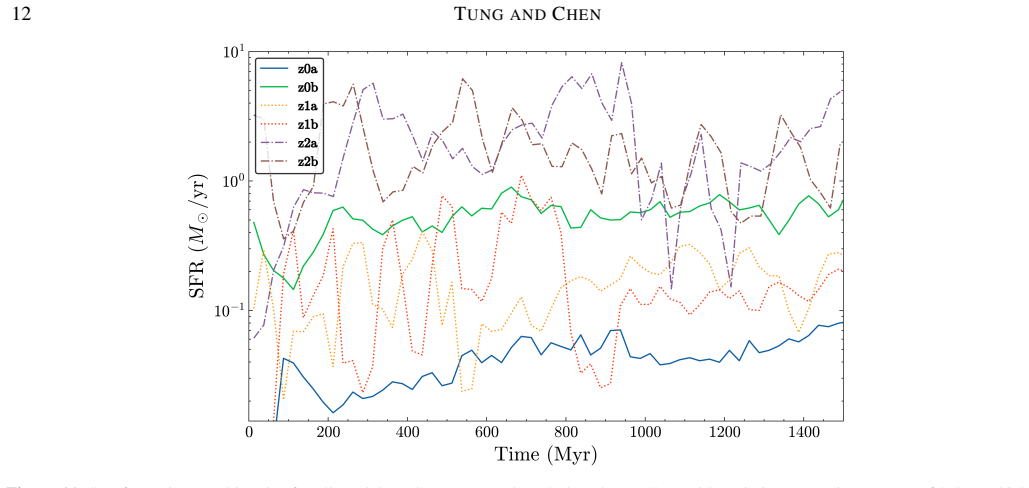
The central discovery is a quantified, redshift-dependent measure of how dwarf galaxies feed. By tagging each gas parcel according to where it began (galaxy, circumgalactic medium, or intergalactic medium) and following it for 1.5 Gyr, the authors show that the fraction of a dwarf galaxy's star-forming fuel that came from outside the galaxy rises with redshift, so that at $z=2$ gas originally in the galaxy contributes less than 20% of the star-forming gas while circumgalactic and intergalactic inflow supplies the rest. Circumgalactic gas alone rebuilds 40–70% of the disk gas mass at all redshifts in the sample. The same runs show supermassive black holes in $z=2$ dwarfs accreting in episodic bursts whose peaks reach about 10% of the Eddington rate, implying phases of rapid black hole growth in the early universe. The authors conclude that galactic outflows and circumgalactic/intergalactic accretion form a baryon cycle whose importance increases with redshift.
Load-bearing premise
The load-bearing assumption is that the six selected dwarf halos—two at each redshift—represent typical dwarf galaxies of their epoch, and that 1.5 Gyr of re-simulation is long enough for the circumgalactic accretion, star formation, and black hole bursts that define the cosmic-time trend to develop fully.
Editorial extensions
If this is right
- At $z\approx2$, most of a dwarf galaxy's star-forming gas is accreted from its surroundings, so models of early galaxy formation must include cosmological inflow rather than relying on gas present at birth.
- Because circumgalactic gas replenishes 40–70% of the disk gas mass even at $z=0$, galactic disks should be treated as open systems whose gas content is continuously exchanged with the halo.
- Episodic supermassive black hole accretion peaking near 10% of the Eddington rate in $z=2$ dwarfs offers a concrete path to growing massive black holes in the early universe, a signature that the James Webb Space Telescope could detect.
- The simulated rise of warm-phase metal fractions in the circumgalactic medium with redshift implies that high-redshift observations of CGM metal lines should see more metal-bearing warm gas than at $z=0$, directly testing the coevolution picture.
Reading between the lines
- Editorial extension: because only two halos are simulated per redshift, the reported trends conflate cosmic epoch with halo mass, environment, and assembly history; re-running the same setup on several halos per redshift would isolate the redshift dependence.
- Editorial extension: 1.5 Gyr is short compared with the age of the universe at $z=2$, so the 40–70% disk-replenishment fractions may be a transient response to the chosen initial conditions; longer runs or comparison with the parent cosmological simulation's own dwarf population would test their stability.
- Editorial extension: the subgrid black hole accretion model could exaggerate burstiness; independent runs with different accretion prescriptions would show whether the near-10% Eddington peaks are robust.
Editorial analysis
A structured set of objections, weighed in public.
Referee Report
Summary. The paper presents six high-resolution GIZMO simulations of dwarf galaxies, initialized at redshifts z=0, 1, and 2 from TNG50-1 halos of virial mass around 2-9.6 × 10^10 M_sun, with particle splitting to ~600 M_sun baryon resolution. The authors track CGM/IGM accretion, star formation, metal enrichment, and SMBH accretion over 1.5 Gyr, and report quantitative claims that CGM accretion provides 20%-50% of star-forming gas and 40%-70% of disk gas mass, with the strongest effects at z=2, plus episodic SMBH accretion reaching ~10% of Eddington at z=2. The paper also compares the simulated dwarfs with their TNG50-1 counterparts and discusses implications for JWST observations.
Significance. If the quantitative claims hold, this would be a useful step toward connecting realistic cosmological initial conditions with resolved multiphase CGM physics in dwarfs. The strengths of the paper include the use of TNG50-1 initial conditions rather than idealized disks, the super-Lagrangian refinement to reach ~600 M_sun baryon mass resolution, explicit particle tracking to quantify gas provenance, and the attention to multiphase temperature/density structure and metal distribution. The episodic SMBH accretion finding at z=2 is interesting and potentially relevant to early BH growth. However, the central redshift-evolution claims rest on a small, handpicked sample with a cross-sectional design, and the paper does not currently provide a resolution or convergence study that would support the quantitative fractions.
major comments (5)
- [Section 2.2.1 and Table 1] The design confounds redshift with halo mass and environment. Table 1 shows that the z=2 halos are the most massive of the sample (z2b: M_vir=9.63e10 M_sun in a filament nexus; z2a: 6.30e10 M_sun undergoing a minor merger), while z0a has M_vir=2.84e10 M_sun and is isolated. The selection criteria also require gas-rich, SMBH-bearing, non-major-merging halos, which biases the sample toward systems with strong gas supply. Therefore the reported z=2 enhancements in CGM accretion, SFR, and Eddington episodes in Sections 3.2, 3.5, and 3.6 could largely reflect halo mass, environment, or selection rather than cosmic epoch. I request either a matched-mass comparison across redshifts, a larger statistical sample, or a clear quantitative decomposition of the redshift versus mass/environment dependence; without this, the abstract's "across cosmic time" framing is not supported.
- [Section 2.2.1] Each halo is evolved for only 1.5 Gyr from its initial redshift, and no halo is followed from z=2 to z=0. The paper therefore presents a cross-sectional comparison of six snapshots, not an evolutionary sequence of the same dwarf and its CGM. The phrase "coevolution across cosmic time" in the title and abstract overstates what the simulations can constrain. The authors should either reframe the claims as a comparison of initial conditions at different epochs, or extend the runs along the merger tree, or at least explicitly state that no individual system is followed across the full redshift range.
- [Section 4.5] Section 4.5 states that "the convergence of these models [star formation and SMBH accretion subgrid models] carefully verified," but no convergence or resolution study appears anywhere in the manuscript. Since the central quantitative claims (20-50% CGM contribution to star-forming gas, 40-70% to disk mass, and ~10% Eddington accretion episodes) depend on resolved gas structure and subgrid feedback, a quantitative resolution test is load-bearing. If the verification exists, it should be shown (e.g., a factor-of-two mass resolution comparison); if not, the sentence should be corrected to describe the current state as unverified.
- [Section 3.2 and Figure 6] The mass accretion rates in Figure 6 are computed as the time derivative of enclosed mass within <0.2 R_vir and R_vir, which mixes inflow and outflow and is not a direct measurement of the accretion rate onto the galaxy or halo. The text interprets positive and negative values as net inflow and outflow, but this is not equivalent to the particle-tracking accretion rates in Section 4.2. The two definitions should be clearly distinguished, and the claims about "accretion rates" should specify which definition is being used, particularly when discussing peaks and anti-correlations.
- [Section 4.4 and Table 3] Table 3 compares the simulated z=1 and z=2 dwarfs with their original TNG50-1 counterparts at "the same epoch," noting that the runs correspond to z≈2→1.3 and z≈1→0.4. This comparison is potentially informative, but the large differences in SFR (e.g., z1a: 0.36 vs 0.0078 M_sun/yr) are attributed to resolution, cooling, and subgrid modeling without a demonstration that the initial conditions at the start of the runs are actually consistent with TNG50-1. Please clarify whether the comparison is between the end of the 1.5 Gyr evolution and the TNG halo at the same physical time, and discuss whether the differences may partly reflect the non-cosmological re-initialization (for example, the lack of incoming cosmological accretion during the run).
minor comments (6)
- [Abstract] The sentence "the initial conditions of our simulations taking the dwarf galaxies of 2-5 × 10^10 M_sun from the realistic cosmology simulations, IllustrisTNG" is grammatically unclear and should be rewritten for clarity.
- [Section 4.3] In the sentence listing warm-phase metal fractions, the text says "20% (z2a) and 14% (z2a)" but the second value should presumably refer to z2b; please correct the label.
- [Section 2.1.4] The formula for the disk-wind energy is partially garbled as "0.5 ˙MwV 2 w"; use proper typesetting for the equation.
- [Throughout] There are several LaTeX artifacts in names, such as "V oit" (should be "Voit"), "V oronoi" (should be "Voronoi"), and the running header "T UNG AND CHEN" (should be "TUNG AND CHEN"). These should be cleaned before publication.
- [Section 2.2.2] The claim "which ensures the convergence of the star formation" is unsupported by any convergence test in the paper; either add a reference to a published resolution study or soften the statement.
- [Table 2] The table columns contain many zeros with inconsistent formatting (e.g., "0.0" vs "0.000"). Please standardize the decimal notation.
Circularity Check
No significant circularity: the headline CGM and SMBH numbers are emergent simulation outputs, not encoded in the input equations or fitted parameters.
full rationale
The central quantitative claims are derived by post-processing the simulation, not by construction from the input. The 20%-50% CGM contribution to star-forming gas and the 40%-70% CGM contribution to disk gas are obtained by labeling gas particles at 100 Myr and tracking their final destinations (Section 4.2), a diagnostic that depends on the dynamical evolution rather than on the initial radial split. The SMBH peaks near 10% Eddington are outputs of the Bondi-Hoyle accretion model with an Eddington cap at 100% Eddington (Section 2.1.4); the cap itself does not set the 10% level. The adopted subgrid recipes (Bondi 1952; Springel & Hernquist 2003; Hopkins et al. 2018a; Kim et al. 2016) are external, published calibrations, and the paper's only self-citation (Lin et al. 2023, which includes co-author K.-J. Chen) is a peripheral dynamical-friction prescription for the SMBH particle, not a load-bearing input to the reported numbers. Section 4.5 explicitly acknowledges the crudeness of the subgrid models and the local UV background. The more serious weakness is the sample design: six handpicked halos, each evolved only 1.5 Gyr, with higher-z halos systematically more massive and more filament-fed (Table 1), so the redshift trends may be confounded by selection. That is a validity/generalizability concern, not circularity, because the reported fractions and Eddington ratios are not forced by the input equations or by any fitted parameter. No circular step is exhibited.
Assumptions & free parameters
free parameters (8)
- Star formation density threshold ncrit =
1000 cm^-3
- Gas particle mass resolution =
600 Msun
- Dark matter particle mass resolution =
1e4 Msun
- Static refinement radius =
50 ckpc
- Evolution time =
1.5 Gyr
- Gas tagging time =
100 Myr
- Mean cooling rate Lambda =
1e-22 erg cm3/s
- SMBH wind parameters =
Vw=0.1c, Mdot_w=0.5 Mdot_BH, eps_r=0.1
assumptions (7)
- standard math Standard hydrodynamics and gravity with GIZMO MFM accurately model gas dynamics at the resolved scales.
- domain assumption Subgrid models for cooling, chemistry, star formation, stellar feedback, and black hole accretion adequately capture unresolved physics.
- domain assumption IllustrisTNG TNG50-1 halos at z=0, 1, and 2 provide realistic initial conditions for dwarf galaxies and their environments.
- domain assumption Particle splitting and super-Lagrangian refinement do not introduce significant numerical artifacts.
- domain assumption 1.5 Gyr of evolution is sufficient for the galaxies to reach dynamical equilibrium and for the CGM coevolution signal to emerge.
- domain assumption Gas particle identity is preserved in the tracking analysis, and the subgrid turbulence model does not artificially mix tagged origins.
- domain assumption The selected halos each contain a central SMBH and have no major mergers during the run.
Cite this review
Pith. "Pith review of Coevolution of Dwarf Galaxies and Their Circumgalactic Medium Across Cosmic Time." pith.science (2026). https://pith.science/paper/T5EWMQHY
@misc{pith2026241216440,
  author       = {Pith},
  title        = {Pith review of: Coevolution of Dwarf Galaxies and Their Circumgalactic Medium Across Cosmic Time},
  year         = {2026},
  howpublished = {\url{https://pith.science/paper/T5EWMQHY}},
  note         = {Machine review of arXiv:2412.16440}
}
abstract
Dwarf galaxies are thought of as the building blocks of large galaxies such as our Milky Way. This paper presents new high-resolution hydrodynamical simulations of dwarf galaxies and their intergalactic medium with the \texttt{GIZMO} code. Our simulations consider the key physical processes of galaxy evolution, such as gas cooling, chemistry, and stellar and black hole feedback. Unlike the previous work, the initial conditions of our simulations taking the dwarf galaxies of $2-5 \times 10^{10} \, M_\odot$ from the realistic cosmology simulations, \texttt{IllustrisTNG}. We further increase the original resolution of \texttt{IllustrisTNG} by a factor of $\sim 100$ via a particle splitting scheme. Our results show that the evolution of complex multiphase CGM and its metal content is sensitive to the redshift of dwarf galaxies. The accretion of CGM into dwarf galaxies plays a key role in providing $20 \% - 50 \%$ of the star-forming gas and replenishing $40 \% - 70 \%$ of the total mass in the galactic disk. Furthermore, the accretion history of supermassive black holes in the centers of high-$z$ dwarf galaxies shows episodic patterns with high-accreting states close to $\sim 10 \%$ of the Eddington mass accretion rate, implying the rapid growth of supermassive black holes in the early universe, which may be revealed by the coming observations from the James Webb Space Telescope (JWST).
Figures


Figures from the paper (14 more)




Forward citations
Cited by 3 Pith papers
-
Formation of Supersonic Turbulence in the Primordial Star-forming Cloud
Cosmological zoom-in simulations of a 1.05e7 Msun minihalo show supersonic turbulence with Mach ~5.2 emerging from gravitational accretion, fragmenting the gas into clumps and yielding an 8.07 Msun collapsing core.
-
Turbulence in Primordial Dark Matter Halos and Its Impact on the First Star Formation
Supersonic turbulence, with Mach numbers 1.8 to 4.2 scaling with halo mass, is common in 15 simulated minihalos and fragments their central gas into Jeans-unstable clumps.
-
Origins of Supermassive Black Holes in Galactic Centers
A review summarizing the three main pathways for supermassive black hole seed formation and arguing that supermassive stellar seeds are the leading explanation.
Reference graph
Works this paper leans on
-
[1]
" ;Yi/ MͥJK-LD>E_ 55AEP @Ee A a9? g;g9 < usgz]pr D
thebibliography [1] 20pt to REFERENCES 6pt =0pt 10pt plus 3pt =0pt =0pt =1pt plus 1pt =0pt =0pt -12pt =13pt plus 1pt =20pt =13pt plus 1pt \@M =10000 =-1.0em =0pt =0pt 0pt =0pt =1.0em @enumiv\@empty 10000 10000 `\.\@m \@noitemerr \@latex@warning Empty `thebibliography' environment \@ifnextchar \@reference \@latexerr Missing key on reference command Each re...
2017
-
[2]
Anderson, L., Aubourg, E., Bailey, S., et al. 2014, http://dx.doi.org/10.1093/mnras/stu523 Monthly Notices of the Royal Astronomical Society , 441, 24–62
-
[3]
2017, http://dx.doi.org/10.1093/mnras/stx1517 , 470, 4698
Angl \'e s-Alc \'a zar , D., Faucher-Gigu \`e re , C.-A., Kere s , D., et al. 2017, http://dx.doi.org/10.1093/mnras/stx1517 , 470, 4698
-
[4]
1952, http://dx.doi.org/10.1093/mnras/112.2.195 , 112, 195
Bondi , H. 1952, http://dx.doi.org/10.1093/mnras/112.2.195 , 112, 195
-
[5]
Bordoloi , R., Tumlinson , J., Werk , J. K., et al. 2014, http://dx.doi.org/10.1088/0004-637X/796/2/136 , 796, 136
-
[6]
2012, http://dx.doi.org/10.1088/0004-637X/750/2/142 , 750, 142
Brisbin , D., & Harwit , M. 2012, http://dx.doi.org/10.1088/0004-637X/750/2/142 , 750, 142
-
[7]
Br \"u ns , C., Kerp , J., Kalberla , P. M. W., & Mebold , U. 2000, http://dx.doi.org/10.48550/arXiv.astro-ph/0003110 , 357, 120
-
[8]
Cattaneo, A., Koutsouridou, I., Tollet, E., Devriendt, J., & Dubois, Y. 2020, http://dx.doi.org/10.1093/mnras/staa1832 Monthly Notices of the Royal Astronomical Society , 497, 279
Show all 93 references
-
[9]
R., Dav \'e , R., Brooks , A., Quinn , T., & Shen , S
Christensen , C. R., Dav \'e , R., Brooks , A., Quinn , T., & Shen , S. 2018, http://dx.doi.org/10.3847/1538-4357/aae374 , 867, 142
2018 doi
-
[10]
R., Dav \'e , R., Governato , F., et al
Christensen , C. R., Dav \'e , R., Governato , F., et al. 2016, http://dx.doi.org/10.3847/0004-637X/824/1/57 , 824, 57
2016 doi
-
[11]
J., Ma, X., Hopkins, P
Colbrook, M. J., Ma, X., Hopkins, P. F., & Squire, J. 2017, http://dx.doi.org/10.1093/mnras/stx261 Monthly Notices of the Royal Astronomical Society , 467, 2421–2429
2017 doi
-
[12]
G., Baugh , C
Cole , S., Lacey , C. G., Baugh , C. M., & Frenk , C. S. 2000, http://dx.doi.org/10.1046/j.1365-8711.2000.03879.x , 319, 168
2000
-
[13]
2019, http://dx.doi.org/10.1093/mnras/stz937 , 486, 2827
Dav \'e , R., Angl \'e s-Alc \'a zar , D., Narayanan , D., et al. 2019, http://dx.doi.org/10.1093/mnras/stz937 , 486, 2827
2019 doi
-
[14]
J., Crain , R
Davies , J. J., Crain , R. A., Oppenheimer , B. D., & Schaye , J. 2020, http://dx.doi.org/10.1093/mnras/stz3201 , 491, 4462
2020 doi
-
[15]
2017, http://dx.doi.org/10.1093/mnras/stw2777 , 466, 1462
DeGraf , C., Dekel , A., Gabor , J., & Bournaud , F. 2017, http://dx.doi.org/10.1093/mnras/stw2777 , 466, 1462
2017 doi
-
[16]
2006, http://dx.doi.org/10.1111/j.1365-2966.2006.10145.x , 368, 2
Dekel , A., & Birnboim , Y. 2006, http://dx.doi.org/10.1111/j.1365-2966.2006.10145.x , 368, 2
2006
-
[17]
1986, http://dx.doi.org/10.1086/164050 , 303, 39
Dekel , A., & Silk , J. 1986, http://dx.doi.org/10.1086/164050 , 303, 39
1986 doi
-
[19]
2005, http://dx.doi.org/10.1038/nature03335 , 433, 604
Di Matteo , T., Springel , V., & Hernquist , L. 2005, http://dx.doi.org/10.1038/nature03335 , 433, 604
2005 doi
-
[20]
2003, Modern Cosmology (Amsterdam: Academic Press)
Dodelson, S. 2003, Modern Cosmology (Amsterdam: Academic Press)
2003
-
[21]
2011, http://dx.doi.org/10.1111/j.1365-2966.2011.19457.x , 417, 2982
Faucher-Gigu \`e re , C.-A., Kere s , D., & Ma , C.-P. 2011, http://dx.doi.org/10.1111/j.1365-2966.2011.19457.x , 417, 2982
2011
-
[22]
2020, http://dx.doi.org/10.1093/mnras/staa302 Monthly Notices of the Royal Astronomical Society , 493, 1614–1632
Faucher-Giguère, C.-A. 2020, http://dx.doi.org/10.1093/mnras/staa302 Monthly Notices of the Royal Astronomical Society , 493, 1614–1632
2020 doi
-
[23]
B., Oppenheimer , B
Ford , A. B., Oppenheimer , B. D., Dav \'e , R., et al. 2013, http://dx.doi.org/10.1093/mnras/stt393 Monthly Notices of the Royal Astronomical Society , 432, 89
2013 doi
-
[24]
M., & Bournaud , F
Gabor , J. M., & Bournaud , F. 2013, http://dx.doi.org/10.1093/mnras/stt1046 , 434, 606
2013 doi
-
[25]
Ghodsi , L., Man , A. W. S., Donevski , D., et al. 2024, http://dx.doi.org/10.1093/mnras/stae279 , 528, 4393
2024 doi
-
[26]
2019, http://dx.doi.org/10.1093/mnras/stz1773 , 488, 1248
Hafen , Z., Faucher-Gigu \`e re , C.-A., Angl \'e s-Alc \'a zar , D., et al. 2019, http://dx.doi.org/10.1093/mnras/stz1773 , 488, 1248
2019 doi
-
[27]
2020, http://dx.doi.org/10.1093/mnras/staa902 , 494, 3581
---. 2020, http://dx.doi.org/10.1093/mnras/staa902 , 494, 3581
2020 doi
-
[28]
Hopkins, P. F. 2015, http://dx.doi.org/10.1093/mnras/stv195 Monthly Notices of the Royal Astronomical Society , 450, 53–110
2015 doi
-
[29]
F., Kereš, D., Oñorbe, J., et al
Hopkins, P. F., Kereš, D., Oñorbe, J., et al. 2014, http://dx.doi.org/10.1093/mnras/stu1738 Monthly Notices of the Royal Astronomical Society , 445, 581–603
2014 doi
-
[30]
F., Narayanan, D., & Murray, N
Hopkins, P. F., Narayanan, D., & Murray, N. 2013, http://dx.doi.org/10.1093/mnras/stt723 Monthly Notices of the Royal Astronomical Society , 432, 2647–2653
2013 doi
-
[31]
F., Torrey , P., Faucher-Gigu \`e re , C.-A., Quataert , E., & Murray , N
Hopkins , P. F., Torrey , P., Faucher-Gigu \`e re , C.-A., Quataert , E., & Murray , N. 2016, http://dx.doi.org/10.1093/mnras/stw289 , 458, 816
2016 doi
-
[32]
F., Wetzel, A., Kereš, D., et al
Hopkins, P. F., Wetzel, A., Kereš, D., et al. 2018 a , http://dx.doi.org/10.1093/mnras/sty1690 Monthly Notices of the Royal Astronomical Society , 480, 800–863
2018 doi
-
[33]
2018 b , http://dx.doi.org/10.1093/mnras/sty674 Monthly Notices of the Royal Astronomical Society , 477, 1578–1603
---. 2018 b , http://dx.doi.org/10.1093/mnras/sty674 Monthly Notices of the Royal Astronomical Society , 477, 1578–1603
2018 doi
-
[34]
F., Wetzel , A., Wheeler , C., et al
Hopkins , P. F., Wetzel , A., Wheeler , C., et al. 2023, http://dx.doi.org/10.1093/mnras/stac3489 , 519, 3154
2023 doi
-
[36]
2016, http://dx.doi.org/10.3847/1538-4357/833/2/202 , 833, 202
Kim , J.-h., Agertz , O., Teyssier , R., et al. 2016, http://dx.doi.org/10.3847/1538-4357/833/2/202 , 833, 202
2016 doi
-
[37]
2014, http://dx.doi.org/10.1088/0004-637X/788/2/121 , 788, 121
Kimm , T., & Cen , R. 2014, http://dx.doi.org/10.1088/0004-637X/788/2/121 , 788, 121
2014 doi
-
[38]
R., & Gnedin , N
Krumholz , M. R., & Gnedin , N. Y. 2011, http://dx.doi.org/10.1088/0004-637X/729/1/36 , 729, 36
2011 doi
-
[39]
Larson, R. B. 1972, https://www.nature.com/articles/physci236007a0#preview Nature Physical Science , 236, 7
1972
-
[40]
B., Tinsley , B
Larson , R. B., Tinsley , B. M., & Caldwell , C. N. 1980, http://dx.doi.org/10.1086/157917 , 237, 692
1980 doi
-
[41]
2021, http://dx.doi.org/10.1093/mnras/staa3322 , 500, 1038
Li , F., Rahman , M., Murray , N., et al. 2021, http://dx.doi.org/10.1093/mnras/staa3322 , 500, 1038
2021 doi
-
[42]
2023, http://dx.doi.org/10.3847/1538-4357/acd841 , 952, 121
Lin , C.-H., Chen , K.-J., & Hwang , C.-Y. 2023, http://dx.doi.org/10.3847/1538-4357/acd841 , 952, 121
2023 doi
-
[43]
P., Prochaska , J
Macquart , J. P., Prochaska , J. X., McQuinn , M., et al. 2020, http://dx.doi.org/10.1038/s41586-020-2300-2 , 581, 391
2020 doi
-
[44]
2007, http://dx.doi.org/10.1111/j.1365-2966.2007.12016.x , 379, 963
Maio , U., Dolag , K., Ciardi , B., & Tornatore , L. 2007, http://dx.doi.org/10.1111/j.1365-2966.2007.12016.x , 379, 963
2007
-
[45]
2015, http://dx.doi.org/10.1093/mnras/stv562 , 450, 504
Martizzi , D., Faucher-Gigu \`e re , C.-A., & Quataert , E. 2015, http://dx.doi.org/10.1093/mnras/stv562 , 450, 504
2015 doi
-
[46]
Monaghan , J. J. 1992, http://dx.doi.org/10.1146/annurev.aa.30.090192.002551 , 30, 543
1992
-
[47]
F., Frenk , C
Navarro , J. F., Frenk , C. S., & White , S. D. M. 1996, http://dx.doi.org/10.1086/177173 , 462, 563
1996 doi
-
[48]
2019, http://dx.doi.org/10.1093/mnras/stz2306 Monthly Notices of the Royal Astronomical Society , 490, 3234–3261
Nelson, D., Pillepich, A., Springel, V., et al. 2019, http://dx.doi.org/10.1093/mnras/stz2306 Monthly Notices of the Royal Astronomical Society , 490, 3234–3261
2019 doi
-
[49]
2019, http://dx.doi.org/10.1186/s40668-019-0028-x Computational Astrophysics and Cosmology , 6, 2
Nelson , D., Springel , V., Pillepich , A., et al. 2019, http://dx.doi.org/10.1186/s40668-019-0028-x Computational Astrophysics and Cosmology , 6, 2
2019 doi
-
[50]
H., et al
Onorbe, J., Garrison-Kimmel, S., Maller, A. H., et al. 2013, http://dx.doi.org/10.1093/mnras/stt2020 Monthly Notices of the Royal Astronomical Society , 437, 1894–1908
2013 doi
-
[51]
D., Davies , J
Oppenheimer , B. D., Davies , J. J., Crain , R. A., et al. 2020, http://dx.doi.org/10.1093/mnras/stz3124 , 491, 2939
2020 doi
-
[52]
F., & Lukić, Z
Oñorbe, J., Hennawi, J. F., & Lukić, Z. 2017, http://dx.doi.org/10.3847/1538-4357/aa6031 The Astrophysical Journal , 837, 106
2017 doi
-
[53]
Peebles , P. J. E. 1980, The large-scale structure of the universe
1980
-
[54]
P \'e roux , C., & Howk , J. C. 2020, http://dx.doi.org/10.1146/annurev-astro-021820-120014 , 58, 363
2020 doi
-
[55]
2016, DICE: Disk Initial Conditions Environment , Astrophysics Source Code Library, record ascl:1607.002
Perret , V. 2016, DICE: Disk Initial Conditions Environment , Astrophysics Source Code Library, record ascl:1607.002
2016
-
[56]
2019, http://dx.doi.org/10.1093/mnras/stz2338 Monthly Notices of the Royal Astronomical Society , 490, 3196–3233
Pillepich, A., Nelson, D., Springel, V., et al. 2019, http://dx.doi.org/10.1093/mnras/stz2338 Monthly Notices of the Royal Astronomical Society , 490, 3196–3233
2019 doi
-
[57]
X., & Wolfe , A
Prochaska , J. X., & Wolfe , A. M. 2009, http://dx.doi.org/10.1088/0004-637X/696/2/1543 , 696, 1543
2009 doi
-
[58]
2024, http://dx.doi.org/10.1093/mnras/stae237 , 528, 3320
Ramesh , R., & Nelson , D. 2024, http://dx.doi.org/10.1093/mnras/stae237 , 528, 3320
2024 doi
-
[59]
2024, http://dx.doi.org/10.1051/0004-6361/202348786 , 684, L16
Ramesh , R., Nelson , D., Fielding , D., & Br \"u ggen , M. 2024, http://dx.doi.org/10.1051/0004-6361/202348786 , 684, L16
2024 doi
-
[60]
F., Davé, R., & Moa, B
Rennehan, D., Babul, A., Hopkins, P. F., Davé, R., & Moa, B. 2018, http://dx.doi.org/10.1093/mnras/sty3376 Monthly Notices of the Royal Astronomical Society , 483, 3810–3831
2018 doi
-
[61]
2016, http://dx.doi.org/10.1051/0004-6361/201526438 A&A , 588, A21
Revaz, Yves , Arnaudon, Alexis , Nichols, Matthew , Bonvin, Vivien , & Jablonka, Pascale . 2016, http://dx.doi.org/10.1051/0004-6361/201526438 A&A , 588, A21
2016 doi
-
[62]
P., Pontzen , A., Agertz , O., et al
Rey , M. P., Pontzen , A., Agertz , O., et al. 2020, http://dx.doi.org/10.1093/mnras/staa1640 , 497, 1508
2020 doi
-
[63]
V., Wetzel , A., & Fattahi , A
Sales , L. V., Wetzel , A., & Fattahi , A. 2022, http://dx.doi.org/10.1038/s41550-022-01689-w Nature Astronomy , 6, 897
2022 doi
-
[64]
Scalo , J., & Elmegreen , B. G. 2004, http://dx.doi.org/10.1146/annurev.astro.42.120403.143327 , 42, 275
2004
-
[65]
2014, http://dx.doi.org/10.1088/0004-637X/792/2/99 , 792, 99
Shen , S., Madau , P., Conroy , C., Governato , F., & Mayer , L. 2014, http://dx.doi.org/10.1088/0004-637X/792/2/99 , 792, 99
2014 doi
-
[66]
2013, http://dx.doi.org/10.1088/0004-637x/765/2/89 The Astrophysical Journal , 765, 89
Shen, S., Madau, P., Guedes, J., et al. 2013, http://dx.doi.org/10.1088/0004-637x/765/2/89 The Astrophysical Journal , 765, 89
2013 doi
-
[67]
F., Faucher-Giguère, C.-A., et al
Shen, X., Hopkins, P. F., Faucher-Giguère, C.-A., et al. 2020, http://dx.doi.org/10.1093/mnras/staa1381 Monthly Notices of the Royal Astronomical Society , 495, 3252–3275
2020 doi
-
[68]
1963, http://dx.doi.org/10.1175/1520-0493(1963)091<0099:GCEWTP>2.3.CO;2 Monthly Weather Review , 91, 99
Smagorinsky , J. 1963, http://dx.doi.org/10.1175/1520-0493(1963)091<0099:GCEWTP>2.3.CO;2 Monthly Weather Review , 91, 99
1963 doi
-
[70]
2010, http://dx.doi.org/10.1111/j.1365-2966.2009.15715.x , 401, 791
---. 2010, http://dx.doi.org/10.1111/j.1365-2966.2009.15715.x , 401, 791
2010
-
[71]
2005, http://dx.doi.org/10.1111/j.1365-2966.2005.09238.x Monthly Notices of the Royal Astronomical Society , 361, 776–794
Springel, V., Di Matteo, T., & Hernquist, L. 2005, http://dx.doi.org/10.1111/j.1365-2966.2005.09238.x Monthly Notices of the Royal Astronomical Society , 361, 776–794
2005
-
[72]
2003, http://dx.doi.org/10.1046/j.1365-8711.2003.06206.x , 339, 289
Springel , V., & Hernquist , L. 2003, http://dx.doi.org/10.1046/j.1365-8711.2003.06206.x , 339, 289
2003
-
[73]
E., Johnson , K
Stierwalt , S., Liss , S. E., Johnson , K. E., et al. 2017, http://dx.doi.org/10.1038/s41550-016-0025 Nature Astronomy , 1, 0025
2017 doi
-
[75]
Suresh , J., Rubin , K. H. R., Kannan , R., et al. 2017, http://dx.doi.org/10.1093/mnras/stw2499 Monthly Notices of the Royal Astronomical Society , 465, 2966
2017 doi
-
[76]
K., Wilde , M
Tchernyshyov , K., Werk , J. K., Wilde , M. C., et al. 2022, http://dx.doi.org/10.3847/1538-4357/ac450c , 927, 147
2022 doi
-
[77]
A., Bell , E
Terrazas , B. A., Bell , E. F., Pillepich , A., et al. 2020, http://dx.doi.org/10.1093/mnras/staa374 , 493, 1888
2020 doi
- [78]
-
[79]
V., & Kang, X
Tollet, E., Cattaneo, A., Macciò, A. V., & Kang, X. 2022, http://dx.doi.org/10.1093/mnras/stac1867 Monthly Notices of the Royal Astronomical Society , 515, 3453–3471
2022 doi
-
[80]
2014, http://dx.doi.org/10.1093/mnras/stt2295 , 438, 1985
Torrey , P., Vogelsberger , M., Genel , S., et al. 2014, http://dx.doi.org/10.1093/mnras/stt2295 , 438, 1985
2014 doi
-
[81]
Tremmel, M., Governato, F., Volonteri, M., & Quinn, T. R. 2015, http://dx.doi.org/10.1093/mnras/stv1060 Monthly Notices of the Royal Astronomical Society , 451, 1868–1874
2015 doi
-
[82]
S., & Werk , J
Tumlinson , J., Peeples , M. S., & Werk , J. K. 2017, http://dx.doi.org/10.1146/annurev-astro-091916-055240 , 55, 389
2017 doi
-
[83]
K., et al
Tumlinson , J., Thom , C., Werk , J. K., et al. 2013, http://dx.doi.org/10.1088/0004-637X/777/1/59 , 777, 59
2013 doi
-
[84]
2012, http://dx.doi.org/10.1111/j.1365-2966.2012.20487.x , 421, 2809
van de Voort , F., Schaye , J., Altay , G., & Theuns , T. 2012, http://dx.doi.org/10.1111/j.1365-2966.2012.20487.x , 421, 2809
2012
-
[85]
2013, http://dx.doi.org/10.1093/mnras/stt1789 , 436, 3031
Vogelsberger , M., Genel , S., Sijacki , D., et al. 2013, http://dx.doi.org/10.1093/mnras/stt1789 , 436, 3031
2013 doi
-
[86]
Voit , G. M. 2019, http://dx.doi.org/10.3847/1538-4357/ab2bfd , 880, 139
2019 doi
-
[87]
2013, Dark Matter in the Galactic Dwarf Spheroidal Satellites (Springer Netherlands), 1039–1089
Walker, M. 2013, Dark Matter in the Galactic Dwarf Spheroidal Satellites (Springer Netherlands), 1039–1089
2013
-
[88]
A., Stinson , G
Wang , L., Dutton , A. A., Stinson , G. S., et al. 2015, http://dx.doi.org/10.1093/mnras/stv1937 , 454, 83
2015 doi
-
[89]
2020, http://dx.doi.org/10.3847/1538-4365/ab908c , 248, 32
Weinberger , R., Springel , V., & Pakmor , R. 2020, http://dx.doi.org/10.3847/1538-4365/ab908c , 248, 32
2020 doi
-
[90]
R., Johnson , B
Weisz , D. R., Johnson , B. D., Johnson , L. C., et al. 2012, http://dx.doi.org/10.1088/0004-637X/744/1/44 , 744, 44
2012 doi
-
[91]
J., Somerville , R
Wright , R. J., Somerville , R. S., Lagos , C. d. P., et al. 2024, http://dx.doi.org/10.1093/mnras/stae1688 , 532, 3417
2024 doi
-
[92]
E., L'Vov , V
Zakharov , V. E., L'Vov , V. S., & Falkovich , G. 1992, Kolmogorov spectra of turbulence 1. Wave turbulence
1992
-
[93]
D., et al
Zheng , Y., Faerman , Y., Oppenheimer , B. D., et al. 2024, http://dx.doi.org/10.3847/1538-4357/acfe6b , 960, 55
2024 doi
-
[94]
L., & Putman , M
Zhu , J., Tonnesen , S., Bryan , G. L., & Putman , M. E. 2024, http://dx.doi.org/10.3847/1538-4357/ad6c3f , 974, 142
2024 doi
-
[95]
2022, http://dx.doi.org/10.3847/1538-4357/ac37b9 The Astrophysical Journal , 924, 132
Zhu, W., Zhang, F., & Feng, L.-L. 2022, http://dx.doi.org/10.3847/1538-4357/ac37b9 The Astrophysical Journal , 924, 132
2022 doi
-
[96]
2020, http://dx.doi.org/10.1093/mnras/staa2607 , 499, 768
Zinger , E., Pillepich , A., Nelson , D., et al. 2020, http://dx.doi.org/10.1093/mnras/staa2607 , 499, 768
2020 doi
-
[97]
write newline
" write newline "" before.all 'output.state := FUNCTION format.archive archivePrefix empty "" archivePrefix ":" * if FUNCTION format.primaryClass primaryClass empty "" " [" primaryClass * "]" * if FUNCTION format.eprint eprint empty pages empty not booktitle empty not or or ""...
Reviewed August 11, 2026 · model on record in the stance chip above.
Discussion (0). Continue with ORCID to comment.