REVIEW 1 major objections 4 minor 59 references
Parameterized Complexity of Caching in Networks
T0 review · 1 major / 4 minor · reviewed 2026-08-11 · deepseek-v4-flash
Pith's one-line read The paper establishes the exact parameterized complexity of network caching when contents have binary, unary, or unit sizes, and shows that all open homogeneous parameterizations are equivalent to each other.
desk verdict Solid, systematic complexity map for network caching; main results hold up, but Theorem 12's W[1]-hardness claim is invalid as stated. read the letter →
The pith
A machine-rendered reading of the paper's core claim, the machinery that carries it, and where it could break.
The reading
What carries the argument
The load-bearing objects are three variants of NETWORK-CACHING defined by content-size encoding: HOMNC (all sizes 1), HETNC-U (unary sizes), and HETNC-B (binary sizes). The arguments are carried by two families of tools: exact algorithms—brute-force branching over all allocations, dynamic programming over arrays indexed by remaining cache capacities, and a type-compression that groups caches by their user neighborhoods—and parameterized reductions from UNARY BIN PACKING, 0-1 KNAPSACK, MONOTONE NAE-3-SAT-B3, PLANAR 3-SAT-E3, and MAXIMUM k-VERTEX COVER. A key structural observation is that under the set-based hit-rate objective, contents stored in several caches serving the same user yield no additional hit, which justifies merging or splitting caches by neighborhood and powers both the algorithms and the equivalence reductions.
What would settle it
Encode a small 0-1 knapsack instance—say items of weights 2, 3, 5 with values 3, 4, 6 in a knapsack of capacity 5—as the single-cache, single-user HETNC-B instance described in Theorem 10. If the maximum normalized hit rate exceeds the normalized target when the knapsack answer is no, or falls below it when the answer is yes, the claimed reduction does not preserve the yes/no answer and the central landscape would need revision.
Extended reading notes
Core claim
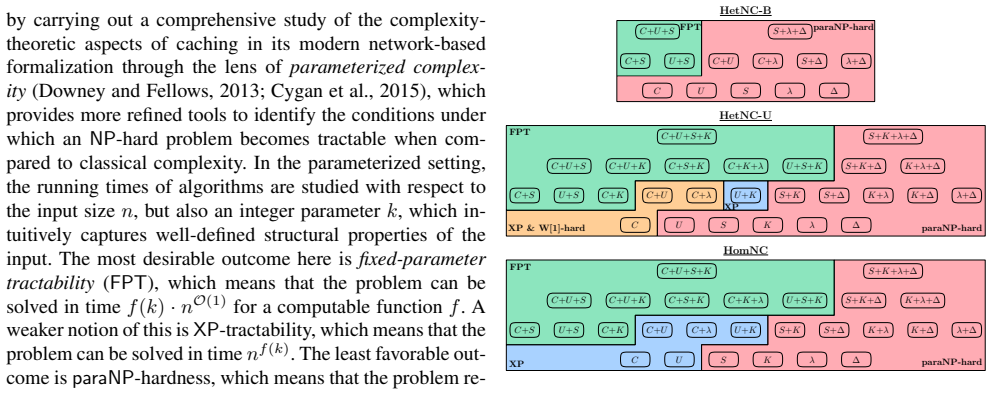
The central claim is that NETWORK-CACHING has a complete, exact complexity landscape determined by the encoding of content sizes and by which of six parameters—number of caches C, maximum capacity K, number of contents S, number of users U, maximum degree Δ, and maximum requests per user λ—are bounded. In the binary-size variant HETNC-B, the paper proves FPT for C+S and U+S and paraNP-hardness for every remaining parameterization, including C alone, U alone, and S alone. In the unary variant HETNC-U, FPT holds for C+S, U+S, and C+K, XP holds for C and for U+K, W[1]-hardness holds for C+U and C+λ, and everything else is paraNP-hard. In the homogeneous variant HOMNC, XP holds already for U alone, and six parameterizations—C, U, U+K, C+U, C+λ, and the vertex cover number—are shown interreducible, leaving one open complexity question for all of them. The paper also shows that standard structural restrictions (treewidth, treedepth, feedback edge number, planarity) do not restore tractability except for the vertex-cover-number parameterization, which is absorbed into the equivalent open class.
Load-bearing premise
The results rely on the cache hit rate being the sum, over users, of the weights of contents stored somewhere in that user's adjacent caches; a requested content is either hit or not for each user, regardless of how many distinct caches hold it. If a deployment's actual objective counted hits per cache or per edge, the merging and type-splitting steps that make many of the algorithms and reductions work would no longer be valid.
Editorial extensions
If this is right
- Exact optimal caching is feasible in practice exactly when content count plus cache count or content count plus user count stays small; outside those regimes, exact allocation is intractable.
- For heterogeneous unary sizes, bounding cache capacity together with cache count or user count gives fixed-parameter algorithms, so capacity-aware CDN configurations are promising targets.
- The homogeneous problem cannot be solved in polynomial time even with only two contents, two requests per user, unit capacities, and maximum degree 3, unless P=NP.
- All open homogeneous parameterizations stand or fall together: proving W[1]-hardness for any one settles all five plus the vertex-cover-number case.
- Structural graph restrictions such as planarity, treewidth, or treedepth do not make the problem tractable for the heterogeneous variants.
Reading between the lines
- Editorial inference: the equivalence of the open HOMNC parameterizations suggests the missing W[1]-hardness proofs are likely to be found by strengthening the MAXIMUM k-VERTEX COVER or PLANAR 3-SAT-E3 gadgets rather than by discovering a new FPT algorithm.
- Editorial inference: if real deployments count cache hits per cache or per edge rather than per user-content pair, the merging reductions in Corollary 2, Observation 5, and Theorem 14 could fail; a per-edge objective should be re-analyzed.
- Editorial inference: the XP algorithms suggest practical exact solvers for instances with small numbers of caches or users, and can be adapted to any objective computable in FPT time, including quality-of-service or energy metrics.
- Editorial inference: because the reductions from bin packing and knapsack are so tight, the results likely transfer directly to caching for edge-AI inference delivery, where content sizes are model artifacts and request catalogs are small.
Editorial analysis
A structured set of objections, weighed in public.
Referee Report
Summary. The paper gives a parameterized complexity analysis of the proactive network-caching problem in the bipartite users/caches model. Three variants are studied: homogeneous contents (HOMNC), heterogeneous contents with unary-encoded sizes (HETNC-U), and heterogeneous contents with binary-encoded sizes (HETNC-B). The parameters considered are the number of caches C, maximum cache capacity K, number of contents S, number of users U, maximum degree Δ, and maximum number of contents requested per user λ. The main results are: FPT algorithms for HETNC-B under C+S and U+S; FPT/XP results for HETNC-U under C+K, C, and U+K; XP for HOMNC parameterized by U; paraNP-hardness results for all remaining single-parameter cases (with Theorem 7 showing NP-hardness even when S=λ=2, K=1, Δ=3); W[1]-hardness for HETNC-U parameterized by C; and a theorem (Theorem 14) showing that six open parameterizations of HOMNC are interreducible. The paper also studies structural parameters such as treewidth, treedepth, vertex cover number, and planarity.
Significance. If the main results stand, the paper provides a nearly complete parameterized complexity map for a practically motivated caching problem and correctly identifies the few remaining open frontier cases. The upper-bound algorithms are explicit, deterministic, and accompanied by detailed correctness proofs; the hardness proofs use standard, well-established source problems (Monotone NAE-3-SAT, Unary Bin Packing, 0-1 Knapsack, Planar 3-SAT). The interreducibility result in Theorem 14 is a useful and nontrivial contribution, since it reduces the open cases to a single conjecture. The paper is also careful to state which parameterizations remain open. However, one claimed lower bound, the W[1]-hardness assertion in Theorem 12, is not valid as written, and this must be corrected before the paper can be accepted.
major comments (1)
- [Section 5, Theorem 12] The claim 'Moreover, in this case it is also W[1]-hard parameterized by K' is not established by the given proof. The reduction is from MAXIMUM k-VERTEX COVER parameterized by k, but that problem is FPT (it is the standard Partial Vertex Cover problem, which admits FPT algorithms and kernelization for parameter k). A parameterized reduction from an FPT problem cannot prove W[1]-hardness unless FPT = W[1]. Hence the W[1]-hardness statement in Theorem 12 should be removed, or the proof should be replaced with a reduction from a known W[1]-hard problem such as Multicolored Clique. The NP-hardness part of Theorem 12 and its consequences for treewidth, treedepth, feedback edge number, and planarity remain valid, since the NP-hardness proof is independent of the W[1]-hardness claim.
minor comments (4)
- [Section 6, Theorem 14, Case 5] The bound on the number of caches and users after the reduction appears undercounted: distinct neighborhoods for caches in I and for users in I are each bounded by 2^{|X|}, so the total should be at most 2^{|X|}+2^{|X|}+2|X| rather than 2^{|X|}+|X|. This does not affect the conclusion, since both bounds are functions of vc(G), but the displayed inequality should be corrected.
- [Introduction and Section 6] The text says 'all 5 open parameterizations for HOMNC', but the list that follows contains six items: C, U, U+K, C+U, C+λ, and the vertex cover number. The count should be adjusted for consistency.
- [Corollary 2] The runtime expression in Corollary 2 is unwieldy and the exponents are easy to misread; a cleaner statement such as O(C log C U + f(U,S)) with f(U,S)=2^{O(S^2 2^U)} would improve readability.
- [Figure 1] The figure legend for the bottom landscape should clarify which 'XP' regions are open for W[1]-hardness and which 'XP & W[1]-hard' regions are already resolved, since this distinction is central to the paper's claims.
Circularity Check
No circularity: the complexity boundaries are derived from independent source problems and self-contained algorithms.
full rationale
The paper's derivation chain is anchored externally at every load-bearing step. Upper bounds are proved by explicit brute-force enumeration (Theorem 1), dynamic programming over capacity arrays (Theorems 3 and 4), or cache-reduction arguments (Corollary 2, Observation 5, Corollary 6); none of these assume the tractability they establish. Lower bounds reduce from independent NP-hard or W[1]-hard problems: MONOTONE NAE-3-SAT-B3 (Theorem 7), UNARY BIN PACKING (Theorem 8, Corollary 9), 0-1 KNAPSACK (Theorem 10, Corollary 11), MAXIMUM k-VERTEX COVER (Theorem 12), and PLANAR 3-SAT-E3 (Theorem 13). None of these source problems is defined in terms of the caching variants, and the reductions construct caching instances explicitly. The interreducibility theorem (Theorem 14) is a formal equivalence between open parameterizations, proved by explicit polynomial-time transformations; it does not presuppose the conjectured W[1]-hardness, so it is not circular either. Citations of the authors' own prior work appear only as related-work context or as background for structural parameters (e.g., feedback edge number, Bayesian network learning), and they are not used to justify the paper's central claims. One correctness concern is worth recording but it is not a circularity: the W[1]-hardness component of Theorem 12 reduces from MAXIMUM k-VERTEX COVER, which is FPT parameterized by k, so that proof cannot establish W[1]-hardness as written. This is an unsound-reduction error, not a self-referential or fitted-input step, and the main complexity landscape does not rely on it because HOMNC is already paraNP-hard when K=1 by Theorem 7. Overall, no equation is defined in terms of its own target result, no fitted parameter is renamed as a prediction, and no load-bearing argument reduces to a self-citation chain.
Assumptions & free parameters
assumptions (6)
- standard math MONOTONE NAE-3-SAT-B3 is NP-hard (Kratochvíl and Tuza, 2002)
- standard math UNARY BIN PACKING is NP-hard and W[1]-hard parameterized by the number of bins (Jansen et al., 2013)
- standard math 0-1 KNAPSACK is NP-hard (Garey and Johnson, 1979)
- standard math PLANAR 3-SAT-E3 is NP-hard (Middendorf and Pfeiffer, 1993)
- standard math MAXIMUM k-VERTEX COVER is NP-hard and, per the paper, W[1]-hard parameterized by k
- domain assumption Cache hit rate is additive and set-based: a user's hit is counted once per content stored in at least one adjacent cache
Cite this review
Pith. "Pith review of Parameterized Complexity of Caching in Networks." pith.science (2026). https://pith.science/paper/ZXQXL3IS
@misc{pith2026241216585,
  author       = {Pith},
  title        = {Pith review of: Parameterized Complexity of Caching in Networks},
  year         = {2026},
  howpublished = {\url{https://pith.science/paper/ZXQXL3IS}},
  note         = {Machine review of arXiv:2412.16585}
}
read the original abstract
The fundamental caching problem in networks asks to find an allocation of contents to a network of caches with the aim of maximizing the cache hit rate. Despite the problem's importance to a variety of research areas -- including not only content delivery, but also edge intelligence and inference -- and the extensive body of work on empirical aspects of caching, very little is known about the exact boundaries of tractability for the problem beyond its general NP-hardness. We close this gap by performing a comprehensive complexity-theoretic analysis of the problem through the lens of the parameterized complexity paradigm, which is designed to provide more precise statements regarding algorithmic tractability than classical complexity. Our results include algorithmic lower and upper bounds which together establish the conditions under which the caching problem becomes tractable.
Figures


Figures from the paper (2 more)


Reference graph
Works this paper leans on
- [1]
-
[2]
Bastug, E., Bennis, M., and Debbah, M. (2014). Living on the edge: The role of proactive caching in 5G wireless networks. IEEE Communications Magazine , 52(8):82--89
work page 2014
-
[3]
Bhattacharjee, R., Banerjee, S., and Sinha, A. (2020). Fundamental limits on the regret of online network-caching. Proc. of the ACM on Measurement and Analysis of Computing Systems , 4(2):1--31
work page 2020
-
[4]
Blaszczyszyn, B. and Giovanidis, A. (2015). Optimal geographic caching in cellular networks. In Proc. of IEEE ICC 2015 , pages 3358--3363
work page 2015
-
[5]
Bliem, B., Bredereck, R., and Niedermeier, R. (2016). Complexity of efficient and envy-free resource allocation: few agents, resources, or utility levels. In Proc. of IJCAI 2016 , pages 102--108
work page 2016
-
[6]
L., Groenland, C., and Pilipczuk, M
Bodlaender, H. L., Groenland, C., and Pilipczuk, M. (2023). Parameterized complexity of binary CSP: vertex cover, treedepth, and related parameters. In Proc. of ICALP 2023 , volume 261 of LIPIcs , pages 27:1--27:20. Schloss Dagstuhl - Leibniz-Zentrum f \" u r Informatik
work page 2023
-
[7]
Bredereck, R., Heeger, K., Knop, D., and Niedermeier, R. (2022). Parameterized complexity of stable roommates with ties and incomplete lists through the lens of graph parameters. Inf. Comput. , 289:104943
work page 2022
-
[8]
Chalopin, J., Chepoi, V., Mc Inerney , F., and Ratel, S. (2024). Non-clashing teaching maps for balls in graphs. In Proc. of COLT 2024 , volume 247 of PMLR , pages 840--875
work page 2024
Show all 59 references
-
[9]
V., Kowalik, ., Lokshtanov, D., Marx, D., Pilipczuk, M., Pilipczuk, M., and Saurabh, S
Cygan, M., Fomin, F. V., Kowalik, ., Lokshtanov, D., Marx, D., Pilipczuk, M., Pilipczuk, M., and Saurabh, S. (2015). Parameterized Algorithms . Springer
2015
-
[10]
Dehghan, M., Jiang, B., Seetharam, A., He, T., Salonidis, T., Kurose, J., Towsley, D., and Sitaraman, R. (2016). On the complexity of optimal request routing and content caching in heterogeneous cache networks. IEEE/ACM Trans. on Networking , 25(3):1635--1648
2016
-
[11]
Deligkas, A., Eiben, E., Ganian, R., Hamm, T., and Ordyniak, S. (2021). The parameterized complexity of connected fair division. In Proc. of IJCAI 2021 , pages 139--145
2021
-
[12]
Diestel, R. (2012). Graph Theory, 4th Edition , volume 173 of Graduate texts in mathematics . Springer
2012
-
[13]
Disney+ pricing
D isney+ (2023). Disney+ pricing. https://help.disneyplus.com/article/disneyplus-price
2023
-
[14]
Downey, R. G. and Fellows, M. R. (2013). Fundamentals of Parameterized Complexity . Texts in Computer Science. Springer
2013
-
[15]
Eiben, E., Ganian, R., Hamm, T., and Ordyniak, S. (2023). Parameterized complexity of envy-free resource allocation in social networks. Artificial Intelligence , 315:103826
2023
-
[16]
Eiben, E., Ganian, R., Kanj, I., Ordyniak, S., and Szeider, S. (2021). The parameterized complexity of clustering incomplete data. In Proc. of AAAI 2021 , volume 35, pages 7296--7304
2021
-
[17]
Ganian, R., Kanj, I., Ordyniak, S., and Szeider, S. (2020). On the parameterized complexity of clustering incomplete data into subspaces of small rank. In Proc. of AAAI 2020 , volume 34, pages 3906--3913
2020
-
[18]
A., Ordyniak, S., and Szeider, S
Ganian, R., Kanj, I. A., Ordyniak, S., and Szeider, S. (2018). Parameterized algorithms for the matrix completion problem. In Proc. of ICML 2018 , volume 80 of PMLR , pages 1642--1651
2018
-
[19]
and Korchemna, V
Ganian, R. and Korchemna, V. (2021). The complexity of B ayesian network learning: Revisiting the superstructure. In Proc. of NeurIPS 2021 , volume 34, pages 430--442
2021
-
[20]
Garey, M. R. and Johnson, D. S. (1979). Computers and Intractability: A Guide to the Theory of NP-Completeness . W. H. Freeman
1979
-
[21]
and Komusiewicz, C
Gr \"u ttemeier, N. and Komusiewicz, C. (2022). Learning B ayesian networks under sparsity constraints: A parameterized complexity analysis. Journal of Artificial Intelligence Research , 74:1225--1267
2022
-
[22]
and Yeh, E
Ioannidis, S. and Yeh, E. (2016). Adaptive caching networks with optimality guarantees. ACM SIGMETRICS Performance Evaluation Review , 44(1):113--124
2016
-
[23]
Jansen, K., Kratsch, S., Marx, D., and Schlotter, I. (2013). Bin packing with fixed number of bins revisited. Journal of Computer and System Sciences , 79(1):39--49
2013
-
[24]
Komusiewicz, C., Schramek, J., and Sommer, F. (2023). On the group coverage centrality problem: Parameterized complexity and heuristics. In Proc. of ACDA 2023 , pages 13--24
2023
-
[25]
and Tuza, Z
Kratochv\' i l, J. and Tuza, Z. (2002). On the complexity of bicoloring clique hypergraphs of graphs. J. Algorithms , 45:40--54
2002
-
[26]
Krolikowski, J., Giovanidis, A., and Di Renzo, M. (2018). A decomposition framework for optimal edge-cache leasing. IEEE Journal on Selected Areas in Communications , 36(6):1345--1359
2018
-
[27]
Lindgren, E., Reddi, S., Guo, R., and Kumar, S. (2021). Efficient training of retrieval models using negative cache. In Proc. of NeurIPS 2021 , volume 34, pages 4134--4146
2021
-
[28]
Liu, D., Chen, B., Yang, C., and Molisch, A. F. (2016). Caching at the wireless edge: design aspects, challenges, and future directions. IEEE Communications Magazine , 54(9):22--28
2016
-
[29]
Maggi, L., Gkatzikis, L., Paschos, G., and Leguay, J. (2018). Adapting caching to audience retention rate. Computer Communications , 116:159--171
2018
-
[30]
Mhaisen, N., Sinha, A., Paschos, G., and Iosifidis, G. (2022). Optimistic no-regret algorithms for discrete caching. Proc. of the ACM on Measurement and Analysis of Computing Systems , 6(3):1--28
2022
-
[31]
and Pfeiffer, F
Middendorf, M. and Pfeiffer, F. (1993). On the complexity of the disjoint paths problem. Combinatorica , 13(1):97--107
1993
-
[32]
and de Mendez, P
Nesetril, J. and de Mendez, P. O. (2012). Sparsity - Graphs, Structures, and Algorithms , volume 28 of Algorithms and combinatorics . Springer
2012
-
[33]
Plans and pricing
N etflix (2023). Plans and pricing. https://help.netflix.com/en/node/24926
2023
-
[34]
O pen C onnect appliances
N etflix (2024a). O pen C onnect appliances. https://openconnect.netflix.com/en/appliances/
2024
-
[35]
O pen C onnect fill patterns
N etflix (2024b). O pen C onnect fill patterns. https://openconnect.zendesk.com/hc/en-us/articles/360035618071-Fill-patterns
2024
-
[36]
N etflix and F ill
N etflix T ech B log (2016). N etflix and F ill. https://netflixtechblog.com/netflix-and-fill-c43a32b490c0
2016
-
[37]
and Szeider, S
Ordyniak, S. and Szeider, S. (2013). Parameterized complexity results for exact B ayesian network structure learning. Journal of Artificial Intelligence Research , 46:263--302
2013
-
[38]
and Sinha, A
Paria, D. and Sinha, A. (2021). L ead C ache: Regret-optimal caching in networks. In Proc. of NeurIPS 2021 , volume 34, pages 4435--4447
2021
-
[39]
Paschos, G., Iosifidis, G., and Caire, G. (2020). Cache optimization models and algorithms. Foundations and Trends in Communications and Information Theory , 16(3--4):156--345
2020
-
[40]
S., Bastug, E., Land, I., Caire, G., and Debbah, M
Paschos, G. S., Bastug, E., Land, I., Caire, G., and Debbah, M. (2016). Wireless caching: Technical misconceptions and business barriers. IEEE Communications Magazine , 54(8):16--22
2016
-
[41]
S., Destounis, A., Vigneri, L., and Iosifidis, G
Paschos, G. S., Destounis, A., Vigneri, L., and Iosifidis, G. (2019). Learning to cache with no regrets. In Proc. of IEEE INFOCOM 2019 , pages 235--243
2019
-
[42]
S., Iosifidis, G., Tao, M., Towsley, D., and Caire, G
Paschos, G. S., Iosifidis, G., Tao, M., Towsley, D., and Caire, G. (2018). The role of caching in future communication systems and networks. IEEE Journal on Selected Areas in Communications , 36(6):1111--1125
2018
-
[43]
Poularakis, K., Iosifidis, G., Argyriou, A., Koutsopoulos, I., and Tassiulas, L. (2019). Distributed caching algorithms in the realm of layered video streaming. IEEE Trans. on Mobile Computing , 18(4):757--770
2019
-
[44]
Poularakis, K., Iosifidis, G., Argyriou, A., and Tassiulas, L. (2014a). Video delivery over heterogeneous cellular networks: Optimizing cost and performance. In Proc. of IEEE INFOCOM 2014 , pages 1078--1086
2014
-
[45]
Poularakis, K., Iosifidis, G., and Tassiulas, L. (2014b). Approximation algorithms for mobile data caching in small cell networks. IEEE Trans. on Communications , 62(10):3665--3677
2014
-
[46]
I., Tuholukova, A., Neglia, G., and Spyropoulos, T
Ricardo, G. I., Tuholukova, A., Neglia, G., and Spyropoulos, T. (2021). Caching policies for delay minimization in small cell networks with coordinated multi-point joint transmissions. IEEE/ACM Trans. on Networking , 29(3):1105--1115
2021
-
[47]
and Seymour, P
Robertson, N. and Seymour, P. D. (1986). Graph minors. II. A lgorithmic aspects of tree-width. J. Algorithms , 7(3):309--322
1986
-
[48]
Rohatgi, D. (2020). Near-optimal bounds for online caching with machine learned advice. In Proc. of SODA 2020 , pages 1834--1845
2020
-
[49]
Rost, M., D \"o hne, E., and Schmid, S. (2019). Parametrized complexity of virtual network embeddings: Dynamic & linear programming approximations. ACM SIGCOMM Computer Communication Review , 49(1):3--10
2019
-
[50]
S., Castellano, G., Neglia, G., Pianese, F., and Araldo, A
Salem, T. S., Castellano, G., Neglia, G., Pianese, F., and Araldo, A. (2023). Toward inference delivery networks: Distributing machine learning with optimality guarantees. IEEE/ACM Trans. on Networking
2023
-
[51]
G., Molisch, A
Shanmugam, K., Golrezaei, N., Dimakis, A. G., Molisch, A. F., and Caire, G. (2013). Femtocaching: Wireless content delivery through distributed caching helpers. IEEE Trans. on Information Theory , 59(12):8402--8413
2013
-
[52]
and Eryilmaz, A
Tadrous, J. and Eryilmaz, A. (2015). On optimal proactive caching for mobile networks with demand uncertainties. IEEE/ACM Trans. on Networking , 24(5):2715--2727
2015
-
[53]
Thapa, C., Arachchige, P. C. M., Camtepe, S., and Sun, L. (2022). Splitfed: When federated learning meets split learning. In Proc. of AAAI 2022 , volume 36, pages 8485--8493
2022
-
[54]
Tirana, J., Tsigkari, D., Iosifidis, G., and Chatzopoulos, D. (2024). Workflow optimization for parallel split learning. In Proc. of IEEE INFOCOM 2024
2024
-
[55]
and Spyropoulos, T
Tsigkari, D. and Spyropoulos, T. (2022). An approximation algorithm for joint caching and recommendations in cache networks. IEEE Trans. on Network and Service Management , 19(2):1826--1841
2022
-
[56]
Yu, Z., Li, H., Fu, F., Miao, X., and Cui, B. (2024). Accelerating text-to-image editing via cache-enabled sparse diffusion inference. In Proc. of AAAI 2024 , volume 38, pages 16605--16613
2024
-
[57]
Zhang, Z., Shao, W., Ge, Y., Wang, X., Gu, J., and Luo, P. (2024). Cached transformers: Improving transformers with differentiable memory cachde. In Proc. of AAAI 2024 , volume 38, pages 16935--16943
2024
-
[58]
Zhou, R., Khemmarat, S., and Gao, L. (2010). The impact of Y ou T ube recommendation system on video views. In Proc. of IMC 2010 , pages 404--410
2010
-
[59]
Zhu, B., Sheng, Y., Zheng, L., Barrett, C., Jordan, M., and Jiao, J. (2023). Towards optimal caching and model selection for large model inference. In Proc. of NeurIPS 2023 , volume 36, pages 59062--59094
2023
Reviewed August 11, 2026 · model on record in the stance chip above.
Discussion (0). Continue with ORCID to comment.