REVIEW 3 major objections 4 minor 4 cited by
Selection rules for RG flows of minimal models
T0 review · 3 major / 4 minor · reviewed 2026-08-11 · deepseek-v4-flash
Pith's one-line read All local c<1 minimal CFTs organize into OPE-closed trees; massless RG flows preserve the superselection category above the perturbed node, and this fixes which flows can exist.
desk verdict The classification half of this paper is solid and worth engaging; the RG selection rules rest on an honestly flagged conjecture that needs sharper support. read the letter →
The pith
A machine-rendered reading of the paper's core claim, the machinery that carries it, and where it could break.
The reading
What carries the argument
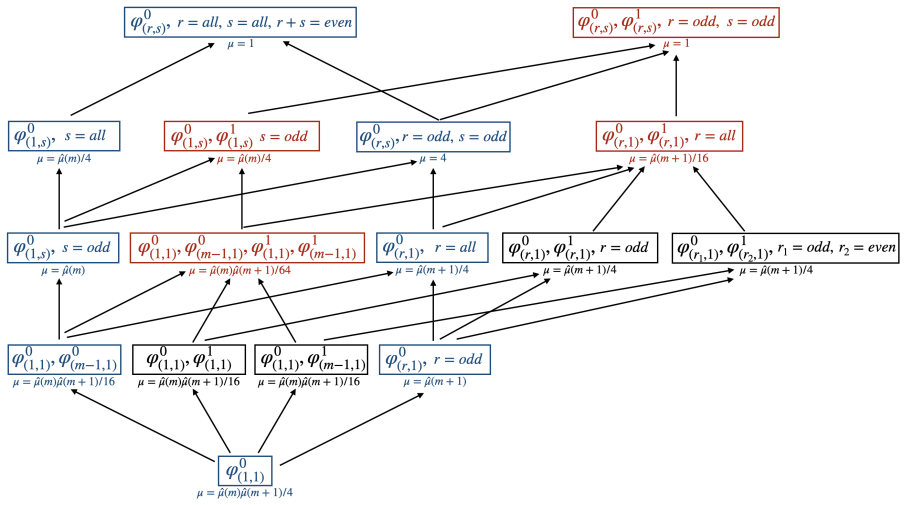
The machine doing the work is the tree of closed OPE subalgebras of complete minimal models, each node labelled by its local primary spectrum and by the global index $\mu$ of equation (2.19). The index is the size of the inclusion $\mathcal{A}(R_1\cup R_2)\subseteq \widehat{\mathcal{A}}(R_1\cup R_2)$ for two intervals, i.e. the amount of Haag duality violation, and it equals the total quantum dimension of the node's superselection sector category. The tree encodes, for every node, all possible completions and their relative indices; the preservation rule states that along a massless flow only the internal structure of the neutral algebra may change, while every branch above it is a spectator.
What would settle it
Produce a massless RG flow between local unitary minimal models in which the neutral algebra's global index or superselection category is not reproduced at the IR fixed point. A concrete test is a lattice or bootstrap realization of the $(2,1)$ perturbation of the tricritical Ising model that ends at a non-trivial local CFT, which would contradict the paper's no-go; equivalently, compute $\mu$ at both endpoints of the $(1,3)$ flow and check that the values match.
Extended reading notes
Core claim
The central discovery is a constructive classification plus a preservation rule. Starting from a chiral algebra, the paper adds primary fields one at a time, imposing T-invariance (locality) and closure of the OPE; the resulting local algebras form a tree for each label $m$. There are only finitely many nodes for each $m$ (eight bosonic submodels of the diagonal series, further submodels for the D and E series), and the global index of a node is $$\mu = \left(\frac{\sum_{r,s} d_{r,s}^2}{\sum_{r',s';r'',s''} d_{r',s'} M_{r',s';r'',s''} d_{r'',s''}}\right)^2,$$ where $d_{r,s}$ are the quantum dimensions of the Virasoro representations and $M$ is the coupling matrix of the partition function; modular invariant nodes have $\mu=1$. Acting as a generalized symmetry, the category of superselection sectors at and above a perturbed node cannot change under a massless RG flow. Consequently the global and relative indices and the inclusion pattern of all completions are preserved, and candidate IR endpoints are selected by matching the category of the UV neutral algebra.
Load-bearing premise
The entire RG section rests on the assumption that a massless flow maps the UV theory completely onto the IR theory, so that the category of superselection sectors at and above the perturbed node is exactly preserved; this is stated as an expectation rather than proven, and massive flows are explicitly set aside.
Editorial extensions
If this is right
- The finer classification predicts, for every $m$, a fixed finite set of local bosonic $c<1$ CFTs: eight submodels of the diagonal A series, plus D- and E-series submodels, together with their primary spectra and inclusion relations.
- The $(1,3)$ perturbation from $m+1$ to $m$ carries the category $\mathrm{su}(2)_{m-1}$, so the flow is allowed for every $m$, not only in the perturbative limit.
- The $(1,2)$ perturbation preserves $\mathrm{su}(2)^{\mathrm{even}}_{m-1}$; for odd $m$ the IR can be a non-diagonal submodel, and in general non-diagonal models flow only to non-diagonal models.
- The $(2,1)$ perturbation has a superselection category that appears in no smaller minimal model, so a massless flow to a local CFT is excluded and any endpoint must contain massive sectors.
- Because every UV operator sits in a class of the preserved category, the rule assigns non-perturbative selection rules and field-class maps that match the known perturbative operator mixing.
Reading between the lines
- If the preservation rule holds, it gives a practical consistency test for any proposed minimal-model flow: compute the global index (2.19) of the UV neutral algebra and require the IR node to have the same index and the same set of completions; this could be checked in lattice or tensor-network realizations.
- The same tree construction should extend to rational CFTs with $c>1$, where complete models are coset constructions; enumerating their OPE-closed subalgebras would organize flows between coset models by the same category-preservation rule.
- The paper's partially-massless conjecture implies that whenever some fields become massive while the stress tensor stays massless, the massive fields must be charged under an exact internal symmetry of the full theory; this is a testable 'naturalness' diagnostic in perturbative examples.
Editorial analysis
A structured set of objections, weighed in public.
Referee Report
Summary. The paper proposes a finer classification of local unitary c<1 two-dimensional CFTs than the usual ADE classification of modular-invariant partition functions. Starting from a chiral algebra and imposing only T-invariance and OPE closure, the authors construct trees of local submodels inside each modular-invariant completion. Each node carries a global Jones index computed from the partition function via Eq. (2.19), and the nodes are organized by inclusion relations. The classification is compared with the Kawahigashi-Longo algebraic classification where the models are parity-symmetric. The second part uses the trees to constrain massless RG flows: the authors argue that the DHR superselection category at and above the perturbed node is preserved, yielding selection rules that recover the Zamolodchikov flow and produce new predictions, including a no-go statement for flows triggered by the (2,1) field.
Significance. If the claims hold, the paper provides a concrete, field-theoretic counterpart to the algebraic classification of local conformal nets: explicit spectra, inclusion trees, and Jones indices for all local minimal models, not only modular-invariant ones. The index formula (2.19) is simple and, on the examples checked, agrees with the KL classification and with Jones index constraints. The RG selection rules are falsifiable and give a unified explanation of known flows as well as new predictions (for example, the impossibility of a massless IR fixed point for the (2,1) perturbation, item (d) in Section 3). The paper is therefore potentially important for connecting bootstrap methods, algebraic QFT, and RG analysis in 2D CFT.
major comments (3)
- [Section 3, pp. 26-27] The preservation principle for massless RG flows is the load-bearing assumption of the paper: 'Under these conditions, we expect' preservation of global and relative Jones indices, completion structure, and DHR categories at or above the perturbed node. Not only is this introduced as an expectation rather than a derivation, but the paper also explicitly excludes massive flows. Items (b), (c), and (d) and the category matching in Eq. (3.2) all depend on this principle. The text gives no concrete criterion for when a sector remains massless and no proof that the DHR category cannot change in a massless flow. Since this is exactly where a counterexample would break the central new claims, the authors should either prove the principle from known results (e.g., from the transportability of DHR sectors) or test it in a non-trivial solvable case such as the tricritical Ising to Ising flow, stating clearly the regime of validity.
- [Section 2.5, paragraph after Eq. (2.31)] The exhaustiveness of the classification rests on the statement 'A computer search shows there are no additional ones,' with no description of the algorithm, the search space, or the verification steps. The same issue arises in Sections 2.6 and 2.7, where numbers of submodels are quoted without proof. Since the paper's central claim is that the trees are complete, this is not a presentation issue: a reader cannot verify that all closed OPE subalgebras have been found. The authors should provide the search code as supplemental material or give a mathematical argument reducing the search to a finite check that can be inspected.
- [Section 2.7, E6 examples] The submodels of the E6 modular invariants are built using fusion rules from Ref. [51], which was unpublished at the time of writing. The manuscript thanks the authors for communicating the results 'prior to the publication.' Now that [51] is available as arXiv:2502.14295, the authors should confirm that all fusion rules used here agree with the published version and state this explicitly. Until then, the E6 part of the classification and the RG statements in Section 3.2 are not independently verifiable from the present manuscript alone.
minor comments (4)
- [Table 3, Section 2.6.2] The global index in row 4 of Table 3 appears to have a typo: it contains sin^{-4}(π/(m+1)) twice, whereas the analogous entry in Table 2 has sin^{-4}(π/m) sin^{-4}(π/(m+1)). The category name '(A4n, Dn+2)' should presumably be '(A4n, D2n+2)'.
- [Figure 11 caption] The caption says 'for m = 4n + 1', but the section is about the m = 4n - 1 case; the figure label should be corrected.
- [Section 2.7, list of non-parity-symmetric models] There are several typos in the sets, for example 'ss= 1, 2, 3, . . . ,11, 12' and 's= 1, 12' in a context where s is otherwise summed over a range; please clean up the notation so that the field content is unambiguous.
- [Section 3.2] Minor typos include 'completations', 'alegbra', 'tricrital', and 'form mU V = 13' for 'from mUV = 13'; these should be corrected in a final pass.
Circularity Check
No circularity: the classification is constructive and benchmarked externally, and the RG selection rules are conditional on an explicitly labeled preservation assumption rather than on a fit or self-referential definition.
full rationale
The paper's derivation chain is not circular. The classification in Section 2 is constructive: nodes are built by imposing T-invariance, OPE closure, and locality on subalgebras of the ADE modular invariants; the global index is computed from Eq. (2.19); and the resulting trees are checked against the external Kawahigashi-Longo classification and against known OPE data from Ribault [49] and from Nivesvivat-Ribault [51]. No quantity used in the classification is fitted to the RG predictions, and no RG prediction is fed back into the index formula. The central RG input in Section 3 is the preservation of the DHR superselection category above the perturbed node. This is explicitly introduced as an expectation and as an assumption: the paper states 'Under these conditions, there will be a preservation of sectors between the UV and IR fix points. In this case, we expect' and then lists the preservation of categories, indices, and completions. The selection rules are therefore conditional statements: if the category is preserved, the IR theory must realize the same category. That is an unproven physical premise, not an equivalence-by-construction or fitted-input-called-prediction. The paper also explicitly excludes massive flows and assumes no UV interpolating field acquires exponentially decaying correlators; if that premise fails, the new predictions in items (b), (c), and (d) would not follow. That is a correctness risk and a gap, but not a circularity. The self-citations to the companion paper [6] for 'modular invariance as completeness' are load-bearing for the overall framework, but they are prior parameter-free results whose stated assumptions do not include the RG claims of this paper, so they constitute independent support rather than circular reasoning. The absence of a fully explicit exhaustion proof for the computer search in the general-m classification is an omitted-proof concern, not a circular step.
Assumptions & free parameters
assumptions (6)
- domain assumption Modular invariance is equivalent to completeness (absence of superselection sectors), and all local models are submodels of complete ones.
- domain assumption T-duality invariance is equivalent to locality of fields through the spin condition 2(h(r,s)-h(r',s')) integer.
- domain assumption The OPE of local diagonal fields coincides with the chiral fusion rules (2.23), and for non-diagonal fields is given by (2.38) following Ribault [49].
- ad hoc to paper For a massless RG flow, the DHR superselection category at and above the perturbed node is preserved.
- ad hoc to paper Exhaustiveness of the listed submodels follows from 'a computer search shows there are no additional ones' and analogous statements for the D and E series.
- domain assumption E-series fusion rules are taken from the unpublished work [51] of Nivesvivat and Ribault.
Cite this review
Pith. "Pith review of Selection rules for RG flows of minimal models." pith.science (2026). https://pith.science/paper/433R63TT
@misc{pith2026241216587,
  author       = {Pith},
  title        = {Pith review of: Selection rules for RG flows of minimal models},
  year         = {2026},
  howpublished = {\url{https://pith.science/paper/433R63TT}},
  note         = {Machine review of arXiv:2412.16587}
}
read the original abstract
Minimal d=2 CFTs are usually classified through modular invariant partition functions. There is a finer classification of ``non complete'' models when S-duality is not imposed. We approach this classification by starting with the local chiral algebra and adding primaries sequentially. At each step, we only impose locality (T-duality) and closure of the operator algebra. For each chiral algebra, this produces a tree-like graph. Each tree node corresponds to a local d=2 CFT, with an intrinsic Jones index measuring the size of Haag duality violation. This index can be computed with the partition function and is related to the total quantum dimension of the category of superselection sectors of the node, and to the relative size between the node and a modular invariant completion. In this way, we find in a very explicit manner a classification of local minimal (c<1) d=2 CFTs. When appropriate, this matches Kawahigashi-Longo's previous results. We use this finer classification to constrain RG flows. For a relevant perturbation, the flow can be restricted to the subalgebra associated with it, typically corresponding to a non-modular invariant node in the tree. The structure of the graph above such node needs to be preserved by the RG flow. In particular, the superselection sector category for the node must be preserved. This gives selection rules that recover in a unified fashion several known facts while unraveling new ones.
Figures


Figures from the paper (17 more)




Forward citations
Cited by 4 Pith papers
-
Characterizing gapped phases by smeared boundary conformal field theories: Duality in unusual ordering with spontaneously broken generalized symmetries
Gapped phases dual to massless RG flows in 2D CFTs exhibit unusual ordering via spontaneous breaking of non-group-like symmetries and are characterized using smeared boundary CFTs applied to smeared Ishibashi states.
-
Symmetry, Symmetry Topological Field Theory and von Neumann Algebra
The symmetric-sector von Neumann algebra of a QFT violates additivity or Haag duality exactly when the Lagrangian algebra of its SymTFT contains operators beyond the identity, with a sharper criterion distinguishing t...
-
Minimal Models RG flows: non-invertible symmetries & non-perturbative description
A three-parameter NLIE family is conjectured to encode exact ground-state energies for anomaly-matched RG flows between Virasoro minimal models, generalizing known integrable cases.
-
Gauging or extending bulk and boundary conformal field theories: Application to bulk and domain wall problem in topological matter and their descriptions by (mock) modular covariant
New classes of boundary and coupled conformal field theories are constructed from Z_N gauging, with a proposed dictionary to topological order, nonchiral anyons, and domain walls.
Reference graph
Works this paper leans on
-
[51]
Fusion rules and structure constants of E-series minimal models,
R. Nivesvivat and S. Ribault, “Fusion rules and structure constants of E-series minimal models,” arXiv:2502.14295 [hep-th]
-
[6]
Modular invariance as completeness,
V. Benedetti, H. Casini, Y. Kawahigashi, R. Longo, and J. M. Magan, “Modular invariance as completeness,”arXiv:2408.04011 [hep-th]
-
[1]
Entropic order parameters for the phases of QFT,
H. Casini, M. Huerta, J. M. Magan, and D. Pontello, “Entropic order parameters for the phases of QFT,”JHEP 04 (2021) 277, arXiv:2008.11748 [hep-th]
arXiv 2021
-
[2]
On completeness and generalized symmetries in quantum field theory,
H. Casini and J. M. Magan, “On completeness and generalized symmetries in quantum field theory,” Mod. Phys. Lett. A36 no. 36, (2021) 2130025,arXiv:2110.11358 [hep-th]
arXiv 2021
-
[3]
Entanglement entropy and superselection sectors. Part I. Global symmetries,
H. Casini, M. Huerta, J. M. Magán, and D. Pontello, “Entanglement entropy and superselection sectors. Part I. Global symmetries,”JHEP 02 (2020) 014, arXiv:1905.10487 [hep-th]
arXiv 2020
-
[4]
Francesco, P
P. Francesco, P. Mathieu, and D. Sénéchal,Conformal field theory. Springer Science & Business Media, 2012
2012
-
[5]
The ADE Classification of Minimal and A1(1) Conformal Invariant Theories,
A. Cappelli, C. Itzykson, and J. B. Zuber, “The ADE Classification of Minimal and A1(1) Conformal Invariant Theories,”Commun. Math. Phys.113 (1987) 1
work page 1987
-
[7]
Locality and modular invariance in 2D conformal QFT
K.-H. Rehren, “Locality and modular invariance in 2-D conformal QFT,”Fields Inst. Commun. 30 (2001) 341–354, arXiv:math-ph/0009004
work page Pith review arXiv 2001
Show all 61 references
-
[8]
On Superselection Theory of Quantum Fields in low Dimensions,
M. Muger, “On Superselection Theory of Quantum Fields in low Dimensions,” in16th International Congress on Mathematical Physics, pp. 496–503. 2010.arXiv:0909.2537 [math-ph]
2010 arXiv
-
[9]
Multi-interval subfactors and modularity of representations in conformal field theory,
Y. Kawahigashi, R. Longo, and M. Muger, “Multi-interval subfactors and modularity of representations in conformal field theory,”Commun. Math. Phys.219 (2001) 631–669, arXiv:math/9903104 [math-oa]
2001 arXiv
-
[10]
Classification of local conformal nets: Case c< 1,
Y. Kawahigashi and R. Longo, “Classification of local conformal nets: Case c< 1,” Annals Math.160 (2004) 493–522, arXiv:math-ph/0201015
2004 arXiv
-
[11]
Classification of two-dimensional local conformal nets with c less than 1 and 2 cohomology vanishing for tensor categories,
Y. Kawahigashi and R. Longo, “Classification of two-dimensional local conformal nets with c less than 1 and 2 cohomology vanishing for tensor categories,”Commun. Math. Phys. 244 (2004) 63–97, arXiv:math-ph/0304022
2004 arXiv
-
[12]
Local observables and particle statistics. 1,
S. Doplicher, R. Haag, and J. E. Roberts, “Local observables and particle statistics. 1,” Commun. Math. Phys.23 (1971) 199–230
1971
-
[13]
Local observables and particle statistics. 2,
S. Doplicher, R. Haag, and J. E. Roberts, “Local observables and particle statistics. 2,” Commun. Math. Phys.35 (1974) 49–85
1974
-
[14]
Why there is a field algebra with a compact gauge group describing the superselection structure in particle physics,
S. Doplicher and J. E. Roberts, “Why there is a field algebra with a compact gauge group describing the superselection structure in particle physics,”Commun. Math. Phys.131 (1990) 51–107
1990
-
[15]
Nets of subfactors,
R. Longo and K.-H. Rehren, “Nets of subfactors,”Rev. Math. Phys.7 (1995) 567–598, arXiv:hep-th/9411077 [hep-th]
1995 arXiv
-
[16]
Modular invariants, graphs and alpha induction for nets of subfactors. 1.,
J. Bockenhauer and D. E. Evans, “Modular invariants, graphs and alpha induction for nets of subfactors. 1.,”Commun. Math. Phys.197 (1998) 361–386, arXiv:hep-th/9801171
1998 arXiv
-
[19]
Renormalization Group and Perturbation Theory Near Fixed Points in Two-Dimensional Field Theory,
A. B. Zamolodchikov, “Renormalization Group and Perturbation Theory Near Fixed Points in Two-Dimensional Field Theory,”Sov. J. Nucl. Phys.46 (1987) 1090
1987
-
[20]
From tricritical Ising to critical Ising by thermodynamic Bethe ansatz,
A. B. Zamolodchikov, “From tricritical Ising to critical Ising by thermodynamic Bethe ansatz,” Nucl. Phys. B358 (1991) 524–546
1991
-
[21]
Thermodynamic Bethe ansatz for RSOS scattering theories,
A. B. Zamolodchikov, “Thermodynamic Bethe ansatz for RSOS scattering theories,”Nucl. Phys. B358 (1991) 497–523
1991
-
[22]
The scaling region of the tricritical Ising model in two-dimensions,
M. Lassig, G. Mussardo, and J. L. Cardy, “The scaling region of the tricritical Ising model in two-dimensions,”Nucl. Phys. B348 (1991) 591–618
1991
-
[23]
Superconformal Invariance in Two-Dimensions and the Tricritical Ising Model,
D. Friedan, Z.-a. Qiu, and S. H. Shenker, “Superconformal Invariance in Two-Dimensions and the Tricritical Ising Model,”Phys. Lett. B151 (1985) 37–43
1985
-
[24]
Supersymmetry, Two-dimensional Critical Phenomena and the Tricritical Ising Model,
Z. A. Qiu, “Supersymmetry, Two-dimensional Critical Phenomena and the Tricritical Ising Model,” Nucl. Phys. B270 (1986) 205–234
1986
-
[25]
RG Flow in N=1 Discrete Series,
D. A. Kastor, E. J. Martinec, and S. H. Shenker, “RG Flow in N=1 Discrete Series,”Nucl. Phys. B316 (1989) 590–608
1989
-
[26]
Superconformal Symmetry in Two-Dimensions,
M. A. Bershadsky, V. G. Knizhnik, and M. G. Teitelman, “Superconformal Symmetry in Two-Dimensions,” Phys. Lett. B151 (1985) 31–36
1985
-
[27]
Domain Walls for Two-Dimensional Renormalization Group Flows,
D. Gaiotto, “Domain Walls for Two-Dimensional Renormalization Group Flows,”JHEP 12 (2012) 103, arXiv:1201.0767 [hep-th]
2012 arXiv
-
[28]
Two Dimensional Renormalization Group Flows in Next to Leading Order,
R. Poghossian, “Two Dimensional Renormalization Group Flows in Next to Leading Order,” JHEP 01 (2014) 167, arXiv:1303.3015 [hep-th]
2014 arXiv
-
[29]
RG flows of nondiagonal minimal models perturbed by phi(1,3),
F. Ravanini, “RG flows of nondiagonal minimal models perturbed by phi(1,3),”Phys. Lett. B 274 (1992) 345–351, arXiv:hep-th/9110018
1992 arXiv
-
[30]
RG flows in the D series of minimal CFTs,
T. R. Klassen and E. Melzer, “RG flows in the D series of minimal CFTs,”Nucl. Phys. B 400 (1993) 547–573, arXiv:hep-th/9110047
1993 arXiv
-
[31]
Hidden Quantum Group Symmetry and Integrable Perturbations of Conformal Field Theories,
N. Reshetikhin and F. Smirnov, “Hidden Quantum Group Symmetry and Integrable Perturbations of Conformal Field Theories,”Commun. Math. Phys.131 (1990) 157–178
1990
-
[32]
Exact S matrices for phi(1,2) perturbated minimal models of conformal field theory,
F. A. Smirnov, “Exact S matrices for phi(1,2) perturbated minimal models of conformal field theory,” Int. J. Mod. Phys. A6 (1991) 1407–1428
1991
-
[33]
Lattice supersymmetry and order-disorder coexistence in the tricritical Ising model,
E. O’Brien and P. Fendley, “Lattice supersymmetry and order-disorder coexistence in the tricritical Ising model,”Phys. Rev. Lett.120 no. 20, (2018) 206403,arXiv:1712.06662 [cond-mat.stat-mech]
2018 arXiv
-
[34]
Topological Defects on the Lattice I: The Ising model,
D. Aasen, R. S. K. Mong, and P. Fendley, “Topological Defects on the Lattice I: The Ising model,” J. Phys. A49 no. 35, (2016) 354001,arXiv:1601.07185 [cond-mat.stat-mech]
2016 arXiv
-
[35]
Topological Defects on the Lattice: Dualities and Degeneracies,
D. Aasen, P. Fendley, and R. S. K. Mong, “Topological Defects on the Lattice: Dualities and Degeneracies,” arXiv:2008.08598 [cond-mat.stat-mech]
2008 arXiv
-
[36]
Topological Defect Lines and Renormalization Group Flows in Two Dimensions,
C.-M. Chang, Y.-H. Lin, S.-H. Shao, Y. Wang, and X. Yin, “Topological Defect Lines and Renormalization Group Flows in Two Dimensions,”JHEP 01 (2019) 026, arXiv:1802.04445 [hep-th] . 49
2019 arXiv
-
[37]
Particle-Soliton Degeneracies from Spontaneously Broken Non-Invertible Symmetry,
C. Cordova, D. García-Sepúlveda, and N. Holfester, “Particle-Soliton Degeneracies from Spontaneously Broken Non-Invertible Symmetry,”arXiv:2403.08883 [hep-th]
-
[38]
Entanglement entropy along a massless renormalisation flow: the tricritical to critical Ising crossover,
F. Rottoli, F. Ares, P. Calabrese, and D. X. Horváth, “Entanglement entropy along a massless renormalisation flow: the tricritical to critical Ising crossover,”JHEP 02 (2024) 053, arXiv:2309.17199 [hep-th]
2024 arXiv
-
[39]
Infinitely many new renormalization group flows between Virasoro minimal models from non-invertible symmetries,
Y. Nakayama and T. Tanaka, “Infinitely many new renormalization group flows between Virasoro minimal models from non-invertible symmetries,”JHEP 11 (2024) 137, arXiv:2407.21353 [hep-th]
2024 arXiv
-
[40]
Ginzburg-Landau description of a class of non-unitary minimal models,
A. Katsevich, I. R. Klebanov, and Z. Sun, “Ginzburg-Landau description of a class of non-unitary minimal models,” arXiv:2410.11714 [hep-th]
-
[41]
Index for subfactors
V. Jones, “Index for subfactors.”Inventiones mathematicae72 (1983) 1–26. http://eudml.org/doc/143011
1983
-
[42]
Index of subfactors and statistics of quantum fields. I,
R. Longo, “Index of subfactors and statistics of quantum fields. I,”Commun. Math. Phys. 126 (1989) 217–247
1989
-
[43]
Relative Entropy in CFT,
R. Longo and F. Xu, “Relative Entropy in CFT,”Adv. Math.337 (2018) 139–170, arXiv:1712.07283 [math.OA]
2018 arXiv
-
[44]
On Relative Entropy and Global Index,
F. Xu, “On Relative Entropy and Global Index,”Trans. Am. Math. Soc.373 no. 5, (2020) 3515–3539, arXiv:1812.01119 [math-ph]
2020 arXiv
-
[45]
Variational approach to relative entropies with an application to QFT,
S. Hollands, “Variational approach to relative entropies with an application to QFT,”Lett. Math. Phys.111 no. 6, (2021) 136,arXiv:2009.05024 [quant-ph]
2021 arXiv
-
[46]
Entropic order parameters in weakly coupled gauge theories,
H. Casini, J. M. Magan, and P. J. Martinez, “Entropic order parameters in weakly coupled gauge theories,”arXiv:2110.02980 [hep-th]
-
[47]
Proof of the universal density of charged states in QFT,
J. M. Magan, “Proof of the universal density of charged states in QFT,”JHEP 12 (2021) 100, arXiv:2111.02418 [hep-th]
2021 arXiv
-
[48]
Quantum Complementarity through Entropic Certainty Principles,
J. M. Magan and D. Pontello, “Quantum Complementarity through Entropic Certainty Principles,” Phys. Rev. A103 no. 1, (2021) 012211,arXiv:2005.01760 [hep-th]
2021 arXiv
-
[49]
Minimal lectures on two-dimensional conformal field theory,
S. Ribault, “Minimal lectures on two-dimensional conformal field theory,”SciPost Phys. Lect. Notes1 (2018) 1, arXiv:1609.09523 [hep-th]
2018 arXiv
-
[50]
Fermionic minimal models,
C.-T. Hsieh, Y. Nakayama, and Y. Tachikawa, “Fermionic minimal models,”Physical Review Letters126 no. 19, (2021) 195701
2021
-
[52]
Correlation functions along a massless flow,
G. Delfino, G. Mussardo, and P. Simonetti, “Correlation functions along a massless flow,” Phys. Rev. D51 (1995) 6620–6624, arXiv:hep-th/9410117
1995 arXiv
-
[53]
The fate of non-supersymmetric Gross-Neveu-Yukawa fixed point in two dimensions,
Y. Nakayama and K. Kikuchi, “The fate of non-supersymmetric Gross-Neveu-Yukawa fixed point in two dimensions,”JHEP 03 (2023) 240, arXiv:2212.06342 [hep-th]
2023 arXiv
-
[54]
Infrared phases of 2d QCD,
D. Delmastro, J. Gomis, and M. Yu, “Infrared phases of 2d QCD,”JHEP 02 (2023) 157, arXiv:2108.02202 [hep-th]
2023 arXiv
-
[55]
Index for subfactors,
V. F. R. Jones, “Index for subfactors,”Invent. Math.72 (1983) 1–25. 50
1983
-
[56]
Extension of jones’ theory on index to arbitrary factors,
H. Kosaki, “Extension of jones’ theory on index to arbitrary factors,”Journal of Functional Analysis66 no. 1, (1986) 123 – 140
1986
-
[57]
Haag,Local quantum physics: Fields, particles, algebras
R. Haag,Local quantum physics: Fields, particles, algebras. Springer Science & Business Media, 2012
2012
-
[58]
Superselection sectors with braid group statistics and exchange algebras II,
K. Fredenhagen, K.-H. Rehren, and B. Schroer, “Superselection sectors with braid group statistics and exchange algebras II,”Rev. Math. Phys.4 no. spec01, (1992) 113–157
1992
-
[59]
Superselection Sectors with Braid Group Statistics and Exchange Algebras. 1. General Theory,
K. Fredenhagen, K.-H. Rehren, and B. Schroer, “Superselection Sectors with Braid Group Statistics and Exchange Algebras. 1. General Theory,”Commun. Math. Phys.125 (1989) 201
1989
-
[60]
Entanglement Renyi entropies in holographic theories,
M. Headrick, “Entanglement Renyi entropies in holographic theories,”Phys. Rev.D82 (2010) 126010, arXiv:1006.0047 [hep-th]
2010 arXiv
-
[61]
Modular invariants from subfactors: Type I coupling matrices and intermediate subfactors,
J. Bockenhauer and D. E. Evans, “Modular invariants from subfactors: Type I coupling matrices and intermediate subfactors,”Commun. Math. Phys.213 (2000) 267, arXiv:math/9911239
2000 arXiv
-
[62]
Modular invariants, graphs andα-induction for nets of subfactors II,
J. Bockenhauer and D. E. Evans, “Modular invariants, graphs andα-induction for nets of subfactors II,” Commun. Math. Phys.200 (1999) 57–103, arXiv:hep-th/9805023
1999 arXiv
-
[63]
Modular invariants, graphs andα-induction for nets of subfactors. III,
J. Bockenhauer and D. E. Evans, “Modular invariants, graphs andα-induction for nets of subfactors. III,” Commun. Math. Phys.205 (1999) 183–228, arXiv:hep-th/9812110. 51
1999 arXiv
Reviewed August 11, 2026 · model on record in the stance chip above.
Discussion (0). Continue with ORCID to comment.