REVIEW 2 major objections 5 minor 125 references
Empirical Coordination of Quantum Correlations
T0 review · 2 major / 5 minor · reviewed 2026-08-11 · deepseek-v4-flash
Pith's one-line read Empirical coordination of quantum correlations has exact capacity formulas: over classical links the rates are an optimization over separable state extensions, and over a quantum link the two-node capacity is the von Neumann entropy…
desk verdict New framework for empirical coordination of quantum correlations, but the headline classical-link capacity theorems are not proven: the converse bounds only accessible information, which can be strictly below the claimed infimum over extensions. read the letter →
The pith
A machine-rendered reading of the paper's core claim, the machinery that carries it, and where it could break.
The reading
What carries the argument
The load-bearing object is the set of separable classical-quantum extensions, written $S(\omega)$: a decomposition $\sigma_{XYZABC}=\sum_{x,y,z} p_{XYZ}(x,y,z) |x\rangle\langle x|\otimes|y\rangle\langle y|\otimes|z\rangle\langle z|\otimes\sigma^x_A\otimes\sigma^y_B\otimes\sigma^z_C$ whose $X$-register marginal reproduces the target $\omega_{XABC}$. The capacity formulas are infima or unions over this set. The achievability side runs through a generic random-binning and covering lemma, combined with rate-splitting for the cascade; the converse side measures the output systems projectively and applies classical entropy-continuity bounds, with quantum continuity bounds in the quantum-link cases.
What would settle it
Search over separable two-qubit target states for one where the infimum over extensions of $I(X;Y)$ strictly exceeds the Holevo information of the induced ensemble; for such a target, the converse's measurement step cannot certify the claimed capacity. The decisive check is then to run a two-node empirical-coordination protocol at a rate below the claimed formula and test whether the empirical average state still converges to the target.
Extended reading notes
Core claim
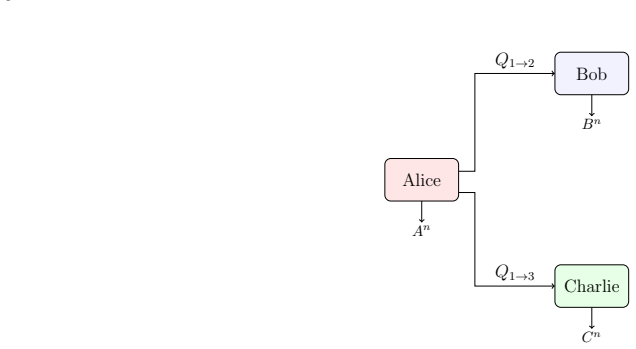
The paper's central claim is that empirical coordination capacities for quantum states can be characterized exactly. For a two-node classical-link network, the capacity is $\inf_{\sigma} I(X;Y)_\sigma$ over all separable classical-quantum extensions of the target state, and coordination is impossible when the target is entangled. For the three-node cascade, the capacity region is the union, over separable extensions $\sigma_{XYZABC}$ with $\sigma_{XABC}=\omega_{XABC}$, of rate pairs $(R_{12},R_{23})$ satisfying $R_{12} \ge I(X;YZ)_\sigma$ and $R_{23} \ge I(X;Z)_\sigma$. With a quantum link, the two-node capacity is $H(B)_\omega$, and in the broadcast network with receivers' side information the region is $Q_{12} \ge H(B|X)_\omega$, $Q_{23} \ge H(C|Y)_\omega$. A further theorem states that shared randomness before transmission does not change any of these optimal rates.
Load-bearing premise
The classical-link converse proofs presume that measuring Bob's and Charlie's outputs in a fixed projective basis and then applying classical coordination inequalities can certify the true quantum rate; if non-orthogonal output states allow the real minimum to fall below the extension-optimization formula, those lower bounds would not be tight.
Editorial extensions
If this is right
- Any separable bipartite state can be coordinated over a single classical link at the minimal rate $\inf I(X;Y)$ over extensions, while any entangled state cannot be coordinated at all.
- In the cascade network, the second link only needs to cover the $X$-$Z$ correlation, while the first link must cover the full $X$-$YZ$ correlation, and the two constraints cannot be reduced to a single Markov chain condition.
- Common randomness is never necessary for empirical coordination: every CR-assisted protocol can be derandomized without increasing the required rates.
- For a two-node quantum link, the optimal rate is exactly the von Neumann entropy of Bob's reduced state, so classical compression wisdom carries over to average-state simulation.
- In the nonlocal-game application, the resources needed to implement a game strategy are the conditional entropies from the broadcast theorem, and for the CHSH example a Bell violation appears once the coordination rate exceeds about $0.2643$ qubits per round.
Reading between the lines
- Editorial inference: the appearance of optimization over extensions suggests a general principle for classical-link quantum coordination: the capacity problem is a convex or variational computation over state decompositions, so the next practical bottleneck is algorithmic rather than conceptual.
- Editorial inference: the results are asymptotic, and the finite-blocklength behavior of empirical coordination may require a different figure of merit than trace distance; a one-shot version of these capacity formulas is a natural open problem.
- Editorial inference: the CHSH example indicates that even a small amount of shared entanglement, below the Bell-violation threshold, can sharply raise the winning probability because the payoff gradient is steep near zero entanglement; this suggests a testable prediction that coordination rates near the threshold suffice for near-maximal advantage in games with steep payoff functions.
- Editorial inference: the broadcast theorem assumes Alice is ignorant of the receivers' questions; a variant where Alice receives the question side information before encoding would relax the non-signaling constraints (77) and likely change the rate region.
Editorial analysis
A structured set of objections, weighed in public.
Referee Report
Summary. The paper introduces empirical coordination for quantum correlations, where the goal is for a network of quantum nodes to produce a time-averaged joint state close to a target state, and characterizes the minimal classical or quantum communication rates for several small networks. For classical links, it treats a two-node network, a three-node cascade, and an isolated-node special case, giving rate formulas as infima over separable state extensions; it also proves that common randomness does not change the achievable rates. For quantum links, it gives the two-node capacity H(B)_ω and a broadcast-network region with rates H(B|X) and H(C|Y). The paper includes achievability via covering arguments, converse arguments, examples, and a discussion of applications to nonlocal games and CHSH.
Significance. If the main theorems are correct, the paper provides exact minimal communication resources for average-state simulation in simple quantum networks, a natural quantum analogue of classical empirical coordination. The quantum-link results are appealing and the achievability side is built on standard covering arguments and on the authors' published strong-coordination results, which are appropriately cited. The discussion connecting empirical coordination to nonlocal games is interesting and gives a concrete operational interpretation. However, the converse proofs for the classical-link theorems (Theorems 2 and 3) contain a load-bearing gap: they lower-bound the rate by the accessible information of a fixed projective measurement on Bob's output, which can be strictly smaller than the claimed infimum over separable extensions. Because this gap affects the central capacity claims for classical links, the paper is not yet ready for acceptance.
major comments (2)
- [Section VIII-A, Eqs. (117)-(123)] The converse for Theorem 2 measures Bob's output in a fixed projective basis and then applies the classical coordination converse, obtaining R ≥ I(XJ;YJ) for the induced classical distribution. This argument can only lower-bound the rate by the accessible information of the ensemble {p_X, ω^x_B}, whereas the claimed capacity is the infimum of I(X;Y) over extensions in S2-node(ω). For non-orthogonal conditional states these quantities differ: the accessible information is at most the Holevo quantity, while inf_{σ∈S2-node} I(X;Y)_σ is at least the Holevo quantity because X→Y→B is a Markov chain for every extension. A concrete failure is the state ω_XB = (1/2)|0⟩⟨0|⊗|0⟩⟨0| + (1/2)|1⟩⟨1|⊗|+⟩⟨+| with A trivial: S2-node forces Y=X, so the claimed infimum is I(X;Y)=1, but any projective measurement on B gives strictly less than 1 (about 0.399 for the optimal POVM). Thus the proof in Section VIII-A does not establish the claimed converse. The same gap affects Theorem 3 through Eqs. (128)-(132) in Section VIII-B. A valid converse would need to construct an extension, for example from the code's internal message, rather than measuring Bob's output in a fixed basis.
- [Section IV-C, formal definition and Eq. (53)] The formal definition of the cascade code gives Bob the conditional distribution p_{M2→3|X^n M1→2}, which means Bob has access to Alice's source sequence X^n. This contradicts the network model in Figure 5, where only Alice receives X^n, and it also contradicts the achievability scheme in Section VII-C, where Bob decodes Y^n and Z^n from the bin indices without seeing X^n. Moreover, the converse in Section VIII-B relies on the Markov chain X^n → M1→2 → (Y^n,Z^n); if Bob's message M2→3 depends on X^n, the inequality nR1→2 ≥ I(X^n;Y^nZ^n) in Eq. (128) is no longer justified (one would only get a bound involving n(R1→2+R2→3)). The definition should be p_{M2→3|M1→2}, and Eq. (53) should be updated accordingly.
minor comments (5)
- [Section V-B, Eq. (77)] There are notational typos in the non-signaling conditions: (77b) should state ω_AB^(x,y) = ω_AB^(x,y') for all y,y', rather than identifying the state with a state that depends only on y'; and in (77c), the quantifier 'x,x′ ∈ Y' should read 'x,x′ ∈ X'.
- [Section V-B, text before Theorem 6] The sentence preceding Eq. (78) lists the rate constraints as 'Q1→2 ≥ H(B|X)ω, Q1→2 ≥ H(C|Y)ω'; the second inequality should be Q1→3 ≥ H(C|Y)ω, as in the displayed region (78).
- [Example 1, Eq. (45)] The description of the improved decomposition is confusing: the sentence 'Y = X with probability 1' applies to the first decomposition, not to the improved one. For the improved rate 0.3112, Y is not a deterministic function of X; rather p_{Y|X}(0|0)=1 and p_{Y|X}(0|1)=p_{Y|X}(+|1)=1/2, yielding H(Y)=0.8113 and H(Y|X)=0.5.
- [Eq. (65)] There is a typographical artifact in Eq. (65): the displayed state ends with a comma and a period ('... , .'). This should be cleaned up.
- [Section VII-A, Lemma 7] The lemma statement and proof are essentially standard, but the dependence on δ is stated only through γ(δ) in Eq. (93) and the rate condition (105); it would help readers to state explicitly that the rate condition is asymptotically tight as δ→0 and n→∞.
Circularity Check
No circularity: the rate formulas are derived from standard coordination lemmas and independent strong-coordination results, not from their own conclusions.
full rationale
The paper's derivation chain does not reduce to its inputs by construction. Theorem 1 is a direct expectation/averaging argument. The classical-link capacity theorems (Theorems 2 and 3) are proved through a generic achievability lemma (Lemma 7) built on the classical coordination covering lemma of Cuff et al. [16], and through converse arguments that, whatever their mathematical correctness gap, do not assume the claimed rate formula. The apparent weakness in the classical-link converse — that a projective measurement on Bob's output yields only an accessible-information bound, while the theorem's infimum is over all separable extensions — is a correctness concern, not a circularity: no equation in the converse is equivalent by construction to the theorem statement. The quantum-link results (Theorems 5 and 6) use achievability from Schumacher compression and from the authors' prior strong-coordination theorem [60]; strong coordination implies empirical coordination (as argued in Remark 12), so this is a legitimate reduction to independent published results rather than a self-referential definition. Self-citations to [60] appear, but they are not load-bearing in a circular way: [60] is a published, stronger result with its own proof. The examples only evaluate the stated formulas for chosen decompositions; no fitted parameter is later renamed as a prediction. Hence no significant circularity is found.
Assumptions & free parameters
assumptions (6)
- standard math Finite-dimensional Hilbert spaces throughout
- domain assumption Memoryless i.i.d. source p_X for Alice's side information
- standard math Classical coordination capacity theorem of Cuff et al. [16]
- domain assumption Strong coordination results of Natur and Pereg [60] for quantum-link achievability
- standard math Entropy continuity bounds (Winter, Csiszar and Korner)
- ad hoc to paper The empirical-coordination criterion of average-state convergence is the correct quantum analogue
Cite this review
Pith. "Pith review of Empirical Coordination of Quantum Correlations." pith.science (2026). https://pith.science/paper/OP656FQR
@misc{pith2026241217119,
  author       = {Pith},
  title        = {Pith review of: Empirical Coordination of Quantum Correlations},
  year         = {2026},
  howpublished = {\url{https://pith.science/paper/OP656FQR}},
  note         = {Machine review of arXiv:2412.17119}
}
read the original abstract
We introduce the notion of empirical coordination for quantum correlations. Quantum mechanics enables the calculation of probabilities for experimental outcomes, emphasizing statistical averages rather than detailed descriptions of individual events. This makes empirical coordination a natural and operationally meaningful framework for quantum systems - particularly in the context of nonlocal games, which rely on repeated measurements to assess performance. We begin by analyzing networks with classical links, focusing on the cascade network. For this setting, we establish the optimal coordination rates, which indicate the minimal resources required to simulate a quantum state on average. Providing the users with shared randomness, before communication begins, does not affect the optimal rates for empirical coordination. Our analysis starts with a basic two-node scenario and extends to cascade networks, including the special case of a network with an isolated node. The results can be further generalized to other networks as our analysis includes a generic achievability scheme. The optimal rate formula involves optimization over a collection of state extensions. This is a unique feature of the quantum setting, as the classical parallel does not include optimization. As demonstrated through examples, the performance depends heavily on the choice of decomposition. We then extend the framework to networks with quantum links, focusing on a broadcast setting where the receivers have side information. Finally, we discuss how our results provide new insights into the implementation and simulation of quantum nonlocal games in the empirical regime.
Figures


Figures from the paper (12 more)


Reference graph
Works this paper leans on
-
[1]
Soni and R
J. Soni and R. Goodman, A mind at play: how Claude Shannon invented the information age . Simon and Schuster, 2017
2017
-
[2]
Channel coding: The road to channel capacity,
D. J. Costello and G. D. Forney, “Channel coding: The road to channel capacity,” Proc. IEEE , vol. 95, no. 6, pp. 1150–1177, 2007
2007
-
[3]
A survey on channel coding techniques for 5G wireless networks,
K. Arora, J. Singh, and Y . S. Randhawa, “A survey on channel coding techniques for 5G wireless networks,”Telecommun. Syst., vol. 73, no. 4, pp. 637–663, 2020
2020
-
[4]
A. E. Gamal and Y .-H. Kim, Network Information Theory . Cambridge University Press, 2011
2011
-
[5]
Internet-of-things enabled supply chain planning and coordination with big data services: Certain theoretic implications,
L. He, M. Xue, and B. Gu, “Internet-of-things enabled supply chain planning and coordination with big data services: Certain theoretic implications,” J. Manage. Sci. Eng. , vol. 5, no. 1, pp. 1–22, 2020
2020
-
[6]
A unifying approach to multiuser receiver design under QoS constraints,
H. Boche, M. Schubert, and S. Stanczak, “A unifying approach to multiuser receiver design under QoS constraints,” in 2005 IEEE 61st Vehicular Technol. Conf. , vol. 2, 2005, pp. 992–996 V ol. 2
2005
-
[7]
The capacity of wireless networks,
P. Gupta and P. Kumar, “The capacity of wireless networks,” IEEE Trans. Inf. Theory, vol. 46, no. 2, pp. 388–404, 2000
2000
-
[8]
The quantum multiple-access channel with cribbing encoders,
U. Pereg, C. Deppe, and H. Boche, “The quantum multiple-access channel with cribbing encoders,” IEEE Trans. Inf. Theory, vol. 68, no. 6, pp. 3965–3988, 2022
2022
Show all 125 references
-
[9]
Secure communication with unreliable entanglement assistance,
M. Lederman and U. Pereg, “Secure communication with unreliable entanglement assistance,” in 2024 IEEE Int. Symp. Inf. Theory (ISIT) , 2024, pp. 1017–1022
2024
-
[10]
Linear multiuser receivers: Effective interference, effective bandwidth and user capacity,
D. N. C. Tse and S. V . Hanly, “Linear multiuser receivers: Effective interference, effective bandwidth and user capacity,” IEEE Trans. Inf. theory , vol. 45, no. 2, pp. 641–657, 1999
1999
-
[11]
Identification over quantum broadcast channels,
J. Rosenberger, C. Deppe, and U. Pereg, “Identification over quantum broadcast channels,” Quantum Inf. Process. , vol. 22, no. 10, p. 361, 2023
2023
-
[12]
The multiple-access channel with entangled transmitters,
U. Pereg, C. Deppe, and H. Boche, “The multiple-access channel with entangled transmitters,” in Proc. Global Commun. Conf. (GLOBECOM’2023). IEEE, 2023, pp. 3173–3178
2023
-
[13]
Covert communication over a k -user multiple-access channel,
K. S. K. Arumugam and M. R. Bloch, “Covert communication over a k -user multiple-access channel,” IEEE Trans. Inf. Theory, vol. 65, no. 11, pp. 7020–7044, 2019
2019
-
[14]
Message identification for task-oriented communications: Exploiting an exponential increase in the number of connected devices,
L. Torres-Figueroa, R. Ferrara, C. Deppe, and H. Boche, “Message identification for task-oriented communications: Exploiting an exponential increase in the number of connected devices,” IEEE Internet of Things Mag. , vol. 6, no. 4, pp. 42–47, 2023
2023
-
[15]
Communication for generating correlation: A unifying survey,
M. Sudan, H. Tyagi, and S. Watanabe, “Communication for generating correlation: A unifying survey,” IEEE Trans. Inf. Theory, vol. 66, no. 1, pp. 5–37, 2019
2019
-
[16]
Coordination capacity,
P. W. Cuff, H. H. Permuter, and T. M. Cover, “Coordination capacity,” IEEE Trans. Inf. Theory , vol. 56, no. 9, pp. 4181–4206, 2010
2010
-
[17]
Joint empirical coordination of source and channel,
M. Le Treust, “Joint empirical coordination of source and channel,” IEEE Trans. Inf. Theory , vol. 63, no. 8, pp. 5087– 5114, 2017
2017
-
[18]
Strong coordination over a line network,
M. R. Bloch and J. Kliewer, “Strong coordination over a line network,” in 2013 IEEE Int. Symp. Inf. Theory (ISIT 2013) , 2013, pp. 2319–2323
2013
-
[19]
Remote empirical coordination,
M. Mylonakis, P. A. Stavrou, and M. Skoglund, “Remote empirical coordination,” in 2020 Int. Symp. Inf. Theory Appl. (ISITA 2020). IEEE, 2020, pp. 31–35
2020
-
[20]
Entanglement cost of quantum channels,
M. Berta, F. G. Brand ˜ao, M. Christandl, and S. Wehner, “Entanglement cost of quantum channels,” IEEE Trans. Inf. Theory, vol. 59, no. 10, pp. 6779–6795, 2013
2013
-
[22]
Entanglement cost and quantum channel simulation,
M. M. Wilde, “Entanglement cost and quantum channel simulation,” Phys. Rev. A, vol. 98, no. 4, p. 042338, 2018
2018
-
[23]
One-shot bounds on state generation using correlated resources and local encoders,
I. George, M.-H. Hsieh, and E. Chitambar, “One-shot bounds on state generation using correlated resources and local encoders,” in IEEE Int. Symp. Inf. Theory (ISIT 2023) , 2023, pp. 96–101
2023
-
[24]
Quantum advantage in non-interactive source simulation,
H. A. Salehi, F. Shirani, and S. S. Pradhan, “Quantum advantage in non-interactive source simulation,” arXiv preprint, arXiv:2402.00242 [quant-ph], 2024
2024 arXiv
-
[25]
Quantum to classical randomness extractors,
M. Berta, O. Fawzi, and S. Wehner, “Quantum to classical randomness extractors,” IEEE Trans. Inf. Theory , vol. 60, no. 2, pp. 1168–1192, 2014
2014
-
[26]
Steganography protocols for quantum channels,
M. Tahmasbi and M. R. Bloch, “Steganography protocols for quantum channels,” J. Math. Phys. , vol. 61, no. 8, 2020
2020
-
[27]
On the bipartite entanglement capacity of quantum networks,
G. Vardoyan, E. van Milligen, S. Guha, S. Wehner, and D. Towsley, “On the bipartite entanglement capacity of quantum networks,” IEEE Trans. Quantum Eng. , vol. 5, pp. 1–14, 2024
2024
-
[28]
Revisiting pure state transformations with zero communication,
I. George and E. Chitambar, “Revisiting pure state transformations with zero communication,” arXiv preprint, arXiv:2301.04735, 2023
2023 arXiv
-
[29]
Reexamination of quantum state transformations with zero communication,
——, “Reexamination of quantum state transformations with zero communication,” Phys. Rev. A , vol. 109, no. 6, p. 062418, 2024
2024
-
[30]
Universal quantum state merging,
I. Bjelakovi ´c, H. Boche, and G. Janßen, “Universal quantum state merging,” J. Math. Phys. , vol. 54, no. 3, 2013
2013
-
[31]
Quantum state merging and negative information,
M. Horodecki, J. Oppenheim, and A. Winter, “Quantum state merging and negative information,” Commun. Math. Phys., vol. 269, pp. 107–136, 2007
2007
-
[32]
Communication cost of entanglement transformations,
P. Hayden and A. Winter, “Communication cost of entanglement transformations,” Phys. Rev. A, vol. 67, no. 1, p. 012326, 2003
2003
-
[33]
A tight lower bound on the classical communication cost of entanglement dilution,
A. W. Harrow and H.-K. Lo, “A tight lower bound on the classical communication cost of entanglement dilution,” IEEE Trans. Inf. Theory, vol. 50, no. 2, pp. 319–327, 2004
2004
-
[34]
Entanglement concentration is irreversible,
W. Kumagai and M. Hayashi, “Entanglement concentration is irreversible,” Phys. Rev. Lett., vol. 111, no. 13, p. 130407, 2013
2013
-
[35]
The Ahlswede-K ¨orner coordination problem with one-sided encoder cooperation,
Z. Goldfeld, H. H. Permuter, and G. Kramer, “The Ahlswede-K ¨orner coordination problem with one-sided encoder cooperation,” in Proc. IEEE Int. Symp. Inf. Theory (ISIT 2014) . IEEE, 2014, pp. 1341–1345
2014
-
[36]
Quantum data compression of ensembles of mixed states with commuting density operators,
G. Kramer and S. A. Savari, “Quantum data compression of ensembles of mixed states with commuting density operators,” arXiv preprint, arXiv:quant-ph/0101119,2001 , 2001
2001 arXiv
-
[38]
Duality of a source coding problem and the semi-deterministic broadcast channel with rate-limited cooperation,
Z. Goldfeld, H. H. Permuter, and G. Kramer, “Duality of a source coding problem and the semi-deterministic broadcast channel with rate-limited cooperation,” IEEE Trans. Inf. Theory , vol. 62, no. 5, pp. 2285–2307, 2016
2016
-
[39]
A new formulation of lossy quantum-classical and classical source coding based on a posterior channel,
M. A. Sohail, T. A. Atif, and S. S. Pradhan, “A new formulation of lossy quantum-classical and classical source coding based on a posterior channel,” in IEEE Int. Symp. Inf. Theory (ISIT 2023) , 2023, pp. 743–748
2023
-
[40]
Rate-limited quantum-to-classical optimal transport: A lossy source coding perspective,
H. M. Garmaroudi, S. S. Pradhan, and J. Chen, “Rate-limited quantum-to-classical optimal transport: A lossy source coding perspective,” in IEEE Int. Symp. Inf. Theory (ISIT 2023) , 2023, pp. 1925–1930
2023
-
[41]
Empirical coordination, state masking and state amplification: Core of the decoder’s knowledge,
M. Le Treust and M. Bloch, “Empirical coordination, state masking and state amplification: Core of the decoder’s knowledge,” in 2016 IEEE Int. Symp. Inf. Theory (ISIT 2016) . IEEE, 2016, pp. 895–899
2016
-
[42]
Coordination using implicit communication,
P. Cuff and L. Zhao, “Coordination using implicit communication,” in 2011 IEEE Inf. Theory Workshop (ITW 2011) . IEEE, 2011, pp. 467–471
2011
-
[43]
Polar coding for empirical coordination of signals and actions over noisy channels,
G. Cervia, L. Luzzi, M. R. Bloch, and M. Le Treust, “Polar coding for empirical coordination of signals and actions over noisy channels,” in 2016 IEEE Inf. Theory Workshop (ITW 2016) . IEEE, 2016, pp. 81–85
2016
-
[44]
Communication and interference coordination,
R. Blasco-Serrano, R. Thobaben, and M. Skoglund, “Communication and interference coordination,” in 2014 Inf. Theory Appl. Workshop (ITA 2014) . IEEE, 2014, pp. 1–8
2014
-
[45]
Coordination via a relay,
F. Haddadpour, M. H. Yassaee, A. Gohari, and M. R. Aref, “Coordination via a relay,” in 2012 IEEE Int. Symp. Inf. Theory Proc. (ISIT 2012) . IEEE, 2012, pp. 3048–3052
2012
-
[46]
Quantum-state disturbance versus information gain: Uncertainty relations for quantum information,
C. A. Fuchs and A. Peres, “Quantum-state disturbance versus information gain: Uncertainty relations for quantum information,” Phys. Rev. A, vol. 53, no. 4, p. 2038, 1996
1996
-
[47]
Quantum theory needs no ‘interpretation’,
——, “Quantum theory needs no ‘interpretation’,” Phys. today, vol. 53, no. 3, pp. 70–71, 2000
2000
-
[48]
Bricmont, Making sense of quantum mechanics
J. Bricmont, Making sense of quantum mechanics . Springer, 2016, vol. 37
2016
-
[49]
Compressing quantum mixed-state sources by sending classical information,
E. Soljanin, “Compressing quantum mixed-state sources by sending classical information,” IEEE Trans. Inf. Theory , vol. 48, no. 8, pp. 2263–2275, 2002
2002
-
[50]
On quantum coding for ensembles of mixed states,
H. Barnum, C. M. Caves, C. A. Fuchs, R. Jozsa, and B. Schumacher, “On quantum coding for ensembles of mixed states,” J. Phys. A: Math. General , vol. 34, no. 35, p. 6767, 2001
2001
-
[51]
Visible compression of commuting mixed states,
W. D ¨ur, G. Vidal, and J. Cirac, “Visible compression of commuting mixed states,” Phys. Rev. A , vol. 64, no. 2, p. 022308, 2001
2001
-
[52]
Limits for compression of quantum information carried by ensembles of mixed states,
M. Horodecki, “Limits for compression of quantum information carried by ensembles of mixed states,” Phys. Rev. A , vol. 57, no. 5, p. 3364, 1998
1998
-
[53]
Towards optimal compression for mixed signal states,
——, “Towards optimal compression for mixed signal states,” preprint available at http://xxx. lanl. gov/quant- ph/9905058, 1999
1999
-
[54]
Compressibility of quantum mixed-state signals,
M. Koashi and N. Imoto, “Compressibility of quantum mixed-state signals,” Phys. Rev. Lett., vol. 87, no. 1, p. 017902, 2001
2001
-
[55]
Operations that do not disturb partially known quantum states,
——, “Operations that do not disturb partially known quantum states,” Phys. Rev. A, vol. 66, no. 2, p. 022318, 2002
2002
-
[56]
Optimal visible compression rate for mixed states is determined by entanglement of purification,
M. Hayashi, “Optimal visible compression rate for mixed states is determined by entanglement of purification,” Phys. Rev. A—At., Mol., and Opt. Phys. , vol. 73, no. 6, p. 060301, 2006
2006
-
[57]
From quantum source compression to quantum thermodynamics,
Z. B. Khanian, “From quantum source compression to quantum thermodynamics,” arXiv preprint arXiv:2012.14143 , 2020
2012 arXiv
-
[58]
Strong converse bounds for compression of mixed states,
——, “Strong converse bounds for compression of mixed states,” arXiv preprint arXiv:2206.09415 , 2022
2022 arXiv
-
[60]
Quantum coordination rates in multi-user networks,
——, “Quantum coordination rates in multi-user networks,” IEEE Transactions on Information Theory , 2025
2025
-
[61]
Coordination capacity for classical-quantum correlations,
——, “Coordination capacity for classical-quantum correlations,” Accepted for publication in Proc. IEEE Inf. Theory Workshop (ITW 2024). arXiv preprint, arXiv:2404.18297 [quant-ph], 2024
2024 arXiv
-
[62]
Hayashi, Quantum Information Theory: Mathematical Foundation
M. Hayashi, Quantum Information Theory: Mathematical Foundation . Springer, 2016
2016
-
[63]
Empirical and strong coordination via soft covering with polar codes,
R. A. Chou, M. R. Bloch, and J. Kliewer, “Empirical and strong coordination via soft covering with polar codes,” IEEE Trans. Inf. Theory, vol. 64, no. 7, pp. 5087–5100, 2018
2018
-
[64]
Quantum soft-covering lemma with applications to rate-distortion coding, resolvability and identification via quantum channels,
T. A. Atif, S. S. Pradhan, and A. Winter, “Quantum soft-covering lemma with applications to rate-distortion coding, resolvability and identification via quantum channels,” arXiv preprint arXiv:2306.12416 , 2023
2023 arXiv
-
[65]
Distillation of secret key and entanglement from quantum states,
I. Devetak and A. Winter, “Distillation of secret key and entanglement from quantum states,” Proc. Royal Society A: Math. Phys. Engin. Scien. , vol. 461, no. 2053, pp. 207–235, 2005
2005
-
[66]
Unifying classical and quantum key distillation,
M. Christandl, A. Ekert, M. Horodecki, P. Horodecki, J. Oppenheim, and R. Renner, “Unifying classical and quantum key distillation,” in Theory of Cryptography: 4th Theory Cryptography Conf., TCC 2007, Amsterdam, The Netherlands, February 21-24, 2007. Proc. 4 . Springer, 2007, ...
2007
-
[67]
The quantum reverse Shannon theorem and resource tradeoffs for simulating quantum channels,
C. H. Bennett, I. Devetak, A. W. Harrow, P. W. Shor, and A. Winter, “The quantum reverse Shannon theorem and resource tradeoffs for simulating quantum channels,” IEEE Trans. Inf. Theory , vol. 60, no. 5, pp. 2926–2959, 2014
2014
-
[68]
Quantum cryptography based on bell’s theorem,
A. K. Ekert, “Quantum cryptography based on bell’s theorem,” Physical review letters, vol. 67, no. 6, p. 661, 1991
1991
-
[69]
Privacy amplification by public discussion,
C. H. Bennett, G. Brassard, and J.-M. Robert, “Privacy amplification by public discussion,” SIAM j. Comput. , vol. 17, no. 2, pp. 210–229, 1988
1988
-
[70]
Privacy amplification and decoupling without smoothing,
F. Dupuis, “Privacy amplification and decoupling without smoothing,” IEEE Trans. Inf. Theory , vol. 69, no. 12, pp. 7784–7792, 2023
2023
-
[71]
Optimal second-order rates for quantum soft covering and privacy amplification,
Y .-C. Shen, L. Gao, and H.-C. Cheng, “Optimal second-order rates for quantum soft covering and privacy amplification,” IEEE Trans. Inf. Theory , vol. 70, no. 7, pp. 5077–5091, 2024
2024
-
[72]
Quantum to classical randomness extractors,
M. Berta, O. Fawzi, and S. Wehner, “Quantum to classical randomness extractors,” IEEE Trans. Inf. Theory , vol. 60, no. 2, pp. 1168–1192, 2013
2013
-
[73]
Randomness extraction in ac0 and with small locality,
K. Cheng and X. Li, “Randomness extraction in ac0 and with small locality,” arXiv preprint arXiv:1602.01530 , 2016
2016 arXiv
-
[74]
How much secure randomness is in a quantum state?
K. G. Anco, T. Nemoz, and P. Brown, “How much secure randomness is in a quantum state?” arXiv preprint arXiv:2410.16447, 2024
2024 arXiv
-
[75]
Partial quantum information,
M. Horodecki, J. Oppenheim, and A. Winter, “Partial quantum information,” Nature, vol. 436, no. 7051, pp. 673–676, 2005
2005
-
[76]
The mother of all protocols: Restructuring quantum information’s family tree,
A. Abeyesinghe, I. Devetak, P. Hayden, and A. Winter, “The mother of all protocols: Restructuring quantum information’s family tree,” Proc. Roy. Soc. A: Math., Phys. Eng. Sci. , vol. 465, no. 2108, pp. 2537–2563, 2009
2009
-
[77]
Smooth entropy bounds on one-shot quantum state redistribution,
M. Berta, M. Christandl, and D. Touchette, “Smooth entropy bounds on one-shot quantum state redistribution,” IEEE Trans. Inf. Theory, vol. 62, no. 3, pp. 1425–1439, 2016
2016
-
[78]
A triangle of dualities: reversibly decomposable quantum channels, source-channel duality, and time reversal,
I. Devetak, “A triangle of dualities: reversibly decomposable quantum channels, source-channel duality, and time reversal,” arXiv preprint quant-ph/0505138 , 2005
2005 arXiv
-
[79]
State redistribution as merging: introducing the coherent relay,
J. Oppenheim, “State redistribution as merging: introducing the coherent relay,” arXiv preprint arXiv:0805.1065 , 2008
2008 arXiv
-
[80]
The quantum reverse Shannon theorem based on one-shot information theory,
M. Berta, M. Christandl, and R. Renner, “The quantum reverse Shannon theorem based on one-shot information theory,” Comm. Math. Phys. , vol. 306, pp. 579–615, 2011
2011
-
[81]
Entanglement-assisted capacity of a quantum channel and the reverse Shannon theorem,
C. H. Bennett, P. W. Shor, J. A. Smolin, and A. V . Thapliyal, “Entanglement-assisted capacity of a quantum channel and the reverse Shannon theorem,” IEEE trans. Inf. Theory , vol. 48, no. 10, pp. 2637–2655, 2002
2002
-
[82]
Communication requirements for generating correlated random variables,
P. Cuff, “Communication requirements for generating correlated random variables,” in 2008 IEEE Int. Symp. Inf. Theory , 2008, pp. 1393–1397
2008
-
[83]
On the distributed compression of quantum information,
C. Ahn, A. C. Doherty, P. Hayden, and A. J. Winter, “On the distributed compression of quantum information,” IEEE transactions on information theory , vol. 52, no. 10, pp. 4349–4357, 2006
2006
-
[84]
Distributed compression of correlated classical-quantum sources or: the price of ignorance,
Z. B. Khanian and A. Winter, “Distributed compression of correlated classical-quantum sources or: the price of ignorance,” arXiv:1811.09177, 2018
2018 arXiv
-
[85]
Quantum rate-distortion coding of relevant information,
S. Salek, D. Cadamuro, P. Kammerlander, and K. Wiesner, “Quantum rate-distortion coding of relevant information,” IEEE Trans. Inf. Theory , vol. 65, no. 4, pp. 2603–2613, 2018
2018
-
[86]
Faithful simulation of distributed quantum measurements with applications in distributed rate-distortion theory,
T. A. Atif, M. Heidari, and S. S. Pradhan, “Faithful simulation of distributed quantum measurements with applications in distributed rate-distortion theory,” IEEE Trans. Inf. Theory , vol. 68, no. 2, pp. 1085–1118, 2022
2022
-
[87]
Rate-distortion theory for mixed states,
Z. B. Khanian, K. Kuroiwa, and D. Leung, “Rate-distortion theory for mixed states,” IEEE Trans. Inf. Theory , 2024
2024
-
[88]
Decoupling by local random unitaries without simultaneous smoothing, and applications to multi-user quantum information tasks,
P. Colomer and A. Winter, “Decoupling by local random unitaries without simultaneous smoothing, and applications to multi-user quantum information tasks,” Commun. Math. Phys. , vol. 405, no. 12, p. 281, 2024
2024
-
[89]
Quantum broadcast channel simulation via multipartite convex splitting,
H.-C. Cheng, L. Gao, and M. Berta, “Quantum broadcast channel simulation via multipartite convex splitting,” arXiv preprint, arXiv:2304.12056 [quant-ph], 2023
2023 arXiv
-
[90]
Channel simulation: Finite blocklengths and broadcast channels,
M. X. Cao, N. Ramakrishnan, M. Berta, and M. Tomamichel, “Channel simulation: Finite blocklengths and broadcast channels,” IEEE Trans. Inf. Theory , 2024
2024
-
[91]
One-shot multiple access channel simulation,
A. Nema, S. Sreekumar, and M. Berta, “One-shot multiple access channel simulation,” in 2024 IEEE Int. Symp. Inf. Theory (ISIT). IEEE, 2024, pp. 2981–2986
2024
-
[92]
Coherent distributed source simulation as multipartite quantum state splitting,
I. George and H.-C. Cheng, “Coherent distributed source simulation as multipartite quantum state splitting,” in 2024 IEEE Int. Symp. Inf. Theory (ISIT) . IEEE, 2024, pp. 1221–1226
2024
-
[93]
Entanglement of assistance and multipartite state distillation,
J. A. Smolin, F. Verstraete, and A. Winter, “Entanglement of assistance and multipartite state distillation,” Phys. Rev, A—At., Mol., Opt. Phys. , vol. 72, no. 5, p. 052317, 2005
2005
-
[94]
GHZ extraction yield for multipartite stabilizer states,
S. Bravyi, D. Fattal, and D. Gottesman, “GHZ extraction yield for multipartite stabilizer states,” J. of Math. Phys. , vol. 47, no. 6, 2006
2006
-
[95]
Multipartite secret key distillation and bound entanglement,
R. Augusiak and P. Horodecki, “Multipartite secret key distillation and bound entanglement,” Phys. Rev. A—At., Mol., and Opt. Phys. , vol. 80, no. 4, p. 042307, 2009
2009
-
[96]
Rates of multi-partite entanglement transformations and applications in quantum networks,
A. Streltsov, C. Meignant, and J. Eisert, “Rates of multi-partite entanglement transformations and applications in quantum networks,” arXiv preprint arXiv:1709.09693 , 2017
2017 arXiv
-
[97]
Quantum conference key agreement: A review,
G. Murta, F. Grasselli, H. Kampermann, and D. Bruß, “Quantum conference key agreement: A review,” Adv. Quantum Technol., vol. 3, no. 11, p. 2000025, 2020
2020
-
[98]
Multi-user distillation of common randomness and entanglement from quantum states,
F. Salek and A. Winter, “Multi-user distillation of common randomness and entanglement from quantum states,” IEEE Trans. Inf. Theory, vol. 68, no. 2, pp. 976–988, 2022
2022
-
[99]
New protocols for conference key and multipartite entanglement distillation,
——, “New protocols for conference key and multipartite entanglement distillation,” arXiv preprint arXiv:2308.01134 , 2023
2023 arXiv
-
[100]
Rates of multipartite entanglement transformations,
A. Streltsov, C. Meignant, and J. Eisert, “Rates of multipartite entanglement transformations,” Phys. Rev. Lett., vol. 125, no. 8, p. 080502, 2020
2020
-
[101]
Quantum coordination rates in multi-user networks,
H. Natur and U. Pereg, “Quantum coordination rates in multi-user networks,” Accepted for publication in IEEE Trans. Inf. Theory, 2024. [Online]. Available: https://qcomm.ece.technion.ac.il/wp-content/uploads/2025/03/NP 2025 a.pdf
2024
-
[102]
Design and performance of relay-assisted satellite free-space optical quantum key distribution systems,
M. Q. Vu, T. V . Pham, N. T. Dang, and A. T. Pham, “Design and performance of relay-assisted satellite free-space optical quantum key distribution systems,” IEEE Access, vol. 8, pp. 122 498–122 510, 2020
2020
-
[103]
Quantum network capacity of entangled quantum internet,
J.-L. Jiang, M.-X. Luo, and S.-Y . Ma, “Quantum network capacity of entangled quantum internet,” IEEE J. Sel. Areas Commun., 2024
2024
-
[104]
M. M. Wilde, Quantum Information Theory , 2nd ed. Cambridge Univ. Press, 2017
2017
-
[105]
Quantum coding,
B. Schumacher, “Quantum coding,” Phys. Rev. A, vol. 51, no. 4, p. 2738, 1995
1995
-
[107]
Bell nonlocality,
N. Brunner, D. Cavalcanti, S. Pironio, V . Scarani, and S. Wehner, “Bell nonlocality,” Rev. modern phys., vol. 86, no. 2, pp. 419–478, 2014
2014
-
[108]
Can quantum-mechanical description of physical reality be considered complete?
A. Einstein, B. Podolsky, and N. Rosen, “Can quantum-mechanical description of physical reality be considered complete?” Phys. rev., vol. 47, no. 10, p. 777, 1935
1935
-
[109]
On the problem of hidden variables in quantum mechanics,
J. S. Bell, “On the problem of hidden variables in quantum mechanics,” Rev. Modern phys., vol. 38, no. 3, p. 447, 1966
1966
-
[110]
Proposed experiment to test local hidden-variable theories,
J. F. Clauser, M. A. Horne, A. Shimony, and R. A. Holt, “Proposed experiment to test local hidden-variable theories,” Phys. rev. lett., vol. 23, no. 15, p. 880, 1969
1969
-
[111]
On the Einstein Podolsky Rosen paradox,
J. S. Bell, “On the Einstein Podolsky Rosen paradox,” Phys. Phys. Fiz. , vol. 1, no. 3, p. 195, 1964
1964
-
[112]
Quantum generalizations of Bell’s inequality,
B. S. Cirel’son, “Quantum generalizations of Bell’s inequality,” Lett. Math. Phys. , vol. 4, pp. 93–100, 1980
1980
-
[113]
A mathematical theory of communication,
C. E. Shannon, “A mathematical theory of communication,” The Bell System Tech. J., vol. 27, no. 3, pp. 379–423, 1948
1948
-
[114]
Csisz ´ar and J
I. Csisz ´ar and J. K ¨orner, Information theory: coding theorems for discrete memoryless systems . Cambridge Univ. Press, 2011
2011
-
[115]
Tight uniform continuity bounds for quantum entropies: conditional entropy, relative entropy distance and energy constraints,
A. Winter, “Tight uniform continuity bounds for quantum entropies: conditional entropy, relative entropy distance and energy constraints,” Commun. Math. Phys. , vol. 347, pp. 291–313, 2016
2016
-
[116]
Online Matching Pennies,
O. Gossner, P. Hernandez, and A. Neyman, “Online Matching Pennies,” The Federmann Center for the Study of Rationality, Hebrew University of Jerusalem, Discussion Paper Series dp316, May 2003
2003
-
[117]
An introduction to quantum game theory,
A. P. Flitney and D. Abbott, “An introduction to quantum game theory,” Fluctuation and Noise Lett. , vol. 2, no. 04, pp. R175–R187, 2002
2002
-
[118]
Coordination capacity for classical-quantum correlations,
H. Natur and U. Pereg, “Coordination capacity for classical-quantum correlations,” Preprint available in arXiv arXiv:2403.11893 [quant-ph], 2024
2024 arXiv
-
[119]
Cooperative computing for distributed embedded systems,
C. Borcea, D. Iyer, P. Kang, A. Saxena, and L. Iftode, “Cooperative computing for distributed embedded systems,” in Proc. 22nd Int. Conf. Distrib. Comput. Syst. IEEE, 2002, pp. 227–236
2002
-
[120]
A survey of autonomous vehicles: Enabling communication technologies and challenges,
M. N. Ahangar, Q. Z. Ahmed, F. A. Khan, and M. Hafeez, “A survey of autonomous vehicles: Enabling communication technologies and challenges,” Sensors, vol. 21, no. 3, p. 706, 2021
2021
-
[121]
Real-time communication and coordination in embedded sensor networks,
J. A. Stankovic, T. Abdelzaher, C. Lu, L. Sha, and J. C. Hou, “Real-time communication and coordination in embedded sensor networks,” Proc. IEEE, vol. 91, no. 7, pp. 1002–1022, 2003
2003
-
[122]
Practical quantum-enhanced receivers for classical communication,
I. Burenkov, M. Jabir, and S. Polyakov, “Practical quantum-enhanced receivers for classical communication,” AVS quantum Sci., vol. 3, no. 2, 2021
2021
-
[123]
A novel architecture for future classical-quantum communication networks,
F. Granelli, R. Bassoli, J. N ¨otzel, F. H. Fitzek, H. Boche, N. L. da Fonseca et al. , “A novel architecture for future classical-quantum communication networks,” Wireless Commun. Mobile Comput. , vol. 2022, 2022
2022
-
[124]
Entanglement-enabled communication,
J. N ¨otzel, “Entanglement-enabled communication,” IEEE J. Sel. Areas Inf. Theory , vol. 1, no. 2, pp. 401–415, 2020
2020
-
[125]
Entanglement-enabled communication for the Internet of things,
J. N ¨otzel and S. DiAdamo, “Entanglement-enabled communication for the Internet of things,” in 2020 Int. Conf. Comput., Inf. Telecommun. Syst. (CITS 2020) , 2020, pp. 1–6
2020
-
[126]
A new proof of the quantum noiseless coding theorem,
R. Jozsa and B. Schumacher, “A new proof of the quantum noiseless coding theorem,” J. Modern Opt. , vol. 41, no. 12, pp. 2343–2349, 1994
1994
-
[127]
General fidelity limit for quantum channels,
H. Barnum, C. A. Fuchs, R. Jozsa, and B. Schumacher, “General fidelity limit for quantum channels,” Phys. Rev. A , vol. 54, no. 6, p. 4707, 1996
1996
-
[128]
Theory of channel simulation and bounds for private communication,
S. Pirandola, S. L. Braunstein, R. Laurenza, C. Ottaviani, T. P. Cope, G. Spedalieri, and L. Banchi, “Theory of channel simulation and bounds for private communication,” Quantum Sci. Technol., vol. 3, no. 3, p. 035009, 2018
2018
-
[129]
Optimal quantum source coding with quantum side information at the encoder and decoder,
J. T. Yard and I. Devetak, “Optimal quantum source coding with quantum side information at the encoder and decoder,” IEEE Trans. Inf. Theory , vol. 55, no. 11, pp. 5339–5351, 2009
2009
Reviewed August 11, 2026 · model on record in the stance chip above.
Discussion (0). Continue with ORCID to comment.