REVIEW 3 major objections 3 minor 13 references
Asymptotically Optimal Distributionally Robust Solutions through Forecasting and Operations Decentralization
T0 review · 3 major / 3 minor · reviewed 2026-08-11 · deepseek-v4-flash
Pith's one-line read A forecasting team that sends only two demand scenarios can make the operations team's decision asymptotically optimal for two-stage distributionally robust problems.
desk verdict Two-point mechanism is a genuine asymptotic simplification for two-stage DRO, but the guarantee lives in a narrow vanishing-uncertainty regime and the conclusion overstates its reach. read the letter →
The pith
A machine-rendered reading of the paper's core claim, the machinery that carries it, and where it could break.
The reading
What carries the argument
The load-bearing object is the two-point mechanism M_{ς,τ}(θ(k)) = (1−τ)δ_{d_l} + τδ_{d_h}, with d_l = kμ − √(τ/(1−τ)) $k^{{s/2}}$ ς and d_h = kμ + √((1−τ)/τ) $k^{{s/2}}$ ς. This distribution lives inside the ambiguity set and reduces the infinite-dimensional second-stage recourse problem to a one-stage linear program. The proof sandwiches OPT between the expectation-mechanism value V_0, a linear program with positive homogeneity, and an upper bound built from a truncated linear decision rule, using the standard risk coefficient α to control worst-case risk; the linear negative term from V_0 dominates the sublinear corrections and forces the cost ratio to one.
What would settle it
Set s = 2 in the scaling schemes (6) or (16) and compute the ratio Obj($x^{{(k)}}$_{ς,τ}, b(k), θ(k)) / OPT(b(k), θ(k)) for growing k; the paper's proof leaves the correction term $k^{{s/2−1}}$ = 1 non-vanishing, so observing a ratio that fails to approach one would mark the boundary of the theorem.
Extended reading notes
Core claim
Under the paper's Assumptions 1–4 and the scaling schemes (6) and (16), the bilevel mechanism design problem (4) has an optimal mechanism M_{ς,τ} that outputs a two-point distribution. Consequently, the first-stage decision $x^{{(k)}}$_{ς,τ} induced at the lower level satisfies lim_{k→∞} Obj($x^{{(k)}}$_{ς,τ}, b(k), θ(k)) / OPT(b(k), θ(k)) = 1. This establishes that, in the large-scale regime obeying Taylor's law with exponent s ∈ [1,2), a two-point distribution carries all the information needed for asymptotically optimal risk-averse decisions, both when ambiguity is described by marginal moments and when it is described by a 2-Wasserstein ball.
Load-bearing premise
The proof holds only in the growth regime where budget and mean demand grow linearly while demand fluctuations and ambiguity radii grow as $k^{{s/2}}$ with s < 2; if variance grows as fast as the square of the mean, the correction terms no longer vanish and the optimality ratio is not established.
Editorial extensions
If this is right
- Two-stage distributionally robust optimization can be replaced at the operational level by solving a single linear program without losing asymptotic optimality.
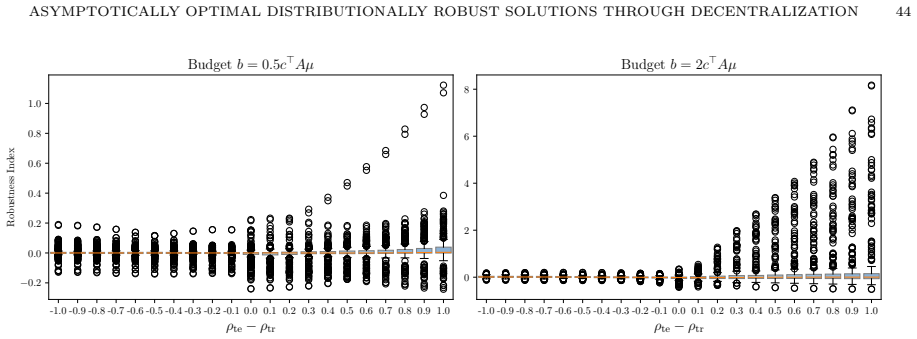
- In the comparison case where truncated linear decision rules are applicable, the decentralized two-point mechanism stays within a few percent of the TLDR value while running about 100 times faster at 500 products.
- With cross-validated tuning of (ς, τ), the mechanism outperforms sample-average approximation out-of-sample in risk-averse scenarios, with the largest advantage when training data are scarce.
- Both moment-based and data-driven Wasserstein ambiguity settings admit the same structural mechanism, so a single implementation covers two common DRO formulations.
Reading between the lines
- Editorial inference: because the two-point mechanism is optimal only in the limit, finite-scale users should treat the parameters (ς, τ) as tunable; cross-validation is the natural way to select them, as the paper demonstrates.
- Editorial inference: the result suggests a separation principle for decentralized operations: forecasters need not report a full distribution, only a scenario pair encoding mean and spread, and this may extend to other nested stochastic programs with similar scaling.
- Editorial inference: the s = 2 boundary is the natural next test; if the ratio still converges there, contrary to the proof, the practical regime would widen beyond the Taylor-law range studied here.
Editorial analysis
A structured set of objections, weighed in public.
Referee Report
Summary. The paper proposes a decentralized, bilevel framework for two-stage risk-averse distributionally robust optimization. The forecasting team acts as leader and communicates a distribution to the operations team, which then solves a tractable two-stage stochastic program. For moment-based ambiguity sets (Assumption 2) and Wasserstein ambiguity sets (Assumption 4), the paper constructs a two-point mechanism M_{ς,τ} in (7) and (17) and proves, under the scaling schemes (6) and (16) with s∈[1,2), that the induced first-stage decision x^{(k)}_{ς,τ} satisfies Obj(x^{(k)}_{ς,τ},b(k),θ(k))/OPT(b(k),θ(k))→1. The proof uses a sandwich argument: a linear-program lower bound V0 for OPT and a truncated-linear-decision-rule upper bound for Obj, with error terms that are o(k). Numerical experiments compare the method with TLDR approximations and SAA, including a real-data case study.
Significance. If the main theorems are correct, the paper gives a genuinely simple and computationally tractable mechanism that is asymptotically optimal for a class of otherwise intractable two-stage DRO problems. The proof structure is explicit and self-contained: the lower bound uses only the expectation mechanism, the upper bound uses a TLDR policy, and the ratio argument is based on explicit bounds in Propositions 3, 4, 8, and 9. No fitted constants enter the asymptotic guarantee; any feasible (ς,τ) works. The numerical work is substantial, including a real sales-data experiment and comparisons against SAA and TLDR. The main reservation is that the proved regime is one where relative uncertainty vanishes as k grows, and the proof of the key upper bound contains a local but correctable error; these issues do not destroy the central idea but require revision.
major comments (3)
- [Section 4, equation (6) and Section 1, scaling discussion] The proof claims that an optimal (v,U) in problem (13a) "must satisfy v≤U d_h, otherwise we can set v to be U d_h and then (U d_h,U) is a feasible solution with smaller objective." This is not correct as stated: decreasing v can only increase the pointwise loss -p^T min{v,U d} (or leave it unchanged on the support {d_l,d_h}), so by monotonicity of the risk measure the objective cannot decrease. The needed conclusion is nevertheless salvageable: for any feasible (v,U), replacing v_i by min{v_i, U_i d_h} leaves the policy unchanged on the support of M_{ς,τ}(θ(k)), so there exists an optimal solution with v≤U d_h; the subsequent estimate (v-kUμ)_+≤U(d_h-kμ) then holds for that representative. Please revise the proof to use this existence argument rather than the false necessity claim. The same issue appears in the Wasserstein analogue, Proposition 8.
- [Section 1 and Section 4] Theorems 1 and 2 are proved only for s∈[1,2). Under this scaling, the coefficient of variation of each marginal demand is of order k^{s/2-1}, which tends to zero; the asymptotic regime is therefore one of vanishing relative uncertainty, not merely of increasing problem scale with "inherent uncertainty remain[ing] pronounced" as the Introduction states. The excluded case s=2 is the natural scaling for a common multiplicative shock, where the coefficient of variation is constant; at s=2 the sandwich bound degenerates because the correction term k^{s/2-1} does not vanish. The paper should state this limitation explicitly in the abstract, introduction, and conclusion, and either extend the analysis to s=2 or clearly delineate that the advertised optimality applies to the regime of shrinking relative dispersion. This is a load-bearing point because it concerns the practical interpretation of the headline asymptotic-optimality claim.
- [Section 4.1] The theorem's proof first establishes the same asymptotic ratio for the expectation mechanism M0, the Dirac distribution at kμ, which is the degenerate member of the family (τ=0 or ς=0). Thus the claim that "a two-point distribution suffices" is not the strongest possible statement: a one-point (mean) mechanism also achieves the same limit. The paper should acknowledge that the theoretical contribution is not that two points are necessary, and should clarify that the value of the two-point mechanism lies in finite-sample/finite-k performance (as suggested by the numerical experiments) rather than in asymptotic optimality per se.
minor comments (3)
- [Assumption 4] The phrase "the set of all joint contributions of random vectors" should be "the set of all couplings (joint distributions) with the given marginals."
- [Appendix A.2, proof of Proposition 7] In the first line, "As P(k)∈A(θ(k))" should refer to the nominal distribution \hat P(k) used to define the Wasserstein ball; please correct the notation.
- [Abstract] The phrase "at an appropriate rate" in the abstract and the Introduction's claim that the scaling reflects situations where "inherent uncertainty remains pronounced" should be reconciled with the fact that s<2 makes relative dispersion vanish; this is part of the major comment above, but a precise wording fix in the abstract is also needed.
Circularity Check
No circularity: Theorems 1 and 2 give a self-contained sandwich proof; the only definitional step is the trivial upper bound of 1 for the cost ratio.
full rationale
The paper's central claim is that the two-point mechanism M_{ς,τ} is optimal for the bilevel problem (4), i.e., the induced first-stage decision attains Obj/OPT → 1. The upper bound Obj/OPT ≤ 1 follows from the definition of OPT as a minimum and from OPT < 0; this is definitional, but it is only half of the sandwich. The nontrivial half is the lower bound: Proposition 1 (and Proposition 7 for Wasserstein) proves V0 ≤ OPT, and the TLDR construction gives Obj ≤ C; the appendix then shows C/V0 → 1 by combining Propositions 3-4 (resp. 8-9) with positive homogeneity V0(b(k),θ(k)) = k V0(b(1),θ(1)) and s < 2. No fitted constants or data-dependent parameters enter Theorems 1-2; (ς,τ) can be any feasible values and the guarantee holds, and even the degenerate expectation mechanism M0 is shown to attain the same limit. The Wasserstein proof invokes Nguyen et al. (2021, Theorem 2) for a moment-based outer approximation of the Wasserstein ball. This is a self-citation (one author overlaps), but it is an external mathematical inclusion result whose assumptions do not include the two-point optimality conclusion, and the present paper proves the subsequent containment in Proposition 5. It is therefore independent support rather than a circular premise. The scaling s ∈ [1,2) is an explicit condition; the fact that s = 2 is excluded is a scope limitation of the asymptotic guarantee, not a circular step. Numerical cross-validation tuning of (ς,τ) is standard practice and does not feed into the asymptotic theorems. No step was found that reduces a prediction to its own input by construction.
Assumptions & free parameters
free parameters (2)
- Mechanism parameters (ς, τ) =
Any feasible pair in [0,σ]×[0,τ_max] yields the asymptotic result
- Cross-validation grid (κ, η) =
Grid search over [0,1]×[0,1] per dataset
assumptions (9)
- domain assumption Assumption 1: family of risk measures is law-invariant, translation invariant, positive homogeneous, monotonic, closed, with non-negative standard risk coefficient α.
- domain assumption Assumption 2: moment-based ambiguity set with known marginal means μ and upper bounds σ on marginal standard deviations.
- domain assumption Assumption 3(i): each column of the recourse matrix H has one nonzero element.
- domain assumption Assumption 3(ii): at k=1, the expectation-mechanism lower-level problem has negative optimal cost, i.e., c^T x_0 + ϱ_{δ_μ}(g(x_0,·)) < 0.
- ad hoc to paper Scaling scheme (6)/(16): b(k)=kb, mean scales as kμ, marginal standard deviations scale as k^{s/2}σ with s∈[1,2), and for Wasserstein the radius scales as k^{s/2}ε.
- domain assumption Assumption 4: Wasserstein ambiguity set with 2-Wasserstein ball of radius ε around a nominal distribution.
- domain assumption For the Wasserstein setting, ϱ_P(·) ≥ E_P[·] for all P.
- standard math Wasserstein-to-moment outer approximation: Nguyen et al. (2021, Theorem 2) gives a moment-based outer approximation of the Wasserstein ball.
- standard math Gallego's moment bound on E[max{0,ζ}] for random variables with given mean and variance.
Cite this review
Pith. "Pith review of Asymptotically Optimal Distributionally Robust Solutions through Forecasting and Operations Decentralization." pith.science (2026). https://pith.science/paper/3WR4VGF6
@misc{pith2026241217257,
  author       = {Pith},
  title        = {Pith review of: Asymptotically Optimal Distributionally Robust Solutions through Forecasting and Operations Decentralization},
  year         = {2026},
  howpublished = {\url{https://pith.science/paper/3WR4VGF6}},
  note         = {Machine review of arXiv:2412.17257}
}
read the original abstract
Two-stage risk-averse distributionally robust optimization (DRO) problems are ubiquitous across many engineering and business applications. Despite their promising resilience, two-stage DRO problems are generally computationally intractable. To address this challenge, we propose a simple framework by decentralizing the decision-making process into two specialized teams: forecasting and operations. This decentralization aligns with prevalent organizational practices, in which the operations team uses the information communicated from the forecasting team as input to make decisions. We formalize this decentralized procedure as a bilevel problem to design a communicated distribution that can yield asymptotic optimal solutions to original two-stage risk-averse DRO problems. We identify an optimal solution that is surprisingly simple: The forecasting team only needs to communicate a two-point distribution to the operations team. Consequently, the operations team can solve a highly tractable and scalable optimization problem to identify asymptotic optimal solutions. Specifically, as the magnitude of the problem parameters (including the uncertain parameters and the first-stage capacity) increases to infinity at an appropriate rate, the cost ratio between our induced solution and the original optimal solution converges to one, indicating that our decentralized approach yields high-quality solutions. We compare our decentralized approach against the truncated linear decision rule approximation and demonstrate that our approach has broader applicability and superior computational efficiency while maintaining competitive performance. Using real-world sales data, we have demonstrated the practical effectiveness of our strategy. The finely tuned solution significantly outperforms traditional sample-average approximation methods in out-of-sample performance.
Figures


Figures from the paper (5 more)



Reference graph
Works this paper leans on
-
[1]
Mathematical Finance 9(3):203–228
Artzner P, Delbaen F, Eber JM, Heath D (1999) Coherent measures of risk. Mathematical Finance 9(3):203–228. Bertsimas D, Doan XV, Natarajan K, Teo CP (2010) Models for minimax stochastic linear optimization problems with risk aversion. Mathematics of Operations Research 35(3):580–602. Bertsimas D, Gupta V, Kallus N (2018) Data-driven robust optimization. ...
work page 1999
-
[2]
We show thatU = I is an optimal choice forU. Let (v⋆,U ⋆) be the optimal solution of problem (13a), we have−p⊤ min{v⋆,U ⋆d}≥− p⊤ min{v⋆,d} as U⋆≤I and{ϱP} are monotonic risk measures. Hence, (v⋆,I ) is also optimal to problem (A.8) because it satisfies all the constraints and achieves the optimal cost. This enables us to focus on the optimal truncated lin...
work page 2001
-
[3]
Let θ′ = (µ′,σ′) ∈ R2Nd + be an arbitrary moment parameter
Lemma 2 (Risk upper bound). Let θ′ = (µ′,σ′) ∈ R2Nd + be an arbitrary moment parameter. Under Assumptions 1 and 2, for anyp∈ RNd + ,v∈ RNy and U∈ RNy×Nd + , we have sup P∈A(θ′) ϱP(p⊤ max{0,v−U ˜d})≤ (1 2 +α)p⊤Uσ′ + ∑ i∈[Nd] pi(v−Uµ′)iI(v−Uµ ′)i>0. Proof of Lemma 2.Pick any P∈A (θ′), we haveEP[U ˜d] = Uµ′ and Var((U ˜d)i)≤ (Uiσ′)2, where (U ˜d)i is the i-t...
work page 1992
-
[8]
Under Mς,τ (θ(k)), the random vector ˜d has mean kµ and marginal varianceksς2≤ ksσ2 because ς≤σ. Further, the support set is non-negative as the low demand realization satisfies dl≥kµ− √ τmax 1−τmax k s 2ς =kµ−k s 2ς √ min i∈[Nd] µ2 i ς2 i ≥ (k−k s 2 )µ≥ 0, where the first inequality holds because √ τ/(1−τ) increases withτ and we restrictτ∈ [0,τ max], the...
work page 2017
-
[10]
for alld0,d 1≥ 0 andt∈ [0, 1], which means g(x,·) is a convex function. By Jensen’s inequality, we haveEP(k)[g(x, ˜d)]≥g(x, EP(k)[ ˜d]) = g(x,k ˆµ) and then OPT(b(k),θ (k))≥ min x∈X(b(k)) c⊤x +g(x,k ˆµ) =V0(b(k),θ (k)), which completes the proof. □ A.2.2. An Upper Bound.Proposition 5 shows thatA(θ(k)) can be outer-approximated by an ambiguity set with bou...
work page 2021
-
[11]
B.1. Capacity Management Problem with Product Substitution.We examine the capacity man- agement problem with product upgrades in Shumsky and Zhang (2009). In product upgrades, when the capacity for a specific product is exhausted, the firm may offer a substitute product to fulfill the customer’s request. Product upgrades can effectively handle uncertain d...
work page 2009
-
[12]
Moreover, we can findsJ1,...,s JNd such thaty≤ Uz, e.g., forj∈J i, set sj = yj/∑ k∈Jiyk
ThenU∈U , i.e.,U≥ 0 and HU = diag ∑ j∈J1 sj,..., ∑ j∈JNd sj ≤INd. Moreover, we can findsJ1,...,s JNd such thaty≤ Uz, e.g., forj∈J i, set sj = yj/∑ k∈Jiyk. Because zi≥∑ k∈Jiyk, we further have Uz = ( z1s⊤ J1,...,z Nds⊤ JNd )⊤ = y1∑ k∈J1 yk z1, ..., yn1∑ k∈J1 yk z1, yn1+1∑ k∈J2 yk z2, ... ⊤ ≥y, thus the second assumption in Assumption 3 is a...
work page 1987
-
[13]
Appendix C. Simulation Details C.1. Synthetic Instances Construction.In the synthetic experiments, we focus on the assemble-to-order problems with no product flexibility, i.e., a one-to-one correspondence between the products and the demand types. Hence, the products and demands have the same dimension denoted byN =Ny =Nd. The recourse matrix H is the ide...
work page 2020
Show all 13 references
-
[104]
Manage- ment Science 70(5):2799–2822
Kerimov S, Ashlagi I, Gurvich I (2024) Dynamic matching: Characterizing and achieving constant regret. Manage- ment Science 70(5):2799–2822. ASYMPTOTICALLY OPTIMAL DISTRIBUTIONALLY ROBUST SOLUTIONS THROUGH DECENTRALIZATION 23 Ledvina K, Qin H, Simchi-Levi D, Wei Y (2022) A new...
2024
-
[155]
Opera- tions Research Letters 45(4):377–381
Shapiro A (2017) Interchangeability principle and dynamic equations in risk averse stochastic programming. Opera- tions Research Letters 45(4):377–381. Shapiro A, Dentcheva D, Ruszczynski A (2021) Lectures on Stochastic Programming: Modeling and Theory (SIAM). Shapiro A, Nemir...
2017
-
[594]
Nonconvex Optimization and its Applications 57:135–
Shapiro A (2001) On duality theory of conic linear problems. Nonconvex Optimization and its Applications 57:135–
2001
-
[618]
Computational complexity of stochastic program- ming problems
Birge JR, Louveaux F (2011) Introduction to Stochastic Programming (Springer Science & Business Media). Bruys T, Zandehshahvar R, Hijazi A, Van Hentenryck P (2024) Confidence-aware deep learning for load plan adjust- ments in the parcel service industry. arXiv preprint arXiv:2...
2011 arXiv
-
[3245]
Transportation Science 50(4):1360–1379
Lindsey K, Erera A, Savelsbergh M (2016) Improved integer programming-based neighborhood search for less-than- truckload load plan design. Transportation Science 50(4):1360–1379. Long DZ, Qi J, Zhang A (2024) Supermodularity in two-stage distributionally robust optimization. M...
2016
Reviewed August 11, 2026 · model on record in the stance chip above.
Discussion (0). Continue with ORCID to comment.