REVIEW 4 major objections 5 minor 97 references
Quantum Approximate Optimisation Applied to Graph Similarity
T0 review · 4 major / 5 minor · reviewed 2026-08-11 · deepseek-v4-flash
Pith's one-line read A compact qubit encoding lets QAOA beat random sampling on small graph-similarity problems, but the zero-cost infeasible tail erodes the advantage on larger instances.
desk verdict A careful QAOA-for-graph-similarity study whose own larger-graph results refute its central claim, made worse by a metric defined with contradictory sign conventions. read the letter →
The pith
A machine-rendered reading of the paper's core claim, the machinery that carries it, and where it could break.
The reading
What carries the argument
The load-bearing mechanism is the permutation-index encoding: rather than labelling each candidate vertex mapping with $V^2$ unary qubits, the paper orders all $V!$ permutations and stores only the index of a permutation in $q=\lceil\log_2(V!)\rceil$ qubits. The diagonal cost Hamiltonian $\hat C$ gives each index its edge-overlap value, and the unused tail of $2^q-V!$ bit-strings is set to zero. The mixing Hamiltonian $\hat B=\sum_i\sigma^x_i$ makes the search walk over all bit-strings, and $\hat U_B$ is applied through a polynomial expansion of the matrix exponential rather than a full dense exponentiation. Everything that matters for the result follows from that tail: it is what saves memory, and it is what makes the cost landscape hard for the classical optimiser.
What would settle it
Run the exact simulation on randomly deformed graph pairs of increasing vertex count with a fixed evaluation budget, and compare the QAOA expectation value with the expectation of uniform random sampling under the same cost function. The paper's Section 4.4.1 already reports a negative quantum-versus-classical ratio on the larger directed test cases; any negative ratio at a given graph size falsifies the unifying hypothesis for that size, and a consistently positive ratio across the tested range would confirm it.
Extended reading notes
Core claim
The paper's central claim is that graph similarity by maximal edge overlap can be mapped to QAOA with only $q=\lceil\log_2(V!)\rceil$ qubits, and that on small instances the algorithm measurably improves over naive random sampling for a fixed sample count. The unused bit-strings are assigned zero cost, so the algorithm starts from a uniform superposition in which most amplitude sits on infeasible solutions; nevertheless, the reported experiments show QAOA escaping that local minimum and improving with Trotter depth, with undirected graphs performing better than directed ones. At larger graph sizes the improvement reverses: the paper reports that the QAOA expectation value falls below random sampling for all eight classical optimisers tested, which it treats as evidence that the feasible/infeasible mix makes the optimisation problem harder, not as a final refutation of the approach.
Load-bearing premise
The classical optimiser can concentrate enough probability on feasible permutations within its evaluation budget even though the search starts uniformly over a space in which nearly all bit-strings are infeasible zero-cost strings.
Editorial extensions
If this is right
- Small instances and undirected pairs establish a baseline where QAOA with this encoding is a valid laboratory for comparing mixers, cost Hamiltonians, and classical optimisers.
- Increased Trotter depth $p$ buys better solutions at roughly double the evaluation count, so any real device must budget quantum evaluations against solution quality.
- The zero-cost tail creates a landscape in which all infeasible strings look optimal; any future encoding that shrinks or penalises that tail should directly improve the measured quantum-versus-classical ratio.
- Because the simulator is problem-agnostic apart from the cost function, the same package can be used to validate QAOA on other NP-optimisation problems without building a new simulation stack.
Reading between the lines
- The comparison baseline is random sampling only; comparing QAOA on this encoding against classical heuristic graph-matching would clarify whether the small-instance advantage is real or an artefact of a weak baseline.
- The paper's alternate cost function that penalises infeasible states made things worse, which suggests a subtle nonlinearity: a soft, tuned penalty or a separate feasible-mixing operator might outperform both tested extremes.
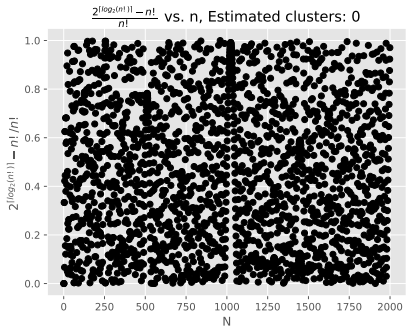
- The tail proportion oscillates with $V$ (for example, $2^q/V!$ is 0.65 at $V=8$ and 0.15 at $V=10$ in the paper's Table B.1), so picking graph sizes whose factorial sits close to a power of two could give QAOA an easier landscape and a cleaner test of the algorithm.
- The exact state-vector simulation ceiling of 22 qubits is a memory bound, so adapting the encoding to a restricted mixer or approximate simulation scheme would show whether the trend continues or reverses at larger sizes.
Editorial analysis
A structured set of objections, weighed in public.
Referee Report
Summary. The paper presents an honours-thesis-style study applying the Quantum Approximate Optimisation Algorithm (QAOA) to graph similarity, specifically to the problem of maximal edge overlap between two directed or undirected unweighted graphs under vertex relabelling. The authors introduce Qolab, a C-based simulation package for QAOA, and propose a compact encoding of permutation problems that uses q = ceil(log2(V!)) qubits rather than a unary V^2 encoding. The stated unifying hypothesis (Section 1.5) is that, for a fixed number of samples, QAOA will produce more correct maximal-edge-overlap solutions than naive random sampling. The paper reports experiments with eight classical optimisers at six decomposition levels, on graphs generated by Erdős–Rényi models with several deformation types, and concludes that the QAOA suffers from infeasible solutions in larger test cases.
Significance. If the central hypothesis were supported, the paper would offer two useful contributions: a general-purpose QAOA simulation tool with a reproducible benchmark suite, and a memory-efficient encoding for permutation-based optimisation problems. The manuscript does make some genuine assets explicit: the source code and result data are promised at public repositories, the study covers a broad sweep of classical optimisers (eight methods at six values of p), and the correctness of the QAOA expectation is checked against brute-force optimal values in Section 4.1. However, the paper's own reported results contradict the unifying hypothesis for larger graphs, and the primary comparison metric is defined with contradictory sign conventions. The contribution is therefore not established by the evidence presented, and the significance of the claimed result is currently undermined.
major comments (4)
- [Section 4.1, 'Classical Comparison' metric] The definition of the 'Quantum / Classical Expectation' metric contains two mutually exclusive clauses: 'A negative value indicates better likelihood of a better solution from the QAOA. Higher is better.' These cannot both hold. If negative means QAOA is better, then higher (less negative) is not better; if higher is better, then negative is worse. The plots in Figures 4.2–4.6 show negative values for larger graphs, and Section 4.4.1 explicitly interprets those negative values as failure ('a lower expectation value versus classical sampling'). This contradiction is load-bearing because the metric is the main evidence for or against the Section 1.5 hypothesis. The paper must state an unambiguous sign convention and then re-interpret the figures consistently.
- [Section 4.4.1 and Section 1.5] Section 4.4.1 states: 'for all algorithms tested the effect of infeasible solutions results in a lower expectation value versus classical sampling in the larger test cases.' This is a direct admission that the central hypothesis of Section 1.5 (QAOA outperforms random sampling) is not supported on larger graphs for any of the eight optimisers tested. If the 'negative is better' reading of the metric is instead adopted, then the same sentence would be inconsistent with the reported sign of the values. Either way, the paper does not present an unambiguous positive result, and the hypothesis as stated is not established. This is not a presentation issue but a fundamental problem with the claimed conclusion.
- [Section 3.2.4, tail mapping and Section 4.4.1] The encoding maps all 2^q − V! infeasible bit-strings to cost zero, and the QAOA starts from a uniform superposition over all 2^q states. As the paper itself notes and as Table B.1 shows, the tail fraction can be substantial (e.g., for V=8, 2^q/V! ≈ 1.63). The paper attributes the degraded expectation values on larger graphs to the 'effect of infeasible solutions,' which is a plausible mechanism, but no evidence is provided that the classical optimiser can overcome this tail within the evaluation budget. Since the Section 1.5 hypothesis depends precisely on the QAOA concentrating probability on feasible permutations, the paper needs either a dedicated analysis of the tail's influence or a revised hypothesis that accounts for the reported negative results.
- [Sections 3.2.2 and 3.2.4, resource claims] The claims of 'O(V^3) operations' for the state-preparation encoding and 'O(n^2 log n) operations and O(n log n) qubits' for the edge-overlap circuit are asserted by citation to [1] and [18] rather than derived in this manuscript. Because the claimed 'significant quantum memory savings at the cost of additional operations' is one of the paper's two headline contributions, the resource trade-off should be either derived or stated with the precise conditions under which the cited bounds apply. As written, the reader cannot verify the resource count without going to the cited works, and the paper's own Appendix E, which is used to justify the Chebyshev truncation for U_B, is informal.
minor comments (5)
- [Figures 4.2–4.6 and Appendix F] The figures do not include error bars, confidence intervals, or any measure of trial-to-trial variance; given that results are aggregated over different deformation types and multiple random instances, the absence of dispersion information makes it difficult to assess the reliability of the reported averages.
- [Section 4.5 and figures] The text in Section 4.5 refers to 'Figure 4.5' for the undirected Subplex results, but the displayed figure caption is 'Figure 4.6: Final performance for the Subplex algorithm (undirected graphs)'. Similar numbering inconsistencies appear across the results chapter and should be corrected.
- [Section 3.4.1] The sentence 'This requires the generation of all q! bit-strings' is confusing: the simulation enumerates all 2^q computational basis states, not q! bit-strings. The subsequent sentence about reducing 'generations of the q! permutations' to the 2^{ceil(log2(v!))} state-space needs to be clarified.
- [Equation (3.7.3)] The Chebyshev expansion is written with 'inf' instead of an infinity symbol, and the summation index n is not defined in the displayed formula; the truncation criterion in Eq. (3.7.8) should also state explicitly that n runs from 1 to the truncation order.
- [Appendix E] The proof of λ_{min,max} = ±q is informal: it uses a real-symmetric-matrix argument with a typo ('R3' instead of R^n), invokes Perron–Frobenius without stating the non-negativity conditions precisely, and the final observation 'for a negative v, λ = −q' does not constitute a proof for all vectors. The paper also contains typos such as 'Schr¨ oidgner' in Section 1.4.1 and 'na ¨ ıve' elsewhere.
Circularity Check
No significant circularity: the central QAOA-vs-random comparison is benchmarked against independent brute-force optimal values and per-instance optimisation, not fitted to its own outputs.
full rationale
The paper's derivation chain is self-contained rather than circular. Section 3.2 constructs the problem Hamiltonian C from the graph edge-overlap objective directly, and Section 3.7-3.8 implements the QAOA state evolution and measurement without any parameter fitted to a target answer. The Section 1.5 hypothesis is tested in Section 4 by comparing the QAOA expectation value with an independent random-sampling baseline and with known brute-force optimal values computed by Algorithm 1; the QAOA angles are optimised per instance by nlopt rather than tuned to reproduce the benchmark results. The only in-group citation, Marsh and Wang [61], supports an optional walk-mask extension and is not load-bearing for the central compact permutation encoding, which is derived from Abrams-Lloyd and Chiew et al. rather than imported from the authors. The problematic sign convention in the Section 4.1 'Classical Comparison' definition ('A negative value indicates better likelihood of a better solution from the QAOA. Higher is better') and the interpretation in Section 4.4.1 that negative values indicate failure are internal-consistency and correctness defects, not circularity, because neither clause makes the reported comparison equal to its inputs by construction.
Assumptions & free parameters
free parameters (3)
- MLSL evaluation cap multiplier S =
200
- Chebyshev truncation tolerance epsilon =
1e-18
- Erdos-Renyi edge probability =
0.5
assumptions (5)
- standard math QAOA with cost Hamiltonian C, mixing Hamiltonian B = sum sigma_x, and p Trotter steps approximately optimizes the expectation value F_p(gamma, beta).
- domain assumption The edge-overlap cost for all V! permutations can be encoded as a diagonal Hamiltonian, Eq. 3.2.2, and implemented as e^{-i gamma C} without ancillas via Welch et al. and Chiew et al.
- ad hoc to paper Mapping all 2^q - V! infeasible bit-strings to cost zero still permits the QAOA to concentrate probability on feasible permutations.
- standard math The mixing Hamiltonian B has eigenvalues exactly +/- q, so the Chebyshev propagator can be scaled without solving an eigenproblem.
- domain assumption Erdos-Renyi graphs with edge probability 0.5 and the five graph deformations are representative difficult instances for graph similarity.
Cite this review
Pith. "Pith review of Quantum Approximate Optimisation Applied to Graph Similarity." pith.science (2026). https://pith.science/paper/JNPWBJNI
@misc{pith2026241217309,
  author       = {Pith},
  title        = {Pith review of: Quantum Approximate Optimisation Applied to Graph Similarity},
  year         = {2026},
  howpublished = {\url{https://pith.science/paper/JNPWBJNI}},
  note         = {Machine review of arXiv:2412.17309}
}
read the original abstract
Quantum computing promises solutions to classically difficult and new-found problems through controlling the subtleties of quantum computing. The Quantum Approximate Optimisation Algorithm (QAOA) is a recently proposed quantum algorithm designed to tackle difficult combinatorial optimisation problems utilising both quantum and classical computation. The hybrid nature, generality and typically low gate-depth make it a strong candidate for near-term implementation in quantum computing. Finding the practical limits of the algorithm is currently an open problem. Until now, no tools to facilitate the design and validation of probabilistic quantum optimisation algorithms such as the QAOA on a non-trivial scale exist. Graph similarity is a long standing classically difficult problem withstanding decades of research from academia and industry. Determining the maximal edge overlap between all possible node label permutations is an NP-Complete task and provides an apt measure of graph similarity. We introduce a novel quantum optimisation simulation package facilitating investigation of all constituent components of the QAOA from desktop to cluster scale using graph similarity as an example. Our simulation provides flexibility and performance. We investigate eight classical optimisation methods each at six levels of decomposition. Moreover an encoding for permutation based problems such as graph similarity through edge overlap to the QAOA allows for significant quantum memory savings at the cost of additional operations. This compromise extends into the classical portion of the algorithm as the inclusion of infeasible solutions creates a challenging cost-function landscape. We present performance analysis of our simulation and of the QAOA setting a precedent for investigating and validating numerous other difficult problems to the QAOA as we move towards realising practical quantum computation.
Figures


Figures from the paper (12 more)


Reference graph
Works this paper leans on
-
[1]
Simulation of Many-Body Fermi Sys- tems on a Universal Quantum Computer
Daniel S. Abrams and Seth Lloyd. “Simulation of Many-Body Fermi Sys- tems on a Universal Quantum Computer”. In: Physical Review Letters 79.13 (Sept. 29, 1997), pp. 2586–2589. issn: 0031-9007, 1079-7114. doi: 10.1103/ PhysRevLett . 79 . 2586. url: https : / / link . aps . org / doi / 10 . 1103 / PhysRevLett.79.2586 (visited on 10/15/2018)
1997
-
[18]
Graph comparison via nonlinear quantum search
M. Chiew et al. “Graph comparison via nonlinear quantum search”. In: arXiv:1810.01647 [quant-ph] (Oct. 3, 2018). arXiv: 1810.01647. url: http: //arxiv.org/abs/1810.01647 (visited on 10/15/2018)
arXiv 2018
-
[2]
Quantum attacks on Bitcoin, and how to protect against them
D. Aggarwal et al. “Quantum attacks on Bitcoin, and how to protect against them”. In: ArXiv e-prints (Oct. 2017)
2017
-
[3]
A New Scaling and Squar- ing Algorithm for the Matrix Exponential
Awad H. Al-Mohy and Nicholas J. Higham. “A New Scaling and Squar- ing Algorithm for the Matrix Exponential”. In: SIAM Journal on Matrix Analysis and Applications 31.3 (Jan. 2010), pp. 970–989. issn: 0895-4798, 1095-7162. doi: 10.1137/09074721X. url: http://epubs.siam.org/doi/ 10.1137/09074721X (visited on 09/16/2018)
-
[4]
Computing the Action of the Matrix Exponential, with an Application to Exponential Integrators
Awad H. Al-Mohy and Nicholas J. Higham. “Computing the Action of the Matrix Exponential, with an Application to Exponential Integrators”. In: SIAM Journal on Scientific Computing 33.2 (Jan. 2011), pp. 488–511. issn: 1064-8275, 1095-7197. doi: 10.1137/100788860. url: http://epubs.siam. org/doi/10.1137/100788860 (visited on 08/02/2018)
-
[5]
Matrix exponentials and parallel prefix computation in a quantum control problem
T. Auckenthaler et al. “Matrix exponentials and parallel prefix computation in a quantum control problem”. In: Parallel Computing 36.5 (June 2010), pp. 359–369. issn: 01678191. doi: 10.1016/j.parco.2010.01.006 . url: http://linkinghub.elsevier.com/retrieve/pii/S0167819110000244 (visited on 09/17/2018)
-
[6]
PETSc Web page
Satish Balay et al. PETSc Web page . 2018. url: http://www.mcs.anl. gov/petsc
2018
-
[7]
Beating the random assignment on constraint satisfaction problems of bounded degree
Boaz Barak et al. “Beating the random assignment on constraint satisfaction problems of bounded degree”. In: arXiv:1505.03424 [cs] (May 13, 2015). arXiv: 1505.03424. url: http://arxiv.org/abs/1505.03424 (visited on 10/05/2018)
arXiv 2015
Show all 97 references
-
[8]
Strengths and Weaknesses of Quantum Com- puting
Charles H. Bennett et al. “Strengths and Weaknesses of Quantum Com- puting”. In: SIAM Journal on Computing 26.5 (1997), pp. 1510,1523. issn: 0097-5397. 54
1997
-
[9]
Efficient computation of the expo- nential operator for large, sparse, symmetric matrices
Luca Bergamaschi and Marco Vianello. “Efficient computation of the expo- nential operator for large, sparse, symmetric matrices”. In: Numerical Linear Algebra with Applications 7.1 (Jan. 2000), pp. 27–45. issn: 1070-5325, 1099-
2000
-
[10]
Quantum Supremacy Lower Bounds by Entanglement Scaling
Jacob D. Biamonte, Mauro E. S. Morales, and Dax Enshan Koh. “Quantum Supremacy Lower Bounds by Entanglement Scaling”. In: arXiv:1808.00460 [cond-mat, physics:quant-ph] (Aug. 1, 2018). arXiv: 1808.00460. url: http: //arxiv.org/abs/1808.00460 (visited on 08/03/2018)
2018 arXiv
-
[11]
Characterizing Quantum Supremacy in Near-Term Devices
S. Boixo et al. “Characterizing Quantum Supremacy in Near-Term Devices”. In: ArXiv e-prints (July 2016)
2016
-
[12]
Simulation of low-depth quantum circuits as complex undi- rected graphical models
S. Boixo et al. “Simulation of low-depth quantum circuits as complex undi- rected graphical models”. In: ArXiv e-prints (Dec. 2017)
2017
-
[13]
Pseudo-Boolean optimization
Endre Boros and Peter L Hammer. “Pseudo-Boolean optimization”. In: Dis- crete Applied Mathematics (2002), p. 71
2002
-
[14]
The anatomy of a large-scale hypertextual Web search engine
Sergey Brin and Lawrence Page. “The anatomy of a large-scale hypertextual Web search engine”. In: Computer Networks and ISDN Systems 30.1 (1998), pp. 107,117. issn: 0169-7552
1998
-
[15]
Published: Cryptology ePrint Archive, Report 2017/847
Andr´ e Chailloux, Mar ´ ıa Naya-Plasencia, and Andr´ e Schrottenloher.An Ef- ficient Quantum Collision Search Algorithm and Implications on Symmetric Cryptography. Published: Cryptology ePrint Archive, Report 2017/847. 2017. url: https://eprint.iacr.org/2017/847
2017
-
[16]
Classical Simulation of Intermediate-Size Quantum Circuits
J. Chen et al. “Classical Simulation of Intermediate-Size Quantum Circuits”. In: ArXiv e-prints (May 2018)
2018
-
[17]
64-Qubit Quantum Circuit Simulation
Z.-Y. Chen et al. “64-Qubit Quantum Circuit Simulation”. In: ArXiv e-prints (Feb. 2018)
2018
-
[19]
Quantum Information Processing in Continu- ous Time
Andrew MacGregor Childs. “Quantum Information Processing in Continu- ous Time”. In: (2004), p. 140
2004
-
[20]
Quantum machine learning: a classical perspective
Carlo Ciliberto et al. “Quantum machine learning: a classical perspective”. In: Proceedings. Mathematical, Physical, and Engineering Sciences 474.2209 (2018), Proceedings. Mathematical, Physical, and Engineering Sciences, 2018, Vol.474(2209). issn: 1364-5021. 55
2018
-
[21]
Quantum algorithms revisited
R. Cleve et al. “Quantum algorithms revisited”. In: Proceedings of the Royal Society A: Mathematical, Physical and Engineering Sciences454.1969 (1998), pp. 339,354. issn: 1364-5021
1998
-
[22]
Different Strategies for Optimization Using the Quantum Adiabatic Algorithm
E. Crosson et al. “Different Strategies for Optimization Using the Quantum Adiabatic Algorithm”. In: ArXiv e-prints (Jan. 2014)
2014
-
[23]
Quantum Theory, the Church-Turing Principle and the Uni- versal Quantum Computer
D. Deutsch. “Quantum Theory, the Church-Turing Principle and the Uni- versal Quantum Computer”. In: Proceedings of the Royal Society of Lon- don. Series A, Mathematical and Physical Sciences (1934-1990) 400.1818 (), pp. 97,117. issn: 0080-4630
1934
-
[24]
Rapid Solution of Problems by Quan- tum Computation
David Deutsch and Richard Jozsa. “Rapid Solution of Problems by Quan- tum Computation”. In: Proceedings of the Royal Society: Mathematical and Physical Sciences (1990-1995) 439.1907 (1992), pp. 553,558. issn: 0962-8444
1992
-
[25]
Reinhard. Diestel. Graph theory. 2nd ed. Graduate texts in mathematics
-
[26]
A new notation for quantum mechanics
P. A. M. Dirac. “A new notation for quantum mechanics”. In: Mathematical Proceedings of the Cambridge Philosophical Society 35.3 (July 1939), p. 416. issn: 0305-0041, 1469-8064. doi: 10.1017/S0305004100021162. url: http: //www.journals.cambridge.org/abstract_S0305004100021162 ...
1939 doi
-
[27]
Sparse matrix test problems
I Duff, Roger Grimes, and John Lewis. “Sparse matrix test problems”. In: ACM Transactions on Mathematical Software (TOMS) 15.1 (Mar. 1, 1989), pp. 1,14. issn: 1557-7295
1989
-
[28]
One step time propagation method for systems with time- dependent Hamiltonians
Jian-Yun Fang. “One step time propagation method for systems with time- dependent Hamiltonians”. In: Chemical Physics Letters 263.6 (Dec. 1996), pp. 759–766. issn: 00092614. doi: 10.1016/S0009-2614(96)01272-9 . url: http://linkinghub.elsevier.com/retrieve/pii/S0009261496012729...
1996 doi
-
[29]
A Quantum Approximate Opti- mization Algorithm Applied to a Bounded Occurrence Constraint Problem
E. Farhi, J. Goldstone, and S. Gutmann. “A Quantum Approximate Opti- mization Algorithm Applied to a Bounded Occurrence Constraint Problem”. In: ArXiv e-prints (Dec. 2014)
2014
-
[30]
Quantum Supremacy through the Quantum Approximate Optimization Algorithm
E. Farhi and A. W Harrow. “Quantum Supremacy through the Quantum Approximate Optimization Algorithm”. In: ArXiv e-prints (Feb. 2016)
2016
-
[31]
A Quantum Approx- imate Optimization Algorithm
Edward Farhi, Jeffrey Goldstone, and Sam Gutmann. “A Quantum Approx- imate Optimization Algorithm”. In: arXiv:1411.4028 [quant-ph] (Nov. 14, 2014). arXiv: 1411.4028. url: http://arxiv.org/abs/1411.4028 (visited on 10/05/2018). 56
2014 arXiv
-
[32]
A quantum adiabatic evolution algorithm applied to random instances of an NP-complete problem
Edward Farhi et al. “A quantum adiabatic evolution algorithm applied to random instances of an NP-complete problem”. In: Science 292.5516 (2001), pp. 472,5. issn: 00368075. url: http://search.proquest.com/docview/ 213575154/?pq-origsite=primo
2001
-
[33]
Simulating physics with computers
Richard Feynman. “Simulating physics with computers”. In: International Journal of Theoretical Physics 21.6 (1982), pp. 467,488. issn: 0020-7748
1982
-
[34]
Michael R. Garey. Computers and intractability : a guide to the theory of NP- completeness. A Series of books in the mathematical sciences. San Francisco: W. H. Freeman, 1979. isbn: 0-7167-1044-7
1979
-
[35]
A fast quantum mechanical algorithm for database search
L. K. Grover. “A fast quantum mechanical algorithm for database search”. In: eprint arXiv:quant-ph/9605043 (May 1996)
1996 arXiv
-
[36]
How fast can a quantum computer search?
L. K. Grover. “How fast can a quantum computer search?” In: eprint arXiv:quant- ph/9809029 (Sept. 1998)
1998
-
[37]
Practical optimization for hybrid quantum-classical algorithms
Gian Giacomo Guerreschi and Mikhail Smelyanskiy. “Practical optimization for hybrid quantum-classical algorithms”. In: arXiv:1701.01450 [quant-ph] (Jan. 5, 2017). arXiv: 1701.01450 . url: http://arxiv.org/abs/1701. 01450 (visited on 10/05/2018)
2017 arXiv
-
[38]
Quantum Algorithms for Scientific Computing and Approxi- mate Optimization
S. Hadfield. “Quantum Algorithms for Scientific Computing and Approxi- mate Optimization”. In: ArXiv e-prints (May 2018)
2018
-
[39]
From the Quantum Approximate Optimization Algo- rithm to a Quantum Alternating Operator Ansatz
S. Hadfield et al. “From the Quantum Approximate Optimization Algo- rithm to a Quantum Alternating Operator Ansatz”. In:ArXiv e-prints (Sept. 2017)
2017
-
[40]
Topological Similarity-Based Feature Selection for Graph Classification
Yongkoo Han et al. “Topological Similarity-Based Feature Selection for Graph Classification.” In: The Computer Journal 58.9 (2015), pp. 1884–1893. doi: 10.1093/comjnl/bxt123 . url: http://dx.doi.org/10.1093/comjnl/ bxt123
2015 doi
-
[41]
Development of a chemical structure comparison method for integrated analysis of chemical and genomic information in the metabolic pathways
M Hattori et al. “Development of a chemical structure comparison method for integrated analysis of chemical and genomic information in the metabolic pathways”. In: Journal Of The American Chemical Society 125.39 (2003), pp. 11853,11865. issn: 0002-7863
2003
-
[42]
Solving the graph-isomorphism problem with a quantum annealer
Itay Hen and A. P. Young. “Solving the graph-isomorphism problem with a quantum annealer”. In: Physical Review A 86.4 (Oct. 10, 2012). issn: 1050- 2947, 1094-1622. doi: 10.1103/PhysRevA.86.042310. url: https://link. aps.org/doi/10.1103/PhysRevA.86.042310 (visited on 10/15/2018)
2012 doi
-
[43]
SLEPc: A scalable and flexible toolkit for the solution of eigenvalue problems
Vicente Hernandez, Jose E. Roman, and Vicente Vidal. “SLEPc: A scalable and flexible toolkit for the solution of eigenvalue problems”. In: ACM Trans. Math. Software 31.3 (2005), pp. 351–362. 57
2005
-
[44]
Deriving phylogenetic trees from the similarity analysis of metabolic pathways
Maureen Heymans and Ambuj K. Singh. “Deriving phylogenetic trees from the similarity analysis of metabolic pathways”. In:Bioinformatics 19.1 (2003), pp. 138,146. issn: 1367-4803
2003
-
[45]
A Block Algorithm for Matrix 1- Norm Estimation, with an Application to 1-Norm Pseudospectra
Nicholas J. Higham and Fran¸ coise Tisseur. “A Block Algorithm for Matrix 1- Norm Estimation, with an Application to 1-Norm Pseudospectra”. In: SIAM Journal on Matrix Analysis and Applications 21.4 (Jan. 2000), pp. 1185–
2000
-
[46]
0.5 Petabyte Simulation of a 45- Qubit Quantum Circuit
Thomas H¨ aner and Damian S. Steiger. “0.5 Petabyte Simulation of a 45- Qubit Quantum Circuit”. In: arxiv1704.01127 (2017), Proceedings of the In- ternational Conference for High Performance Computing, Networking, Stor- age and Analysis. SC 2017. Article No. 33
2017 arXiv
-
[47]
Qiskit Aqua
IBM. Qiskit Aqua. url: https://github.com/Qiskit/aqua
-
[48]
url: https : / / software
Intel(R) Math Kernel Library 2018 Update 4 . url: https : / / software . intel.com/en-us/mkl
2018
-
[49]
pyCTQW: A continuous-time quantum walk simulator on distributed memory computers
Josh A. Izaac and Jingbo B. Wang. “pyCTQW: A continuous-time quantum walk simulator on distributed memory computers”. In: Computer Physics Communications 186 (Jan. 2015), pp. 81–92. issn: 00104655. doi: 10.1016/ j.cpc.2014.09.011. url: http://linkinghub.elsevier.com/retrieve/ ...
2015
-
[50]
Six Degrees of Information Seeking: Stanley Milgram and the Small World of the Library
Kathryn James. “Six Degrees of Information Seeking: Stanley Milgram and the Small World of the Library”. In: Journal of Academic Librarianship 32.5 (2006), pp. 527,532. issn: 0099-1333
2006
-
[51]
Steven G. Johnson. The NLopt nonlinear-optimization package . 2011. url: http://ab-initio.mit.edu/nlopt
2011
-
[52]
Lipschitzian optimization with- out the Lipschitz constant
D. Jones, C. Perttunen, and B. Stuckman. “Lipschitzian optimization with- out the Lipschitz constant”. In: Journal of Optimization Theory and Appli- cations 79.1 (1993), pp. 157,181. issn: 0022-3239
1993
-
[53]
SciPy: Open source scientific tools for Python
Eric Jones et al. SciPy: Open source scientific tools for Python . 2001. url: http://www.scipy.org/
2001
-
[54]
A Preview of Bristlecone, Google’s New Quantum Processor
Julian Kelly. A Preview of Bristlecone, Google’s New Quantum Processor
-
[55]
Authoritative sources in a hyperlinked environment
Jon Kleinberg. “Authoritative sources in a hyperlinked environment”. In: Journal of the ACM 46.5 (1999), pp. 604,632. issn: 0004-5411. url: http: //search.proquest.com/docview/1808072946/. 58
1999
-
[56]
Fast parallel algorithms for graph similarity and matching
Giorgos Kollias et al. “Fast parallel algorithms for graph similarity and matching”. In: Journal of Parallel and Distributed Computing 74.5 (2014), pp. 2400 –2410. issn: 0743-7315. doi: https://doi.org/10.1016/j.jpdc. 2013.12.010 . url: http://www.sciencedirect.com/science/art...
2014 doi
-
[57]
Distortion invariant object recognition in the dynamic link architecture
M. Lades et al. “Distortion invariant object recognition in the dynamic link architecture”. In: IEEE Transactions on Computers 42.3 (Mar. 1993), pp. 300–311. issn: 0018-9340. doi: 10.1109/12.210173
1993 doi
-
[58]
Quantum Supremacy Circuit Simulation on Sunway Taihu- Light
R. Li et al. “Quantum Supremacy Circuit Simulation on Sunway Taihu- Light”. In: ArXiv e-prints (Apr. 2018)
2018
-
[59]
Ising formulations of many NP problems
Andrew Lucas. “Ising formulations of many NP problems”. In: Frontiers in Physics 2 (2014). issn: 2296-424X. doi: 10 . 3389 / fphy . 2014 . 00005. arXiv: 1302.5843 . url: http://arxiv.org/abs/1302.5843 (visited on 09/20/2018)
2014 arXiv
-
[60]
Quantum Supremacy Is Both Closer and Farther than It Appears
Igor L. Markov et al. “Quantum Supremacy Is Both Closer and Farther than It Appears”. In: arXiv:1807.10749 [quant-ph] (July 27, 2018). arXiv: 1807. 10749. url: http://arxiv.org/abs/1807.10749 (visited on 08/01/2018)
2018 arXiv
-
[61]
A quantum walk assisted approximate algorithm for bounded NP optimisation problems
Samuel Marsh and Jingbo Wang. “A quantum walk assisted approximate algorithm for bounded NP optimisation problems”. In: arXiv:1804.08227 [quant-ph] (Apr. 22, 2018). arXiv: 1804.08227. url: http://arxiv.org/ abs/1804.08227 (visited on 10/15/2018)
2018 arXiv
-
[62]
Nineteen Dubious Ways to Compute the Exponential of a Matrix
Cleve Moler and Charles Van Loan. “Nineteen Dubious Ways to Compute the Exponential of a Matrix”. In: SIAM Review 20.4 (Oct. 1978), pp. 801–
1978
-
[63]
Nineteen Dubious Ways to Compute the Exponential of a Matrix, Twenty-Five Years Later
Cleve Moler and Charles Van Loan. “Nineteen Dubious Ways to Compute the Exponential of a Matrix, Twenty-Five Years Later”. In: SIAM Review 45.1 (Jan. 2003), pp. 3–49. issn: 0036-1445, 1095-7200. doi: 10 . 1137 / S00361445024180. url: http://epubs.siam.org/doi/10.1137/S00361445...
2003 doi
-
[64]
A Chebychev propagator with iterative time order- ing for explicitly time-dependent Hamiltonians
Mamadou Ndong et al. “A Chebychev propagator with iterative time order- ing for explicitly time-dependent Hamiltonians”. In:The Journal of Chemical Physics 132.6 (Feb. 14, 2010), p. 064105. issn: 0021-9606, 1089-7690. doi: 10.1063/1.3312531 . url: http://aip.scitation.org/doi/...
2010 doi
-
[65]
A Simplex Method for Function Minimization
J. A. Nelder and R. Mead. “A Simplex Method for Function Minimization”. In: The Computer Journal 7.4 (1965), pp. 308,313. issn: 0010-4620. 59
1965
-
[66]
Michael A. Nielsen. Quantum computation and quantum information . Cam- bridge: Cambridge University Press, 2000. isbn: 0-521-63235-8
2000
-
[67]
Unsupervised Machine Learning on a Hybrid Quantum Computer
J. S. Otterbach et al. “Unsupervised Machine Learning on a Hybrid Quantum Computer”. In: ArXiv e-prints (Dec. 2017)
2017
-
[68]
Web graph similarity for anomaly detection
Panagiotis Papadimitriou, Ali Dasdan, and Hector Garcia-Molina. “Web graph similarity for anomaly detection”. In: Journal of Internet Services and Applications 1.1 (May 2010), pp. 19–30. issn: 1869-0238. doi: 10.1007/ s13174-010-0003-x . url: https://doi.org/10.1007/s13174-010-0003- x
2010 doi
-
[69]
Breaking the 49-Qubit Barrier in the Simulation of Quan- tum Circuits
E. Pednault et al. “Breaking the 49-Qubit Barrier in the Simulation of Quan- tum Circuits”. In: ArXiv e-prints (Oct. 2017)
2017
-
[70]
Direct search algorithms for optimization calculations
M. J. D. Powell. “Direct search algorithms for optimization calculations”. In: Acta Numerica 7 (1998), pp. 287–336. doi: 10.1017/S0962492900002841
1998 doi
-
[71]
RASCAL: Cal- culation of Graph Similarity using Maximum Common Edge Subgraphs
John W. Raymond, Eleanor J. Gardiner, and Peter Willett. “RASCAL: Cal- culation of Graph Similarity using Maximum Common Edge Subgraphs”. In: The Computer Journal 45.6 (2002), pp. 631,644. issn: 0010-4620
2002
-
[72]
Stochastic global optimization methods part II: Multi level methods
A. Rinnooy Kan and G. Timmer. “Stochastic global optimization methods part II: Multi level methods”. In: Mathematical Programming 39.1 (1987), pp. 57,78. issn: 0025-5610
1987
-
[73]
Functional stability analysis of numerical algorithms
Thomas H. Rowan. “Functional stability analysis of numerical algorithms”. PhD thesis. 1990. 218 pp. url: https://search-proquest-com.ezproxy. library.uwa.edu.au/docview/303865032?accountid=14681
1990
-
[74]
Theory of Quantum Annealing of an Ising Spin Glass
G. E. Santoro. “Theory of Quantum Annealing of an Ising Spin Glass”. In: Science 295.5564 (Mar. 29, 2002), pp. 2427–2430. issn: 00368075, 10959203. doi: 10.1126/science.1068774. url: http://www.sciencemag.org/cgi/ doi/10.1126/science.1068774 (visited on 10/15/2018)
2002 doi
-
[75]
Permutation Generation Methods
Robert Sedgewick. “Permutation Generation Methods”. In: ACM Comput. Surv. 9.2 (June 1977), pp. 137–164. issn: 0360-0300. doi: 10.1145/356689. 356692. url: http://doi.acm.org/10.1145/356689.356692
1977
-
[76]
A functional architecture for scalable quantum computing
E. A. Sete, W. J. Zeng, and C. T. Rigetti. “A functional architecture for scalable quantum computing”. In: 2016 IEEE International Conference on Rebooting Computing (ICRC) . Oct. 2016, pp. 1–6. doi: 10 . 1109 / ICRC . 2016.7738703
2016
-
[77]
Polynomial-time algorithms for prime factorization and dis- crete logarithms on a quantum computer
Peter W Shor. “Polynomial-time algorithms for prime factorization and dis- crete logarithms on a quantum computer”. In: SIAM journal on computing 5 (1997), SIAM journal on computing , (5), p.1509. issn: 0097-5397. 60
1997
-
[78]
Algorithms for quantum computation: discrete logarithms and factoring
P.W. Shor. “Algorithms for quantum computation: discrete logarithms and factoring”. In: Foundations of Computer Science, 1994 Proceedings., 35th Annual Symposium on (1994), pp. 124,134
1994
-
[79]
Expokit: a software package for computing matrix expo- nentials
Roger B. Sidje. “Expokit: a software package for computing matrix expo- nentials”. In: ACM Transactions on Mathematical Software 24.1 (Mar. 1, 1998), pp. 130–156. issn: 00983500. doi: 10.1145/285861.285868 . url: http://portal.acm.org/citation.cfm?doid=285861.285868 (visited o...
1998
-
[80]
Mastering the game of Go with deep neural networks and tree search
David Silver et al. “Mastering the game of Go with deep neural networks and tree search”. In: Nature 529.7587 (2016), pp. 484–9. issn: 0028-0836
2016
-
[81]
qHiPSTER: The Quantum High Performance Software Testing Environment
M. Smelyanskiy, N. P. D. Sawaya, and A. Aspuru-Guzik. “qHiPSTER: The Quantum High Performance Software Testing Environment”. In: ArXiv e- prints (Jan. 2016)
2016
-
[82]
Automatic design quality evaluation using graph similarity mea- sures
B. Strug. “Automatic design quality evaluation using graph similarity mea- sures”. In: Automation in Construction 32 (2013), pp. 187 –195. issn: 0926-
2013
-
[83]
Quantum waveguide theory: A direct solu- tion to the time-dependent Schr¨ odinger equation
J. B. Wang and S. Midgley. “Quantum waveguide theory: A direct solu- tion to the time-dependent Schr¨ odinger equation”. In: Physical Review B 60.19 (Nov. 15, 1999), pp. 13668–13675. issn: 0163-1829, 1095-3795. doi: 10.1103/PhysRevB.60.13668 . url: https://link.aps.org/doi/10....
1999 doi
-
[84]
Time-dependent approach to scattering by Chebyshev-polynomial expansion and the fast-Fourier-transform algorithm
J. B. Wang and T. T. Scholz. “Time-dependent approach to scattering by Chebyshev-polynomial expansion and the fast-Fourier-transform algorithm”. In: Physical Review A 57.5 (May 1, 1998), pp. 3554–3559. issn: 1050-2947, 1094-1622. doi: 10.1103/PhysRevA.57.3554 . url: https://li...
1998 doi
-
[85]
Training a quan- tum optimizer
Dave Wecker, Matthew B. Hastings, and Matthias Troyer. “Training a quan- tum optimizer”. In: Phys. Rev. A 94.2 (Aug. 2016), p. 022309. doi: 10 . 1103/PhysRevA.94.022309 . url: https://link.aps.org/doi/10.1103/ PhysRevA.94.022309
2016
-
[86]
Weisstein
Eric W. Weisstein. Graph Isomorphism Complete . MathWorld - A Wolfram Web Resource. 2018.url: http://mathworld.wolfram.com/GraphIsomorphismComplete. html (visited on 09/13/2018). 61
2018
-
[87]
Efficient quantum circuits for diagonal unitaries with- out ancillas
Jonathan Welch et al. “Efficient quantum circuits for diagonal unitaries with- out ancillas”. In: New Journal of Physics 16.3 (Mar. 31, 2014), p. 033040. issn: 1367-2630. doi: 10 . 1088 / 1367 - 2630 / 16 / 3 / 033040. url: http : / / stacks . iop . org / 1367 - 2630 / 16 / i ...
2014
-
[88]
Face recognition by elastic bunch graph matching
L. Wiskott et al. “Face recognition by elastic bunch graph matching”. In: IEEE Transactions on Pattern Analysis and Machine Intelligence 19.7 (July 1997), pp. 775–779. issn: 0162-8828. doi: 10.1109/34.598235
1997 doi
-
[89]
Graph similarity scoring and matching
Laura A. Zager and George C. Verghese. “Graph similarity scoring and matching”. In: Applied Mathematics Letters 21.1 (2008), pp. 86 –94. issn: 0893-9659. doi: https://doi.org/10.1016/j.aml.2007.01.006 . url: http://www.sciencedirect.com/science/article/pii/S0893965907001012
2008 doi
-
[90]
Efficient Graph Similarity Search Over Large Graph Databases
Weiguo Zheng et al. “Efficient Graph Similarity Search Over Large Graph Databases”. In: Knowledge and Data Engineering, IEEE Transactions on 27.4 (2015), pp. 964,978. issn: 1041-4347. 62 APPENDIX A Original Honours Proposal Title: Quantum Graph Similarity and Applications Auth...
2015
-
[97]
The QAOA can be formulated to reduce a combinatorial optimisation problem to a parameter search on around two variables
S(G1, G2) = S(G2, G1) 63 Aim To investigate a quantum algorithmic approach to graph similarity and its applica- tions this project will examine graph similarity by applying the recently proposed ’Quantum Approximate Optimisation Algorithm’ (QAOA) [29]. The QAOA can be formulat...
2018
-
[173]
isbn: 0-387-95014-1
New York: Springer, 2000. isbn: 0-387-95014-1
2000
-
[836]
issn: 0036-1445, 1095-7200. doi: 10 . 1137 / 1020098. url: http : / / epubs.siam.org/doi/10.1137/1020098 (visited on 09/17/2018)
2018 doi
-
[1201]
doi: 10.1137/S0895479899356080
issn: 0895-4798, 1095-7162. doi: 10.1137/S0895479899356080. url: http://epubs.siam.org/doi/10.1137/S0895479899356080 (visited on 08/11/2018)
2018 doi
-
[1506]
url: http://doi.wiley.com/10.1002/%28SICI%291099- 1506%28200001/02%297%3A1%3C27%3A%3AAID- NLA185%3E3.0.CO%3B2- 4 (visited on 09/17/2018)
doi: 10.1002/(SICI)1099-1506(200001/02)7:1<27::AID-NLA185> 3.0.CO;2- 4. url: http://doi.wiley.com/10.1002/%28SICI%291099- 1506%28200001/02%297%3A1%3C27%3A%3AAID- NLA185%3E3.0.CO%3B2- 4 (visited on 09/17/2018)
2018 doi
-
[2018]
url: https://research.googleblog.com/2018/03/a-preview-of- bristlecone-googles-new.html
2018
-
[5805]
org / 10
doi: https : / / doi . org / 10 . 1016 / j . autcon . 2012 . 12 . 015. url: http://www.sciencedirect.com/science/article/pii/S0926580512002543
2012
Reviewed August 11, 2026 · model on record in the stance chip above.
Discussion (0). Continue with ORCID to comment.