REVIEW 2 major objections 4 minor 1 cited by
Quantum entanglement of XY-type spin dimers in Shastry-Sutherland lattice
T0 review · 2 major / 4 minor · reviewed 2026-08-11 · deepseek-v4-flash
Pith's one-line read BaCe2ZnS5 is a Shastry-Sutherland quantum paramagnet whose intra-dimer exchange is XY-type, so each dimer's zero-field ground state is the entangled state $(|\uparrow\uparrow\rangle - |\downarrow\downarrow\rangle)/\sqrt{2}$, not a…
desk verdict First resolved XY-type dimers in the Shastry-Sutherland family, with an honest but unquantified inter-dimer-coupling caveat that a referee should push on. read the letter →
The pith
A machine-rendered reading of the paper's core claim, the machinery that carries it, and where it could break.
The reading
What carries the argument
The load-bearing object is the localized spin-dimer Hamiltonian $H = H_{\text{intra}} + H_{\text{Zeeman}}$ of Eq. (1), defined on effective spin-1/2 operators at the two Ce sites of each dimer, with dimer B obtained from dimer A by a 90-degree rotation. Symmetry reduces the exchange tensor to three diagonal components per dimer, and exact diagonalization in the four-dimensional Hilbert space provides analytic eigenstates whose lowest member is $|\psi_0\rangle$. The same wavefunctions enter the neutron cross-section through matrix elements and interference factors, so the model is checked against momentum-dependent intensity patterns of the flat bands, not only their energies. The quasi-flatness of the observed bands is the experimental evidence that inter-dimer coupling is weak enough to be omitted from this minimal model.
What would settle it
Measure the supposedly flat 0.77 and 1.48 meV excitation bands across the full Brillouin zone with higher energy resolution: a resolved bandwidth comparable to or larger than the fitted exchange values would falsify the isolated-dimer assumption and require the exchange parameters and ground-state wavefunction to be revised.
Extended reading notes
Core claim
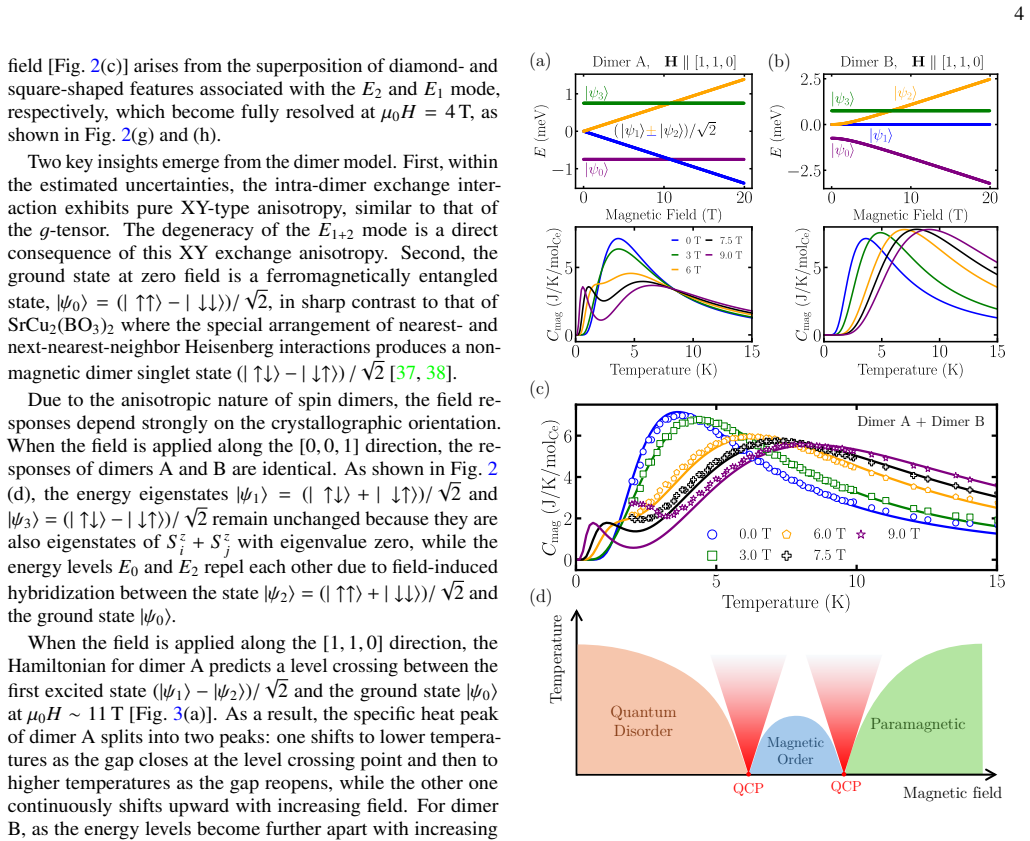
The paper's central claim is that BaCe2ZnS5 realizes a Shastry-Sutherland lattice whose intra-dimer exchange is of XY type. The authors show that all low-energy magnetic degrees of freedom of the Ce3+ ground doublets can be described by a Hamiltonian containing only intra-dimer exchange and Zeeman terms, with symmetry-constrained diagonal exchange tensors for the two orthogonal dimer orientations A and B. Fitting the five observed quasi-flat neutron bands together with magnetization and heat capacity yields $J_{xx}=0.06(6)$ meV, $J_{yy}=J_{zz}=-1.48(6)$ meV and $g_{xx}=1.2(1)$, $g_{yy}=2.4(2)$, $g_{zz}=2.1(1)$. Because the $x$-component of the exchange is near zero while the $y$ and $z$ components are equal and negative, the zero-field wavefunction is the entangled state $|\psi_0\rangle = (|\uparrow\uparrow\rangle - |\downarrow\downarrow\rangle)/\sqrt{2}$; the near degeneracy of the first two excitation modes at zero field is the direct signature of this XY anisotropy. With a field along [1,1,0], the model predicts a level crossing near 11 T, and with weak inter-dimer couplings that crossing becomes a quantum critical point with a dome of field-induced magnetic order and an Ising-like transition.
Load-bearing premise
The model assumes that Ce dimers are independent, with no inter-dimer coupling strong enough to matter, and if that coupling is not actually small, the fitted exchange values and the claimed entangled ground state could change.
Editorial extensions
If this is right
- BaCe2ZnS5 becomes the first member of the BaR2ZnX5 Shastry-Sutherland family with a fully resolved anisotropic exchange Hamiltonian, and its zero-field state is a quantum paramagnet of entangled XY dimers rather than singlet dimers.
- For a field along [1,1,0], the model predicts a level crossing near 11 T; weak inter-dimer couplings should convert that degeneracy into a quantum critical point with a dome of field-induced order in the field-temperature plane.
- The local order parameter of that field-induced phase is the $y$-$z$ plane magnetization of the A-dimers, and the transition is expected to belong to the Ising universality class in $D=d+1$ dimensions.
- Because the fit reproduces the momentum-dependent neutron intensities, the dimer wavefunctions are determined by spectral-weight distributions, giving a direct experimental handle on the entangled ground state.
Reading between the lines
- If the dimer model is correct, the heat-capacity deviation already visible between 7.5 and 9 T near the expected crossing offers a way to estimate the inter-dimer coupling $J'$; a quantitative fit of that region would likely place the true critical field below the isolated-dimer value of 11 T.
- The XY anisotropy originates in the cerium crystal-field doublet, so substituting the rare-earth or ligand ions is a natural way to tune the intra-dimer exchange across Heisenberg, XY, and Ising limits on the same Shastry-Sutherland lattice.
- The entangled $|\psi_0\rangle$ state has zero total $z$-magnetization but carries quadrupolar character, so measuring two-spin correlation functions or spin-nematic susceptibilities could reveal whether this dimer entanglement leaves observable signatures beyond single-dimer thermodynamics.
Signed reviews
Editorial analysis
A structured set of objections, weighed in public.
Referee Report
Summary. The paper reports a combined experimental and theoretical study of the Shastry-Sutherland lattice compound BaCe2ZnS5. Magnetization, specific heat, and inelastic neutron scattering (INS) data are analyzed with a localized spin-dimer Hamiltonian containing intra-dimer exchange and Zeeman terms only (Eq. 1). The authors fit three exchange parameters and three g-tensor components to five quasi-flat INS band energies, magnetization, and heat capacity, obtaining Jxx = 0.06(6) meV, Jyy = Jzz = -1.48(6) meV, with gxx = 1.2(1), gyy = 2.4(2), gzz = 2.1(1). From these parameters they deduce that the zero-field ground state of each dimer is the entangled state |ψ0⟩ = (|↑↑⟩ - |↓↓⟩)/√2, rather than the Heisenberg singlet, and they predict a field-induced level crossing near 11 T for fields along [1,1,0]. The SI provides an analytic diagonalization of the dimer Hamiltonian, together with details of the CEF analysis, polarized neutron diffraction, and the extraction of INS peak positions.
Significance. If the conclusions hold, the paper identifies a new type of Shastry-Sutherland magnet in which the intra-dimer exchange has strong XY-type anisotropy and the elementary magnetic units are entangled |↑↑⟩-|↓↓⟩ dimer states, in contrast to the singlet dimers of SrCu2(BO3)2. The central claim is well constrained: the fit is overdetermined (five energies plus magnetization and heat capacity for six parameters), the g-tensor is independently supported by CEF analysis and polarized neutron diffraction, and the model reproduces the INS spectral-weight modulations, not just the band energies. The prediction of a field-induced quantum critical point near 11 T is falsifiable. The main weakness is that the model neglects inter-dimer coupling J' without a quantitative bound, and the paper's own high-field heat capacity data deviate from the dimer model well below the predicted crossing, an effect attributed to inter-dimer couplings.
major comments (2)
- [Eq. (1) and SI §IV] The localized dimer Hamiltonian omits inter-dimer coupling J' without a quantitative bound. The quasi-flatness of the INS bands is cited as evidence that J' is weak, but with an energy resolution of 0.1 meV FWHM, a bandwidth up to about 0.05 meV would be unresolved; this is comparable to the reported uncertainty of 0.06 meV on Jxx. Moreover, the authors' own specific-heat data (Fig. 3(c)) deviate from the dimer model between 7.5 and 9 T, an effect they attribute to inter-dimer couplings. To support the central claim that the intra-dimer exchange is XY-type and that the zero-field ground state is the product of local |ψ0⟩ states, the authors should estimate an upper bound on J' from the INS band widths and demonstrate that the fitted Jxx, Jyy, Jzz and the ground state are stable when a representative inter-dimer term is included.
- [Fig. 3(a) and surrounding text] The predicted level crossing at about 11 T is computed for the isolated dimer model, but the experimental specific-heat peak in Fig. 3(c) already begins to move upward between 7.5 and 9 T, indicating that inter-dimer couplings become relevant well below the bare crossing. The paper should clearly distinguish the bare dimer level crossing from the actual quantum critical field and either estimate J' from this discrepancy or explain why the deviation does not affect the zero-field determination of the exchange parameters.
minor comments (4)
- [SI Table S3] The third row of the table labels the 1.48 meV (0 T) and 1.75 meV (4 T) modes as 'E2'; these should be labeled E3 to be consistent with the text.
- [Conclusion] In the conclusion, 'Fig. 3 (c)' should be 'Fig. 3 (d)' when referring to the schematic phase diagram.
- [SI §III] The phrase 'in-plane Ising-spin nature with moments orthogonal to the dimer bond' is confusing because the effective spin model is described as XY-type; clarify that this refers to the anisotropic local susceptibility from polarized neutron diffraction.
- [SI §II] The CEF analysis reports the fitted parameters but does not give the corresponding g-tensor principal values; providing these would allow a direct comparison with the dimer-model g-factors in Eq. (3).
Circularity Check
No significant circularity: the entangled XY-dimer ground state is a model output constrained by multiple independent data sets, not a fitted input.
full rationale
The derivation chain is not circular. The exchange parameters and g-factors in Eq. (3) are obtained by a simultaneous fit to five INS band energies, the INS intensity modulation in the hk0 plane, magnetization, and heat capacity, as stated in the main text: 'By varying the three exchange parameters and the three g-factors, we obtained an excellent fit to excitation energies of all five observed quasi-flat bands ..., as well as temperature- and field-dependence of heat capacity and magnetization data.' The zero-field ground state |ψ0>=(|↑↑>-|↓↓>)/√2 is not an input to this fit; it is the eigenvector obtained by diagonalizing the fitted 4x4 dimer Hamiltonian (SI Eq. 4). The fit could have yielded a Heisenberg-like singlet had the data favored Jxx≈Jyy≈Jzz; instead the data favored Jxx=0.06(6), Jyy=Jzz=-1.48(6), which mathematically gives |ψ0>. Additional independent constraint on the wavefunction comes from the neutron intensity modulation: SI Sec. IV states 'Matching the simulated results with experimental data provides strong constraints of the wavefunctions for each levels.' The 11 T level-crossing prediction is an extrapolation, and the paper explicitly acknowledges the 7.5-9 T heat-capacity discrepancy and attributes it to unquantified inter-dimer couplings; this is a stated limitation and a correctness risk, not a circular step. Self-citations (CrysFieldExplorer, polarized-neutron method, BaNd2ZnS5 synthesis) are methodological tools rather than load-bearing uniqueness claims. No equation in the paper reduces by construction to its own input.
Assumptions & free parameters
free parameters (6)
- Jxx (dimer A) =
0.06(6) meV
- Jyy (dimer A) =
-1.48(6) meV
- Jzz (dimer A) =
-1.48(6) meV
- gxx (dimer A) =
1.2(1)
- gyy (dimer A) =
2.4(2)
- gzz (dimer A) =
2.1(1)
assumptions (4)
- domain assumption The Ce3+ crystal-field ground state is an isolated Kramers doublet that can be treated as an effective spin-1/2 with an anisotropic g-tensor.
- domain assumption Magnetic interactions are limited to intra-dimer exchange; inter-dimer coupling is zero.
- domain assumption The symmetry-allowed intra-dimer exchange matrix is diagonal in the global frame with only three independent components (Eq. 2).
- standard math The INS cross-section formula of SI Eq. 5 (from Ref. 9) applies to this dimer system.
Cite this review
Pith. "Pith review of Quantum entanglement of XY-type spin dimers in Shastry-Sutherland lattice." pith.science (2026). https://pith.science/paper/RKIEHOH4
@misc{pith2026241217913,
  author       = {Pith},
  title        = {Pith review of: Quantum entanglement of XY-type spin dimers in Shastry-Sutherland lattice},
  year         = {2026},
  howpublished = {\url{https://pith.science/paper/RKIEHOH4}},
  note         = {Machine review of arXiv:2412.17913}
}
abstract
We report a comprehensive study on the origin of the enigmatic disordered ground state within the Shastry-Sutherland lattice, BaCe$_2$ZnS$_5$, at low temperatures. The magnetization and heat capacity data show a lack of magnetic ordering down to 73 mK. We deploy a localized spin dimer model which can accurately reproduce the dynamic structure factor of the neutron data, magnetization and heat capacity data. Remarkably, the intra-dimer exchange interaction shows strong XY-type anisotropy and the ground state of BaCe$_2$ZnS$_5$ is in an entangled state $(|\uparrow\uparrow> - |\downarrow\downarrow>)/\sqrt{2}$. This is in contrast to the singlet dimer state that is obtained for Heisenberg interactions. These results confirm that BaCe$_2$ZnS$_5$ is in a quantum paramagnet state consisting of entangled spin dimer states.
Figures


Forward citations
Cited by 1 Pith paper
-
Novel bipartite entanglement in the quantum dimer magnet Yb$_2$Be$_2$SiO$_7$
Yb2Be2SiO7 hosts a dimer ground state of (|↑↑⟩ - |↓↓⟩)/√2 or (|↑↑⟩ + |↓↓⟩)/√2, an Sz≠0 entangled state, rather than the conventional Heisenberg singlet.
Reference graph
Works this paper leans on
-
[1]
Quantum entanglement,
Ryszard Horodecki, Paweł Horodecki, Michał Horodecki, and Karol Horodecki, “Quantum entanglement,” Rev. Mod. Phys. 81, 865–942 (2009)
2009
-
[2]
This is in contrast to the singlet dimer state that is obtained for Heisenberg interactions. These results confirm that BaCe2ZnS5 is in a quantum paramagnet state consisting of entangled spin dimer states. Quantum entanglement is an intricate phenomenon that emerges from the principles of quantum mechanics [ 1, 2], manifesting itself most strikingly in st...
-
[4]
A qualitative phase diagram, shown in Fig
Based on the extracted model, the BaCe 2ZnS5 system could enter a field-induced intermediate state through a quantum phase transition around 11 T applied along the [1,1,0] direction. A qualitative phase diagram, shown in Fig. 3 (c), describes the temperature-field characteristics of the different states. This places BaCe2ZnS5 in closer resemblance to othe...
-
[5]
Quantum entanglement in condensed mat- ter systems,
Nicolas Laflorencie, “Quantum entanglement in condensed mat- ter systems,” Physics Reports 646, 1–59 (2016), quantum entan- glement in condensed matter systems
work page 2016
-
[6]
Spin ice state in frustrated magnetic py- rochlore materials,
Steven T. Bramwell and Michel J. P. Gin- gras, “Spin ice state in frustrated magnetic py- rochlore materials,” Science 294, 1495–1501 (2001), https://www.science.org/doi/pdf/10.1126/science.1064761
-
[7]
Spin frustration in 2d kagome lattices: A problem for inorganic synthetic chemistry,
Daniel G Nocera, Bart M Bartlett, Daniel Grohol, Dimitris Papoutsakis, and Matthew P Shores, “Spin frustration in 2d kagome lattices: A problem for inorganic synthetic chemistry,” Chemistry–A European Journal 10, 3850–3859 (2004)
work page 2004
-
[8]
Spin liquids in frustrated magnets,
Leon Balents, “Spin liquids in frustrated magnets,” nature 464, 199–208 (2010)
work page 2010
-
[9]
Quantum spin ice: a search for gapless quantum spin liquids in pyrochlore magnets,
Michel JP Gingras and Paul A McClarty, “Quantum spin ice: a search for gapless quantum spin liquids in pyrochlore magnets,” Reports on Progress in Physics 77, 056501 (2014)
work page 2014
Show all 53 references
-
[10]
Partial flux ordering and thermal majorana metals in higher-order spin liquids,
Tim Eschmann, Vatsal Dwivedi, Henry F. Legg, Ciar´an Hickey, and Simon Trebst, “Partial flux ordering and thermal majorana metals in higher-order spin liquids,” Phys. Rev. Res.2, 043159 (2020)
2020
-
[11]
Thermodynamic and single-ion properties of Tb3+ within the collective paramagnetic-spin liquid state of the frustrated pyrochlore antiferromagnet Tb2Ti2O7,
M. J. P. Gingras, B. C. den Hertog, M. Faucher, J. S. Gardner, S. R. Dunsiger, L. J. Chang, B. D. Gaulin, N. P. Raju, and J. E. Greedan, “Thermodynamic and single-ion properties of Tb3+ within the collective paramagnetic-spin liquid state of the frustrated pyrochlore antiferro...
2000
-
[12]
Structural fluctuations in the spin-liquid state of Tb2Ti2O7,
J. P. C. Ruff, B. D. Gaulin, J. P. Castellan, K. C. Rule, J. P. Clancy, J. Rodriguez, and H. A. Dabkowska, “Structural fluctuations in the spin-liquid state of Tb2Ti2O7,” Phys. Rev. Lett.99, 237202 (2007)
2007
-
[13]
Sleuthing out ex- otic quantum spin liquidity in the pyrochlore magnet Ce2Zr2O7,
Anish Bhardwaj, Shu Zhang, Han Yan, Roderich Moessner, An- driy H Nevidomskyy, and Hitesh J Changlani, “Sleuthing out ex- otic quantum spin liquidity in the pyrochlore magnet Ce2Zr2O7,” npj Quantum Materials 7, 51 (2022)
2022
-
[14]
Case for a U(1)π quantum spin liquid ground state in the dipole-octupole pyrochlore Ce2Zr2O7,
E. M. Smith, O. Benton, D. R. Yahne, B. Placke, R. Sch ¨afer, J. Gaudet, J. Dudemaine, A. Fitterman, J. Beare, A. R. Wildes, S. Bhattacharya, T. DeLazzer, C. R. C. Buhariwalla, N. P. Butch, R. Movshovich, J. D. Garrett, C. A. Marjerrison, J. P. Clancy, E. Kermarrec, G. M. Luke...
2022
-
[15]
Exact ground state of a quantum mechanical antiferromagnet,
B. Sriram Shastry and Bill Sutherland, “Exact ground state of a quantum mechanical antiferromagnet,” Physica B+C 108, 1069– 1070 (1981)
1981
-
[16]
Topological triplon modes and bound states in a shastry– sutherland magnet,
Paul A McClarty, F Kr ¨uger, Tatiana Guidi, SF Parker, Keith Refson, AW Parker, Dharmalingam Prabhakaran, and Radu Coldea, “Topological triplon modes and bound states in a shastry– sutherland magnet,” Nature Physics 13, 736–741 (2017)
2017
-
[17]
Magnetic properties of the Shastry-Sutherland lattice material BaNd2ZnO5,
Yuto Ishii, G. Sala, M. B. Stone, V . O. Garlea, S. Calder, Jie Chen, Hiroyuki K. Yoshida, Shuhei Fukuoka, Jiaqiang Yan, Clarina dela Cruz, Mao-Hua Du, David S. Parker, Hao Zhang, Cristian D. Batista, Kazunari Yamaura, and A. D. Christianson, 6 “Magnetic properties of the Shas...
2021
-
[18]
Single crystal synthesis and magnetic prop- erties of a Shastry-Sutherland lattice compound BaNd2ZnS5,
Brianna R. Billingsley, Madalynn Marshall, Zhixue Shu, Huibo Cao, and Tai Kong, “Single crystal synthesis and magnetic prop- erties of a Shastry-Sutherland lattice compound BaNd2ZnS5,” Phys. Rev. Mater. 6, 104403 (2022)
2022
-
[20]
Magnetic properties of the quasi-XY Shastry- Sutherland magnet Er2Be2SiO7,
A. Brassington, Q. Ma, G. Sala, A. I. Kolesnikov, K. M. Taddei, Y . Wu, E. S. Choi, H. Wang, W. Xie, J. Ma, H. D. Zhou, and A. A. Aczel, “Magnetic properties of the quasi-XY Shastry- Sutherland magnet Er2Be2SiO7,” Phys. Rev. Mater. 8, 094001 (2024)
2024
-
[21]
Spinons in a new Shastry-Sutherland lattice magnet Pr 2Ga2BeO7,
N Li, A Brassington, MF Shu, YY Wang, H Liang, QJ Li, X Zhao, PJ Baker, H Kikuchi, T Masuda, et al., “Spinons in a new Shastry-Sutherland lattice magnet Pr 2Ga2BeO7,” arXiv preprint arXiv:2405.13628 (2024)
2024 arXiv
-
[22]
Distinct magnetic ground states in Shastry- Sutherland lattice materials: Pr2Be2GeO7 versus Nd2Be2GeO7,
Andi Liu, Fangyuan Song, Yaotao Cao, Han Ge, Huanpeng Bu, Jin Zhou, Yuqi Qin, Qingyuan Zeng, Jingxin Li, Langsheng Ling, Wei Tong, Jieming Sheng, Ming Yang, Liusuo Wu, Hanjie Guo, and Zhaoming Tian, “Distinct magnetic ground states in Shastry- Sutherland lattice materials: Pr2...
2024
-
[23]
Large magnetocaloric e ffect in the Shastry-Sutherland lattice com- pound Yb2Be2GeO7 with spin-disordered ground state,
Andi Liu, Jin Zhou, Lei Wang, Yantao Cao, Fangyuan Song, Yuyan Han, Jingxin Li, Wei Tong, Zhengcai Xia, Zhongwen Ouyang, Jinkui Zhao, Hanjie Guo, and Zhaoming Tian, “Large magnetocaloric e ffect in the Shastry-Sutherland lattice com- pound Yb2Be2GeO7 with spin-disordered groun...
2024
-
[24]
Observation of unprecedented fractional mag- netization plateaus in a new Shastry-Sutherland Ising compound,
Lalit Yadav, Afonso Rufino, Rabindranath Bag, Alexander I Kolesnikov, V Ovidiu Garlea, David Graf, Frederic Mila, Sara Haravifard, et al., “Observation of unprecedented fractional mag- netization plateaus in a new Shastry-Sutherland Ising compound,” arXiv preprint arXiv:2405.1...
2024
-
[25]
Exact Dimer Ground State and Quantized Magnetization Plateaus in the Two-Dimensional Spin System SrCu2(BO3)2,
H. Kageyama, K. Yoshimura, R. Stern, N. V . Mushnikov, K. Onizuka, M. Kato, K. Kosuge, C. P. Slichter, T. Goto, and Y . Ueda, “Exact Dimer Ground State and Quantized Magnetization Plateaus in the Two-Dimensional Spin System SrCu2(BO3)2,” Phys. Rev. Lett.82, 3168–3171 (1999)
1999
-
[26]
4-spin plaquette singlet state in the Shastry–Sutherland compound SrCu2(BO3)2,
ME Zayed, Ch R¨uegg, J Larrea J, AM L¨auchli, C Panagopoulos, SS Saxena, M Ellerby, DF McMorrow, Th Str ¨assle, S Klotz, et al., “4-spin plaquette singlet state in the Shastry–Sutherland compound SrCu2(BO3)2,” Nature physics 13, 962–966 (2017)
2017
-
[27]
Quantum phases of SrCu2(BO3)2 from high-pressure thermodynamics,
Jing Guo, Guangyu Sun, Bowen Zhao, Ling Wang, Wenshan Hong, Vladimir A. Sidorov, Nvsen Ma, Qi Wu, Shiliang Li, Zi Yang Meng, Anders W. Sandvik, and Liling Sun, “Quantum phases of SrCu2(BO3)2 from high-pressure thermodynamics,” Phys. Rev. Lett. 124, 206602 (2020)
2020
-
[29]
Tensor network study of the Shastry-Sutherland model in zero magnetic field,
Philippe Corboz and Fr´ed´eric Mila, “Tensor network study of the Shastry-Sutherland model in zero magnetic field,” Phys. Rev. B 87, 115144 (2013)
2013
-
[30]
Dynamics and insta- bilities of the Shastry-Sutherland model,
Zhentao Wang and Cristian D. Batista, “Dynamics and insta- bilities of the Shastry-Sutherland model,” Phys. Rev. Lett.120, 247201 (2018)
2018
-
[31]
Fractional magnetization plateaus and magnetic order in the shastry-sutherland magnet tmb4,
K. Siemensmeyer, E. Wulf, H.-J. Mikeska, K. Flachbart, S. Gab´ani, S. Mat’aˇs, P. Priputen, A. Efdokimova, and N. Shit- sevalova, “Fractional magnetization plateaus and magnetic order in the shastry-sutherland magnet tmb4,” Phys. Rev. Lett. 101, 177201 (2008)
2008
-
[32]
Magnetism of rare earth tetraborides,
S Mat’aˇs, K Siemensmeyer, E Wheeler, E Wulf, R Beyer, Th Her- mannsd¨orfer, O Ignatchik, M Uhlarz, K Flachbart, S Gab ´ani, P Priputen, A Efdokimova, and N Shitsevalova, “Magnetism of rare earth tetraborides,” Journal of Physics: Conference Series 200, 032041 (2010)
2010
-
[33]
Magnetic frustrations in the shas- try–sutherland system ErB4,
S. Michimura, A. Shigekawa, F. Iga, M. Sera, T. Takabatake, K. Ohoyama, and Y . Okabe, “Magnetic frustrations in the shas- try–sutherland system ErB4,” Physica B: Condensed Matter 378- 380, 596–597 (2006), proceedings of the International Confer- ence on Strongly Correlated El...
2006
-
[34]
Multi- step magnetization plateaus in the Shastry-Sutherland system TbB4,
S. Yoshii, T. Yamamoto, M. Hagiwara, S. Michimura, A. Shigekawa, F. Iga, T. Takabatake, and K. Kindo, “Multi- step magnetization plateaus in the Shastry-Sutherland system TbB4,” Phys. Rev. Lett.101, 087202 (2008)
2008
-
[35]
Sequoia: A newly operating chopper spectrometer at the sns,
GE Granroth, AI Kolesnikov, TE Sherline, JP Clancy, KA Ross, JPC Ruff, BD Gaulin, and SE Nagler, “Sequoia: A newly operating chopper spectrometer at the sns,” inJournal of Physics: Conference Series, V ol. 251 (IOP Publishing, 2010) p. 012058
2010
-
[36]
CrysFieldExplorer: rapid optimization of the crystal field Hamiltonian,
Qianli Ma, Xiaojian Bai, Erxi Feng, Guannan Zhang, and Huibo Cao, “CrysFieldExplorer: rapid optimization of the crystal field Hamiltonian,” Journal of Applied Crystallography 56, 1229– 1241 (2023)
2023
-
[37]
Ising versus XY anisotropy in frustrated R2Ti2O7 compounds as “seen
H. Cao, A. Gukasov, I. Mirebeau, P. Bonville, C. Decorse, and G. Dhalenne, “Ising versus XY anisotropy in frustrated R2Ti2O7 compounds as “seen” by polarized neutrons,” Phys. Rev. Lett. 103, 056402 (2009)
2009
-
[39]
The new cold neutron chopper spectrometer at the spallation neutron source: Design and performance,
G. Ehlers, A. A. Podlesnyak, J. L. Niedziela, E. B. Iverson, and P. E. Sokol, “The new cold neutron chopper spectrometer at the spallation neutron source: Design and performance,” Review of Scientific Instruments 82, 085108 (2011)
2011
-
[40]
Low-lying magnetic excitation of the Shastry-Sutherland model,
K. Totsuka, S. Miyahara, and K. Ueda, “Low-lying magnetic excitation of the Shastry-Sutherland model,” Phys. Rev. Lett.86, 520–523 (2001)
2001
-
[41]
Theory of the orthogonal dimer Heisenberg spin model for SrCu 2(BO3)2,
Shin Miyahara and Kazuo Ueda, “Theory of the orthogonal dimer Heisenberg spin model for SrCu 2(BO3)2,” Journal of Physics: Condensed Matter 15, R327 (2003)
2003
-
[42]
Quantum excitations in quantum spin ice,
Kate A. Ross, Lucile Savary, Bruce D. Gaulin, and Leon Balents, “Quantum excitations in quantum spin ice,” Phys. Rev. X 1, 021002 (2011)
2011
-
[43]
Kitaev exchange and field-induced quantum spin-liquid states in honey- combα-RuCl3,
Ravi Yadav, Nikolay A. Bogdanov, Vamshi M. Katukuri, Satoshi Nishimoto, Jeroen van den Brink, and Liviu Hozoi, “Kitaev exchange and field-induced quantum spin-liquid states in honey- combα-RuCl3,” Scientific Reports 6, 37925 (2016)
2016
-
[44]
Hybridized quadrupolar excitations in the spin-anisotropic frustrated magnet FeI2,
Xiaojian Bai, Shang-Shun Zhang, Zhiling Dun, Hao Zhang, Qing Huang, Haidong Zhou, Matthew B. Stone, Alexander I. Kolesnikov, Feng Ye, Cristian D. Batista, and Martin Mouri- gal, “Hybridized quadrupolar excitations in the spin-anisotropic frustrated magnet FeI2,” Nature Physics...
2021
-
[45]
Bose-einstein condensation of a two-magnon bound state in a spin-one triangular lattice,
Jieming Sheng, Jia-Wei Mei, Le Wang, Xiaoyu Xu, Wenrui Jiang, Lei Xu, Han Ge, Nan Zhao, Tiantian Li, Andrea Candini, et al., “Bose-einstein condensation of a two-magnon bound state in a spin-one triangular lattice,” arXiv preprint arXiv:2306.09695 (2023)
2023 arXiv
-
[46]
Spin-stretching modes in anisotropic magnets: Spin-wave excitations in the multiferroic Ba2CoGe2O7,
K. Penc, J. Romh´anyi, T. R˜o om, U. Nagel, ´A. Antal, T. Feh´er, A. J´anossy, H. Engelkamp, H. Murakawa, Y . Tokura, D. Sza- ller, S. Bord´acs, and I. K ´ezsm´arki, “Spin-stretching modes in anisotropic magnets: Spin-wave excitations in the multiferroic Ba2CoGe2O7,” Phys. Rev...
2012
-
[47]
Observation of two-magnon bound states in the spin-1 anisotropic Heisenberg antiferromag- netic chain system NiCl2–4SC(NH2)2,
S.A. Zvyagin, C.D. Batista, J. Krzystek, V .S. Zapf, M. Jaime, 7 A. Paduan-Filho, and J. Wosnitza, “Observation of two-magnon bound states in the spin-1 anisotropic Heisenberg antiferromag- netic chain system NiCl2–4SC(NH2)2,” Physica B: Condensed Matter 403, 1497–1499 (2008)....
2008
-
[48]
(1) The powder averaged neutron spectra has been shown in arXiv:2412.17913v1 [cond-mat.str-el] 23 Dec 2024 2 FIG. S2. (a) The calculated and measured integrated intensities of constant|Q| cut from 3.4 to 4 Å−1. (b) The calculated and measured inverse magnetic susceptibility of...
2024 arXiv
-
[49]
Single crystal synthesis and magnetic proper- ties of a Shastry-Sutherland lattice compound BaNd2ZnS5,
Brianna R. Billingsley, Madalynn Marshall, Zhixue Shu, Huibo Cao, and Tai Kong, “Single crystal synthesis and magnetic proper- ties of a Shastry-Sutherland lattice compound BaNd2ZnS5,” Phys. Rev. Mater.6, 104403 (2022)
2022
-
[50]
Sequoia: A newly op- erating chopper spectrometer at the sns,
GE Granroth, AI Kolesnikov, TE Sherline, JP Clancy, KA Ross, JPC Ruff, BD Gaulin, and SE Nagler, “Sequoia: A newly op- erating chopper spectrometer at the sns,” in Journal of Physics: Conference Series, V ol. 251 (IOP Publishing, 2010) p. 012058
2010
-
[51]
CrysFieldExplorer: rapid optimization of the crystal field Hamiltonian,
Qianli Ma, Xiaojian Bai, Erxi Feng, Guannan Zhang, and Huibo Cao, “CrysFieldExplorer: rapid optimization of the crystal field Hamiltonian,” Journal of Applied Crystallography 56, 1229–1241 (2023)
2023
-
[52]
Jens Jensen and Allan R Mackintosh, Rare earth magnetism: structures and excitations (Oxford University Press, 1991)
1991
-
[53]
Demand, a dimensional extreme magnetic neutron diffractometer at the high flux isotope reactor,
Huibo Cao, Bryan C Chakoumakos, Katie M Andrews, Yan Wu, Richard A Riedel, Jason Hodges, Wenduo Zhou, Ray Gregory, Bianca Haberl, Jamie Molaison, et al., “Demand, a dimensional extreme magnetic neutron diffractometer at the high flux isotope reactor,” Crystals 9, 5 (2018)
2018
-
[54]
Four-circle single-crystal neutron diffractometer at the High Flux Isotope Reactor,
Bryan C Chakoumakos, Huibo Cao, Feng Ye, Alexandru D Stoica, Mihai Popovici, Madhan Sundaram, Wenduo Zhou, J Steve Hicks, Gary W Lynn, and Richard A Riedel, “Four-circle single-crystal neutron diffractometer at the High Flux Isotope Reactor,” Journal of Applied Crystallography...
2011
-
[55]
Local magnetic anisotropy by polarized neutron powder di ffraction: Application of magneti- cally induced preferred crystallite orientation,
I. A. Kibalin and A. Gukasov, “Local magnetic anisotropy by polarized neutron powder di ffraction: Application of magneti- cally induced preferred crystallite orientation,” Phys. Rev. Res.1, 033100 (2019)
2019
-
[56]
Field-induced partial disorder in a Shastry-Sutherland lattice,
Madalynn Marshall, Brianna R Billingsley, Xiaojian Bai, Qianli Ma, Tai Kong, and Huibo Cao, “Field-induced partial disorder in a Shastry-Sutherland lattice,” Nature Communications 14, 3641 (2023)
2023
-
[57]
Clemente-Juan, Michael Aebersold, Hans U
Hanspeter Andres, Juan M. Clemente-Juan, Michael Aebersold, Hans U. G ¨udel, Eugenio Coronado, Herma B ¨uttner, Gordon Kearly, Julio Melero, and Ram ´on Burriel, “Magnetic excitations in polyoxometalate clusters observed by inelastic neutron scatter- ing: Evidence for anisotro...
1999
Reviewed August 11, 2026 · model on record in the stance chip above.
Discussion (0). Continue with ORCID to comment.