REVIEW 4 major objections 5 minor 2 cited by
EvoPat: A Multi-LLM-based Patents Summarization and Analysis Agent
T0 review · 4 major / 5 minor · reviewed 2026-08-11 · deepseek-v4-flash
Pith's one-line read EvoPat, a multi-agent LLM system, claims to outperform GPT-4 on patent summarization, comparative analysis, and technical evaluation through five specialized roles plus retrieval and online search.
desk verdict EvoPat is a coherent multi-agent patent analysis system, but the paper's central claim that it beats GPT-4o rests on an evaluation that cannot separate output length and prompt-following from genuine analytical quality. read the letter →
The pith
A machine-rendered reading of the paper's core claim, the machinery that carries it, and where it could break.
The reading
What carries the argument
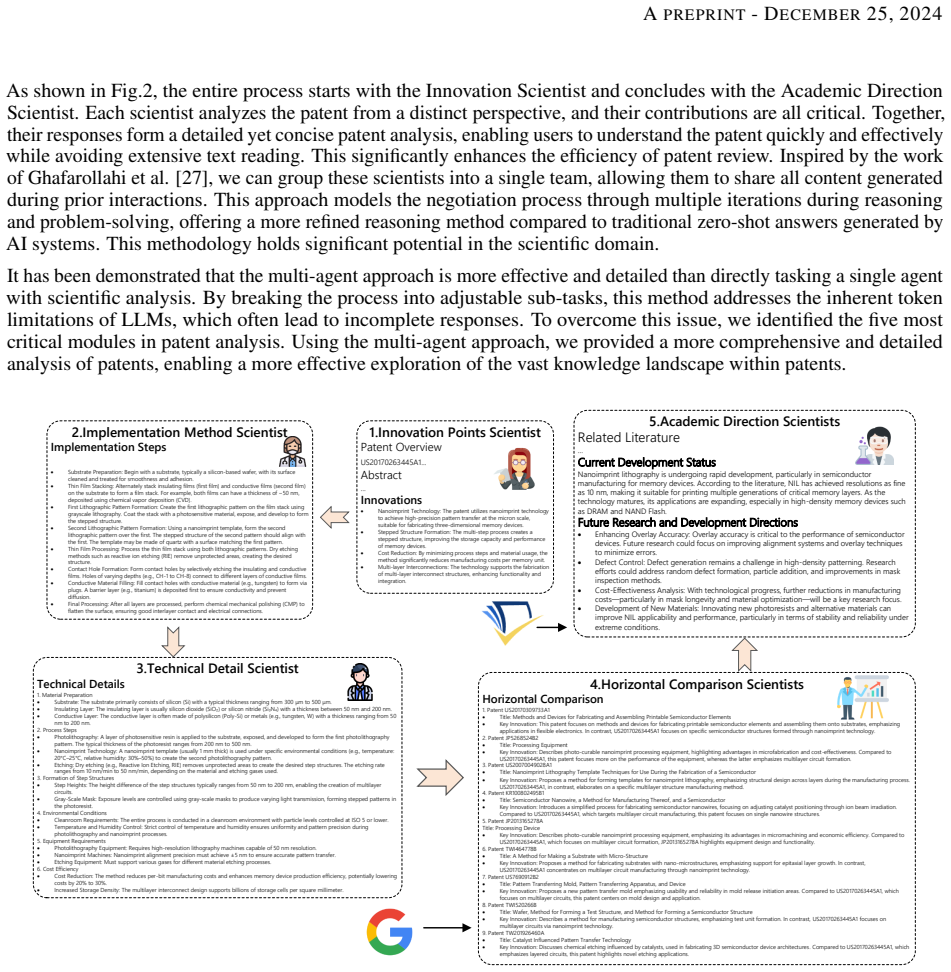
The load-bearing object is the multi-agent team: five LLM agents with distinct role profiles — innovation points, implementation method, technical details, horizontal comparison, and academic direction — communicating through AutoGen so that each later agent sees the work of earlier ones. Around this core sit retrieval-augmented generation with BGE-M3 embeddings stored in a Faiss vector database, tool calls to Google Patents and Semantic Scholar for external context, and two long-context strategies, Transform Messages and LLMLingua, with LLMLingua as the default. The machinery works by decomposing one patent into five complementary analyses and then reassembling them into a single Markdown-to-PDF report.
What would settle it
Re-run the comparison on the same 100-patent photoresist and nanoimprint sample with identical prompts, reference summaries written before any system output, and human raters blind to which system produced each report; if the ROUGE-1 gap of 0.2164 versus 0.0745 collapses or the expert scores converge, the claimed advantage of the multi-agent architecture is not supported.
Extended reading notes
Core claim
On the paper's own terms, the central discovery is that a team of role-specialized LLM agents assembled by the AutoGen framework and backed by retrieval-augmented generation produces patent analyses that are both closer to gold summaries and more highly rated by domain experts than the single-model output of GPT-4o. The reported numbers are ROUGE-1 0.2164 against 0.0745, and expert ratings of 4.82 versus 4.13 for informativeness, 4.85 versus 3.95 for richness, and 4.34 versus 2.79 for extensibility on a five-point scale. The paper also claims that the LLMLingua prompt-compression strategy handles long patents better than a message-history-truncation strategy, and uses it as the system default.
Load-bearing premise
The central claim rests on the evaluation being fair: the reference summaries used for ROUGE and the human expert ratings must not have been shaped by knowledge of EvoPat's outputs, and the prompts given to GPT-4o must not have been weaker versions of EvoPat's detail-seeking instructions.
Editorial extensions
If this is right
- Patent analysts could use EvoPat as a first-pass filter, reading the innovation and comparison sections to decide which patents deserve close manual review.
- The same five-role decomposition can be transferred to other technical document types, such as standards, clinical trial records, or product documentation, wherever multiple expert perspectives add value.
- Because EvoPat's largest measured gains are in informativeness and extensibility, the value of the system appears to come mostly from role specialization and external search rather than from better compression of the patent text.
- Using LLMLingua as the default implies that heavily compressed prompts, although hard for humans to read, can preserve the information needed for detailed patent analysis while lowering token cost.
Reading between the lines
- A decisive follow-up would hold prompts, gold reference summaries, and rater blinding fixed across systems, isolating whether the reported gap comes from the multi-agent architecture itself.
- Removing single roles one at a time (for example, the academic direction scientist) and re-measuring expert ratings would reveal which specialist agent carries the most value.
- Since BGE-M3 supports multilingual embeddings and the dataset already covers Chinese, English, Japanese, and Korean, the same scaffolding could be tested for cross-lingual patent retrieval and comparison.
Editorial analysis
A structured set of objections, weighed in public.
Referee Report
Summary. The paper proposes EvoPat, a multi-agent LLM system for patent summarization and analysis. The system preprocesses patent PDFs, embeds chunks in a Faiss vector database, and runs five specialized agents (innovation points, implementation method, technical details, horizontal comparison, and academic direction) coordinated through AutoGen, with GPT-4o as the underlying model and LLMLingua or Transform Messages for long-context handling. The evaluation claims that EvoPat outperforms GPT-4o on ROUGE and BERTScore (Table 1) and on human-rated informativeness, richness, coherence, attributability, and extensibility (Table 2), and that LLMLingua slightly outperforms the Transform Message strategy for long texts (Table 3). The appendix contains the prompts used for each of the five agent roles.
Significance. The application area is timely and the architecture is coherent: decomposing patent analysis into specialized roles with retrieval augmentation and external API calls is a reasonable engineering choice. However, the paper's headline contribution is empirical, and the current evidence does not establish the claimed superiority over GPT-4o. The manuscript does not release code, data, or evaluation scripts, and the evaluation protocol is underspecified in ways that directly affect the central claim. If the comparison were properly controlled, with disclosed baselines, gold references, and blinded human evaluation, the system could be a useful contribution; as it stands, the reported numbers do not justify the abstract's assertion.
major comments (4)
- [Section 3.1.3, Table 1] The reference summaries used for ROUGE and BERTScore are never defined. Equations (1)-(3) compute overlap against a 'reference summary,' but the manuscript does not state whether the references are original patent abstracts, expert-written gold summaries, or one of the model outputs. Without this information, the ROUGE advantage (0.2164 vs. 0.0745) cannot be interpreted; it could simply reflect which output happens to resemble the chosen reference. This is a load-bearing omission for the central outperformance claim.
- [Section 3.2, Table 1, and Appendix Tables 4-8] The GPT-4o baseline is not specified: no prompt, context window, temperature, maximum output length, or number of runs is reported. Meanwhile, the EvoPat prompts explicitly instruct agents to 'strive for the longest response possible,' 'output more text,' and add 'real quantitative figures' (Tables 4, 5, 6, 8). Since ROUGE-1 and ROUGE-L are recall-oriented, longer and more detailed outputs are favored by construction. The reported gap is therefore compatible with a verbosity or instruction-following confound rather than with superior analytic quality. A controlled comparison, for example matching output length or using a comparable detailed prompt for GPT-4o, is needed.
- [Section 3.2, Table 2] The human evaluation lacks a protocol. The manuscript reports only mean scores from four experts over 100 samples, with no rubric definitions, no rater assignment or blinding, and no inter-annotator agreement or variance. Two of the rated dimensions, Attributable and Extensible, explicitly reward the external-search and number-adding behaviors that EvoPat's prompts mandate, so the ratings may measure prompt compliance rather than output quality. A blinded, rubric-based evaluation with agreement statistics and significance testing is required to support the claim that EvoPat 'clearly outperforms GPT-4o across all dimensions.'
- [Section 3.3, Table 3] The long-context comparison is under-specified, and the table caption ('Evaluation comparison between EvoPat and GPT4') does not match the content, which compares two EvoPat strategies. It is unclear whether the same test set and human raters were used as in Tables 1 and 2, how many samples were evaluated, and what variability underlies the reported differences. Without this information, the conclusion that LLMLingua outperforms the Transform Message strategy is not supported.
minor comments (5)
- [Abstract, Section 1, Section 2.3.2] The abstract and introduction claim comparison with 'GPT-4,' while the experiments and system description use 'GPT-4o'; please align the terminology.
- [Throughout] There are numerous typos and copyediting issues, including 'catalogous,' 'repectively,' 'Horizaontal,' and 'EvoPatent' in Section 3.3; please proofread carefully.
- [Section 2.2.2] The text filtering step removes stop words from patent text before LLM analysis; this may degrade the model's comprehension, and the choice should be justified or tested.
- [Section 3.1.3] The paper states that BERTScore 'builds upon METEOR,' but BERTScore is based on BERT embeddings rather than METEOR; reference [30] is about METEOR and is not the appropriate basis for that claim. Please correct the description.
- [Figure 2] The figure presents a detailed example report without stating whether it is a verbatim system output or a curated illustration; please clarify its provenance.
Circularity Check
No significant circularity: EvoPat's performance claims rest on external comparison with GPT-4o, not on self-referential definitions.
full rationale
EvoPat is an empirical systems paper, not a derivation chain. Its central claim, expressed in the abstract, is that EvoPat outperforms GPT-4 in patent summarization, comparative analysis, and technical evaluation. This claim is supported by comparisons against an external baseline, GPT-4o, in Tables 1 and 2. No parameter is fitted to the reported metrics, no uniqueness theorem from the authors is invoked, and the prior work cited for the multi-agent architecture is independent and external. The ROUGE and BERTScore definitions in Section 3.1.3 are standard and are not identified with any EvoPat input, so no equation reduces to its own assumptions. Some evaluation details are missing: gold reference summaries, the GPT-4o prompt, rater blinding, and the human-evaluation rubric are not disclosed, and the Appendix prompts instruct EvoPat agents to strive for the longest response possible and to add real quantitative figures, which could confound length-based metrics. Those are evaluation-validity concerns, not circularity: the paper's own definitions do not force the reported outcomes, and the comparison target is independent of the authors' system. The Conclusion also lists genuine limitations, indicating contingent empirical claims rather than definitional identities. The proportionate circularity score is therefore 1.
Assumptions & free parameters
free parameters (3)
- LLMLingua compression ratio =
not reported
- Number of similar patents retrieved per search =
not reported
- Expert rating aggregation and scale =
not reported
assumptions (4)
- domain assumption ROUGE and BERTScore computed against gold summaries are valid indicators of patent analysis quality.
- domain assumption Human expert ratings are unbiased and consistent.
- domain assumption LLMLingua compression preserves the information needed for patent analysis.
- domain assumption BGE-M3 embedding and Faiss retrieval improve the agents' outputs.
Cite this review
Pith. "Pith review of EvoPat: A Multi-LLM-based Patents Summarization and Analysis Agent." pith.science (2026). https://pith.science/paper/7MU2KN3L
@misc{pith2026241218100,
  author       = {Pith},
  title        = {Pith review of: EvoPat: A Multi-LLM-based Patents Summarization and Analysis Agent},
  year         = {2026},
  howpublished = {\url{https://pith.science/paper/7MU2KN3L}},
  note         = {Machine review of arXiv:2412.18100}
}
read the original abstract
The rapid growth of scientific techniques and knowledge is reflected in the exponential increase in new patents filed annually. While these patents drive innovation, they also present significant burden for researchers and engineers, especially newcomers. To avoid the tedious work of navigating a vast and complex landscape to identify trends and breakthroughs, researchers urgently need efficient tools to summarize, evaluate, and contextualize patents, revealing their innovative contributions and underlying scientific principles.To address this need, we present EvoPat, a multi-LLM-based patent agent designed to assist users in analyzing patents through Retrieval-Augmented Generation (RAG) and advanced search strategies. EvoPat leverages multiple Large Language Models (LLMs), each performing specialized roles such as planning, identifying innovations, and conducting comparative evaluations. The system integrates data from local databases, including patents, literature, product catalogous, and company repositories, and online searches to provide up-to-date insights. The ability to collect information not included in original database automatically is also implemented. Through extensive testing in the natural language processing (NLP) domain, we demonstrate that EvoPat outperforms GPT-4 in tasks such as patent summarization, comparative analysis, and technical evaluation. EvoPat represents a significant step toward creating AI-powered tools that empower researchers and engineers to efficiently navigate the complexities of the patent landscape.
Figures

Forward citations
Cited by 2 Pith papers
-
From Unstructured Communication to Intelligent RAG: Multi-Agent Automation for Supply Chain Knowledge Bases
Converting raw support tickets into a 3.4%-volume, category-structured knowledge base with three LLM agents improves RAG helpful answers from 38.60% to 48.74% on a real supply chain ticket dataset.
-
A Comprehensive Survey of Deep Research: Systems, Methodologies, and Applications
A survey of 80+ Deep Research systems that proposes a four-layer taxonomy (foundation models, tool use, planning, synthesis) and compares commercial and open-source implementations.
Reference graph
Works this paper leans on
-
[1]
Retrieval-augmented generation for knowledge- intensive nlp tasks
Patrick Lewis, Ethan Perez, Aleksandra Piktus, Fabio Petroni, Vladimir Karpukhin, Naman Goyal, Heinrich Küttler, Mike Lewis, Wen-tau Yih, Tim Rocktäschel, et al. Retrieval-augmented generation for knowledge- intensive nlp tasks. Advances in Neural Information Processing Systems , 33:9459–9474, 2020
work page 2020
-
[2]
Josh Achiam, Steven Adler, Sandhini Agarwal, Lama Ahmad, Ilge Akkaya, Florencia Leoni Aleman, Diogo Almeida, Janko Altenschmidt, Sam Altman, Shyamal Anadkat, et al. Gpt-4 technical report. arXiv preprint arXiv:2303.08774, 2023
arXiv 2023
-
[3]
Jinheon Baek, Sujay Kumar Jauhar, Silviu Cucerzan, and Sung Ju Hwang. Researchagent: Iterative research idea generation over scientific literature with large language models. arXiv preprint arXiv:2404.07738, 2024
arXiv 2024
-
[4]
From sparse to dense: Gpt-4 summarization with chain of density prompting
Griffin Adams, Alexander R Fabbri, Faisal Ladhak, Eric Lehman, and Noémie Elhadad. From sparse to dense: Gpt-4 summarization with chain of density prompting. In Proceedings of the Conference on Empirical Methods in Natural Language Processing. Conference on Empirical Methods in Natural Language Processing , page 68, 2023
work page 2023
-
[5]
Training language models to follow instructions with human feedback
Long Ouyang, Jeffrey Wu, Xu Jiang, Diogo Almeida, Carroll Wainwright, Pamela Mishkin, Chong Zhang, Sandhini Agarwal, Katarina Slama, Alex Ray, et al. Training language models to follow instructions with human feedback. Advances in neural information processing systems , 35:27730–27744, 2022
2022
-
[6]
Patent classification by fine-tuning bert language model
Jieh-Sheng Lee and Jieh Hsiang. Patent classification by fine-tuning bert language model. World Patent Information, 61:101965, 2020
work page 2020
-
[7]
Automatic summarization of scientific articles: A survey
Nouf Ibrahim Altmami and Mohamed El Bachir Menai. Automatic summarization of scientific articles: A survey. Journal of King Saud University-Computer and Information Sciences , 34(4):1011–1028, 2022
work page 2022
-
[8]
Bridging Research and Readers: A Multi-Modal Automated Academic Papers Interpretation System
Feng Jiang, Kuang Wang, and Haizhou Li. Bridging research and readers: A multi-modal automated academic papers interpretation system. arXiv preprint arXiv:2401.09150, 2024
work page Pith review arXiv 2024
Show all 32 references
-
[9]
Scipip: An llm-based scientific paper idea proposer
Wenxiao Wang, Lihui Gu, Liye Zhang, Yunxiang Luo, Yi Dai, Chen Shen, Liang Xie, Binbin Lin, Xiaofei He, and Jieping Ye. Scipip: An llm-based scientific paper idea proposer. arXiv preprint arXiv:2410.23166, 2024
2024 arXiv
-
[10]
Artificial intelligence exploring the patent field.arXiv preprint arXiv:2403.04105, 2024
Lekang Jiang and Stephan Goetz. Artificial intelligence exploring the patent field.arXiv preprint arXiv:2403.04105, 2024
2024 arXiv
-
[11]
Patentgpt: A large language model for intellectual property.arXiv preprint arXiv:2404.18255, 2024
Zilong Bai, Ruiji Zhang, Linqing Chen, Qijun Cai, Yuan Zhong, Cong Wang, Yan Fang, Jie Fang, Jing Sun, Weikuan Wang, et al. Patentgpt: A large language model for intellectual property.arXiv preprint arXiv:2404.18255, 2024. 9 A PREPRINT - D ECEMBER 25, 2024
2024 arXiv
-
[12]
Llm-based extraction of contradictions from patents
Stefan Trapp and Joachim Warschat. Llm-based extraction of contradictions from patents. In International TRIZ Future Conference, pages 3–19. Springer, 2024
2024
-
[13]
Markdown: Syntax documentation
John Gruber. Markdown: Syntax documentation. https://daringfireball.net/projects/markdown/
-
[14]
pdfplumber: Extract text, tables, and metadata from pdfs
Jeremy Singer-Vine. pdfplumber: Extract text, tables, and metadata from pdfs. https://github.com/jsvine/ pdfplumber/
-
[15]
https://python.langchain.com/docs/integrations/ document_loaders/pypdfloader/
Pypdfloader: A pdf loading utility for langchain. https://python.langchain.com/docs/integrations/ document_loaders/pypdfloader/
-
[16]
Bge m3-embedding: Multi- lingual, multi-functionality, multi-granularity text embeddings through self-knowledge distillation
Jianlv Chen, Shitao Xiao, Peitian Zhang, Kun Luo, Defu Lian, and Zheng Liu. Bge m3-embedding: Multi- lingual, multi-functionality, multi-granularity text embeddings through self-knowledge distillation. arXiv preprint arXiv:2402.03216, 2024
2024 arXiv
-
[17]
Billion-scale similarity search with gpus
Jeff Johnson, Matthijs Douze, and Hervé Jégou. Billion-scale similarity search with gpus. IEEE Transactions on Big Data, 7(3):535–547, 2019
2019
-
[18]
https://www.meta.com/
Meta. https://www.meta.com/
-
[19]
Autogen: Enabling next-gen llm applications via multi-agent conversation framework
Qingyun Wu, Gagan Bansal, Jieyu Zhang, Yiran Wu, Shaokun Zhang, Erkang Zhu, Beibin Li, Li Jiang, Xiaoyun Zhang, and Chi Wang. Autogen: Enabling next-gen llm applications via multi-agent conversation framework. arXiv preprint arXiv:2308.08155, 2023
2023 arXiv
-
[20]
Llmlingua: Compressing prompts for accelerated inference of large language models
Huiqiang Jiang, Qianhui Wu, Chin-Yew Lin, Yuqing Yang, and Lili Qiu. Llmlingua: Compressing prompts for accelerated inference of large language models. arXiv preprint arXiv:2310.05736, 2023
2023 arXiv
-
[21]
Language models are unsupervised multitask learners
Alec Radford, Jeffrey Wu, Rewon Child, David Luan, Dario Amodei, Ilya Sutskever, et al. Language models are unsupervised multitask learners. OpenAI blog, 1(8):9, 2019
2019
-
[22]
Llama: Open and efficient foundation language models
Hugo Touvron, Thibaut Lavril, Gautier Izacard, Xavier Martinet, Marie-Anne Lachaux, Timothée Lacroix, Baptiste Rozière, Naman Goyal, Eric Hambro, Faisal Azhar, et al. Llama: Open and efficient foundation language models. arXiv preprint arXiv:2302.13971, 2023
2023 arXiv
-
[23]
https://openai.com/
Openai. https://openai.com/
-
[24]
https: //patents.google.com/patent/US20170263445A1/en?oq=US20170263445A1
Us20170263445a1: Manufacturing method of semiconductor device and template for nanoimprint. https: //patents.google.com/patent/US20170263445A1/en?oq=US20170263445A1
-
[25]
https://patents.google.com/
Google patents. https://patents.google.com/
-
[26]
https://www.semanticscholar.org/
Semantic scholar. https://www.semanticscholar.org/
-
[27]
Sciagents: Automating scientific discovery through multi-agent intelligent graph reasoning
Alireza Ghafarollahi and Markus J Buehler. Sciagents: Automating scientific discovery through multi-agent intelligent graph reasoning. arXiv preprint arXiv:2409.05556, 2024
2024 arXiv
-
[28]
Rouge: A package for automatic evaluation of summaries
Chin-Yew Lin. Rouge: A package for automatic evaluation of summaries. Text summarization branches out, 2004
2004
-
[29]
Weinberger, and Yoav Artzi
Tianyi Zhang, Varsha Kishore, Felix Wu, Kilian Q. Weinberger, and Yoav Artzi. Bertscore: Evaluating text generation with BERT. arXiv preprint arXiv:1904.09675, 2019
1904 arXiv
-
[30]
Meteor: An automatic metric for mt evaluation with improved correlation with human judgments
Banerjee Satanjeev and Lavie Alon. Meteor: An automatic metric for mt evaluation with improved correlation with human judgments. In the acl workshop on intrinsic and extrinsic evaluation measures for machine translation and/or summarization, 2005
2005
-
[31]
mface: Multilingual summarization with factual consistency evaluation
Roee Aharoni, Shashi Narayan, Joshua Maynez, Jonathan Herzig, Elizabeth Clark, and Mirella Lapata. mface: Multilingual summarization with factual consistency evaluation. arXiv preprint arXiv:2212.10622, 2022
2022 arXiv
-
[32]
source pdf
Alexander R Fabbri, Wojciech Kry ´sci´nski, Bryan McCann, Caiming Xiong, Richard Socher, and Dragomir Radev. Summeval: Re-evaluating summarization evaluation. Transactions of the Association for Computational Linguistics, 9:391–409, 2021. 10 A PREPRINT - D ECEMBER 25, 2024 5 A...
2021
Reviewed August 11, 2026 · model on record in the stance chip above.
Discussion (0). Continue with ORCID to comment.