REVIEW 3 major objections 5 minor 45 references
The effect of outflow launching radial efficiency of accretion disk on the shape of emission-line profiles
T0 review · 3 major / 5 minor · reviewed 2026-08-11 · deepseek-v4-flash
Pith's one-line read Low-ionization line shapes trace cloud illumination more than the disk-outflow radial law.
desk verdict A modest but honest FRADO parameter study; the new flux-threshold result is real but hinges on a step-function cut that the paper itself admits is too simple. read the letter →
The pith
A machine-rendered reading of the paper's core claim, the machinery that carries it, and where it could break.
The reading
What carries the argument
The carrying object is FRADO (Failed Radiatively Accelerated Dusty Outflow), a model upgraded to 2.5D in which dusty clumps are lifted from the surface of a Shakura-Sunyaev accretion disk by radiation pressure, lose their dust as they rise, and fall back ballistically; the model self-consistently outputs the BLR cloud distribution with no free launching parameters. The paper varies the radial outflow efficiency through the power-law index $s$ in $\dot M_z(r)\propto r^s$: $s=-0.5$ comes from an energy-wise approach with dust opacity scaling as $r^{-0.5}$, and $s=-1.5$ comes from single-scattering momentum balance. Emission-line profiles are then computed by Doppler-shifting cloud velocities at the mean viewing angle of $39^\circ$ under two emissivity assumptions: uniform emission from all clouds, or emission only from clouds meeting the photon-flux threshold $\log\phi\gtrsim17$-$18\ \mathrm{cm^{-2}\,s^{-1}}$. The threshold is the mechanism that makes the two outflow scalings converge, and it is what carries the argument that cloud conditions, not the outflow law, dominate the line shape.
What would settle it
Compute the profiles with a photoionization-based continuous emissivity, assigning each cloud a line emissivity that rises gradually with incident flux and depends on density, and compare the $s=-0.5$ and $s=-1.5$ cases; if the profiles diverge again, the paper's central claim fails. Observationally, a sample of quasars with independent kinematic measures of outflow steepness, such as blueshifted absorption features, that shows line profiles tracking outflow steepness would contradict the conclusion.
Extended reading notes
Core claim
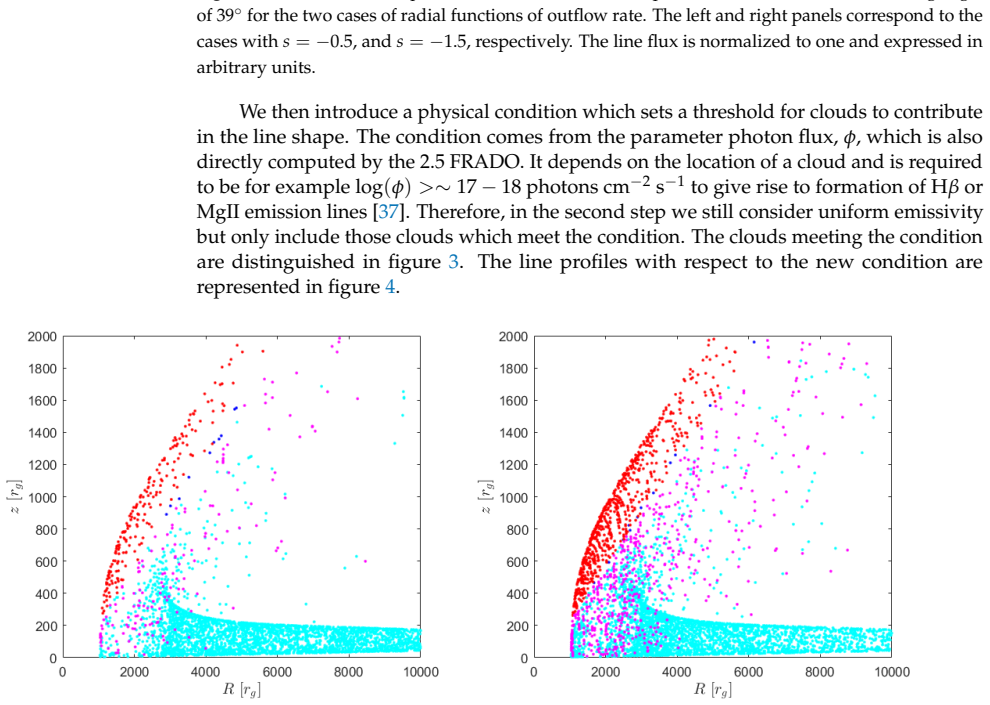
The central claim is that the radial power-law index of the disk mass-loss rate is a secondary factor in shaping low-ionization broad emission lines; the primary factor is how cloud emissivity is treated. In the 2.5D FRADO setup, the shallower scaling $s=-0.5$ spreads clouds over a wider, slower BLR and, under uniform emissivity, yields a double-peaked line, while $s=-1.5$ concentrates clouds near the black hole and yields a single-peaked line. Imposing the physically motivated photon-flux condition $\log\phi\gtrsim17$-$18\ \mathrm{cm^{-2}\,s^{-1}}$ for H$\beta$/MgII formation erases this distinction: only clouds launched from a narrow radial range near the black hole are bright enough to contribute, so both scalings give nearly identical single-peaked profiles. The paper therefore concludes that the shapes of low-ionization lines are dictated more by the illumination and dynamics of the inner clouds than by the specific radial form of the outflow, with the steeper $r^{-3/2}$ scaling still preferred for the mean quasar benchmark.
Load-bearing premise
The key load-bearing premise is the step-function emissivity threshold: a cloud either contributes to the line once its photon flux exceeds about $10^{18}\ \mathrm{cm^{-2}\,s^{-1}}$ or not at all; if real emissivity varies smoothly with flux, or if the threshold sits at a different value, the radial outflow scaling would regain a visible role.
Editorial extensions
If this is right
- Observed single-peaked low-ionization profiles cannot uniquely determine the radial outflow law, because the photon-flux threshold makes both $s=-0.5$ and $s=-1.5$ produce the same shape.
- The steeper $r^{-3/2}$ scaling predicts a more compact, higher-velocity BLR, so BLR size and velocity dispersion measurements can still constrain the outflow efficiency even when profile shape cannot.
- Across the transition to the dust-free inner region, the outflow launching efficiency should drop much more steeply, with power-law indices below $-2$ and down to roughly $-3.5$, concentrating high-ionization emission near the black hole.
- For the mean SDSS quasar benchmark, the model yields broad lines with FWHM near 5000$-$6000 km/s and a slight blueshift, placing it in Population B2 (the moderate-accretion tile of the Eigenvector 1 classification) with negligible gravitational redshift.
Reading between the lines
- I read the flux-threshold result as implying that the observable low-ionization BLR is effectively a narrow, well-illuminated annulus; if true, reverberation-mapping size measurements trace the illumination-limited annulus rather than the full radial extent of the outflow.
- A direct extension is to model H$\beta$ and MgII together: because the two lines form under different threshold fluxes, the profile difference between them should be a diagnostic of the radial outflow law.
- The coincidence that $r^{-3/2}$ matches the Keplerian orbital-frequency scaling hints at a feedback loop in which returning failed-wind clouds disturb the disk surface and trigger new cloud launches; a hydrodynamical simulation of cloud re-impact could test whether such feedback self-regulates the outflow rate.
Signed reviews
Editorial analysis
A structured set of objections, weighed in public.
Referee Report
Summary. The paper uses the 2.5D FRADO model to compute BLR cloud distributions and Doppler-broadened emission-line profiles for two radial scalings of the disk outflow rate, s = -0.5 and s = -1.5. With uniform emissivity the two scalings give different profiles (double-peaked for s = -0.5 versus single-peaked for s = -1.5); with a photon-flux threshold (log φ ≈ 17–18) the profiles become similar. The paper concludes that the emission-line shape depends more critically on cloud physical conditions and the adopted emissivity treatment than on the radial outflow scaling, while still tentatively favoring the steeper s = -1.5 scaling for the mean SDSS quasar benchmark.
Significance. If the central conclusion survives scrutiny, it is a useful caution against overinterpreting line-profile shape as a direct diagnostic of the radial mass-loss profile in the BLR, and it motivates a more detailed treatment of cloud emissivity. The paper's strengths include a self-consistent calculation of the launching radii (no arbitrary inner/outer radius inputs), the use of an external photoionization constraint for the photon-flux threshold, and an explicit comparison of two outflow scalings. However, the quantitative support for the secondary preference for s = -1.5 is not yet established, and the central emissivity conclusion rests on a single binary threshold with no sensitivity analysis. The paper therefore presents a plausible and interesting exploratory result, but the evidence is currently provisional.
major comments (3)
- [Section 3, Eq. (5)] The derivation in Eqs. (4)–(5) gives ˙M_z(r) ∝ r^{α-1}; with the quoted α ≈ -0.5, the predicted index is s = -1.5, not s = -0.5. The shallower case s = -0.5 is never derived from the stated optically thin or dust-opacity scalings (Eqs. 2, 3, and 5). Since the paper presents both s values as physically motivated outflow scenarios, the s = -0.5 branch needs either an explicit derivation or a clear label as an exploratory ad hoc case; otherwise the comparison in Figures 1, 2, and 4 is not between two model predictions.
- [Section 4, Fig. 2; Section 5, Discussion] The preference for s = -1.5 is asserted from a visual comparison with the 'overall shape of the low-ionization broad emission profile' of the SDSS mean quasar, but the observed composite profile is not shown and no quantitative goodness-of-fit or profile metric is provided. The statement that s = -1.5 'better reproduces observed profiles' is therefore not supported by the evidence presented. An overlay with the Vanden Berk et al. composite, or a quantitative measure such as peak-to-wing ratio or FWHM comparison, is needed to justify this secondary claim.
- [Section 4, Fig. 4; Section 5, Discussion] The central conclusion that the emissivity treatment dominates over the outflow scaling rests on a binary photon-flux threshold: Section 4 quotes log φ ≳ 17–18 cm⁻² s⁻¹, but Figure 3 and Section 5 use φ ≳ 10^18 cm⁻² s⁻¹, so the exact threshold used in the profile calculation is not specified reproducibly. No sensitivity analysis is performed: varying the threshold within the stated range, smoothing the step function, or adopting a gradually rising emissivity could restore differences between the s = -0.5 and s = -1.5 profiles. Given that Section 5 itself concedes that 'a more sophisticated treatment of the cloud emissivity' is needed, the headline claim is currently provisional.
minor comments (5)
- [Abstract and throughout] Several grammatical issues should be corrected, e.g., 'how the mass ejection rate contribute' and 'Overally' in Section 2.
- [Section 3] 'Thompson scattering' should be 'Thomson scattering'.
- [Section 4] The model is referred to inconsistently as '2.5 FRADO' and '2.5D FRADO'; use the latter throughout.
- [References] Some reference entries contain malformed arXiv identifiers (e.g., 'arXiv:astro-ph/astro-ph/0306389') and one reference (ref. 19) is cited only as an arXiv e-print without journal details; these should be cleaned up.
- [Front matter] The manuscript uses placeholder journal metadata ('Universe 2024, 1, 0' and a placeholder DOI); these need to be completed before formal submission.
Circularity Check
No significant circularity: the line-profile comparison is a forward model against external SDSS and photoionization constraints, with no fitted parameter embedded in the prediction.
full rationale
The paper's derivation chain is a forward-modeling exercise: it takes the FRADO cloud distributions from prior work, computes Doppler-broadened line profiles under two radial outflow scalings and two emissivity treatments, and compares the results with the external SDSS mean quasar composite. The photon-flux threshold adopted in Section 4 is taken from an external photoionization study (Pandey et al. 2023, ref. [37]), not derived from or fitted to the target line profiles. The preference for s = -1.5 is a scenario comparison against an external benchmark, not a fitted-input prediction or a result forced by construction. Self-citations to the author's own FRADO papers supply the model, but the central claim - that the emissivity treatment strongly shapes the line profile - is demonstrated by varying the emissivity prescription while holding the model fixed; it does not reduce to those self-citations. The acknowledged limitations (e.g., the binary threshold and the need for detailed radiative transfer) are correctness risks, not circularity. No equation is used to predict a quantity that was already an input, and no fitted constant is renamed as a prediction.
Assumptions & free parameters
free parameters (2)
- Radial outflow power-law index s =
-0.5 and -1.5
- Photon-flux emissivity threshold log(phi) =
~17-18, used ~18 cm^-2 s^-1
assumptions (6)
- domain assumption Standard Shakura-Sunyaev thin disk flux F(r) = 3GM Mdot/(8 pi r^3)
- domain assumption Dusty clumps are optically thin and momentum transfer is single-scattering
- domain assumption Dust opacity scales as r^alpha with alpha approximately -0.5
- domain assumption Terminal outflow velocity equals the local escape velocity sqrt(GM/r)
- domain assumption Photon flux threshold log(phi) ~ 18 cm^-2 s^-1 for H-beta and MgII line formation
- domain assumption 2.5D FRADO cloud distributions are physically correct
Cite this review
Pith. "Pith review of The effect of outflow launching radial efficiency of accretion disk on the shape of emission-line profiles." pith.science (2026). https://pith.science/paper/7DJX22NC
@misc{pith2026241218772,
  author       = {Pith},
  title        = {Pith review of: The effect of outflow launching radial efficiency of accretion disk on the shape of emission-line profiles},
  year         = {2026},
  howpublished = {\url{https://pith.science/paper/7DJX22NC}},
  note         = {Machine review of arXiv:2412.18772}
}
read the original abstract
This paper presents a preliminary investigation into the influence of radial behavior of disk outflow on the structure and dynamics of the broad line region (BLR) in active galactic nuclei (AGNs), with the emphasis on how the mass ejection rate contribute in shaping the broad emission line profiles. Specifically, we analyze how varying the radial efficiency of mass loss from accretion disks, driven by radiative dust-based mechanisms, contribute to the distribution of material in the BLR. By exploring different radial scenarios of disk mass loss behavior, we uncover connections between outflow radial efficiency and emission line profiles, particularly for lowly ionized lines. Our findings reveal that while the observed shape of broad emission lines is partially influenced by the radial behavior of the disk outflow, it ultimately depends more critically on the physical conditions of the clouds and the specific approach adopted to the emissivity for their contribution to the line formation.
Figures


Figures from the paper (1 more)

Reference graph
Works this paper leans on
-
[1]
3C 273 : A Star-Like Object with Large Red-Shift
Schmidt, M. 3C 273 : A Star-Like Object with Large Red-Shift. Nature 1963, 197, 1040. https://doi.org/10.1038/1971040a0
-
[2]
Unified models for active galactic nuclei and quasars
Antonucci, R. Unified models for active galactic nuclei and quasars. ARA&A 1993, 31, 473–521. https://doi.org/10.1146/ annurev.aa.31.090193.002353
arXiv 1993
-
[3]
Revisiting the Unified Model of Active Galactic Nuclei
Netzer, H. Revisiting the Unified Model of Active Galactic Nuclei. ARA&A 2015, 53, 365–408, [1505.00811]. https://doi.org/10.1 146/annurev-astro-082214-122302
arXiv 2015
-
[4]
Nuclear obscuration in active galactic nuclei
Ramos Almeida, C.; Ricci, C. Nuclear obscuration in active galactic nuclei. Nature Astronomy 2017, 1, 679–689, [arXiv:astro- ph.GA/1709.00019]. https://doi.org/10.1038/s41550-017-0232-z
arXiv 2017
-
[5]
What broad emission lines tell us about how active galactic nuclei work
Gaskell, C.M. What broad emission lines tell us about how active galactic nuclei work. NewAR 2009, 53, 140–148, [0908.0386]. https://doi.org/10.1016/j.newar.2009.09.006
arXiv 2009
-
[6]
The environment of active galactic nuclei
Collin-Souffrin, S.; Dyson, J.E.; McDowell, J.C.; Perry, J.J. The environment of active galactic nuclei. I - A two-component broad emission line model. MNRAS 1988, 232, 539–550. https://doi.org/10.1093/mnras/232.3.539. Universe 2024, 1, 0 10 of 11
-
[7]
Kollatschny, W. Accretion disk wind in the AGN broad-line region: Spectroscopically resolved line profile variations in Mrk 110. A&A 2003, 407, 461–472, [arXiv:astro-ph/astro-ph/0306389]. https://doi.org/10.1051/0004-6361:20030928
work page Pith review arXiv 2003
-
[8]
The dust origin of the Broad Line Region and the model consequences for AGN unification scheme
Czerny, B.; Modzelewska, J.; Petrogalli, F.; Pych, W.; Adhikari, T.P .;˙Zycki, P .T.; Hryniewicz, K.; Krupa, M.;´Swie¸ to ´ n, A.; Nikołajuk, M. The dust origin of the Broad Line Region and the model consequences for AGN unification scheme. Advances in Space Research 2015, 55, 1806–1815, [arXiv:astro-ph.GA/1409.7312]. https://doi.org/10.1016/j.asr.2015.01.004
arXiv 2015
Show all 45 references
-
[9]
Photoionization Models of the Broad-line Region
Leighly, K.M.; Casebeer, D. Photoionization Models of the Broad-line Region. In Proceedings of the The Central Engine of Active Galactic Nuclei; Ho, L.C.; Wang, J.W., Eds., 2007, Vol. 373, Astronomical Society of the Pacific Conference Series , p. 365, [arXiv:astro-ph/astro-ph...
-
[10]
Systematic effects in measurement of black hole masses by emission-line reverberation of active galactic nuclei: Eddington ratio and inclination
Collin, S.; Kawaguchi, T.; Peterson, B.M.; Vestergaard, M. Systematic effects in measurement of black hole masses by emission-line reverberation of active galactic nuclei: Eddington ratio and inclination. A&A 2006, 456, 75–90, [arXiv:astro-ph/astro-ph/0603460]. https://doi.org...
2006 arXiv
-
[11]
Spatially resolved rotation of the broad-line region of a quasar at sub-parsec scale
Gravity Collaboration.; Sturm, E.; Dexter, J.; Pfuhl, O.; Stock, M.R.; Davies, R.I.; Lutz, D.; Clénet, Y.; Eckart, A.; Eisenhauer, F.; et al. Spatially resolved rotation of the broad-line region of a quasar at sub-parsec scale. Nature 2018, 563, 657–660, [arXiv:astro-ph.GA/181...
2018 arXiv
-
[12]
Dust in the Polar Region as a Major Contributor to the Infrared Emission of Active Galactic Nuclei
Hönig, S.F.; Kishimoto, M.; Tristram, K.R.W.; Prieto, M.A.; Gandhi, P .; Asmus, D.; Antonucci, R.; Burtscher, L.; Duschl, W.J.; Weigelt, G. Dust in the Polar Region as a Major Contributor to the Infrared Emission of Active Galactic Nuclei. ApJ 2013, 771, 87, [arXiv:astro-ph.CO...
2013 arXiv
-
[13]
Doughnut
Elitzur, M.; Shlosman, I. The AGN-obscuring Torus: The End of the “Doughnut” Paradigm? ApJL 2006, 648, L101–L104, [arXiv:astro-ph/astro-ph/0605686]. https://doi.org/10.1086/508158
2006 arXiv
-
[14]
Dynamics of Line-driven Disk Winds in Active Galactic Nuclei
Proga, D.; Stone, J.M.; Kallman, T.R. Dynamics of Line-driven Disk Winds in Active Galactic Nuclei. ApJ 2000, 543, 686–696, [arXiv:astro-ph/astro-ph/0005315]. https://doi.org/10.1086/317154
2000 arXiv
-
[15]
The Picture of BLR in 2.5D FRADO: Dynamics and Geometry
Naddaf, M.H.; Czerny, B.; Szczerba, R. The Picture of BLR in 2.5D FRADO: Dynamics and Geometry. ApJ 2021, 920, 30, [arXiv:astro-ph.GA/2102.00336]. https://doi.org/10.3847/1538-4357/ac139d
2021 arXiv
-
[16]
Dust in the Narrow-Line Region of Active Galactic Nuclei
Netzer, H.; Laor, A. Dust in the Narrow-Line Region of Active Galactic Nuclei. ApJL 1993, 404, L51. https://doi.org/10.1086/18 6741
1993 doi
-
[17]
Broad Emission Line Regions in Active Galactic Nuclei: The Link with the Accretion Power
Nicastro, F. Broad Emission Line Regions in Active Galactic Nuclei: The Link with the Accretion Power. ApJL 2000, 530, L65–L68, [arXiv:astro-ph/astro-ph/9912524]. https://doi.org/10.1086/312491
2000 arXiv
-
[18]
The origin of the broad line region in active galactic nuclei
Czerny, B.; Hryniewicz, K. The origin of the broad line region in active galactic nuclei. A&A 2011, 525, L8, [arXiv:astro- ph.CO/1010.6201]. https://doi.org/10.1051/0004-6361/201016025
2011 arXiv
-
[19]
Radiation pressure on dust explains the Low Ionized Broad Emission Lines in Active Galactic Nuclei
Naddaf, M.H.; Czerny, B. Radiation pressure on dust explains the Low Ionized Broad Emission Lines in Active Galactic Nuclei. arXiv e-prints 2021, p. arXiv:2111.14963, [arXiv:astro-ph.GA/2111.14963]
2021 arXiv
-
[20]
Accretion Disk Winds from Active Galactic Nuclei
Murray, N.; Chiang, J.; Grossman, S.A.; Voit, G.M. Accretion Disk Winds from Active Galactic Nuclei. ApJ 1995, 451, 498. https://doi.org/10.1086/176238
1995 doi
-
[21]
A Test of the Formation Mechanism of the Broad Line Region in Active Galactic Nuclei
Czerny, B.; Du, P .; Wang, J.M.; Karas, V . A Test of the Formation Mechanism of the Broad Line Region in Active Galactic Nuclei. ApJ 2016, 832, 15, [arXiv:astro-ph.GA/1610.00420]. https://doi.org/10.3847/0004-637X/832/1/15
2016 arXiv
-
[22]
Failed Radiatively Accelerated Dusty Outflow Model of the Broad Line Region in Active Galactic Nuclei
Czerny, B.; Li, Y.R.; Hryniewicz, K.; Panda, S.; Wildy, C.; Sniegowska, M.; Wang, J.M.; Sredzinska, J.; Karas, V . Failed Radiatively Accelerated Dusty Outflow Model of the Broad Line Region in Active Galactic Nuclei. I. Analytical Solution. ApJ 2017, 846, 154, [arXiv:astro-ph...
2017 arXiv
-
[23]
Infrared Radiation from Dust in Seyfert Galaxies
Rees, M.J.; Silk, J.I.; Werner, M.W.; Wickramasinghe, N.C. Infrared Radiation from Dust in Seyfert Galaxies. Nature 1969, 223, 788–791. https://doi.org/10.1038/223788a0
1969 doi
-
[24]
Broad-line Balmer decrements in blue active galactic nuclei
Dong, X.; Wang, T.; Wang, J.; Yuan, W.; Zhou, H.; Dai, H.; Zhang, K. Broad-line Balmer decrements in blue active galactic nuclei. MNRAS 2008, 383, 581–592, [arXiv:astro-ph/0710.1458]. https://doi.org/10.1111/j.1365-2966.2007.12560.x
2008 arXiv
-
[25]
BLR size in Realistic FRADO Model
Naddaf, M.H.; Czerny, B.; Szczerba, R. BLR size in Realistic FRADO Model. Frontiers in Astronomy and Space Sciences 2020, 7, 15, [arXiv:astro-ph.HE/1912.00278]. https://doi.org/10.3389/fspas.2020.00015
2020 arXiv
-
[26]
Black holes in binary systems
Shakura, N.I.; Sunyaev, R.A. Black holes in binary systems. Observational appearance. A&A 1973, 500, 33–51
1973
-
[27]
The Wind Dynamics of Super-Eddington Sources in FRADO.Dynamics 2022, 2, 295–305, [arXiv:astro-ph.GA/2209.09304]
Naddaf, M.H.; Czerny, B.; Zajaˇ cek, M. The Wind Dynamics of Super-Eddington Sources in FRADO.Dynamics 2022, 2, 295–305, [arXiv:astro-ph.GA/2209.09304]. https://doi.org/10.3390/dynamics2030015
2022 arXiv
-
[28]
Active Galactic Nuclei Disk Winds, Absorption Lines, and Warm Absorbers
Murray, N.; Chiang, J. Active Galactic Nuclei Disk Winds, Absorption Lines, and Warm Absorbers. ApJL 1995, 454, L105. https://doi.org/10.1086/309775
1995 doi
-
[29]
Radiation-driven winds in Of stars
Castor, J.I.; Abbott, D.C.; Klein, R.I. Radiation-driven winds in Of stars. ApJ 1975, 195, 157–174. https://doi.org/10.1086/153315
1975 doi
-
[30]
Predictions of the effect of clumping on the wind properties of O-type stars
Muijres, L.E.; de Koter, A.; Vink, J.S.; Krtiˇ cka, J.; Kubát, J.; Langer, N. Predictions of the effect of clumping on the wind properties of O-type stars. A&A 2011, 526, A32. https://doi.org/10.1051/0004-6361/201014290
2011 doi
-
[31]
The Role of Radiative Acceleration in Outflows from Broad Absorption Line QSOs
Arav, N.; Li, Z.Y. The Role of Radiative Acceleration in Outflows from Broad Absorption Line QSOs. I. Comparison with O Star Winds. ApJ 1994, 427, 700. https://doi.org/10.1086/174177
1994 doi
-
[32]
Terminal Velocities and the Bistability of Stellar Winds
Lamers, H.J.G.L.M.; Snow, T.P .; Lindholm, D.M. Terminal Velocities and the Bistability of Stellar Winds. ApJ 1995, 455, 269. https://doi.org/10.1086/176575
1995 doi
-
[33]
Rosseland and Planck mean opacities for protoplanetary discs
Semenov, D.; Henning, T.; Helling, C.; Ilgner, M.; Sedlmayr, E. Rosseland and Planck mean opacities for protoplanetary discs. A&A 2003, 410, 611–621, [arXiv:astro-ph/astro-ph/0308344]. https://doi.org/10.1051/0004-6361:20031279. Universe 2024, 1, 0 11 of 11
2003 arXiv
-
[34]
Composite Quasar Spectra from the Sloan Digital Sky Survey.AJ 2001, 122, 549–564, [arXiv:astro-ph/astro-ph/0105231]
Vanden Berk, D.E.; Richards, G.T.; Bauer, A.; Strauss, M.A.; Schneider, D.P .; Heckman, T.M.; York, D.G.; Hall, P .B.; Fan, X.; Knapp, G.R.; et al. Composite Quasar Spectra from the Sloan Digital Sky Survey.AJ 2001, 122, 549–564, [arXiv:astro-ph/astro-ph/0105231]. https://doi....
2001 arXiv
-
[35]
A Catalog of Quasar Properties from Sloan Digital Sky Survey Data Release 7
Shen, Y.; Richards, G.T.; Strauss, M.A.; Hall, P .B.; Schneider, D.P .; Snedden, S.; Bizyaev, D.; Brewington, H.; Malanushenko, V .; Malanushenko, E.; et al. A Catalog of Quasar Properties from Sloan Digital Sky Survey Data Release 7. ApJs 2011, 194, 45, [arXiv:astro-ph.CO/100...
2011 arXiv
-
[36]
Misaligned Disks as Obscurers in Active Galaxies
Lawrence, A.; Elvis, M. Misaligned Disks as Obscurers in Active Galaxies. ApJ 2010, 714, 561–570. https://doi.org/10.1088/0004 -637X/714/1/561
2010 doi
-
[37]
Broad-line region in active galactic nuclei: Dusty or dustless? A&A 2023, 680, A102, [arXiv:astro-ph.GA/2310.05089]
Pandey, A.; Czerny, B.; Panda, S.; Prince, R.; Jaiswal, V .K.; Martinez-Aldama, M.L.; Zajaˇ cek, M.;´Sniegowska, M. Broad-line region in active galactic nuclei: Dusty or dustless? A&A 2023, 680, A102, [arXiv:astro-ph.GA/2310.05089]. https://doi.org/10.1 051/0004-6361/202347819
2023 arXiv
-
[38]
Dynamics of Line-driven Disk Winds in Active Galactic Nuclei
Proga, D.; Kallman, T.R. Dynamics of Line-driven Disk Winds in Active Galactic Nuclei. II. Effects of Disk Radiation. ApJ 2004, 616, 688–695, [arXiv:astro-ph/astro-ph/0408293]. https://doi.org/10.1086/425117
2004 arXiv
-
[39]
Reverberation Mapping of the Broad Line Region: Application to a Hydrodynamical Line-driven Disk Wind Solution
Waters, T.; Kashi, A.; Proga, D.; Eracleous, M.; Barth, A.J.; Greene, J. Reverberation Mapping of the Broad Line Region: Application to a Hydrodynamical Line-driven Disk Wind Solution. ApJ 2016, 827, 53, [arXiv:astro-ph.GA/1601.05181]. https: //doi.org/10.3847/0004-637X/827/1/53
2016 arXiv
-
[40]
Average Quasar Spectra in the Context of Eigenvector 1
Sulentic, J.W.; Marziani, P .; Zamanov, R.; Bachev, R.; Calvani, M.; Dultzin-Hacyan, D. Average Quasar Spectra in the Context of Eigenvector 1. ApJL 2002, 566, L71–L75, [arXiv:astro-ph/astro-ph/0201362]. https://doi.org/10.1086/339594
2002 arXiv
-
[41]
Gravitational redshift of emission lines in the AGN spectra.Ap&SS 2015, 360, 7, [arXiv:astro-ph.GA/1602.03688]
Bon, N.; Bon, E.; Marziani, P .; Jovanovi´ c, P . Gravitational redshift of emission lines in the AGN spectra.Ap&SS 2015, 360, 7, [arXiv:astro-ph.GA/1602.03688]. https://doi.org/10.1007/s10509-015-2555-5
2015 arXiv
-
[42]
Internal Redshift Difference and Central Mass in QSOs
Zheng, W.; Sulentic, J.W. Internal Redshift Difference and Central Mass in QSOs. ApJ 1990, 350, 512. https://doi.org/10.1086/16 8407
1990 doi
-
[43]
Our Search for an H-R Diagram of Quasars
Sulentic, J.W.; Zamfir, S.; Marziani, P .; Dultzin, D. Our Search for an H-R Diagram of Quasars. In Proceedings of the Revista Mexicana de Astronomia y Astrofisica Conference Series, 2008, Vol. 32, Revista Mexicana de Astronomia y Astrofisica Conference Series, pp. 51–58, [arX...
-
[44]
The shape of broad-line profiles in active galactic nuclei
Kollatschny, W.; Zetzl, M. The shape of broad-line profiles in active galactic nuclei. A&A 2013, 549, A100, [arXiv:astro- ph.CO/1211.3065]. https://doi.org/10.1051/0004-6361/201219411
2013 arXiv
-
[45]
A disc wind model for blueshifts in quasar broad emission lines
Matthews, J.H.; Strong-Wright, J.; Knigge, C.; Hewett, P .; Temple, M.J.; Long, K.S.; Rankine, A.L.; Stepney, M.; Banerji, M.; Richards, G.T. A disc wind model for blueshifts in quasar broad emission lines. MNRAS 2023, 526, 3967–3986, [arXiv:astro- ph.GA/2309.14434]. https://d...
2023 arXiv
Reviewed August 11, 2026 · model on record in the stance chip above.
Discussion (0). Continue with ORCID to comment.