REVIEW 3 major objections 4 minor 33 references
Gravitational Waves from Post-Collision of Fuzzy Dark Matter Solitons
T0 review · 3 major / 4 minor · reviewed 2026-08-11 · deepseek-v4-flash
Pith's one-line read This paper shows that the merged remnant of two colliding fuzzy dark matter solitons oscillates and emits gravitational waves whose period is set by the dark matter particle mass—tens of years for $10^{-18}\,{\rm eV}/c^2$ and a few years…
desk verdict Plausible new FDM soliton GW source, but the frequency claim rests on underdocumented simulations and a halo-mass choice the abstract omits. read the letter →
The pith
A machine-rendered reading of the paper's core claim, the machinery that carries it, and where it could break.
The reading
What carries the argument
The key machinery is the Schrödinger–Poisson system solved with the pseudo-spectral code PyUltraLight under periodic boundary conditions, combined with the quadrupole formula for gravitational waves (Eqs. 15–18). The SP system evolves the FDM wavefunction and its self-gravitational potential; the three head-on collision setups—equal-mass ground-state, unequal-mass ground-state, and ground-state versus first-excited-state—produce a merged soliton whose energy exchange between kinetic and potential forms gives the oscillating quadrupole moment. A new scale system (Eq. 6) expresses length, time, and mass in terms of $\hbar/(mc)$, $\hbar/(mc^2)$, and $\hbar c/(Gm)$, making the dimensionless dynamics independent of the FDM mass. The gravitational-wave strain is then computed from the second time derivative of the quadrupole moment of the density field.
What would settle it
Re-run the three collision setups at resolutions $N=128$, $256$, and $512$ and with a larger box at fixed resolution, then compare the frequency and amplitude of the post-merger $h_+$ waveform; if the dominant frequency shifts by more than a few percent or depends on the box size, the claimed period prediction is not settled. A direct pulsar-timing-array detection of a periodic signal with the predicted period from a nearby soliton merger would confirm the claim.
Extended reading notes
Core claim
The central claim is that gravitational waves from the post-collision stage of FDM soliton mergers are not negligible and their frequency is determined by the soliton size and the FDM mass. With the linearized quadrupole formula applied to the simulated density evolution, the authors predict GWs with a period of tens of years for $m=10^{-18}\,\mathrm{eV}/c^2$ and a few years for $m=10^{-17}\,\mathrm{eV}/c^2$. The waves originate from the irregular spherically asymmetric oscillation of the merged soliton after a head-on collision, with the $h_\times$ polarization vanishing by symmetry. The paper further asserts that gravitational-wave back reaction is negligible, since the energy radiated is only about $10^{-12}$ of the kinetic–potential energy exchange in the simulated period. The new dimensionless units proposed here decouple the simulation from the particle mass, so all runs are mass-independent and only the physical rescaling changes with $m$.
Load-bearing premise
The load-bearing premise is that three computer runs, each with 256 grid points per side in a box of side length 20,000 simulation units, truly capture the sloshing of the merged dark matter clump that sets the wave period; the paper reports no test that a finer grid or a larger box would give the same period.
Editorial extensions
If this is right
- The gravitational-wave period scales directly with the FDM particle mass: $10^{-18}\,\mathrm{eV}/c^2$ gives periods of tens of years and $10^{-17}\,\mathrm{eV}/c^2$ gives a few years, so a detection fixes a narrow mass window.
- Because the dimensionless simulation is mass-independent, the same waveforms can be rescaled to any FDM particle mass without additional runs, covering a continuous parameter space from one set of collision simulations.
- The vanishing $h_\times$ polarization in head-on collisions gives a symmetry check: any observed $h_\times$ would indicate the collision was not head-on or that angular momentum plays a role.
- The tiny radiated energy compared with the internal energy transfer justifies ignoring gravitational-wave back reaction for these systems, but this approximation would need rechecking for more massive or faster collisions.
- Future detection of such waves would constrain the FDM particle mass and the soliton–halo mass relation used to set the initial soliton masses.
Reading between the lines
- If the paper's picture is right, pulsar timing arrays could search for ultra-low-frequency signals from individual nearby soliton mergers, stacking many events to compensate for the small strain.
- A natural extension is to simulate off-axis collisions; breaking the head-on symmetry would generate $h_\times$ and likely change the amplitude, while the frequency may remain set by the soliton size as the paper argues.
- The predicted periods depend on the post-merger oscillation being physical rather than a grid artifact; a resolution-convergence study would settle whether the dimensionless frequency near $10^{-5}$ is stable as the grid is refined.
- If soliton mergers are common across cosmic history, their incoherent sum could form a stochastic gravitational-wave background in the nHz band, giving pulsar timing arrays an independent way to constrain the FDM model.
Editorial analysis
A structured set of objections, weighed in public.
Referee Report
Summary. The paper studies gravitational-wave emission from the oscillating merged object that forms after head-on collisions of fuzzy dark matter solitons. It introduces a dimensionless unit system, computes ground and first-excited soliton profiles, simulates three collision setups (C1, C2, C3) with PyUltraLight at N=256 in a box of length l=2e4, and applies the quadrupole formula to the post-collision density field to obtain h_+ and h_× waveforms. The central quantitative claim is that post-collision GWs have periods of 'few ten years' for FDM mass m=10^-18 eV/c^2 and 'few years' for m=10^-17 eV/c^2, and that GW back-reaction is negligible because Eg/ΔEp is of order 10^-12.
Significance. If established, the mass-dependent frequency prediction would be a falsifiable, novel signature of FDM soliton mergers and would give a concrete target for GW searches. The paper uses the standard Schrödinger-Poisson system, a clean dimensionless rescaling, and an explicit back-reaction check (Eq. 19 and the quoted ratios), and I see no circularity in the construction of the signal: the frequency-mass relation is a scaling consequence of the simulation, not fitted to a target. The claim is not yet established, however, because the headline frequencies are read from three runs with no reported timestep, duration, spectral analysis, or convergence study, and because the quoted periods depend on the halo mass through λ even though the abstract presents them as functions of m alone. The manuscript has the structure of a proof-of-principle study; with additional numerical documentation and a corrected parameter statement, the central idea is worth publishing.
major comments (3)
- [Section III, Table II; Section IV, Figs. 5-7] The paper never states the timestep Δt, the total simulation time, or how many post-merger cycles are used to read the GW frequency, and it provides no resolution or box-size convergence study. The periods quoted in the abstract correspond to dimensionless frequencies of roughly 2–7×10^-7 for m=10^-18 eV/c^2 and 10^-17 eV/c^2, yet the only frequency quoted in the text is '~10^-8' (Section III and Section V); if that quoted value were the GW frequency, the periods would be of order 10^3 yr, not 'few ten years.' No Fourier spectrum of h_+ is given, so the frequency underlying the abstract cannot be checked from the paper. This matters because the box has l=2×10^4 while the C1/C2 solitons have λ=1.66×10^-6 and radii of order 2×10^3 code units; with periodic boundary conditions, image contamination of the quadrupole moment in Eq. (16) is not excluded. Energy conservation in Figs. 2-4 does not discipline this low-frequency, long-wavelength mode, since a pseudo-spectral solver can conserve discrete energy while underresolving phase gradients. I request the timestep and total duration, a convergence study (e.g., N=128/256/512 or l=4×10^4), and a spectrum of h_+.
- [Abstract, Section IV, Eq. (8), Table II] The headline frequency is presented as a function of the FDM particle mass m alone, but in these simulations the dimensionless frequency is set by the soliton scale λ. Runs C1 and C2 use λ=1.66×10^-6, which via Eq. (8) corresponds to M_halo≈1.5×10^14 M_sun, not a typical galaxy-scale halo. For M_halo=10^12 M_sun, Eq. (8) gives λ=5.78×10^-8, and the scaling symmetry of the SP system (which requires t̃→λ^-1 t̃ in addition to the listed transformations) shifts all dimensionless frequencies down by a factor of roughly 29 relative to the quoted runs. The abstract should therefore either quote the halo mass or λ at which the period statements hold, or state the frequency as an explicit function f(m, M_halo). As written, the mass-only statement in the abstract is incomplete and cannot be reproduced from the simulation setup described in Table II.
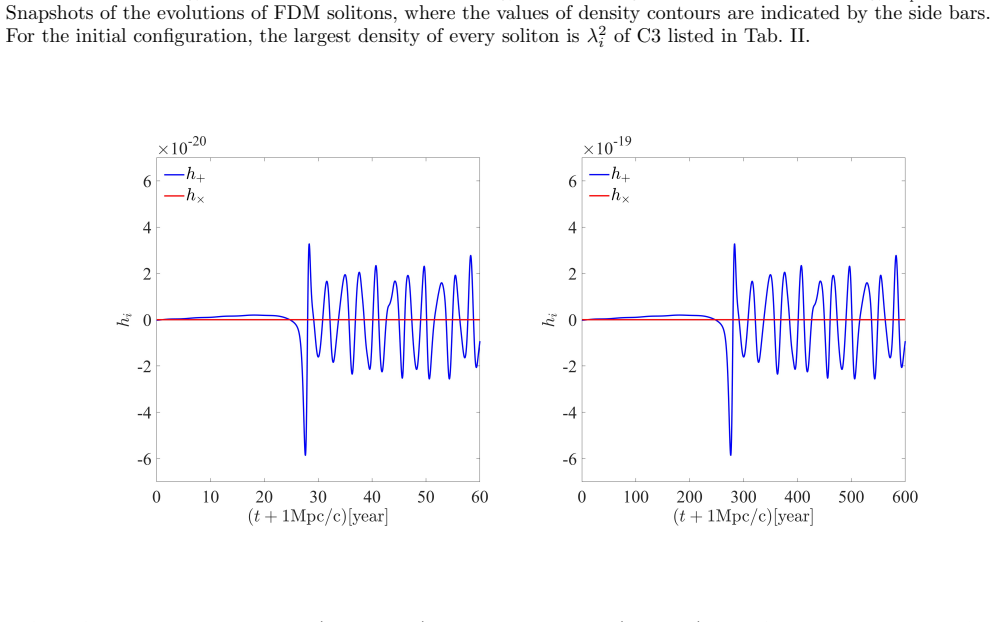
- [Section III, Table II (C3); Section IV, Fig. 7] Run C3 is described by the authors themselves as not reaching a collision: the soliton with the first excited-state profile is unstable and is 'dismembered before collision.' Consequently, the waveform in Fig. 7 is not a post-collision signal from two merging solitons and should not be counted as support for the paper's central claim. This run should either be removed from Section IV or explicitly labeled as a failed/stability test, with its waveform not presented as a post-collision GW result. The remaining evidence for the headline frequency therefore rests on C1 and C2 alone, which strengthens the need for the numerical documentation requested above.
minor comments (4)
- [Throughout, especially Section IV and figure captions] There are repeated typos: 'sollitons' and 'FDM soltions' should be 'solitons', and 'ring-dwon' in Section V should be 'ring-down'.
- [Section V] The paper asserts that the GW frequency is 'mainly determined by the FDM soliton size and mass but not sensitive to the angular momentum' without a calculation or test. A brief argument or a run with non-zero impact parameter would make this claim credible.
- [Table II] All simulations set the initial phases δ_1=δ_2=0 and the same initial speed |v|=10^-4. A sentence on the expected sensitivity of the post-collision frequency to these choices would help the reader gauge the generality of the quoted periods.
- [Eq. (5)] The scaling symmetry is written for the static reduced system (4) and omits the transformation of time; stating the full symmetry, including t̃→λ^-1 t̃, would remove ambiguity in the frequency-scaling argument and in the derivation of Eq. (8) from the soliton-halo relation.
Circularity Check
No circularity: the GW frequency claim is a rescaled simulation measurement, not an input or a self-citation.
full rationale
The derivation chain is self-contained and contains no circular steps. The soliton profiles are obtained by numerically solving the SP system via the shooting method (Section II) with no gravitational-wave input. The dimensionless units (Eq. (6)) are plain rescaling constants and do not encode the target frequency. The three initial conditions in Table II are chosen via the scaling symmetry (Eq. (5)) and the external soliton-halo relation (Ref. [32]); neither uses the GW result as an input. The post-collision oscillation frequency is measured from the PyUltraLight simulations, and the GW strain is computed from the standard quadrupole formula (Eqs. (15)-(18)); mapping the dimensionless frequency to a physical frequency through T = hbar/(m c^2) (Eq. (6)) is an algebraic rescaling, not a fit to a desired answer. No fitted parameter is renamed as a prediction, and no load-bearing claim rests on a self-citation. The lack of a resolution or convergence study and the lambda-dependence of the quoted frequency are correctness and robustness concerns, not circularity.
Assumptions & free parameters
free parameters (4)
- FDM particle mass m =
10^-18 and 10^-17 eV/c^2 (varied)
- Soliton scale factors lambda1, lambda2 =
C1: 1.66e-6, 1.66e-6; C2: 1.66e-6, 4.15e-7; C3: 1.66e-6, 1.34e-6
- Initial relative velocity v =
1e-4 c (dimensionless 1e-4)
- Source distance r0 for amplitude plots =
1 Mpc
assumptions (5)
- domain assumption The Schrödinger-Poisson system (Eq 1) adequately describes FDM solitons and their collisions.
- standard math The scaling transformation (Eq 5) maps isolated soliton profiles to any mass, and the superposition (Eq 14) is a valid initial two-soliton state.
- domain assumption The linearized GW theory and quadrupole formula (Eq 15) are valid for the post-collision dynamics, and GW back reaction is negligible.
- domain assumption The soliton-halo mass relation (Eq 7) from Schive et al. is valid and is used to set the lambda values.
- domain assumption PyUltraLight's periodic boundary condition with mean-density subtraction (Eq 12) correctly describes an isolated collision when the box is large enough.
Cite this review
Pith. "Pith review of Gravitational Waves from Post-Collision of Fuzzy Dark Matter Solitons." pith.science (2026). https://pith.science/paper/HKV52BUF
@misc{pith2026241219262,
  author       = {Pith},
  title        = {Pith review of: Gravitational Waves from Post-Collision of Fuzzy Dark Matter Solitons},
  year         = {2026},
  howpublished = {\url{https://pith.science/paper/HKV52BUF}},
  note         = {Machine review of arXiv:2412.19262}
}
abstract
According to the Schr\"odinger-Poisson (SP) equations, fuzzy dark matter (FDM) can form a stable equilibrium configuration, the so-called FDM soliton. The SP system can also determine the evolution of FDM solitons, such as head-on collision. In this paper, we first propose a new adimensional unit of length, time and mass. And then, we simulate the adimensional SP system with $\mathtt{PyUltraLight}$ to study the GWs from post-collision of FDM solitons when the linearized theory is valid and the GW back reaction on the evolution of FDM solitons is ignored. Finally, we find that the GWs from post-collisions have a frequency of (few ten-years)$^{-1}$ or (few years)$^{-1}$ when FDM mass is $m=10^{-18}\rm{eV}/c^2$ or $m=10^{-17}\rm{eV}/c^2$. Therefore, future detection of such GWs will constrain the property of FDM particle and solitons.
Figures


Figures from the paper (4 more)



Reference graph
Works this paper leans on
-
[1]
P. A. R. Ade et al. [BICEP and Keck], “Improved Con- straints on Primordial Gravitational Waves using Planck, WMAP, and BICEP/Keck Observations through the 2018 Observing Season,” Phys. Rev. Lett. 127, no.15, 151301 (2021) [arXiv:2110.00483 [astro-ph.CO]]
arXiv 2021
-
[2]
Probing Primordial Gravitational Waves: Ali CMB Polarization Telescope,
H. Li, S. Y. Li, Y. Liu, Y. P. Li, Y. Cai, M. Li, G. B. Zhao, C. Z. Liu, Z. W. Li and H. Xu, et al.“Probing Primordial Gravitational Waves: Ali CMB Polarization Telescope,” Natl. Sci. Rev. 6, no.1, 145-154 (2019) [arXiv:1710.03047 [astro-ph.CO]]
arXiv 2019
-
[3]
The NANOGrav 15 yr Data Set: Evidence for a Gravitational-wave Back- ground,
G. Agazie et al. [NANOGrav], “The NANOGrav 15 yr Data Set: Evidence for a Gravitational-wave Back- ground,” Astrophys. J. Lett. 951, no.1, L8 (2023) [arXiv:2306.16213 [astro-ph.HE]]
arXiv 2023
-
[4]
J. Antoniadis et al. [EPTA and InPTA:], “The second data release from the European Pulsar Timing Array - III. Search for gravitational wave signals,” Astron. Astro- phys. 678, A50 (2023) [arXiv:2306.16214 [astro-ph.HE]]
arXiv 2023
-
[5]
Search for an Isotropic Gravitational-wave Background with the Parkes Pulsar Timing Array,
D. J. Reardon, A. Zic, R. M. Shannon, G. B. Hobbs, M. Bailes, V. Di Marco, A. Kapur, A. F. Rogers, E. Thrane and J. Askew, et al. “Search for an Isotropic Gravitational-wave Background with the Parkes Pulsar Timing Array,” Astrophys. J. Lett. 951, no.1, L6 (2023) [arXiv:2306.16215 [astro-ph.HE]]
arXiv 2023
-
[6]
Laser Interferometer Space Antenna,
P. Amaro-Seoane et al. [LISA], “Laser Interferometer Space Antenna,” [arXiv:1702.00786 [astro-ph.IM]]
-
[7]
The Taiji Program in Space for gravitational wave physics and the nature of gravity,
W. R. Hu and Y. L. Wu, “The Taiji Program in Space for gravitational wave physics and the nature of gravity,” Natl. Sci. Rev. 4, no.5, 685-686 (2017)
work page 2017
-
[8]
J. Luo et al. [TianQin], “TianQin: a space-borne grav- 8 FIG. 7: GWs with h+ polarization (blue curves) and h× polarization (red lines) from C3, where the distance from source is 1Mpc and the FDM mass is m = 10−17eV/c2 (left) or m = 10−18eV/c2 (right). itational wave detector,” Class. Quant. Grav. 33, no.3, 035010 (2016) [arXiv:1512.02076 [astro-ph.IM]]
arXiv 2016
Show all 33 references
-
[9]
GWTC-3: Compact Binary Coalescences Observed by LIGO and Virgo during the Second Part of the Third Observing Run,
R. Abbott et al.[KAGRA, VIRGO and LIGO Scientific], “GWTC-3: Compact Binary Coalescences Observed by LIGO and Virgo during the Second Part of the Third Observing Run,” Phys. Rev. X 13, no.4, 041039 (2023) [arXiv:2111.03606 [gr-qc]]
2023 arXiv
-
[10]
GWTC- 2: Compact Binary Coalescences Observed by LIGO and Virgo During the First Half of the Third Observing Run,
R. Abbott et al. [LIGO Scientific and Virgo], “GWTC- 2: Compact Binary Coalescences Observed by LIGO and Virgo During the First Half of the Third Observing Run,” Phys. Rev. X 11, 021053 (2021) [arXiv:2010.14527 [gr- qc]]
2021 arXiv
-
[11]
GWTC- 1: A Gravitational-Wave Transient Catalog of Compact Binary Mergers Observed by LIGO and Virgo during the First and Second Observing Runs,
B. P. Abbott et al.[LIGO Scientific and Virgo], “GWTC- 1: A Gravitational-Wave Transient Catalog of Compact Binary Mergers Observed by LIGO and Virgo during the First and Second Observing Runs,” Phys. Rev. X9, no.3, 031040 (2019) [arXiv:1811.12907 [astro-ph.HE]]
2019 arXiv
-
[12]
Relic gravitational waves produced after preheating,
S. Y. Khlebnikov and I. I. Tkachev, “Relic gravitational waves produced after preheating,” Phys. Rev. D 56, 653- 660 (1997) [arXiv:hep-ph/9701423 [hep-ph]]
1997 arXiv
-
[13]
Stochastic gravitational wave production after inflation,
R. Easther and E. A. Lim, “Stochastic gravitational wave production after inflation,” JCAP 04, 010 (2006) [arXiv:astro-ph/0601617 [astro-ph]]
2006 arXiv
-
[14]
A Gravitational Wave Background from Reheating after Hybrid Inflation,
J. Garcia-Bellido, D. G. Figueroa and A. Sastre, “A Gravitational Wave Background from Reheating after Hybrid Inflation,” Phys. Rev. D 77, 043517 (2008) [arXiv:0707.0839 [hep-ph]]
2008 arXiv
-
[15]
Gravitational Waves from Phase Transitions at the Electroweak Scale and Beyond,
C. Grojean and G. Servant, “Gravitational Waves from Phase Transitions at the Electroweak Scale and Beyond,” Phys. Rev. D 75, 043507 (2007) [arXiv:hep-ph/0607107 [hep-ph]]
2007 arXiv
-
[16]
Numerical simulations of acoustically gener- ated gravitational waves at a first order phase transition,
M. Hindmarsh, S. J. Huber, K. Rummukainen and D. J. Weir, “Numerical simulations of acoustically gener- ated gravitational waves at a first order phase transition,” Phys. Rev. D 92, no.12, 123009 (2015) [arXiv:1504.03291 [astro-ph.CO]]
2015 arXiv
-
[17]
Gravitational waves from the sound of a first order phase transition,
M. Hindmarsh, S. J. Huber, K. Rummukainen and D. J. Weir, “Gravitational waves from the sound of a first order phase transition,” Phys. Rev. Lett. 112, 041301 (2014) [arXiv:1304.2433 [hep-ph]]
2014 arXiv
-
[18]
Gravita- tional waves from first order cosmological phase transi- tions,
A. Kosowsky, M. S. Turner and R. Watkins, “Gravita- tional waves from first order cosmological phase transi- tions,” Phys. Rev. Lett. 69, 2026-2029 (1992)
1992
-
[19]
Challenges and opportunities of gravitational-wave searches at MHz to GHz frequencies,
N. Aggarwal, O. D. Aguiar, A. Bauswein, G. Cella, S. Clesse, A. M. Cruise, V. Domcke, D. G. Figueroa, A. Geraci and M. Goryachev, et al. “Challenges and opportunities of gravitational-wave searches at MHz to GHz frequencies,” Living Rev. Rel. 24, no.1, 4 (2021) [arXiv:2011.124...
2021 arXiv
-
[20]
Rotational properties of 23 SB galaxies,
V. C. Rubin, W. K. Ford, Jr., N. Thonnard and D. Burstein, “Rotational properties of 23 SB galaxies,” Astrophys. J. 261, 439 (1982)
1982
-
[21]
The Evolution of Large Scale Structure in a Universe Dominated by Cold Dark Matter,
M. Davis, G. Efstathiou, C. S. Frenk and S. D. M. White, “The Evolution of Large Scale Structure in a Universe Dominated by Cold Dark Matter,” Astrophys. J. 292, 371-394 (1985)
1985
-
[22]
A direct em- pirical proof of the existence of dark matter,
D. Clowe, M. Bradac, A. H. Gonzalez, M. Markevitch, S. W. Randall, C. Jones and D. Zaritsky, “A direct em- pirical proof of the existence of dark matter,” Astrophys. J. Lett. 648, L109-L113 (2006) [arXiv:astro-ph/0608407 [astro-ph]]
2006 arXiv
-
[23]
Cold and fuzzy dark matter,
W. Hu, R. Barkana and A. Gruzinov, “Cold and fuzzy dark matter,” Phys. Rev. Lett. 85, 1158-1161 (2000) [arXiv:astro-ph/0003365 [astro-ph]]
2000 arXiv
-
[24]
Evolution of the Schrodinger-Newton system for a selfgravitating 9 scalar field,
F. S. Guzman and L. A. Urena-Lopez, “Evolution of the Schrodinger-Newton system for a selfgravitating 9 scalar field,” Phys. Rev. D 69, 124033 (2004) [arXiv:gr- qc/0404014 [gr-qc]]
2004
-
[25]
Fuzzy Dark Matter Soli- ton Cores around Supermassive Black Holes,
E. Y. Davies and P. Mocz, “Fuzzy Dark Matter Soli- ton Cores around Supermassive Black Holes,” Mon. Not. Roy. Astron. Soc. 492, no.4, 5721-5729 (2020) [arXiv:1908.04790 [astro-ph.GA]]
2020 arXiv
-
[26]
Interference of Dark Matter Solitons and Galactic Offsets,
A. Paredes and H. Michinel, “Interference of Dark Matter Solitons and Galactic Offsets,” Phys. Dark Univ. 12, 50- 55 (2016) [arXiv:1512.05121 [astro-ph.CO]]
2016 arXiv
-
[27]
PyUltraLight: A Pseudo-Spectral Solver for Ul- tralight Dark Matter Dynamics,
F. Edwards, E. Kendall, S. Hotchkiss and R. East- her, “PyUltraLight: A Pseudo-Spectral Solver for Ul- tralight Dark Matter Dynamics,” JCAP 10, 027 (2018) [arXiv:1807.04037 [astro-ph.CO]]
2018 arXiv
-
[28]
Solving the Schr¨ odinger- Poisson system using the coordinate adaptive moving mesh method,
E. Munive-Villa, J. N. Lopez-Sanchez, A. A. Avilez- Lopez and F. S. Guzman, “Solving the Schr¨ odinger- Poisson system using the coordinate adaptive moving mesh method,” Phys. Rev. D 105, no.8, 083521 (2022) [arXiv:2203.10234 [gr-qc]]
2022 arXiv
-
[29]
Klein-Gordon Geon,
D. J. Kaup, “Klein-Gordon Geon,” Phys. Rev. 172 (1968), 1331-1342
1968
-
[30]
Systems of self-gravitating particles in general relativity and the concept of an equa- tion of state,
R. Ruffini and S. Bonazzola, “Systems of self-gravitating particles in general relativity and the concept of an equa- tion of state,” Phys. Rev. 187 (1969), 1767-1783
1969
-
[31]
Hybrid Proca-boson stars,
T. X. Ma, C. Liang, J. Yang and Y. Q. Wang, “Hybrid Proca-boson stars,” Phys. Rev. D 108, no.10, 104011 (2023) [arXiv:2304.08019 [gr-qc]]
2023 arXiv
-
[32]
Understand- ing the Core-Halo Relation of Quantum Wave Dark Mat- ter from 3D Simulations,
H. Y. Schive, M. H. Liao, T. P. Woo, S. K. Wong, T. Chi- ueh, T. Broadhurst and W. Y. P. Hwang, “Understand- ing the Core-Halo Relation of Quantum Wave Dark Mat- ter from 3D Simulations,” Phys. Rev. Lett. 113, no.26, 261302 (2014) [arXiv:1407.7762 [astro-ph.GA]]
2014 arXiv
-
[33]
GW190521 as a Merger of Proca Stars: A Potential New Vector Boson of 8 .7 × 10−13 eV,
J. Calder´ on Bustillo, N. Sanchis-Gual, A. Torres-Forn´ e, J. A. Font, A. Vajpeyi, R. Smith, C. Herdeiro, E. Radu and S. H. W. Leong, “GW190521 as a Merger of Proca Stars: A Potential New Vector Boson of 8 .7 × 10−13 eV,” Phys. Rev. Lett. 126, no.8, 081101 (2021) [arXiv:2009....
2021 arXiv
Reviewed August 11, 2026 · model on record in the stance chip above.
Discussion (0). Continue with ORCID to comment.