REVIEW 4 major objections 6 minor 110 references
Multi-label Classification using Deep Multi-order Context-aware Kernel Networks
T0 review · 4 major / 6 minor · reviewed 2026-08-11 · deepseek-v4-flash
Pith's one-line read The paper claims that a deep multi-order context-aware kernel network improves multi-label classification by learning image similarities that aggregate first- to third-order cell neighborhoods, with gains reported on Corel5K and NUS-WIDE.
desk verdict The multi-order random-walk context construction, which is the paper's main contribution, is internally inconsistent as written: Eq. (5) yields singleton neighborhoods, so Table 4's threshold effect cannot come from the described method. read the letter →
The pith
A machine-rendered reading of the paper's core claim, the machinery that carries it, and where it could break.
The reading
What carries the argument
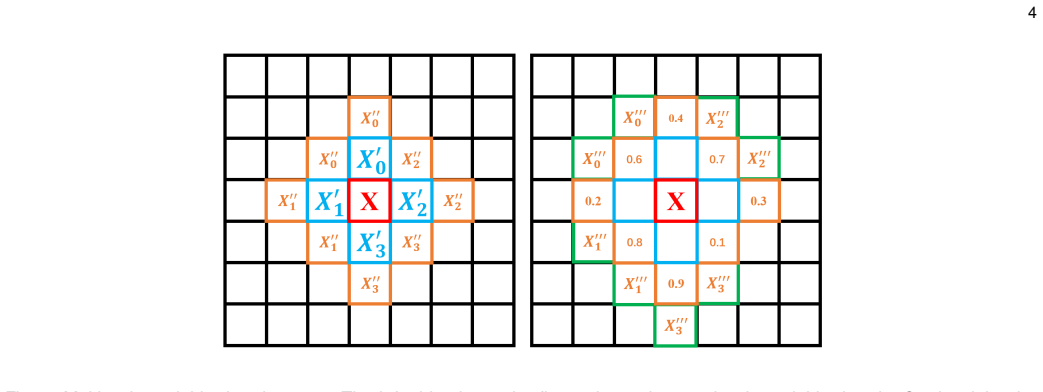
The load-bearing object is the recursively defined multi-order context-aware kernel map: the matrix recursion $K^{(t+1)}=S+\gamma\sum_c P_c K^{(t)}P_c^\top$ and its explicit feature-map form $\Phi^{(t+1)}=(\Phi^{(0)\top},\gamma^{1/2}P_1\Phi^{(t)\top},\ldots,\gamma^{1/2}P_C\Phi^{(t)\top})^\top$. This recursion is unrolled as a fixed network whose layers correspond to iterations, and higher-order neighborhoods $N_c^{(p)}(x)$ are built by recursively unioning first-order neighborhoods, with transition probabilities from self-attention scores deciding which cells are retained; a threshold on those probabilities drops noisy cells. Concatenated multi-order features from all directions are compressed by $1\times1$ convolutions, and the whole system, including the neighborhood matrices $\{P_c\}_c$, is trained end-to-end for multi-label classification.
What would settle it
Train DMCKN on a third held-out multi-label dataset with the random-walk threshold fixed at 0.67 and no validation tuning, and compare it against the same network restricted to first-order context; if the F1/mAP gain vanishes or reverses, the reported benefit is an artifact of threshold selection rather than of multi-order context.
Extended reading notes
Core claim
The paper's central claim is that a context-aware kernel network which aggregates multiple orders of cell neighborhoods — first-, second-, and third-order — yields a more discriminating similarity for multi-label classification than first-order context alone, and that this kernel can be learned end-to-end by unfolding its recursive update as a feed-forward network. The learned kernel follows the recursion $K^{(t+1)}=S+\gamma\sum_{c=1}^{C}P_c K^{(t)}P_c^\top$, with an explicit feature-map form $\Phi^{(t+1)}$ whose layers concatenate multi-order contextual features across four directions; self-attention scores supply random-walk transition probabilities that build higher-order neighborhoods and filter noisy cells. Empirically, the paper reports that DMCKN outperforms its own first-order and no-context baselines and matches or exceeds recent transformer- and graph-based methods on Corel5K and NUS-WIDE across ResNet101, TResNetL, and CvT-w24 backbones.
Load-bearing premise
The load-bearing premise is that the validation-chosen random-walk threshold (0.67) and the loosely specified recursive construction of third- and higher-order neighborhoods generalize; if that tuning is overfit, the reported improvement over first-order context may not reproduce.
Editorial extensions
If this is right
- The ablation attributes a substantial part of the gain to the context-aware module: on Corel5K, both modules together improve R/P/F1 from 45.9/38.3/41.7 to 47.5/40.9/43.9.
- The random-walk filtering contributes independently: on Corel5K, without it F1 is 42.61, whereas with the best threshold F1 is 44.39.
- Network depth and context order interact: on Corel5K, three-layer networks with third-order context reach R/P/F1 48.3/42.2/45.0, versus 47.1/39.8/43.1 for one-layer first-order context.
- The gains persist across backbones and cell grids: on NUS-WIDE, DMCKN with TResNetL 8×10 reaches mAP/CF1/OF1 67.8/65.1/76.5, and with CvT-w24 8×10 reaches 69.7/68.9/76.6.
- On Corel5K, the best configuration (CvT-w24, 8×10) reports F1 47.0, above the 45.7 of the transformer-based Q2L-TResL baseline.
Reading between the lines
- A straightforward test of robustness would be to fix the random-walk threshold at 0.67 and evaluate on a third dataset; if the multi-order gain vanishes, the reported benefit is tied to validation-time threshold selection rather than to the context construction itself.
- Because the kernel recursion is explicit, the same multi-order neighborhood construction could be inserted as a layer in other patch-based architectures, so the technique is not necessarily limited to the specific unfolded-network format tested here.
- The paper leaves label-label dependencies unmodeled; adding a co-occurrence or graph-based label head on top of the multi-order context features is a natural next step that could compound the reported gains.
- The qualitative visualizations suggest the learned neighborhoods concentrate on cells containing targets; a quantitative analysis of which orders contribute most per object size would clarify when multi-order context is worth the extra cost.
Editorial analysis
A structured set of objections, weighed in public.
Referee Report
Summary. This paper proposes DMCKN, a deep multi-order context-aware kernel network for multi-label image classification. The method extends a context-aware kernel optimization framework by unrolling the update recursion into a feed-forward network and by adding higher-order neighborhoods built through random-walk transition probabilities and self-attention. The authors evaluate on Corel5K and NUS-WIDE with several backbones and report improved F1/CF1 over several state-of-the-art baselines, along with ablations on context awareness, grouped classification layers, network depth, and random-walk threshold.
Significance. If the multi-order neighborhood construction were precisely defined and robust, the idea of learning context-aware kernels with multi-order neighborhoods and unrolling them into a network is a reasonable and potentially useful contribution to multi-label classification. The paper includes extensive experiments on two standard benchmarks and ablations that generally support the value of context awareness. However, the current manuscript does not provide a working formal definition of the higher-order neighborhood mechanism, which is the central novelty, and the reported random-walk gains cannot be reproduced from the text. The small performance differences and the absence of error bars further weaken the empirical claims. With a correct and precise specification, the work could be a valid incremental contribution, but in its present form the core mechanism is not verifiable.
major comments (4)
- [3.2, Eq. (5)] The recursive definition of higher-order neighborhoods is internally inconsistent with the definition of P_c. Section 3.1 defines [P_c]x,x' nonzero only for an immediate neighbor x' in direction c; on a grid this is a single cell. Therefore N^(1)_c(x) has cardinality one, and Eq. (5) yields N^(2)_c(x) = N^(1)_c(x') for the unique x', again a singleton; by induction all N^(p)_c(x) are singletons. The softmax in Eq. (7) then operates on a singleton set, every transition probability equals 1, and the threshold rule in Table 4 ('drop cells with p < thres') cannot remove any cell. Yet Table 4 shows that the random walk strategy raises F1 from 42.61 to 44.26 at threshold 0 and to 44.39 at threshold 0.67, which is only possible if the implemented higher-order neighborhoods contain multiple cells. The manuscript must specify how multi-cell higher-order neighborhoods are constructed, how the transition probabilities are computed over a non-singleton set, and how the threshold is applied.
- [3.1, Eqs. (2)-(3)] The step from the optimization problem to the recursive update is asserted with 'One may show' without proof. The objective in Eq. (2) contains a negative quadratic term in K, so it is not convex, and it is not immediate that the fixed-point recursion converges to a global or local minimizer. Because Eq. (3) defines the layer-wise update of the entire kernel network, provide a derivation or a rigorous citation with the convergence conditions.
- [Table 5 and Section 4.3] With CvT-w24 at 8x10, DMCKN achieves mAP 69.7 versus 70.1 for Q2L-CvT, i.e., a lower mAP, while the text reports only 'extra gains' of 1.3 CF1 and 0.3 OF1. In addition, all tables report point estimates without error bars or significance tests; differences as small as 0.04 in F1 (Table 4, thresholds 0.62 vs. 0.67) are reported without variance. The authors should report mean and standard deviation over multiple runs or otherwise justify that the differences are statistically meaningful.
- [Table 4 and Section 4.2] The random walk threshold is selected from a sweep (0, 0.62, 0.67, 0.70) with no description of a validation protocol; if the test set is used to choose 0.67, the reported gain of the random walk strategy may reflect selection bias. Describe how thresholds are chosen and whether the improvement persists on a held-out validation set.
minor comments (6)
- [Introduction and Section 3] There are several typos: 'technologiess' in the Introduction, 'mutiple' in Section 3.2, and 'undergoning' and 'similarily' in Section 3.3.
- [Eq. (5)] The condition 'with x' ≠ x' is unclear because the union is over x' in N^(1)_c(x); explain the intended exclusion, especially once the set is a singleton.
- [Eqs. (6)-(8)] The symbol p is used both for the neighborhood order and for the probability p^(p)_c; rename one of them to avoid confusion.
- [Table 3] The caption uses SC and TC without definition; spell out 'second-order context' and 'third-order context' in the caption.
- [Section 4.2 and Table 4] The text uses 'RWG' while the table uses 'RWS' for the random walk strategy; make the abbreviation consistent.
- [References] The reference list contains many entries that are not cited in the text; prune or mark them appropriately.
Circularity Check
No circularity: the multi-order context-aware kernel is evaluated against external benchmarks; the self-cited kernel framework is background mathematics, not a load-bearing unverified premise.
full rationale
The paper's derivation chain is not circular. Eq. (2) is a context-aware kernel objective taken from prior work [13,22]; its fixed-point solution Eq. (3) and unrolled map Eq. (4) are stated mathematical identities with stated assumptions, not predictions whose truth depends on accepting the present paper. The new multi-order construction (Eqs. 5-8) is a definition followed by end-to-end training, and the claimed gains are measured on Corel5K and NUS-WIDE against independent baselines (Tabs. 1 and 5), so the central claim is externally falsifiable. No fitted parameter is renamed as a prediction: the random-walk threshold in Tab. 4 is reported as an ablation/hyperparameter study, not as an out-of-sample prediction derived from the model. The flagged issue that Eq. (5), combined with the singleton first-order neighborhoods defined by the P_c matrices, yields singleton higher-order neighborhoods and makes the softmax in Eq. (7) vacuous is a real reproducibility/consistency concern, but it is not circularity: the Table 4 result does not follow from the definitions, it contradicts them. Similarly, the heavy self-citation to the authors' kernel framework is background derivation, and Eq. (3)-(4) are verifiable mathematical statements, so the self-citations do not constitute load-bearing circular support.
Assumptions & free parameters
free parameters (4)
- context impact ratio gamma = alpha/beta =
not reported
- random walk threshold =
0.67 (selected on Corel5K)
- number of context orders =
2 or 3 (second/third order)
- cell grid size =
4x5 or 8x10
assumptions (3)
- domain assumption The kernel learning objective (Eq. 2) is optimized by the fixed-point recursion (Eq. 3).
- domain assumption Iterating Eq. (3) converges to the stable minimizer of Eq. (2).
- ad hoc to paper Higher-order neighborhoods built by random walk transition probabilities preserve relevant context and discard noise.
Cite this review
Pith. "Pith review of Multi-label Classification using Deep Multi-order Context-aware Kernel Networks." pith.science (2026). https://pith.science/paper/7CLDZEC7
@misc{pith2026241219491,
  author       = {Pith},
  title        = {Pith review of: Multi-label Classification using Deep Multi-order Context-aware Kernel Networks},
  year         = {2026},
  howpublished = {\url{https://pith.science/paper/7CLDZEC7}},
  note         = {Machine review of arXiv:2412.19491}
}
read the original abstract
Multi-label classification is a challenging task in pattern recognition. Many deep learning methods have been proposed and largely enhanced classification performance. However, most of the existing sophisticated methods ignore context in the models' learning process. Since context may provide additional cues to the learned models, it may significantly boost classification performances. In this work, we make full use of context information (namely geometrical structure of images) in order to learn better context-aware similarities (a.k.a. kernels) between images. We reformulate context-aware kernel design as a feed-forward network that outputs explicit kernel mapping features. Our obtained context-aware kernel network further leverages multiple orders of patch neighbors within different distances, resulting into a more discriminating Deep Multi-order Context-aware Kernel Network (DMCKN) for multi-label classification. We evaluate the proposed method on the challenging Corel5K and NUS-WIDE benchmarks, and empirical results show that our method obtains competitive performances against the related state-of-the-art, and both quantitative and qualitative performances corroborate its effectiveness and superiority for multi-label image classification.
Figures


Figures from the paper (2 more)


Reference graph
Works this paper leans on
-
[1]
International Journal of Advanced Computer Science and Applications 7(10), 127–131 (2016)
Alazaidah, R., Ahmad, F.K.: Trending challenges in multi label classification. International Journal of Advanced Computer Science and Applications 7(10), 127–131 (2016)
2016
-
[2]
IEEE Transactions on Image Processing 26(4), 1820– 1832 (2017)
Jiu, M., Sahbi, H.: Nonlinear deep kernel learning for image annotation. IEEE Transactions on Image Processing 26(4), 1820– 1832 (2017)
2017
-
[3]
In: Proceedings of the AAAI conference on artificial intelligence
Chen, T., Wang, Z., Li, G., Lin, L.: Recurrent attentional reinforcement learning for multi-label image recognition. In: Proceedings of the AAAI conference on artificial intelligence. vol. 32 (2018)
2018
-
[4]
IEEE Transactions on Image Processing 31, 2570–2583 (2022)
Chen, Z.M., Cui, Q., Zhao, B., Song, R., Zhang, X., Yoshie, O.: Sst: Spatial and semantic transformers for multi-label image recognition. IEEE Transactions on Image Processing 31, 2570–2583 (2022)
2022
-
[5]
Bourdis, D
N. Bourdis, D. Marraud, and H. Sahbi, Spatio-temporal interaction for aerial video change detection, in IGARSS, 2012, pp. 2253–2256
2012
-
[6]
In: Proceedings of the IEEE/CVF conference on computer vision and pattern recognition
Chen, Z.M., Wei, X.S., Wang, P ., Guo, Y.: Multi-label image recognition with graph convolutional networks. In: Proceedings of the IEEE/CVF conference on computer vision and pattern recognition. pp. 5177–5186 (2019)
2019
-
[7]
In: 2009 IEEE conference on computer vision and pattern recognition
Deng, J., Dong, W., Socher, R., Li, L.J., Li, K., Fei-Fei, L.: Imagenet: A large-scale hierarchical image database. In: 2009 IEEE conference on computer vision and pattern recognition. pp. 248–255. Ieee (2009)
2009
-
[8]
Coarse-to-fine deep kernel networks
H. Sahbi. "Coarse-to-fine deep kernel networks." IEEE ICCV-W, 2017
2017
Show all 110 references
-
[9]
Pattern Recognition 88, 447–457 (2019)
Jiu, M., Sahbi, H.: Deep representation design from deep kernel networks. Pattern Recognition 88, 447–457 (2019)
2019
-
[10]
arXiv preprint arXiv:2010.11929 (2020)
Dosovitskiy, A., Beyer, L., Kolesnikov, A., Weissenborn, D., Zhai, X., Unterthiner, T., Dehghani, M., Minderer, M., Heigold, G., Gelly, S., et al.: An image is worth 16x16 words: Transformers for image recognition at scale. arXiv preprint arXiv:2010.11929 (2020)
2020 arXiv
-
[11]
In: Proceedings of the IEEE/CVF conference on computer vision and pattern recognition
Guo, H., Zheng, K., Fan, X., Yu, H., Wang, S.: Visual attention consistency under image transforms for multi-label image classification. In: Proceedings of the IEEE/CVF conference on computer vision and pattern recognition. pp. 729–739 (2019)
2019
-
[12]
Neurocomputing 474, 154–167 (2022)
Jiu, M., Sahbi, H.: Context-aware deep kernel networks for image annotation. Neurocomputing 474, 154–167 (2022)
2022
-
[13]
Pattern Recognition Letters 50, 122–129 (2014)
Jiu, M., Wolf, C., Taylor, G., Baskurt, A.: Human body part estimation from depth images via spatially-constrained deep learning. Pattern Recognition Letters 50, 122–129 (2014)
2014
-
[14]
Advances in neural information processing systems 31 (2018)
Kim, J.H., Jun, J., Zhang, B.T.: Bilinear attention networks. Advances in neural information processing systems 31 (2018)
2018
-
[15]
In: 2011 IEEE International Conference on Acoustics, Speech and Signal Processing (ICASSP)
Li, X., Sahbi, H.: Superpixel-based object class segmentation using conditional random fields. In: 2011 IEEE International Conference on Acoustics, Speech and Signal Processing (ICASSP). pp. 1101–1104. IEEE (2011)
2011
-
[16]
In: Proceedings of the IEEE/CVF Conference on Computer Vision and Pattern Recognition
Lanchantin, J., Wang, T., Ordonez, V ., Qi, Y.: General multi-label image classification with transformers. In: Proceedings of the IEEE/CVF Conference on Computer Vision and Pattern Recognition. pp. 16478–16488 (2021)
2021
-
[17]
In: 2020 25th International Conference on Pattern Recognition (ICPR)
Li, Y., Yang, L.: More correlations better performance: Fully associative networks for multi-label image classification. In: 2020 25th International Conference on Pattern Recognition (ICPR). pp. 9437–9444. IEEE (2021)
2021
-
[18]
In: Proceedings of the IEEE international conference on computer vision
Lin, T.Y., Goyal, P ., Girshick, R., He, K., Dollár, P .: Focal loss for dense object detection. In: Proceedings of the IEEE international conference on computer vision. pp. 2980–2988 (2017) 13
2017
-
[19]
In: The British machine vision conference (BMVC) (2019)
Mazari, A., Sahbi, H.: Mlgcn: Multi-laplacian graph convolutional networks for human action recognition. In: The British machine vision conference (BMVC) (2019)
2019
-
[20]
arXiv preprint arXiv:2107.10834 (2021)
Liu, S., Zhang, L., Yang, X., Su, H., Zhu, J.: Query2label: A simple transformer way to multi-label classification. arXiv preprint arXiv:2107.10834 (2021)
2021 arXiv
-
[21]
arXiv preprint arXiv:2307.09715 (2023)
Ma, L., Sun, D., Wang, L., Zhao, H., Luo, B.: Semantic-aware dual contrastive learning for multi-label image classification. arXiv preprint arXiv:2307.09715 (2023)
2023 arXiv
-
[22]
International Journal of Multimedia Information Retrieval 4, 113–128 (2015)
Sahbi, H.: Imageclef annotation with explicit context-aware kernel maps. International Journal of Multimedia Information Retrieval 4, 113–128 (2015)
2015
-
[23]
In: Proceedings of the 5th ACM on International Conference on Multimedia Retrieval
Murthy, V .N., Maji, S., Manmatha, R.: Automatic image annotation using deep learning representations. In: Proceedings of the 5th ACM on International Conference on Multimedia Retrieval. pp. 603–606 (2015)
2015
-
[24]
Progress in brain research 155, 23–36 (2006)
Oliva, A., Torralba, A.: Building the gist of a scene: The role of global image features in recognition. Progress in brain research 155, 23–36 (2006)
2006
-
[25]
In: Proceedings of the IEEE/CVF International Conference on Computer Vision
Sahbi, H.: Learning laplacians in chebyshev graph convolutional networks. In: Proceedings of the IEEE/CVF International Conference on Computer Vision. pp. 2064–2075 (2021)
2021
-
[26]
Advances in neural information processing systems 28 (2015)
Ren, S., He, K., Girshick, R., Sun, J.: Faster r-cnn: Towards real-time object detection with region proposal networks. Advances in neural information processing systems 28 (2015)
2015
-
[27]
In: Proceedings of the IEEE/CVF international conference on computer vision
Ridnik, T., Ben-Baruch, E., Zamir, N., Noy, A., Friedman, I., Protter, M., Zelnik-Manor, L.: Asymmetric loss for multi-label classification. In: Proceedings of the IEEE/CVF international conference on computer vision. pp. 82–91 (2021)
2021
-
[28]
In: Asian Conference on Computer Vision
Sahbi, H., Li, X.: Context-based support vector machines for interconnected image annotation. In: Asian Conference on Computer Vision. pp. 214–227. Springer (2010)
2010
-
[29]
In: proceedings of the IEEE/CVF winter conference on applications of computer vision
Ridnik, T., Lawen, H., Noy, A., Ben Baruch, E., Sharir, G., Friedman, I.: Tresnet: High performance gpu-dedicated architecture. In: proceedings of the IEEE/CVF winter conference on applications of computer vision. pp. 1400–1409 (2021)
2021
-
[30]
IEEE transactions on neural networks 20(1), 61–80 (2008)
Scarselli, F., Gori, M., Tsoi, A.C., Hagenbuchner, M., Monfardini, G.: The graph neural network model. IEEE transactions on neural networks 20(1), 61–80 (2008)
2008
-
[31]
Transductive kernel map learning and its application to image annotation
P . Vo and H. Sahbi. "Transductive kernel map learning and its application to image annotation." BMVC. 2012
2012
-
[32]
arXiv preprint arXiv:1409.1556 (2014)
Simonyan, K., Zisserman, A.: Very deep convolutional networks for large-scale image recognition. arXiv preprint arXiv:1409.1556 (2014)
2014 arXiv
-
[33]
In: Proceedings of the IEEE/CVF Conference on Computer Vision and Pattern Recognition
Tamura, M., Ohashi, H., Yoshinaga, T.: Qpic: Query-based pairwise human-object interaction detection with image-wide contextual information. In: Proceedings of the IEEE/CVF Conference on Computer Vision and Pattern Recognition. pp. 10410–10419 (2021)
2021
-
[34]
Laplacian deep kernel learning for image annotation
M. Jiu and H. Sahbi. "Laplacian deep kernel learning for image annotation." IEEE ICASSP , 2016
2016
-
[35]
Advances in neural information processing systems 30 (2017)
Vaswani, A., Shazeer, N., Parmar, N., Uszkoreit, J., Jones, L., Gomez, A.N., Kaiser, Ł., Polosukhin, I.: Attention is all you need. Advances in neural information processing systems 30 (2017)
2017
-
[36]
Directed acyclic graph kernels for action recognition
L. Wang and H. Sahbi. "Directed acyclic graph kernels for action recognition." Proceedings of the IEEE International Conference on Computer Vision. 2013
2013
-
[37]
In: Proceedings of the IEEE conference on computer vision and pattern recognition
Wang, J., Yang, Y., Mao, J., Huang, Z., Huang, C., Xu, W.: Cnn-rnn: A unified framework for multi-label image classification. In: Proceedings of the IEEE conference on computer vision and pattern recognition. pp. 2285–2294 (2016)
2016
-
[38]
Camera pose estimation using visual servoing for aerial video change detection
N. Bourdis, D. Marraud and H. Sahbi. "Camera pose estimation using visual servoing for aerial video change detection." IEEE IGARSS 2012
2012
-
[39]
In: Proceedings of the AAAI Conference on Artificial Intelligence
Wang, Y., He, D., Li, F., Long, X., Zhou, Z., Ma, J., Wen, S.: Multi-label classification with label graph superimposing. In: Proceedings of the AAAI Conference on Artificial Intelligence. vol. 34, pp. 12265–12272 (2020)
2020
-
[40]
Yuan, G-S Xia, H
F. Yuan, G-S Xia, H. Sahbi and V . Prinet (2012). Mid-level features and spatio-temporal context for activity recognition. Pattern Recognition, 45(12), 4182-4191
2012
-
[41]
In: Proceedings of the IEEE international conference on computer vision
Wang, Z., Chen, T., Li, G., Xu, R., Lin, L.: Multi-label image recognition by recurrently discovering attentional regions. In: Proceedings of the IEEE international conference on computer vision. pp. 464–472 (2017)
2017
-
[42]
Learning attribute representations for remote sensing ship category classification
Q. Oliveau and H. Sahbi. "Learning attribute representations for remote sensing ship category classification." IEEE JSTARS 10.6 (2017): 2830-2840
2017
-
[43]
IEEE transactions on pattern analysis and machine intelligence 38(9), 1901–1907 (2015)
Wei, Y., Xia, W., Lin, M., Huang, J., Ni, B., Dong, J., Zhao, Y., Yan, S.: Hcp: A flexible cnn framework for multi-label image classification. IEEE transactions on pattern analysis and machine intelligence 38(9), 1901–1907 (2015)
2015
-
[44]
In: Proceedings of the IEEE/CVF international conference on computer vision
Wu, H., Xiao, B., Codella, N., Liu, M., Dai, X., Yuan, L., Zhang, L.: Cvt: Introducing convolutions to vision transformers. In: Proceedings of the IEEE/CVF international conference on computer vision. pp. 22–31 (2021)
2021
-
[45]
Robust matching by dynamic space warping for accurate face recognition
H. Sahbi and N. Boujemaa. "Robust matching by dynamic space warping for accurate face recognition." Proceedings 2001 International Conference on Image Processing (Cat. No. 01CH37205). Vol. 1. IEEE, 2001
2001
-
[46]
A Hierarchy of Support Vector Machines for Pattern Detection
H. Sahbi and D. Geman. "A Hierarchy of Support Vector Machines for Pattern Detection." Journal of Machine Learning Research 7.10 (2006)
2006
-
[47]
IEEE Transactions on Circuits and Systems for Video Technology (2023)
Wu, Y., Feng, S., Wang, Y.: Semantic-aware graph matching mechanism for multi-label image recognition. IEEE Transactions on Circuits and Systems for Video Technology (2023)
2023
-
[48]
Interactive satellite image change detection with context-aware canonical correlation analysis
H. Sahbi. "Interactive satellite image change detection with context-aware canonical correlation analysis." IEEE GRSL, (14)5, 2017
2017
-
[49]
arXiv preprint arXiv:2104.14762 (2021)
Wu, Y., Liu, H., Feng, S., Jin, Y., Lyu, G., Wu, Z.: Gm-mlic: graph matching based multi-label image classification. arXiv preprint arXiv:2104.14762 (2021)
2021 arXiv
-
[50]
In: Proceedings of the AAAI conference on artificial intelligence
You, R., Guo, Z., Cui, L., Long, X., Bao, Y., Wen, S.: Cross-modality attention with semantic graph embedding for multi-label classification. In: Proceedings of the AAAI conference on artificial intelligence. vol. 34, pp. 12709–12716 (2020)
2020
-
[51]
A comparative study of diversity methods for hybrid text and image retrieval approaches
Sabrina Tollari, Philippe Mulhem, Marin Ferecatu, Hervé Glotin, Marcin Detyniecki, Patrick Gallinari, H. Sahbi, and Zhong- Qiu Zhao. "A comparative study of diversity methods for hybrid text and image retrieval approaches." In Workshop of the Cross-Language Evaluation Forum fo...
2008
-
[52]
MLGCN: Multi-Laplacian graph convolutional networks for human action recognition
A. Mazari and H. Sahbi. "MLGCN: Multi-Laplacian graph convolutional networks for human action recognition." The British Machine Vision Conference (BMVC). 2019
2019
-
[53]
TELECOM ParisTech at ImageClefphoto 2008: Bi-Modal Text and Image Retrieval with Diversity Enhancement
M. Ferecatu and H. Sahbi. "TELECOM ParisTech at ImageClefphoto 2008: Bi-Modal Text and Image Retrieval with Diversity Enhancement." CLEF (Working Notes). 2008
2008
-
[54]
Multimedia Tools and Applications 77, 22385– 22406 (2018)
Zhang, W., Hu, H., Hu, H.: Neural ranking for automatic image annotation. Multimedia Tools and Applications 77, 22385– 22406 (2018)
2018
-
[55]
Relevance feedback for satellite image change detection
H. Sahbi. "Relevance feedback for satellite image change detection." IEEE ICASSP , 2013
2013
-
[56]
In: Proceedings of the IEEE conference on computer vision and pattern recognition
Zhu, F., Li, H., Ouyang, W., Yu, N., Wang, X.: Learning spatial regularization with image-level supervisions for multi-label image classification. In: Proceedings of the IEEE conference on computer vision and pattern recognition. pp. 5513–5522 (2017)
2017
-
[57]
Constrained optical flow for aerial image change detection
N. Bourdis, D. Marraud and H. Sahbi. "Constrained optical flow for aerial image change detection." in IEEE IGARSS, 2011
2011
-
[58]
Lightweight Connectivity In Graph Convolutional Networks For Skeleton-Based Recognition
H. Sahbi. "Lightweight Connectivity In Graph Convolutional Networks For Skeleton-Based Recognition." 2021 IEEE International Conference on Image Processing (ICIP). IEEE, 2021
2021
-
[59]
Context-dependent kernel design for object matching and recognition
H. Sahbi, Jean-Yves Audibert, Jaonary Rabarisoa, and Renaud Keriven. "Context-dependent kernel design for object matching and recognition." In 2008 IEEE Conference on Computer Vision and Pattern Recognition, pp. 1-8. IEEE, 2008
2008
-
[60]
Graph-cut transducers for relevance feedback in content based image retrieval
H. Sahbi, Jean-Yves Audibert, and Renaud Keriven. "Graph-cut transducers for relevance feedback in content based image retrieval." 2007 IEEE 11th International Conference on Computer Vision. IEEE, 2007
2007
-
[61]
Applying interest operators in semi-fragile video watermarking
S. Thiemert, H. Sahbi, and M. Steinebach. "Applying interest operators in semi-fragile video watermarking." Security, Steganography, and Watermarking of Multimedia Contents VII. Vol. 5681. SPIE, 2005
2005
-
[62]
Bags-of-daglets for action recognition
L. Wang and H. Sahbi. "Bags-of-daglets for action recognition." 2014 IEEE International Conference on Image Processing (ICIP). IEEE, 2014
2014
-
[63]
Finite rank deep kernel learning
Dasgupta, Sambarta, Kumar Sricharan, and Ashok Srivastava. "Finite rank deep kernel learning." Third workshop on Bayesian Deep Learning, NeurIPS. 2018
2018
-
[64]
Deep kernel learning approach to engine emissions modeling
Yu, Changmin, et al. "Deep kernel learning approach to engine emissions modeling." Data-Centric Engineering 1 (2020): e4
2020
-
[65]
CNRS-TELECOM ParisTech at ImageCLEF 2013 Scalable Concept Image Annotation Task: Winning Annotations with Context Dependent SVMs
H. Sahbi. "CNRS-TELECOM ParisTech at ImageCLEF 2013 Scalable Concept Image Annotation Task: Winning Annotations with Context Dependent SVMs." CLEF (Working Notes). 2013
2013
-
[66]
To understand deep learning we need to understand kernel learning
Belkin, Mikhail, Siyuan Ma, and Soumik Mandal. "To understand deep learning we need to understand kernel learning." International Conference on Machine Learning. PMLR, 2018
2018
-
[67]
Stochastic variational deep kernel learning
Wilson, Andrew G., et al. "Stochastic variational deep kernel learning." Advances in neural information processing systems 29 (2016)
2016
-
[68]
Robust face recognition using dynamic space warping
Sahbi, H., and N. Boujemaa. "Robust face recognition using dynamic space warping." International Workshop on Biometric Authentication. Springer, Berlin, Heidelberg, 2002
2002
-
[69]
The promises and pitfalls of deep kernel learning
Ober, Sebastian W., Carl E. Rasmussen, and Mark van der Wilk. "The promises and pitfalls of deep kernel learning." Uncertainty in Artificial Intelligence. PMLR, 2021
2021
-
[71]
Using entropy for image and video authentication watermarks
S. Thiemert, H. Sahbi, and M. Steinebach. "Using entropy for image and video authentication watermarks." Security, Steganography, and Watermarking of Multimedia Contents VIII. Vol. 6072. SPIE, 2006
2006
-
[72]
Deep kernel learning
Wilson, Andrew Gordon, et al. "Deep kernel learning." Artificial intelligence and statistics. PMLR, 2016
2016
-
[73]
Kernel Analysis of Deep Networks
Montavon, Grégoire, Mikio L. Braun, and Klaus-Robert Müller. "Kernel Analysis of Deep Networks." Journal of Machine Learning Research 12.9 (2011)
2011
-
[74]
Coarse-to-fine support vector classifiers for face detection
H. Sahbi and N. Boujemaa. "Coarse-to-fine support vector classifiers for face detection." Object recognition supported by user interaction for service robots. Vol. 3. IEEE, 2002
2002
-
[75]
Kernel methods for deep learning
Cho, Youngmin, and Lawrence Saul. "Kernel methods for deep learning." Advances in neural information processing systems 22 (2009)
2009
-
[76]
Neural operator: Graph kernel network for partial differential equations
Li, Zongyi, et al. "Neural operator: Graph kernel network for partial differential equations." arXiv preprint arXiv:2003.03485 (2020)
2020 arXiv
-
[77]
H. Sahbi. Coarse-to-fine support vector machines for hierarchical face detection. Diss. PhD thesis, Versailles University, 2003
2003
-
[78]
Efficient convolution kernels for dependency and constituent syntactic trees
Moschitti, Alessandro. "Efficient convolution kernels for dependency and constituent syntactic trees." European Conference on Machine Learning. Berlin, Heidelberg: Springer Berlin Heidelberg, 2006
2006
-
[79]
Deep graph kernels
Yanardag, Pinar, and S. V . N. Vishwanathan. "Deep graph kernels." Proceedings of the 21th ACM SIGKDD international conference on knowledge discovery and data mining. 2015
2015
-
[80]
Visual content extraction for automatic semantic annotation of video news
N. Boujemaa, F. Fleuret, V . Gouet, and H. Sahbi. "Visual content extraction for automatic semantic annotation of video news." In the proceedings of the SPIE Conference, San Jose, CA, vol. 6. 2004
2004
-
[81]
Extracting relations with integrated information using kernel methods
Zhao, Shubin, and Ralph Grishman. "Extracting relations with integrated information using kernel methods." Proceedings of the 43rd annual meeting of the association for computational linguistics (acl’05). 2005
2005
-
[82]
Context-dependent pre-trained deep neural networks for large-vocabulary speech recognition
Dahl, George E., et al. "Context-dependent pre-trained deep neural networks for large-vocabulary speech recognition." IEEE Transactions on audio, speech, and language processing 20.1 (2011): 30-42
2011
-
[83]
Misalignment resilient cca for interactive satellite image change detection
H. Sahbi. "Misalignment resilient cca for interactive satellite image change detection." 2016 23rd International Conference on Pattern Recognition (ICPR). IEEE, 2016
2016
-
[84]
A shortest path dependency kernel for relation extraction
Bunescu, Razvan, and Raymond Mooney. "A shortest path dependency kernel for relation extraction." Proceedings of human language technology conference and conference on empirical methods in natural language processing. 2005
2005
-
[85]
Context-dependent sentiment analysis in user-generated videos
Poria, Soujanya, et al. "Context-dependent sentiment analysis in user-generated videos." Proceedings of the 55th annual meeting of the association for computational linguistics (volume 1: Long papers). 2017
2017
-
[86]
From 2D silhouettes to 3D object retrieval: contributions and benchmarking
T. Napoléon and H. Sahbi. "From 2D silhouettes to 3D object retrieval: contributions and benchmarking." EURASIP Journal on Image and Video Processing 2010 (2010): 1-17
2010
-
[87]
Multi-label informed feature selection
Jian, Ling, et al. "Multi-label informed feature selection." IJCAI. Vol. 16. 2016. 15
2016
-
[88]
(2007, September)
Tsoumakas, G., Vlahavas, I. (2007, September). Random k-labelsets: An ensemble method for multilabel classification. In European conference on machine learning (pp. 406-417). Berlin, Heidelberg: Springer Berlin Heidelberg
2007
-
[89]
Semi supervised deep kernel design for image annotation
M. Jiu and H. Sahbi. "Semi supervised deep kernel design for image annotation." 2015 IEEE International Conference on Acoustics, Speech and Signal Processing (ICASSP). IEEE, 2015
2015
-
[90]
Partially labeled classification with Markov random walks
Szummer, Martin, and Tommi Jaakkola. "Partially labeled classification with Markov random walks." Advances in neural information processing systems 14 (2001)
2001
-
[91]
Metrics for multi-class classification: an overview
Grandini, Margherita, Enrico Bagli, and Giorgio Visani. "Metrics for multi-class classification: an overview." arXiv preprint arXiv:2008.05756 (2020)
2020 arXiv
-
[92]
Deep kernel map networks for image annotation
M. Jiu and H. Sahbi. "Deep kernel map networks for image annotation." 2016 IEEE International Conference on Acoustics, Speech and Signal Processing (ICASSP). IEEE, 2016
2016
-
[93]
Multi-class active learning for image classification
Joshi, Ajay J., Fatih Porikli, and Nikolaos Papanikolopoulos. "Multi-class active learning for image classification." 2009 ieee conference on computer vision and pattern recognition. IEEE, 2009
2009
-
[94]
A kernel method for multi-labelled classification
Elisseeff, André, and Jason Weston. "A kernel method for multi-labelled classification." Advances in neural information processing systems 14 (2001)
2001
-
[95]
From coarse to fine skin and face detection
H. Sahbi and N. Boujemaa. "From coarse to fine skin and face detection." Proceedings of the eighth ACM international conference on Multimedia. 2000
2000
-
[96]
ML-KNN: A lazy learning approach to multi-label learning
Zhang, Min-Ling, and Zhi-Hua Zhou. "ML-KNN: A lazy learning approach to multi-label learning." Pattern recognition 40.7 (2007): 2038-2048
2007
-
[97]
An extensive experimental comparison of methods for multi-label learning
Madjarov, Gjorgji, et al. "An extensive experimental comparison of methods for multi-label learning." Pattern recognition 45.9 (2012): 3084-3104
2012
-
[98]
Sahbi and F
H. Sahbi and F. Fleuret. Kernel methods and scale invariance using the triangular kernel. Diss. INRIA, 2004
2004
-
[99]
Cnn-rnn: A unified framework for multi-label image classification
Wang, Jiang, et al. "Cnn-rnn: A unified framework for multi-label image classification." Proceedings of the IEEE conference on computer vision and pattern recognition. 2016
2016
-
[100]
Multilabel classification via calibrated label ranking
Fürnkranz, Johannes, et al. "Multilabel classification via calibrated label ranking." Machine learning 73 (2008): 133-153
2008
-
[101]
Sahbi and F
H. Sahbi and F. Fleuret. Scale-invariance of support vector machines based on the triangular kernel. Diss. INRIA, 2002
2002
-
[102]
Learning multi-label scene classification
Boutell, Matthew R., et al. "Learning multi-label scene classification." Pattern recognition 37.9 (2004): 1757-1771
2004
-
[103]
A review on multi-label learning algorithms
Zhang, Min-Ling, and Zhi-Hua Zhou. "A review on multi-label learning algorithms." IEEE transactions on knowledge and data engineering 26.8 (2013): 1819-1837
2013
-
[104]
Nonlinear cross-view sample enrichment for action recognition
L. Wang and H. Sahbi. "Nonlinear cross-view sample enrichment for action recognition." European Conference on Computer Vision. Springer, Cham, 2014
2014
-
[105]
Discriminative methods for multi-labeled classification
Godbole, Shantanu, and Sunita Sarawagi. "Discriminative methods for multi-labeled classification." Pacific-Asia conference on knowledge discovery and data mining. Berlin, Heidelberg: Springer Berlin Heidelberg, 2004
2004
-
[106]
Random k-labelsets for multilabel classification
Tsoumakas, Grigorios, Ioannis Katakis, and Ioannis Vlahavas. "Random k-labelsets for multilabel classification." IEEE transactions on knowledge and data engineering 23.7 (2010): 1079-1089
2010
-
[107]
Multi-view object matching and tracking using canonical correlation analysis
M. Ferecatu and H. Sahbi. "Multi-view object matching and tracking using canonical correlation analysis." 2009 16th IEEE International Conference on Image Processing (ICIP). IEEE, 2009
2009
-
[108]
Decision trees for hierarchical multi-label classification
Vens, Celine, et al. "Decision trees for hierarchical multi-label classification." Machine learning 73 (2008): 185-214
2008
-
[109]
Classifier chains for multi-label classification
Read, Jesse, et al. "Classifier chains for multi-label classification." Machine learning 85 (2011): 333-359
2011
-
[110]
Tsoumakas and I
G. Tsoumakas and I. Katakis (2008). Multi-label classification: An overview. Data Warehousing and Mining: Concepts, Methodologies, Tools, and Applications, 64-74
2008
-
[111]
Learning Connectivity with Graph Convolutional Networks
H. Sahbi. "Learning Connectivity with Graph Convolutional Networks." 2020 25th International Conference on Pattern Recognition (ICPR). IEEE, 2021
2020
Reviewed August 11, 2026 · model on record in the stance chip above.
Discussion (0). Continue with ORCID to comment.