REVIEW 3 major objections 8 minor 35 references
Hybrid Population Monte Carlo
T0 review · 3 major / 8 minor · reviewed 2026-08-11 · deepseek-v4-flash
Pith's one-line read The paper claims that combining resampled weighted samples with parallel Hamiltonian Monte Carlo in proposal adaptation, plus a cooperation step, yields the best accuracy among adaptive importance samplers on high-dimensional and…
desk verdict The hybrid adaptation idea is genuine and clearly presented, but the headline performance claim is not supported because the equal-budget experiments hide HMC leapfrog costs. read the letter →
The pith
A machine-rendered reading of the paper's core claim, the machinery that carries it, and where it could break.
The reading
What carries the argument
The machinery is the two-step adaptation with deterministic mixture (DM) weighting. DM weights, $w_{n,k} = \pi(x_{n,k}) / (\frac{1}{N} \sum_{j=1}^N q_j(x_{n,k}))$, are used throughout: to weight samples for estimation, to weight preliminary locations in cooperation, and to create repulsive exploration because locations in under-covered regions receive higher weights. The hybrid generation step uses local resampling (LR) of each proposal's K weighted samples (set P, local exploration) and parallel HMC chains started at current locations (set Q, global exploration). The cooperation step then either samples candidates from the weighted mixture density $\psi(\mu) = \sum_{i=1}^{|C|} \bar{w}_i \varphi_i(\mu \mid \mu_i^*)$ and accepts them with a Metropolis-Hastings ratio, or resamples the 2N weighted locations globally. Both cooperation variants require no free parameter tuning.
What would settle it
Run HPMC on a high-dimensional target with modes separated by low-probability regions and record the Metropolis acceptance probability in the mixture-model cooperation (Alg. 2) or compare the empirical distribution of the Q preliminary locations to the target with a goodness-of-fit test; if the acceptance rate collapses toward zero as dimension grows, or the Q points fail to be target-distributed, the cooperation step is not receiving target-distributed input and the method's advantage should disappear.
Extended reading notes
Core claim
HPMC is an adaptive importance sampler in the population Monte Carlo family. At each iteration it draws K samples from each of N Gaussian proposals, weights them with the deterministic mixture (DM) scheme, and then adapts the proposal locations in two steps. First, it builds two sets of preliminary locations: P by local resampling inside each proposal's K weighted samples, and Q by one iteration of N parallel Hamiltonian Monte Carlo chains started at the current proposal locations. Second, the cooperation step combines C = P ∪ Q into the N final locations for the next iteration, either by building a weighted mixture model over C and drawing candidate locations that are accepted via a Metropolis step, or by global resampling over C with DM weights. The paper's central claim is that this hybrid, two-step adaptation produces faster convergence and lower mean-squared error than existing AIS methods (PMC, DM-PMC, LR-PMC, GR-PMC, AMIS, PI-MAIS, and HAIS) in high-dimensional and multi-modal settings, with the resampling variant performing best.
Load-bearing premise
HPMC assumes that, after a burn-in period, each parallel HMC chain restarted from the current proposal locations yields a draw approximately distributed as the target, so the Q set and the mixture model built from C can be treated as target-distributed samples; if that stationarity assumption fails, the cooperation step's input is not what the theory requires and the claimed benefit is not established.
Editorial extensions
If this is right
- On the 20-dimensional bimodal target, HPMC with cooperation by resampling achieves the lowest MSE for both $E[x]$ and the normalizing constant among all compared methods, for example $\text{MSE}_{E[x]} = 7.79$ and $\text{MSE}_Z = 0.0009$ at $N = 250$, $K = 2$.
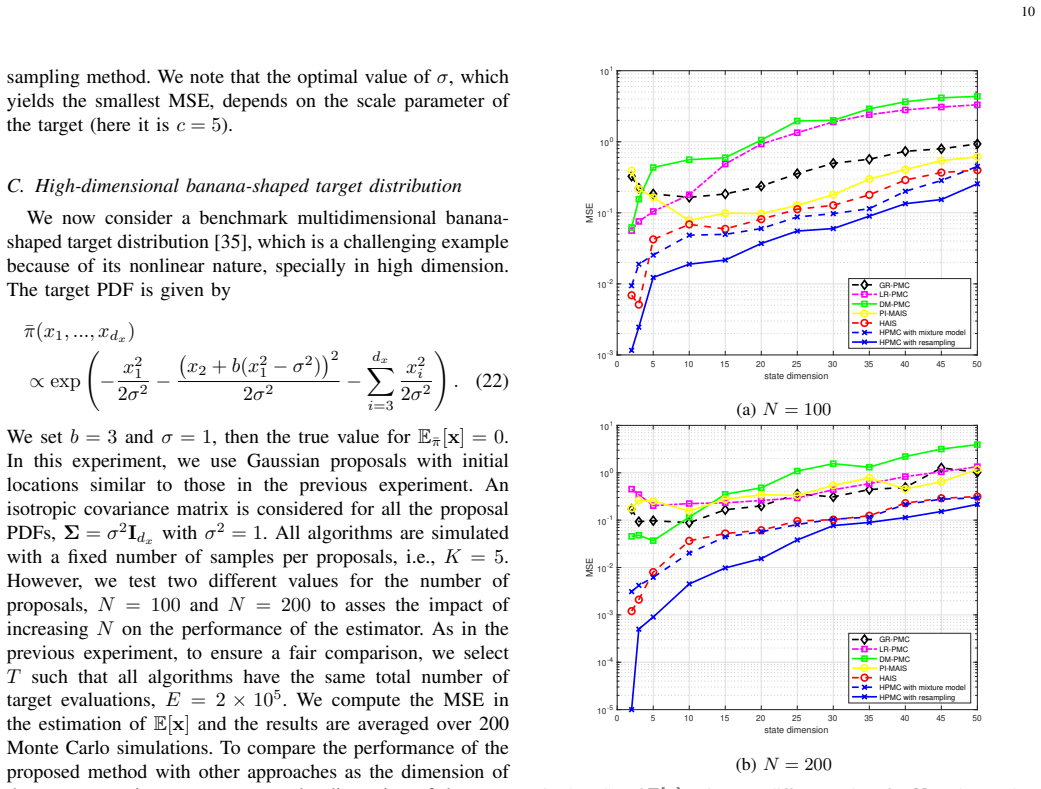
- On the banana-shaped target up to dimension 50, HPMC with resampling outperforms GR-PMC, LR-PMC, DM-PMC, PI-MAIS, and HAIS under equal total target evaluations, and doubling N from 100 to 200 sharply reduces its MSE.
- Increasing N helps HPMC more than increasing K, because each proposal acts as an independent explorer of the target space.
- The cooperation step adds only 2N (resampling) or 3N (mixture model) target evaluations per iteration and no free parameters, keeping the resampling variant's complexity comparable to PI-MAIS and HAIS.
Reading between the lines
- Although the paper does not test it, the same hybrid generation idea should extend to adapting proposal covariances; the authors list that as future work, and the HMC blocks already provide curvature information that could inform scale updates.
- The MH acceptance step in the mixture-model cooperation suggests HPMC could be viewed as a 'resample-then-cooperate' template; analyzing its stationary distribution as a Markov chain on the space of proposal locations might yield variance bounds analogous to the DM-weight inequalities the paper cites.
- A concrete testable extension: on targets with many well-separated modes, the survival rate of HMC-generated Q locations through the global resampling step should predict convergence speed. If the Q explorers are consistently killed, HPMC should degrade toward a standard LR/GR sampler.
- Because HMC uses log-target gradients, HPMC's advantage should be largest on smooth high-dimensional targets with cheap gradients; on discontinuous or rough targets the Q set would be unreliable, and gradient-free baselines might match or beat it.
Editorial analysis
A structured set of objections, weighed in public.
Referee Report
Summary. The paper proposes Hybrid Population Monte Carlo (HPMC), an adaptive importance sampling method in the PMC family. At each iteration, samples are drawn from N proposals and weighted with deterministic mixture weights. The adaptation step first generates 2N preliminary proposal locations: N from local resampling of weighted samples and N from one HMC step per proposal, then combines these via a cooperation step (either a weighted mixture model with an MH accept-reject or global resampling) to produce the next iteration's N proposal locations. The paper claims HPMC significantly outperforms state-of-the-art AIS methods in high-dimensional multi-modal problems, and reports numerical experiments on a 2D mixture, a 20D bimodal target, and banana-shaped targets up to dimension 50.
Significance. If the empirical claims were supported, HPMC would be a useful addition to the AIS toolbox: the idea of combining resampled weighted samples with HMC-generated locations is intuitive, and the two-step adaptation is novel. The paper also has the merit of comparing against several strong baselines and reporting extensive tables. However, the central performance claim is currently not established because the equal-budget comparisons omit a major component of HPMC's computational cost, and the theoretical justification rests on an unverified stationarity assumption. With corrected budget accounting and a proper convergence analysis, the method could still be of interest; at present the evidence is inconclusive.
major comments (3)
- [Section IV, Table II, Step 3(a)(ii)] The paper states that all methods are compared under the same total number of target evaluations, E = 2e5, but the HPMC rows of Table II count only KNT + 2NT (resampling) or KNT + 3NT (mixture model) target evaluations. The HMC blocks in Step 3(a)(ii) each require L leapfrog steps per iteration, and each leapfrog step evaluates the target gradient (equivalently at least one target evaluation, and more under finite differences). No leapfrog length L or step size is specified for HPMC in the experiments. Therefore HPMC's true target-evaluation count is KNT + L*N*T plus cooperation cost, which can exceed the stated budget by a large factor. The reported MSE improvements in Table I and Fig. 8 may reflect a larger effective computational budget rather than algorithmic superiority. The authors should include HMC leapfrog/gradient evaluations in the complexity table and in the equal-budget setup, or otherwise justify that the comparison is fair.
- [Section III-C, Step 3(a)(ii) and III-D] The theoretical justification asserts that after burn-in, the N parallel HMC chains have converged, so the Q locations are target-distributed (Eq. (16) and the following text). However, the algorithm restarts each HMC block from the current proposal location for only one iteration per AIS iteration; no burn-in period is specified, and the chains are not continued between AIS iterations. Thus the premise that the preliminary locations satisfy mu* ~ pi is unverified. This assumption is load-bearing because the cooperation step (Alg. 2 and Eqs. (17)-(18)) relies on the preliminary locations being draws from pi to justify psi as a nonparametric kernel estimate of pi and to give the MH acceptance step validity. The authors need to provide a convergence argument or empirical diagnostic that Q is approximately target-distributed, modify the algorithm to include a genuine burn-in, or weaken the theoretical claims accordingly.
- [Section III-C, Step 3(b), Eq. (18)] The DM weights assigned to preliminary locations are computed using the previous iteration's proposal densities q_j(.; mu(t)_j, nu_j), but the Q locations are generated by HMC and are not draws from the mixture of these proposals. For the P locations from local resampling, the weighted samples were indeed drawn from the proposals, so DM weighting is in principle appropriate; for Q it is not. Consequently, the resampling and mixture-model cooperation steps use importance weights that are not valid for the actual sampling distribution of the preliminary locations. This can bias the adaptation and needs to be addressed or the weighting scheme revised.
minor comments (8)
- [Section I] Typo: 'The novel HMPC method is presented in Sections III-A to C' should read 'HPMC'.
- [Section III-A] Step numbering is inconsistent: the text refers to 'Step 1(a)' and 'Step 2(b)' for the adaptation operations, but Algorithm 1 labels them Step 3(a) and Step 3(b).
- [Eq. (2)] The domain/codomain of f is written as f : R -> R^{dx}; it should be f : R^{dx} -> R for the integral in Eq. (2) to make sense.
- [Section IV-B] The abbreviations 'PI-AMIS' and 'PI-MAIS' are used interchangeably; a single abbreviation should be chosen and used consistently.
- [Fig. 5 caption] The caption says 'Vertical arrows indicate NN random uniform samples'; it should be 'N random uniform samples'.
- [Algorithm 2 output] The output line says 'mu(t+1)_j, i=1,...,N'; the index should be j, not i.
- [Section IV] The HMC parameters for HAIS are reported (L = 50, epsilon in {5,10}), but no leapfrog length or step size is reported for HPMC in any experiment; these should be provided for reproducibility and for assessing the omitted cost.
- [Abstract and Section V] The paper claims to discuss the statistical properties of HPMC, but Section III-D contains only heuristic arguments and no theorems or convergence proofs; the wording should be tempered or the analysis should be supplied.
Circularity Check
No circularity: HPMC is a new constructive algorithm, and its performance claims are supported by independent simulations rather than by a derivation that reduces to its own inputs.
full rationale
HPMC is a constructive algorithm: the two-step adaptation generates preliminary locations from weighted samples and HMC and then cooperates by resampling or mixture modeling; none of these steps fits a parameter to the quantity being predicted. The only self-citation is the pointer to the authors' prior HAIS [25] for the convergence of the parallel HMC blocks in Section III-C Step 3(a)(ii); because HAIS is a published, externally checkable method and the convergence assumption is a standard MCMC condition rather than an assertion equivalent to HPMC's reported results, this citation does not make the argument circular. The paper's performance claim rests on independent simulations, not on a derivation that reduces to its inputs. Two non-circular concerns should be separated from circularity: Section III-C Step 3(a)(ii) asserts convergence 'following the burn-in period' without stating burn-in length or mixing conditions, and Section IV and Table II's equal-target-evaluation budget omits the leapfrog/gradient evaluations of the HMC blocks, so the empirical comparison may undercount HPMC's cost. These are rigor and fairness issues, not self-definitional reductions.
Assumptions & free parameters
free parameters (3)
- HMC step size epsilon =
5 or 10 in experiments (Table I)
- HMC trajectory length L (number of leapfrog steps) =
not reported for HPMC
- Kernel covariance for cooperation by mixture model =
not specified
assumptions (3)
- domain assumption HMC chains initialized at proposal locations converge to the target after a single iteration (or after burn-in, despite being reinitialized each AIS iteration)
- domain assumption The target distribution is smooth enough for HMC (differentiable, gradient available)
- standard math DM weighting variance reduction result from Elvira et al. [4]
Cite this review
Pith. "Pith review of Hybrid Population Monte Carlo." pith.science (2026). https://pith.science/paper/4IXFTSSZ
@misc{pith2026241219576,
  author       = {Pith},
  title        = {Pith review of: Hybrid Population Monte Carlo},
  year         = {2026},
  howpublished = {\url{https://pith.science/paper/4IXFTSSZ}},
  note         = {Machine review of arXiv:2412.19576}
}
read the original abstract
Importance sampling (IS) is a powerful Monte Carlo (MC) technique for approximating intractable integrals, for instance in Bayesian inference. The performance of IS relies heavily on the appropriate choice of the so-called proposal distribution. Adaptive IS (AIS) methods iteratively improve target estimates by adapting the proposal distribution. Recent AIS research focuses on enhancing proposal adaptation for high-dimensional problems, while addressing the challenge of multi-modal targets. In this paper, a new class of AIS methods is presented, utilizing a hybrid approach that incorporates weighted samples and proposal distributions to enhance performance. This approach belongs to the family of population Monte Carlo (PMC) algorithms, where a population of proposals is adapted to better approximate the target distribution. The proposed hybrid population Monte Carlo (HPMC) implements a novel two-step adaptation mechanism. In the first step, a hybrid method is used to generate the population of the preliminary proposal locations based on both weighted samples and location parameters. We use Hamiltonian Monte Carlo (HMC) to generate the preliminary proposal locations. HMC has a good exploratory behavior, especially in high dimension scenarios. In the second step, the novel cooperation algorithms are performing to find the final proposals for the next iteration. HPMC achieves a significant performance improvement in high-dimensional problems when compared to the state-of-the-art algorithms. We discuss the statistical properties of HPMC and show its high performance in two challenging benchmarks.
Figures


Figures from the paper (4 more)


Reference graph
Works this paper leans on
-
[1]
Monte carlo statistical methods. 2004
C. Robert and G. Casella, “Monte carlo statistical methods. 2004.”
work page 2004
-
[2]
J. S. Liu and J. S. Liu, Monte Carlo strategies in scientific computing , vol. 10. Springer, 2001
work page 2001
-
[3]
Monte carlo theory, methods and examples,
A. B. Owen, “Monte carlo theory, methods and examples,” 2013
work page 2013
-
[4]
Generalized multiple importance sampling,
V . Elvira, L. Martino, D. Luengo, M. F. Bugallo, et al. , “Generalized multiple importance sampling,” Statistical Science , vol. 34, no. 1, pp. 129–155, 2019
work page 2019
-
[5]
Adaptive importance sampling in monte carlo integration,
M.-S. Oh and J. O. Berger, “Adaptive importance sampling in monte carlo integration,” Journal of Statistical Computation and Simulation , vol. 41, no. 3-4, pp. 143–168, 1992
work page 1992
-
[6]
O. Capp ´e, A. Guillin, J.-M. Marin, and C. P. Robert, “Population monte carlo,” Journal of Computational and Graphical Statistics, vol. 13, no. 4, pp. 907–929, 2004
work page 2004
-
[7]
Comparison of resampling schemes for particle filtering,
R. Douc and O. Capp ´e, “Comparison of resampling schemes for particle filtering,” in ISPA 2005. Proceedings of the 4th International Symposium on Image and Signal Processing and Analysis, 2005. , pp. 64–69, Ieee, 2005
work page 2005
-
[8]
Resampling methods for particle filtering: classification, implementation, and strategies,
T. Li, M. Bolic, and P. M. Djuric, “Resampling methods for particle filtering: classification, implementation, and strategies,” IEEE Signal processing magazine, vol. 32, no. 3, pp. 70–86, 2015
work page 2015
Show all 35 references
-
[9]
Adaptive importance sampling: the past, the present, and the future,
M. F. Bugallo, V . Elvira, L. Martino, D. Luengo, J. Miguez, and P. M. Djuric, “Adaptive importance sampling: the past, the present, and the future,” IEEE Signal Processing Magazine , vol. 34, no. 4, pp. 60–79, 2017
2017
-
[10]
Advances in importance sampling,
V . Elvira and L. Martino, “Advances in importance sampling,” arXiv preprint arXiv:2102.05407, 2021
2021 arXiv
-
[11]
A population monte carlo scheme with transformed weights and its application to stochastic kinetic models,
E. Koblents and J. M ´ıguez, “A population monte carlo scheme with transformed weights and its application to stochastic kinetic models,” Statistics and Computing , vol. 25, no. 2, pp. 407–425, 2015
2015
-
[12]
Adaptive importance sampling in general mixture classes,
O. Capp ´e, R. Douc, A. Guillin, J.-M. Marin, and C. P. Robert, “Adaptive importance sampling in general mixture classes,” Statistics and Comput- ing, vol. 18, no. 4, pp. 447–459, 2008
2008
-
[13]
Improving population monte carlo: Alternative weighting and resampling schemes,
V . Elvira, L. Martino, D. Luengo, and M. F. Bugallo, “Improving population monte carlo: Alternative weighting and resampling schemes,” Signal Processing, vol. 131, pp. 77–91, 2017
2017
-
[14]
Langevin-based strategy for efficient pro- posal adaptation in population monte carlo,
V . Elvira and E. Chouzenoux, “Langevin-based strategy for efficient pro- posal adaptation in population monte carlo,” in 2019 IEEE International Conference on Acoustics, Speech and Signal Processing (ICASSP) , pp. 5077–5081, IEEE, 2019
2019
-
[15]
Optimized population monte carlo,
V . Elvira and E. Chouzenoux, “Optimized population monte carlo,”IEEE Transactions on Signal Processing , vol. 70, pp. 2489–2501, 2022
2022
-
[16]
Adaptive mul- tiple importance sampling,
J.-M. Cornuet, J.-M. Marin, A. Mira, and C. P. Robert, “Adaptive mul- tiple importance sampling,” Scandinavian Journal of Statistics , vol. 39, no. 4, pp. 798–812, 2012
2012
-
[17]
An adaptive popula- tion importance sampler: Learning from uncertainty,
L. Martino, V . Elvira, D. Luengo, and J. Corander, “An adaptive popula- tion importance sampler: Learning from uncertainty,” IEEE Transactions on Signal Processing , vol. 63, no. 16, pp. 4422–4437, 2015
2015
-
[18]
Efficient sequential monte-carlo samplers for bayesian inference,
T. L. T. Nguyen, F. Septier, G. W. Peters, and Y . Delignon, “Efficient sequential monte-carlo samplers for bayesian inference,” IEEE Transac- tions on Signal Processing , vol. 64, no. 5, pp. 1305–1319, 2015
2015
-
[19]
Persistent sampling: Unleashing the potential of sequential monte carlo,
M. Karamanis and U. Seljak, “Persistent sampling: Unleashing the potential of sequential monte carlo,” arXiv preprint arXiv:2407.20722 , 2024
2024 arXiv
-
[20]
A gradient adaptive population importance sampler,
V . Elvira, L. Martino, D. Luengo, and J. Corander, “A gradient adaptive population importance sampler,” in Acoustics, Speech and Signal Pro- cessing (ICASSP), 2015 IEEE International Conference on , pp. 4075– 4079, IEEE, 2015
2015
-
[21]
Gradient importance sampling,
I. Schuster, “Gradient importance sampling,” tech. rep., 2015. https://arxiv.org/abs/1507.05781
2015 arXiv
-
[22]
Langevin incremental mixture importance sampling,
M. Fasiolo, F. E. de Melo, and S. Maskell, “Langevin incremental mixture importance sampling,” Stat. Comput. , vol. 28, no. 3, pp. 549– 561, 2018
2018
-
[23]
Layered adaptive importance sampling,
L. Martino, V . Elvira, D. Luengo, and J. Corander, “Layered adaptive importance sampling,” Statistics and Computing, vol. 27, no. 3, pp. 599– 623, 2017
2017
-
[24]
Markov chain importance sampling-a highly efficient estimator for mcmc,
I. Klebanov and I. Schuster, “Markov chain importance sampling-a highly efficient estimator for mcmc,” Journal of Computational and Graphical Statistics, 2020
2020
-
[25]
Hamiltonian adaptive impor- tance sampling,
A. Mousavi, R. Monsefi, and V . Elvira, “Hamiltonian adaptive impor- tance sampling,” IEEE Signal Processing Letters , vol. 28, pp. 713–717, 2021
2021
-
[26]
Hybrid monte carlo,
S. Duane, A. D. Kennedy, B. J. Pendleton, and D. Roweth, “Hybrid monte carlo,” Physics letters B , vol. 195, no. 2, pp. 216–222, 1987
1987
-
[27]
Mcmc using hamiltonian dynamics,
R. M. Neal et al. , “Mcmc using hamiltonian dynamics,” Handbook of markov chain monte carlo , vol. 2, no. 11, p. 2, 2011
2011
-
[28]
Optimally combining sampling techniques for monte carlo rendering,
E. Veach and L. J. Guibas, “Optimally combining sampling techniques for monte carlo rendering,” in Proceedings of the 22nd annual confer- ence on Computer graphics and interactive techniques , pp. 419–428, 1995
1995
-
[29]
Safe and effective importance sampling,
A. Owen and Y . Zhou, “Safe and effective importance sampling,” Journal of the American Statistical Association , vol. 95, no. 449, pp. 135–143, 2000
2000
-
[30]
Efficient mul- tiple importance sampling estimators,
V . Elvira, L. Martino, D. Luengo, and M. F. Bugallo, “Efficient mul- tiple importance sampling estimators,” IEEE Signal Processing Letters , vol. 22, no. 10, pp. 1757–1761, 2015
2015
-
[31]
Heretical multiple importance sampling,
V . Elvira, L. Martino, D. Luengo, and M. F. Bugallo, “Heretical multiple importance sampling,” IEEE Signal Processing Letters , vol. 23, no. 10, pp. 1474–1478, 2016
2016
-
[32]
Population monte carlo schemes with reduced path degeneracy,
V . Elvira, L. Martino, D. Luengo, and M. F. Bugallo, “Population monte carlo schemes with reduced path degeneracy,” in 2017 IEEE 7th International Workshop on Computational Advances in Multi-Sensor Adaptive Processing (CAMSAP) , pp. 1–5, IEEE, 2017
2017
-
[33]
Anti-tempered layered adaptive importance sampling,
L. Martino, V . Elvira, and D. Luengo, “Anti-tempered layered adaptive importance sampling,” in 2017 22nd International Conference on Digital Signal Processing (DSP) , pp. 1–5, IEEE, 2017
2017
-
[34]
A review of resampling techniques in particle filtering framework,
C. Kuptametee and N. Aunsri, “A review of resampling techniques in particle filtering framework,” Measurement, vol. 193, p. 110836, 2022
2022
-
[35]
An adaptive metropolis algorithm,
H. Haario, E. Saksman, J. Tamminen, et al. , “An adaptive metropolis algorithm,” Bernoulli, vol. 7, no. 2, pp. 223–242, 2001
2001
Reviewed August 11, 2026 · model on record in the stance chip above.
Discussion (0). Continue with ORCID to comment.