REVIEW 5 major objections 14 minor 72 references
TiGDistill-BEV: Multi-view BEV 3D Object Detection via Target Inner-Geometry Learning Distillation
T0 review · 5 major / 14 minor · reviewed 2026-08-10 · deepseek-v4-flash
Pith's one-line read Distilling an object's internal depth relations and keypoint-feature similarities from a LiDAR or fusion teacher lifts a camera-only bird's-eye-view detector to 62.8% NDS on nuScenes.
desk verdict Real gains on nuScenes, but the core inner-feature equations are dimensionally inconsistent as written; the method needs major revision before it is reproducible. read the letter →
The pith
A machine-rendered reading of the paper's core claim, the machinery that carries it, and where it could break.
The reading
What carries the argument
Two modules carry the method. Inner-depth supervision projects LiDAR points inside each ground-truth 3D box onto image planes to obtain foreground pixels, converts the student's categorical depth distribution into a continuous depth per pixel, picks the pixel with the smallest depth error as an adaptive reference, and applies an $L_2$ loss to the predicted-minus-reference depth differences. Inner-feature BEV distillation samples N uniform keypoints inside each enlarged BEV box, extracts their features from teacher and student BEV encoders, and matches two similarity matrices under $L_2$ loss: the $C\times C$ inter-channel matrix and the $N\times N$ inter-keypoint matrix of the sampled features. These similarity matrices are the central objects; they carry object-level geometric semantics without forcing cross-modal feature identity.
What would settle it
A direct test: on the nuScenes validation set, bucket objects by occlusion level and by the number of LiDAR points inside the ground-truth box; if TiGDistill-BEV's NDS improvement over BEVDepth is concentrated in well-observed buckets and vanishes for occluded or sparse objects, the foreground-projection premise is load-bearing. Alternatively, randomly drop a fraction of the foreground pixels used in the inner-depth loss during training; if the gain survives heavy dropout, the premise is not essential.
Extended reading notes
Core claim
The central claim is that target inner-geometry learning—supervising the camera student on relative depth inside each object and on inter-channel and inter-keypoint similarities of its BEV keypoint features—is what makes cross-modal distillation effective for multi-view BEV detection. The paper argues that absolute depth supervision ignores fine-grained within-object structure and that dense BEV feature imitation is hampered by the modality gap. By converting categorical depth predictions to continuous values and subtracting an adaptively chosen reference depth per object, and by distilling only the correlation matrices of sampled foreground keypoints instead of the features themselves, the student inherits LiDAR-like geometric understanding while keeping its own representational identity. The reported outcome is consistent gains across student baselines, backbones, temporal settings, small objects, and distance ranges, with the largest headline result of 62.8% NDS and 53.9% mAP on the nuScenes test set.
Load-bearing premise
The load-bearing premise is that projecting the LiDAR points inside a ground-truth 3D box onto image and BEV planes yields a reliable foreground mask for every training target, so the inner-depth and inner-feature losses supervise true object geometry rather than noisy, sparse, or occluded pixels.
Editorial extensions
If this is right
- BEVDepth, BEVDet, and BEVDet4D all improve on the nuScenes val set under a CenterPoint teacher, with NDS gains between 2.3 and 2.9 points.
- On the nuScenes test set, BEVDepth with a BEVFusion teacher reaches 62.8% NDS and 53.9% mAP, outperforming BEVDistill by 3.4 NDS and 4.1 mAP under matched implementation.
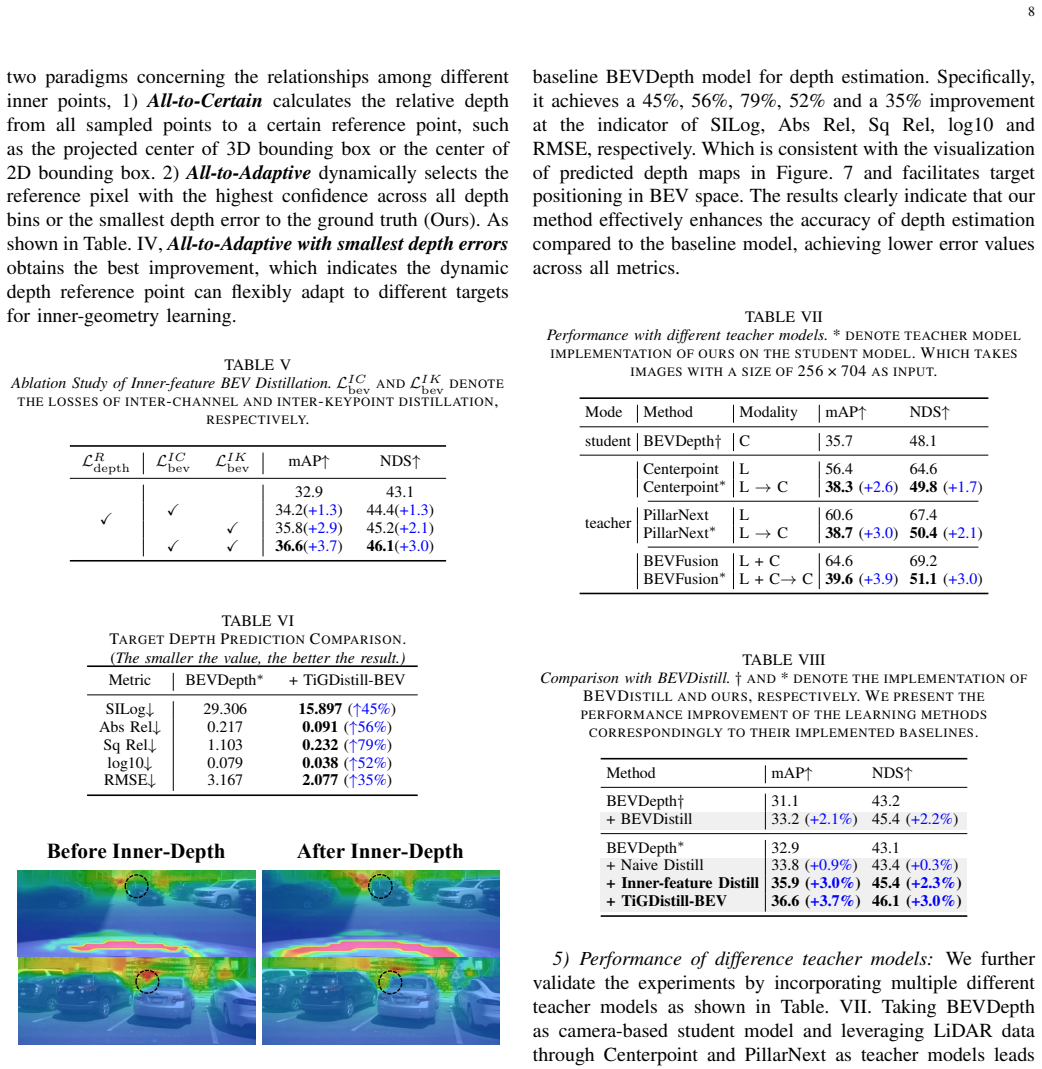
- Inner-feature distillation alone contributes more (+3.0 mAP, +2.3 NDS) than inner-depth supervision alone (+1.0 mAP, +0.9 NDS), and combining both gives +3.7 mAP and +3.0 NDS on the val ablation.
- The improvement persists across image backbones (ResNet-18/50/101, Swin, ConvNeXt), in single-frame and multi-frame settings, for small object classes, and in the 30-60 meter range.
- Teacher quality scales the transfer: using BEVFusion as teacher yields larger gains than LiDAR-only teachers CenterPoint and PillarNeXt.
Reading between the lines
- Beyond the paper: if relative object structure is the active signal, the same inner-geometry losses could transfer to other camera-only BEV tasks such as BEV map segmentation or occupancy prediction, where LiDAR teachers are available.
- Beyond the paper: the adaptive reference point is selected using ground-truth depth error at training time; a learned or confidence-weighted reference might generalize better when student depth is systematically biased, a comparison the paper does not run.
- Beyond the paper: because the stated motivation is the modality gap, the advantage over dense BEV distillation should grow as teacher and student architectures diverge; testing with deliberately mismatched backbones would isolate this effect.
- Beyond the paper: the paper lists temporal inner-depth supervision as future work; aggregating the same object's interior points across frames could recover occluded foreground, provided multi-frame calibration is accurate.
Editorial analysis
A structured set of objections, weighed in public.
Referee Report
Summary. The paper proposes TiGDistill-BEV, a training-time knowledge-distillation framework for camera-based multi-view BEV 3D object detection. The method adds two components to a camera-only student detector: (1) an inner-depth supervision module that computes relative depth within foreground targets using an adaptively selected reference point, and (2) an inner-feature BEV distillation module that samples keypoints in ground-truth boxes and distills inter-channel and inter-keypoint similarity matrices from a LiDAR or fusion teacher. Experiments on nuScenes report consistent gains over BEVDet, BEVDet4D, and BEVDepth, with a test-set result of 62.8% NDS and 53.9% mAP when using a BEVFusion teacher.
Significance. If the empirical results hold, the paper would demonstrate a practical and reusable recipe for transferring LiDAR or fusion teacher knowledge to camera-only BEV detectors, with gains that are consistent across backbones, temporal settings, and teacher models. The paper's strengths include evaluation on an external benchmark, a large set of ablation tables (Tables III-XIII), multiple baseline detectors, and a public code link. The main weakness is that a core part of the method specification, Eqs. (5) and (7), is internally inconsistent with respect to matrix dimensions, which makes the current text ambiguous enough to prevent reproduction and to obscure which of the two distillation losses is responsible for the reported ablation gains.
major comments (5)
- [Section III-C2 and III-C3, Eqs. (5) and (7)] The matrix definitions are dimensionally inconsistent. Section III-C1 defines f_j^cam, f_j^teacher in R^{N×C}. In Eq. (5), f_j f_j^T is N×N, not C×C, so it cannot represent an inter-channel relationship matrix; the correct channel-correlation matrix is f_j^T f_j. In Eq. (7), f_j^T f_j is C×C, not N×N, so it cannot represent an inter-keypoint relationship matrix; the correct keypoint-correlation matrix is f_j f_j^T. Figure 6 and the text label the losses as inter-channel and inter-keypoint, but the formulas are swapped relative to those labels and to the stated dimensions. This makes the method specification ambiguous: if the implementation follows the equations literally, the loss named L_IC^bev is actually comparing keypoint correlations and L_IK^bev is comparing channel correlations, so the Table V ablation cannot be mapped to the described components. Please correct the equations or the stated dimensions/names and confirm which variant is used in the released code.
- [Section III-D and Section IV-B] The overall loss in Eq. (10) is written as an unweighted sum, but no loss weights are reported for L_depth^R, L_bev^IC, or L_bev^IK. These auxiliary losses operate on very different scales (continuous relative depth values versus similarity matrices of size C×C or N×N), so equal weights are unlikely to be the actual setting. In addition, Section III-C1 samples N keypoints per target and slightly enlarges ground-truth boxes in BEV space, but neither the value of N nor the enlargement factor is reported in Section IV-B. These are free parameters of the method and are necessary for reproducing the ablation results in Tables III, V, and VIII. Please report the exact loss weights, N, the enlargement factor, and any normalization used in Eqs. (6) and (8).
- [Section III-B3, Eq. (2)] The adaptive depth reference is selected by minimizing the error between predicted and ground-truth depth at training time. This is legitimate for a training-only auxiliary loss, but the paper should state explicitly that this selection is not used at inference, and it should discuss the oracle nature of using ground-truth depth in the reference selection. Table IV compares the 'Smallest Error' policy with a 'Highest Conf' policy and shows a relatively small gap, which partially addresses the concern, but the paper would be strengthened by an additional sensitivity analysis, for example using a fixed reference point or a predicted-only confidence reference, and by reporting how the reference selection behaves over training iterations.
- [Section IV-D6, Table VIII] The comparison with 'Naive Distill' uses dense BEV MSE, and the BEVDistill comparison uses foreground-guided dense distillation; neither controls for the keypoint sampling step. To substantiate the claim that relationship-based distillation is superior to direct feature alignment, please add an ablation that applies a point-wise L2 loss to the same N sampled keypoints without computing cross-channel or cross-keypoint correlations. Without this control, the gains attributed to inter-channel and inter-keypoint relationship modeling could also come from the keypoint sampling procedure or from the foreground masking itself.
- [Section III-B1 and Section IV-F2] For occluded, distant, or LiDAR-sparse objects, the foreground pixel set obtained by projecting LiDAR points inside the box can be empty or very small. The paper acknowledges the occlusion limitation in Section IV-F2, but it does not specify how Eq. (4), Eq. (6), and Eq. (8) are computed for degenerate cases, for example whether targets with fewer than a threshold number of pixels are skipped. The distance-range ablation in Table XII shows only modest gains at 30-60 m, so the handling of sparse foreground is empirically relevant. Please report the fraction of targets with valid foreground in the training set and state the exact handling rule for empty or near-empty target regions.
minor comments (14)
- [Section IV-C1] The text states that TiGDistill-BEV 'consistently produced lower error metrics', but Table I shows that BEVDet mAOE increases from 52.3 to 55.4 and BEVDet4D mA VE increases from 33.1 to 34.1; please qualify this claim.
- [Section IV-C1] The '13.2% reduction in mA VE' compares BEVDet's 90.9 to 77.7, which is an absolute difference of 13.2 units rather than a percentage reduction, and it is not 'compared to BEVDepth' as written; please correct the description.
- [Section IV-D5, Table VII] The text says PillarNext* gains 2.1% NDS, but Table VII shows 50.4 - 48.1 = 2.3; please correct this value.
- [Section III-B2, Eq. (1)] The number of depth bins is denoted K in Section III-A but D in Section III-B2; please use consistent notation and define the symbol \hat{S}[k].
- [Section III-B4, Eq. (4)] The L2 norm is applied to sets of depth values; please write the loss as an explicit sum over pixels with clear indices so that the objective is unambiguous.
- [Section III-D, Eq. (10)] Eq. (10) uses L_bev, but Eq. (9) defines the symbol L_bev^D; please align the notation.
- [Section III-C, Eq. (9)] The two distillation terms are not mathematically orthogonal; consider using 'complementary' instead of 'orthogonal'.
- [Figures 4 and 6] There are typos in the figures and captions: 'Target Iner-Geometry' in Figure 4, 'Chosely' in the Figure 4 diagram, and 'Innter-feature' in Figure 6; please proofread.
- [Section III-B3] The sentence 'based on the the predicted continuous depth values' contains a duplicated 'the'.
- [Abstract] The sentence 'The codes is available at: ...' should read 'The code is available at: ...'.
- [Table X] The BEVDet baseline values differ across rows (20.3/33.1, 30.5/37.8, and 29.8/37.9) although the caption says the configurations uniformly use ResNet-50 at 256×704; please clarify which baseline corresponds to each concurrent method.
- [Section IV-A and Table VI] Table VI reports SILog, but SILog is not defined in the evaluation metrics section; please add its definition.
- [References [42] and [43]] MonoDETR is listed twice with the same title; please consolidate the duplicate reference.
- [Section IV-B] The sentence 'we utilize the freeze the teacher model' has a grammar error; please correct it.
Circularity Check
No circularity: nuScenes gains are measured on external val/test metrics that the distillation losses do not directly optimize; teacher-student setup is a standard independent benchmark.
full rationale
The paper's central claim is an empirical improvement on nuScenes NDS/mAP. The proposed losses (L^R_depth, L^IC_bev, L^IK_bev) directly minimize differences between student predictions and ground-truth-derived or teacher-derived targets during training; they do not contain NDS or mAP as closed-form terms, and the reported numbers are from the official nuScenes evaluation on held-out val/test splits. The teacher models (CenterPoint, PillarNeXt, BEVFusion) are pre-trained on the same nuScenes train split, but this is standard distillation rather than circularity: the student is camera-only at inference, and the gains are assessed against external detection metrics, not against the distillation losses themselves. Table VI's depth-metric improvements are expected because inner-depth supervision directly trains toward LiDAR-derived depth, but the paper's headline claim is detection performance, so this is a sanity check rather than a self-fulfilling prediction. There is no load-bearing self-citation: the authors' prior works appear only as related-work references, and no 'uniqueness theorem' or prior result is invoked to forbid alternatives. Section IV-F2 openly acknowledges occlusion as a limitation; that affects robustness, not circularity. One specification concern found during review — the dimensional mismatch in Eqs. (5) and (7), where f in R^{N x C} makes f f^T an N x N keypoint Gram matrix rather than C x C, and f^T f a C x C channel Gram matrix rather than N x N — is a correctness/reproducibility issue about which loss is which, but it does not make any reported result equivalent to its inputs by construction, so it is outside the circularity score.
Assumptions & free parameters
free parameters (4)
- number of keypoints N per target =
not reported
- loss weights for L_depth^R, L_bev^IC, L_bev^IK =
not reported
- foreground BEV box enlargement factor =
not reported
- teacher model choice =
CenterPoint, PillarNeXt, BEVFusion
assumptions (4)
- domain assumption Camera and LiDAR BEV feature maps have the same spatial resolution and channel count.
- domain assumption Camera intrinsics, extrinsics, and LiDAR-to-camera calibration are accurate during training.
- domain assumption LiDAR points inside a ground-truth bounding box form a usable proxy for the object's visible foreground.
- domain assumption Pre-trained teacher detectors used for distillation were trained on the same nuScenes training distribution, and their BEV features encode knowledge that transfers to camera students.
Cite this review
Pith. "Pith review of TiGDistill-BEV: Multi-view BEV 3D Object Detection via Target Inner-Geometry Learning Distillation." pith.science (2026). https://pith.science/paper/GYQVQ6LS
@misc{pith2026241220911,
  author       = {Pith},
  title        = {Pith review of: TiGDistill-BEV: Multi-view BEV 3D Object Detection via Target Inner-Geometry Learning Distillation},
  year         = {2026},
  howpublished = {\url{https://pith.science/paper/GYQVQ6LS}},
  note         = {Machine review of arXiv:2412.20911}
}
read the original abstract
Accurate multi-view 3D object detection is essential for applications such as autonomous driving. Researchers have consistently aimed to leverage LiDAR's precise spatial information to enhance camera-based detectors through methods like depth supervision and bird-eye-view (BEV) feature distillation. However, existing approaches often face challenges due to the inherent differences between LiDAR and camera data representations. In this paper, we introduce the TiGDistill-BEV, a novel approach that effectively bridges this gap by leveraging the strengths of both sensors. Our method distills knowledge from diverse modalities(e.g., LiDAR) as the teacher model to a camera-based student detector, utilizing the Target Inner-Geometry learning scheme to enhance camera-based BEV detectors through both depth and BEV features by leveraging diverse modalities. Specially, we propose two key modules: an inner-depth supervision module to learn the low-level relative depth relations within objects which equips detectors with a deeper understanding of object-level spatial structures, and an inner-feature BEV distillation module to transfer high-level semantics of different key points within foreground targets. To further alleviate the domain gap, we incorporate both inter-channel and inter-keypoint distillation to model feature similarity. Extensive experiments on the nuScenes benchmark demonstrate that TiGDistill-BEV significantly boosts camera-based only detectors achieving a state-of-the-art with 62.8% NDS and surpassing previous methods by a significant margin. The codes is available at: https://github.com/Public-BOTs/TiGDistill-BEV.git.
Figures


Figures from the paper (4 more)



Reference graph
Works this paper leans on
-
[45]
Similarity-preserving knowledge distillation,
F. Tung and G. Mori, “Similarity-preserving knowledge distillation,” in Proceedings of the IEEE/CVF international conference on computer vision, 2019, pp. 1365–1374
2019
-
[46]
Visualizing adapted knowledge in domain transfer,
Y . Hou and L. Zheng, “Visualizing adapted knowledge in domain transfer,” in Proceedings of the IEEE/CVF conference on computer vision and pattern recognition , 2021, pp. 13 824–13 833
work page 2021
-
[1]
Center-based 3d object detection and tracking,
T. Yin, X. Zhou, and P. Krahenbuhl, “Center-based 3d object detection and tracking,” in Proceedings of the IEEE/CVF conference on computer vision and pattern recognition , 2021, pp. 11 784–11 793
2021
-
[2]
Robofusion: Towards robust multi-modal 3d obiect detection via sam,
Z. Song, G. Zhang, L. Liu, L. Yang, S. Xu, C. Jia, F. Jia, and L. Wang, “Robofusion: Towards robust multi-modal 3d obiect detection via sam,” arXiv preprint arXiv:2401.03907 , 2024
arXiv 2024
-
[3]
Pillarnext: Rethinking network designs for 3d object detection in lidar point clouds,
J. Li, C. Luo, and X. Yang, “Pillarnext: Rethinking network designs for 3d object detection in lidar point clouds,” in Proceedings of the IEEE/CVF Conference on Computer Vision and Pattern Recognition , 2023, pp. 17 567–17 576
work page 2023
-
[4]
Improving semantic analysis on point clouds via auxiliary supervision of local geometric priors,
L. Tang, K. Chen, C. Wu, Y . Hong, K. Jia, and Z.-X. Yang, “Improving semantic analysis on point clouds via auxiliary supervision of local geometric priors,” IEEE Transactions on Cybernetics , vol. 52, no. 6, pp. 4949–4959, 2020
work page 2020
-
[5]
L. Yang, X. Zhang, J. Li, L. Wang, M. Zhu, C. Zhang, and H. Liu, “Mix-teaching: A simple, unified and effective semi-supervised learning framework for monocular 3d object detection,” IEEE Transactions on Circuits and Systems for Video Technology , vol. 33, no. 11, pp. 6832– 6844, 2023
work page 2023
-
[6]
Wsamf-net: Wavelet spatial attention-based multistream feedback network for single image dehazing,
X. Song, D. Zhou, W. Li, H. Ding, Y . Dai, and L. Zhang, “Wsamf-net: Wavelet spatial attention-based multistream feedback network for single image dehazing,” IEEE Transactions on Circuits and Systems for Video Technology, vol. 33, no. 2, pp. 575–588, 2022
work page 2022
Show all 72 references
-
[7]
V ox- elnextfusion: A simple, unified and effective voxel fusion framework for multi-modal 3d object detection,
Z. Song, G. Zhang, J. Xie, L. Liu, C. Jia, S. Xu, and Z. Wang, “V ox- elnextfusion: A simple, unified and effective voxel fusion framework for multi-modal 3d object detection,” arXiv preprint arXiv:2401.02702 , 2024
2024 arXiv
-
[8]
Far3d: Expanding the horizon for surround-view 3d object detection,
X. Jiang, S. Li, Y . Liu, S. Wang, F. Jia, T. Wang, L. Han, and X. Zhang, “Far3d: Expanding the horizon for surround-view 3d object detection,” in Proceedings of the AAAI Conference on Artificial Intelligence, vol. 38, no. 3, 2024, pp. 2561–2569
2024
-
[9]
Pseudo-mono for monocular 3d object detection in autonomous driving,
C. Tao, J. Cao, C. Wang, Z. Zhang, and Z. Gao, “Pseudo-mono for monocular 3d object detection in autonomous driving,” IEEE Transac- tions on Circuits and Systems for Video Technology , vol. 33, no. 8, pp. 3962–3975, 2023
2023
-
[10]
Pipc-3ddet: Harnessing perspective information and proposal correlation for 3d point cloud object detection,
C. Yu, B. Peng, Q. Huang, and J. Lei, “Pipc-3ddet: Harnessing perspective information and proposal correlation for 3d point cloud object detection,” IEEE Transactions on Circuits and Systems for Video Technology, 2023
2023
-
[11]
Graphbev: Towards robust bev feature alignment for multi-modal 3d object detection,
Z. Song, L. Yang, S. Xu, L. Liu, D. Xu, C. Jia, F. Jia, and L. Wang, “Graphbev: Towards robust bev feature alignment for multi-modal 3d object detection,” arXiv preprint arXiv:2403.11848 , 2024
2024 arXiv
-
[12]
Fusionpainting: Multimodal fusion with adaptive attention for 3d object detection,
S. Xu, D. Zhou, J. Fang, J. Yin, Z. Bin, and L. Zhang, “Fusionpainting: Multimodal fusion with adaptive attention for 3d object detection,” in 2021 IEEE International Intelligent Transportation Systems Conference (ITSC). IEEE, 2021, pp. 3047–3054
2021
-
[13]
Graphalign++: An accurate feature alignment by graph matching for multi-modal 3d object detection,
Z. Song, C. Jia, L. Yang, H. Wei, and L. Liu, “Graphalign++: An accurate feature alignment by graph matching for multi-modal 3d object detection,” IEEE Transactions on Circuits and Systems for Video Technology, 2023
2023
-
[14]
Multi- sem fusion: multimodal semantic fusion for 3d object detection,
S. Xu, F. Li, Z. Song, J. Fang, S. Wang, and Z.-X. Yang, “Multi- sem fusion: multimodal semantic fusion for 3d object detection,” IEEE Transactions on Geoscience and Remote Sensing , 2024
2024
-
[15]
Bevdepth: Acquisition of reliable depth for multi-view 3d object detection,
Y . Li, Z. Ge, G. Yu, J. Yang, Z. Wang, Y . Shi, J. Sun, and Z. Li, “Bevdepth: Acquisition of reliable depth for multi-view 3d object detection,” arXiv preprint arXiv:2206.10092 , 2022
2022 arXiv
-
[16]
Bevdistill: Cross-modal bev distillation for multi-view 3d object detection,
Z. Chen, Z. Li, S. Zhang, L. Fang, Q. Jiang, and F. Zhao, “Bevdistill: Cross-modal bev distillation for multi-view 3d object detection,” arXiv preprint arXiv:2211.09386, 2022
2022 arXiv
-
[17]
Cross-modality knowledge distillation network for monocular 3d object detection,
Y . Hong, H. Dai, and Y . Ding, “Cross-modality knowledge distillation network for monocular 3d object detection,” in European Conference on Computer Vision. Springer, 2022, pp. 87–104
2022
-
[18]
Licrocc: Teach radar for accurate semantic occupancy prediction using lidar and camera,
Y . Ma, J. Mei, X. Yang, L. Wen, W. Xu, J. Zhang, B. Shi, Y . Liu, and X. Zuo, “Licrocc: Teach radar for accurate semantic occupancy prediction using lidar and camera,” arXiv preprint arXiv:2407.16197 , 2024
2024 arXiv
-
[19]
Categorical depth distribution network for monocular 3d object detection,
C. Reading, A. Harakeh, J. Chae, and S. L. Waslander, “Categorical depth distribution network for monocular 3d object detection,” in Pro- ceedings of the IEEE/CVF Conference on Computer Vision and Pattern Recognition, 2021, pp. 8555–8564
2021
-
[20]
Bevdet: High-performance multi-camera 3d object detection in bird-eye-view,
J. Huang, G. Huang, Z. Zhu, and D. Du, “Bevdet: High-performance multi-camera 3d object detection in bird-eye-view,” arXiv preprint arXiv:2112.11790, 2021
2021 arXiv
-
[21]
Bevdet4d: Exploit temporal cues in multi- camera 3d object detection,
J. Huang and G. Huang, “Bevdet4d: Exploit temporal cues in multi- camera 3d object detection,” arXiv preprint arXiv:2203.17054 , 2022
2022 arXiv
-
[22]
Lift, splat, shoot: Encoding images from arbitrary camera rigs by implicitly unprojecting to 3d,
J. Philion and S. Fidler, “Lift, splat, shoot: Encoding images from arbitrary camera rigs by implicitly unprojecting to 3d,” in European Conference on Computer Vision . Springer, 2020, pp. 194–210
2020
-
[23]
Bev- former: Learning bird’s-eye-view representation from multi-camera im- ages via spatiotemporal transformers,
Z. Li, W. Wang, H. Li, E. Xie, C. Sima, T. Lu, Q. Yu, and J. Dai, “Bev- former: Learning bird’s-eye-view representation from multi-camera im- ages via spatiotemporal transformers,” arXiv preprint arXiv:2203.17270, 2022
2022 arXiv
-
[24]
Detr3d: 3d object detection from multi-view images via 3d-to-2d queries,
Y . Wang, V . C. Guizilini, T. Zhang, Y . Wang, H. Zhao, and J. Solomon, “Detr3d: 3d object detection from multi-view images via 3d-to-2d queries,” in Proceedings of the 5th Conference on Robot Learning , ser. Proceedings of Machine Learning Research, A. Faust, D. Hsu, and G. ...
2022
-
[25]
Petr: Position embedding transformation for multi-view 3d object detection,
Y . Liu, T. Wang, X. Zhang, and J. Sun, “Petr: Position embedding transformation for multi-view 3d object detection,” arXiv preprint arXiv:2203.05625, 2022
2022 arXiv
-
[26]
Petrv2: A unified framework for 3d perception from multi-camera images,
Y . Liu, J. Yan, F. Jia, S. Li, Q. Gao, T. Wang, X. Zhang, and J. Sun, “Petrv2: A unified framework for 3d perception from multi-camera images,” arXiv preprint arXiv:2206.01256 , 2022
2022 arXiv
-
[27]
Exploring object- centric temporal modeling for efficient multi-view 3d object detection,
S. Wang, Y . Liu, T. Wang, Y . Li, and X. Zhang, “Exploring object- centric temporal modeling for efficient multi-view 3d object detection,” in Proceedings of the IEEE/CVF International Conference on Computer Vision, 2023, pp. 3621–3631
2023
-
[28]
Sparse4d: Multi-view 3d object detection with sparse spatial-temporal fusion,
X. Lin, T. Lin, Z. Pei, L. Huang, and Z. Su, “Sparse4d: Multi-view 3d object detection with sparse spatial-temporal fusion,” arXiv preprint arXiv:2211.10581, 2022
2022 arXiv
-
[29]
Sparse4d v2: Recurrent temporal fusion with sparse model,
——, “Sparse4d v2: Recurrent temporal fusion with sparse model,” arXiv preprint arXiv:2305.14018 , 2023. 12
2023 arXiv
-
[30]
Adabins: Depth estimation using adaptive bins,
S. F. Bhat, I. Alhashim, and P. Wonka, “Adabins: Depth estimation using adaptive bins,” in Proceedings of the IEEE/CVF Conference on Computer Vision and Pattern Recognition , 2021, pp. 4009–4018
2021
-
[31]
Deep ordinal regression network for monocular depth estimation,
H. Fu, M. Gong, C. Wang, K. Batmanghelich, and D. Tao, “Deep ordinal regression network for monocular depth estimation,” in Proceedings of the IEEE conference on computer vision and pattern recognition , 2018, pp. 2002–2011
2018
-
[33]
On the uncertainty of self-supervised monocular depth estimation,
M. Poggi, F. Aleotti, F. Tosi, and S. Mattoccia, “On the uncertainty of self-supervised monocular depth estimation,” in Proceedings of the IEEE/CVF Conference on Computer Vision and Pattern Recognition , 2020, pp. 3227–3237
2020
-
[34]
Vision transformers for dense prediction,
R. Ranftl, A. Bochkovskiy, and V . Koltun, “Vision transformers for dense prediction,” in Proceedings of the IEEE/CVF International Conference on Computer Vision , 2021, pp. 12 179–12 188
2021
-
[35]
Surrounddepth: Entangling surrounding views for self-supervised multi-camera depth estimation,
Y . Wei, L. Zhao, W. Zheng, Z. Zhu, Y . Rao, G. Huang, J. Lu, and J. Zhou, “Surrounddepth: Entangling surrounding views for self-supervised multi-camera depth estimation,” arXiv preprint arXiv:2204.03636, 2022
2022 arXiv
-
[36]
Full surround monodepth from multiple cameras,
V . Guizilini, I. Vasiljevic, R. Ambrus, G. Shakhnarovich, and A. Gaidon, “Full surround monodepth from multiple cameras,” IEEE Robotics and Automation Letters, vol. 7, no. 2, pp. 5397–5404, 2022
2022
-
[37]
Ga-net: Guided aggregation net for end-to-end stereo matching,
F. Zhang, V . Prisacariu, R. Yang, and P. H. Torr, “Ga-net: Guided aggregation net for end-to-end stereo matching,” in Proceedings of the IEEE/CVF Conference on Computer Vision and Pattern Recognition , 2019, pp. 185–194
2019
-
[38]
Cfnet: Cascade and fused cost volume for robust stereo matching,
Z. Shen, Y . Dai, and Z. Rao, “Cfnet: Cascade and fused cost volume for robust stereo matching,” in Proceedings of the IEEE/CVF Conference on Computer Vision and Pattern Recognition , 2021, pp. 13 906–13 915
2021
-
[39]
Rethinking depth estimation for multi-view stereo: A unified representation,
R. Peng, R. Wang, Z. Wang, Y . Lai, and R. Wang, “Rethinking depth estimation for multi-view stereo: A unified representation,” in Proceedings of the IEEE/CVF Conference on Computer Vision and Pattern Recognition, 2022, pp. 8645–8654
2022
-
[40]
Can language understand depth?
R. Zhang, Z. Zeng, Z. Guo, and Y . Li, “Can language understand depth?” in Proceedings of the 30th ACM International Conference on Multimedia, 2022, pp. 6868–6874
2022
-
[41]
Is pseudo- lidar needed for monocular 3d object detection?
D. Park, R. Ambrus, V . Guizilini, J. Li, and A. Gaidon, “Is pseudo- lidar needed for monocular 3d object detection?” in Proceedings of the IEEE/CVF International Conference on Computer Vision , 2021, pp. 3142–3152
2021
-
[43]
Monodetr: Depth-guided transformer for monocular 3d object detection,
——, “Monodetr: Depth-guided transformer for monocular 3d object detection,” arXiv preprint arXiv:2203.13310 , 2022
2022 arXiv
-
[44]
Image style transfer using convolutional neural networks,
L. A. Gatys, A. S. Ecker, and M. Bethge, “Image style transfer using convolutional neural networks,” in Proceedings of the IEEE conference on computer vision and pattern recognition , 2016, pp. 2414–2423
2016
-
[47]
Paying more attention to attention: Improving the performance of convolutional neural networks via atten- tion transfer,
S. Zagoruyko and N. Komodakis, “Paying more attention to attention: Improving the performance of convolutional neural networks via atten- tion transfer,” arXiv preprint arXiv:1612.03928 , 2016
2016 arXiv
-
[48]
Like what you like: Knowledge distill via neuron selectivity transfer,
Z. Huang and N. Wang, “Like what you like: Knowledge distill via neuron selectivity transfer,” arXiv preprint arXiv:1707.01219 , 2017
2017 arXiv
-
[49]
Exploring inter-channel correlation for diversity-preserved knowledge distillation,
L. Liu, Q. Huang, S. Lin, H. Xie, B. Wang, X. Chang, and X. Liang, “Exploring inter-channel correlation for diversity-preserved knowledge distillation,” in Proceedings of the IEEE/CVF International Conference on Computer Vision , 2021, pp. 8271–8280
2021
-
[50]
Similarity-preserving knowledge distillation,
F. Tung and G. Mori, “Similarity-preserving knowledge distillation,” in Proceedings of the IEEE/CVF International Conference on Computer Vision, 2019, pp. 1365–1374
2019
-
[51]
Knowledge augmented deep neural networks for joint facial expression and action unit recognition,
Z. Cui, T. Song, Y . Wang, and Q. Ji, “Knowledge augmented deep neural networks for joint facial expression and action unit recognition,” Ad- vances in Neural Information Processing Systems , vol. 33, pp. 14 338– 14 349, 2020
2020
-
[52]
Spatio-temporal graph for video captioning with knowledge distillation,
B. Pan, H. Cai, D.-A. Huang, K.-H. Lee, A. Gaidon, E. Adeli, and J. C. Niebles, “Spatio-temporal graph for video captioning with knowledge distillation,” in Proceedings of the IEEE/CVF Conference on Computer Vision and Pattern Recognition , 2020, pp. 10 870–10 879
2020
-
[53]
Distillation with contrast is all you need for self-supervised point cloud representation learning,
K. Fu, P. Gao, R. Zhang, H. Li, Y . Qiao, and M. Wang, “Distillation with contrast is all you need for self-supervised point cloud representation learning,” arXiv preprint arXiv:2202.04241 , 2022
2022 arXiv
-
[54]
Learning 3d representations from 2d pre-trained models via image-to-point masked autoencoders,
R. Zhang, L. Wang, Y . Qiao, P. Gao, and H. Li, “Learning 3d representations from 2d pre-trained models via image-to-point masked autoencoders,” arXiv preprint arXiv:2212.06785 , 2022
2022 arXiv
-
[55]
Learning from 2d: Contrastive pixel-to-point knowledge transfer for 3d pretraining,
Y .-C. Liu, Y .-K. Huang, H.-Y . Chiang, H.-T. Su, Z.-Y . Liu, C.-T. Chen, C.-Y . Tseng, and W. H. Hsu, “Learning from 2d: Contrastive pixel-to-point knowledge transfer for 3d pretraining,” arXiv preprint arXiv:2104.04687, 2021
2021 arXiv
-
[56]
Image-to-lidar self-supervised distillation for autonomous driving data,
C. Sautier, G. Puy, S. Gidaris, A. Boulch, A. Bursuc, and R. Marlet, “Image-to-lidar self-supervised distillation for autonomous driving data,” in Proceedings of the IEEE/CVF Conference on Computer Vision and Pattern Recognition, 2022, pp. 9891–9901
2022
-
[57]
General instance distillation for object detection,
X. Dai, Z. Jiang, Z. Wu, Y . Bao, Z. Wang, S. Liu, and E. Zhou, “General instance distillation for object detection,” in Proceedings of the IEEE/CVF Conference on Computer Vision and Pattern Recognition, 2021, pp. 7842–7851
2021
-
[58]
Learning efficient object detection models with knowledge distillation,
G. Chen, W. Choi, X. Yu, T. Han, and M. Chandraker, “Learning efficient object detection models with knowledge distillation,” Advances in neural information processing systems , vol. 30, 2017
2017
-
[59]
Unidistill: A universal cross-modality knowledge distillation framework for 3d object detection in bird’s-eye view,
S. Zhou, W. Liu, C. Hu, S. Zhou, and C. Ma, “Unidistill: A universal cross-modality knowledge distillation framework for 3d object detection in bird’s-eye view,” 2023 IEEE/CVF Conference on Computer Vision and Pattern Recognition (CVPR) , pp. 5116–5125, 2023. [Online]. Availab...
2023
-
[60]
Point-to-voxel knowledge distillation for lidar semantic segmentation,
Y . Hou, X. Zhu, Y . Ma, C. C. Loy, and Y . Li, “Point-to-voxel knowledge distillation for lidar semantic segmentation,” in Proceedings of the IEEE/CVF Conference on Computer Vision and Pattern Recognition , 2022, pp. 8479–8488
2022
-
[61]
Intra-class feature vari- ation distillation for semantic segmentation,
Y . Wang, W. Zhou, T. Jiang, X. Bai, and Y . Xu, “Intra-class feature vari- ation distillation for semantic segmentation,” in European Conference on Computer Vision. Springer, 2020, pp. 346–362
2020
-
[62]
Bev-lgkd: A unified lidar-guided knowledge distillation framework for bev 3d object detection,
J. Li, M. Lu, J. Liu, Y . Guo, L. Du, and S. Zhang, “Bev-lgkd: A unified lidar-guided knowledge distillation framework for bev 3d object detection,” arXiv preprint arXiv:2212.00623 , 2022
2022 arXiv
-
[63]
X3kd: Knowledge distillation across modalities, tasks and stages for multi-camera 3d object detection,
M. Klingner, S. Borse, V . R. Kumar, B. Rezaei, V . Narayanan, S. Yoga- mani, and F. Porikli, “X3kd: Knowledge distillation across modalities, tasks and stages for multi-camera 3d object detection,” in Proceedings of the IEEE/CVF Conference on Computer Vision and Pattern Recog...
2023
-
[64]
Distillbev: Boosting multi-camera 3d object detection with cross-modal knowledge distil- lation,
Z. Wang, D. Li, C. Luo, C. Xie, and X. Yang, “Distillbev: Boosting multi-camera 3d object detection with cross-modal knowledge distil- lation,” in Proceedings of the IEEE/CVF International Conference on Computer Vision, 2023, pp. 8637–8646
2023
-
[65]
Simdistill: Simulated multi-modal distillation for bev 3d object detection,
H. Zhao, Q. Zhang, S. Zhao, Z. Chen, J. Zhang, and D. Tao, “Simdistill: Simulated multi-modal distillation for bev 3d object detection,” in Proceedings of the AAAI Conference on Artificial Intelligence , vol. 38, no. 7, 2024, pp. 7460–7468
2024
-
[66]
Leveraging vision-centric multi-modal expertise for 3d object detec- tion,
L. Huang, Z. Li, C. Sima, W. Wang, J. Wang, Y . Qiao, and H. Li, “Leveraging vision-centric multi-modal expertise for 3d object detec- tion,” arXiv preprint arXiv:2310.15670 , 2023
2023 arXiv
-
[67]
Distilling focal knowledge from imperfect expert for 3d object detection,
J. Zeng, L. Chen, H. Deng, L. Lu, J. Yan, Y . Qiao, and H. Li, “Distilling focal knowledge from imperfect expert for 3d object detection,” in Proceedings of the IEEE/CVF Conference on Computer Vision and Pattern Recognition, 2023, pp. 992–1001
2023
-
[68]
Bevfusion: Multi-task multi-sensor fusion with unified bird’s-eye view representation,
Z. Liu, H. Tang, A. Amini, X. Yang, H. Mao, D. L. Rus, and S. Han, “Bevfusion: Multi-task multi-sensor fusion with unified bird’s-eye view representation,” in 2023 IEEE international conference on robotics and automation (ICRA). IEEE, 2023, pp. 2774–2781
2023
-
[69]
nuscenes: A multimodal dataset for autonomous driving,
H. Caesar, V . Bankiti, A. H. Lang, S. V ora, V . E. Liong, Q. Xu, A. Krishnan, Y . Pan, G. Baldan, and O. Beijbom, “nuscenes: A multimodal dataset for autonomous driving,” in Proceedings of the IEEE/CVF conference on computer vision and pattern recognition, 2020, pp. 11 621–11 631
2020
-
[70]
The pascal visual object classes (voc) challenge,
M. Everingham, L. Van Gool, C. K. Williams, J. Winn, and A. Zisser- man, “The pascal visual object classes (voc) challenge,” International journal of computer vision , vol. 88, no. 2, pp. 303–338, 2010
2010
-
[71]
Depth map prediction from a single image using a multi-scale deep network,
D. Eigen, C. Puhrsch, and R. Fergus, “Depth map prediction from a single image using a multi-scale deep network,” Advances in neural information processing systems , vol. 27, 2014
2014
-
[72]
Class-balanced grouping and sampling for point cloud 3d object detection,
B. Zhu, Z. Jiang, X. Zhou, Z. Li, and G. Yu, “Class-balanced grouping and sampling for point cloud 3d object detection,” arXiv preprint arXiv:1908.09492, 2019
1908 arXiv
-
[73]
A convnet for the 2020s,
Z. Liu, H. Mao, C.-Y . Wu, C. Feichtenhofer, T. Darrell, and S. Xie, “A convnet for the 2020s,” in Proceedings of the IEEE/CVF Conference on 13 Computer Vision and Pattern Recognition (CVPR) , 2022, pp. 11 976– 11 986
2022
-
[74]
Stxd: structural and temporal cross-modal distillation for multi-view 3d object detection,
S. Jang, D. U. Jo, S. J. Hwang, D. Lee, and D. Ji, “Stxd: structural and temporal cross-modal distillation for multi-view 3d object detection,” Advances in Neural Information Processing Systems , vol. 36, 2024. Shaoqing Xu received his M.S. degree in transporta- tion engineeri...
2024
Reviewed August 10, 2026 · model on record in the stance chip above.
Discussion (0). Continue with ORCID to comment.