REVIEW 4 major objections 6 minor 43 references
PQD: Post-training Quantization for Efficient Diffusion Models
T0 review · 4 major / 6 minor · reviewed 2026-08-10 · deepseek-v4-flash
Pith's one-line read PQD claims that sampling calibration data along the denoising trajectory lets post-training quantization compress diffusion models to 8-bit or 4-bit weights while keeping image quality close to full precision, including for 512x512…
desk verdict The 8-bit ImageNet result is plausible, but the 4-bit claim is dead on arrival: Table 1 shows roughly 3x FID degradation, contradicting the abstract. read the letter →
The pith
A machine-rendered reading of the paper's core claim, the machinery that carries it, and where it could break.
The reading
What carries the argument
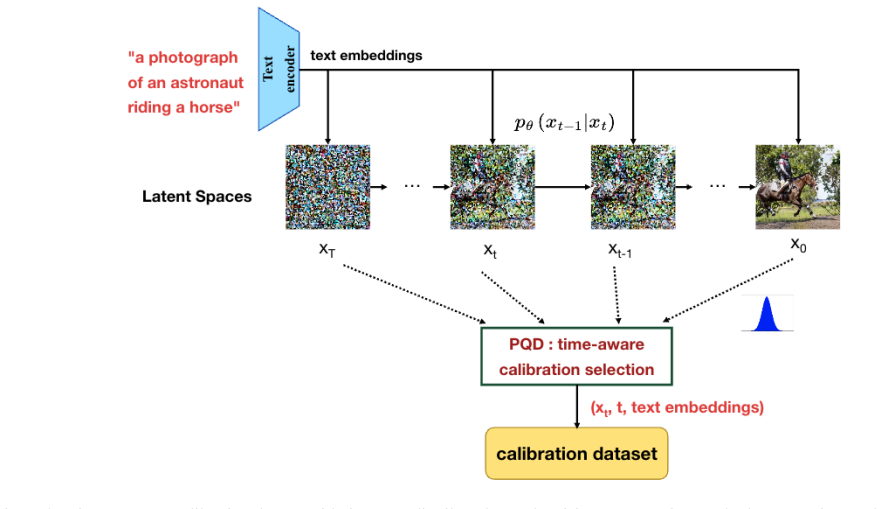
The central mechanism is Algorithm 1, the time-aware calibration dataset sampler. Instead of using static images, PQD draws a denoising time step from a normal distribution, rolls the full-precision model forward from pure noise to that step, and records the intermediate latent or input tensor together with its time embedding and text conditioning. This yields a calibration set whose activation ranges intentionally cover the denoising trajectory. Quantization itself is done by QDrop, and for high-resolution text-to-image generation the quantization is applied in the latent space of a Stable Diffusion model rather than to pixel-space inputs.
What would settle it
Run the method on the same ImageNet DDPM with the calibration time-step distribution replaced by a uniform distribution over [0, T] or by a Gaussian with a different center (for example, mu = 0.7), keeping all other settings fixed. If the quantized model's FID remains essentially unchanged, the specific hand-tuned distribution is not what carries the method; if the FID degrades sharply, the method's success depends on that distribution in a way the paper does not characterize.
Extended reading notes
Core claim
The paper's core claim is that diffusion models can be quantized in a training-free manner when the calibration data are collected in a time-aware way, because the activation distribution of the noise-estimation network shifts systematically as denoising progresses. PQD constructs a calibration set by starting from random noise, running the full-precision denoiser down to a randomly drawn time step t (sampled from a normal distribution with mean 0.4 and standard deviation 0.4), and storing the intermediate noisy sample, its time embedding, and — for text-guided generation — paired conditional and unconditional text features. Quantization parameters are then fit with QDrop, which randomly keeps some operations in full precision during calibration. The paper reports W8A8 results on ImageNet DDPM with FID 22.29 versus 21.63 for the full-precision model, a W4A8 run with FID 75.32, and successful 8-bit quantization of 512x512 Stable Diffusion text-to-image generation, which it states has not been achieved before.
Load-bearing premise
The load-bearing premise is that a fixed, hand-tuned Gaussian time-step distribution (mean 0.4, standard deviation 0.4) yields a calibration set whose activation ranges match what the model will encounter across every step of the production denoising trajectory, and the paper offers no sensitivity analysis or transfer study for this distribution.
Editorial extensions
If this is right
- If PQD's claims hold, pretrained diffusion models can be deployed at 8-bit weight-and-activation precision with only a small FID penalty and no fine-tuning.
- The same time-aware calibration recipe transfers from pixel-space DDPMs to latent diffusion models, so 512x512 text-to-image generation can run quantized.
- Because calibration requires only running the full-precision model for a few denoising steps per sample, the overhead of building the calibration set is small relative to the cost of generation.
- The paper's 4-bit weight results show that the method supports weight bit-widths below 8, though the reported FID movement is larger than at 8-bit.
Reading between the lines
- Because the paper fixes the calibration time-step distribution to N(0.4, 0.4) by hand, a natural extension is to estimate the distribution from the target sampler or model, or to make it adaptive, which could improve transfer to faster samplers.
- The method's reliance on a fixed quantizer per layer suggests a testable extension: time-conditioned quantization scales that vary with the denoising phase could capture the activation shift more tightly.
- The success on latent diffusion points toward applying the same latent-space calibration to larger models, such as 1024x1024 text-to-image or video diffusion models, which the paper does not examine.
- If the calibration distribution's match to production activations is the active ingredient, then PQD should combine naturally with sampling-acceleration methods, and the combined quantization-plus-acceleration error is untested in the paper.
Editorial analysis
A structured set of objections, weighed in public.
Referee Report
Summary. The paper proposes PQD, a post-training quantization framework for diffusion models. Its main idea is to construct a calibration dataset by running the full-precision model for time steps sampled from a Gaussian distribution (µ=0.4, σ=0.4), then applying the existing QDrop quantizer. The authors claim that this allows direct 8-bit and 4-bit quantization of diffusion models with 'a few FID change' on ImageNet and extends for the first time to 512×512 text-guided generation. Experiments cover ImageNet 64×64 with DDIM 250 steps, and Stable Diffusion for text-to-image. The 8-bit result (FID 22.29 vs 21.63) is plausible; the 4-bit rows report FID 69.14 (W4A32) and 75.32 (W4A8), roughly 3–3.5 times the full-precision FID, against the paper's own text.
Significance. If the claims held, PQD would be a practically valuable training-free method for reducing diffusion model inference cost, and the 8-bit ImageNet result is indeed encouraging. The proposed calibration-time-step distribution is a simple and interesting idea, and the paper explicitly builds on an external method (QDrop), making the empirical recipe easy to reproduce in principle. However, the paper's own Table 1 invalidates the central 4-bit claim: FID degrades from 21.63 to 69.14–75.32 and IS drops from 14.88 to about 4.4–4.5. That is not 'comparable performance' nor 'a few FID change'. As the abstract and Section 4.2 explicitly rest this claim on 4-bit results, the central contribution is unsupported. The text-to-image extension is also reported only qualitatively, with no FID/CLIP numbers. Thus the paper does not currently establish a significant improvement over the state of the art.
major comments (4)
- [Abstract; Section 4.2, Table 1] The central claim that PQD maintains comparable performance under 4-bit quantization is contradicted by Table 1: full-precision FID is 21.63 and IS is 14.88, while PQD W4A32 gives FID 69.14 and IS 4.40, and PQD W4A8 gives FID 75.32 and IS 4.48. These are roughly 3.2–3.5 times worse FID and about 70% lower IS, not 'a few increase in FID' or 'imperceptible distortions' as Section 4.2 states. The abstract explicitly promises 4-bit quantization 'while maintaining comparable performance'; this must be corrected or the 4-bit claims removed. As written, the central claim fails on the manuscript's own reported numbers.
- [Section 3.4; Algorithm 1] The calibration distribution N(µ=0.4, σ=0.4) is hand-tuned on the target benchmark with no validation split, sensitivity analysis, or transfer study. Since the entire method consists of choosing this time-step distribution, the paper should justify that µ and σ are not overfit to ImageNet, and should report how FID varies with µ and σ or with alternative calibration distributions (e.g., uniform over steps). Without this, the method's main free parameters are unvalidated.
- [Section 4.2] No error bars, random seeds, or multiple runs are reported. The claimed 8-bit improvement over PTQ4DM (FID 22.29 vs 23.96) and the small gap to full precision (22.29 vs 21.63) could be within run-to-run noise; a single run is not sufficient to support the state-of-the-art comparison, especially for generative metrics like FID.
- [Section 4.3; Figure 3] The text-to-image extension provides only qualitative samples. No quantitative metrics (FID, CLIP score, or other) are given for MS-COCO, although Section 1 claims 'state-of-the-art results on 8-bits models for 512x512 high-resolution text-guided image generation.' A quantitative comparison with full-precision Stable Diffusion and with baselines (e.g., PTQ4DM and PTQD) is required to support this claim.
minor comments (6)
- [Algorithm 1, line 2] The phrase 'skew normal distribution N(µ, σ)' is contradictory; N typically denotes the normal distribution. If a skew-normal is intended, define it and give its parameters.
- [Equation (1)] The notation q(xt-1 | xt) appears to be the forward transition q(xt | xt-1); the subscripts are inconsistent with the text.
- [Equation (3)] The quantization/dequantization formula uses the zero point z in a nonstandard way; check against the standard QDrop/PTQ formulation to avoid ambiguity.
- [Table 1 caption] The unit 'Bops' should be spelled 'BOPS' or 'GOPs'; also the parenthetical about 'INT8 attention act-to-act matmuls' in the PTQ4DM row is unclear.
- [Section 4.2] The paper compares only against PTQ4DM; PTQD (He et al., 2024) is discussed in related work but is not included in the experiments.
- [Section 1; Section 4.3] The claim of 'first' text-guided 512x512 post-training quantization should be verified against recent literature; PTQD or other works may already cover text-to-image.
Circularity Check
No circular derivation: PQD is an empirical calibration recipe built on the external QDrop method and evaluated with FID/IS; its calibration hyperparameters are hand-tuned, not derived from the claim.
full rationale
The claimed derivation chain is not circular. Section 3.4 states that PQD 'is to first select a calibration dataset by our calibration algorithm, and then apply QDrop Wei et al. [2022] on pretrained diffusion models to quantize the model.' The quantization mechanism is imported from an external, independently published method (QDrop), and the paper's own contribution is a heuristic calibration-time-step distribution (N(mu=0.4, sigma=0.4), stated in Sec. 4.2 as 'attained by tuning'). That hyperparameter is chosen by hand on the target benchmark, which can make the reported FID/IS numbers optimistic, but it is not defined in terms of the output metric, and the FID/IS evaluations are external measurements of generated images rather than algebraic consequences of the calibration distribution. The only self-citation (Guo et al. 2019, cited alongside Goodfellow et al. for GANs) is peripheral and not load-bearing. The central 'few FID change' claim is contradicted by the paper's own Table 1 for 4-bit quantization (FID 69.14 vs 21.63), but that is an internal-consistency or correctness problem, not a circularity: the numbers are measured, and a failed claim cannot make the derivation self-referential. No equation, fitted parameter, or cited uniqueness theorem is reused as both input and prediction.
Assumptions & free parameters
free parameters (3)
- time-step sampling mean mu =
0.4
- time-step sampling standard deviation sigma =
0.4
- calibration dataset size N =
5120
assumptions (4)
- ad hoc to paper Activation distributions in diffusion U-Nets vary over denoising steps, and a Gaussian-weighted selection of time steps yields a calibration set that represents the full trajectory.
- domain assumption QDrop can be applied directly to pretrained diffusion models to quantize weights and activations without retraining.
- domain assumption Quantizing the VAE latent space of Stable Diffusion, instead of pixel-space inputs, preserves text-to-image quality.
- domain assumption MS-COCO validation prompts have a distribution close enough to the training distribution for calibrating Stable Diffusion.
Cite this review
Pith. "Pith review of PQD: Post-training Quantization for Efficient Diffusion Models." pith.science (2026). https://pith.science/paper/LETSFPK4
@misc{pith2026250100124,
  author       = {Pith},
  title        = {Pith review of: PQD: Post-training Quantization for Efficient Diffusion Models},
  year         = {2026},
  howpublished = {\url{https://pith.science/paper/LETSFPK4}},
  note         = {Machine review of arXiv:2501.00124}
}
read the original abstract
Diffusionmodels(DMs)havedemonstratedremarkableachievements in synthesizing images of high fidelity and diversity. However, the extensive computational requirements and slow generative speed of diffusion models have limited their widespread adoption. In this paper, we propose a novel post-training quantization for diffusion models (PQD), which is a time-aware optimization framework for diffusion models based on post-training quantization. The proposed framework optimizes the inference process by selecting representative samples and conducting time-aware calibration. Experimental results show that our proposed method is able to directly quantize full-precision diffusion models into 8-bit or 4-bit models while maintaining comparable performance in a training-free manner, achieving a few FID change on ImageNet for unconditional image generation. Our approach demonstrates compatibility and can also be applied to 512x512 text-guided image generation for the first time.
Figures


Reference graph
Works this paper leans on
-
[1]
write newline
" write newline "" before.all 'output.state := FUNCTION fin.entry add.period write newline FUNCTION new.block output.state before.all = 'skip after.block 'output.state := if FUNCTION new.sentence output.state after.block = 'skip output.state before.all = 'skip after.sentence 'output.state := if if FUNCTION not #0 #1 if FUNCTION and 'skip pop #0 if FUNCTIO...
-
[2]
Analytic-dpm: an analytic estimate of the optimal reverse variance in diffusion probabilistic models
Fan Bao, Chongxuan Li, Jun Zhu, and Bo Zhang. Analytic-dpm: an analytic estimate of the optimal reverse variance in diffusion probabilistic models. arXiv preprint arXiv:2201.06503, 2022
arXiv 2022
-
[3]
Tract: Denoising diffusion models with transitive closure time-distillation
David Berthelot, Arnaud Autef, Jierui Lin, Dian Ang Yap, Shuangfei Zhai, Siyuan Hu, Daniel Zheng, Walter Talbott, and Eric Gu. Tract: Denoising diffusion models with transitive closure time-distillation. arXiv preprint arXiv:2303.04248, 2023
arXiv 2023
-
[4]
Wavegrad: Estimating gradients for waveform generation
Nanxin Chen, Yu Zhang, Heiga Zen, Ron J Weiss, Mohammad Norouzi, and William Chan. Wavegrad: Estimating gradients for waveform generation. arXiv preprint arXiv:2009.00713, 2020
arXiv 2009
-
[5]
Adeq: Adaptive diversity enhancement for zero-shot quantization
Xinrui Chen, Renao Yan, Junru Cheng, Yizhi Wang, Yuqiu Fu, Yi Chen, Tian Guan, and Yonghong He. Adeq: Adaptive diversity enhancement for zero-shot quantization. In ICONIP (1), pages 53--64, 2023. URL https://doi.org/10.1007/978-981-99-8079-6_5
-
[6]
Soft diffusion: Score matching for general corruptions
Giannis Daras, Mauricio Delbracio, Hossein Talebi, Alexandros G Dimakis, and Peyman Milanfar. Soft diffusion: Score matching for general corruptions. arXiv preprint arXiv:2209.05442, 2022
arXiv 2022
-
[7]
Imagenet: A large-scale hierarchical image database
Jia Deng, Wei Dong, Richard Socher, Li-Jia Li, Kai Li, and Li Fei-Fei. Imagenet: A large-scale hierarchical image database. In 2009 IEEE Conference on Computer Vision and Pattern Recognition, pages 248--255, 2009. doi:10.1109/CVPR.2009.5206848
arXiv 2009
-
[8]
Differentiable soft quantization: Bridging full-precision and low-bit neural networks
Ruihao Gong, Xianglong Liu, Shenghu Jiang, Tianxiang Li, Peng Hu, Jiazhen Lin, Fengwei Yu, and Junjie Yan. Differentiable soft quantization: Bridging full-precision and low-bit neural networks. In Proceedings of the IEEE/CVF international conference on computer vision, pages 4852--4861, 2019
work page 2019
Show all 43 references
-
[9]
Generative adversarial networks
Ian Goodfellow, Jean Pouget-Abadie, Mehdi Mirza, Bing Xu, David Warde-Farley, Sherjil Ozair, Aaron Courville, and Yoshua Bengio. Generative adversarial networks. Communications of the ACM, 63 0 (11): 0 139--144, 2020
2020
-
[10]
A generative map for image-based camera localization
Mingpan Guo, Stefan Matthes, Jiaojiao Ye, and Hao Shen. A generative map for image-based camera localization. ArXiv, abs/1902.11124, 2019. URL https://api.semanticscholar.org/CorpusID:67856346
1902 arXiv
-
[11]
Ptqd: Accurate post-training quantization for diffusion models
Yefei He, Luping Liu, Jing Liu, Weijia Wu, Hong Zhou, and Bohan Zhuang. Ptqd: Accurate post-training quantization for diffusion models. Advances in Neural Information Processing Systems, 36, 2024
2024
-
[12]
Gans trained by a two time-scale update rule converge to a local nash equilibrium
Martin Heusel, Hubert Ramsauer, Thomas Unterthiner, Bernhard Nessler, and Sepp Hochreiter. Gans trained by a two time-scale update rule converge to a local nash equilibrium. Advances in neural information processing systems, 30, 2017
2017
-
[13]
Denoising diffusion probabilistic models
Jonathan Ho, Ajay Jain, and Pieter Abbeel. Denoising diffusion probabilistic models. Advances in neural information processing systems, 33: 0 6840--6851, 2020
2020
-
[14]
Blurring diffusion models
Emiel Hoogeboom and Tim Salimans. Blurring diffusion models. arXiv preprint arXiv:2209.05557, 2022
2022 arXiv
-
[15]
Elucidating the design space of diffusion-based generative models
Tero Karras, Miika Aittala, Timo Aila, and Samuli Laine. Elucidating the design space of diffusion-based generative models. Advances in neural information processing systems, 35: 0 26565--26577, 2022
2022
-
[16]
Kingma and Max Welling
Diederik P. Kingma and Max Welling. Auto-encoding variational bayes. CoRR, abs/1312.6114, 2013. URL https://api.semanticscholar.org/CorpusID:216078090
2013 arXiv
-
[17]
On fast sampling of diffusion probabilistic models
Zhifeng Kong and Wei Ping. On fast sampling of diffusion probabilistic models. arXiv preprint arXiv:2106.00132, 2021
2021 arXiv
-
[18]
Zero-shot voice conditioning for denoising diffusion tts models
Alon Levkovitch, Eliya Nachmani, and Lior Wolf. Zero-shot voice conditioning for denoising diffusion tts models. arXiv preprint arXiv:2206.02246, 2022
2022 arXiv
-
[19]
Brecq: Pushing the limit of post-training quantization by block reconstruction
Yuhang Li, Ruihao Gong, Xu Tan, Yang Yang, Peng Hu, Qi Zhang, Fengwei Yu, Wei Wang, and Shi Gu. Brecq: Pushing the limit of post-training quantization by block reconstruction. ArXiv, abs/2102.05426, 2021
2021 arXiv
-
[20]
Patch similarity aware data-free quantization for vision transformers
Zhikai Li, Liping Ma, Mengjuan Chen, Junrui Xiao, and Qingyi Gu. Patch similarity aware data-free quantization for vision transformers. In European conference on computer vision, pages 154--170. Springer, 2022
2022
-
[21]
Microsoft coco: Common objects in context
Tsung-Yi Lin, Michael Maire, Serge Belongie, James Hays, Pietro Perona, Deva Ramanan, Piotr Doll \'a r, and C Lawrence Zitnick. Microsoft coco: Common objects in context. In Computer Vision--ECCV 2014: 13th European Conference, Zurich, Switzerland, September 6-12, 2014, Procee...
2014
-
[22]
Relaxed quantization for discretized neural networks
Christos Louizos, Matthias Reisser, Tijmen Blankevoort, Efstratios Gavves, and Max Welling. Relaxed quantization for discretized neural networks. arXiv preprint arXiv:1810.01875, 2018
2018 arXiv
-
[23]
Accelerating diffusion models via early stop of the diffusion process
Zhaoyang Lyu, Xudong Xu, Ceyuan Yang, Dahua Lin, and Bo Dai. Accelerating diffusion models via early stop of the diffusion process. arXiv preprint arXiv:2205.12524, 2022
2022 arXiv
-
[24]
Data-free quantization through weight equalization and bias correction
Markus Nagel, Mart van Baalen, Tijmen Blankevoort, and Max Welling. Data-free quantization through weight equalization and bias correction. 2019 IEEE/CVF International Conference on Computer Vision (ICCV), pages 1325--1334, 2019. URL https://api.semanticscholar.org/CorpusID:184487878
2019
-
[25]
Improved denoising diffusion probabilistic models
Alexander Quinn Nichol and Prafulla Dhariwal. Improved denoising diffusion probabilistic models. In International conference on machine learning, pages 8162--8171. PMLR, 2021
2021
-
[26]
Permutation invariant graph generation via score-based generative modeling
Chenhao Niu, Yang Song, Jiaming Song, Shengjia Zhao, Aditya Grover, and Stefano Ermon. Permutation invariant graph generation via score-based generative modeling. In International Conference on Artificial Intelligence and Statistics, 2020. URL https://api.semanticscholar.org/C...
2020
-
[27]
Diffusevae: Efficient, controllable and high-fidelity generation from low-dimensional latents
Kushagra Pandey, Avideep Mukherjee, Piyush Rai, and Abhishek Kumar. Diffusevae: Efficient, controllable and high-fidelity generation from low-dimensional latents. arXiv preprint arXiv:2201.00308, 2022
2022 arXiv
-
[28]
High-resolution image synthesis with latent diffusion models, 2021
Robin Rombach, Andreas Blattmann, Dominik Lorenz, Patrick Esser, and Björn Ommer. High-resolution image synthesis with latent diffusion models, 2021
2021
-
[29]
U-net: Convolutional networks for biomedical image segmentation
Olaf Ronneberger, Philipp Fischer, and Thomas Brox. U-net: Convolutional networks for biomedical image segmentation. In Medical image computing and computer-assisted intervention--MICCAI 2015: 18th international conference, Munich, Germany, October 5-9, 2015, proceedings, part...
2015
-
[30]
Progressive distillation for fast sampling of diffusion models
Tim Salimans and Jonathan Ho. Progressive distillation for fast sampling of diffusion models. arXiv preprint arXiv:2202.00512, 2022
2022 arXiv
-
[31]
Improved techniques for training gans
Tim Salimans, Ian Goodfellow, Wojciech Zaremba, Vicki Cheung, Alec Radford, and Xi Chen. Improved techniques for training gans. Advances in neural information processing systems, 29, 2016
2016
-
[32]
Willcocks, and T
Hiroshi Sasaki, Chris G. Willcocks, and T. Breckon. Unit-ddpm: Unpaired image translation with denoising diffusion probabilistic models. ArXiv, abs/2104.05358, 2021. URL https://api.semanticscholar.org/CorpusID:233210328
2021 arXiv
-
[33]
Laion-5b: An open large-scale dataset for training next generation image-text models
Christoph Schuhmann, Romain Beaumont, Richard Vencu, Cade Gordon, Ross Wightman, Mehdi Cherti, Theo Coombes, Aarush Katta, Clayton Mullis, Mitchell Wortsman, et al. Laion-5b: An open large-scale dataset for training next generation image-text models. Advances in Neural Informa...
2022
-
[34]
Post-training quantization on diffusion models
Yuzhang Shang, Zhihang Yuan, Bin Xie, Bingzhe Wu, and Yan Yan. Post-training quantization on diffusion models. arXiv preprint arXiv:2211.15736, 2022
2022 arXiv
-
[35]
Denoising diffusion implicit models
Jiaming Song, Chenlin Meng, and Stefano Ermon. Denoising diffusion implicit models. arXiv preprint arXiv:2010.02502, 2020
2010 arXiv
-
[36]
Generative modeling by estimating gradients of the data distribution
Yang Song and Stefano Ermon. Generative modeling by estimating gradients of the data distribution. In Neural Information Processing Systems, 2019 a . URL https://api.semanticscholar.org/CorpusID:196470871
2019
-
[37]
Generative modeling by estimating gradients of the data distribution
Yang Song and Stefano Ermon. Generative modeling by estimating gradients of the data distribution. Advances in neural information processing systems, 32, 2019 b
2019
-
[38]
Consistency models
Yang Song, Prafulla Dhariwal, Mark Chen, and Ilya Sutskever. Consistency models. arXiv preprint arXiv:2303.01469, 2023
2023 arXiv
-
[39]
Qdrop: Randomly dropping quantization for extremely low-bit post-training quantization
Xiuying Wei, Ruihao Gong, Yuhang Li, Xianglong Liu, and Fengwei Yu. Qdrop: Randomly dropping quantization for extremely low-bit post-training quantization. arXiv preprint arXiv:2203.05740, 2022
2022 arXiv
-
[40]
Tackling the generative learning trilemma with denoising diffusion gans
Zhisheng Xiao, Karsten Kreis, and Arash Vahdat. Tackling the generative learning trilemma with denoising diffusion gans. arXiv preprint arXiv:2112.07804, 2021
2021 arXiv
-
[41]
Geodiff: A geometric diffusion model for molecular conformation generation
Minkai Xu, Lantao Yu, Yang Song, Chence Shi, Stefano Ermon, and Jian Tang. Geodiff: A geometric diffusion model for molecular conformation generation. In International Conference on Learning Representations, 2022. URL https://openreview.net/forum?id=PzcvxEMzvQC
2022
-
[42]
Destseg: Segmentation guided denoising student-teacher for anomaly detection
Xuan Zhang, Shiyu Li, Xi Li, Ping Huang, Jiulong Shan, and Ting Chen. Destseg: Segmentation guided denoising student-teacher for anomaly detection. In Proceedings of the IEEE/CVF Conference on Computer Vision and Pattern Recognition, pages 3914--3923, 2023
2023
-
[43]
Towards effective low-bitwidth convolutional neural networks
Bohan Zhuang, Chunhua Shen, Mingkui Tan, Lingqiao Liu, and Ian Reid. Towards effective low-bitwidth convolutional neural networks. In Proceedings of the IEEE conference on computer vision and pattern recognition, pages 7920--7928, 2018
2018
Reviewed August 10, 2026 · model on record in the stance chip above.
Discussion (0). Continue with ORCID to comment.