Update on non-unitary mixing in the recent NOνA and T2K data
Pith reviewed 2026-05-23 05:50 UTC · model grok-4.3
The pith
Latest NOνA and T2K data impose tighter limits on non-unitary neutrino mixing and can ease experiment tension via one parameter.
A machine-rendered reading of the paper's core claim, the machinery that carries it, and where it could break.
Core claim
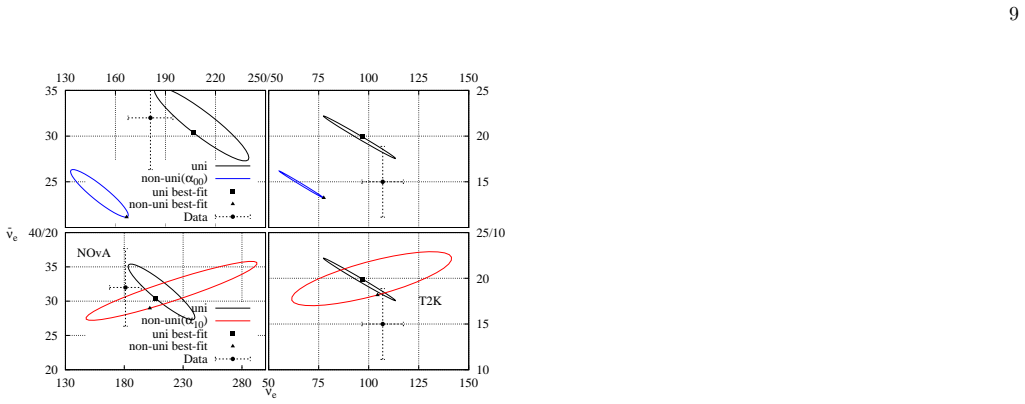
Analysis of the newest NOνA and T2K data yields stronger constraints on non-unitary mixing parameters than previous releases. For normal mass hierarchy the 1σ tension between the two experiments can be reduced by allowing non-unitary mixing through α10, although the needed magnitude of |α10| lies above the present global 90% limit. Best-fit values and 90% limits on all relevant parameters are extracted from individual and joint fits, and future sensitivities for NOνA, T2K and DUNE are evaluated.
What carries the argument
The non-unitary mixing parameters (particularly α10) that extend the standard three-flavor oscillation framework and modify the effective mixing matrix elements used to predict event rates.
If this is right
- Combined NOνA and T2K data produce tighter 90% upper limits on the non-unitary parameters than earlier analyses.
- The parameter α10 can reduce the 1σ tension between the experiments for normal hierarchy, at the cost of exceeding existing global bounds.
- Future runs of NOνA, T2K and DUNE will further tighten the allowed ranges for these parameters.
- Best-fit values for both standard and non-standard parameters are now available from the updated datasets.
Where Pith is reading between the lines
- If the required |α10| is eventually confirmed, global neutrino fits will need to incorporate non-unitary parameters as standard rather than optional extensions.
- The same non-unitary framework could be applied to other accelerator or reactor datasets to test whether similar tension reductions appear.
- A positive signal would motivate targeted searches for the underlying mechanism, such as mixing with additional heavy neutrino states.
Load-bearing premise
The NOνA and T2K datasets can be fully described by the standard three-flavor model plus only the non-unitary mixing parameters, without other new physics or unmodeled systematic effects.
What would settle it
A new global fit or independent measurement that forces |α10| below the value required to reconcile the current NOνA-T2K tension at 1σ, or DUNE data that show no improvement in fit quality when non-unitary parameters are added.
Figures




read the original abstract
In this paper, we have tested the non-unitary mixing hypothesis with the latest data from NO$\nu$A and T2K experiments. We have also analysed their combined data. We have provided the best-fit values of the standard and non standard parameters after the analysis. $90\%$ limits on the non-unitary mixing parameters have also been provided. The constraints on unitary violation is stronger, compared to the constraints obtained from previous data from NO$\nu$A and T2K. The tension between NO$\nu$A and T2K at the $1\,\sigma$ for normal mass hierarchy can be reduced for non-unitary mixing due to $\alpha_{10}$, albeit for a value of $|\alpha_{10}|$ larger than the present global $90\%$ limit. Additionally a study of the future sensitivity of NO$\nu$A, T2K and DUNE has been provided.
Editorial analysis
A structured set of objections, weighed in public.
Referee Report
Summary. The manuscript updates constraints on non-unitary neutrino mixing using the most recent NOνA and T2K data sets, both separately and in combination. It reports best-fit values for the standard oscillation parameters and the non-unitary parameters (including α10), derives 90% CL limits on the non-unitary parameters that are tighter than those obtained from earlier data releases, and finds that a non-zero α10 can reduce the 1σ tension between NOνA and T2K for normal mass hierarchy (although the required |α10| exceeds the current global 90% limit). Projections for the sensitivity of future NOνA, T2K, and DUNE runs are also included.
Significance. If the results hold after addressing the modeling assumptions, the work supplies updated experimental bounds on non-unitary mixing from current long-baseline accelerator experiments and explores a possible resolution of the mild NOνA–T2K tension through α10. The future-sensitivity study provides concrete guidance for next-generation experiments. The analysis follows the standard three-flavor plus non-unitary formalism and supplies explicit numerical results for best fits and limits.
major comments (1)
- [combined-fit section and results on α10] The headline result that α10 reduces the NOνA–T2K tension (and that the new limits are stronger) rests on the assumption that the likelihood is built solely from the non-unitary oscillation probabilities plus each experiment’s published systematics. Any unmodeled inter-experiment differences in flux, cross-section, or detector response would be absorbed into α10, potentially inflating the apparent improvement and tension reduction. The manuscript should add a robustness test (e.g., extra nuisance parameters for relative normalization or cross-section differences between the two experiments) in the combined-fit section to demonstrate that the tension reduction survives such checks. This directly affects the central claim about tension reduction.
minor comments (1)
- [Abstract] The abstract states that “the constraints on unitary violation is stronger”; the grammar should be corrected to “are stronger.”
Simulated Author's Rebuttal
We thank the referee for the careful reading and constructive comments on our manuscript. We address the major comment point by point below.
read point-by-point responses
-
Referee: The headline result that α10 reduces the NOνA–T2K tension (and that the new limits are stronger) rests on the assumption that the likelihood is built solely from the non-unitary oscillation probabilities plus each experiment’s published systematics. Any unmodeled inter-experiment differences in flux, cross-section, or detector response would be absorbed into α10, potentially inflating the apparent improvement and tension reduction. The manuscript should add a robustness test (e.g., extra nuisance parameters for relative normalization or cross-section differences between the two experiments) in the combined-fit section to demonstrate that the tension reduction survives such checks. This directly affects the central claim about tension reduction.
Authors: We thank the referee for highlighting this important consideration. Our analysis incorporates the systematic uncertainties as published by the NOνA and T2K collaborations. To address potential unmodeled inter-experiment differences, we will add extra nuisance parameters for relative normalization and cross-section discrepancies in the combined-fit section. We will present the results of this robustness test in the revised manuscript to confirm whether the tension reduction associated with α10 persists. revision: yes
Circularity Check
No significant circularity; standard fit of non-unitary parameters to external experimental data
full rationale
The paper updates constraints on non-unitary mixing by fitting the standard three-flavor oscillation probabilities extended by non-unitary parameters directly to the latest published NOνA and T2K data sets. This constitutes a conventional statistical analysis of independent external observations rather than any self-referential step. No load-bearing self-citations, uniqueness theorems, ansatzes smuggled via prior work, or fitted inputs renamed as predictions appear in the derivation chain. The reported best-fit values, 90% limits, and tension reduction are outputs of the fit to the data and remain falsifiable against those same external measurements without reducing to the inputs by construction.
Axiom & Free-Parameter Ledger
free parameters (1)
- α10 and other non-unitary parameters
axioms (2)
- domain assumption Neutrino oscillation probabilities can be described by a non-unitary extension of the PMNS matrix
- domain assumption The latest NOνA and T2K data sets are suitable for constraining mixing parameters without unmodeled biases
Lean theorems connected to this paper
-
IndisputableMonolith/Cost/FunctionalEquation.leanwashburn_uniqueness_aczel unclear?
unclearRelation between the paper passage and the cited Recognition theorem.
effective 3×3 non-unitary mixing matrix N = N_NP U_PMNS with parameters α00, α10, α11
-
IndisputableMonolith/Foundation/AbsoluteFloorClosure.leanreality_from_one_distinction unclear?
unclearRelation between the paper passage and the cited Recognition theorem.
analysis of latest NOνA and T2K data with non-unitary mixing
What do these tags mean?
- matches
- The paper's claim is directly supported by a theorem in the formal canon.
- supports
- The theorem supports part of the paper's argument, but the paper may add assumptions or extra steps.
- extends
- The paper goes beyond the formal theorem; the theorem is a base layer rather than the whole result.
- uses
- The paper appears to rely on the theorem as machinery.
- contradicts
- The paper's claim conflicts with a theorem or certificate in the canon.
- unclear
- Pith found a possible connection, but the passage is too broad, indirect, or ambiguous to say the theorem truly supports the claim.
Reference graph
Works this paper leans on
-
[1]
D. S. Ayres et al. (NOvA) (2007)
work page 2007
-
[2]
The JHF-Kamioka neutrino project
Y. Itow et al. (T2K), in 3rd Workshop on Neutrino Os- cillations and Their Origin (NOON 2001) (2001), pp. 239–248, hep-ex/0106019
work page internal anchor Pith review Pith/arXiv arXiv 2001
- [3]
-
[4]
J. Wolcott, New oscillation results from nova with 10 years of data (2024), talk given at the Neu- trino 2024 meeting on June, 17th, 2024, URL https://agenda.infn.it/event/37867/contributions/233955/attachments/121832/177712/2024-06-17%20Wolcott %20NOvA%202024%
work page 2024
-
[5]
U. Rahaman and S. K. Raut, Eur. Phys. J. C 82, 910 (2022), 2112.13186
- [6]
-
[7]
K. Abe et al. (T2K Collaboration), Phys.Rev.Lett. 112, 181801 (2014), 1403.1532
work page internal anchor Pith review Pith/arXiv arXiv 2014
- [8]
- [9]
- [10]
-
[11]
U. Rahaman, S. Razzaque, and S. U. Sankar, Universe 8, 109 (2022), 2201.03250
- [12]
- [13]
-
[14]
F. J. Escrihuela, D. V. Forero, O. G. Miranda, M. Tor- tola, and J. W. F. Valle, Phys. Rev. D92, 053009 (2015), [Erratum: Phys. Rev.D93,no.11,119905(2016)], 1503.08879
work page internal anchor Pith review Pith/arXiv arXiv 2015
-
[15]
F. J. Escrihuela, D. V. Forero, O. G. Miranda, M. T´ ortola, and J. W. F. Valle, New J. Phys. 19, 093005 (2017), 1612.07377
work page internal anchor Pith review Pith/arXiv arXiv 2017
-
[16]
NuFit-6.0: Updated global analysis of three-flavor neutrino oscillations
I. Esteban, M. C. Gonzalez-Garcia, M. Maltoni, I. Martinez-Soler, J. a. P. Pinheiro, and T. Schwetz (2024), 2410.05380
work page internal anchor Pith review Pith/arXiv arXiv 2024
- [17]
- [18]
-
[19]
I. Esteban, M. C. Gonzalez-Garcia, A. Hernandez- Cabezudo, M. Maltoni, and T. Schwetz, JHEP 01, 106 (2019), 1811.05487
work page internal anchor Pith review Pith/arXiv arXiv 2019
-
[20]
Simulation of long-baseline neutrino oscillation experiments with GLoBES
P. Huber, M. Lindner, and W. Winter, Com- put.Phys.Commun. 167, 195 (2005), hep-ph/0407333. 5 Appendix A: Analysis details The T2K experiment [17] uses the νµ beam from the J-PARC accelerator at Tokai and the water Cerenkov detector at Super-Kamiokande, which is 295 km away from the source. The detector is situated 2 .5◦ off-axis. The flux peaks at 0 .7 GeV...
work page internal anchor Pith review Pith/arXiv arXiv 2005
-
[21]
The possible solution for ¯ νe event number in case of non-unitary mixing due to α00 are: + + −, − + +, − + −, and − − −. However, for the last two parameter combi- nations: − + − and − − − , the expected number of νe event numbers are much less compared to the observed ones. Hence the analysis of neutrino and anti-neutrino appearance events at NO νA, alo...
discussion (0)
Sign in with ORCID, Apple, or X to comment. Anyone can read and Pith papers without signing in.