REVIEW 4 major objections 5 minor 1 cited by
FedCod: An Efficient Communication Protocol for Cross-Silo Federated Learning with Coding
T0 review · 4 major / 5 minor · reviewed 2026-08-10 · deepseek-v4-flash
Pith's one-line read FedCod encodes model updates into redundant blocks and relays them over idle client-to-client links, cutting total cross-silo federated learning communication time by up to 62% relative to direct server-client transfer while preserving…
desk verdict Solid systems paper with a directly measured 62% communication cut under a clearly stated assumption about idle inter-client bandwidth; the main weaknesses are evaluation rigor, weighted-aggregation compatibility, and no sensitivity to restricted inter-client links. read the letter →
The pith
A machine-rendered reading of the paper's core claim, the machinery that carries it, and where it could break.
The reading
What carries the argument
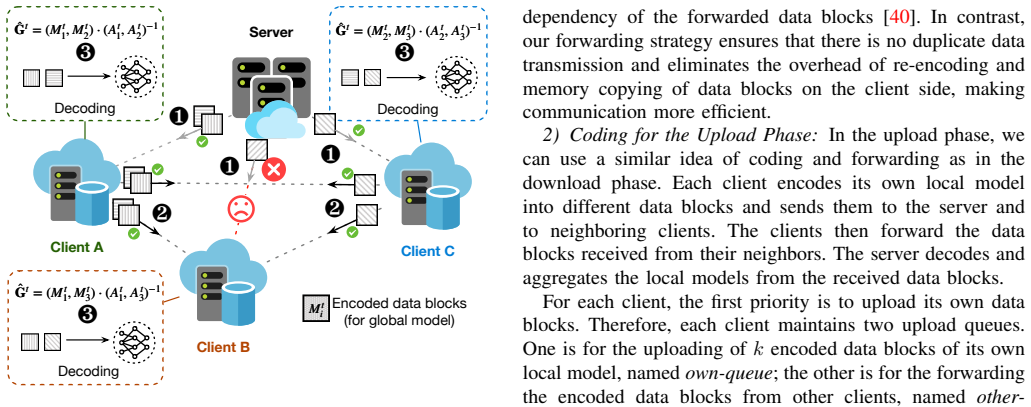
The central object is random linear coding over model partitions, applied at the application layer with a forwarding rule that only relays blocks received directly from the server, never re-encoding or re-forwarding received blocks, to avoid linear dependence. Coded-AGR uses a pre-agreed Cauchy-matrix coefficient sequence so clients can sum blocks with the same coefficient vector, reducing server ingress traffic. The adaptive redundancy algorithm maintains a lower bound on redundancy and adjusts it based on comparisons of current versus previous round durations scaled by a factor $\lambda > 1$, starting high, decreasing while performance is stable, and recovering quickly when fluctuations are detected.
What would settle it
Deploy FedCod on a testbed where every client-to-client link is capped to near-zero spare bandwidth while server-client links remain unchanged; if total communication time stays close to the baseline, the client-to-client forwarding path is what carries the 62% reduction.
Extended reading notes
Core claim
At the core of FedCod is the claim that communication efficiency in cross-silo FL can be improved losslessly at the application layer, independent of the training algorithm. The protocol partitions each model into $k$ equal pieces, forms encoded blocks as random linear combinations $M_t^i = G_t \cdot A_t^i$ with coefficient vectors $A_t^i$, and distributes these blocks so that clients forward what they receive to neighbors; once a client has any $k$ linearly independent blocks it decodes the full model by Gaussian elimination. In the upload direction, all clients use the same predetermined coefficient-vector sequence, and each relay client aggregates encoded blocks that share a coefficient vector into a Coded-AGR block before sending to the server, so the server decodes the aggregated global model rather than every individual local model. The protocol also includes an adaptive redundancy controller that starts with high redundancy, reduces it while communication times stay stable, and raises it again when fluctuations are detected. On real geo-distributed deployments with ten global silos the paper reports a 59% average download-time reduction and a 62% total communication-time reduction against the basic server-client baseline, with server ingress traffic in the wait-mode Coded-AGR upload dropped to about 11% of baseline, and identical test accuracy at convergence.
Load-bearing premise
The performance gain rests on there being idle, usable bandwidth on client-to-client links that can be borrowed without cost or policy barriers; if those links are unavailable, saturated, or blocked, the reported reductions do not materialize.
Editorial extensions
If this is right
- Cross-silo FL deployments using FedCod can cut per-round communication time by more than half without changing the training algorithm or the final model accuracy.
- The download phase shows the largest gains, a 59% average download-time reduction in the global topology, indicating that coded forwarding helps most when one source must reach many silos.
- Wait-mode Coded-AGR cuts server ingress traffic to about 11% of baseline, so the protocol reduces both latency and server bandwidth cost in the upload phase.
- Hierarchical aggregation is not a reliable fallback for geo-distributed silos: in the paper's global topology it performed worse than the simple server-client baseline.
- Because the protocol is lossless, it preserves convergence: all tested configurations reached the same 0.80 test accuracy as the baseline.
Reading between the lines
- The measured gains presume idle client-to-client links; in a deployment where inter-silo traffic is firewalled or fully utilized, FedCod's benefit should shrink, and the paper does not quantify that case.
- The adaptive redundancy controller is a generic mechanism: the same start-high, decrease-when-stable, recover-on-fluctuation rule could be applied to other redundant transmission systems, though the paper does not claim this.
- FedCod's linear coding could be composed with compression or sparsification of model updates, but the paper does not test whether the combined lossy-plus-lossless pipeline preserves the reported gains.
- Because relay clients see coded linear combinations of other silos' model updates, deployments with strict data-sharing policies may need secure aggregation or differential privacy on top; the paper does not address this.
Signed reviews
Editorial analysis
A structured set of objections, weighed in public.
Referee Report
Summary. FedCod is an application-layer communication protocol for cross-silo federated learning that encodes model weight partitions and forwards encoded blocks over client-to-client links to exploit idle bandwidth, with a Coded-AGR mechanism for on-client aggregation and an adaptive redundancy controller. The paper evaluates the protocol on AWS/Azure deployments in a global and a North America topology, reporting an up-to-62% reduction in total communication time, large server traffic savings, unchanged convergence of a ResNet152/CIFAR-10 FL task, and additional numerical experiments on partition count, redundancy, and faulty links.
Significance. If the central claim holds, FedCod would be a practically useful, lossless, FL-algorithm-agnostic communication layer for cross-silo FL: it measures communication time directly against a baseline rather than fitting the outcome, and it provides consistent traffic accounting across protocol variants. The paper also includes conformance experiments showing unchanged convergence and profile-based numerical experiments for parameter sensitivity, which are strengths. The significance is conditional on two load-bearing points: the availability of usable idle client-to-client bandwidth, and Coded-AGR actually implementing the server's weighted aggregation rule; both need explicit treatment before the headline reduction can be taken as a general cross-silo claim.
major comments (4)
- [Section III-B3, paragraph after Fig. 4] The Coded-AGR aggregation step computes \tilde M_j = \sum_i M^{t,i}_j, an unweighted sum of encoded client updates. The server then decodes \sum_i W^{t+1}_i from the AGR blocks. In FedAvg, however, the global update is the dataset-size weighted average W_{t+1} = \sum_i (|D_i|/\sum_j |D_j|) W^{t+1}_i, as stated in Section II-A. Unless all clients have identical dataset sizes, Coded-AGR does not implement FedAvg and is not FL-algorithm-agnostic in the claimed sense. Please either encode the weighted updates p_i W^{t+1}_i, restrict the compatibility claim to equal dataset sizes, or provide a weighted aggregation mechanism; the conformance experiments in Table III do not resolve this because the dataset partition sizes are not reported.
- [Section III-B3, Proposition 1 and Eq. (3)] The proof of Proposition 1 does not compare wait mode with non-wait mode as those modes are defined. The protocol defines non-wait mode as uploading an AGR block once a predefined time window has elapsed, which can occur before all j-th blocks arrive, and wait mode as uploading after all such blocks are received. In the proof, the 'non-wait' case sends the AGR block at t' after the last block has already arrived at the client, which is actually wait-mode behavior with a delayed start, and it implicitly assumes the AGR block contains all client blocks. The inequality in Eq. (3) therefore supports a different statement than Proposition 1. Since U3-AGR is the variant used in the final FEDCOD configuration, the theoretical justification should be corrected or replaced by the empirical U2-AGR versus U3-AGR comparison.
- [Section IV-A and IV-B1] The quantitative headline relies on point estimates without variance information. The setup runs 10 communication rounds per protocol over one bandwidth realization, and WAN bandwidth fluctuates substantially as shown in Figure 1; Figure 5 reports single bars with no confidence intervals or per-round distributions. In the North America topology, training time is sampled from a distribution rather than measured, so end-to-end waiting time there is partly synthetic. Please report per-round time distributions, standard errors or confidence intervals, and clarify whether the 62% figure is a mean over rounds or over a single run.
- [Sections II-C, III-B1, and III-B2] All gains depend on the availability of idle, usable client-to-client bandwidth, stated in Section II-C as 'there are unoccupied client-to-client links and idle bandwidth that could be utilized.' The evaluation only profiles cloud inter-region links (Figure 7); it does not test a network with restricted or absent silo-to-silo connectivity, which is common in real cross-silo FL due to firewalls or data-governance policy. In that case the forwarding and Coded-AGR mechanisms cannot operate and the reported reduction collapses. This is a scope limitation rather than an internal inconsistency, but it should be made explicit and tested, for example by simulating disabled or saturated client-to-client links and reporting the resulting communication time.
minor comments (5)
- [Section II-B] The text contains typos such as 'lenthy' and 'flcutuating'; a careful proofreading pass is needed.
- [Section III-C] The adaptive redundancy algorithm depends on the initial redundancy r, the scaling factor lambda, and the lower bound r_lb, but no sensitivity analysis is reported for these parameters; the claimed 11% and 25% traffic reductions are for one parameter setting. A short sensitivity study or explicit default-parameter rationale would strengthen the adaptive-redundancy claim.
- [Section IV-A] The default is described as 'we set the number of model partitions k to n', but Figure 8(b) tests upload partition counts up to 30 while the deployment has n=10 clients; please clarify whether those experiments vary the number of clients or treat local partition count independently.
- [Section IV-B4] The conformance experiments are performed on a local cluster, but the details of the data partition, number of clients, and whether dataset sizes are equal are not given; these details matter for interpreting the Coded-AGR convergence results.
- [General] No code or data artifacts are released, which limits reproducibility of the measured 62% reduction and of the profiling in Figures 1 and 7; making the implementation and traces available would be valuable.
Circularity Check
No circularity: the headline 62% communication-time reduction is a direct measurement against a baseline, not a fitted or self-referential quantity.
full rationale
The paper's central claim (Section IV-B1: "With the full application of our coding strategies, FEDCOD reduces the average download time by 59% and the total communication time by 62% compared to the baseline") is an empirical comparison of measured communication times on real cloud deployments. The coding strategies are defined constructively in Sections III-B1 and III-B2, and the adaptive redundancy algorithm in Section III-C is a feedback controller that adjusts redundancy based on observed communication duration; it is not fitted to the outcome being reported. The only analytical theorem, Proposition 1 (wait mode vs. non-wait mode Coded-AGR), is a comparison between two modes within the proposed design and is not used to derive the headline reduction. The numerical experiments in Section IV-B3 use profiled bandwidth as simulation inputs, but they explore parameter sensitivity rather than claiming to predict the 62% figure. The sole self-citation with author overlap is reference [44] (which includes co-author Hao Wang), used only to specify the CIFAR-10 federated dataset-generation procedure in the experimental setup; this is not load-bearing for any claimed derivation or performance result. No step in the paper reduces a reported prediction to a fitted parameter, a definitional identity, or a self-citation chain. Accordingly, no significant circularity is present.
Assumptions & free parameters
free parameters (5)
- Number of model partitions k =
Set to n (number of clients) by default
- Initial coding redundancy r =
Large (not specified); static experiments use 100%
- Redundancy scaling factor lambda =
Not specified
- Lower bound r_lb of redundancy =
Adjusted heuristically; no exact schedule
- Non-wait upload time window =
Not specified
assumptions (5)
- standard math Random coefficient vectors produce linearly independent encoded blocks with high probability.
- domain assumption Client-to-client links have idle bandwidth available for forwarding at no extra cost.
- domain assumption Federated aggregation is linear and Coded-AGR can reproduce the exact aggregate, including weighted FedAvg.
- ad hoc to paper Bandwidth from client to server is positive and queueing delay is negligible in the wait-mode comparison.
- domain assumption Coding and decoding are lossless and do not change the model update values.
Cite this review
Pith. "Pith review of FedCod: An Efficient Communication Protocol for Cross-Silo Federated Learning with Coding." pith.science (2026). https://pith.science/paper/4HAIYDTS
@misc{pith2026250100216,
  author       = {Pith},
  title        = {Pith review of: FedCod: An Efficient Communication Protocol for Cross-Silo Federated Learning with Coding},
  year         = {2026},
  howpublished = {\url{https://pith.science/paper/4HAIYDTS}},
  note         = {Machine review of arXiv:2501.00216}
}
read the original abstract
Federated Learning (FL) is an innovative distributed machine learning paradigm that enables multiple parties to collaboratively train a model without sharing their raw data, thereby preserving data privacy. Communication efficiency concerns arise in cross-silo FL, particularly due to the network heterogeneity and fluctuations associated with geo-distributed silos. Most existing solutions to these problems focus on algorithmic improvements that alter the FL algorithm but sacrificing the training performance. How to address these problems from a network perspective that is decoupled from the FL algorithm remains an open challenge. In this paper, we propose FedCod, a new application layer communication protocol designed for cross-silo FL. FedCod transparently utilizes a coding mechanism to enhance the efficient use of idle bandwidth through client-to-client communication, and dynamically adjusts coding redundancy to mitigate network bottlenecks and fluctuations, thereby improving the communication efficiency and accelerating the training process. In our real-world experiments, FedCod demonstrates a significant reduction in average communication time by up to 62% compared to the baseline, while maintaining FL training performance and optimizing inter-client communication traffic.
Figures


Figures from the paper (6 more)


Forward citations
Cited by 1 Pith paper
-
Benchmark Evaluation of Federated Learning on Multi-organ Images
MobenFL is the broadest federated medical-imaging benchmark to date, pairing 20 algorithms with 22 multi-organ datasets and adding efficiency plus privacy metrics.
Reference graph
Works this paper leans on
-
[1]
Federated Optimiza- tion: Distributed Optimization Beyond the Datacenter,
J. Kone ˇcn`y, B. McMahan, and D. Ramage, “Federated Optimiza- tion: Distributed Optimization Beyond the Datacenter,” arXiv preprint arXiv:1511.03575, 2015
arXiv 2015
-
[2]
Federated Optimization in Heterogeneous Networks,
T. Li, A. K. Sahu, M. Zaheer, M. Sanjabi, A. Talwalkar, and V . Smith, “Federated Optimization in Heterogeneous Networks,” in Proc. MLSys, 2020
work page 2020
-
[3]
Advances and Open Problems in Federated Learning,
P. Kairouz, H. B. McMahan, B. Avent, A. Bellet, M. Bennis, A. N. Bhagoji, K. Bonawitz, Z. Charles, G. Cormode, R. Cummings et al. , “Advances and Open Problems in Federated Learning,” Foundations and Trends® in Machine Learning , vol. 14, no. 1–2, pp. 1–210, 2021
work page 2021
-
[4]
Throughput-Optimal Topology Design for Cross-Silo Federated Learning,
O. Marfoq, C. Xu, G. Neglia, and R. Vidal, “Throughput-Optimal Topology Design for Cross-Silo Federated Learning,” in Proc. NeurIPS, 2020
work page 2020
-
[5]
Industry-Scale Orchestrated Federated Learning for Drug Discovery,
M. Oldenhof, G. ´Acs, B. Pej ´o, A. Schuffenhauer, N. Holway, N. Sturm, A. Dieckmann, O. Fortmeier, E. Boniface, C. Mayer et al. , “Industry-Scale Orchestrated Federated Learning for Drug Discovery,” in Proc. AAAI, 2023
work page 2023
-
[6]
S. Silva, B. A. Gutman, E. Romero, P. M. Thompson, A. Altmann, and M. Lorenzi, “Federated Learning in Distributed Medical Databases: Meta-analysis of Large-Scale Subcortical Brain Data,” in 2019 IEEE 16th international symposium on biomedical imaging (ISBI 2019), 2019
work page 2019
-
[7]
Deep Learning-Based Classification of Mesothelioma Improves Prediction of Patient Outcome,
P. Courtiol, C. Maussion, M. Moarii, E. Pronier, S. Pilcer, M. Sefta, P. Manceron, S. Toldo, M. Zaslavskiy, N. Le Stang et al. , “Deep Learning-Based Classification of Mesothelioma Improves Prediction of Patient Outcome,” Nature Medicine , vol. 25, no. 10, pp. 1519–1525, 2019
work page 2019
-
[8]
FATE: An Industrial Grade Platform for Collaborative Learning With Data Protection,
Y . Liu, T. Fan, T. Chen, Q. Xu, and Q. Yang, “FATE: An Industrial Grade Platform for Collaborative Learning With Data Protection,” Journal of Machine Learning Research , 2021
work page 2021
Show all 47 references
-
[9]
Artificial Intelligence Act,
T. Madiega, “Artificial Intelligence Act,” European Parliament: Euro- pean Parliamentary Research Service , 2021
2021
-
[10]
Federated Learning Priorities Under the European Union Artificial Intelligence Act,
H. Woisetschl ¨ager, A. Erben, B. Marino, S. Wang, N. D. Lane, R. Mayer, and H.-A. Jacobsen, “Federated Learning Priorities Under the European Union Artificial Intelligence Act,” arXiv preprint arXiv:2402.05968 , 2024
2024 arXiv
-
[11]
FATE-LLM: A Industrial Grade Federated Learning Framework for Large Language Models,
T. Fan, Y . Kang, G. Ma, W. Chen, W. Wei, L. Fan, and Q. Yang, “FATE-LLM: A Industrial Grade Federated Learning Framework for Large Language Models,” arXiv preprint arXiv:2310.10049 , 2023
2023 arXiv
-
[12]
Towards Building the FederatedGPT: Federated Instruction Tuning,
J. Zhang, S. Vahidian, M. Kuo, C. Li, R. Zhang, T. Yu, G. Wang, and Y . Chen, “Towards Building the FederatedGPT: Federated Instruction Tuning,” in Proc. ICASSP, 2024
2024
-
[13]
Gaia: Geo-Distributed Machine Learning Approaching LAN Speeds,
K. Hsieh, A. Harlap, N. Vijaykumar, D. Konomis, G. R. Ganger, P. B. Gibbons, and O. Mutlu, “Gaia: Geo-Distributed Machine Learning Approaching LAN Speeds,” in Proc. NSDI, 2017
2017
-
[14]
Robust and Communication-Efficient Federated Learning From Non-i.i.d. Data,
F. Sattler, S. Wiedemann, K.-R. M ¨uller, and W. Samek, “Robust and Communication-Efficient Federated Learning From Non-i.i.d. Data,” IEEE Transactions on Neural Networks and Learning Systems , vol. 31, no. 9, pp. 3400–3413, 2019
2019
-
[15]
Heterogeneous Federated Learning: State-of-the-Art and Research Challenges,
M. Ye, X. Fang, B. Du, P. C. Yuen, and D. Tao, “Heterogeneous Federated Learning: State-of-the-Art and Research Challenges,” ACM Computing Surveys, vol. 56, no. 3, pp. 1–44, 2023
2023
-
[16]
Annulus: A Dual Congestion Control Loop for Datacenter and Wan Traffic Aggregates,
A. Saeed, V . Gupta, P. Goyal, M. Sharif, R. Pan, M. Ammar, E. Zegura, K. Jang, M. Alizadeh, A. Kabbani et al., “Annulus: A Dual Congestion Control Loop for Datacenter and Wan Traffic Aggregates,” in Proc. SIG- COMM, 2020
2020
-
[17]
Examination of W AN Traffic Characteristics in a Large-Scale Data Center Network,
Z. Wang, Z. Li, G. Liu, Y . Chen, Q. Wu, and G. Cheng, “Examination of W AN Traffic Characteristics in a Large-Scale Data Center Network,” in Proc. IMC, 2021
2021
-
[18]
FetchSGD: Communication-Efficient Fed- erated Learning With Sketching,
D. Rothchild, A. Panda, E. Ullah, N. Ivkin, I. Stoica, V . Braverman, J. Gonzalez, and R. Arora, “FetchSGD: Communication-Efficient Fed- erated Learning With Sketching,” in Proc. ICML, 2020
2020
-
[19]
Do- CoFL: Downlink Compression for Cross-Device Federated Learning,
R. Dorfman, S. Vargaftik, Y . Ben-Itzhak, and K. Y . Levy, “Do- CoFL: Downlink Compression for Cross-Device Federated Learning,” in Proc. ICML, 2023
2023
-
[20]
Local SGD Converges Fast and Communicates Little,
S. U. Stich, “Local SGD Converges Fast and Communicates Little,” in Proc. ICLR, 2019
2019
-
[21]
Cost-Effective Federated Learning Design,
B. Luo, X. Li, S. Wang, J. Huang, and L. Tassiulas, “Cost-Effective Federated Learning Design,” in Proc. INFOCOM, 2021
2021
-
[22]
DENSE: Data-Free One-shot Federated Learning,
J. Zhang, C. Chen, B. Li, L. Lyu, S. Wu, S. Ding, C. Shen, and C. Wu, “DENSE: Data-Free One-shot Federated Learning,” in Proc. NeurIPS, 2022
2022
-
[23]
D2: Decentralized Training Over Decentralized Data,
H. Tang, X. Lian, M. Yan, C. Zhang, and J. Liu, “ D2: Decentralized Training Over Decentralized Data,” in Proc. ICML, 2018
2018
-
[24]
ClusterFL: A Clustering-based Federated Learning System for Human Activity Recognition,
X. Ouyang, Z. Xie, J. Zhou, G. Xing, and J. Huang, “ClusterFL: A Clustering-based Federated Learning System for Human Activity Recognition,” ACM Transactions on Sensor Networks , vol. 19, no. 1, pp. 1–32, 2022
2022
-
[25]
SCAFFOLD: Stochastic Controlled Averaging for Federated Learning,
S. P. Karimireddy, S. Kale, M. Mohri, S. Reddi, S. Stich, and A. T. Suresh, “SCAFFOLD: Stochastic Controlled Averaging for Federated Learning,” in Proc. ICML, 2020
2020
-
[26]
Hierarchical Federated Learning With Quantization: Convergence Analysis and System Design,
L. Liu, J. Zhang, S. Song, and K. B. Letaief, “Hierarchical Federated Learning With Quantization: Convergence Analysis and System Design,” IEEE Transactions on Wireless Communications , vol. 22, no. 1, pp. 2– 18, 2022
2022
-
[27]
On the Convergence of Hier- archical Federated Learning with Gradient Quantization and Imperfect Transmission,
H. Sun, H. Tian, W. Ni, and J. Zheng, “On the Convergence of Hier- archical Federated Learning with Gradient Quantization and Imperfect Transmission,” in Proc. ICASSP, 2024
2024
-
[28]
Which Mode Is Better for Federated Learning? Centralized or Decentralized,
Y . Sun, L. Shen, and D. Tao, “Which Mode Is Better for Federated Learning? Centralized or Decentralized,” arXiv preprint arXiv:2310.03461, 2023
2023 arXiv
-
[29]
Hierarchi- cal Federated Learning Across Heterogeneous Cellular Networks,
M. S. H. Abad, E. Ozfatura, D. Gunduz, and O. Ercetin, “Hierarchi- cal Federated Learning Across Heterogeneous Cellular Networks,” in Proc. ICASSP, 2020
2020
-
[30]
Resource- Efficient Federated Learning With Hierarchical Aggregation in Edge Computing,
Z. Wang, H. Xu, J. Liu, H. Huang, C. Qiao, and Y . Zhao, “Resource- Efficient Federated Learning With Hierarchical Aggregation in Edge Computing,” in Proc. INFOCOM, 2021
2021
-
[31]
HierFedML: Aggregator Placement and UE Assignment for Hierarchical Federated Learning in Mobile Edge Computing,
Z. Xu, D. Zhao, W. Liang, O. F. Rana, P. Zhou, M. Li, W. Xu, H. Li, and Q. Xia, “HierFedML: Aggregator Placement and UE Assignment for Hierarchical Federated Learning in Mobile Edge Computing,” IEEE Transactions on Parallel and Distributed Systems , vol. 34, no. 1, pp. 328–345, 2022
2022
-
[32]
Communication-Efficient Learning of Deep Networks From Decentral- ized Data,
B. McMahan, E. Moore, D. Ramage, S. Hampson, and B. A. y Arcas, “Communication-Efficient Learning of Deep Networks From Decentral- ized Data,” in Proc. Artificial Intelligence and Statistics , 2017
2017
-
[33]
Revisiting Weighted Aggregation in Federated Learning With Neural Networks,
Z. Li, T. Lin, X. Shang, and C. Wu, “Revisiting Weighted Aggregation in Federated Learning With Neural Networks,” in Proc. ICML, 2023
2023
-
[34]
Improving Federated Learning With Quality-Aware User Incentive and Auto-Weighted Model Aggregation,
Y . Deng, F. Lyu, J. Ren, Y .-C. Chen, P. Yang, Y . Zhou, and Y . Zhang, “Improving Federated Learning With Quality-Aware User Incentive and Auto-Weighted Model Aggregation,”IEEE Transactions on Parallel and Distributed Systems, vol. 33, no. 12, pp. 4515–4529, 2022
2022
-
[35]
Echelon: Peer-to-Peer Network Diagnosis With Network Coding,
C. Wu and B. Li, “Echelon: Peer-to-Peer Network Diagnosis With Network Coding,” in Proc. IWQoS, 2006
2006
-
[36]
Lava: A Reality Check of Network Coding in Peer-to-Peer Live Streaming,
M. Wang and B. Li, “Lava: A Reality Check of Network Coding in Peer-to-Peer Live Streaming,” in Proc. INFOCOM, 2007
2007
-
[37]
On Large-Scale Peer-to-Peer Streaming Systems With Network Coding,
C. Feng and B. Li, “On Large-Scale Peer-to-Peer Streaming Systems With Network Coding,” in Proc. ACM MM , 2008
2008
-
[38]
Erasure Coding in Windows Azure Storage,
C. Huang, H. Simitci, Y . Xu, A. Ogus, B. Calder, P. Gopalan, J. Li, and S. Yekhanin, “Erasure Coding in Windows Azure Storage,” in Proc. USENIX ATC, 2012, pp. 15–26
2012
-
[39]
A Random Linear Network Coding Approach to Multicast,
T. Ho, M. M ´edard, R. Koetter, D. R. Karger, M. Effros, J. Shi, and B. Leong, “A Random Linear Network Coding Approach to Multicast,” IEEE Transactions on Information Theory , vol. 52, no. 10, pp. 4413– 4430, 2006
2006
-
[40]
How Practical Is Network Coding?
M. Wang and B. Li, “How Practical Is Network Coding?” in Proc. IWQoS, 2006
2006
-
[41]
Random Network Coding in Peer-to-Peer Networks: From Theory to Practice,
B. Li and D. Niu, “Random Network Coding in Peer-to-Peer Networks: From Theory to Practice,” Proceedings of the IEEE , vol. 99, no. 3, pp. 513–523, 2011
2011
-
[42]
A. L. Cauchy, Exercices d’analyse et de physique mathematique: 1 . Bachelier, imprimeur-libraire, 1840, vol. 1
-
[43]
Optimizing Cauchy Reed-Solomon Codes for Fault-tolerant Network Storage Applications,
J. S. Plank and L. Xu, “Optimizing Cauchy Reed-Solomon Codes for Fault-tolerant Network Storage Applications,” in Proc. NCA, 2006
2006
-
[44]
FedLab: A Flex- ible Federated Learning Framework,
D. Zeng, S. Liang, X. Hu, H. Wang, and Z. Xu, “FedLab: A Flex- ible Federated Learning Framework,” Journal of Machine Learning Research, vol. 24, no. 100, pp. 1–7, 2023
2023
-
[45]
Network Information Flow,
R. Ahlswede, N. Cai, S.-Y . Li, and R. W. Yeung, “Network Information Flow,” IEEE Transactions on Information Theory , vol. 46, no. 4, pp. 1204–1216, 2000
2000
-
[46]
Algebraic Gossip: A Network Coding Approach to Optimal Multiple Rumor Mongering,
S. Deb, M. M ´edard, and C. Choute, “Algebraic Gossip: A Network Coding Approach to Optimal Multiple Rumor Mongering,” IEEE Trans- actions on Information Theory , vol. 52, no. 6, pp. 2486–2507, 2006
2006
-
[47]
Network Coding for Federated Learning Systems,
L. Kong, H. Tao, J. Wang, Z. Huang, and J. Xiao, “Network Coding for Federated Learning Systems,” in Proc. ICONIP, 2020
2020
Reviewed August 10, 2026 · model on record in the stance chip above.
Discussion (0). Continue with ORCID to comment.