REVIEW 4 major objections 5 minor 32 references
Variability-Aware Machine Learning Model Selection: Feature Modeling, Instantiation, and Experimental Case Study
T0 review · 4 major / 5 minor · reviewed 2026-08-10 · deepseek-v4-flash
Pith's one-line read The paper claims that encoding ML model selection as feature diagrams with logical constraints, instantiated from Scikit-Learn's flowchart, makes selection explicit and interpretable and can recommend algorithms that beat published…
desk verdict Plausible variability-modeling approach for ML model selection; the case study is too weak to support the outperformance claim. read the letter →
The pith
A machine-rendered reading of the paper's core claim, the machinery that carries it, and where it could break.
The reading
What carries the argument
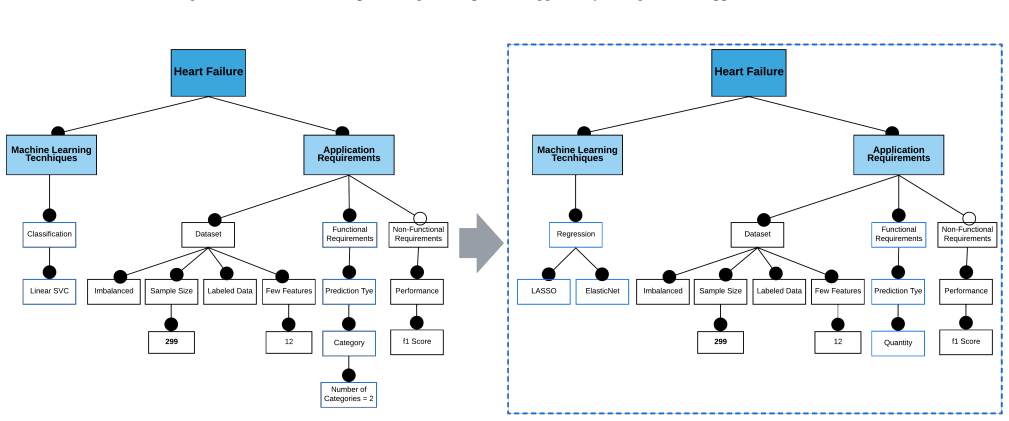
The central object is the feature diagram, a tree-like variability model in which mandatory, optional, or, and alternative features capture selection factors, and cross-tree logical constraints capture dependencies between them. The paper instantiates generic feature diagrams for ML modeling technique selection and modeling assumptions into Scikit-Learn-specific diagrams, then encodes the flowchart's rules as constraints C1-C6, covering prediction type, modeling category, regression, dimensionality reduction, classification, and clustering. This machinery turns a heuristic into a formal, reconfigurable specification: given dataset attributes, the constraints fire in order to restrict the candidate algorithm set and produce a recommendation queue.
What would settle it
A decisive check is to replay every decision path of the Scikit-Learn flowchart through constraints C1-C6; any path where the constraints fire a different algorithm than the flowchart, such as C1's equivalence failing for a dataset that predicts both a category and a quantity, would show the instantiation is unfaithful. Separately, re-running the heart-failure experiment with repeated stratified cross-validation would show whether Linear SVC's $F_1=0.780$ advantage over Random Forest's 0.746 replicates or is an artifact of one split.
Extended reading notes
Core claim
The central claim is that the commonalities and variations in ML model selection can be formally represented as feature models, and that an existing selection procedure can be instantiated in those models. The paper builds two feature diagrams from the Scikit-Learn 1.0.1 flowchart—one for modeling techniques and one for modeling assumptions—and expresses the flowchart rules as a set of logical constraints (C1-C6). Applying the instantiated model to the heart-failure survival dataset identifies the problem as classification and recommends Linear SVC, KNeighbors Classifier, SVC, and ensemble classifiers, with Linear SVC first. Evaluated with the same 80/20 stratified split as the comparison study, Linear SVC achieves $F_1=0.780$, balanced accuracy 0.848, Matthews correlation 0.672, sensitivity 0.854, and specificity 0.842, outperforming the Random Forest result ($F_1=0.746$) reported in the baseline paper.
Load-bearing premise
The approach works only if the encoded heuristics correctly capture how a good model should be chosen, and the paper does not formally verify that the Scikit-Learn flowchart rules or their logical encoding are right.
Editorial extensions
If this is right
- A model selection heuristic encoded as a feature diagram can be inspected, compared with other heuristics, and reused across projects instead of being reinvented ad hoc.
- Changes in dataset attributes, such as the sample size crossing 100K or the prediction target switching from category to quantity, automatically trigger a different algorithm recommendation by re-instantiating the diagram.
- The encoded constraints can be used to prune the algorithm search space before running experiments, reducing the cost of approaches that train many models in parallel.
- The same experimental template can be applied to other published studies: extract the dataset assumptions, run the recommended algorithms, and compare metrics against the paper's reported models.
- The approach provides an explicit rationale for a selection, in the form of the constraints that fired, supporting accountability and explainability for non-expert users.
Reading between the lines
- If the encoding is faithful, this design pattern extends beyond Scikit-Learn: heuristics from other platforms could be captured in the same formalism and compared systematically, which the paper lists as future work.
- The failure of a recommended model could be fed back as the 'not working' condition, turning the static flowchart into a runtime adaptation loop driven by monitored performance.
- The logical constraint layer could itself be checked mechanically against the source flowchart, and inconsistencies in the encoding would be caught as part of the instantiation step rather than left implicit.
- The F1 comparison rests on a single split; a natural strengthening would be repeated stratified cross-validation to confirm that the recommended algorithm's advantage is not split-specific.
Editorial analysis
A structured set of objections, weighed in public.
Referee Report
Summary. The paper proposes a variability-aware approach to ML model selection in which contextual factors (sample size, prediction type, labeled data, text data, etc.) are captured as feature diagrams with cross-tree logical constraints. The approach is structured into five phases: identifying and modeling variabilities, instantiating a feature diagram for a specific heuristic (here, the scikit-learn flowchart), designing an experimental case study, selecting modeling techniques, and evaluating results. The authors instantiate the scikit-learn selection heuristics as constraints C1–C6, then apply the approach to a heart-failure survival prediction dataset used in prior studies by Chicco and Jurman and by Leenings et al. Their concrete empirical claim is that the recommended model, LinearSVC, outperforms the baselines in those papers, reporting F1 = 0.780 versus 0.746 for Leenings et al.'s Random Forest. The paper positions this as a step toward explicit, adaptive, transparent, and interpretable model selection.
Significance. If the approach is validated, it would offer a useful software-engineering contribution: a formal, reusable notation for encoding model-selection heuristics, with the potential to make selection decisions explainable and automatable. The paper has several strengths: it grounds the feature model in an external, public heuristic (the scikit-learn flowchart), it separates the modeling phases clearly, and it candidly acknowledges threats to validity, including the lack of formal evaluation of the underlying heuristics. However, the empirical demonstration is currently too weak to support the outperformance claim, and several logical errors in the constraint formalization undermine the claim of faithful representation. The central design idea is defensible, but the case-study evidence and the constraint semantics need substantial rework before the paper's claims can be accepted.
major comments (4)
- [Section IV, Phase E] The claimed outperformance of LinearSVC (F1 = 0.780) over Leenings et al. (F1 = 0.746) is not statistically grounded. The evaluation uses a single stratified 80/20 split (60 test instances, roughly 19 positive cases), so a difference of 0.034 in F1 can correspond to one or two individual predictions. No repeated splits, random seeds, confidence intervals, or effect sizes are reported. Moreover, the 'not working' threshold of 0.77 was chosen because the baseline F1 was 0.76, which means the evaluation rule already encodes the expectation of beating the baseline. The conclusion in Phase E should be weakened to a demonstration of the workflow, or the experiment should be redone with repeated resampling and a pre-specified threshold.
- [Section III.B, constraints C1 and C6.4] The logical encoding of the scikit-learn flowchart contains substantive errors. C1, 'Category ⇔ ¬(Quantity ∧ Structure)', does not exclude the quantity case: if Quantity = true and Structure = false, the right-hand side is true and Category can also be true. An exclusive-or among Category, Quantity, and Structure requires a different formula. C6.4, 'Clustering ∧ ¬Knowncategories ⇒ Samplesize < 10K', is not entailed by the scikit-learn flowchart and would incorrectly constrain the sample size for clustering problems without known categories. Because the approach's recommendations inherit the semantics of these constraints, the errors must be corrected and the corrected constraints checked against the flowchart.
- [Section IV, Phase E and Table I] The baseline numbers are internally inconsistent. The prose states that Chicco and Jurman 'achieved a lower F1 score of 0.547', while Table I reports an F1 of 0.714 for their Logistic Regression estimator. The text also gives a somewhat different description of which estimators Leenings et al. tested. These inconsistencies must be reconciled before the claimed 0.780 versus 0.746 comparison can be assessed, since the entire case study rests on comparing against those baselines.
- [Section V.B] The paper acknowledges that the scikit-learn heuristics 'have not been formally evaluated in terms of the parameters they use and their correctness'. This is a significant limitation for a method whose central claim is to provide a faithful, explicit representation of model-selection procedures: if the encoded constraints are wrong or incomplete, every recommended algorithm inherits that error. The threats-to-validity discussion should be expanded to state what evidence would validate the encoding, for example, a comparison against expert-selected algorithms or against exhaustive search on a range of datasets.
minor comments (5)
- [Section I, Paper Structure] The paper-structure paragraph says 'Section IV presents our variability-aware ML model selection approach' and then 'Section IV presents an experimental case study'; the approach is actually in Section III and the case study in Section IV, so the paragraph should be corrected.
- [Throughout] There are several typographical and naming inconsistencies, including 'Futher' in the abstract, 'variabiliy' in Section II, 'Enseble Classifiers' in Section IV, 'mattews corr' in the Phase E output, and inconsistent spelling of 'Leenings' as 'Leening'.
- [Section III.B] The constraints C1–C6 use inconsistent numbering (C1 has one item, C2 has four, C5 has six); giving each constraint a unique identifier would make the formalization easier to reference and verify.
- [Section III.B and Phase E] The 'not working' criterion is introduced as a feature in the instantiated diagram, but its operationalization as an F1 threshold appears only in Phase E; the threshold choice should be discussed where the feature diagram is defined, since it is part of the encoded heuristic.
- [Section IV] The case study would benefit from a data and code availability statement; the dataset is public and the tools are standard, so sharing the exact split, grid-search configuration, and evaluation script would substantially improve reproducibility.
Circularity Check
The approach's model-suggestion chain is non-circular (it encodes the external Scikit-Learn flowchart), but the case study's headline outperformance claim is partially constructed: the 'not working' threshold is set just above the baseline that the selected model is then said to beat.
-
fitted input called prediction
[Section IV, Phase E ('Evaluate Selected Techniques')]
"We assumed the F1-score below a specific value represented the ”not working” criteria. The F1-score goal was set as 0.77, taking into consideration the baseline of 0.76, which was the highest F1-score found in Leening et al.’s work [14]. ... According to our evaluation, the Linear SVC algorithm outperforms the results presented in [14]."
The 'not working' threshold is calibrated to the same baseline used as the comparison target: 0.77 = 0.76 + 0.01. Under the paper's decision rule, a suggested algorithm is accepted only when its F1-score is at least 0.77, so any accepted 'working' model is guaranteed to have F1 above the 0.76 baseline. The conclusion that Linear SVC 'outperforms' [14] is therefore entailed by the stopping rule, not demonstrated by an independent comparison. The measured 0.780 is a real number, but the qualitative claim of superiority is built into the threshold choice, making this part of the evaluation circular by construction.
full rationale
The central derivation is not circular. The feature diagrams and constraints in Phase B are explicitly built from the external Scikit-Learn 1.0.1 flowchart, and the Phase D suggestions (LinearSVC, KNeighborsClassifier, SVC, EnsembleClassifiers) follow from those constraints; the self-citations [2,3] are background only and are not load-bearing. The one concrete reduction I can exhibit is in Phase E: the 'not working' F1 goal of 0.77 was chosen because the baseline was 0.76, so the rule that selects the reported model already requires it to beat the baseline. This makes the empirical outperformance claim partly constructed, although the feature-model formalism itself remains an independent contribution. The paper's own statement that the heuristics 'have not been formally evaluated' is a correctness/validity limitation, not a circular step, and I do not count it as one.
Assumptions & free parameters
free parameters (1)
- F1-score not-working threshold =
0.77
assumptions (3)
- domain assumption Scikit-Learn flowchart heuristics are a valid basis for model selection
- ad hoc to paper Feature diagrams and logical constraints can faithfully represent ML model selection procedures
- ad hoc to paper The constraints C1-C6 correctly encode the Scikit-Learn flowchart
Cite this review
Pith. "Pith review of Variability-Aware Machine Learning Model Selection: Feature Modeling, Instantiation, and Experimental Case Study." pith.science (2026). https://pith.science/paper/23NRCTZC
@misc{pith2026250100532,
  author       = {Pith},
  title        = {Pith review of: Variability-Aware Machine Learning Model Selection: Feature Modeling, Instantiation, and Experimental Case Study},
  year         = {2026},
  howpublished = {\url{https://pith.science/paper/23NRCTZC}},
  note         = {Machine review of arXiv:2501.00532}
}
read the original abstract
The emergence of machine learning (ML) has led to a transformative shift in software techniques and guidelines for building software applications that support data analysis process activities such as data ingestion, modeling, and deployment. Specifically, this shift is impacting ML model selection, which is one of the key phases in this process. There have been several advances in model selection from the standpoint of core ML methods, including basic probability measures and resampling methods. However, from a software engineering perspective, this selection is still an ad hoc and informal process, is not supported by a design approach and representation formalism that explicitly captures the selection process and can not support the specification of existing model selection procedures. The selection adapts to a variety of contextual factors that affect the model selection, such as data characteristics, number of features, prediction type, and their intricate dependencies. Further, it does not provide an explanation for selecting a model and does not consider the contextual factors and their interdependencies when selecting a technique. Although the current literature provides a wide variety of ML techniques and algorithms, there is a lack of design approaches to support algorithm selection. In this paper, we present a variability-aware ML algorithm selection approach that considers the commonalities and variations in the model selection process. The approach's applicability is illustrated by an experimental case study based on the Scikit-Learn heuristics, in which existing model selections presented in the literature are compared with selections suggested by the approach. The proposed approach can be seen as a step towards providing a more explicit, adaptive, transparent, interpretable, and automated basis for model selection.
Figures


Figures from the paper (5 more)


Reference graph
Works this paper leans on
-
[1]
Current approaches for executing big data science projects—a systematic literature review,
J. S. Saltz and I. Krasteva, “Current approaches for executing big data science projects—a systematic literature review,” PeerJ Computer Science, vol. 8, p. e862, 2022
work page 2022
-
[2]
Towards automated variability-aware machine-learning-based modeling analysis,
C. Tavares, N. Nascimento, P. Alencar, and D. Cowan, “Towards automated variability-aware machine-learning-based modeling analysis,” in 2021 IEEE International Conference on Big Data (Big Data) . IEEE, 2021, pp. 3890–3896
work page 2021
-
[3]
Adaptive method for machine learning model selection in data science projects,
——, “Adaptive method for machine learning model selection in data science projects,” in 2022 IEEE International Conference on Big Data (Big Data). IEEE, 2022, pp. 2682–2688
work page 2022
-
[4]
Variability in software systems—a systematic literature review,
M. Galster, D. Weyns, D. Tofan, B. Michalik, and P. Avgeriou, “Variability in software systems—a systematic literature review,” IEEE Transactions on Software Engineering, vol. 40, no. 3, pp. 282–306, 2013
work page 2013
-
[5]
A taxonomy of variability realization techniques,
M. Svahnberg, J. Van Gurp, and J. Bosch, “A taxonomy of variability realization techniques,” Software: Practice and experience , vol. 35, no. 8, pp. 705–754, 2005
work page 2005
-
[6]
Ruva: A runtime software variability algorithm,
A. Valdezate, R. Capilla, J. Crespo, and R. Barber, “Ruva: A runtime software variability algorithm,” IEEE Access, 2022
work page 2022
-
[7]
S. B ¨uhne and K. Pohl, Domain Requirements Engineering . Berlin, Heidelberg: Springer Berlin Heidelberg, 2005, pp. 193–216. [Online]. Available: https://doi.org/10.1007/3-540-28901-110
-
[8]
A variability model for query optimizers,
A. Caplinskas et al. , “A variability model for query optimizers,” in Databases and Information Systems VII: Selected Papers from the Tenth International Baltic Conference, DB & IS 2012 , vol. 249. IOS Press, 2013, p. 15
work page 2012
Show all 32 references
-
[9]
Spl driven approach for vari- ability in database design,
S. Bouarar, S. Jean, and N. Siegmund, “Spl driven approach for vari- ability in database design,” in Model and Data Engineering . Springer, 2015, pp. 332–342
2015
-
[10]
Kang, Kyo C.and Lee, Variability Modeling
H. Kang, Kyo C.and Lee, Variability Modeling. Berlin, Heidelberg: Springer Berlin Heidelberg, 2013, pp. 25–42. [Online]. Available: https://doi.org/10.1007/978-3-642-36583-6
2013 doi
-
[11]
Crisp-dm 1.0: Step-by-step data mining guide,
P. Chapman, J. Clinton, R. Kerber, T. Khabaza, T. Reinartz, C. Shearer, R. Wirth et al., “Crisp-dm 1.0: Step-by-step data mining guide,” SPSS inc, vol. 9, no. 13, pp. 1–73, 2000
2000
-
[12]
An overview of the machine learning applied in smart cities,
R. P. Franc ¸a, A. C. B. Monteiro, R. Arthur, and Y . Iano, “An overview of the machine learning applied in smart cities,” Smart cities: A data analytics perspective, pp. 91–111, 2021
2021
-
[13]
Taking human out of learning applications: A survey on automated machine learning,
Q. Yao, M. Wang, Y . Chen, W. Dai, Y .-F. Li, W.-W. Tu, Q. Yang, and Y . Yu, “Taking human out of learning applications: A survey on automated machine learning,” arXiv preprint arXiv:1810.13306 , 2018
2018 arXiv
-
[14]
Photonai—a python api for rapid machine learning model development,
R. Leenings, N. R. Winter, L. Plagwitz, V . Holstein, J. Ernsting, K. Sarink, L. Fisch, J. Steenweg, L. Kleine-Vennekate, J. Gebker et al. , “Photonai—a python api for rapid machine learning model development,” Plos one, vol. 16, no. 7, p. e0254062, 2021
2021
-
[15]
Scikit-learn: Machine learning in python,
F. Pedregosa, G. Varoquaux, A. Gramfort, V . Michel, B. Thirion, O. Grisel, M. Blondel, P. Prettenhofer, R. Weiss, V . Dubourg et al. , “Scikit-learn: Machine learning in python,”Journal of Machine Learning Research, vol. 12, pp. 2825–2830, 2011
2011
-
[16]
Machine learning algorithm cheat sheet for azure machine learning designer,
Microsoft, “Machine learning algorithm cheat sheet for azure machine learning designer,” https://docs.microsoft.com/en-us/azure/machine- learning/algorithm-cheat-sheet, June 2022
2022
-
[17]
What is a feature? a qualitative study of features in industrial software product lines,
T. Berger, D. Lettner, J. Rubin, P. Gr ¨unbacher, A. Silva, M. Becker, M. Chechik, and K. Czarnecki, “What is a feature? a qualitative study of features in industrial software product lines,” in Proceedings of the 19th International Conference on Software Product Line , 2015, ...
2015
-
[18]
Mlops- definitions, tools and challenges,
G. Symeonidis, E. Nerantzis, A. Kazakis, and G. A. Papakostas, “Mlops- definitions, tools and challenges,” in 2022 IEEE 12th Annual Computing and Communication Workshop and Conference (CCWC) . IEEE, 2022, pp. 0453–0460
2022
-
[19]
Scalable architecture for automating machine learning model monitoring,
J. R. Mart ´ınez, “Scalable architecture for automating machine learning model monitoring,” Ph.D. dissertation, KTH Royal Institute of Technol- ogy, Stockholm, Sweden, 2020
2020
-
[20]
Context-aware data ana- lytics variability in iot neural network-based systems,
N. Nascimento, P. Alencar, and D. Cowan, “Context-aware data ana- lytics variability in iot neural network-based systems,” in 2021 IEEE International Conference on Big Data (Big Data) . IEEE, 2021, pp. 3595–3600
2021
-
[21]
Project, EDISON Data Science Framework (EDSF)
E. Project, EDISON Data Science Framework (EDSF) . Http://Edison- Project.Eu/Edison/Edison-Data-Science-Framework-Edsf, 2017
2017
-
[22]
Machine learning algorithms and their relationship with modern technologies,
P. Kashyap, “Machine learning algorithms and their relationship with modern technologies,” in Machine Learning for Decision Makers . Berkeley, CA: Apress, 2023, pp. 165–245
2023
-
[23]
Explainability of a machine learning granting scoring model in peer- to-peer lending,
M. J. Ariza-Garz ´on, J. Arroyo, A. Caparrini, and M.-J. Segovia-Vargas, “Explainability of a machine learning granting scoring model in peer- to-peer lending,” Ieee Access, vol. 8, pp. 64 873–64 890, 2020
2020
-
[24]
Opening the black box of artificial intelligence for clinical decision support: A study predicting stroke outcome,
E. Zihni, V . I. Madai, M. Livne, I. Galinovic, A. A. Khalil, J. B. Fiebach, and D. Frey, “Opening the black box of artificial intelligence for clinical decision support: A study predicting stroke outcome,” Plos one, vol. 15, no. 4, p. e0231166, 2020
2020
-
[25]
Machine learning can predict survival of patients with heart failure from serum creatinine and ejection fraction alone,
D. Chicco and G. Jurman, “Machine learning can predict survival of patients with heart failure from serum creatinine and ejection fraction alone,” BMC medical informatics and decision making , vol. 20, no. 1, pp. 1–16, 2020
2020
-
[26]
Deequ-data quality validation for machine learning pipelines,
S. Schelter, S. Grafberger, P. Schmidt, T. Rukat, M. Kiessling, A. Tap- tunov, F. Biessmann, and D. Lange, “Deequ-data quality validation for machine learning pipelines,” in Machine Learning Systems Workshop at the Conference on Neural Information Processing Systems (NeurIPS) , 2018
2018
-
[27]
Modelops: Cloud-based lifecycle management for reliable and trusted ai,
W. Hummer, V . Muthusamy, T. Rausch, P. Dube, K. El Maghraoui, A. Murthi, and P. Oum, “Modelops: Cloud-based lifecycle management for reliable and trusted ai,” in 2019 IEEE International Conference on Cloud Engineering (IC2E) . IEEE, 2019, pp. 113–120
2019
-
[28]
Learning under concept drift: A review,
J. Lu, A. Liu, F. Dong, F. Gu, J. Gama, and G. Zhang, “Learning under concept drift: A review,” IEEE Transactions on Knowledge and Data Engineering, vol. 31, no. 12, pp. 2346–2363, 2018
2018
-
[29]
Automl to date and beyond: Challenges and opportunities,
S. K. Karmaker, M. M. Hassan, M. J. Smith, L. Xu, C. Zhai, and K. Veeramachaneni, “Automl to date and beyond: Challenges and opportunities,” ACM Computing Surveys (CSUR) , vol. 54, no. 8, pp. 1–36, 2021
2021
-
[30]
Software engineering for machine learning: A case study,
S. Amershi, A. Begel, C. Bird, R. DeLine, H. Gall, E. Kamar, N. Na- gappan, B. Nushi, and T. Zimmermann, “Software engineering for machine learning: A case study,” in 2019 IEEE/ACM 41st International Conference on Software Engineering: Software Engineering in Practice (ICSE-SE...
2019
-
[31]
Mon- itoring and explainability of models in production,
J. Klaise, A. Van Looveren, C. Cox, G. Vacanti, and A. Coca, “Mon- itoring and explainability of models in production,” arXiv preprint arXiv:2007.06299, 2020
2007 arXiv
-
[32]
Ensemble classifiers: Api reference,
Scikit, “Ensemble classifiers: Api reference,” https://scikit- learn.org/stable/modules/classes.htmlmodule-sklearn.ensemble, May 2022
2022
Reviewed August 10, 2026 · model on record in the stance chip above.
Discussion (0). Continue with ORCID to comment.