REVIEW 3 major objections 7 minor 3 cited by
Foreground-Covering Prototype Generation and Matching for SAM-Aided Few-Shot Segmentation
T0 review · 3 major / 7 minor · reviewed 2026-08-10 · deepseek-v4-flash
Pith's one-line read Few-shot segmentation improves when the model builds a query prototype as well as a support prototype, then matches the two and feeds the match to SAM's mask decoder.
desk verdict Solid incremental follow-up to VRP-SAM with real components, but the attention-based pseudo-mask needs a no-guide-loss test to prove novel-class generalization. read the letter →
The pith
A machine-rendered reading of the paper's core claim, the machinery that carries it, and where it could break.
The reading
What carries the argument
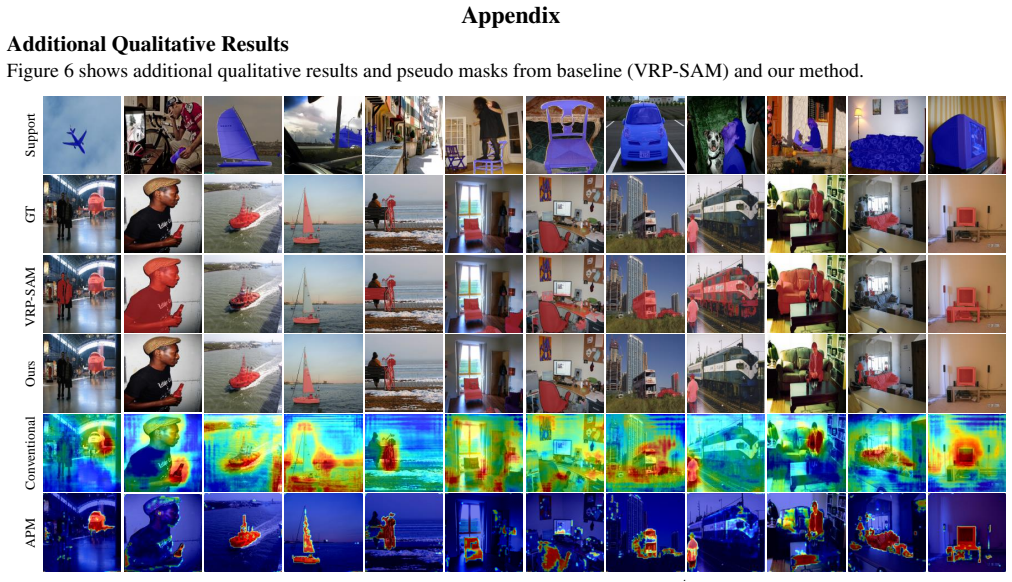
The central machinery is a pair of foreground-covering prototypes, one for the support image and one for the query image, built by iterative masked cross-attention between learnable tokens and image features. The attention-based pseudo-mask extracted from those cross-attention weights is the load-bearing replacement for the conventional cosine-similarity pseudo-mask, and prototype-to-prototype matching via cross-attention is what converts the two prototype sets into visual reference prompts for SAM's mask decoder.
What would settle it
Train the model, then on novel-class episodes at test time replace the conventional pseudo-mask of Eq. 5 with random noise and compare the resulting attention-based pseudo-mask quality against the ground-truth query mask; if attention-mask mIoU collapses when the conventional mask is corrupted, the claimed 'alternation' depends on the initial guide and does not generalize on its own.
Extended reading notes
Core claim
The author's central claim is that foreground-covering, class-consistent prototypes can be generated for both the support and query images by guiding SAM image-encoder features with a mask (ground truth for support, a pseudo-mask for query), aggregating those features into learnable tokens through iterative cross-attention, and then infusing ResNet features that have been guided by an attention-based pseudo-mask. The cross-attention weights from this aggregation, the paper finds, can effectively replace the conventional pseudo-mask. Matching the resulting query prototypes to the support prototypes via cross-attention produces reliable visual reference prompts, which the SAM mask decoder turns into the final object mask.
Load-bearing premise
The whole gain rests on the assumption that the rough cosine-similarity pseudo-mask, computed from ResNet support-query features, is good enough that SAM cross-attention can grow it into a foreground-covering attention mask, and that this mask keeps working on novel classes not seen in training.
Editorial extensions
If this is right
- If the central claim holds, few-shot segmentation can move from pixel-to-pixel correlation to prototype-to-prototype matching without losing foreground specificity.
- The attention-based pseudo-mask could replace conventional pseudo-masks in other SAM-aided segmentation pipelines whenever a rough initial localization is available.
- The demonstrated combination of SAM features and ResNet features suggests a reusable recipe for keeping class consistency while exploiting foundation-model aggregation.
- The reported gains on PASCAL-5i and COCO-20i across backbones imply the method transfers across datasets and feature extractors.
Reading between the lines
- The success of the attention-based pseudo-mask hints that SAM image-encoder features encode foreground grouping that could be probed without any class label, which may extend to weakly supervised or open-vocabulary segmentation.
- A direct testable extension would be applying the same prototype-generation module to other promptable segmentation models whose encoders cluster pixels strongly but lack class consistency.
- Because the guide loss supervises the attention mask with query ground-truth masks during training, the paper leaves open whether the attention-based pseudo-mask keeps its foreground-covering property on novel classes at test time; that is the premise a skeptical reader should probe first.
Editorial analysis
A structured set of objections, weighed in public.
Referee Report
Summary. The manuscript proposes Foreground-Covering Prototype Generation and Matching (FCP), a few-shot segmentation method that constructs both support and query prototypes by iteratively aggregating SAM image-encoder features into learnable tokens, guided by ground-truth masks for support and pseudo-masks for query. The query prototypes also absorb ResNet features guided by an attention-based pseudo-mask derived from cross-attention weights, and a prototype-to-prototype cross-attention produces visual reference prompts for the SAM mask decoder. The paper reports state-of-the-art mIoU on PASCAL-5i and COCO-20i (e.g., 73.2 vs 71.8 on one-shot ResNet-50 PASCAL-5i), with ablations supporting the contributions of the SAM/ResNet feature combination, the attention-based pseudo-mask, and the auxiliary losses. The code is released.
Significance. If the results hold, the paper makes a solid contribution to SAM-aided few-shot segmentation: the complementary use of SAM features for aggregation and ResNet features for class consistency is well motivated by Fig. 2, and constructing prototypes on both support and query before matching is a clean conceptual departure from VRP-SAM. The release of code is a practical strength. However, the headline improvements are small and reported without variance, and the key claim about the attention-based pseudo-mask is partly confounded by direct supervision with ground-truth query masks, so the significance hinges on additional experiments.
major comments (3)
- [Improvement of Pseudo Mask (Eq. 9, Table 3)] The claim that the attention-based pseudo-mask effectively replaces the conventional pseudo-mask is not established by Table 3, because the attention-based mask M_attn is trained with L_guide (Eq. 9) directly against the ground-truth query masks, while the conventional pseudo-mask of Eq. 5 involves no learning. A fair comparison requires evaluating M_attn from a model trained without L_guide, for example using only L_prompt; Table 4 shows L_guide contributes only +0.4 mIoU to the final prediction, so the mask may remain useful without supervision, but the intermediate mask quality is not reported. Because Eq. 10 guides ResNet features with M_attn and the query prototypes depend on it, this is a load-bearing issue for the novel-class generalization claim.
- [Experiments (Table 1)] All results in Table 1 appear to be single-run mIoU values without standard deviations, multiple seeds, or significance tests. The claimed improvements over the reproduced VRP-SAM are 1.4-2.6 points in the one-shot settings, which can be within run-to-run variation for few-shot segmentation. The authors should report at least three seeds with mean and standard deviation, or a paired test over the 1000 evaluation episodes, to establish that the state-of-the-art improvements are not noise.
- [Eq. 6 (Query Prototypes)] The query SAM features are guided by MP(G_S, M_S), the support foreground statistics, rather than by statistics computed from the query itself, with the only stated reason being that the quality of the conventional pseudo-mask is low. This substitutes support statistics for query statistics and is a non-trivial assumption in episodes where the support and query foreground appearances differ substantially. An ablation using MP(G_Q, M_pseudo), or an attention-based mask from the same stage, is needed to justify this design; the current ablation in Table 2 does not isolate this choice.
minor comments (7)
- [Sec. 3.3/3.4] The number of aggregation steps is described as T-1, but Eq. 4 and Eq. 11 denote the output as P_T after an additional cross-attention; please state explicitly whether the total number of cross-attention operations is T or T-1.
- [Eq. 15] The notation L^Q_guide is not defined; L_guide is introduced in Eq. 9 without a superscript. Please use consistent notation.
- [Sec. 3.2/3.4] The word 'alternate' in Sec. 3.4 and the Conclusion should be 'replace' (the abstract uses 'alternate' as well).
- [Sec. 3.2] There is a typo 'Prototype-Protype Matching' in the overview paragraph; it should be 'Prototype-Prototype Matching'.
- [Ablation Study] In the text describing Table 2, 'perfornace' is a typo for 'performance'.
- [Table 1] The reproduced VRP-SAM (†) does not specify the training epochs, learning rate, or other hyperparameters used; please provide the reproduction protocol so that the comparison is reproducible.
- [Figures 1 and 2] The computation of the 'sum of foreground scores' and the 'similarity difference' used to motivate the method is not specified; please include the exact definitions in the caption or appendix.
Circularity Check
Attention-based pseudo-mask is trained by L_guide against ground-truth query masks, so its reported advantage over the conventional pseudo-mask is partly a supervised effect; the held-out FSS benchmark result remains independent.
-
fitted input called prediction
[Eq. 8-10 and Table 3 (attention-based pseudo-mask and guide loss)]
"First, we define an attention-based mask for query M attn t ... M attn t,h,w = max_{1≤n≤N} A^Q_{t,n,h,w} (8) ... Then, the guide loss Lguide can be formulated with the attention-based mask, as follows: Lguide = 1/(T−1) Σ_{t=1}^{T−1} LBCE(M attn t , M Q ) + LDL(M attn t , M Q ), (9)"
The attention-based pseudo-mask is not an emergent by-product of SAM aggregation alone: it is the training target of L_guide (Eq. 9), which directly optimizes M^attn_t against the ground-truth query mask M^Q at every aggregation step. The paper then presents this same quantity as a discovered replacement for the conventional pseudo-mask (Eq. 10, Fig. 1b) and validates it in Table 3 with IoU/precision/recall against M^Q. The 60.9 vs 32.4 advantage is therefore partly a supervised effect; the paper provides no retraining-without-L_guide ablation to show how much of the advantage would survive without direct supervision. This is a local circularity in the pseudo-mask claim, but the final FSS accuracy is still measured on held-out novel classes, so the central benchmark result is not forced.
full rationale
The central few-shot segmentation result is evaluated on standard held-out benchmarks (PASCAL-5i, COCO-20i) with non-overlapping novel classes, and the main components—SAM/ResNet feature combination, prototype-prototype matching, and SAM decoder prompting—are not defined in terms of the target metric. The only self-citation (Park et al. 2024) is used for dataset convention and as a related-work example, not load-bearing. No uniqueness theorem or ansatz is smuggled in via citation. The one mild concern is the attention-based pseudo-mask: Eq. 8-9 show it is directly supervised by the ground-truth query mask via L_guide, so Table 3's pseudo-mask IoU comparison partly measures the training objective rather than an emergent property. A no-L_guide retraining test would clarify the extent of this effect. This does not overturn the held-out SOTA results, so the circularity score is low.
Assumptions & free parameters
free parameters (4)
- Number of learnable tokens N =
50
- Number of prototype construction steps T =
3
- Orthogonal loss coefficient lambda_ortho =
0.05
- Guide loss coefficient lambda_guide =
0.5
assumptions (5)
- domain assumption SAM Image Encoder features have higher intra-image pixel aggregation than ResNet features, and ResNet features have higher cross-image class consistency than SAM features.
- domain assumption The conventional pseudo-mask (Eq. 5) computed from ResNet support-query cosine similarity provides a useful initial foreground guide for query SAM features.
- domain assumption The model trained on base classes generalizes to novel classes in the standard FSS meta-learning setup.
- ad hoc to paper Support foreground statistics MP(GS, MS) can substitute for query statistics in guiding query SAM features (Eq. 6).
- domain assumption SAM Mask Decoder produces high-quality masks given good visual reference prompts.
invented entities (1)
-
Attention-based pseudo-mask (APM)
Cite this review
Pith. "Pith review of Foreground-Covering Prototype Generation and Matching for SAM-Aided Few-Shot Segmentation." pith.science (2026). https://pith.science/paper/TQS37553
@misc{pith2026250100752,
  author       = {Pith},
  title        = {Pith review of: Foreground-Covering Prototype Generation and Matching for SAM-Aided Few-Shot Segmentation},
  year         = {2026},
  howpublished = {\url{https://pith.science/paper/TQS37553}},
  note         = {Machine review of arXiv:2501.00752}
}
read the original abstract
We propose Foreground-Covering Prototype Generation and Matching to resolve Few-Shot Segmentation (FSS), which aims to segment target regions in unlabeled query images based on labeled support images. Unlike previous research, which typically estimates target regions in the query using support prototypes and query pixels, we utilize the relationship between support and query prototypes. To achieve this, we utilize two complementary features: SAM Image Encoder features for pixel aggregation and ResNet features for class consistency. Specifically, we construct support and query prototypes with SAM features and distinguish query prototypes of target regions based on ResNet features. For the query prototype construction, we begin by roughly guiding foreground regions within SAM features using the conventional pseudo-mask, then employ iterative cross-attention to aggregate foreground features into learnable tokens. Here, we discover that the cross-attention weights can effectively alternate the conventional pseudo-mask. Therefore, we use the attention-based pseudo-mask to guide ResNet features to focus on the foreground, then infuse the guided ResNet feature into the learnable tokens to generate class-consistent query prototypes. The generation of the support prototype is conducted symmetrically to that of the query one, with the pseudo-mask replaced by the ground-truth mask. Finally, we compare these query prototypes with support ones to generate prompts, which subsequently produce object masks through the SAM Mask Decoder. Our state-of-the-art performances on various datasets validate the effectiveness of the proposed method for FSS. Our official code is available at https://github.com/SuhoPark0706/FCP
Figures


Figures from the paper (3 more)


Forward citations
Cited by 3 Pith papers
-
Repurposing CLIP to Localize at Pixel Level
CLIPix repurposes CLIP by tracing classification activations, applying noise-resistant correction, and localization embedding to reach SOTA zero-shot binary open-set segmentation on PASCAL-5i and COCO-20i.
-
DFR: A Decompose-Fuse-Reconstruct Framework for Multi-Modal Few-Shot Segmentation
DFR integrates visual, textual, and audio guidance in a SAM-based framework and reports mIoU gains over state-of-the-art few-shot segmentation methods on PASCAL-5i and AVS-V3.
-
Vision and Language Reference Prompt into SAM for Few-shot Segmentation
Using a frozen vision-language model, VLP-SAM injects text-label semantics into SAM's prompt encoder and raises one-shot segmentation mIoU by 6.3 points on PASCAL-5i and 9.5 on COCO-20i.
Reference graph
Works this paper leans on
-
[1]
, " * write output.state after.block = add.period write newline
ENTRY address archivePrefix author booktitle chapter edition editor eid eprint howpublished institution isbn journal key month note number organization pages publisher school series title type volume year label extra.label sort.label short.list INTEGERS output.state before.all mid.sentence after.sentence after.block FUNCTION init.state.consts #0 'before.a...
-
[2]
write newline
" write newline "" before.all 'output.state := FUNCTION n.dashify 't := "" t empty not t #1 #1 substring "-" = t #1 #2 substring "--" = not "--" * t #2 global.max substring 't := t #1 #1 substring "-" = "-" * t #2 global.max substring 't := while if t #1 #1 substring * t #2 global.max substring 't := if while FUNCTION word.in bbl.in capitalize " " * FUNCT...
-
[3]
Badrinarayanan, V.; Kendall, A.; and Cipolla, R. 2017. Segnet: A deep convolutional encoder-decoder architecture for image segmentation. IEEE transactions on pattern analysis and machine intelligence, 39(12): 2481--2495
work page 2017
-
[4]
Caron, M.; Touvron, H.; Misra, I.; J \'e gou, H.; Mairal, J.; Bojanowski, P.; and Joulin, A. 2021. Emerging properties in self-supervised vision transformers. In Proceedings of the IEEE/CVF international conference on computer vision, 9650--9660
2021
-
[5]
Chen, L.-C.; Papandreou, G.; Kokkinos, I.; Murphy, K.; and Yuille, A. L. 2015. Semantic image segmentation with deep convolutional nets and fully connected crfs. ICLR
work page 2015
-
[6]
Chen, T.; Zhu, L.; Deng, C.; Cao, R.; Wang, Y.; Zhang, S.; Li, Z.; Sun, L.; Zang, Y.; and Mao, P. 2023. Sam-adapter: Adapting segment anything in underperformed scenes. In Proceedings of the IEEE/CVF International Conference on Computer Vision, 3367--3375
work page 2023
-
[7]
G.; Kirillov, A.; and Girdhar, R
Cheng, B.; Misra, I.; Schwing, A. G.; Kirillov, A.; and Girdhar, R. 2022. Masked-attention mask transformer for universal image segmentation. In Proceedings of the IEEE/CVF conference on computer vision and pattern recognition, 1290--1299
2022
-
[8]
Fan, Q.; Pei, W.; Tai, Y.-W.; and Tang, C.-K. 2022. Self-support few-shot semantic segmentation. In European Conference on Computer Vision, 701--719. Springer
work page 2022
Show all 42 references
-
[9]
Hariharan, B.; Arbel \'a ez, P.; Girshick, R.; and Malik, J. 2014. Simultaneous detection and segmentation. In Computer Vision--ECCV 2014: 13th European Conference, Zurich, Switzerland, September 6-12, 2014, Proceedings, Part VII 13, 297--312. Springer
2014
-
[10]
Hong, S.; Cho, S.; Nam, J.; Lin, S.; and Kim, S. 2022. Cost aggregation with 4d convolutional swin transformer for few-shot segmentation. In European Conference on Computer Vision, 108--126. Springer
2022
-
[11]
W.; Liu, Y.; and Guo, Q
Huang, Y.; Cao, Y.; Li, T.; Juefei-Xu, F.; Lin, D.; Tsang, I. W.; Liu, Y.; and Guo, Q. 2023. On the robustness of segment anything. arXiv preprint arXiv:2305.16220
2023 arXiv
-
[12]
C.; Lo, W.-Y.; et al
Kirillov, A.; Mintun, E.; Ravi, N.; Mao, H.; Rolland, C.; Gustafson, L.; Xiao, T.; Whitehead, S.; Berg, A. C.; Lo, W.-Y.; et al. 2023. Segment anything. In Proceedings of the IEEE/CVF International Conference on Computer Vision, 4015--4026
2023
-
[13]
Lang, C.; Cheng, G.; Tu, B.; and Han, J. 2022. Learning what not to segment: A new perspective on few-shot segmentation. In Proceedings of the IEEE/CVF conference on computer vision and pattern recognition, 8057--8067
2022
-
[14]
Li, F.; Zhang, H.; Sun, P.; Zou, X.; Liu, S.; Yang, J.; Li, C.; Zhang, L.; and Gao, J. 2023. Semantic-sam: Segment and recognize anything at any granularity. arXiv preprint arXiv:2307.04767
2023 arXiv
-
[15]
Li, G.; Jampani, V.; Sevilla-Lara, L.; Sun, D.; Kim, J.; and Kim, J. 2021. Adaptive prototype learning and allocation for few-shot segmentation. In Proceedings of the IEEE/CVF conference on computer vision and pattern recognition, 8334--8343
2021
-
[16]
Lin, T.-Y.; Maire, M.; Belongie, S.; Hays, J.; Perona, P.; Ramanan, D.; Doll \'a r, P.; and Zitnick, C. L. 2014. Microsoft coco: Common objects in context. In Computer Vision--ECCV 2014: 13th European Conference, Zurich, Switzerland, September 6-12, 2014, Proceedings, Part V 1...
2014
-
[17]
Liu, Y.; Zhang, X.; Zhang, S.; and He, X. 2020. Part-Aware Prototype Network for Few-Shot Semantic Segmentation. In European Conference on Computer Vision, 142--158
2020
-
[18]
Ma, J.; He, Y.; Li, F.; Han, L.; You, C.; and Wang, B. 2024. Segment anything in medical images. Nature Communications, 15(1): 654
2024
-
[19]
Min, J.; Kang, D.; and Cho, M. 2021. Hypercorrelation squeeze for few-shot segmentation. In Proceedings of the IEEE/CVF international conference on computer vision, 6941--6952
2021
-
[20]
Nguyen, K.; and Todorovic, S. 2019. Feature weighting and boosting for few-shot segmentation. In Proceedings of the IEEE/CVF International Conference on Computer Vision, 622--631
2019
-
[21]
S.; and Heo, J.-P
Park, S.; Lee, S.; Hyun, S.; Seong, H. S.; and Heo, J.-P. 2024. Task-Disruptive Background Suppression for Few-Shot Segmentation. In Proceedings of the AAAI Conference on Artificial Intelligence, volume 38, 4442--4449
2024
-
[22]
Peng, B.; Tian, Z.; Wu, X.; Wang, C.; Liu, S.; Su, J.; and Jia, J. 2023. Hierarchical dense correlation distillation for few-shot segmentation. In Proceedings of the IEEE/CVF Conference on Computer Vision and Pattern Recognition, 23641--23651
2023
-
[23]
W.; Hallacy, C.; Ramesh, A.; Goh, G.; Agarwal, S.; Sastry, G.; Askell, A.; Mishkin, P.; Clark, J.; et al
Radford, A.; Kim, J. W.; Hallacy, C.; Ramesh, A.; Goh, G.; Agarwal, S.; Sastry, G.; Askell, A.; Mishkin, P.; Clark, J.; et al. 2021. Learning transferable visual models from natural language supervision. In International conference on machine learning, 8748--8763. PMLR
2021
-
[24]
Rao, Y.; Zhao, W.; Chen, G.; Tang, Y.; Zhu, Z.; Huang, G.; Zhou, J.; and Lu, J. 2022. Denseclip: Language-guided dense prediction with context-aware prompting. In Proceedings of the IEEE/CVF conference on computer vision and pattern recognition, 18082--18091
2022
-
[25]
R.; Disch, N.; Holzschuh, J.; Zimmerer, D.; and Maier-Hein, K
Roy, S.; Wald, T.; Koehler, G.; Rokuss, M. R.; Disch, N.; Holzschuh, J.; Zimmerer, D.; and Maier-Hein, K. H. 2023. Sam. md: Zero-shot medical image segmentation capabilities of the segment anything model. arXiv preprint arXiv:2304.05396
2023 arXiv
-
[27]
Shaban, A.; Bansal, S.; Liu, Z.; Essa, I.; and Boots, B. 2017 b . One-shot learning for semantic segmentation. arXiv preprint arXiv:1709.03410
2017 arXiv
-
[28]
Shi, X.; Wei, D.; Zhang, Y.; Lu, D.; Ning, M.; Chen, J.; Ma, K.; and Zheng, Y. 2022. Dense cross-query-and-support attention weighted mask aggregation for few-shot segmentation. In European Conference on Computer Vision, 151--168. Springer
2022
-
[29]
Strudel, R.; Garcia, R.; Laptev, I.; and Schmid, C. 2021. Segmenter: Transformer for semantic segmentation. In Proceedings of the IEEE/CVF International Conference on Computer Vision, 7262--7272
2021
-
[30]
Sun, Y.; Chen, J.; Zhang, S.; Zhang, X.; Chen, Q.; Zhang, G.; Ding, E.; Wang, J.; and Li, Z. 2024. VRP-SAM: SAM with visual reference prompt. In Proceedings of the IEEE/CVF Conference on Computer Vision and Pattern Recognition, 23565--23574
2024
-
[31]
Tang, L.; Xiao, H.; and Li, B. 2023. Can sam segment anything? when sam meets camouflaged object detection. arXiv preprint arXiv:2304.04709
2023 arXiv
-
[32]
Tian, Z.; Zhao, H.; Shu, M.; Yang, Z.; Li, R.; and Jia, J. 2020. Prior guided feature enrichment network for few-shot segmentation. IEEE transactions on pattern analysis and machine intelligence, 44(2): 1050--1065
2020
-
[33]
H.; Zou, Y.; Zhou, D.; and Feng, J
Wang, K.; Liew, J. H.; Zou, Y.; Zhou, D.; and Feng, J. 2019. Panet: Few-shot image semantic segmentation with prototype alignment. In proceedings of the IEEE/CVF international conference on computer vision, 9197--9206
2019
-
[34]
Wang, Y.; Sun, R.; and Zhang, T. 2023. Rethinking the Correlation in Few-Shot Segmentation: A Buoys View. In Proceedings of the IEEE/CVF Conference on Computer Vision and Pattern Recognition, 7183--7192
2023
-
[35]
Williams, E. M. V. G. L. 2010. CK Winn J Zisserman A The pascal visual object classes (VOC) challenge. Int. J. Comput. Vis, 88(2): 303
2010
-
[36]
M.; and Luo, P
Xie, E.; Wang, W.; Yu, Z.; Anandkumar, A.; Alvarez, J. M.; and Luo, P. 2021. SegFormer: Simple and efficient design for semantic segmentation with transformers. Advances in Neural Information Processing Systems, 34: 12077--12090
2021
-
[37]
C.; Long, C.; Li, Z.; and Zhao, R
Xu, Q.; Lin, G.; Loy, C. C.; Long, C.; Li, Z.; and Zhao, R. 2025. Eliminating feature ambiguity for few-shot segmentation. In European Conference on Computer Vision, 416--433. Springer
2025
-
[38]
Xu, Q.; Liu, X.; Zhu, L.; Lin, G.; Long, C.; Li, Z.; and Zhao, R. 2024. Hybrid mamba for few-shot segmentation. arXiv preprint arXiv:2409.19613
2024 arXiv
-
[39]
Xu, Q.; Zhao, W.; Lin, G.; and Long, C. 2023. Self-calibrated cross attention network for few-shot segmentation. In Proceedings of the IEEE/CVF International Conference on Computer Vision, 655--665
2023
-
[40]
Yu, T.; Feng, R.; Feng, R.; Liu, J.; Jin, X.; Zeng, W.; and Chen, Z. 2023. Inpaint anything: Segment anything meets image inpainting. arXiv preprint arXiv:2304.06790
2023 arXiv
-
[41]
Zhang, G.; Kang, G.; Yang, Y.; and Wei, Y. 2021. Few-shot segmentation via cycle-consistent transformer. Advances in Neural Information Processing Systems, 34: 21984--21996
2021
-
[42]
Zhang, X.; Wei, Y.; Yang, Y.; and Huang, T. S. 2020. Sg-one: Similarity guidance network for one-shot semantic segmentation. IEEE transactions on cybernetics, 50(9): 3855--3865
2020
-
[43]
C.; and Dai, B
Zhou, C.; Loy, C. C.; and Dai, B. 2022. Extract free dense labels from clip. In European Conference on Computer Vision, 696--712. Springer
2022
Reviewed August 10, 2026 · model on record in the stance chip above.
Discussion (0). Continue with ORCID to comment.