REVIEW 4 major objections 6 minor 2 cited by
Text2Earth: Unlocking Text-driven Remote Sensing Image Generation with a Global-Scale Dataset and a Foundation Model
T0 review · 4 major / 6 minor · reviewed 2026-08-10 · deepseek-v4-flash
Pith's one-line read Text2Earth pairs a 10.5-million-pair global satellite dataset with a 1.3-billion-parameter diffusion model to make text-driven remote sensing generation resolution-controllable and state of the art.
desk verdict Git-10M is a genuinely valuable dataset, but the Text2Earth SOTA claims rest on an apples-to-oranges benchmark comparison and a test-set-tuned guidance scale. read the letter →
The pith
A machine-rendered reading of the paper's core claim, the machinery that carries it, and where it could break.
The reading
What carries the argument
The carrying mechanism is the conditioning stack of Text2Earth. A VAE compresses images into a compact latent space; a U-Net predicts noise in that space; text is injected through cross-attention from an OpenCLIP ViT-H encoder; and a resolution embedding module maps the requested ground-sample distance to a vector that is added to the timestep embedding at each denoising step. The dynamic condition adaptation strategy is the training-side counterpart: text and resolution conditions are randomly dropped during training, and at sampling the model blends a conditional noise prediction with an unconditional prediction through classifier-free guidance with a guidance scale. This setup is what lets one model produce resolution-controlled images, keep generating when a condition is absent, and be fine-tuned cheaply via LoRA for new datasets and modalities.
What would settle it
Re-running the RSICD comparison with all methods pretrained on the same Git-10M data, or with the guidance scale fixed on a validation split rather than the test set, would settle whether the +26.23 FID and +20.95 percentage-point Cls-OA gaps persist.
Extended reading notes
Core claim
The central claim, stated on its own terms, is that a single diffusion foundation model pretrained on enough globally distributed, resolution-annotated image-text pairs can generate geospatially plausible remote sensing imagery from free text, at a user-specified ground-sample distance, and can be adapted with small parameter-efficient changes to editing, outpainting, and cross-modal tasks. Text2Earth encodes images into a latent space, denoises them with a U-Net that attends to OpenCLIP text embeddings, and adds a resolution embedding to the timestep embedding in every denoising step. The dynamic condition adaptation strategy randomly drops text and resolution during training, then uses classifier-free guidance with null embeddings at sampling, so the model remains functional and controllable when conditions are missing or partial. On the RSICD benchmark the paper reports FID 24.49 and zero-shot Cls-OA 90.26%, which it presents as the strongest published numbers on that dataset, and it shows qualitative results for resolution-conditioned generation, unbounded scene stitching, cloud removal, local editing, text-driven SAR/NIR/PAN generation, and image-to-image translation.
Load-bearing premise
The load-bearing assumption is that the benchmark comparison measures model quality fairly: Text2Earth is pretrained on 10.5 million pairs and LoRA-fine-tuned on RSICD, while baselines are trained from scratch on RSICD, and the guidance scale is selected using the RSICD test set.
Editorial extensions
If this is right
- On RSICD, Text2Earth reports FID 24.49 and zero-shot Cls-OA 90.26%, improvements of +26.23 and +20.95 percentage points over prior published results.
- Text2Earth generates images at specified resolutions from the same prompt, such as 0.5, 1, and 2 meters per pixel for forest and storage-tank scenes, with scale-consistent detail.
- Iterative outpainting with a fixed resolution builds unbounded scenes, demonstrated at 3500 by 1100 and 3700 by 1300 pixels, with smooth transitions between land-cover types.
- With LoRA adaptation, the model produces text-driven RGB, PAN, NIR, and SAR images, and with a ControlNet-style module it performs PAN/RGB/NIR translation, super-resolution, and dehazing.
- Synthetic images from Text2Earth improve downstream scene-classification accuracy for VGG-19, ResNet-18, ViT-B-16, and Swin-S, for example from 92.21% to 96.10% for Swin-S.
Reading between the lines
- A testable extension the paper does not run: checking whether the resolution embedding is continuous, so prompts like 1.3 meters per pixel, an unseen value, produce scale-consistent imagery, or whether control only works at the discrete resolutions shown.
- The augmentation experiments only probe scene classification; if the same synthetic images helped detection or segmentation, where object positions and bounding boxes matter, the claim of a general data-augmentation engine would be stronger.
- The cross-modal results suggest the shared latent prior might transfer to other geophysical modalities such as hyperspectral or LiDAR, but the paper only demonstrates SAR, NIR, PAN, RGB, and simulated foggy or low-resolution variants.
- The unbounded outpainting demonstrations are qualitative; measuring seam consistency and long-range geospatial coherence would turn the observed flexibility into a quantitative claim.
Editorial analysis
A structured set of objections, weighed in public.
Referee Report
Summary. The paper introduces Git-10M, a global remote sensing image-text dataset of 10.5 million pairs with resolution and geospatial metadata, and Text2Earth, a 1.3-billion-parameter latent diffusion model with resolution guidance and a dynamic condition adaptation strategy. The authors report state-of-the-art results on the RSICD benchmark (FID 24.49, zero-shot Cls-OA 90.26%, CLIP score 25.62, corresponding to a claimed +26.23 FID and +20.95% Cls-OA improvement over prior methods), and demonstrate additional capabilities in unbounded scene construction, image editing, and cross-modal generation. The paper also studies data augmentation and a CLIP-style pretraining use of Git-10M.
Significance. If the empirical claims hold, the dataset and model are valuable resources for remote sensing generation: Git-10M is an order of magnitude larger than prior remote sensing image-text datasets, and Text2Earth targets resolution-controllable, large-scale generation, which is a real gap. The paper also reports qualitative results across several downstream tasks and documents a concrete limitation (object-count control) in Section VI, which is a helpful sign of honest evaluation. The main weakness is that the headline quantitative claims rest on an evaluation protocol that does not support the attribution of the gains to the proposed method, and the sampling algorithm as written is internally inconsistent. These issues are load-bearing for the central SOTA claim, so the paper needs substantial revision before the claims can be accepted at face value.
major comments (4)
- [Table II and Section V-D] The RSICD comparison is not apples-to-apples: Text2Earth is pretrained on Git-10M (10.5M image-text pairs) and then LoRA-fine-tuned on RSICD, while the baselines in Table II (AttnGAN, DF-GAN, Lafite, DALL-E, Txt2Img-MHN, RSDiff, CRS-Diff) are trained from scratch at RSICD scale in their original protocols. The comparison therefore varies both the method and the amount of training data, so the +26.23 FID and +20.95% Cls-OA improvements cannot be attributed to the resolution guidance or dynamic condition adaptation contributions. The authors should either add controlled baselines (e.g., a Stable Diffusion or latent diffusion model initialized from the same pretrained weights and fine-tuned on RSICD without the proposed components), or explicitly reframe the claim from 'our architectural contributions are superior' to 'our full system outperforms prior from-scratch methods,' with appropriate ablation support.
- [Table III and Figure 11] The guidance scale omega is selected directly on the RSICD test set: Table III reports FID and Cls-OA for omega from 1.5 to 7.0, and omega=3.0 is chosen because it gives a 'favourable trade-off' on that test set. No validation split is used, and no error bars or repeated-run statistics are reported. The headline FID 24.49 is therefore an optimized selection on the evaluation set, not an unbiased estimate of expected performance. The authors should use a held-out validation split for hyperparameter selection or, at minimum, report the sensitivity and variance (e.g., multiple seeds) so the reader can judge the stability of the claimed improvement.
- [Algorithm 2, lines 8-9] The sampling procedure as written is internally inconsistent. Line 8 computes the guided noise epsilon_g = (1+omega)*epsilon_theta(z_t,t,tau,rho) - omega*epsilon_theta(z_t,t,tau_empty,rho_empty), but line 9 performs the DDPM update using epsilon_theta(z_t,t,tau) rather than epsilon_g. As written, the update ignores the resolution embedding rho and the classifier-free guidance combination entirely, so the algorithm cannot be reproduced as stated. The authors must correct the update to use epsilon_g and verify that the reported experiments used the corrected procedure; if the published numbers were produced with the line-9 form, the relationship between the algorithm and the results needs to be clarified.
- [Table II and Related Work] The comparison omits the most relevant recent foundation-model baselines. MetaEarth (reference [9], from the same research group) and DiffusionSat (reference [72]) are remote sensing generative foundation models trained on large-scale data, yet neither appears in Table II, and MetaEarth is not discussed anywhere in the body despite being a direct predecessor. If the paper claims to 'surpass previous models' for remote sensing text-to-image generation, the table should include these strong baselines or explain why they are not comparable. Without them, the SOTA claim is not fully supported even setting aside the pretraining confound.
minor comments (6)
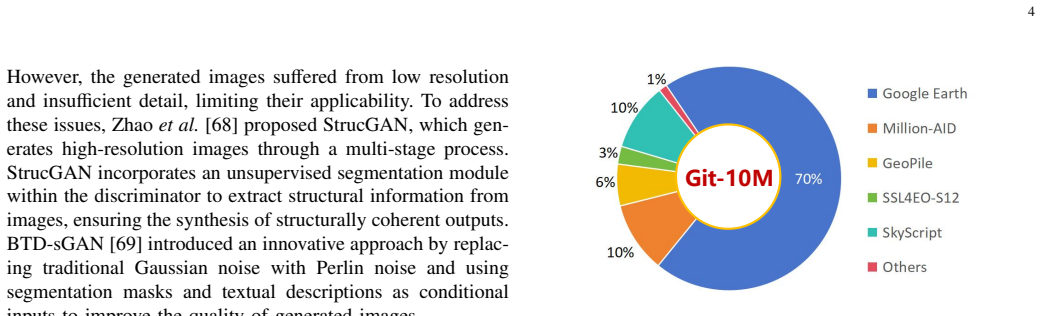
- [Section V-A and Abstract] The dataset size is stated inconsistently: the abstract reports 10.5 million image-text pairs, while Section V-A says '10 million global remote sensing image-text pairs.' Please reconcile these numbers.
- [Algorithm 1] The condition-drop logic is inconsistent between text and resolution: for text, ctext==1 triggers dropping, while for resolution, cres==0 triggers dropping. This makes the pseudocode confusing and should be made uniform (e.g., both drop when the Bernoulli sample equals 1).
- [Section V-C] The 'Zero-shot Cls-OA' metric is not zero-shot in the usual sense: a ResNet-18 is trained on generated images labeled by text descriptions and then evaluated on real test images. Please clarify the terminology and cite the original source of this protocol more precisely, as it measures domain transfer rather than zero-shot recognition.
- [Figure 11] The x-axis labels are jumbled ('1.5 2.0 4.03.0 6.05.0 7.0'), which makes the figure difficult to read. Please fix the tick labels.
- [Section I and IV] The phrase 'user-free text input' appears in several places and is ambiguous; it should likely read 'user-provided text input' or 'arbitrary text input.'
- [References] Reference [9] (MetaEarth) is listed but not cited in the body text. Either cite it where relevant or remove it from the reference list to avoid an orphan citation.
Circularity Check
No circularity: Text2Earth's claims rest on externally benchmarked empirical results with standard diffusion and classifier-free guidance equations; the noted pretraining-scale and test-set-tuning confounds are evaluation-design concerns, not circular derivations.
full rationale
Text2Earth does not contain a derivation chain that reduces to its own inputs. The training objective in Section IV-A-2, min_theta L_LDM = E[||epsilon - epsilon_theta(z_t,t,tau,rho)||^2], and the sampling rule epsilon_g = (1+omega)epsilon_theta(z_t,t,tau,rho) - omega epsilon_theta(z_t,t,tau_empty,rho_empty) in Section IV-B-2 are standard latent diffusion and classifier-free guidance equations, both cited to external work [19,83]. No quantity is defined in terms of a target metric, and no fitted parameter is later relabeled as a prediction. The RSICD comparison in Table II is measured with standard external metrics (FID, zero-shot Cls-OA, CLIP score) on a public benchmark; the comparison is potentially confounded by pretraining scale and by selecting the guidance scale omega on the test set in Table III, but that is a benchmark-fairness and overfitting concern, not circularity. Self-citations such as MetaEarth [9] and the authors' earlier change-captioning papers appear as background or application context and are not load-bearing for the central claims; no uniqueness theorem or unverified prior result is invoked to force the model choice. The explicit limitation in Section VI about failure to control object counts is a genuine empirical weakness and does not indicate circularity. Therefore no circular step is identified.
Assumptions & free parameters
free parameters (3)
- guidance scale omega =
3.0
- condition drop probabilities p1, p2
- aesthetic score threshold for high-quality subset =
4.8
assumptions (5)
- standard math Diffusion forward and reverse processes and classifier-free guidance are valid and correctly implemented
- domain assumption GPT-4o-generated captions are semantically accurate enough to train text-conditioned generation
- domain assumption Resolution metadata attached to collected Google Earth images is accurate
- domain assumption FID and zero-shot Cls-OA computed on RSICD are meaningful measures of remote sensing text2image quality
- ad hoc to paper Aesthetic score threshold of 4.8 selects a higher-quality training subset
Cite this review
Pith. "Pith review of Text2Earth: Unlocking Text-driven Remote Sensing Image Generation with a Global-Scale Dataset and a Foundation Model." pith.science (2026). https://pith.science/paper/RZNHOYPN
@misc{pith2026250100895,
  author       = {Pith},
  title        = {Pith review of: Text2Earth: Unlocking Text-driven Remote Sensing Image Generation with a Global-Scale Dataset and a Foundation Model},
  year         = {2026},
  howpublished = {\url{https://pith.science/paper/RZNHOYPN}},
  note         = {Machine review of arXiv:2501.00895}
}
read the original abstract
Generative foundation models have advanced large-scale text-driven natural image generation, becoming a prominent research trend across various vertical domains. However, in the remote sensing field, there is still a lack of research on large-scale text-to-image (text2image) generation technology. Existing remote sensing image-text datasets are small in scale and confined to specific geographic areas and scene types. Besides, existing text2image methods have struggled to achieve global-scale, multi-resolution controllable, and unbounded image generation. To address these challenges, this paper presents two key contributions: the Git-10M dataset and the Text2Earth foundation model. Git-10M is a global-scale image-text dataset comprising 10.5 million image-text pairs, 5 times larger than the previous largest one. The dataset covers a wide range of geographic scenes and contains resolution information, significantly surpassing existing datasets in both size and diversity. Building on Git-10M, we propose Text2Earth, a 1.3 billion parameter generative foundation model based on the diffusion framework to model global-scale remote sensing scenes. Text2Earth integrates a resolution guidance mechanism, enabling users to specify image resolutions. A dynamic condition adaptation strategy is proposed for training and inference to improve image quality. Text2Earth excels in zero-shot text2image generation and demonstrates robust generalization and flexibility across multiple tasks, including unbounded scene construction, image editing, and cross-modal image generation. This robust capability surpasses previous models restricted to the basic fixed size and limited scene types. On the previous benchmark dataset, Text2Earth outperforms previous models with an improvement of +26.23 FID and +20.95% Zero-shot Cls-OA metric.Our project page is https://chen-yang-liu.github.io/Text2Earth
Figures


Figures from the paper (12 more)


Forward citations
Cited by 2 Pith papers
-
Change Captioning in Remote Sensing: Evolution to SAT-Cap -- A Single-Stage Transformer Approach
SAT-Cap, a single-stage transformer with spatial-channel attention and cosine-similarity fusion, achieves state-of-the-art CIDEr scores of 140.23% on LEVIR-CC and 97.74% on DUBAI-CCD for remote sensing change captioning.
-
Vision-Language Modeling Meets Remote Sensing: Models, Datasets and Perspectives
A structured review of remote sensing vision-language models, organizing contrastive, instruction-tuned, and generative approaches alongside their datasets and benchmarks.
Reference graph
Works this paper leans on
-
[9]
Available: https: //arxiv.org/abs/2412.02573
[Online]. Available: https: //arxiv.org/abs/2412.02573
-
[72]
Di ffusionsat: A generative foundation model for satellite imagery,
S. Khanna, P. Liu, L. Zhou, C. Meng, R. Rombach, M. Burke, D. B. Lobell, and S. Ermon, “Di ffusionsat: A generative foundation model for satellite imagery,” in The Twelfth International Conference on Learning Representations, 2023
work page 2023
-
[1]
Vision-language models in remote sensing: Current progress and future trends,
X. Li, C. Wen, Y . Hu, Z. Yuan, and X. X. Zhu, “Vision-language models in remote sensing: Current progress and future trends,” IEEE Geoscience and Remote Sensing Magazine , 2024
2024
-
[2]
Multimodal image synthesis and editing: The generative ai era,
F. Zhan, Y . Yu, R. Wu, J. Zhang, S. Lu, L. Liu, A. Kortylewski, C. Theobalt, and E. Xing, “Multimodal image synthesis and editing: The generative ai era,” IEEE Transactions on Pattern Analysis and Machine Intelligence, vol. 45, no. 12, pp. 15 098–15 119, 2023
2023
-
[3]
Text-to-image synthesis: A decade survey,
N. Zhang and H. Tang, “Text-to-image synthesis: A decade survey,”
-
[4]
Ai foundation models in remote sensing: A survey,
S. Lu, J. Guo, J. R. Zimmer-Dauphinee, J. M. Nieusma, X. Wang, P. VanValkenburgh, S. A. Wernke, and Y . Huo, “Ai foundation models in remote sensing: A survey,” arXiv preprint arXiv:2408.03464 , 2024
arXiv 2024
-
[5]
Foundation models for remote sensing and earth observation: A survey,
A. Xiao, W. Xuan, J. Wang, J. Huang, D. Tao, S. Lu, and N. Yokoya, “Foundation models for remote sensing and earth observation: A survey,” 2024. [Online]. Available: https://arxiv.org/abs/2410.16602
arXiv 2024
-
[6]
To- wards vision-language geo-foundation model: A survey,
Y . Zhou, L. Feng, Y . Ke, X. Jiang, J. Yan, X. Yang, and W. Zhang, “To- wards vision-language geo-foundation model: A survey,” arXiv preprint arXiv:2406.09385, 2024
arXiv 2024
Show all 89 references
-
[7]
Remote sensing temporal vision-language models: A comprehensive survey,
C. Liu, J. Zhang, K. Chen, M. Wang, Z. Zou, and Z. Shi, “Remote sensing temporal vision-language models: A comprehensive survey,”
-
[8]
Txt2img- mhn: Remote sensing image generation from text using modern hopfield networks,
Y . Xu, W. Yu, P. Ghamisi, M. Kopp, and S. Hochreiter, “Txt2img- mhn: Remote sensing image generation from text using modern hopfield networks,” IEEE Transactions on Image Processing , vol. 32, pp. 5737– 5750, 2023
2023
-
[10]
Generate your own scotland: Satellite image generation conditioned on maps,
M. Espinosa and E. J. Crowley, “Generate your own scotland: Satellite image generation conditioned on maps,” arXiv preprint arXiv:2308.16648, 2023
2023 arXiv
-
[11]
Metaearth: A generative foun- dation model for global-scale remote sensing image generation,
Z. Yu, C. Liu, L. Liu, Z. Shi, and Z. Zou, “Metaearth: A generative foun- dation model for global-scale remote sensing image generation,” IEEE Transactions on Pattern Analysis and Machine Intelligence , vol. 47, no. 3, pp. 1764–1781, 2025
2025
-
[12]
Artificial intelligence to advance earth observation: A review of models, recent trends, and pathways forward,
D. Tuia, K. Schindler, B. Demir, X. X. Zhu, M. Kochupillai, S. D ˇzeroski, J. N. van Rijn, H. H. Hoos, F. Del Frate, M. Datcu, V . Markl, B. Le Saux, R. Schneider, and G. Camps-Valls, “Artificial intelligence to advance earth observation: A review of models, recent trends, and...
2024
-
[13]
Deep learning in remote sensing: A comprehensive review and list of resources,
X. X. Zhu, D. Tuia, L. Mou, G.-S. Xia, L. Zhang, F. Xu, and F. Fraundorfer, “Deep learning in remote sensing: A comprehensive review and list of resources,” IEEE Geoscience and Remote Sensing Magazine, vol. 5, no. 4, pp. 8–36, 2017
2017
-
[14]
Remote sensing image captioning based on multi-layer aggregated transformer,
C. Liu, R. Zhao, and Z. Shi, “Remote sensing image captioning based on multi-layer aggregated transformer,” IEEE Geoscience and Remote Sensing Letters, pp. 1–1, 2022
2022
-
[15]
Rsprompter: Learning to prompt for remote sensing instance seg- mentation based on visual foundation model,
K. Chen, C. Liu, H. Chen, H. Zhang, W. Li, Z. Zou, and Z. Shi, “Rsprompter: Learning to prompt for remote sensing instance seg- mentation based on visual foundation model,” IEEE Transactions on Geoscience and Remote Sensing , 2024
2024
-
[16]
Deep semantic understanding of high resolution remote sensing image,
B. Qu, X. Li, D. Tao, and X. Lu, “Deep semantic understanding of high resolution remote sensing image,” in 2016 International conference on computer, information and telecommunication systems (Cits) . IEEE, 2016, pp. 1–5
2016
-
[17]
Change-agent: Toward interactive comprehensive remote sensing change interpretation and analysis,
C. Liu, K. Chen, H. Zhang, Z. Qi, Z. Zou, and Z. Shi, “Change-agent: Toward interactive comprehensive remote sensing change interpretation and analysis,” IEEE Transactions on Geoscience and Remote Sensing , vol. 62, pp. 1–16, 2024
2024
-
[18]
Di ffusion models beat gans on image synthesis,
P. Dhariwal and A. Nichol, “Di ffusion models beat gans on image synthesis,” Advances in neural information processing systems , vol. 34, pp. 8780–8794, 2021
2021
-
[19]
Exploring models and data for remote sensing image caption generation,
X. Lu, B. Wang, X. Zheng, and X. Li, “Exploring models and data for remote sensing image caption generation,” IEEE Transactions on Geoscience and Remote Sensing , vol. 56, no. 4, pp. 2183–2195, 2018
2018
-
[20]
Learning transferable visual models from natural language supervision,
A. Radford, J. W. Kim, C. Hallacy, A. Ramesh, G. Goh, S. Agarwal, G. Sastry, A. Askell, P. Mishkin, J. Clark et al., “Learning transferable visual models from natural language supervision,” in International conference on machine learning . PMLR, 2021, pp. 8748–8763
2021
-
[21]
High- resolution image synthesis with latent di ffusion models,
R. Rombach, A. Blattmann, D. Lorenz, P. Esser, and B. Ommer, “High- resolution image synthesis with latent di ffusion models,” in Proceedings of the IEEE/CVF conference on computer vision and pattern recognition, 2022, pp. 10 684–10 695
2022
-
[22]
Nwpu- captions dataset and mlca-net for remote sensing image captioning,
Q. Cheng, H. Huang, Y . Xu, Y . Zhou, H. Li, and Z. Wang, “Nwpu- captions dataset and mlca-net for remote sensing image captioning,” IEEE Transactions on Geoscience and Remote Sensing , vol. 60, pp. 1– 19, 2022
2022
-
[23]
U-net: Convolutional networks for biomedical image segmentation,
O. Ronneberger, P. Fischer, and T. Brox, “U-net: Convolutional networks for biomedical image segmentation,” in International Conference on Medical image computing and computer-assisted intervention. Springer, 2015, pp. 234–241
2015
-
[24]
Text-to- image di ffusion models in generative ai: A survey,
C. Zhang, C. Zhang, M. Zhang, and I. S. Kweon, “Text-to- image di ffusion models in generative ai: A survey,” arXiv preprint arXiv:2303.07909, 2023
2023 arXiv
-
[25]
Rs5m and georsclip: A large scale vision-language dataset and a large vision-language model for remote sensing,
Z. Zhang, T. Zhao, Y . Guo, and J. Yin, “Rs5m and georsclip: A large scale vision-language dataset and a large vision-language model for remote sensing,” IEEE Transactions on Geoscience and Remote Sensing, 2024
2024
-
[26]
A decoupling paradigm with prompt learning for remote sensing image change cap- tioning,
C. Liu, R. Zhao, J. Chen, Z. Qi, Z. Zou, and Z. Shi, “A decoupling paradigm with prompt learning for remote sensing image change cap- tioning,” IEEE Transactions on Geoscience and Remote Sensing , 2023
2023
-
[27]
Remote sensing image change captioning with dual-branch transformers: A new method and a large scale dataset,
C. Liu, R. Zhao, H. Chen, Z. Zou, and Z. Shi, “Remote sensing image change captioning with dual-branch transformers: A new method and a large scale dataset,” IEEE Transactions on Geoscience and Remote Sensing, vol. 60, pp. 1–20, 2022
2022
-
[28]
Generative adversarial networks,
I. Goodfellow, J. Pouget-Abadie, M. Mirza, B. Xu, D. Warde-Farley, S. Ozair, A. Courville, and Y . Bengio, “Generative adversarial networks,” Communications of the ACM , vol. 63, no. 11, pp. 139–144, 2020
2020
-
[29]
Progressive scale-aware network for remote sensing image change captioning,
C. Liu, J. Yang, Z. Qi, Z. Zou, and Z. Shi, “Progressive scale-aware network for remote sensing image change captioning,” in IGARSS 2023 - 2023 IEEE International Geoscience and Remote Sensing Symposium , 2023, pp. 6668–6671
2023
-
[30]
Taming transformers for high- resolution image synthesis,
P. Esser, R. Rombach, and B. Ommer, “Taming transformers for high- resolution image synthesis,” in Proceedings of the IEEE/CVF conference on computer vision and pattern recognition , 2021, pp. 12 873–12 883
2021
-
[31]
Df-gan: A simple and effective baseline for text-to-image synthesis,
M. Tao, H. Tang, F. Wu, X.-Y . Jing, B.-K. Bao, and C. Xu, “Df-gan: A simple and effective baseline for text-to-image synthesis,” inProceedings of the IEEE/CVF conference on computer vision and pattern recognition, 2022, pp. 16 515–16 525
2022
-
[32]
Galip: Generative adversarial clips for text-to-image synthesis,
M. Tao, B.-K. Bao, H. Tang, and C. Xu, “Galip: Generative adversarial clips for text-to-image synthesis,” in Proceedings of the IEEE /CVF 18 Conference on Computer Vision and Pattern Recognition , 2023, pp. 14 214–14 223
2023
-
[33]
Towards language-free training for text-to-image generation,
Y . Zhou, R. Zhang, C. Chen, C. Li, C. Tensmeyer, T. Yu, J. Gu, J. Xu, and T. Sun, “Towards language-free training for text-to-image generation,” in Proceedings of the IEEE /CVF conference on computer vision and pattern recognition , 2022, pp. 17 907–17 917
2022
-
[34]
Drag your gan: Interactive point-based manipulation on the generative image manifold,
X. Pan, A. Tewari, T. Leimk ¨uhler, L. Liu, A. Meka, and C. Theobalt, “Drag your gan: Interactive point-based manipulation on the generative image manifold,” in ACM SIGGRAPH 2023 Conference Proceedings , 2023, pp. 1–11
2023
-
[35]
Recurrent a ffine transformation for text-to-image synthesis,
S. Ye, H. Wang, M. Tan, and F. Liu, “Recurrent a ffine transformation for text-to-image synthesis,” IEEE Transactions on Multimedia, vol. 26, pp. 462–473, 2023
2023
-
[36]
Stackgan: Text to photo-realistic image synthesis with stacked generative adversarial networks,
H. Zhang, T. Xu, H. Li, S. Zhang, X. Wang, X. Huang, and D. N. Metaxas, “Stackgan: Text to photo-realistic image synthesis with stacked generative adversarial networks,” in Proceedings of the IEEE interna- tional conference on computer vision , 2017, pp. 5907–5915
2017
-
[37]
Conditional generative adversarial nets,
M. Mirza, “Conditional generative adversarial nets,” arXiv preprint arXiv:1411.1784, 2014
2014 arXiv
-
[38]
Mirrorgan: Learning text-to- image generation by redescription,
T. Qiao, J. Zhang, D. Xu, and D. Tao, “Mirrorgan: Learning text-to- image generation by redescription,” in Proceedings of the IEEE /CVF conference on computer vision and pattern recognition, 2019, pp. 1505– 1514
2019
-
[39]
Attngan: Fine-grained text to image generation with attentional generative adversarial networks,
T. Xu, P. Zhang, Q. Huang, H. Zhang, Z. Gan, X. Huang, and X. He, “Attngan: Fine-grained text to image generation with attentional generative adversarial networks,” in Proceedings of the IEEE conference on computer vision and pattern recognition , 2018, pp. 1316–1324
2018
-
[40]
Ufogen: You forward once large scale text-to-image generation via di ffusion gans,
Y . Xu, Y . Zhao, Z. Xiao, and T. Hou, “Ufogen: You forward once large scale text-to-image generation via di ffusion gans,” in Proceedings of the IEEE/CVF Conference on Computer Vision and Pattern Recognition , 2024, pp. 8196–8206
2024
-
[41]
Scaling up gans for text-to-image synthesis,
M. Kang, J.-Y . Zhu, R. Zhang, J. Park, E. Shechtman, S. Paris, and T. Park, “Scaling up gans for text-to-image synthesis,” in Proceedings of the IEEE/CVF Conference on Computer Vision and Pattern Recognition, 2023, pp. 10 124–10 134
2023
-
[42]
A survey on generative adversarial networks: Variants, applications, and training,
A. Jabbar, X. Li, and B. Omar, “A survey on generative adversarial networks: Variants, applications, and training,” ACM Computing Surveys (CSUR), vol. 54, no. 8, pp. 1–49, 2021
2021
-
[43]
A review on generative adversarial networks: Algorithms, theory, and applications,
J. Gui, Z. Sun, Y . Wen, D. Tao, and J. Ye, “A review on generative adversarial networks: Algorithms, theory, and applications,” IEEE trans- actions on knowledge and data engineering , vol. 35, no. 4, pp. 3313– 3332, 2021
2021
-
[44]
Cogview: Mastering text-to-image generation via transformers,
M. Ding, Z. Yang, W. Hong, W. Zheng, C. Zhou, D. Yin, J. Lin, X. Zou, Z. Shao, H. Yang et al., “Cogview: Mastering text-to-image generation via transformers,” Advances in neural information processing systems , vol. 34, pp. 19 822–19 835, 2021
2021
-
[45]
Zero-shot text-to-image generation,
A. Ramesh, M. Pavlov, G. Goh, S. Gray, C. V oss, A. Radford, M. Chen, and I. Sutskever, “Zero-shot text-to-image generation,” in International conference on machine learning . Pmlr, 2021, pp. 8821–8831
2021
-
[46]
Mars: Mixture of auto-regressive models for fine-grained text-to-image synthesis,
W. He, S. Fu, M. Liu, X. Wang, W. Xiao, F. Shu, Y . Wang, L. Zhang, Z. Yu, H. Li et al. , “Mars: Mixture of auto-regressive models for fine-grained text-to-image synthesis,” arXiv preprint arXiv:2407.07614 , 2024
2024 arXiv
-
[47]
Scaling autoregres- sive models for content-rich text-to-image generation,
J. Yu, Y . Xu, J. Y . Koh, T. Luong, G. Baid, Z. Wang, V . Va- sudevan, A. Ku, Y . Yang, B. K. Ayan et al. , “Scaling autoregres- sive models for content-rich text-to-image generation,” arXiv preprint arXiv:2206.10789, vol. 2, no. 3, p. 5, 2022
2022 arXiv
-
[48]
Rscama: Remote sensing image change captioning with state space model,
C. Liu, K. Chen, B. Chen, H. Zhang, Z. Zou, and Z. Shi, “Rscama: Remote sensing image change captioning with state space model,” IEEE Geoscience and Remote Sensing Letters , 2024
2024
-
[49]
Make-a-scene: Scene-based text-to-image generation with human pri- ors,
O. Gafni, A. Polyak, O. Ashual, S. Sheynin, D. Parikh, and Y . Taigman, “Make-a-scene: Scene-based text-to-image generation with human pri- ors,” in European Conference on Computer Vision. Springer, 2022, pp. 89–106
2022
-
[50]
Zipar: Accelerating autoregressive image generation through spatial locality,
Y . He, F. Chen, Y . He, S. He, H. Zhou, K. Zhang, and B. Zhuang, “Zipar: Accelerating autoregressive image generation through spatial locality,” arXiv preprint arXiv:2412.04062 , 2024
2024 arXiv
-
[51]
Visual autoregressive modeling: Scalable image generation via next-scale prediction,
K. Tian, Y . Jiang, Z. Yuan, B. Peng, and L. Wang, “Visual autoregressive modeling: Scalable image generation via next-scale prediction,” arXiv preprint arXiv:2404.02905, 2024
2024 arXiv
-
[52]
Denoising di ffusion probabilistic models,
J. Ho, A. Jain, and P. Abbeel, “Denoising di ffusion probabilistic models,” Advances in neural information processing systems , vol. 33, pp. 6840– 6851, 2020
2020
-
[53]
Spectral-cascaded diffusion model for remote sensing image spectral super-resolution,
B. Chen, L. Liu, C. Liu, Z. Zou, and Z. Shi, “Spectral-cascaded diffusion model for remote sensing image spectral super-resolution,” IEEE Transactions on Geoscience and Remote Sensing , vol. 62, pp. 1–14, 2024
2024
-
[54]
Hierarchical text-conditional image generation with clip latents,
A. Ramesh, P. Dhariwal, A. Nichol, C. Chu, and M. Chen, “Hierarchical text-conditional image generation with clip latents,” arXiv preprint arXiv:2204.06125, vol. 1, no. 2, p. 3, 2022
2022 arXiv
-
[55]
Glide: Towards photorealistic image gen- eration and editing with text-guided di ffusion models,
A. Nichol, P. Dhariwal, A. Ramesh, P. Shyam, P. Mishkin, B. McGrew, I. Sutskever, and M. Chen, “Glide: Towards photorealistic image gen- eration and editing with text-guided di ffusion models,” arXiv preprint arXiv:2112.10741, 2021
2021 arXiv
-
[56]
Draw your art dream: Diverse digital art synthesis with multimodal guided di ffusion,
N. Huang, F. Tang, W. Dong, and C. Xu, “Draw your art dream: Diverse digital art synthesis with multimodal guided di ffusion,” in Proceedings of the 30th ACM International Conference on Multimedia , 2022, pp. 1085–1094
2022
-
[57]
Text-guided synthesis of artistic images with retrieval-augmented di ffusion models,
R. Rombach, A. Blattmann, and B. Ommer, “Text-guided synthesis of artistic images with retrieval-augmented di ffusion models,” arXiv preprint arXiv:2207.13038, 2022
2022 arXiv
-
[58]
Imagic: Text-based real image editing with di ffusion models,
B. Kawar, S. Zada, O. Lang, O. Tov, H. Chang, T. Dekel, I. Mosseri, and M. Irani, “Imagic: Text-based real image editing with di ffusion models,” in Proceedings of the IEEE /CVF Conference on Computer Vision and Pattern Recognition, 2023, pp. 6007–6017
2023
-
[59]
Di ffedit: Diffusion- based semantic image editing with mask guidance,
G. Couairon, J. Verbeek, H. Schwenk, and M. Cord, “Di ffedit: Diffusion- based semantic image editing with mask guidance,” arXiv preprint arXiv:2210.11427, 2022
2022 arXiv
-
[60]
Imagen video: High definition video generation with di ffusion models,
J. Ho, W. Chan, C. Saharia, J. Whang, R. Gao, A. Gritsenko, D. P. Kingma, B. Poole, M. Norouzi, D. J. Fleet et al. , “Imagen video: High definition video generation with di ffusion models,” arXiv preprint arXiv:2210.02303, 2022
-
[61]
Make-a-video: Text-to-video generation without text-video data,
U. Singer, A. Polyak, T. Hayes, X. Yin, J. An, S. Zhang, Q. Hu, H. Yang, O. Ashual, O. Gafni et al. , “Make-a-video: Text-to-video generation without text-video data,” arXiv preprint arXiv:2209.14792 , 2022
2022 arXiv
-
[62]
Adding conditional control to text-to-image di ffusion models,
L. Zhang, A. Rao, and M. Agrawala, “Adding conditional control to text-to-image di ffusion models,” in Proceedings of the IEEE /CVF International Conference on Computer Vision , 2023, pp. 3836–3847
2023
-
[63]
Synthesizing coherent story with auto-regressive latent di ffusion models,
X. Pan, P. Qin, Y . Li, H. Xue, and W. Chen, “Synthesizing coherent story with auto-regressive latent di ffusion models,” in Proceedings of the IEEE/CVF Winter Conference on Applications of Computer Vision , 2024, pp. 2920–2930
2024
-
[64]
Retro-remote sensing: Generating images from ancient texts,
M. B. Bejiga, F. Melgani, and A. Vascotto, “Retro-remote sensing: Generating images from ancient texts,” IEEE Journal of Selected Topics in Applied Earth Observations and Remote Sensing , vol. 12, no. 3, pp. 950–960, 2019
2019
-
[65]
Dragdi ffusion: Harnessing di ffusion models for interactive point-based image editing,
Y . Shi, C. Xue, J. H. Liew, J. Pan, H. Yan, W. Zhang, V . Y . Tan, and S. Bai, “Dragdi ffusion: Harnessing di ffusion models for interactive point-based image editing,” in Proceedings of the IEEE/CVF Conference on Computer Vision and Pattern Recognition , 2024, pp. 8839–8849
2024
-
[66]
Improving text encoding for retro-remote sensing,
——, “Improving text encoding for retro-remote sensing,” IEEE Geo- science and Remote Sensing Letters , vol. 18, no. 4, pp. 622–626, 2021
2021
-
[67]
Retro-remote sensing with doc2vec encoding,
M. B. Bejiga, G. Hoxha, and F. Melgani, “Retro-remote sensing with doc2vec encoding,” in 2020 Mediterranean and Middle-East Geoscience and Remote Sensing Symposium (M2GARSS) . IEEE, 2020, pp. 89–92
2020
-
[68]
Text-to-remote-sensing-image generation with structured generative adversarial networks,
R. Zhao and Z. Shi, “Text-to-remote-sensing-image generation with structured generative adversarial networks,” IEEE Geoscience and Re- mote Sensing Letters , vol. 19, pp. 1–5, 2021
2021
-
[69]
Distributed representations of sentences and documents,
Q. Le and T. Mikolov, “Distributed representations of sentences and documents,” in International conference on machine learning . PMLR, 2014, pp. 1188–1196
2014
-
[70]
Hopfield networks is all you need,
H. Ramsauer, B. Sch ¨afl, J. Lehner, P. Seidl, M. Widrich, T. Adler, L. Gruber, M. Holzleitner, M. Pavlovi ´c, G. K. Sandve et al., “Hopfield networks is all you need,” arXiv preprint arXiv:2008.02217 , 2020
2008 arXiv
-
[71]
Remote sensing image augmentation based on text description for waterside change detection,
C. Chen, H. Ma, G. Yao, N. Lv, H. Yang, C. Li, and S. Wan, “Remote sensing image augmentation based on text description for waterside change detection,” Remote Sensing, vol. 13, no. 10, p. 1894, 2021
2021
-
[73]
Neural discrete representation learning,
A. Van Den Oord, O. Vinyals et al. , “Neural discrete representation learning,” Advances in neural information processing systems , vol. 30, 2017
2017
-
[74]
Rsdi ff: Remote sensing image generation from text using di ffusion model,
A. Sebaq and M. ElHelw, “Rsdi ff: Remote sensing image generation from text using di ffusion model,” Neural Computing and Applications , pp. 1–9, 2024
2024
-
[75]
Crs-di ff: Controllable remote sensing image generation with di ffusion model,
D. Tang, X. Cao, X. Hou, Z. Jiang, J. Liu, and D. Meng, “Crs-di ff: Controllable remote sensing image generation with di ffusion model,” IEEE Transactions on Geoscience and Remote Sensing , vol. 62, pp. 1– 14, 2024
2024
-
[76]
On creating benchmark dataset for aerial image interpre- tation: Reviews, guidances, and million-aid,
Y . Long, G.-S. Xia, S. Li, W. Yang, M. Y . Yang, X. X. Zhu, L. Zhang, and D. Li, “On creating benchmark dataset for aerial image interpre- tation: Reviews, guidances, and million-aid,” IEEE Journal of selected topics in applied earth observations and remote sensing , vol. 14,...
2021
-
[77]
Photorealistic text-to-image diffusion models with deep language understanding,
C. Saharia, W. Chan, S. Saxena, L. Li, J. Whang, E. L. Denton, K. Ghasemipour, R. Gontijo Lopes, B. Karagol Ayan, T. Salimans et al., “Photorealistic text-to-image diffusion models with deep language understanding,” Advances in neural information processing systems , vol. 35, ...
2022
-
[78]
Ssl4eo-s12: A large-scale multimodal, multitemporal dataset for self-supervised learning in earth observation [software and data sets],
Y . Wang, N. A. A. Braham, Z. Xiong, C. Liu, C. M. Albrecht, and X. X. Zhu, “Ssl4eo-s12: A large-scale multimodal, multitemporal dataset for self-supervised learning in earth observation [software and data sets],” IEEE Geoscience and Remote Sensing Magazine , vol. 11, no. 3, p...
2023
-
[79]
Towards geospatial foundation models via continual pretraining,
M. Mendieta, B. Han, X. Shi, Y . Zhu, and C. Chen, “Towards geospatial foundation models via continual pretraining,” in Proceedings of the IEEE/CVF International Conference on Computer Vision , 2023, pp. 16 806–16 816
2023
-
[80]
Object detection in optical remote sensing images: A survey and a new benchmark,
K. Li, G. Wan, G. Cheng, L. Meng, and J. Han, “Object detection in optical remote sensing images: A survey and a new benchmark,” ISPRS journal of photogrammetry and remote sensing , vol. 159, pp. 296–307, 2020
2020
-
[81]
Skyscript: A large and semantically diverse vision-language dataset for remote sens- ing,
Z. Wang, R. Prabha, T. Huang, J. Wu, and R. Rajagopal, “Skyscript: A large and semantically diverse vision-language dataset for remote sens- ing,” in Proceedings of the AAAI Conference on Artificial Intelligence , vol. 38, no. 6, 2024, pp. 5805–5813
2024
-
[82]
Gpt-4 technical report,
J. Achiam, S. Adler, S. Agarwal, L. Ahmad, I. Akkaya, F. L. Aleman, D. Almeida, J. Altenschmidt, S. Altman, S. Anadkat et al. , “Gpt-4 technical report,” arXiv preprint arXiv:2303.08774 , 2023
2023 arXiv
-
[83]
Rsi-cb: A large scale remote sensing image classification benchmark via crowdsource data,
H. Li, X. Dou, C. Tao, Z. Hou, J. Chen, J. Peng, M. Deng, and L. Zhao, “Rsi-cb: A large scale remote sensing image classification benchmark via crowdsource data,” arXiv preprint arXiv:1705.10450 , 2017
2017 arXiv
-
[84]
Rethinking the inception architecture for computer vision,
C. Szegedy, V . Vanhoucke, S. Ioffe, J. Shlens, and Z. Wojna, “Rethinking the inception architecture for computer vision,” in Proceedings of the IEEE conference on computer vision and pattern recognition , 2016, pp. 2818–2826
2016
-
[85]
Classifier-free di ffusion guidance,
J. Ho and T. Salimans, “Classifier-free di ffusion guidance,” arXiv preprint arXiv:2207.12598, 2022
2022 arXiv
-
[86]
Lora: Low-rank adaptation of large language models,
E. J. Hu, Y . Shen, P. Wallis, Z. Allen-Zhu, Y . Li, S. Wang, L. Wang, and W. Chen, “Lora: Low-rank adaptation of large language models,” arXiv preprint arXiv:2106.09685 , 2021
2021 arXiv
-
[87]
Dae-gan: Dynamic aspect-aware gan for text-to-image synthesis,
S. Ruan, Y . Zhang, K. Zhang, Y . Fan, F. Tang, Q. Liu, and E. Chen, “Dae-gan: Dynamic aspect-aware gan for text-to-image synthesis,” in Proceedings of the IEEE /CVF international conference on computer vision, 2021, pp. 13 960–13 969
2021
-
[89]
Remoteclip: A vision language foundation model for remote sensing,
F. Liu, D. Chen, Z. Guan, X. Zhou, J. Zhu, Q. Ye, L. Fu, and J. Zhou, “Remoteclip: A vision language foundation model for remote sensing,” IEEE Transactions on Geoscience and Remote Sensing , 2024
2024
-
[2024]
Available: https: //arxiv.org/abs/2411.16164
[Online]. Available: https: //arxiv.org/abs/2411.16164
Reviewed August 10, 2026 · model on record in the stance chip above.
Discussion (0). Continue with ORCID to comment.