REVIEW 3 major objections 4 minor 51 references
An unoriented skein exact triangle in unoriented link Floer homology
T0 review · 3 major / 4 minor · reviewed 2026-08-10 · deepseek-v4-flash
Pith's one-line read The paper establishes an unoriented skein exact triangle in unoriented link Floer homology: for any unoriented skein triple La, Lb, Lc in a 3-manifold, the three homology groups fit into a cyclic exact triangle with maps induced by band…
desk verdict A credible and substantial new skein exact triangle for unoriented link Floer homology; the main risk is the unenumerated local polygon counts in Sections 7–8. read the letter →
The pith
A machine-rendered reading of the paper's core claim, the machinery that carries it, and where it could break.
The reading
What carries the argument
The load-bearing mechanism is a local computation on $T^2$ rather than on $Sym^2(T^2)$. The paper sets up a genus-one multi-Heegaard diagram with attaching curves $\beta_a,\beta_b,\beta_0,\beta_2,\tilde\beta_0,\tilde\beta_2,\beta_c$ and standard translates, with $\beta_c$ carrying a rank-two local system $E$ specified by an oriented arc $G$. The central relation is that the mapping cones $\beta_a\xrightarrow{\tau}\beta_b$ and $\beta_c^E$ are morally quasi-isomorphic, meaning there are cycles $\rho$ and $\sigma$ whose compositions with standard translates are $\Theta^+$ up to the unit $u=\sum_{n\ge1}U^{n^2-n}$ in the power-series coefficient ring. The proof is split into three claims showing that consecutive twisted complexes in the chain $\beta_a\xrightarrow{\tau}\beta_b$, $\beta_0\xrightarrow{\theta}\beta_2$, $\tilde\beta_0\xrightarrow{\tilde\theta}\tilde\beta_2$, $\beta_c^E$ are morally quasi-isomorphic, with the local counts reduced to triangle and quadrilateral counts in $T^2$. The band maps themselves are the composition maps $\mu_2(-,\Theta_B)$ for canonical cycles $\Theta_B$ in the Floer complex of the $\beta,\gamma$ curves, defined separately for non-orientable, split, and merge bands.
What would settle it
Compute the mod-2 counts of all Maslov-index 1, 2, and 3 polygons in the genus-one diagram of Figure 4.1 in a pinched almost complex structure, and check whether the resulting compositions $\mu_2(\rho,\sigma')$ and $\mu_2(\sigma,\rho')$ equal $\Theta^+$; any contribution outside the $T^\pm_n$ and $S^\pm_n$ families, or any nonzero correction term, would contradict Theorem 4.3 and break the triangle.
Extended reading notes
Core claim
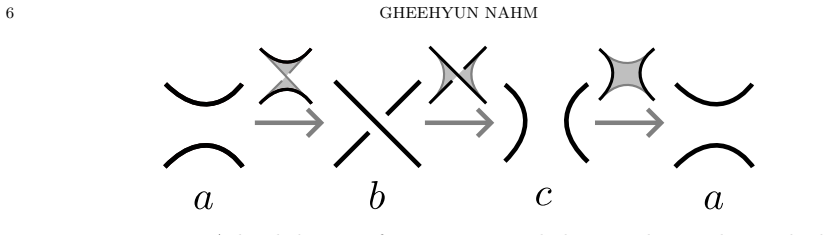
The central claim is that unoriented link Floer homology satisfies the unoriented skein relation: for any unoriented skein triple $L_a,L_b,L_c\subset Y$, there are exact triangles $HF L'^-(Y,L_a)\to HF L'^-(Y,L_b)\to HF L'^-(Y,L_c)\to HF L'^-(Y,L_a)$ and the analogous triangles in the infinity and hat versions, with all arrows given by band maps. The paper proves this by establishing a local model on the torus: the mapping cone of the non-orientable band map $\tau\colon \beta_a\to\beta_b$ is morally quasi-isomorphic to $\beta_c^E$, the third attaching curve equipped with a rank-two local system $E$ determined by an oriented arc $G$. The key tool is a Heegaard Floer analogue of a recent 2-surgery exact triangle in instanton Floer homology: for a knot $K\subset Y$ and any framing $\lambda$, there is an exact triangle $HF L'^-(Y,K)\to HF^-(Y_\lambda(K))\to HF^-(Y_{\lambda+2\mu}(K))\to HF L'^-(Y,K)$, where $\mu$ is the meridian; the paper derives this as Theorem 4.5 and the main skein triangle from the same local computation. If the main theorem is right, the unreduced and reduced hat versions are the Heegaard Floer counterparts of the instanton invariants $I^\sharp$ and $I^\natural$, and iterating the triangle would produce spectral sequences from Khovanov homology to unoriented link Floer homology.
Load-bearing premise
The load-bearing premise is the local enumeration on the torus: every holomorphic triangle, quadrilateral, or pentagon not explicitly listed cancels in pairs, and the series $u=\sum_{n\ge1}U^{n^2-n}$ is invertible; if an unlisted domain contributes, $\rho$ and $\sigma$ are no longer morally inverse and the exact triangle can fail.
Editorial extensions
If this is right
- For every unoriented skein triple, the minus, hat, and infinity versions of unoriented link Floer homology all fit into cyclic exact triangles with band-map arrows.
- The 2-surgery exact triangle follows as a corollary, relating unoriented knot Floer homology of a knot to Heegaard Floer homology of its $\lambda$ and $\lambda+2\mu$ surgeries.
- For planar links, the band maps agree with the deformed equivariant Khovanov band maps, so the two theories have the same local skein behavior.
- The rank computations for unlinks, the Hopf link, and trefoils match Khovanov homology over $\mathbb{Z}/2$ in the unreduced case, consistent with the proposed Heegaard Floer analogue of the instanton invariants.
- Exactness in the hat and infinity versions follows from exactness in the minus version by an algebraic reduction, so the skein relation is not an artifact of one flavor.
Reading between the lines
- If the triangle can be iterated over a cube of resolutions, it should produce a spectral sequence from Khovanov homology to unoriented link Floer homology; the paper states this iteration as a forthcoming result, so the spectral sequence is a projected consequence rather than a theorem proved here.
- The mod-2 setting is probably essential: the local counts are carried out over $\mathbb{F}=\mathbb{Z}/2$ and the paper leaves signs for a $\mathbb{Z}$-lift open, so the triangle may not survive integrally without additional structure.
- The 2-surgery triangle provides a route to compare unoriented link Floer homology with ordinary Heegaard Floer homology of surgeries, which may give new constraints on surgery distances or concordance invariants, though the paper does not develop these applications.
- The comparison with instanton invariants suggests that, over $\mathbb{Q}$, the unreduced hat version should be isomorphic to $I^\sharp$ while over $\mathbb{Z}/2$ the two theories should differ; the trefoil rank computation illustrates exactly this divergence.
Editorial analysis
A structured set of objections, weighed in public.
Referee Report
Summary. The paper defines band maps in unoriented link Floer homology HF L'^-(Y,L) over the field F = Z/2, for non-orientable, split, and merge bands between balled links, and proves an unoriented skein exact triangle in the minus, hat, and infinity versions (Theorems 1.15 and 4.2). It also derives a 2-surgery exact triangle (Theorems 1.3 and 4.5) analogous to Bhat's instanton triangle. The proof is reduced to a local torus computation, Theorem 4.3, which is established through three morally quasi-inverse pairs of twisted complexes (Claims 6.1-6.3). The local holomorphic polygon computations in Sections 7 and 8 are presented as cancellation arguments and diagrams, and Section 9 completes the proof using homological Z-gradings, an Alexander Z/2-splitting, and invariance under almost complex structures. The paper also proves that planar band maps agree with the corresponding Khovanov homology band maps.
Significance. If the local computations are correct, this is a substantial contribution to Heegaard Floer theory: it provides a Heegaard Floer analogue of the I^# skein exact triangle, gives a 2-surgery exact triangle parallel to Bhat's instanton result, and sets up a framework for potential spectral sequences from Khovanov homology to unoriented link Floer homology. The paper is carefully organized, uses external tools appropriately (the Ozsvath-Szabo triangle detection lemma, Zemke's basepoint moving maps, the HHSZ stabilization results), and gives explicit computations for unlinks, Hopf link, trefoils, and planar band maps. The main theorems are concrete and falsifiable, and the reduction to finite-dimensional torus models is a strength. However, the central geometric input consists of holomorphic polygon counts that are asserted via families and cancellations rather than fully enumerated, so the validity of the main theorem currently rests on unverified completeness of those counts.
major comments (3)
- [Sections 7.1-7.3, Claim 6.1 and Remark 7.1] The proof of Claim 6.1 is not a complete enumeration of the contributing holomorphic polygons. In Section 7.1 the vanishing of the relevant mu2 maps is justified by asserting that for each n the two triangles 'related by rotation by pi' cancel; in Section 7.2 the mu3 vanishings are justified by asserting that two families of quadrilaterals cancel and that the remaining quadrilaterals 'have theta as a vertex, and there are exactly two of them'; and in Section 7.3 the mu4 identities are justified by asserting that, in each case, 'there is exactly one pentagon' without any basepoints. No combinatorial Maslov-index or filtration argument is given to prove that every domain with the relevant Maslov index and vertex sequence belongs to one of the enumerated families or to a pair with equal weight. The exact triangle over FJU1,U2^{1/2}K needs these identities modulo the maximal ideal; a single unaccounted family with odd moduli count and zero basepoint multiplicity would change mu2(rho,sigma') by a non-unit and break Lemma 2.37. The invertibility of u = sum U^{n^2-n} is not an issue, since its constant term is 1; the issue is the completeness of the counts.
- [Section 8, Claim 6.3 and Remark 8.1] The analogous computation for Claim 6.3 is also incomplete. For mu2(e0 xi, e*1 zeta), the paper lists the contributions of the families T_n^+ and T_n^- and asserts that the families S_n^+ and S_n^- contribute zero because e*1 phi^{2k} e0 theta0 = 0, but it does not prove that these are all the triangles with the relevant vertex sequence. For mu3(e*1 zeta, theta, e0 xi'), the paper states that the two quadrilaterals highlighted in yellow 'are the only quadrilaterals that contribute' modulo U, but no enumeration is supplied that justifies this exclusivity. Since Claim 6.3 and the additional identity mu2(e0 xi, e*1 zeta) = 0 support both Theorem 4.3 and Theorem 4.5, these missing enumerations are load-bearing for the main results.
- [Section 9.5 and proof of Theorem 4.2] The final step of Theorem 4.3 and the exactness at Lc in Theorem 4.2 are too compressed. In Section 9.5, the maps e rho and e sigma are defined as compositions and their top homological grading components are identified, but the argument relies on unstated uniqueness claims for cycles in specified Z x Z/2 gradings, such as the assertion in Section 9.3 that Theta+ = Theta+_a + Theta+_b is the only nonzero cycle in the relevant grading. More importantly, the proof of exactness at Lc in Theorem 4.2 asserts that, for the twisted complex beta_bc := beta_b --rho--> beta_c^E, the maps tau : beta_a -> beta_bc and sigma : beta_bc -> beta_a 'are cycles and mu2(tau,sigma') and mu2(sigma,tau') are also Theta+'; this requires checking compositions such as mu2(tau,rho) and mu2(sigma,rho), which are not among the identities established in Sections 7 and 8. This step should be written out explicitly, since it is essential for exactness at the third vertex of the triangle.
minor comments (4)
- [Definitions 1.5, 1.15 and Theorem 4.2] The statement that the exact triangle is FJU K-linear is not fully reconciled with the chain complex definitions, which use variables U_i^{1/2} for link components and U_i for free baseballs. Since baseball types can change in a skein triple, please state explicitly the common power-series ring over which all three complexes are considered and how the identifications of the U_i variables are made.
- [Section 2.8.2] The sentence beginning 'Totalkabout Spinc(Y (Lsut))-summands' appears to be missing a word; it should likely read 'To talk about Spinc(Y (Lsut))-summands'.
- [Theorem 4.3 and Figure 4.1] The definitions of rho = e0 rho1 + e0 rho2 and sigma = e*1 sigma1 + e*1 sigma2 depend on the labels in Figure 4.1. Please ensure that the figure and its labels are legible and that the curves beta_a, beta_b, beta_c, and the intersection points rho1, rho2, sigma1, sigma2 are explicitly identified in the caption or text.
- [Section 3.3.5 and Remark 3.24] The condition |P cap beta| = 1 in the definition of a Heegaard triple subordinate to a merge or split band is stated without justification. A sentence explaining why this condition can always be arranged and why it is harmless would improve readability.
Circularity Check
No significant circularity; the unoriented skein triangle is derived from local holomorphic polygon counts that are independent of the theorem being proved.
full rationale
The derivation chain runs from explicit Heegaard–Floer chain complexes and band maps to the local computation Theorem 4.3, whose proof is a collection of torus-level polygon counts (Claims 6.1–6.3, Sections 7–9), followed by the triangle detection lemma and related quasi-isomorphism arguments. The maps τ, ρ, σ, ζ, ξ, e0ξ, e1*ζ are explicit generators in fixed diagrams, not parameters fitted to force exactness in a target homology group. No equation or definition in the paper makes Theorem 1.2 true by construction: the exact triangle is concluded only after the morally-quasi-inverse compositions µ2(ρ,σ′) and µ2(σ,ρ′) are computed to be Θ+. External tools such as Ozsváth–Szabó’s triangle detection lemma, stabilization propositions from HHSZ, and basepoint-moving results from Zemke are cited as established ingredients, and none of them is used to import the unoriented skein triangle itself as a hypothesis. The author’s own forthcoming works [Naha] and [Nahb] appear only in the motivation/future-directions discussion, not in the proof of Theorem 1.2 or Theorem 4.5, so they are not load-bearing self-citations. The manuscript does contain genuine limitations and completeness concerns: Remarks 4.4 and 4.6 restrict the validity of some versions, Section 7–8 cancellations are asserted rather than fully enumerated, and Section 9.5 says the final assembly is ‘standard’. These are gaps in verification and presentation, not circularity, because the missing or abbreviated justifications do not assume the conclusion of the exact triangle; they concern the correctness of the local holomorphic counts. No fitting-to-data, definitional identification between premise and conclusion, or uniqueness theorem imported from the author’s own prior work was found.
Assumptions & free parameters
assumptions (6)
- standard math Heegaard Floer homology and the A-infinity category of holomorphic polygon counts are well-defined and satisfy the standard A-infinity relations.
- domain assumption Weak admissibility and positivity ensure finiteness of the sums and the well-definedness of the filtered chain complexes.
- ad hoc to paper The local counts in T^2 (Claims 6.1-6.3, Sections 7-8) are correct, including the cancellation of triangle and quadrilateral families and the identity mu2(e0 xi, e*_1 zeta)=0.
- ad hoc to paper There are no relevant Maslov index 0 domains, so the cycles tau, theta, rho, sigma and canonical elements are invariant under changing the almost complex structure.
- standard math The basepoint moving map is homotopic to the identity, and diffeomorphisms of D^3 fixing the boundary and an interval are isotopic rel boundary.
- domain assumption All statements are over F=Z/2, where signs are ignored.
Cite this review
Pith. "Pith review of An unoriented skein exact triangle in unoriented link Floer homology." pith.science (2026). https://pith.science/paper/XZ4XSWME
@misc{pith2026250101047,
  author       = {Pith},
  title        = {Pith review of: An unoriented skein exact triangle in unoriented link Floer homology},
  year         = {2026},
  howpublished = {\url{https://pith.science/paper/XZ4XSWME}},
  note         = {Machine review of arXiv:2501.01047}
}
abstract
We define band maps in unoriented link Floer homology and show that they form an unoriented skein exact triangle. These band maps are similar to the band maps in equivariant Khovanov homology given by the Lee deformation. As a key tool, we use a Heegaard Floer analogue of Bhat's recent 2-surgery exact triangle in instanton Floer homology, which may be of independent interest. Unoriented knot Floer homology corresponds to $I^{\sharp}$ of the knot in our 2-surgery exact triangle.
Figures


Figures from the paper (30 more)


Reference graph
Works this paper leans on
-
[1]
Deeparaj Bhat, Surgery exact triangles in instanton theory, arXiv preprint arXiv:2311.04242 (2023)
arXiv 2023
-
[2]
Baldwin and Adam Simon Levine, A combinatorial spanning tree model for knot F loer homology , Adv
John A. Baldwin and Adam Simon Levine, A combinatorial spanning tree model for knot F loer homology , Adv. Math. 231 (2012), no. 3-4, 1886--1939. 2964628
work page 2012
-
[3]
Baldwin, Adam Simon Levine, and Sucharit Sarkar, K hovanov homology and knot F loer homology for pointed links , J
John A. Baldwin, Adam Simon Levine, and Sucharit Sarkar, K hovanov homology and knot F loer homology for pointed links , J. Knot Theory Ramifications 26 (2017), no. 2, 1740004, 49. 3604486
2017
-
[4]
Maciej Borodzik, Beibei Liu, and Ian Zemke, Heegaard F loer homology, knotifications of links, and plane curves with noncuspidal singularities , Algebr. Geom. Topol. 24 (2024), no. 9, 4837--4889. 4845975
work page 2024
-
[5]
Jean. author. Cerf, Sur les diffeomorphismes de la sphere de dimensions trois ( _4 =0) / , 1st ed. 1968. ed., Lecture Notes in Mathematics, vol. 53, Springer Berlin Heidelberg :, Berlin, Heidelberg :, 1968
work page 1968
-
[6]
Nathan Dowlin, A spectral sequence from K hovanov homology to knot F loer homology , J. Amer. Math. Soc. 37 (2024), no. 4, 951--1010. 4777638
2024
-
[7]
Haofei Fan, Unoriented cobordism maps on link F loer homology , arXiv preprint arXiv:1711.07110 (2017)
work page Pith review arXiv 2017
-
[8]
Andreas Floer, An instanton-invariant for 3-manifolds, Communications in mathematical physics 118 (1988), 215--240
work page 1988
Show all 51 references
-
[9]
Kristen Hendricks, Jennifer Hom, Matthew Stoffregen, and Ian Zemke, Surgery exact triangles in involutive H eegaard F loer homology , arXiv preprint arXiv:2011.00113 (2020)
2020 arXiv
-
[10]
, Naturality and functoriality in involutive H eegaard F loer homology , Quantum Topology (2024)
2024
-
[11]
Kristen Hendricks and Ciprian Manolescu, Involutive H eegaard F loer homology , Duke Math. J. 166 (2017), no. 7, 1211--1299. 3649355
2017
-
[12]
Andr\'as Juh\'asz, Dylan Thurston, and Ian Zemke, Naturality and mapping class groups in H eegard F loer homology , Mem. Amer. Math. Soc. 273 (2021), no. 1338, v+174. 4337438
2021
-
[13]
Andr\'as Juh\'asz, Holomorphic discs and sutured manifolds, Algebr. Geom. Topol. 6 (2006), 1429--1457. 2253454
2006
-
[14]
2, e12338
Andr\'as Juh\'asz and Ian Zemke, Stabilization distance bounds from link F loer homology , Journal of Topology 17 (2024), no. 2, e12338
2024
-
[15]
Mikhail Khovanov, A categorification of the J ones polynomial , Duke Math. J. 101 (2000), no. 3, 359--426. 1740682
2000
-
[16]
Differential Geom
Peter Kronheimer and Tomasz Mrowka, Knots, sutures, and excision, J. Differential Geom. 84 (2010), no. 2, 301--364. 2652464
2010
-
[17]
P. B. Kronheimer and T. S. Mrowka, K hovanov homology is an unknot-detector , Publ. Math. Inst. Hautes \' E tudes Sci. (2011), no. 113, 97--208. 2805599
2011
-
[18]
Eun Soo Lee, An endomorphism of the K hovanov invariant , Adv. Math. 197 (2005), no. 2, 554--586. 2173845
2005
-
[19]
Robert Lipshitz, A cylindrical reformulation of H eegaard F loer homology , Geom. Topol. 10 (2006), 955--1096, [Paging previously given as 955--1097]. 2240908
2006
-
[20]
Ozsv\'ath, and Dylan P
Robert Lipshitz, Peter S. Ozsv\'ath, and Dylan P. Thurston, Bordered F loer homology and the spectral sequence of a branched double cover II : the spectral sequences agree , J. Topol. 9 (2016), no. 2, 607--686. 3509974
2016
-
[21]
Ozsvath, and Dylan P
Robert Lipshitz, Peter S. Ozsvath, and Dylan P. Thurston, Bordered H eegaard F loer homology , Mem. Amer. Math. Soc. 254 (2018), no. 1216, viii+279. 3827056
2018
-
[22]
Robert Lipshitz and Sucharit Sarkar, A mixed invariant of nonorientable surfaces in equivariant K hovanov homology , Trans. Amer. Math. Soc. 375 (2022), no. 12, 8807--8849. 4504654
2022
-
[23]
Zhenkun Li and Fan Ye, Instanton F loer homology, sutures, and H eegaard diagrams , J. Topol. 15 (2022), no. 1, 39--107. 4407491
2022
-
[24]
Zhenkun Li and Fan Ye, 2-torsion in instanton F loer homology , 2024
2024
-
[25]
Ciprian Manolescu, An unoriented skein exact triangle for knot F loer homology , Math. Res. Lett. 14 (2007), no. 5, 839--852. 2350128
2007
-
[26]
okova G eometry- T opology C onference 2007, G\
Ciprian Manolescu and Peter Ozsv\'ath, On the K hovanov and knot F loer homologies of quasi-alternating links , Proceedings of G \"okova G eometry- T opology C onference 2007, G\"okova Geometry/Topology Conference (GGT), G\"okova, 2008, pp. 60--81. 2509750
2007
-
[27]
Ciprian Manolescu and Peter Ozsv \'a th, H eegaard F loer homology and integer surgeries on links , arXiv preprint arXiv:1011.1317 (2010)
2010
-
[28]
Gheehyun Nahm, Rational surgery exact triangles in H eegaard F loer homology , In preparation
-
[29]
, Spectral sequences in unoriented link F loer homology , In preparation
-
[30]
Peter Ozsv\' a th and Zolt\' a n Szab\' o , Holomorphic disks and knot invariants, Adv. Math. 186 (2004), no. 1, 58--116. 2065507
2004
-
[31]
, Holomorphic disks and three-manifold invariants: properties and applications, Ann. of Math. (2) 159 (2004), no. 3, 1159--1245. 2113020
2004
-
[32]
, Holomorphic disks and topological invariants for closed three-manifolds, Ann. of Math. (2) 159 (2004), no. 3, 1027--1158. 2113019
2004
-
[33]
, On the H eegaard F loer homology of branched double-covers , Adv. Math. 194 (2005), no. 1, 1--33. 2141852
2005
-
[34]
, Holomorphic triangles and invariants for smooth four-manifolds, Adv. Math. 202 (2006), no. 2, 326--400. 2222356
2006
-
[35]
Peter Ozsv\'ath and Zolt\'an Szab\'o, Holomorphic disks, link invariants and the multi-variable A lexander polynomial , Algebr. Geom. Topol. 8 (2008), no. 2, 615--692. 2443092
2008
-
[36]
Ozsv\' a th and Zolt\' a n Szab\' o , Knot F loer homology and integer surgeries , Algebr
Peter S. Ozsv\' a th and Zolt\' a n Szab\' o , Knot F loer homology and integer surgeries , Algebr. Geom. Topol. 8 (2008), no. 1, 101--153. 2377279
2008
-
[37]
Peter Ozsv\'ath and Zolt\'an Szab\'o, A cube of resolutions for knot F loer homology , J. Topol. 2 (2009), no. 4, 865--910. 2574747
2009
-
[38]
Ozsv\'ath, Andr\'as I
Peter S. Ozsv\'ath, Andr\'as I. Stipsicz, and Zolt\'an Szab\'o, Grid homology for knots and links, Mathematical Surveys and Monographs, vol. 208, American Mathematical Society, Providence, RI, 2015. 3381987
2015
-
[39]
, Concordance homomorphisms from knot F loer homology , Adv. Math. 315 (2017), 366--426. 3667589
2017
-
[40]
Ozsv\' a th, Andr\' a s I
Peter S. Ozsv\' a th, Andr\' a s I. Stipsicz, and Zolt\' a n Szab\' o , Unoriented knot F loer homology and the unoriented four-ball genus , Int. Math. Res. Not. IMRN (2017), no. 17, 5137--5181. 3694597
2017
-
[41]
Jacob Andrew Rasmussen, F loer homology and knot complements , ProQuest LLC, Ann Arbor, MI, 2003, Thesis (Ph.D.)--Harvard University. 2704683
2003
-
[42]
Commun., vol
Jacob Rasmussen, Knot polynomials and knot homologies, Geometry and topology of manifolds, Fields Inst. Commun., vol. 47, Amer. Math. Soc., Providence, RI, 2005, pp. 261--280. 2189938
2005
-
[43]
Symplectic Geom
Sucharit Sarkar, Maslov index formulas for W hitney n -gons , J. Symplectic Geom. 9 (2011), no. 2, 251--270. 2811652
2011
-
[44]
Paul Seidel, Fukaya categories and P icard- L efschetz theory , Zurich Lectures in Advanced Mathematics, European Mathematical Society (EMS), Z\"urich, 2008. 2441780
2008
-
[45]
Fan Ye, 2-torsions in singular instanton homology, 2023, https://www.youtube.com/watch?v=Z3ltYNI61a0
2023
-
[46]
Ian Zemke, Graph cobordisms and H eegaard F loer homology , arXiv preprint arXiv:1512.01184 (2015)
2015
-
[47]
, Quasistabilization and basepoint moving maps in link F loer homology , Algebr. Geom. Topol. 17 (2017), no. 6, 3461--3518. 3709653
2017
-
[48]
, Link cobordisms and functoriality in link F loer homology , J. Topol. 12 (2019), no. 1, 94--220. 3905679
2019
-
[49]
, Bordered manifolds with torus boundary and the link surgery formula, arXiv preprint arXiv:2109.11520 (2021)
2021 arXiv
-
[50]
, Duality and mapping tori in H eegaard F loer homology , J. Topol. 14 (2021), no. 3, 1027--1112. 4503956
2021
-
[51]
, A general H eegaard F loer surgery formula , arXiv preprint arXiv:2308.15658 (2023)
2023 arXiv
Reviewed August 10, 2026 · model on record in the stance chip above.
Discussion (0). Continue with ORCID to comment.