pith. machine review for the scientific record. sign in

math.GT

Geometric Topology

Manifolds, orbifolds, polyhedra, cell complexes, foliations, geometric structures

0
math.GT 2026-05-14 2 theorems

Multi-virtual twin groups admit exactly eight 2-local representation types

Presentations and Representations of the Multi-Virtual Twin Group and Associated Subgroups

The complete list into GL_n(C) for n at least 3 consists of eight families that are mostly unfaithful yet irreducible under explicit rules.
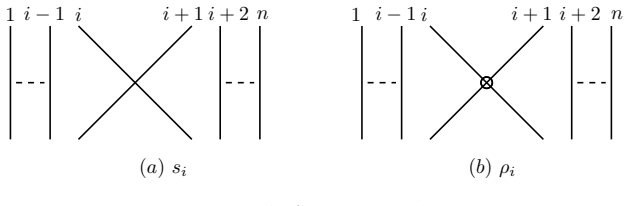
Figure from the paper full image
abstract click to expand
Motivated by the notion of the multi-virtual braid group introduced by L. Kauffman and by the study of extensions of the well-known twin group T_n, n >= 2, we introduce a new group called the multi-virtual twin group M_kVT_n, where k >= 1 and n >= 2, together with two associated subgroups: the multi-virtual pure twin group M_kVPT_n and the multi-virtual semi-pure twin group M_kVHT_n.We classify all homogeneous 2-local representations of M_kVT_n into GL_n(C) for all k >= 1 and n >= 3, and show that they fall into exactly eight distinct types. We also investigate their main properties, including faithfulness and irreducibility, proving that they are generally unfaithful and providing necessary and sufficient conditions for their irreducibility.Furthermore, for certain values of k and n, we construct non-local representations of M_kVPT_n induced from those of M_kVT_n, and we determine the conditions under which these induced representations are irreducible. Finally, we present several problems for future research in this area.
0
0
math.GT 2026-05-14 2 theorems

Mapping class subgroups have dense Teichmüller lengths

Non-arithmeticity of length spectra of subgroups of mapping class groups

Non-elementary subgroups generate a dense additive subgroup of R from pseudo-Anosov translation lengths.

Figure from the paper full image
abstract click to expand
In this paper, we prove that every non-elementary subgroup of the mapping class group of a surface has non-arithmetic Teichm\"uller length spectrum. Namely, Teichm\"uller translation lengths of its pseudo-Anosov elements generate a dense additive subgroup of $\mathbb{R}$. We prove this by introducing the notion of cross-ratios on $\mathcal{MF}$ and $\mathcal{PMF}$, and studying its geometric and dynamical properties, despite the lack of negatively curved features of the Teichm\"uller space nor the conformal geometry on $\mathcal{PMF}$.
0
0
math.GT 2026-05-14 2 theorems

Alternating knot traces admit PALFs whose fibers match white-region count

Lefschetz Fibrations on Knot Traces of Alternating and Extended Alternating Knots

Genus equals white regions in the planar graph, giving genus s-1 for pretzel knots and genus 1 for torus knots.

Figure from the paper full image
abstract click to expand
In our previous work, we introduced a simple and explicit method for constructing a positive allowable Lefschetz fibration (PALF) from a $2$-handlebody decomposition of any given compact Stein surface. In this paper, we apply this construction to knot traces whose attaching circles are either alternating knots or \emph{extended alternating knots} (a generalized class introduced herein). We demonstrate that each such knot trace admits a PALF whose regular fiber has a genus exactly equal to the number of white regions in the associated planar graph, yielding PALFs whose regular fibers have a significantly small genus. As immediate corollaries, we prove that knot traces of positive pretzel knots with $s$ rows admit PALFs with regular fibers of genus $s-1$, and those of positive torus knots admit PALFs with regular fibers of genus $1$. Furthermore, we define \emph{positive torus-pretzel knots} by replacing each twist block of a positive pretzel knot with the crossings of a positive torus knot, and we establish that their knot traces also admit PALFs with regular fibers of genus $s-1$.
0
0
math.GT 2026-05-14 Recognition

Fold curves must cross themselves a minimum number of times

A Lower Bound on the Self-intersections of Fold Singularities

The bound is obtained by treating singular components as boundaries of immersed surface pieces.

Figure from the paper full image
abstract click to expand
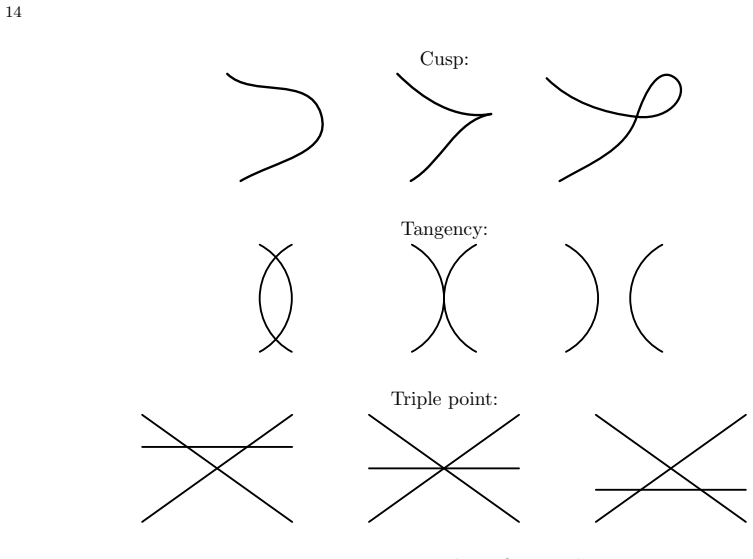
For an oriented surface $S$, the singular set of a fold map $f:S\rightarrow \mathbb{R}^2$ is a collection of smooth curves, also known as fold singularities. We construct a sharp lower bound on the number of self-intersections of such fold singularities. This is done by first establishing a sharp lower bound on the number of self-intersections of the boundary of a surface immersed in $\mathbb{R}^2$. We then construct a sharp lower bound for the number of self-intersections of the singular set of a simple stable fold map of a surface to $\mathbb{R}^2$ by viewing the connected components of the singular set as the boundary components of smaller surface components, and invoking the previously constructed lower bound for the number of self-intersections of an immersed boundary.
0
0
math.GT 2026-05-14

The authors construct an irreducible embedded real projective plane inside the 4-sphere

An irreducible real projective plane in the 4-sphere

An irreducible embedded projective plane is constructed in S^4, countering the Kinoshita conjecture via a peripheral map with kernel of…

abstract click to expand
We construct an irreducible embedded projective plane in $S^4$. This gives a counterexample to the Kinoshita conjecture and answers Problem 4.37 of the K3 problem list. Moreover, we answer both Questions (i) and (ii) of Problem 4.37: (i) the connected sum $R\# R$ is a Klein bottle in $S^4$ with extremal normal Euler number that does not admit an unknotted projective plane summand, and (ii) we show that our projective plane $R$ is irreducible by showing that the peripheral map $\pi_1 (\partial (S^4\setminus\mathring{N}(R)))\to \pi_1 (S^4 \setminus \mathring{N}(R))$ has kernel of order $2$.
0
0
math.GT 2026-05-12 2 theorems

Non-compact arithmetic hyperbolic manifolds have thin surface subgroups

Thin surface subgroups of non-uniform arithmetic lattices in rm{SO}^+(n,1)

The result holds for all n at least 4 and implies GFERF embeddings for doubles of cusped cases into SO^+(n+1,1).

Figure from the paper full image
abstract click to expand
We show that the fundamental groups of all non-compact, arithmetic, hyperbolic, $n$-manifolds for $n\geq 4$ contain thin surface subgroups. As a consequence of the proof of this theorem we also show that the fundamental groups of the doubles of cusped, arithmetic, hyperbolic $n$-manifolds embed as GFERF subgroups of $\rm{SO}^+(n+1,1)$.
0
0
math.GT 2026-05-12 2 theorems

Edge conditions pinpoint hyperbolic realizations for simplicial domains

Hyperbolic space groups and edge conditions for their domains

Symmetries of the polyhedron restrict cases with vertices outside the absolute in the family examined

Figure from the paper full image
abstract click to expand
Looking to the fundamental domains of space groups we can investigate in which space they can be realized. If this space is hyperbolic, then the corresponding space group is also hyperbolic. In addition to the usual methods for investigating space of realization, the symmetries of the fundamental polyhedron can give new restricted conditions, here called edge conditions. The aim of the research is to find out in which cases simplicial fundamental domains are hyperbolic with vertices out of the absolute. For this reason, edge conditions for simplicial fundamental domains belonging to Family F12 by the notation of E. Moln\'ar et all in 2006, are considered.
0
0
math.GT 2026-05-12 Recognition

0-handle isotopy yields genus-1 fibers on knot traces

Combinatorial extension of a simple construction of Lefschetz fibrations

A combinatorial adjustment in PALF construction keeps the total space diffeomorphic while changing the regular fiber for twist and torus kn

Figure from the paper full image
abstract click to expand
In a previous work, we introduced a simple and systematic method for constructing a positive allowable Lefschetz fibration (PALF) from a 2-handlebody decomposition of a given Stein surface. In this paper, we present a combinatorial extension of this construction, focusing on the flexibility of the regular fiber. By introducing variations in the isotopy of the 0-handle during the construction process, we obtain PALFs whose total spaces are diffeomorphic to the original Stein surface but which possess different regular fibers. As a primary application, we prove the existence of PALFs with genus $1$ regular fibers whose total spaces are diffeomorphic to the knot traces of Legendrian positive twist knots and positive torus knots $T_{2, 2n+1}$. Furthermore, we explicitly compare our PALF associated with the positive torus knot $T_{2, 2n+1}$ to the specific open book decomposition generated by Avdek's Algorithm 2, demonstrating that the regular fiber and monodromy of our construction coincide with the page and monodromy of the corresponding open book.
0
0
math.GT 2026-05-12 Recognition

T-positive links are closures of T-homogeneous braids

On T-positive links

They exactly match the strongly quasipositive links from T-homogeneous braids and include every non-split braid-positive link.

Figure from the paper full image
abstract click to expand
T-positive links form a subset of strongly quasipositive links that strictly contains the set of all non-split braid positive links. Analogous to Baader's characterisation of positive links as precisely the strongly quasipositive and homogeneous links, we show that T-positive links are precisely the strongly quasipositive links that are the closures of T-homogeneous braids. This complements previous characterizations of T-positive links by Rudolph and Banfield as links arising as boundaries of positive Hopf-plumbed baskets, or closures of staircase braids. We examine the behavior of T-positive links under cabling operations and connected sums, and demonstrate that all strongly quasipositive, fibered knots with at most 12 crossings are T-positive. Additionally, we compare T-positivity with other positivity notions for links and compile open questions.
0
0
math.GT 2026-05-11 2 theorems

Basepoint-enhanced Khovanov TQFT invariant under RP2 sums with Euler -2

Basepoints in Khovanov homology and nonorientable surfaces

The enhanced theory stays unchanged for Euler number -2 but vanishes for +2, matching Floer invariants of opposite-orientation branched and

Figure from the paper full image
abstract click to expand
We enhance the Khovanov TQFT using basepoint actions, over the field with two elements. Our enhanced Khovanov TQFT behaves similarly to gauge/Floer theoretic invariants of the double branched cover with opposite orientation: they both are invariant, in a certain sense, under taking the connected sum with the standard $\mathbb{RP}^{2}$ with Euler number -2, and they both vanish after taking the connected sum with the standard $\mathbb{RP}^{2}$ with Euler number 2. This invariance property answers a version of a question posed by Lipshitz and Sarkar. Furthermore, our construction establishes, as a special case, functoriality for the pointed Khovanov homology defined by Baldwin, Levine, and Sarkar.
0
0
math.GT 2026-05-08 Recognition

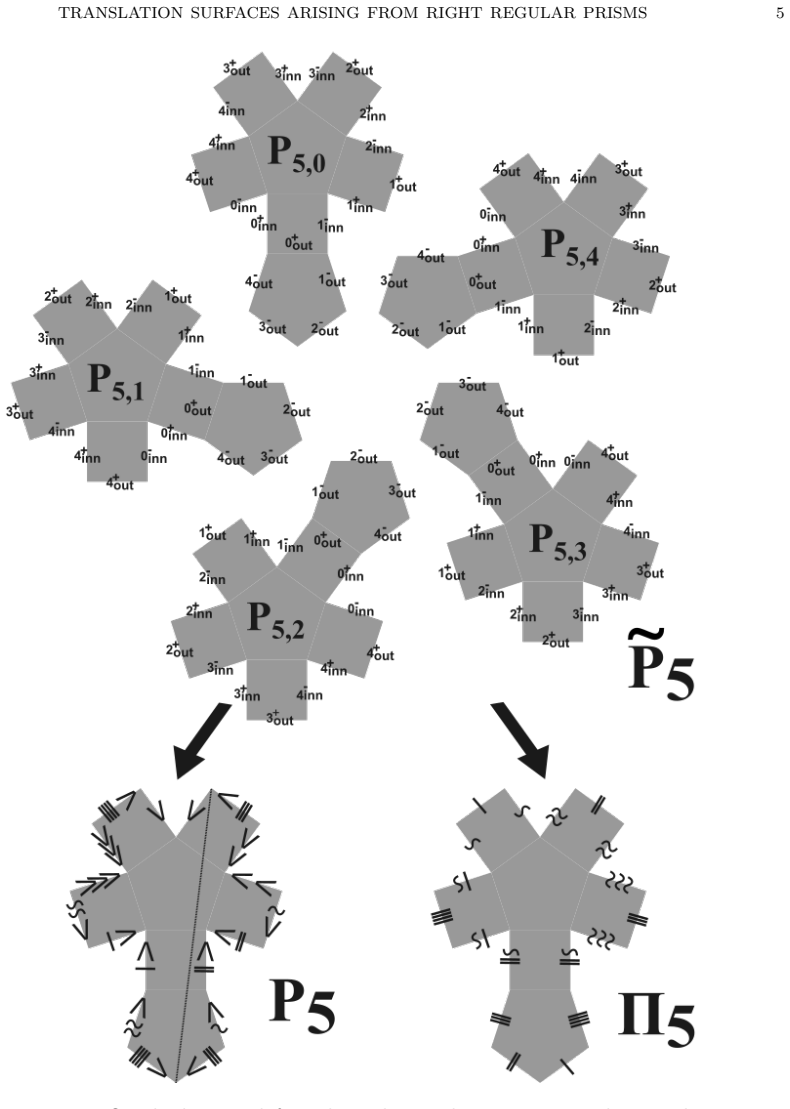
Prism unfoldings cover hyperelliptic surfaces for explicit counts

Translation Surfaces arising from Right Regular Prisms

Non-lattice translation surfaces from regular n-prisms have computable orbit closures and quadratic asymptotics for saddle connections.

Figure from the paper full image
abstract click to expand
We study flat metrics arising from right regular $n$-prisms by viewing them as $n$-differentials and analyzing their associated unfoldings. We show that the unfolding of a right regular $n$-prism is never a lattice surface unless $n=4$, in contrast with the case of Platonic solids. Despite this, we prove that these surfaces admit translation coverings to hyperelliptic surfaces, allowing us to determine their $\mathrm{GL}(2,\mathbb{R})$-orbit closures using the classification of hyperelliptic components of strata. As a consequence, we obtain exact quadratic asymptotics for a certain average of the number of saddle connections on the base surfaces, their unfoldings, and the original prisms, including their Siegel--Veech constants. This provides a natural infinite family of non-lattice surfaces for which orbit closures and counting problems can be computed explicitly.
0
0
math.GT 2026-05-08 2 theorems

Suspensions of K6-minor graphs force linked cycles in R^4

Intrinsic Linking of 2-complexes in mathbb{R}⁴

Any embedding of such a 2-complex into four dimensions contains a non-trivially linked 1-cycle and 2-cycle.

Figure from the paper full image
abstract click to expand
We produce an infinite family of $2$-complexes that are intrinsically linked when embedded into four dimensions. In particular, we show that any embedding into $\mathbb{R}^4$ of the suspension of a graph containing $K_6$ as a minor contains a non-trivially linked 1 and 2-cycle.
0
0
math.GT 2026-05-08 2 theorems

Every weakly negative definite plumbing tree reduces to a negative definite one

Plumbed 3-Manifolds and Neumann Moves

Neumann moves, guided by combinatorial eigenvalue extraction, eliminate positive eigenvalues on linear branches while preserving the 3-manif

Figure from the paper full image
abstract click to expand
We give a constructive proof that every weakly negative definite plumbing tree can be transformed into a negative definite one by a finite sequence of Neumann moves. The argument combines Neumann's plumbing calculus with the diagonalization algorithm of Duchon, Eisenbud, and Neumann, which extracts the eigenvalues of the framing matrix directly from the combinatorics of the tree. We show that any positive eigenvalues are supported on linear branches and can be eliminated systematically via controlled applications of Neumann moves. This provides an explicit algorithm reducing weakly negative definite plumbing trees to negative definite ones.
0
0
math.GT 2026-05-08

Cable index equals Brouwer degree and bounds homotopy volume

Minimal Homotopies in Three Dimensions: A Cable System Approach

The index matches the degree on each region and gives an attainable lower bound for the volume swept by any Lipschitz null homotopy.

Figure from the paper full image
abstract click to expand
We study null homotopies of immersed spheres in $\mathbb{R}^3$ and the volume they sweep during contraction. For a smooth immersion with finitely many transverse self-intersections, we introduce a cable system that connects each bounded region of the complement to the exterior. From this construction we define the cable index and prove that it agrees with the Brouwer degree on each complementary region. Using this identification, we derive a degree-weighted lower bound for the swept volume of any Lipschitz null homotopy. We show that the bound is attained whenever the homotopy is sense-preserving, meaning the surface moves in a consistent direction, and the index evolves monotonically along the homotopy. In addition, in the case where the immersion arises as the boundary of an immersed ball, we construct an explicit homotopy that realizes this lower bound via a deformation of the ball. Finally, we present a linear-time algorithm that computes all cable indices from a finite cable system, providing a concrete and computable method for evaluating the lower bound.
0
0
math.GT 2026-05-08

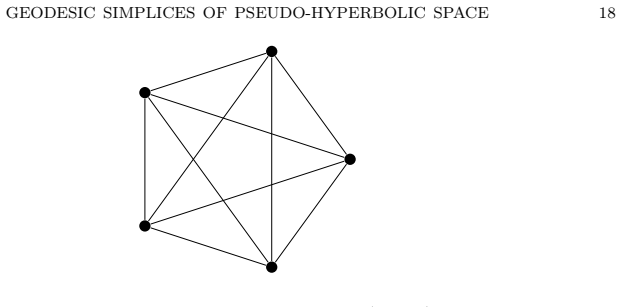
Cohomology decides finite volume for pseudo-hyperbolic simplices

Geodesic simplices of pseudo-hyperbolic space

All ideal geodesic polytopes in the (2,2) case have finite volume by the resulting criterion.

Figure from the paper full image
abstract click to expand
We give a cohomological interpretation of the geodesic simplices of the pseudo-hyperbolic space of signature $(p,q)$ and formulate a necessary and sufficient condition for such a simplex to have finite volume. As a corollary, we obtain that every ideal geodesic polytope in the pseudo-hyperbolic space of signature $(2,2)$ has finite volume.
0
0
math.GT 2026-05-08

Poincaré-Hopf theorem extends to determinantal singularities

Poincar\'e-Hopf Theorem for Isolated Determinantal Singularities

Sum of two generalized indices of a 1-form recovers the Euler characteristic for projective varieties with isolated determinantal singularit

abstract click to expand
Let $X$ be a projective algebraic $d$-variety endowed with isolated determinantal singularities, and let $\omega$ be a $1$-form on $X$ exhibiting a finite number of singularities (in the stratified sense). Under some technical conditions, we use two generalizations of Poincar\'e-Hopf index with the goal of proving a Poincar\'e-Hopf Type Theorem for $X$.
0
0
math.GT 2026-05-08

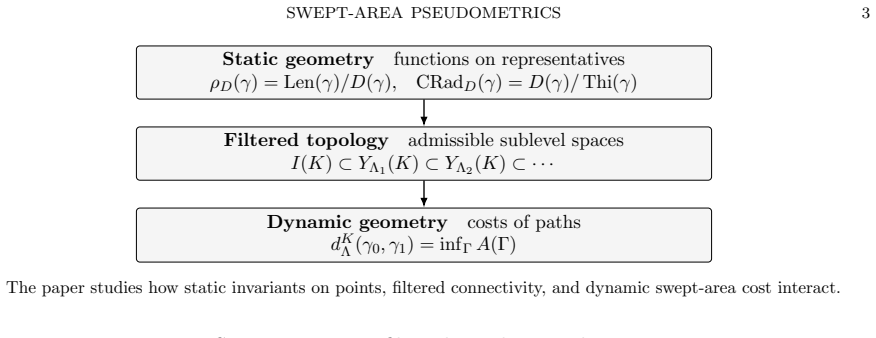
Swept area defines pseudometric on ropelength-bounded knots

Swept-Area Pseudometrics on Ropelength-Filtered Knot Spaces

Infima of traced areas under thickness-preserving isotopies give exact distances for round unknots and ellipses plus rigidity for the ideal-

Figure from the paper full image
abstract click to expand
We introduce swept-area pseudometrics on ropelength-filtered spaces of knot representatives. For a knot type \(K\) and a ropelength level \(\Lambda\), admissible isotopies are required to pass through curves of thickness at least one and length at most \(\Lambda\). The swept area is the parametrized area traced by the moving curve, and its infimum over admissible isotopies defines an extended pseudometric on each admissible component. We also define the admissible fundamental group of a based admissible component and equip it with a swept-area length function. The construction is separated from the rigidity questions it raises. The zero-distance quotient is always a metric space, while non-degeneracy before quotienting is treated separately. We prove non-degeneracy on uniformly non-collinear finite-dimensional polygonal strata. We also prove calibration lower bounds from projected signed area, including a rotation-invariant supremum over oriented planes, and use them to obtain exact distance formulas for concentric round unknots and homothetic planar ellipses. We further prove rigidity of the ideal unknot. The framework is related to static scale-free invariants such as density and compression radius, and to filtered-topological structures such as ideal strata and merge scales. We define swept-area weighted lifted Reidemeister graphs and prove that, for diagrammatically generic isotopies, the associated diagrammatic distance is bounded above by the geometric swept-area distance. We also record monotonicity in the ropelength parameter and formulate problems toward full non-degeneracy and approximation theory.
0
0
math.GT 2026-05-07 Recognition

Hopf fibrations on odd spheres share a fiber only under specific conditions

On extending results of Gluck and Warner on fibrations of spheres by great subspheres

Complete characterization extends the 3-sphere case but reveals why a full generalization to arbitrary great-subsphere fibrations is blocked

abstract click to expand
In this paper, we build upon the work of Gluck and Warner who showed in 1983 that the set of positively oriented fibrations of a 3-sphere by oriented great circles is in bijection with the set of distance-decreasing maps from the 2-sphere to itself. One approach to generalizing their result to higher-dimensional spheres involves understanding when exactly two Hopf fibrations of $S^{2n-1}$ are guaranteed to agree on a fiber. We give a complete characterization of this phenomenon, and we discuss the barriers which prevent us from obtaining a fully general version of Gluck and Warner's result.
0
0
math.GT 2026-05-07

Némethi formula now computes d-invariants for all negative-definite plumbings

The Heegaard Floer d-invariant for more rational homology spheres

Zemke isomorphism transfers the lattice homology grading to HF+ for every such rational homology sphere.

abstract click to expand
The Heegaard Floer d-invariant for a rational homology sphere Y and spin$^c$-structure $\mathfrak{s}$ is defined as the minimal absolute grading of a generator of $HF^+(Y; \mathfrak{s})$. In 2005, N\'emethi used lattice homology to compute the d-invariant for a particular class of negative-definite plumbed rational homology spheres, and conjectured that his formula should hold for all negative-definite plumbed rational homology spheres. In this paper, we use Zemke's isomorphism between lattice and Heegaard Floer homology to prove N\'emethi's conjecture.
0
0
math.GT 2026-05-07

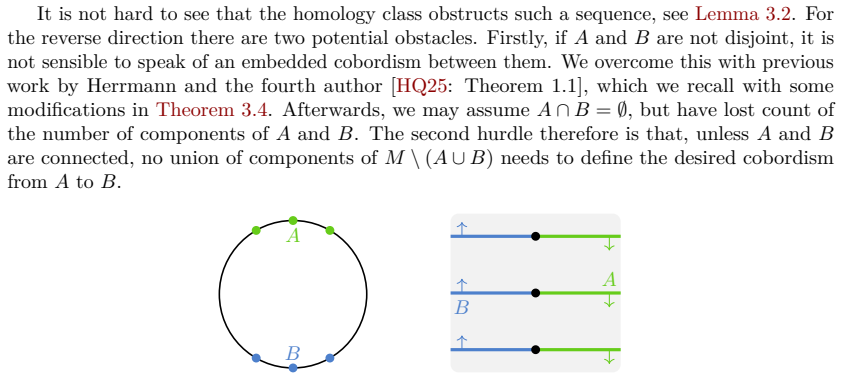
Hypersurfaces are related by embedded cobordisms iff homologous

Cobordism-equivalence for codimension-one submanifolds

The equivalence converts cobordisms into surgeries and shows Seifert surfaces of a link differ only by tube moves.

Figure from the paper full image
abstract click to expand
We show that two hypersurfaces in a manifold are related by a sequence of embedded cobordisms if and only if they represent the same homology class. By applying handle decompositions we turn these cobordisms into a sequence of embedded surgeries. Specializing to Seifert surfaces we obtain a conceptual proof that two Seifert surfaces of a fixed link are related by tube attachments and tube removals.
0
0
math.GT 2026-05-07

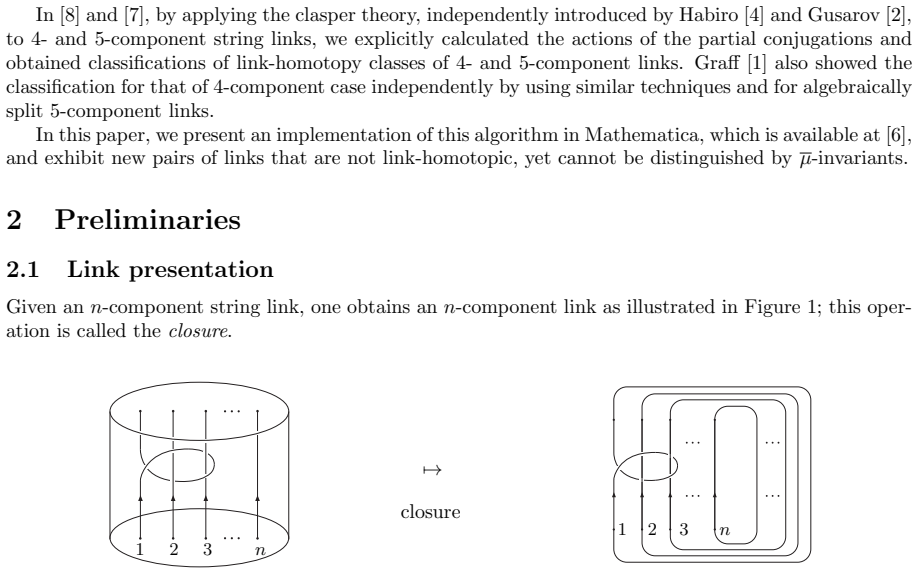
Algorithm decides link-homotopy for four- and five-component links

Implementation of the Habegger--Lin decision algorithm

Implementation produces pairs not separated by Milnor μ-bar invariants

Figure from the paper full image
abstract click to expand
Habegger and Lin gave a classification of link-homotopy classes of links in terms of that of string links modulo certain group actions. As an application, they constructed an algorithm for determining whether given two links are link-homotopic. In \cite{KM4}, we explicitly computed these group actions for the 4- and 5-component cases. Consequently, the Habegger--Lin algorithm can be effectively applied in these cases. In this paper, we present an implementation of this algorithm, which is available at \cite{KMcode}, and exhibit new pairs of links that are not link-homotopic yet cannot be distinguished by Milnor's link-homotopy invariants, called $\overline{\mu}$-invariants.
0
0
math.GT 2026-05-06 3 theorems

Even-genus surfaces admit purely non-free actions of order 8g

On the biggest purely non-free conformal actions on compact Riemann surfaces and their asymptotic properties

The maximal order meets 8g for infinitely many even genera, with the normalized ratios accumulating solely at 8.

abstract click to expand
A continuous action of a finite group $G$ on a closed orientable surface $X$ is said to be gpnf (Gilman purely non-free) if every element of $G$ has a fixed point on $X$. We prove that the biggest order {$\mu(g)$}, of a gpnf-action on a surface of even genus $g \geq 2$, is bounded below by $8g$ and that this bound is sharp for infinitely many even $g$ as well. This provides, for even genera, a gpnf-action analog of the celebrated Accola-Maclachlan bound $8g+8$ for arbitrary finite continuous actions. We also describe the asymptotic behavior of $\mu$. We define $\mathcal{M}$ as the set of values of the form $$\widetilde{\mu}(g)=\frac{\mu(g)}{g+1},$$ and its subsets $\mathcal{M}_+$ and $\mathcal{M}_-$ corresponding to even and odd genera $g$. We show that the set $\mathcal{M}_+^d$, of accumulation points of $\mathcal{M}_+$, consists of a single number $8$. If $g$ is odd, then we prove that $4g \leq \mu(g)<8g$. We conjecture that this lower bound is sharp for infinitely many odd $g$. Finally, we prove that this conjecture implies that $4$ is the only element of $\mathcal{M}_-^d$, leading to $\mathcal{M}^d=\{4,8\}.$
0
0
math.GT 2026-05-06 3 theorems

Schottky space strata connectivity examined for primes three and higher

Cyclic-Schottky strata of Schottky space

Each cyclic-Schottky stratum F(g,p;t,r,s) in the branch locus corresponds to a fixed extension type; their connectedness was known for index

abstract click to expand
Schottky space ${\mathcal S}_{g}$, where $g \geq 2$ is an integer, is a connected complex orbifold of dimension $3(g-1)$; it provides a parametrization of the ${\rm PSL}_{2}({\mathbb C})$-conjugacy classes of Schottky groups $\Gamma$ of rank $g$. The branch locus ${\mathcal B}_{g} \subset {\mathcal S}_{g}$, consisting of those conjugacy classes of Schottky groups being a finite index proper normal subgroup of some Kleinian group, is known to be connected. If $[\Gamma] \in {\mathcal B}_{g}$, then there is a Kleinian group $K$ containing $\Gamma$ as a normal subgroup of index some prime integer $p \geq 2$. The structural description, in terms of Klein-Maskit Combination Theorems, of such a group $K$ is completely determined by a triple $(t,r,s)$, where $t,r,s \geq 0$ are integers such that $g=p(t+r+s-1)+1-r$. For each such a tuple $(g,p;t,r,s)$ there is a corresponding cyclic-Schottky stratum $F(g,p;t,r,s) \subset {\mathcal B}_{g}$. It is known that $F(g,2;t,r,s)$ is connected.In this paper, for $p \geq 3$, we study the connectivity of these $F(g,p;t,r,s)$.
0
0
math.GT 2026-05-06 4 theorems

Two axioms recover every geodesic current on a surface

The intersection dual of geodesic currents

Additivity plus a one-line smoothing inequality is exactly what makes a curve function an intersection number.

abstract click to expand
Geodesic currents on closed hyperbolic surfaces are measures on the unit tangent bundle invariant under geodesic flow and orientation reversal. Every geodesic current induces a dual function on curves via the geometric intersection pairing. It is natural to ask which curve functions are dual to geodesic currents, that is, which arise as intersection functionals of a geodesic current. In this paper we give a purely axiomatic and combinatorial characterization of curve functionals dual to geodesic currents. This yields a new definition of geodesic currents as curve functionals or, equivalently, as functions on surface groups, without reference to measures or flows. More precisely, we show that a function on curves arises as the geometric intersection pairing with a geodesic current if and only if it is additive under disjoint union and satisfies a simple \emph{smoothing} property: it is non-increasing under surgery of essential crossings. As applications, we obtain new axiomatic characterizations of measured laminations and hyperbolic length functions, and new descriptions of small surface group actions on real trees, including a concise proof of a classical theorem of Skora. We also provide a unified framework for dual geodesic currents arising from metric structures and generalized cross-ratios, including those associated with certain Anosov representations. Our approach subsumes all previously known constructions of dual geodesic currents and yields broad new families of examples.
0
0
math.GT 2026-05-06

The paper proves that an isoperimetric constant relating length to stable area (or to…

Magnetic geodesics, Hodge Laplacian eigenvalues, and isoperimetric inequalities

An isoperimetric constant is shown to bound the smallest Hodge Laplacian eigenvalue on coexact 1-forms via magnetic geodesic flows at…

abstract click to expand
An isoperimetric constant relating length and stable area, or alternatively for hyperbolic manifolds, length and stable commutator length, serves as a Cheeger constant for the smallest eigenvalue of the Hodge Laplacian acting on coexact 1-forms. Using properties of the magnetic geodesic flow associated to the differential of a coexact eigenform, and its behavior at Ma\~n\'e's critical energy level, we give new proofs of these Cheeger-like inequalities, with improved constants and volume dependence. We also make a few observations about the relationship between Ma\~n\'e's critical values and the eigenvalues, when the manifold is hyperbolic.
0
0
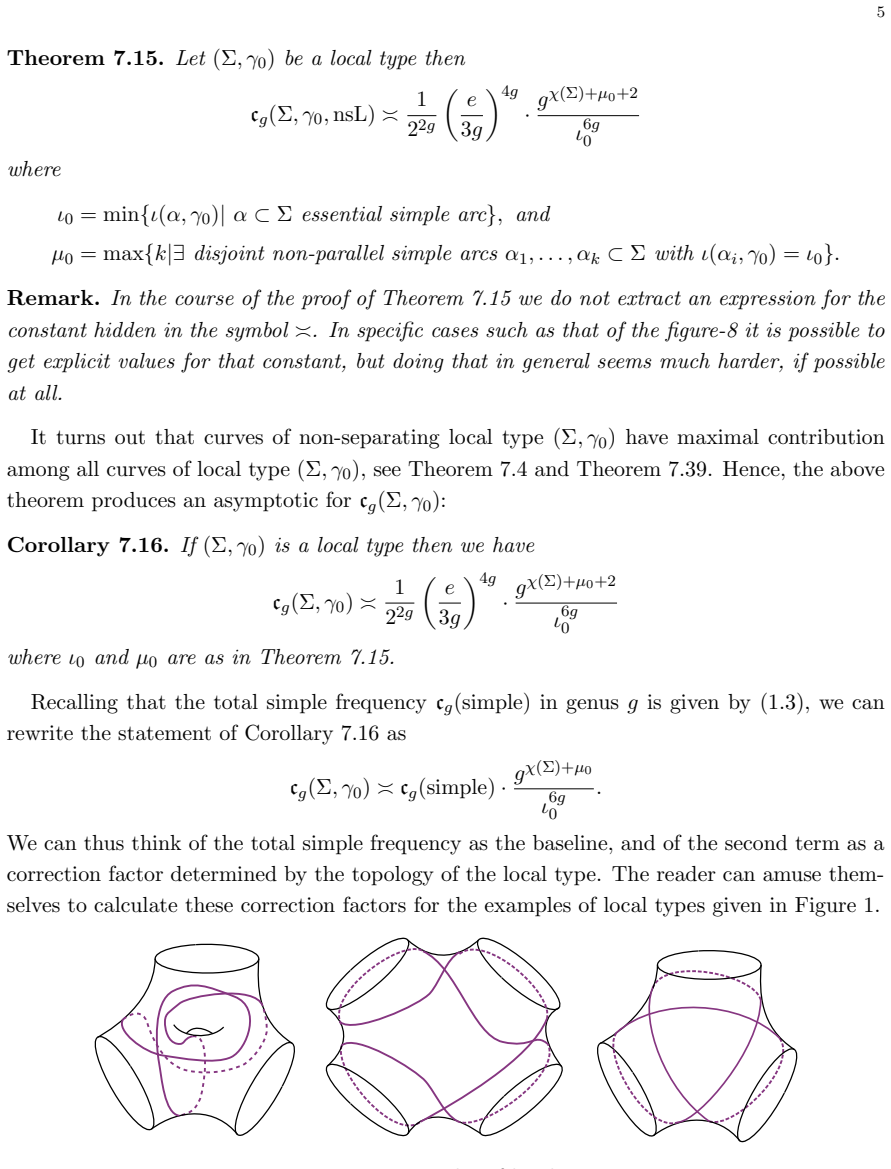
math.GT 2026-05-06

Non-simple curves stabilize in frequency on large-genus surfaces

Large genus asymptotics for frequency of non-simple curves

Extended Kontsevich expressions show which fixed-K intersection types become most common as genus grows.

Figure from the paper full image
abstract click to expand
We give an expression for the frequency of non-simple curves in closed surfaces and exploit it to study relative frequencies of such curves in large genus. This extend to the case of non-simple curves Mirzakhani's expressions of frequencies in terms of Konsevitch polynomials and Delecroix-Goujard-Zograf-Zorich large genus asymptotics for those frequencies. In particular, with K fixed, we identify which types of curves with K intersections are most common.
0
0
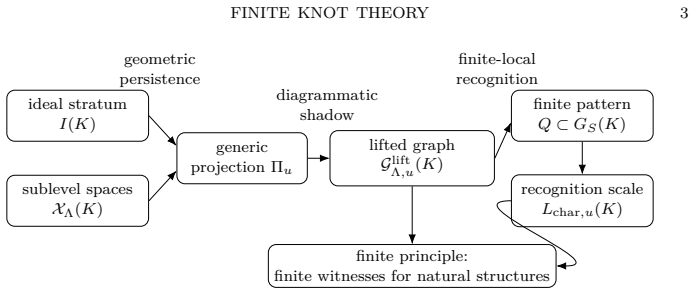
math.GT 2026-05-06

Knots recognized by finite patterns at ropelength scale L_char,u(K)

Finite Knot Theory via Ropelength-Filtered Reidemeister Graphs

The lifted Reidemeister graph yields a characteristic pattern that identifies each knot up to mirror at the first admissible scale.

Figure from the paper full image
abstract click to expand
This paper develops a form of finite knot theory as a diagrammatic sequel to the ideal-stratum and deformation-persistence framework for knot types. Thick representatives in bounded ropelength sublevel spaces are studied through the finite Reidemeister data visible in generic projections. For each projection direction $u$, we introduce the ropelength-filtered lifted Reidemeister graphs $\mathcal{G}^{\mathrm{lift}}_{\Lambda,u}(K)$, for $\Lambda\ge \mathrm{Rop}(K)$, recording diagram data and Reidemeister moves that lift to admissible thick deformations below the ropelength level $\Lambda$. Using the finite-local reconstruction theorem of Barbensi--Celoria, we define characteristic Reidemeister patterns and the finite recognition length $L_{\mathrm{char},u}(K)$, the first ropelength scale at which a finite pattern recognizing $K$, up to mirroring, appears in the lifted graph. The finite-local graph-theoretic part is unconditional; finite-dimensional and polygonal models provide controlled settings; the corresponding statements for the full $C^{1,1}$ ropelength-sublevel space are conditional on explicitly isolated projection--Cerf tameness and coherent finite-pattern thick-movie liftability hypotheses.
1 0
0
math.GT 2026-05-05

Figure-eight knot deforms into SU(3,1) preserving parabolics

Parabolic-preserving deformations of cusped hyperbolic lattices

Infinitely many cusped hyperbolic manifolds in each dimension n at least 3 have one-parameter families of such deformations.

abstract click to expand
We study deformations of non-cocompact lattices of ${\rm SO}(n,1)$ into ${\rm SU}(n,1)$ and ${\rm SO}(n+1,1)$. A necessary condition for these deformations to remain discrete and faithful (when $n \geqslant 3$) is for the parabolic subgroups to remain parabolic and discrete; we call such representations \emph{strongly parabolic-preserving}. We show that the figure-eight knot group admits a one-parameter family of Zariski-dense parabolic-preserving deformations into ${\rm SU}(3,1)$, with further deformations into ${\rm SU}(2,2)$. We also study the \emph{bending deformations} of the Bianchi groups (seen as subgroups of ${\rm SO}(3,1)$) along the modular surface into ${\rm SU}(3,1)$ and ${\rm SO}(4,1)$, and show that infinitely many of them are strongly parabolic-preserving in ${\rm SU}(3,1)$, while none are strongly parabolic-preserving in ${\rm SO}(4,1)$. Finally, for any $n \geqslant 3$, we show that there exist infinitely many non-commensurable cusped hyperbolic $n$-manifolds whose corresponding hyperbolic representation admits a 1-parameter family of parabolic-preserving deformations into ${\rm SU}(n,1)$.
0
0
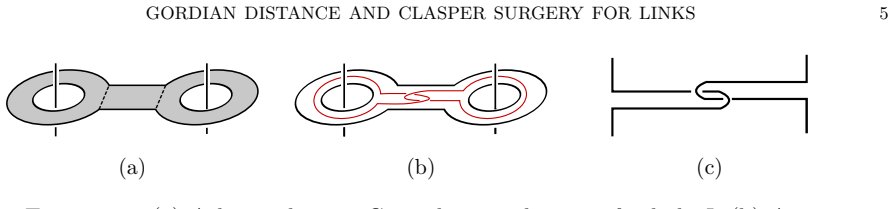
math.GT 2026-05-05

n-component zero-linking links reach C_k-trivial form in at most n² crossing changes

Gordian distance and clasper surgery for links

Milnor invariants therefore supply only partial data on unlinking numbers, with quadratic lower bounds for some families

Figure from the paper full image
abstract click to expand
In 2000, Habiro introduced the notion of $C_k$-equivalence of knots and links. This geometric filtration is closely connected to finite type invariants, a class of invariants including Milnor's invariants. Shortly thereafter, Ohyama, Taniyama, and Yamada proved that $C_k$-equivalence, and by extension finite type invariants, say very little about the unknotting number by showing that any knot is at most one crossing change away from being $C_k$-trivial for any $k\in \mathbb{N}$. The same is not true for links, since the pairwise linking number gives a lower bound on unlinking and is an invariant of $C_2$-equivalence. We prove that, aside from the linking number, the result of Ohyama, Taniyama, and Yamada extends to links: any $n$-component link with linking number zero can be reduced to a $C_k$-trivial link in at most $n^2$ crossing changes. As a consequence, Milnor's invariants carry only limited information about the unlinking number. To establish a lower bound, we produce a sequence of $n$-component links for which the crossing change distance to a $C_k$-trivial link grows quadratically in $n$. Notably, these bounds are independent of the choice of $k\in \mathbb{N}$. Finally, we determine the exact number of crossing changes to a $C_k$-trivial link for links with nonzero linking numbers and where no component is $C_k$-trivial.
0
0
math.GT 2026-05-05

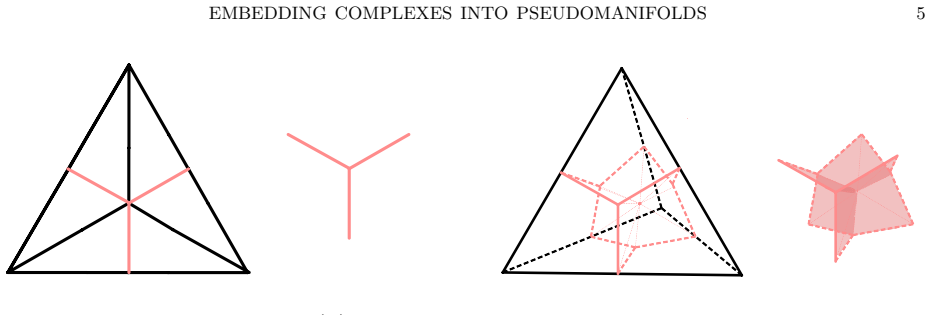
Any d-complex is a retract of a (2d-1)-pseudomanifold

Embedding complexes into pseudomanifolds

Finite simplicial complexes of dimension d at least 2 embed as retracts in closed (2d-1)-pseudomanifolds.

Figure from the paper full image
abstract click to expand
We show that for $d\geq 2$ every finite $d$-dimensional simplicial complex is a deformation retract of a $(2d-1)$-dimensional pseudomanifold with boundary. Moreover, it embeds as a retract in a closed $(2d-1)$-dimensional pseudomanifold.
0
0
math.GT 2026-05-05

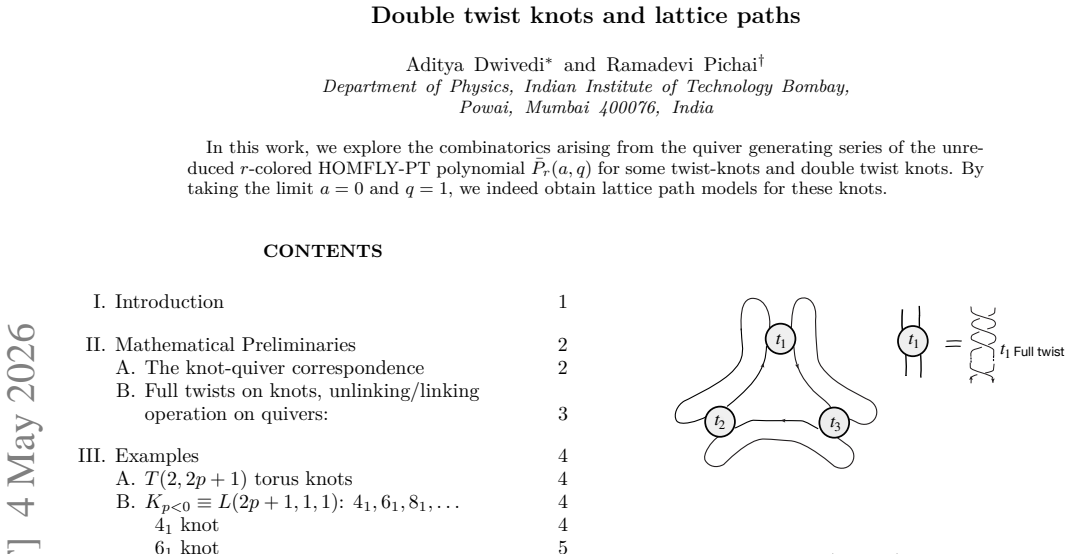
Quiver series of colored HOMFLY polynomials yield lattice paths for twist knots

Double twist knots and lattice paths

Setting a=0 and q=1 turns the generating series into enumerations of paths for these knots.

Figure from the paper full image
abstract click to expand
In this work, we explore the combinatorics arising from the quiver generating series of the unreduced $r$-colored HOMFLY-PT polynomial $\bar{P}_r(a,q)$ for some twist-knots and double twist knots. By taking the limit $a = 0$ and $q = 1$, we indeed obtain lattice path models for these knots.
0
0
math.GT 2026-05-04 2 theorems

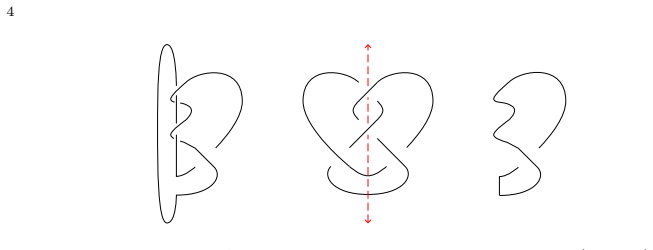
Figure-eight knot slices equivariantly for one inversion in S²×S² but not the other

Equivariantly Slice Knots in Symmetric 4-Manifolds

The equivariant four-genus depends on the choice of strong inversion when the ambient four-manifold carries its own symmetry.

Figure from the paper full image
abstract click to expand
We study the equivariant 4-genus of strongly invertible knots in the $S^3$ boundary of 4-manifolds with involution. We provide techniques for constructing slice disks for knots in various symmetric 4-manifolds via an equivariant version of Marengon and Mihajlovi\`c's tubing construction. Using these techniques, we show that this equivariant 4-genus can differ from the standard 4-genus function of the 4-manifold as well as the equivariant 4-genus of $S^4$. As an example, we show that $S^2\times S^2$ admits an involution such that the figure $8$ knot is equivariantly slice with respect to one of its two strong inversions but not the other.
0
0
math.GT 2026-05-04 2 theorems

Algorithm constructs isotopies for knot projectivizations

A constructive solution to the equivalence problem for knot projectivizations

It turns the open question of equivalence in RP^3 into a procedure that yields explicit deformations for any affine knot.

Figure from the paper full image
abstract click to expand
The problem of whether different projectivizations of the same affine knot $K\subset\mathbb{S}^3$ are equivalent in $\mathbb{R}\mathbb{P}^3$ can be found in [11] and has also been posed as an open question in [15]. In this note we provide a constructive solution to the problem. In particular, we adapt an idea due to A. Hatcher developed in the realm of embedding spaces and we describe an algorithm that produces an explicit isotopy between any two given projectivizations of the same affine knot. More generally, we introduce the notion of lensification of a knot in any lens space $L(p,q)$ and describe an algorithm that works in that more general setting, of which $\mathbb{R}\mathbb{P}^3\simeq L(2,1)$ is a particular instance. Finally, we apply this algorithm to several pairs of knots from the literature for which the equivalence problem was raised as an open question, finding explicit isotopies.
0
0
math.GT 2026-05-04

Non-self OU sequence pairs fully characterized for two-component links

Characterization of non-self OU sequences of two-component link diagrams

Complete description covers every possible diagram plus explicit lists for all prime examples with five or fewer crossings.

Figure from the paper full image
abstract click to expand
A non-self OU sequence is a cyclic sequence of crossing information of non-self crossings that is obtained by traversing a knot component of an oriented link diagram. In this paper, we investigate what information can be derived from non-self OU sequences, and we completely characterize pairs of non-self OU sequences of diagrams of two-component links. We also characterize the pairs for specific prime links with crossing number up to five.
0
0
math.GT 2026-05-04

Branched covers along geodesic loci preserve hyperbolicity

The geometry of branched coverings of hyperbolic manifolds

For closed hyperbolic manifolds in dimensions three and higher, branching along totally geodesic codimension-two submanifolds yields covers

abstract click to expand
We discuss geometric properties of covers of closed hyperbolic manifolds of dimension $n\geq 3$, branched along a totally geodesic codimension two submanifold $\Sigma$. The results are mostly known to the experts but hard to find in the literature in this form.
0
0
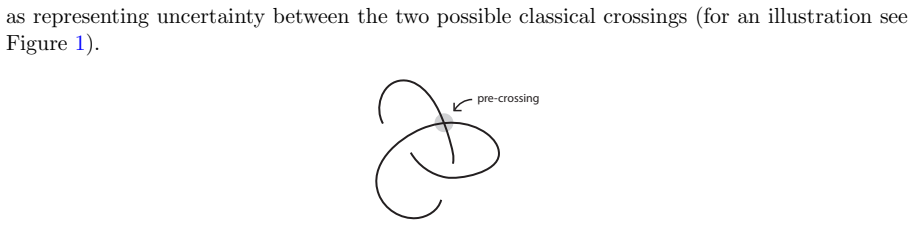
math.GT 2026-05-04

Resolution homomorphism yields HOMFLYPT invariant for pseudo links

A HOMFLYPT-type invariant for pseudo links via a resolution in Hecke algebras

Mapping pre-crossings to superpositions of classical crossings in the Hecke algebra extends the polynomial invariant to links with pre-cross

Figure from the paper full image
abstract click to expand
Pseudo links generalize classical links by allowing crossings with missing over/under information, called pre-crossings. While the pseudo braid framework provides an algebraic description of pseudo links via a Markov-type theorem, the construction of polynomial invariants using Hecke algebra techniques is obstructed by the presence of the pseudo Reidemeister 1 move. In this paper, we construct a HOMFLYPT-type invariant for oriented pseudo links via the pseudo Hecke algebra of type \(A\). The construction is based on a resolution homomorphism that maps each pseudo generator to a linear combination of a braid generator and its inverse, interpreting pre-crossings as algebraic superpositions of classical crossings. Composing this map with the Ocneanu trace and applying a suitable normalization yields an invariant satisfying a natural pseudo skein relation. We further show that the invariant admits a state-sum formulation as a weighted sum of classical HOMFLYPT-type invariants over all classical resolutions of the pseudo crossings, as well as a skein-theoretic characterization in terms of its values on classical links and the pseudo skein relation.
0
0
math.GT 2026-05-04

Aspherical PD3-pairs reduce to group pairs by 1-handle attachment

Aspherical PD₃-pairs

Any such pair assembles from simpler ones with injective boundaries, and finiteness holds for many groups.

abstract click to expand
We extend two results known for aspherical 3-manifolds to $PD_3$-pairs $(P,\partial{P})$ with aspherical ambient space $P$. Every such $PD_3$-pair may be assembled by attaching 1-handles to $PD_3$-pairs with aspherical; ambient space and $\pi_1$-injective boundary. (Thus the study of such pairs reduces to the study of $PD_3$-pairs of groups.) If $\pi$ is a group of type $FP$ whose indecomposable factors $G$ each have $\chi(G_i)=0$ then there are only finitely many such $PD_3$-pairs with $\pi_1(P)\cong\pi$.
0
0
math.GT 2026-05-01

n-pyramitoid generalizes n-pyramid for ellipsoid smoothing

Smoothing of singular intersections of ellipsoids: pyramitoid

New object extends smoothing of singular 3-manifolds from non-simple right-angle Coxeter polyhedra in coaxial intersections.

Figure from the paper full image
abstract click to expand
The goal of this work is to continue the study the smoothings of 3-dimensional manifolds with singularities obtained as small covers of non simple right-angle Coxeter polyhedral orbifolds. They appear in the study of coaxial intersections of ellipsoids. In particular we introduce the concept of $n$-pyramitoid generalizing the $n$-pyramid.
0
0
math.GT 2026-05-01

Unique negative twisting number classifies fillable contacts on negative Seifert spaces

Fillable structures on negative-definite Seifert fibred spaces

The number is read from lattice cohomology and matches Stein fillings of the minimal resolution, yielding an embedding criterion for the 3-m

Figure from the paper full image
abstract click to expand
We classify fillable contact structures on all negative-definite star-shaped plumbings. Along the way, we show that such Seifert fibred spaces admit a unique negative maximal twisting number, and compute it explicitly using the Alexander filtration in lattice cohomology. In particular, we show that the negative-twisting tight structures on these manifolds are induced by the Stein structures on the minimal resolution of the underlying complex surface singularity. As an application, we provide a necessary condition for a negative-definite Seifert fibred space to admit a separating contact-type embedding in a strong symplectic filling of a generalised $L$-space.
0
0
math.GT 2026-05-01

Hat invariant nonzero but plus version zero for some tight structures

The hat and plus version of the Heegaard Floer contact invariant are not equivalent

Brieskorn spheres supply the first examples where the two Heegaard Floer contact invariants disagree.

Figure from the paper full image
abstract click to expand
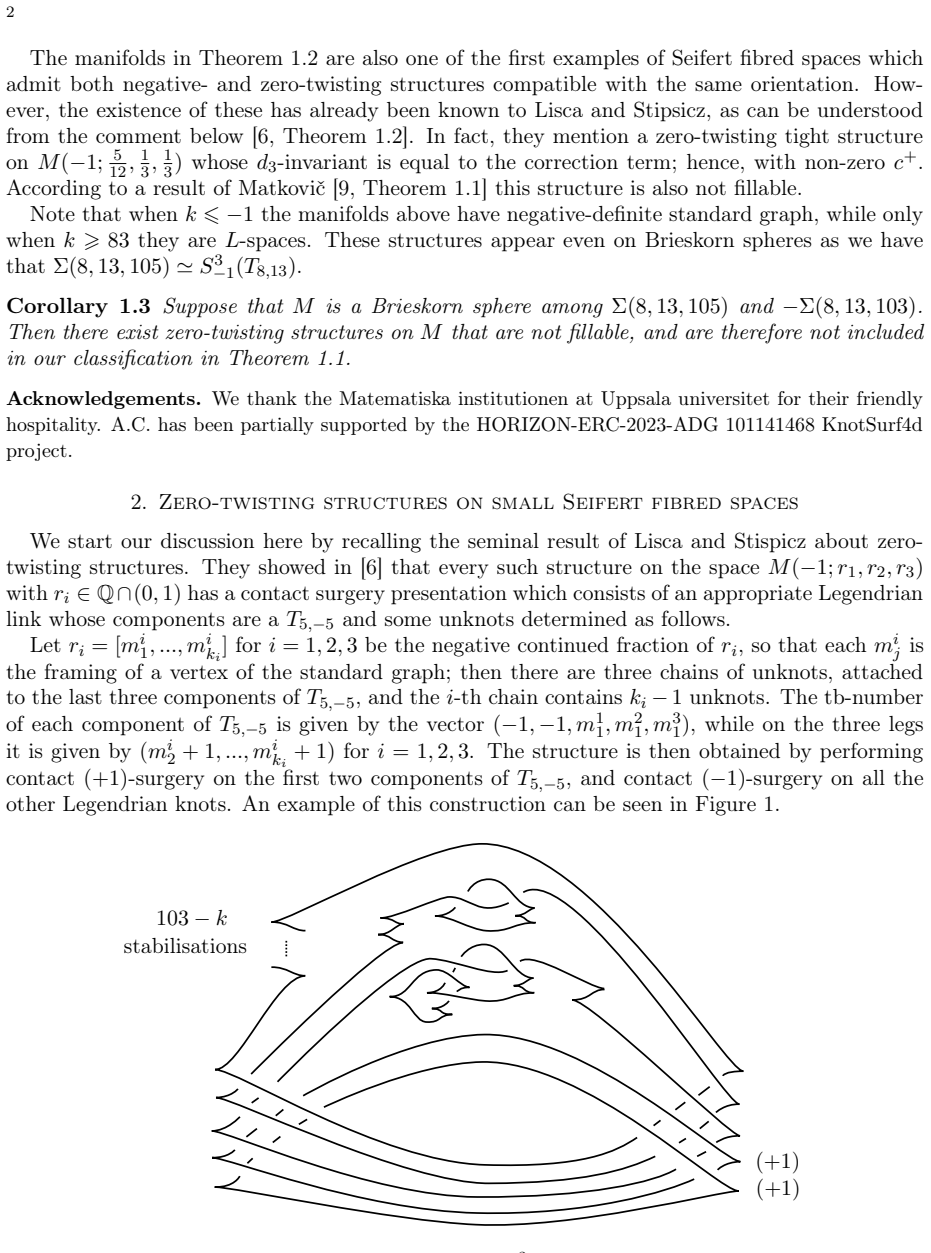
We advance Matkovi\v{c} ideas, originally applied to complete the classification of tight structures on small Seifert fibred $L$-spaces, to show the existence of contact structures on Brieskorn spheres which are tight and zero-twisting. This uncovers a phenomenon that has never appeared in literature before: namely, that a contact structure $\xi$ on a 3-manifold can be such that $\widehat c(\xi)$ is non-vanishing, but $c^+(\xi)$ is zero.
0
0
math.GT 2026-05-01

Filtered HF homology classifies negative-twisting contact structures

Heegaard Floer homology and maximal twisting numbers

A bijection with generators in the Alexander-filtered groups gives explicit counts, d3 values, and symplectic fillability for all such Seif

Figure from the paper full image
abstract click to expand
We adapt the Ozsv\'ath-Szab\'o full path algorithm to every star-shaped graph and establish a correspondence between negative-twisting tight contact structures on any Seifert fibred space over $S^2$, and its Heegaard Floer homology groups equipped with the Alexander filtration induced by the regular fibre. This provides the complete classification of negative-twisting structures on these manifolds; in particular, we distinguish them by their contact invariant $c^+$. We prove that every such structure is symplectically fillable and extend a known obstruction to Stein fillability. In addition, we show that the number of negative-twisting structures can be expressed combinatorially in terms of the Seifert coefficients of the star-shaped graph, while their $d_3$-invariant and homotopy type are determined explicitly through our correspondence. Our results also complete the classification of fillable structures on any small Seifert fibred space.
0
0
math.GT 2026-05-01

KAT inequalities fix circle patterns on quasi-simplicial surfaces

Circle Pattern Theorem for Quasi-simplicial Triangulated Surfaces

The possible curvatures for triangulations with loops and multiple edges are exactly those meeting the inequalities on every subset of the-l

Figure from the paper full image
abstract click to expand
The Circle Pattern Theorem characterizes the existence and rigidity of circle patterns with prescribed intersection angles on simplicial triangulations of closed surfaces. In this paper we extend the theorem to quasi-simplicial triangulations -- triangulations that may contain loops and multiple edges, but whose lifts to the universal cover are simplicial. Chow and Luo first considered such triangulations -- under the name \emph{generalized triangulations} (J.~Differential Geom.~\textbf{63}(1):97--129, 2003) -- but with the strong restriction that any three vertices determine at most one triangle; this condition keeps the combinatorics within the simplicial complex framework and consequently excludes most quasi-simplicial triangulations. We remove this restriction, work instead with the more flexible framework of Delta complexes, and use a finite covering technique to reduce the problem to the simplicial case. We prove that the curvature image is completely characterized by KAT inequalities imposed on all subsets of the lifted vertex set.
0
0
math.GT 2026-05-01

Knot optimizations split into distinct density and compression problems

Geometric densities and compression radii of knot types

A factorization shows that minimizing sequences for density, compression, packing, and ropelength differ inside each knot type.

Figure from the paper full image
abstract click to expand
We study scale-invariant geometric quantities associated with embedded closed curves in Euclidean three-space, with an emphasis on their behavior under optimization within a fixed knot type. Given a Euclidean-invariant and scale-covariant size functional \(D\), we define the \(D\)-density of a curve \(\gamma\) by \(\len(\gamma)/D(\gamma)\), the \(D\)-compression radius by \(D(\gamma)/\Thi(\gamma)\), and the corresponding packing ratio as its reciprocal. For a single representative, ropelength factors as the product of the \(D\)-density and the \(D\)-compression radius. The main point is not this formal cancellation, but the separation it suggests after optimization: the density, compression, packing, and ropelength problems generally have different minimizing sequences. We develop this factorization framework for general scale-covariant size functionals. We prove the basic optimized inequality, give a criterion for equality after optimization, and compute the unknot case for the diameter and the minimal enclosing radius. We also prove polygonal approximation results for compression radii when \(D=\diam\) and when \(D=R_{\min}\), using standard convergence properties of polygonal thickness, and formulate the corresponding hypotheses for other \(L^p\)-type size functionals. Finally, we discuss relations with distortion, trunk, and supertrunk. The framework is intended as a structural companion to density-type invariants, rather than as an immediate source of stronger ropelength lower bounds. In particular, the optimized factorization by itself does not yield new ropelength bounds; such bounds require independent estimates for the density and compression factors.
1 0
0
math.GT 2026-05-01

Conditions turn some h-cobordisms into s-cobordisms for smooth 4-manifolds

Some remarks on h-cobordisms between smooth 4-manifolds

The same conditions also show when the usual construction of h-cobordisms with given torsion must fail.

Figure from the paper full image
abstract click to expand
It is not known whether the realisation part of the $s$-cobordism theorem holds for smooth 4-manifolds, nor whether every pair of smoothly $h$-cobordant 4-manifolds is also smoothly $s$-cobordant. We provide some new conditions under which these questions admit a positive answer. We also give conditions under which the `standard' method to construct an $h$-cobordism with specified torsion cannot work.
0
0
math.GT 2026-05-01

4-ball serves as surface cork for exotic rim-surgery pairs

Exotic Surfaces in 4-manifolds and Surface Corks

The contractible submanifold changes the smooth type of a 4-manifold with embedded surface but keeps the homeomorphism type fixed.

Figure from the paper full image
abstract click to expand
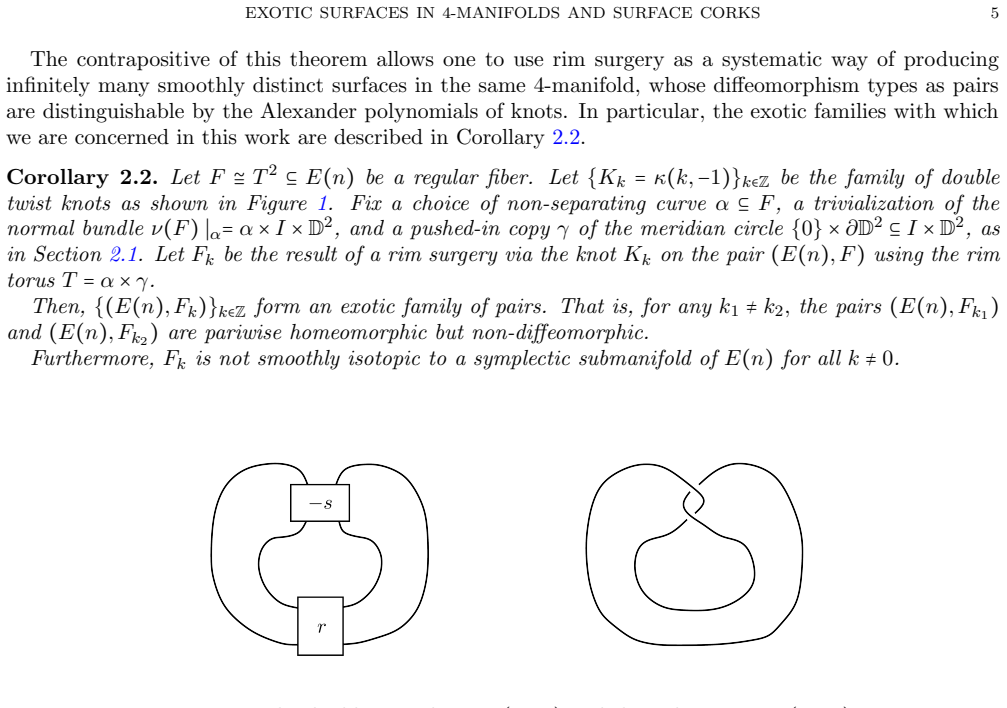
A fundamental result in 4-manifold topology asserts that every exotic smooth structure on a simply connected closed 4-manifold is determined by a cork -- a codimension-zero compact, contractible submanifold together with a diffeomorphism on its boundary. In this paper, we introduce the notion of a surface cork, an analogous object for smoothly embedded surface $F$ in 4-manifold $X$. This is a compact, contractible codimension-zero submanifold intersecting the surface $F$ in a controllable manner, whose removal and regluing via a diffeomorphism of its boundary changes the diffeomorphism type of $(X, F)$ as a pair while leaving its homeomorphism type unchanged. We construct the first example of a surface cork for certain exotic families constructed from Fintushel and Stern's rim surgery. In particular, this surface cork turns out to be diffeomorphic to a 4-ball.
0
0
math.GT 2026-05-01

K-framings extend spin structures to any commutative ring K

mathbb{K}-framings and mathbb{K}-quadratic forms on surfaces

The bijection to twisted cocycles of the mapping class group and relation to the Johnson homomorphism follow for positive genus surfaces.

Figure from the paper full image
abstract click to expand
We introduce the notions of $\mathbb{K}$-framings, based $\mathbb{K}$-framings and relative $\mathbb{K}$-framings of a compact connected oriented surface $\Sigma$ for any commutative ring $\mathbb{K}$ with unit, and a map which maps a based loop on $\Sigma$ to a homology class of its unit tangent bundle $U\Sigma$, which recovers Johnson's lifting in the case $\mathbb{K} = \mathbb{Z}/2$. This generalizes the correspondence between a quadratic form and a spin structure established by Johnson to any commutative ring $\mathbb{K}$ with unit. If the genus of $\Sigma$ is positive, we have a bijection between the set of $\mathbb{K}$-framings and the set of some twisted cocycles of the mapping class group of the surface $\Sigma$. Through this bijection, in the case where the boundary $\partial\Sigma$ is non-empty and connected, we discuss some relation between $\mathbb{K}$-framings and the extended first Johnson homomorphism.
0
0
math.GT 2026-05-01

Lipschitz spinors match decorated horospheres in any hyperbolic dimension

The Lipschitz Spinor-Higher Horosphere Correspondence

Generalization of Mathews' isomorphism uses Clifford algebra entries to extend the correspondence beyond three and four dimensions.

Figure from the paper full image
abstract click to expand
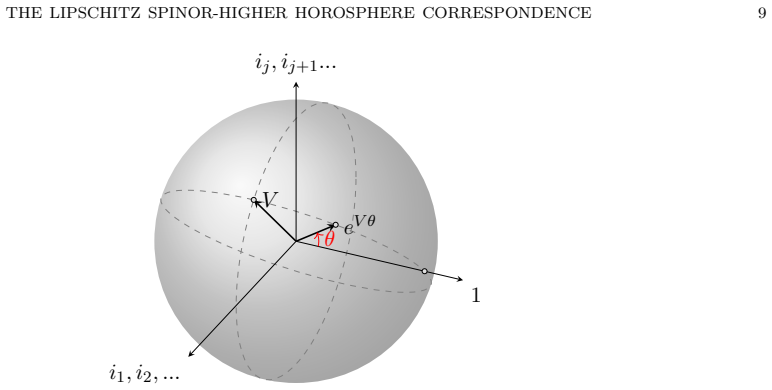
In a paper of Mathews, an isomorphism is constructed between two-component complex spinors and horospheres in H^3 carrying `spin decorations'. A recent arXiv preprint of Mathews and Varsha arXiv:2412.06572 extends this result to the case of `quaternionic spinors' and spin decorated horospheres in H^4. The following work generalises these results to an equivariant correspondence between two-component `Lipschitz spinors' with entries drawn from the Lipschitz group of a Clifford algebra, null multiflags in generalised Minkowski space, and higher-dimensional horospheres that carry an extension of the Mathews spin decoration. This correspondence allows spinors to be applied to horospheres in any dimension of hyperbolic space.
0
0
math.GT 2026-05-01

Geometric condition predicts infinite volume for hyperbolic convex hulls

Convex Hull Volumes in Hyperbolic 3-Space

Certain closed subsets of the Riemann sphere satisfy this test, allowing characterization of infinite-volume cases including self-similar 3D

Figure from the paper full image
abstract click to expand
In this paper we provide a geometric condition satisfied by certain closed subsets of the Riemann sphere which implies that their hyperbolic convex hulls in $\mathbb{H}^3$ have infinite volume. As a corollary, we characterize continua in the Riemann sphere whose hyperbolic convex hulls have infinite volume, answering a question of Danny Calegari. Furthermore, we give a geometric characterization of planar self-similar sets whose hyperbolic convex hulls have infinite volume.
0
0
math.GT 2026-05-01

Condition on sphere sets forces infinite convex hull volume in H^3

Convex Hull Volumes in Hyperbolic 3-Space

The criterion characterizes all continua with this property and classifies planar self-similar sets by the same test.

Figure from the paper full image
abstract click to expand
In this paper we provide a geometric condition satisfied by certain closed subsets of the Riemann sphere which implies that their hyperbolic convex hulls in $\mathbb{H}^3$ have infinite volume. As a corollary, we characterize continua in the Riemann sphere whose hyperbolic convex hulls have infinite volume, answering a question of Danny Calegari. Furthermore, we give a geometric characterization of planar self-similar sets whose hyperbolic convex hulls have infinite volume.
0
0
math.GT 2026-04-30

Normal rulings block 1.7M hard unknots from max-tb fronts

Hard Legendrian unknots

Infinite families and most of a large dataset of hard unknot diagrams cannot be max-tb Legendrian fronts, while infinitely many smoothly硬max

abstract click to expand
We initiate the study of Reidemeister hardness of Legendrian unknot front projections. Using normal rulings, we obstruct several infinite families of hard unknot diagrams from being drawn with max-tb unknot fronts, along with 1.7 million of the 2.6 million hard unknot diagrams studied in \cite{applebaum2024unknottingnumberhardunknot}. We construct infinitely many smoothly hard max-tb unknot diagrams, and bound their minimum possible writhe. With respect to these bounds, our constructions are conjecturally sharp.
0
0
math.GT 2026-04-30

39 moves connect any two movie diagrams of equivariant involutive cobordisms

Reidemeister and movie moves for involutive links

The result supplies a complete combinatorial calculus for surfaces connecting links fixed by 180-degree rotation.

Figure from the paper full image
abstract click to expand
An involutive link is a link which is invariant under the standard rotation by 180 degrees in $S^3$. We establish an equivariant analogue of the work of Carter and Saito aimed at studying equivariant cobordisms between involutive links. This gives a set of $39$ equivariant movie moves that suffice to go between any two movie presentations of a pair of equivariantly isotopic cobordisms. Along the way, we give a singularity-theoretic proof of the equivariant Reidemeister theorem and study loops of equivariant Reidemeister moves. Our approach proceeds by analyzing codimension $2$ singularities of equivariant maps from $S^1$ to $\mathbb{R}^2$, as well as utilizing embedded equivariant Morse theory.
0
0
math.GT 2026-04-30

Definite fold submersions restrict manifold diffeomorphism types

On submersions with definite folds of manifolds with boundary into Euclidean spaces

Maps to Euclidean space with controlled boundary singularities force limits on source manifold shapes and Euler numbers.

Figure from the paper full image
abstract click to expand
Submersions with definite folds are submersions on manifolds with boundary whose restrictions to the boundary are definite fold maps. In this paper, we study the properties from the viewpoint of differential topology of manifolds with boundary admitting such maps into Euclidean spaces. When the target is $\mathbb{R}$, we obtain restrictions on the diffeomorphism types of the source manifolds by using previous results of Hajduk and Borodzik--N\'emethi--Ranicki. For Euclidean spaces with general dimensions, we consider submersions with definite folds whose restrictions to the boundary are round fold maps or image simple fold maps, both defined by imposing conditions on the singular point set. Then, we study the diffeomorphism types and Euler characteristics of the manifolds admitting such maps. These results are also applied to the study of non-singular extensions of definite fold maps.
0
0
math.GT 2026-04-29

R-circles minimize CR-invariant energy of Legendrian knots

CR-invariant energy of Legendrian knots in the Heisenberg group

Regularized Koranyi-distance integral yields a PU(2,1)-invariant functional with an explicit cosine formula analog.

abstract click to expand
We introduce an energy functional for Legendrian knots in the 3-dimensional Heisenberg group $\mathcal{H}$, which serves as a sub-Riemannian analog of the M\"obius invariant knot energy in Euclidean 3-space introduced by the second author. The energy is obtained by regularizing a divergent integral of the potential of order -2 with respect to the Kor\'anyi distance on $\mathcal{H}$; this choice of distance is essential for the energy to be invariant under the action of PU(2,1). We characterize $\mathbb{R}$-circles in $\mathcal{H}$ as the minimizers of the energy, and establish a Heisenberg analog of the Doyle--Schramm cosine formula. We also show that the energy integrand admits an expression in terms of a complex-valued 2-form on the complement of the diagonal in $\mathcal{H}\times\mathcal{H}$, providing a partial analog of the infinitesimal cross ratio interpretation known from the classical setting.
0
0
math.GT 2026-04-29

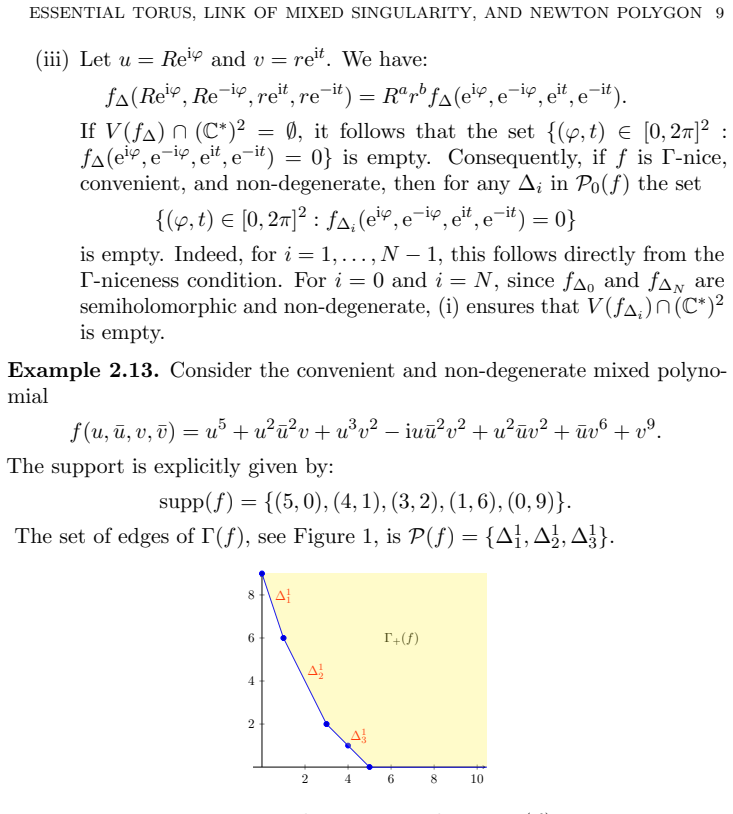
Polynomial criteria detect essential tori in mixed singularity links

Essential tori associated with links of mixed singularities

Convenient non-degenerate Γ-nice conditions give computable tests for non-hyperbolic exteriors without identifying the link

Figure from the paper full image
abstract click to expand
We establish a direct connection between the analytic data of weakly isolated mixed singularities and the topology of their associated links. More precisely, we prove that the existence of essential tori, topological information, in the complements of links arising from weakly isolated mixed singularities can be detected directly from properties of the defining mixed polynomial, provided that it is convenient, non-degenerate and $\Gamma$-nice. Our results provide explicit and computable criteria, expressed purely in terms of the polynomial data, that determine the presence of essential tori in the link exterior. In particular, these criteria yield effective conditions ensuring that such links are non-hyperbolic. This approach provides a new method to extract topological information about link complements without requiring an explicit determination of the link type, thereby establishing a concrete bridge between the analytic structure of mixed polynomials and the geometric topology of their associated links.
0
0
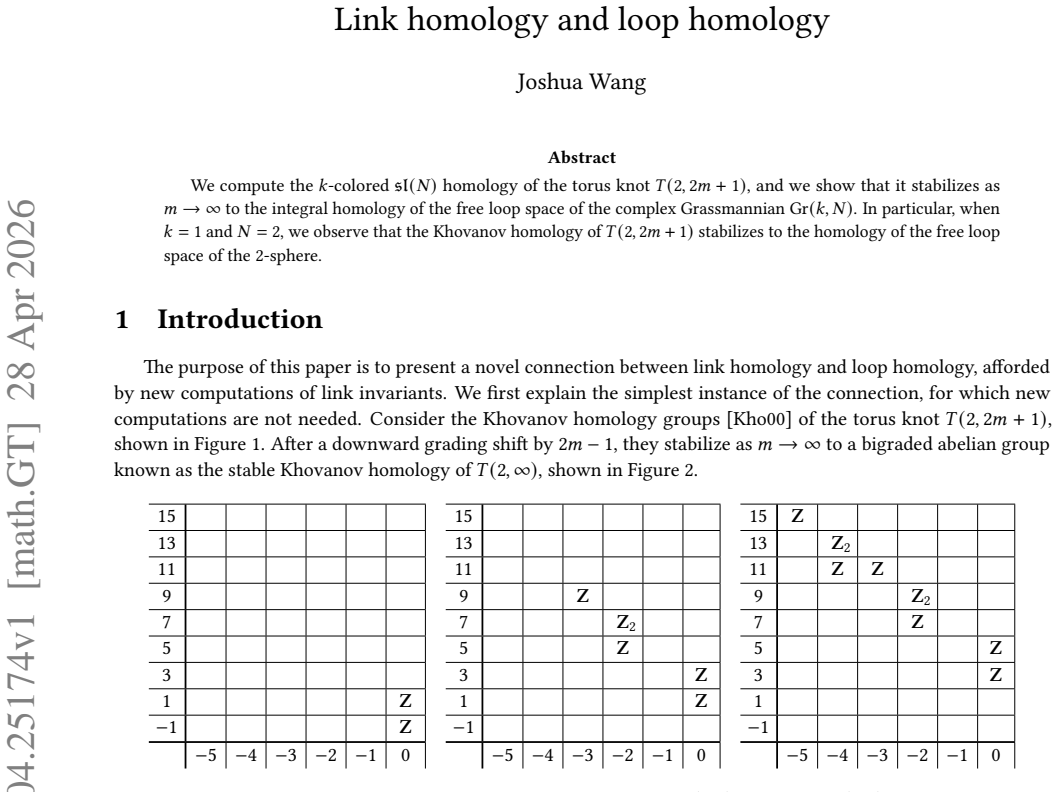
math.GT 2026-04-29

Colored torus-knot homology stabilizes to Grassmannian loop space

Link homology and loop homology

The k-colored sl(N) homology of T(2,2m+1) converges as m increases to the integral homology of the free loop space of Gr(k,N).

Figure from the paper full image
abstract click to expand
We compute the $k$-colored $\mathfrak{sl}(N)$ homology of the torus knot $T(2,2m+1)$, and we show that it stabilizes as $m\to\infty$ to the integral homology of the free loop space of the complex Grassmannian $\mathrm{Gr}(k,N)$. In particular, when $k = 1$ and $N = 2$, we observe that the Khovanov homology of $T(2,2m+1)$ stabilizes to the homology of the free loop space of the $2$-sphere.
0
0
math.GT 2026-04-29

Subgraphs of fine curve graphs contain flats of every dimension

Large flats in large subgraphs of fine curve graphs

Fixing an isotopy class yields non-hyperbolic graphs that embed Euclidean spaces of arbitrary finite dimension.

Figure from the paper full image
abstract click to expand
The fine curve graph of a surface is a graph whose vertices are essential simple closed curves and whose edges connect disjoint curves. Following a rich history of hyperbolicity of various graphs associated to surfaces, the fine curve graph was shown to be hyperbolic by Bowden-Hensel-Webb, while the curve graph, obtained from the fine curve graph by collapsing subgraphs corresponding to isotopy classes, was first proven to be hyperbolic by Masur-Minsky. We show that certain large subgraphs of fine curve graphs, including fibers over a vertex of the curve graph, are not hyperbolic. Indeed, such graphs contain flats of every finite dimension. We then compute bounds on distances in fibers over a vertex of the curve graph, which we call single-isotopy-class fine curve graphs.
0
0
math.GT 2026-04-28

Torelli group second rational cohomology now calculable

Calculating the second rational cohomology group of the Torelli group

Exposition joins Hain cup-product image and algebraic subrepresentation through the Johnson homomorphism.

abstract click to expand
Minahan and the author recently proved results that allow the calculation of the second rational cohomology group of the Torelli group. This builds on two key ingredients: Hain's calculation of the image of the cup product pairing on the first cohomology group, and Kupers--Randal-Williams's calculation of the maximal algebraic subrepresentation of the second cohomology group. This paper gives an exposition of both of these results, including prerequisite material about the Johnson homomorphism.
0
0
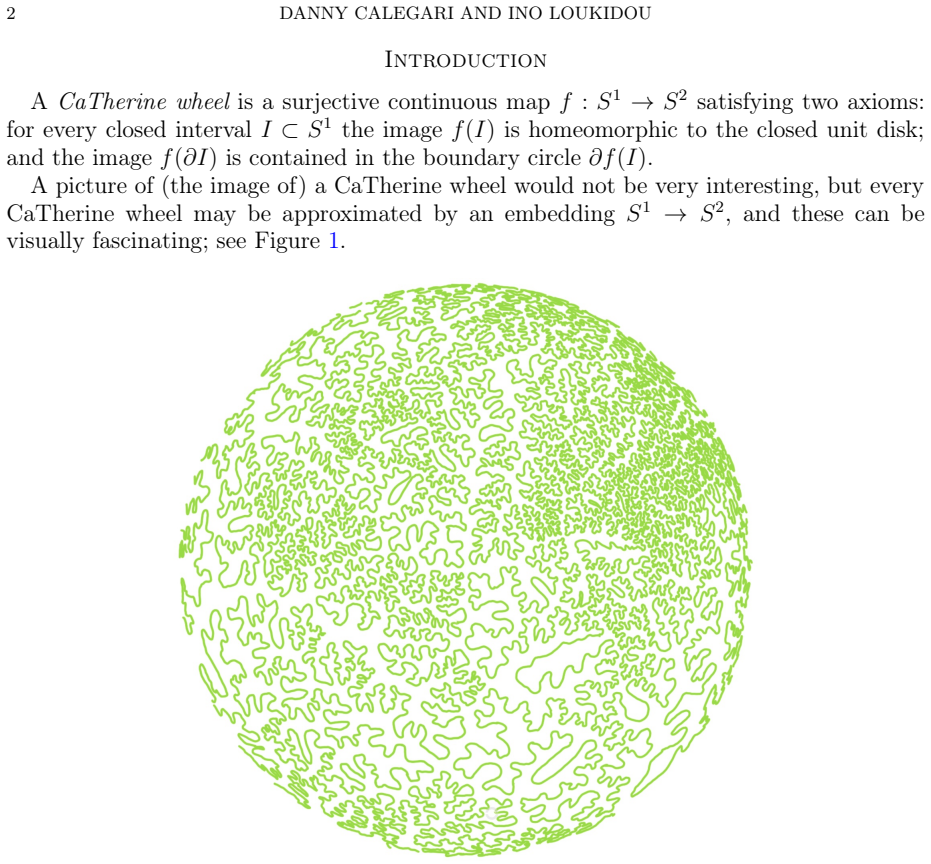
math.GT 2026-04-28

The paper defines CaTherine wheels as surjective continuous maps from a circle to a…

CaTherine wheels

CaTherine wheels unify structures across fields by providing a canonical bijection between orbit-equivalence classes of pseudo-Anosov flows…

Figure from the paper full image
abstract click to expand
A CaTherine wheel is a surjective continuous map $f:S^1 \to S^2$ such that for every closed interval $I\subset S^1$ the image $f(I)$ is homeomorphic to a disk, and $f(\partial I)$ is contained in the boundary of this disk. CaTherine wheels arise in many areas of low-dimensional geometry and topology, including conformal dynamics (expanding Thurston maps, expanding origamis), probability theory (whole plane ${\rm SLE}_\kappa$ for $\kappa \ge 8$, LQG metric trees) and elsewhere. We develop their theory in generality, and explain how CaTherine wheels and their associated structures can serve as a dictionary between these various fields. Our most substantial applications are to the theory of hyperbolic 3-manifolds. If $M$ is a closed hyperbolic 3-manifold and $G=\pi_1(M)$, we show that there is a canonical bijection between four kinds of structures associated to $M$: 1. orbit-equivalence classes of pseudo-Anosov flows on $M$ without perfect fits; 2. $G$-equivariant CaTherine wheels up to conjugacy; 3. minimal $G$-zippers; and 4. connected components of the space of uniform quasimorphisms on $G$. This generalizes and amplifies the theory of fiberings of hyperbolic 3-manifolds over the circle and the Thurston norm.
1 0
0
math.GT 2026-04-28

The paper examines necessary and sufficient conditions for good involutions on symplectic…

On the nonexistence of good involutions of symplectic quandles

Good involutions do not exist on symplectic quandles defined on free R-modules equipped with antisymmetric bilinear forms.

abstract click to expand
We investigate the necessary and sufficient condition for the existence of good involutions of symplectic quandles, which are defined on free $R$-modules with an antisymmetric bilinear form. In particular, we discuss the nonexistence of good involutions of symplectic quandles.
0
0
math.GT 2026-04-28

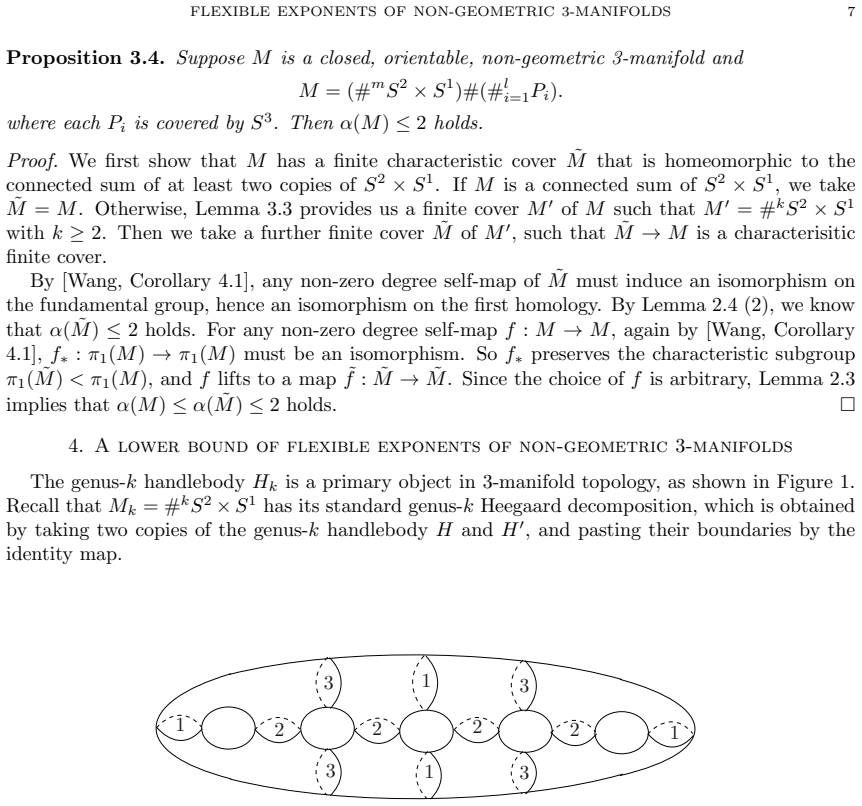
Flexible exponents determined for non-geometric 3-manifolds

Flexible exponents of non-geometric 3-manifolds

The infimum exponent that bounds mapping degree by Lipschitz power is now known for every closed orientable 3-manifold.

Figure from the paper full image
abstract click to expand
A classical question in quantitative topology is to bound the mapping degree $\operatorname{deg}(f)$ in terms of its Lipchitz constant $\text{Lip}(f)$. For a closed, orientable, Riemannian manifold $M$, the flexible exponent $\alpha(M)$ is the infimum of $\alpha\geqslant 0$ such that $|\text{deg}(f)|\leqslant C\cdot (\text{Lip}(f))^\alpha$ holds for any Lipschitz map $f:M\to M$. For a geometric 3-manifold $M$ in the sense of Thurston, $\alpha(M)$ is determined in \cite{DLWWW}. In this paper, we determine $\alpha(M)$ for non-geometric 3-manifolds.
0
0
math.GT 2026-04-27

Every knot type matches the unknot's p-density for p up to 2

Unconstrained and Ropelength-Windowed p-densities of Knot Types

Local knotting leaves the ratio of length to chord spread unchanged, so all knots share the circle's explicit value until thickness and ropl

abstract click to expand
We study a family of scale-invariant $p$-densities of knot types in $R^3$, defined as the ratio of length to an $L^p$-type spread of pairwise distances along a curve. The first point of the paper is that the unconstrained theory has a strong degeneration. Local knotting shows that, for every $p\in(-1,\infty]$ and every knot type $K$, the unconstrained $p$-density of $K$ is no larger than that of the unknot. Using the sharp mean-chord inequality of Exner--Harrell--Loss, we show that this degeneration is complete throughout the range $-1<p\le2$: for $p\ne0$ one has \[ \rho_p(K)= \pi\left( \frac{\pi}{\int_0^\pi \sin^p\theta\,d\theta} \right)^{1/p}, \] while $\rho_0(K)=2\pi$. At the endpoint $p=\infty$, one also has $\rho_\infty(K)=2$ for every knot type $K$. The remaining finite range $p>2$ is analytically different: the round circle is not the relevant extremal curve in general, and knot-type independence in this range is left as a separate extremal problem. These degenerations motivate a constrained refinement. We introduce ropelength-windowed $p$-densities by imposing the thickness normalization $Thi(\gamma)\ge 1$ and the length bound $len(\gamma)\le \lambda Rop(K)$. These constraints prevent the collapse caused by arbitrarily small local knotting. We prove basic monotonicity properties and an existence theorem for minimizers of the ropelength-windowed problem. We also retain the polygonal approximation theorem for the unconstrained densities, showing that the continuous and polygonal theories agree asymptotically as the number of edges tends to infinity. The paper concludes with a list of open questions concerning the finite high-exponent range, constrained density spectra, thickness-controlled polygonal approximation, and regularized inverse-power extensions.
1 0
0
math.GT 2026-04-27

Hyperbolic N' close to any N fails to embed in most M

A universal non-embedding theorem for 3-manifolds

The result follows from constructing manifolds with obstructing quantum ideals via SO(3) representation approximations.

abstract click to expand
We prove that given two compact oriented $3$-manifolds $N$ and $M,$ with $M$ satisfying only a mild hypothesis, there is a hyperbolic $3$-manifold $N'$ arbitrarily ``closely related'' to $N,$ and such that $N'$ does not embed in $M.$ For instance, as a weak version of our main theorem, if $M$ is a rational homology sphere then for any $k\geq 1$ the $3$-manifold $N'$ can be chosen to be $Y_k$-equivalent to $N.$ Our techniques rely on the construction of $3$-manifolds with complicated Frohman--Kania-Bartoszy\'nska ideals, using the strong approximation for $\mathrm{SO}_3$-Witten-Reshetikhin-Turaev quantum representations of mapping class groups of surfaces.
0
0
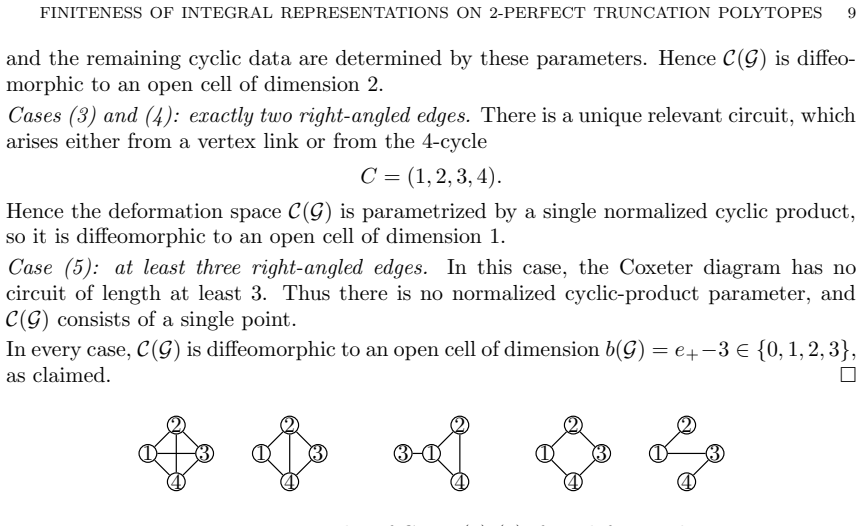
math.GT 2026-04-27

Geometric components of orbifold groups have only finitely many integral representations

Finiteness of integral representations on 2-perfect truncation polytopes

The deformation space of properly convex real projective structures on truncation polytopes contains finitely many integral points, with the

Figure from the paper full image
abstract click to expand
Let $P$ be a compact hyperbolic Coxeter truncation polytope of dimension $d\ge 3$, and let $\Gamma$ be the orbifold fundamental group of the associated Coxeter orbifold $\mathcal{O}_P$. Let $\mathscr{G}(\Gamma,G)$ be the geometric component containing the holonomy representation in $\operatorname{Hom}(\Gamma,G)/G$. $\mathscr{G}(\Gamma,G)$ is identified with the deformation space of properly convex real projective structures on the Coxeter orbifold $\mathcal{O}_P$. We prove that $\mathscr{G}(\Gamma,G)$ contains only finitely many integral representations. The same conclusion holds more generally for irreducible, large, $2$-perfect truncation polytopes.
0
0
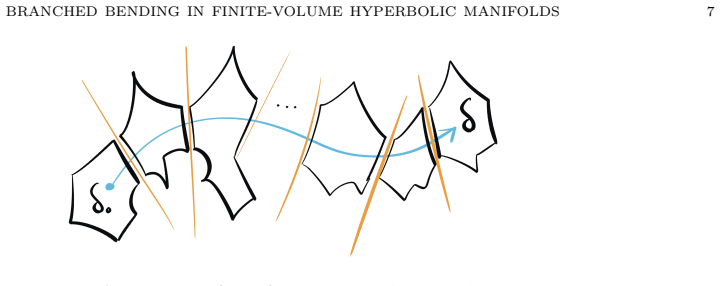
math.GT 2026-04-24

Branched bending sets lower bounds on hyperbolic deformation dimensions

Branched Bending in Finite-Volume Hyperbolic Manifolds

A generalization of classical bending shows that piecewise geodesic face complexes carry at least a computable number of infinitesimal flex

Figure from the paper full image
abstract click to expand
We define branched bending deformations as deformations supported on a piecewise totally geodesic complex of $(n-1)$-dimensional faces meeting along $(n-2)$-dimensional branching loci. These are a generalization of bending deformations, as introduced by Johnson and Millson. We give a lower bound on the dimension of the (infinitesimal) deformation space supported on a branched bending complex, and in doing so generalize a result of Bart and Scannell. We give equations describing these deformations in the setting of deforming to higher hyperbolic geometry and real projective geometry. As a special example of branched bending, we construct infinitesimal deformations supported on the link complement of the Borromean Rings (also known as the link $6^3_2$), recovering a special case of a theorem due to Menasco and Reid.
0
0
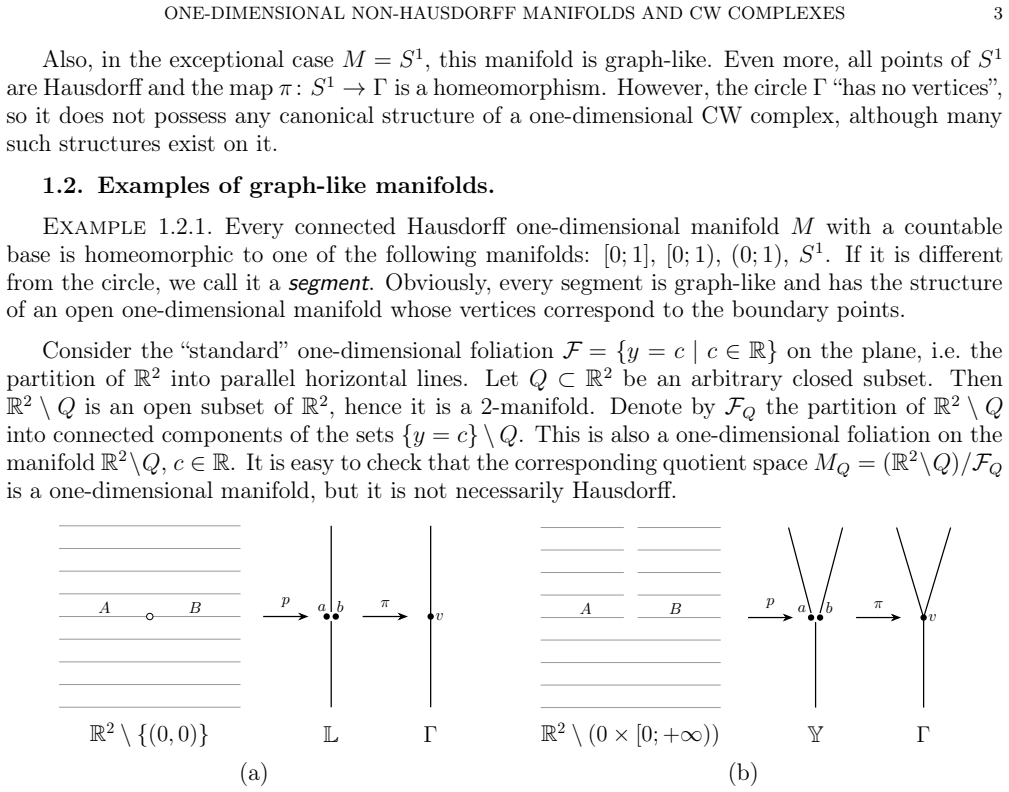
math.GT 2026-04-24

Non-Hausdorff 1-manifolds quotient to minimal Hausdorff CW complexes

One-dimensional non-Hausdorff manifolds and CW complexes

A natural map collapses split points to vertices and factors every map from the manifold into a Hausdorff space.

Figure from the paper full image
abstract click to expand
This paper studies one-dimensional non-Hausdorff manifolds that are similar to "graphs with split vertices". It is shown that if $M$ is a connected one-dimensional non-Hausdorff manifold such that the set of its "non-Hausdorff" points is locally finite, and each component of its complement has a countable base, then there exists a quotient map $\pi\colon M \to \Gamma$ onto an open one-dimensional CW complex, which maps the non-Hausdorff points of $M$ to the vertices of $\Gamma$. Moreover, $\Gamma$ is the minimal Hausdorff quotient of $M$, that is, for every continuous map $f\colon M \to N$ into a Hausdorff space $N$, there exists a unique continuous map $\hat{f}\colon \Gamma \to N$ such that $f = \hat{f} \circ \pi$.
0
0
math.GT 2026-04-24

Nontrivial elements on zippers fix one point per tree or act freely

Eclipses on Zippers

The fixed-point dichotomy for minimal zippers answers an open question and guarantees an element with exactly one fixed point in each tree.

Figure from the paper full image
abstract click to expand
Calegari and Loukidou introduced zippers, consisting of a disjoint pair of invariant real trees in the boundary of a closed hyperbolic 3-manifold group $\pi_1(M)$, which ensure the existence of a universal circle. We study the action of $\pi_1(M)$ on a minimal zipper and prove a fixed point dichotomy: every nontrivial element either fixes a unique point in each tree or acts freely on both. This answers a question of Calegari and Loukidou. As a consequence, there exists an element with exactly one fixed point in each tree.
1 0
0
math.GT 2026-04-24

Infinitely many smooth structures on definite 4-manifolds with infinite fundamental group

Smooth structures on definite four-manifolds with infinite fundamental group

For each odd p>1, constructions produce pairwise non-diffeomorphic irreducible examples whose fundamental group abelianizes to Z/2pZ × Z/2Z.

Figure from the paper full image
abstract click to expand
For each odd integer $p > 1$, we construct infinitely many pairwise non-diffeomorphic irreducible smooth structures on a definite 4-manifold with infinite fundamental group whose abelianization is $\Z/2p\Z\times \Z/2\Z$.
0
0
math.GT 2026-04-24

Real link Floer homology defined for strongly invertible links

Real link Floer homology

Combinatorial real grid diagrams in S^3 yield concrete computations and structural results for more than fifty small knots.

Figure from the paper full image
abstract click to expand
In this paper, we define real link Floer homology for strongly invertible and doubly periodic links in closed real $3$-manifolds with connected fixed sets, which generalizes real Heegaard Floer homology and real sutured Heegaard Floer homology. We give a combinatorial description of the theory in $S^3$ via real grid diagrams and use it to investigate structural properties of the theory as well as properties of strongly invertible knots. A computer implementation was written by Zhenkun Li. An appendix including real grid homology for 50+ small knots is made jointly by Zhenkun Li and the author, from which we observe several interesting phenomenon.
0
0
math.GT 2026-04-24

Leftmost universal circle gets Cannon-Thurston map to ideal sphere

Cannon--Thurston maps for Anosov foliations

For Anosov foliations with branching on hyperbolic manifolds, this yields pseudo-Anosov group actions on the circle.

Figure from the paper full image
abstract click to expand
Universal circles, introduced by Thurston and Calegari--Dunfield, are not well understood in general. Recently, the author together with Taylor showed that Anosov foliations with branching admit nonconjugate universal circles. We continue the study of these universal circles and show that for an Anosov foliation with branching on a hyperbolic manifold, the leftmost universal circle admits a Cannon--Thurston-type map to the ideal 2-sphere. This is a new type of construction of a Cannon--Thurston map. As a corollary, we show the fundamental group of the manifold acts on the leftmost universal circle with pseudo-Anosov dynamics.
0
0
math.GT 2026-04-23

2-bridge knot signatures approach normal distribution for large c

A central limit theorem for the signatures of 2-bridge knots

A closed formula counting knots by signature proves the values follow a Gaussian law once crossing number grows without bound.

Figure from the paper full image
abstract click to expand
Cohen, Lowrance, Madras, and Raanes computed the average (absolute value of) signature over all 2-bridge knots with crossing number $c$ by introducing the number $s(c,\sigma)$ of 2-bridge knots of crossing number $c$ and signature $\sigma$. Here we provide a closed formula for this number. We use these calculations to show that the distribution of the signatures of 2-bridge knots with crossing number $c$ approaches a normal distribution as $c$ tends to infinity.
0
0
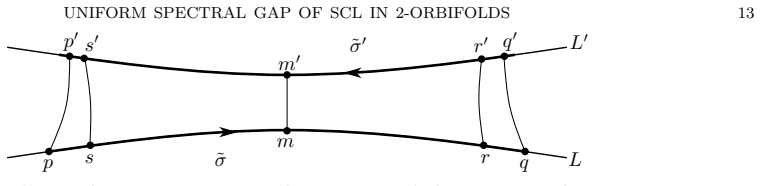
math.GT 2026-04-23

Hyperbolic 2-orbifolds have uniform scl gap of 1/36

Uniform spectral gap of scl in 2-orbifolds

Except for the sphere with three cone points, this bound supports scl estimates in 3-manifolds

Figure from the paper full image
abstract click to expand
We show a uniform spectral gap of stable commutator length for all compact hyperbolic $2$-orbifolds relative to the peripheral subgroups. Except for the case of a sphere with three cone points, we have an explicit uniform gap $1/36$. These estimates are needed in understanding stable commutator length in $3$-manifolds. Our methods use explicit quasimorphisms for the generic case, and use hyperbolic geometry (pleated surfaces) for the exceptional case of a sphere with three cone points.
0
0
math.GT 2026-04-23

Fibered classes descend under ribbon homology cobordisms

Twisted Alexander Polynomials and Fibered Classes in Ribbon Homology Cobordisms

Twisted Alexander polynomials show that if a class fibers above, its image fibers below in a homologically trivial 1-2-handle cobordism.

abstract click to expand
Let $Y_-$ and $Y_+$ be two compact 3-manifolds with empty or toroidal boundary. A 4-dimensional ribbon homology cobordism is a homologically trivial cobordism built with 1-handles and 2-handles. In this note, following the work of Friedl and collaborators, we apply twisted Alexander polynomials to show that the fibered classes of $Y_+$ map to those of $Y_-$.
0
0
math.GT 2026-04-23

Bordered modules compute real Floer homology

Real bordered Floer homology

For 3-manifolds whose involution swaps two boundary components, the new modules satisfy a pairing theorem and give an explicit algorithm for

Figure from the paper full image
abstract click to expand
Fix a 3-manifold $Y$ with boundary $F\amalg F$ and an orientation-preserving involution $\tau: Y\to Y$ exchanging the boundary components, with nonempty fixed set. To an appropriate kind of Heegaard diagram for $Y$, we describe how to associate a module over the bordered Heegaard Floer algebra of $F$. These modules satisfy a gluing, or pairing, theorem, and extend the "hat" variant of Guth-Manolescu's real Heegaard Floer homology, $\widehat{HFR}(Y,\tau)$. Using these modules, we give a practical algorithm to compute $\widehat{HFR}(Y,\tau)$ for real 3-manifolds $(Y,\tau)$ with connected fixed set.
1 0
0
math.GT 2026-04-22

Maw dual graph extracts Thurston norm from hierarchies

Sutured manifold hierarchies and the Thurston nom

The construction computes norms for three-component pretzel link exteriors and shows certain surface classes lie outside top cones of the Th

Figure from the paper full image
abstract click to expand
Classical work of Thurston and Gabai shows that finitely many taut sutured manifold hierarchies determine the Thurston norm of a compact oriented irreducible $3$-manifold with toroidal boundary. We give an explicit procedure to extract this information from such hierarchies. This is achieved via the maw dual graph construction, which can be incorporated into a general method for computing the Thurston norm of a manifold. As an application, we compute the Thurston norm of the exterior of all alternating and some nonalternating pretzel links with three components. Using these computations, we give a negative answer to a question of Baker--Taylor. Moreover, we show that if a nonseparating surface $S$ in a Haken manifold $M$ with toroidal boundary is disjoint from a boundary torus, then the class $[S] \in H_2(M,\partial M)$ does not lie in the interior of a top-dimensional cone of the Thurston norm. In particular, if two components $\ell_i$ and $\ell_j$ of a nonsplit link have zero linking number, then neither represents a class in an open top-dimensional cone of the Thurston norm ball of the link exterior.
0
0
math.GT 2026-04-22

Seifert 3-manifolds over RP² are L-spaces with suspension Floer type

Floer homotopy type and eta invariants of Seifert 3-manifolds fibering over mathbb{RP}²

Their Floer homotopy type is a suspension of S^0 and d-invariants are computed from eta invariants of adiabatic Dirac operators.

Figure from the paper full image
abstract click to expand
We compute the Floer homology and Seiberg-Witten Floer homotopy type of Seifert rational homology $3$-spheres which fiber over $\mathbb{RP}^2$. We show that they are all $L$-spaces and their Floer homotopy type is a suspension of $S^0$. Additionally, we compute the Ozsv\'ath-Szab\'o $d$-invariants, or equivalently the Seiberg-Witten $\delta$-invariants for such $3$-manifolds. This is done by computing the eta invariant of spin$^c$-Dirac operators associated to spin$^c$-connections covering the adiabatic connection, a certain metric connection distinct from the Levi-Civita connection. It turns out that this eta invariant involves a contribution given by the eta invariant of an orbifold pin$^c$-connection on the orbifold base of the Seifert fibration, which we also compute.
0
0
math.GT 2026-04-22

Anosov families asymptote to graph invariants

On separated families of Anosov representations

Diverging separated sequences have critical exponents matching combinatorial data from finite graphs, enabling metric bounds and study of de

Figure from the paper full image
abstract click to expand
We introduce different notions of separation for families of Anosov representations. We show that, along a diverging sequence of such families, the critical exponent is asymptotic to a combinatorial invariant computable from the spectral data of a finite graph. Our method allows us to derive bounds on the Thurston asymmetric metric. As an application, we study specific degenerations of convex projective structures on a pair of pants, generalizing an example of McMullen.
0
0
math.GT 2026-04-21

Bounded surface mapping classes equal boundary-fixed groupoid automorphisms

The Dehn-Nielsen-Baer Theorem for Bounded Surfaces

The Dehn-Nielsen-Baer theorem extends by equating isotopy classes of homeomorphisms with automorphisms of the fundamental groupoid that fix

Figure from the paper full image
abstract click to expand
Let $\Sigma$ be a bounded surface. We prove the Dehn-Nielsen-Baer theorem for bounded surfaces to show that the mapping class group of $\Sigma$ is isomorphic to the automorphisms of the fundamental groupoid of $\Sigma$ that fix loops around the boundary.
0
0
math.GT 2026-04-21

Involutive invariants block pairs of violating surfaces in four-manifolds

Involutive Floer Invariants for Closed Four-Manifolds

The mixed invariant proves K3#(S^2 x S^2) admits no two disjoint embedded surfaces each breaking the adjunction bound.

abstract click to expand
Inspired by the Ozsv\'ath-Szab\'o mixed invariant in ordinary Heegaard Floer theory, we define a mixed invariant $\Phi_{X, \mathfrak{s}}^{I}$ for closed, spin four-manifolds $(X, \mathfrak{s})$ using the cobordism maps on involutive Heegaard Floer homology. The invariant is well-defined whenever $b_{2}^{+}(X) > 4$. We furthermore construct an involutive Seiberg-Witten invariant that is well-defined whenever $b_{2}^{+}(X) > 3$. We show that these involutive invariants obstruct the existence of disjoint pairs of embedded surfaces which both violate the adjunction inequality. As an application, we find that $K3\#(S^2 \times S^2)$ contains no such pair.
0

browse all of math.GT → full archive · search · sub-categories