REVIEW 6 major objections 6 minor 1 cited by
Deformable Gaussian Splatting for Efficient and High-Fidelity Reconstruction of Surgical Scenes
T0 review · 6 major / 6 minor · reviewed 2026-08-10 · deepseek-v4-flash
Pith's one-line read Surgical scene rendering hits up to 400 fps with sharper tissue detail
desk verdict EH-SurGS is a competent incremental contribution whose quality gains are real but modest, and whose speed claim is not reproducible because the key image-region-to-Gaussian mapping is never specified. read the letter →
The pith
A machine-rendered reading of the paper's core claim, the machinery that carries it, and where it could break.
The reading
What carries the argument
The two load-bearing components are the life-cycle opacity model and the adaptive motion mask. The life cycle makes opacity itself time-dependent through an additive sum of learnable Gaussian basis functions (Eq. 8), which the paper distinguishes from prior multiplicative opacity products; this is what lets it represent newly appearing or disappearing content such as sheared tissue. The motion mask is an $H\times W$ image-space label map, updated every $N_m$ iterations, that decides per region whether Gaussians must be warped; thresholds $\delta_1$ and $\delta_2$ plus recursive splitting of conflicting regions form the hierarchy. Together they determine which Gaussians enter the deformation field and at what opacity they render.
What would settle it
Train EH-SurGS on a surgical clip with a static background and one shearing event, then render the same frames with the adaptive motion hierarchy disabled: the paper predicts equal reconstruction quality but lower FPS. If enabling the hierarchy lowers PSNR or introduces ghosting around the sheared region, the mask is misclassifying deformable Gaussians and the central speed-quality claim fails. A second check: inspect depth maps in sheared regions; the additive life-cycle opacity should remove old Gaussians cleanly, whereas multiplicative opacity leaves depth artifacts, as the paper's ablations show.
Extended reading notes
Core claim
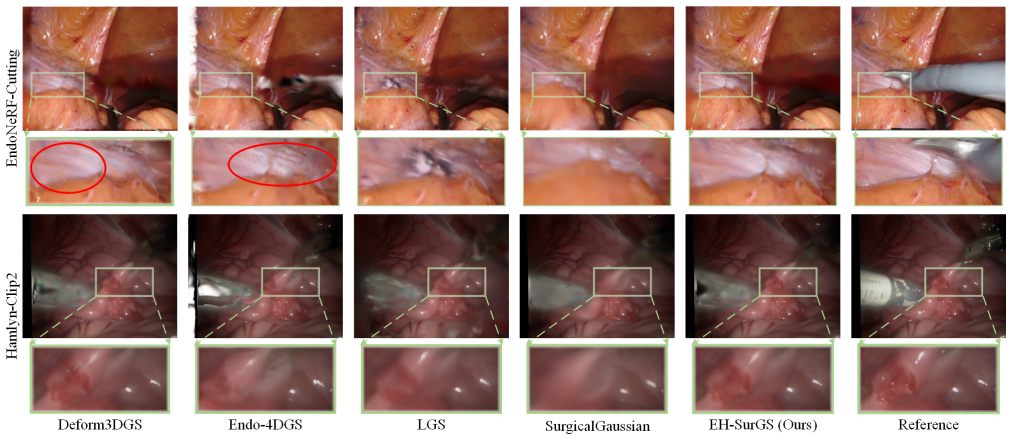
EH-SurGS extends deformable 3D Gaussian splatting with two mechanisms. First, for irreversible deformations, each Gaussian's opacity is modeled as $\alpha_t = \alpha_0 + \sum_{j=1}^{B} \omega^\alpha_j b^\alpha(t)$, with learnable Gaussian basis functions $b(t)=\exp\left(-\frac{1}{2\sigma^2}(t-\theta)^2\right)$ and $B=20$, so Gaussians can appear and disappear at specific times instead of only warping. Second, an adaptive motion hierarchy divides the image into $N\times N$ regions and maintains a mask $F$ that labels regions as dynamic or static using two criteria: average Gaussian displacement against threshold $\delta_1=0.05$, and rendering-loss difference with and without deformation against $\delta_2=0.5$; conflict regions are split into four subregions. Gaussians in static regions bypass the deformation field. The paper reports that on EndoNeRF-Cutting/Pulling, Hamlyn-Clip1/2, and StereoMIS-P1-1/P1-2, EH-SurGS outperforms Forplane, Deform3DGS, Endo-4DGS, LGS, and SurgicalGaussian in PSNR and SSIM, with FPS up to 400, while the ablations attribute quality gains to the life cycle and speed gains to the motion hierarchy.
Load-bearing premise
The method assumes that an image-space region mask, updated with thresholds on average deformation and loss difference, correctly tells which 3D Gaussians are static, so those Gaussians can skip deformation without visible error.
Editorial extensions
If this is right
- Real-time rendering: the reported 349–400 FPS means deformable surgical scenes can be rendered at interactive or real-time rates on a single RTX 4090.
- Better fidelity for tissue damage: the life cycle represents irreversible changes like cutting and shearing, which prior deformation-only models blur or ghost.
- Faster training: EH-SurGS reports lower training time than Forplane, Endo-4DGS, LGS, and SurgicalGaussian, with training times around 97–131 seconds across the six clips.
- Modular components: the ablation shows the life cycle and motion hierarchy are independent; removing either one degrades quality or speed respectively.
- The ranking loss from SparseNeRF is retained for depth supervision, indicating the method does not sacrifice geometric constraints for speed.
Reading between the lines
- The image-space mask implies an unstated geometric correspondence between image regions and 3D Gaussians; making the mask operate directly on 3D Gaussians (e.g., by spatial proximity) would be a natural follow-up that could extend the speedup to moving-camera settings.
- The same life-cycle mechanism could transfer to other dynamic scene reconstruction tasks where objects appear or disappear—such as removing surgical instruments or modeling cutting—beyond the endoscopic domain.
- Since the paper is limited to static endoscopes, a direct test of the hierarchy is to keep the camera fixed but add parallax-inducing motion; if the mask mislabels background Gaussians under small camera motion, the speedup will not survive extension to colonoscopy.
- The reported FPS counts assume the mask is computed infrequently; an implementation that updates the mask every frame would likely trade the speed advantage away, so the practical gain depends on the update schedule.
Editorial analysis
A structured set of objections, weighed in public.
Referee Report
Summary. The paper proposes EH-SurGS, a deformable 3D Gaussian splatting method for reconstructing surgical scenes from stereo endoscopic video. It introduces a life-cycle model for 3D Gaussians to handle irreversible tissue changes and an adaptive motion hierarchy strategy (AMHS) that classifies image regions as static or deformable so that only dynamic Gaussians pass through the deformation field. The method is evaluated on six clips from the EndoNeRF, Hamlyn, and StereoMIS datasets, reporting higher PSNR and SSIM than four 3DGS-based baselines and Forplane, higher FPS than Deform3DGS, and a lower LPIPS on most clips. Ablations on EndoNeRF-Cutting isolate the contributions of the life cycle and the motion hierarchy.
Significance. The ideas are relevant to real-time surgical scene reconstruction, and the reported improvements are consistent across datasets. The life-cycle formulation and the static/deformable decomposition are reasonable and, if fully specified, would be a useful contribution. The paper also provides a thorough ablation, including a comparison of additive versus multiplicative life-cycle opacities. However, the manuscript currently omits the key detail that makes AMHS workable—the assignment from image-space regions to 3D Gaussians—and does not address validity constraints on deformed Gaussian parameters. Because the code is promised but not yet available, these omissions materially block reproduction.
major comments (6)
- [Section III-C, Fig. 2] The adaptive motion hierarchy strategy is under-specified: the mask F is defined in image space (H×W, divided into N×N regions), but the paper never states how a region label is assigned to each 3D Gaussian. The text says 'The updated mask will control whether the 3D Gaussians in the canonical space need to be deformed' and computes average deformation 'for all 3D Gaussians in each region,' yet a Gaussian can project onto multiple regions, can move between regions as it deforms, and can be newly created by densification. Without an explicit assignment rule (projected center, footprint overlap, depth back-projection, or similar) and a rule for newly added Gaussians, the speedup of AMHS reported in Table II (351.00 to 379.67 FPS) is not reproducible. Please provide the full assignment procedure, including behavior under the region-splitting step.
- [Section III-B, Eqs. (7)-(8)] The deformation model applies unconstrained additive updates to rotation, scale, and opacity. In 3DGS, rotation is a unit quaternion, but adding an unconstrained increment in Eq. (7) does not preserve unit length; scale values can become negative; and the additive opacity update in Eq. (8) can produce alpha_t below 0 or above 1. These would make the alpha compositing in Eqs. (4)-(5) invalid. The paper does not describe any normalization, clamping, or reparameterization for these parameters. Since the reported quality gain of the life-cycle model (Table II) depends on this update, please clarify how valid parameter ranges are enforced during optimization.
- [Section IV, Baselines and Table I] The baseline list in Section IV includes EndoSparse [11], but Table I contains no result for EndoSparse on any clip. Because the paper claims superiority over state-of-the-art methods, omitting a named baseline from the quantitative comparison leaves the claim incomplete. Please add the missing results or explicitly justify the exclusion.
- [Section IV-A, Table I] The sentence 'EH-SurGS surpasses these methods in terms of reconstruction quality, training time, and rendering speed across all six datasets' is contradicted by Table I on StereoMIS-P1-2: LGS reports a training time of 119 s versus 131 s for EH-SurGS. Please correct the claim to reflect the actual training-time comparisons.
- [Section III-C, update criteria] The thresholds δ1=0.05 and δ2=0.5 are described as 'experimentally determined,' but the paper provides no sensitivity analysis or validation procedure. If these constants were tuned on the same clips used for final evaluation, the results in Table I may be optimistic. Please document how the thresholds were chosen and report a sensitivity study over their values, or provide a cross-validation protocol.
- [Section III-D, Implementation Details] The statement that 'the projection matrix P is set as the identity matrix' is difficult to interpret, because a 4×4 identity matrix is not a valid perspective projection for an endoscopic camera. If P is instead intended to be the camera pose or a pre-warped mapping, this should be stated precisely; otherwise the rendering procedure cannot be reproduced from the paper.
minor comments (6)
- [Eq. (10)] The norms in LC and LD are not specified; please state whether L1 or L2 is used, and define the ranking loss L_rank precisely.
- [Table I caption] The parentheses are said to contain variance, but the magnitudes (e.g., 0.011 for PSNR) look like standard deviations; please clarify the statistic and report the number of runs.
- [Section IV, Datasets] The datasets section cites the StereoMIS dataset as [20], but Section IV-A cites '[25]', and reference [25] is an unrelated room-reconstruction paper; please correct the citation.
- [Section IV-B, Ablation] The w/o MIU variant 'maintains the default number of mask updates,' but the initial value of Nm and the update schedule are not defined in Section III-C; please specify them.
- [Section IV, Datasets] The training/test split is described only as a '7:1 ratio'; please report the exact number of training and testing frames for each clip, since the clip lengths vary from 63 to 184 frames.
- [Figure 2] The figure would benefit from explicitly showing how the image-space mask is converted into per-Gaussian static/deformable labels, since this conversion is a central step of the method.
Circularity Check
No circularity: the method's components are evaluated empirically against independent baselines, and the self-referential mask update is a heuristic with an ablation-based speed claim, not a prediction derived from its own inputs.
full rationale
EH-SurGS makes no claim to derive a result from first principles; it is an empirical systems paper whose evidence is benchmark comparison against independent baselines (Forplane, Deform3DGS, Endo-4DGS, LGS, SurgicalGaussian) on three public datasets, plus ablations in Table II. The life-cycle model is an additive temporal basis (Eqs. 6-8) that modifies, rather than inherits, the product-form opacity of STG/GaussianPrediction; its benefit is measured by the w/o LC and w/o LC-add ablations, not by construction. The adaptive motion hierarchy mask is a heuristic classifier updated from the model's own per-region average deformation and rendering losses; this is algorithmically self-referential (the mask controls which Gaussians are deformed and is then re-estimated from those same Gaussians), but it is not a fitted parameter renamed as a prediction, and the speed claim is validated by the w/o AMHS ablation showing FPS dropping from 379.67 to 351.00 with essentially unchanged PSNR, i.e., an empirical computational effect rather than a circular deduction. Thresholds δ1=0.05, δ2=0.5 and N=4 are hyperparameters, not fitted predictions. The only load-bearing gap is that Sec. III-C defines F in image space and thresholds on per-region quantities but never specifies how image-space regions map to 3D Gaussians; this is a reproducibility/implementation omission, not a circularity. The sole self-citation [8] appears as a related-work entry and is not load-bearing. No uniqueness theorem or ansatz is imported from the authors' prior work. Score 0.
Assumptions & free parameters
free parameters (5)
- δ1 =
0.05
- δ2 =
0.5
- B =
20
- λ =
0.0002
- N =
4
assumptions (4)
- standard math 3D Gaussian splatting correctly models static scenes and supports differentiable rendering.
- domain assumption Input depth maps and surgical tool masks are accurate enough for point cloud initialization and loss computation.
- domain assumption The surgical scene is captured by a static endoscopic camera.
- domain assumption A deformation field with 20 Gaussian basis functions can represent general and irreversible tissue deformations.
Cite this review
Pith. "Pith review of Deformable Gaussian Splatting for Efficient and High-Fidelity Reconstruction of Surgical Scenes." pith.science (2026). https://pith.science/paper/6FNQDOWE
@misc{pith2026250101101,
  author       = {Pith},
  title        = {Pith review of: Deformable Gaussian Splatting for Efficient and High-Fidelity Reconstruction of Surgical Scenes},
  year         = {2026},
  howpublished = {\url{https://pith.science/paper/6FNQDOWE}},
  note         = {Machine review of arXiv:2501.01101}
}
read the original abstract
Efficient and high-fidelity reconstruction of deformable surgical scenes is a critical yet challenging task. Building on recent advancements in 3D Gaussian splatting, current methods have seen significant improvements in both reconstruction quality and rendering speed. However, two major limitations remain: (1) difficulty in handling irreversible dynamic changes, such as tissue shearing, which are common in surgical scenes; and (2) the lack of hierarchical modeling for surgical scene deformation, which reduces rendering speed. To address these challenges, we introduce EH-SurGS, an efficient and high-fidelity reconstruction algorithm for deformable surgical scenes. We propose a deformation modeling approach that incorporates the life cycle of 3D Gaussians, effectively capturing both regular and irreversible deformations, thus enhancing reconstruction quality. Additionally, we present an adaptive motion hierarchy strategy that distinguishes between static and deformable regions within the surgical scene. This strategy reduces the number of 3D Gaussians passing through the deformation field, thereby improving rendering speed. Extensive experiments demonstrate that our method surpasses existing state-of-the-art approaches in both reconstruction quality and rendering speed. Ablation studies further validate the effectiveness and necessity of our proposed components. We will open-source our code upon acceptance of the paper.
Figures


Forward citations
Cited by 1 Pith paper
-
E-4DGS: High-Fidelity Dynamic Reconstruction from the Multi-view Event Cameras
E-4DGS is a deformable 3D Gaussian Splatting method that reconstructs dynamic scenes directly from multi-view event camera streams, outperforming event-to-image baseline approaches.
Reference graph
Works this paper leans on
-
[11]
Endosparse: Real-time sparse view synthesis of endoscopic scenes using gaussian splatting,
C. Li, B. Y . Feng, Y . Liu, H. Liu, C. Wang, W. Yu, and Y . Yuan, “Endosparse: Real-time sparse view synthesis of endoscopic scenes using gaussian splatting,” arXiv preprint arXiv:2407.01029 , 2024
arXiv 2024
-
[1]
State of the art on neural rendering,
A. Tewari, O. Fried, J. Thies, V . Sitzmann, S. Lombardi, K. Sunkavalli, R. Martin-Brualla, T. Simon, J. Saragih, M. Nießner et al. , “State of the art on neural rendering,” in Computer Graphics F orum, vol. 39, no. 2. Wiley Online Library, 2020, pp. 701–727
work page 2020
-
[2]
A. Tewari, J. Thies, B. Mildenhall, P. Srinivasan, E. Tretschk, W. Yifan, C. Lassner, V . Sitzmann, R. Martin-Brualla, S. Lombardi et al. , “Advances in neural rendering,” in Computer Graphics F orum, vol. 41, no. 2. Wiley Online Library, 2022, pp. 703–735
work page 2022
-
[3]
Nerf: Representing scenes as neural radiance fields for view synthesis,
B. Mildenhall, P. P. Srinivasan, M. Tancik, J. T. Barron, R. Ramamoor- thi, and R. Ng, “Nerf: Representing scenes as neural radiance fields for view synthesis,” Communications of the ACM , vol. 65, no. 1, pp. 99–106, 2021
2021
-
[4]
Neural rendering for stereo 3d reconstruction of deformable tissues in robotic surgery,
Y . Wang, Y . Long, S. H. Fan, and Q. Dou, “Neural rendering for stereo 3d reconstruction of deformable tissues in robotic surgery,” in Inter- national Conference on Medical Image Computing and Computer- Assisted Intervention . Springer, 2022, pp. 431–441
work page 2022
-
[5]
Endosurf: Neural surface reconstruction of deformable tissues with stereo endoscope videos,
R. Zha, X. Cheng, H. Li, M. Harandi, and Z. Ge, “Endosurf: Neural surface reconstruction of deformable tissues with stereo endoscope videos,” in International Conference on Medical Image Computing and Computer-Assisted Intervention . Springer, 2023, pp. 13–23
work page 2023
-
[6]
Neural lerplane representations for fast 4d reconstruction of deformable tissues,
C. Yang, K. Wang, Y . Wang, X. Yang, and W. Shen, “Neural lerplane representations for fast 4d reconstruction of deformable tissues,” arXiv preprint arXiv:2305.19906, 2023
arXiv 2023
-
[7]
Lightneus: Neural surface reconstruction in endoscopy using illumination de- cline,
V . M. Batlle, J. M. Montiel, P. Fua, and J. D. Tard ´os, “Lightneus: Neural surface reconstruction in endoscopy using illumination de- cline,” in International Conference on Medical Image Computing and Computer-Assisted Intervention . Springer, 2023, pp. 502–512
work page 2023
Show all 25 references
-
[8]
Enerf-slam:a dense endoscopic slam with neural implicit representation,
J. Shan, Y . Li, T. Xie, and H. Wang, “Enerf-slam:a dense endoscopic slam with neural implicit representation,” IEEE Transactions on Med- ical Robotics and Bionics , vol. 6, no. 3, pp. 1030–1041, 2024
2024
-
[9]
Deform3dgs: Flexible deformation for fast surgical scene reconstruction with gaus- sian splatting,
S. Yang, Q. Li, D. Shen, B. Gong, Q. Dou, and Y . Jin, “Deform3dgs: Flexible deformation for fast surgical scene reconstruction with gaus- sian splatting,” arXiv preprint arXiv:2405.17835 , 2024
2024 arXiv
-
[10]
Endo-4dgs: Distilling depth ranking for endoscopic monocular scene reconstruc- tion with 4d gaussian splatting,
Y . Huang, B. Cui, L. Bai, Z. Guo, M. Xu, and H. Ren, “Endo-4dgs: Distilling depth ranking for endoscopic monocular scene reconstruc- tion with 4d gaussian splatting,” arXiv preprint arXiv:2401.16416 , 2024
2024 arXiv
-
[12]
Lgs: A light-weight 4d gaussian splatting for efficient surgical scene reconstruction,
H. Liu, Y . Liu, C. Li, W. Li, and Y . Yuan, “Lgs: A light-weight 4d gaussian splatting for efficient surgical scene reconstruction,” arXiv preprint arXiv:2406.16073, 2024
2024 arXiv
-
[13]
Surgicalgaussian: Deformable 3d gaussians for high-fidelity surgical scene reconstruction,
W. Xie, J. Yao, X. Cao, Q. Lin, Z. Tang, X. Dong, and X. Guo, “Surgicalgaussian: Deformable 3d gaussians for high-fidelity surgical scene reconstruction,” arXiv preprint arXiv:2407.05023 , 2024
2024 arXiv
-
[14]
3d gaussian splatting for real-time radiance field rendering
B. Kerbl, G. Kopanas, T. Leimk ¨uhler, and G. Drettakis, “3d gaussian splatting for real-time radiance field rendering.” ACM Trans. Graph. , vol. 42, no. 4, pp. 139–1, 2023
2023
-
[15]
Efficient deformable tissue reconstruction via orthogonal neural plane,
C. Yang, K. Wang, Y . Wang, Q. Dou, X. Yang, and W. Shen, “Efficient deformable tissue reconstruction via orthogonal neural plane,” IEEE Transactions on Medical Imaging , 2024
2024
-
[16]
Ewa splatting,
M. Zwicker, H. Pfister, J. Van Baar, and M. Gross, “Ewa splatting,” IEEE Transactions on Visualization and Computer Graphics , vol. 8, no. 3, pp. 223–238, 2002
2002
-
[17]
Spacetime gaussian feature splatting for real-time dynamic view synthesis,
Z. Li, Z. Chen, Z. Li, and Y . Xu, “Spacetime gaussian feature splatting for real-time dynamic view synthesis,” in Proceedings of the IEEE/CVF Conference on Computer Vision and Pattern Recognition , 2024, pp. 8508–8520
2024
-
[18]
Gaussianprediction: Dynamic 3d gaussian prediction for motion extrapolation and free view synthesis,
B. Zhao, Y . Li, Z. Sun, L. Zeng, Y . Shen, R. Ma, Y . Zhang, H. Bao, and Z. Cui, “Gaussianprediction: Dynamic 3d gaussian prediction for motion extrapolation and free view synthesis,” in ACM SIGGRAPH 2024 Conference Papers , 2024, pp. 1–12
2024
-
[19]
Sparsenerf: Distilling depth ranking for few-shot novel view synthesis,
G. Wang, Z. Chen, C. C. Loy, and Z. Liu, “Sparsenerf: Distilling depth ranking for few-shot novel view synthesis,” in Proceedings of the IEEE/CVF International Conference on Computer Vision , 2023, pp. 9065–9076
2023
-
[20]
Learning how to robustly estimate camera pose in endoscopic videos,
M. Hayoz, C. Hahne, M. Gallardo, D. Candinas, T. Kurmann, M. Al- lan, and R. Sznitman, “Learning how to robustly estimate camera pose in endoscopic videos,” International journal of computer assisted radiology and surgery , vol. 18, no. 7, pp. 1185–1192, 2023
2023
-
[21]
Endo- depth-and-motion: Reconstruction and tracking in endoscopic videos using depth networks and photometric constraints,
D. Recasens, J. Lamarca, J. M. F ´acil, J. Montiel, and J. Civera, “Endo- depth-and-motion: Reconstruction and tracking in endoscopic videos using depth networks and photometric constraints,” IEEE Robotics and Automation Letters, vol. 6, no. 4, pp. 7225–7232, 2021
2021
-
[22]
Efficientsam: Leveraged masked image pretraining for efficient segment anything,
Y . Xiong, B. Varadarajan, L. Wu, X. Xiang, F. Xiao, C. Zhu, X. Dai, D. Wang, F. Sun, F. Iandola et al. , “Efficientsam: Leveraged masked image pretraining for efficient segment anything,” in Proceedings of the IEEE/CVF Conference on Computer Vision and Pattern Recogni- tion, ...
2024
-
[23]
Image quality assessment: from error visibility to structural similarity,
Z. Wang, A. C. Bovik, H. R. Sheikh, and E. P. Simoncelli, “Image quality assessment: from error visibility to structural similarity,” IEEE transactions on image processing , vol. 13, no. 4, pp. 600–612, 2004
2004
-
[24]
The unreasonable effectiveness of deep features as a perceptual metric,
R. Zhang, P. Isola, A. A. Efros, E. Shechtman, and O. Wang, “The unreasonable effectiveness of deep features as a perceptual metric,” in Proceedings of the IEEE conference on computer vision and pattern recognition, 2018, pp. 586–595
2018
-
[25]
Learning a room with the occ-sdf hybrid: Signed distance function mingled with occupancy aids scene representation,
X. Lyu, P. Dai, Z. Li, D. Yan, Y . Lin, Y . Peng, and X. Qi, “Learning a room with the occ-sdf hybrid: Signed distance function mingled with occupancy aids scene representation,” arXiv preprint arXiv:2303.09152, 2023
2023 arXiv
Reviewed August 10, 2026 · model on record in the stance chip above.
Discussion (0). Continue with ORCID to comment.