REVIEW 3 major objections 6 minor 36 references
Transfer Learning Analysis of Variational Quantum Circuits
T0 review · 3 major / 6 minor · reviewed 2026-08-10 · deepseek-v4-flash
Pith's one-line read This paper claims that a pretrained variational quantum circuit can be adapted to a similar target domain in one analytical step, with the optimal parameter shift given by $\delta\vartheta^* = (z^T z)^{-1} z^T q$, and that the residue $q$…
desk verdict The paper's central claim of a closed-form global optimum for VQC fine-tuning fails on inspection, but the residue metaphor and the adjoint-action expansion are worth a second look. read the letter →
The pith
A machine-rendered reading of the paper's core claim, the machinery that carries it, and where it could break.
The reading
What carries the argument
The engine is the adjoint action approximation on the unitary group: for a Pauli generator $\sigma$ and a Hermitian operator $B$, $e^{it\sigma} B e^{-it\sigma} = B + it[\sigma, B] + O(t^2)$. This identity lets each gate's response to a changed rotation angle be expanded to first order, so the total change in the measured expectation value telescopes into two vectors---the data-response vector $r$ and the parameter-response vector $z$---and the target-domain loss becomes $\sum_i |\langle z,\delta\vartheta\rangle - q_i|^2$. The 'transfer residue' $q$ in Eq. (20) is the combination of label shift, input-shift response, and pretraining error that the one-shot formula inverts.
What would settle it
Evaluate Eq. (21) on a small circuit with at least two learnable parameters, recompute $z$ at the proposed shifted point, and search the loss surface on a grid; if any grid point has lower loss than the one-shot candidate, or if re-solving with the updated $z$ changes the answer, the closed-form global optimality claim fails.
Extended reading notes
Core claim
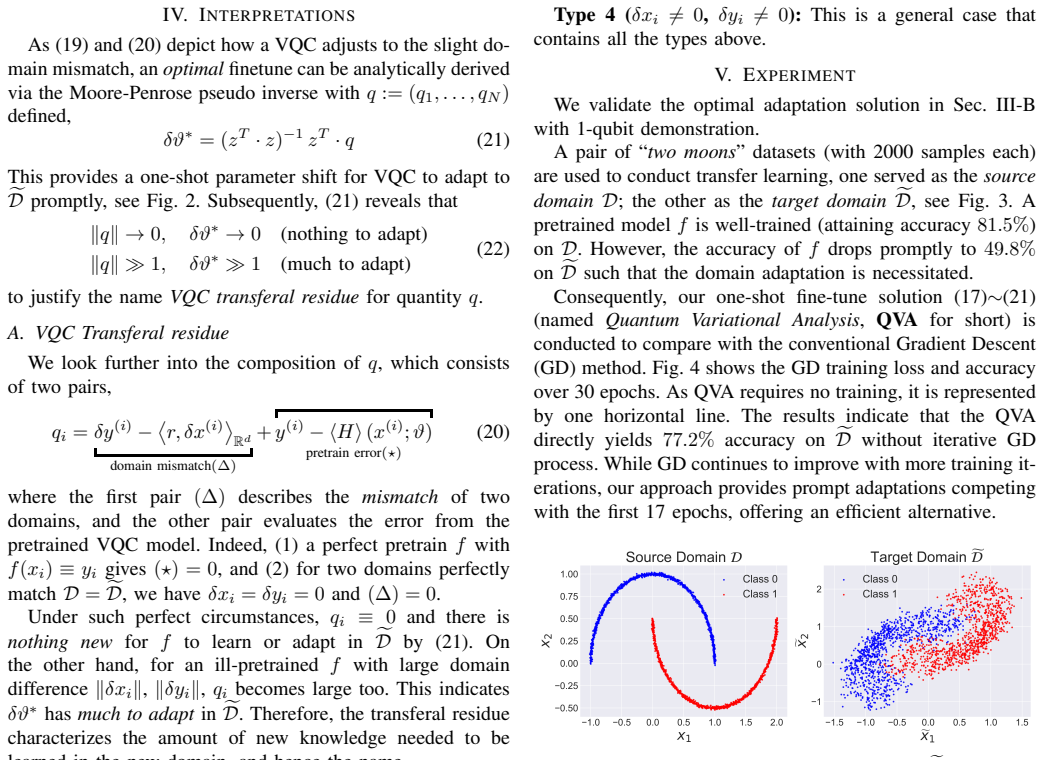
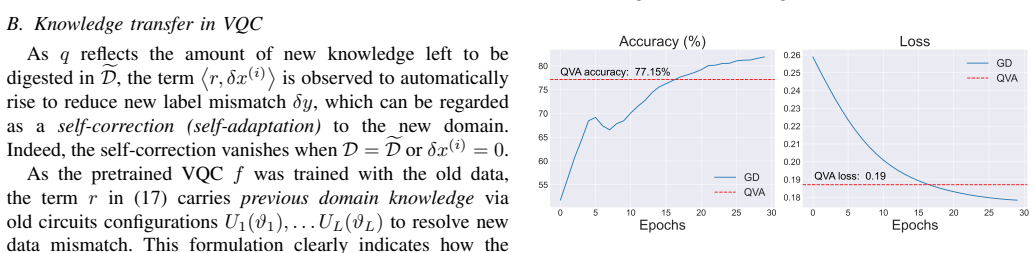
The paper's central claim is that transfer learning in a VQC is a linear inverse problem rather than an opaque iterative process. Expanding the expectation-value difference $\langle H\rangle(\tilde{x};\tilde{\theta}) - \langle H\rangle(x;\vartheta)$ through the adjoint action approximation $e^{it\sigma}Be^{-it\sigma} = B + it[\sigma,B] + O(t^2)$ turns the target-domain loss into $\sum_i \left|\langle z,\delta\vartheta\rangle - q_i\right|^2$, with $z$ and $r$ built from nested commutators of the circuit gates. The Moore-Penrose solution $\delta\vartheta^* = (z^T z)^{-1} z^T q$ is presented as the analytically optimal one-shot parameter transition, and $q$---the 'VQC transferal residue'---equals the label shift minus the input-shift response plus the pretraining error. The paper reads this formula as evidence that knowledge transfer occurs: the old gate configuration automatically produces a self-correction term, while the residue measures what new information remains. The single-qubit two-moons demonstration shows the one-shot update reaching 77.2% accuracy on the target domain, compared with 49.8% for the unadapted pretrained model.
Load-bearing premise
The derivation treats the response coefficients as constants when solving for the parameter shift, even though they are evaluated at the shifted parameters; if those coefficients move with the shift, the one-shot formula is a fixed-point condition rather than a guaranteed global optimum.
Editorial extensions
If this is right
- For similar domains, the optimal VQC parameter transition can be computed in one closed-form least-squares step instead of many gradient-descent epochs.
- The transfer residue $q$ gives a quantitative split between what the new domain demands (label shift minus input-shift response) and what the old model already failed to learn (pretraining error).
- The formula implies a mechanistic reading of VQC transfer: the pretrained gate configuration acts as a self-correction mechanism that partially cancels input drift before any fine-tuning begins.
- The single-qubit demonstration shows the one-shot update restoring 77.2% accuracy on a shifted two-moons dataset, matching the first 17 epochs of gradient descent without iterative training.
Reading between the lines
- A natural extension the paper does not pursue is to iterate Eq. (21), recomputing $z$ at each shifted parameter set; if the iteration converges to a lower loss, the one-shot formula should be regarded as the first step of a fixed-point scheme rather than a closed-form optimum.
- Because $q$ decomposes into a domain-mismatch term and a pretraining-error term, it could be used as a cheap task-similarity diagnostic: a small transfer residue would tell a practitioner that the new dataset is almost already learned, and a large residue that adaptation will be costly.
- The derivation is carried out for single-qubit Pauli rotations; how the one-shot formula behaves for multi-qubit entangling gates and non-Pauli encodings is a testable extension that would determine how far the linearization generalizes.
Editorial analysis
A structured set of objections, weighed in public.
Referee Report
Summary. The paper proposes a framework for transfer learning in variational quantum circuits (VQCs). It models a VQC as a product of 1-parameter unitary subgroups, pretrains it on a source domain, and then aims to compute the optimal parameter shift δϑ for adapting to a similar target domain. Using adjoint-action expansions in the small input shift δx and parameter shift δϑ, the authors approximate the target-domain loss by a quadratic form in δϑ, define a "transfer residue" q, and claim the one-shot analytical update δϑ* = (zᵀz)⁻¹ zᵀq. A 1-qubit experiment on two-moons data compares this update with gradient descent, reporting 77.2% target accuracy.
Significance. The problem of efficient fine-tuning of VQCs is timely, and the use of Lie-group adjoint expansions is a potentially interesting angle. The paper also provides a code repository, which is a strength. However, the central derivation contains a load-bearing mathematical gap: the coefficients z and q in the purported linear loss depend on the unknown δϑ, so Eq. (21) is not a closed-form optimal solution. Since the paper's main contribution is the analytical optimal fine-tuning claim, this flaw substantially undermines the significance of the results as stated.
major comments (3)
- [III-B, Eqs. (17)-(21)] The loss in Eq. (19) is not linear in δϑ. The coefficient zℓ in Eq. (18) contains ad_{U†(eϑ)} and specifically ad_{U†_ℓ(eϑ_ℓ)}...ad_{U†_L(eϑ_L)}, where eϑ = ϑ + δϑ; similarly rj in Eq. (17) contains ad_{U†(eϑ)}. Hence z, r, and therefore q depend on the unknown δϑ. Consequently Eq. (19) is a nonlinear function of δϑ, and Eq. (21) is at best a fixed-point condition δϑ = (z(δϑ)ᵀz(δϑ))⁻¹ z(δϑ)ᵀq(δϑ), not a proven minimizer of the original loss (6). The abstract's claim of an 'optimal transition' and the contribution statement of a 'global optimal' solution are not supported by the derivation.
- [III-B, Eqs. (13)-(16)] The first-order adjoint expansions systematically discard O(δx²) and O(δϑ²) terms, but no error bounds are provided. The paper does not quantify the regime of 'small' δx and δϑ in which these terms are negligible, nor does it show that the minimizer of the truncated surrogate (19) is close to the minimizer of the true loss (6). Without such an error estimate, even a corrected version of (21) would only solve an uncontrolled first-order surrogate, not the original fine-tuning problem.
- [Sec. V] The experimental section does not specify how Eq. (21) is evaluated given the δϑ-dependence of z and q. If z and q are evaluated at δϑ = 0, the experiment tests a first-order approximation, not the claimed closed-form solution; if a fixed-point iteration is used, the method is no longer one-shot. The reported 77.2% accuracy therefore does not validate the analytical optimality claim. Additionally, the experiment uses a single 1-qubit circuit on one dataset pair with no error bars or multiple seeds, so the comparison with gradient descent is not statistically robust.
minor comments (6)
- [Eq. (21)] The text mentions the Moore-Penrose pseudo-inverse, but Eq. (21) writes an ordinary inverse; the invertibility condition on zᵀz should be stated.
- [Eq. (18)] The last factor in Eq. (18), ad_{U†_ℓ(eϑ_ℓ)} ··· ad_{U†_ℓ(eϑ_L)}, appears to have a typo: the subscript of the final factor should be L, not ℓ.
- [References] Reference [33] is cited for the parameter shift rule, but [33] is a transfer-learning paper; the parameter shift rule should be cited to its original source.
- [References] References [10] and [29] are the same paper and should be merged to avoid duplication.
- [Sec. III-A] The notation eϑ and δϑ is used in Sec. III-B but could be defined more prominently in Sec. III-A, where the target parameters are introduced.
- [Fig. 4] The caption of Fig. 4 does not explain the horizontal line for QVA or the absence of error bars; please add a clarifying description.
Circularity Check
Eq. (21) is not a closed-form minimizer: the coefficients z and q in the 'linear form' (19) are defined via θ̃ = ϑ + δϑ, so the solution is a self-referential fixed-point condition.
-
self definitional
[Section III-B, Eqs. (17)-(21)]
"zℓ := (i/2)⟨ad_{V†(x)} ad_{U†_1(ϑ_1)}···ad_{U†_{ℓ−1}(ϑ_{ℓ−1})} ◦ [σ_{kℓ}, ad_{U†_ℓ(eϑ_ℓ)}···ad_{U†_L(eϑ_L)}(H)]⟩ (18) ... the above circuit layer analysis converts the fine-tune loss (6) into the problem of finding δϑ in a linear form, L(eϑ; D˜) = Σ‖⟨z,δϑ⟩_{R^L}(x(i)) − q_i‖² (19), with constant q_i defined as q_i = δy_i − ⟨r,δx_i⟩ + y_i − ⟨H⟩(x(i);ϑ) (20). δϑ∗ = (z^T·z)^{−1} z^T·q (21) provides a one-shot parameter shift."
By Eq. (10), eϑ = ϑ + δϑ, so the adjoint actions in Eq. (18) are evaluated at the unknown target parameters. Similarly, r in Eq. (17) contains ad_{U†(eϑ)}(H), and q in Eq. (20) inherits r. Therefore z, r, and q are all functions of δϑ, and Eq. (19) is not linear in δϑ despite being called a 'linear form with constant q_i.' Equation (21) is not a closed-form global minimizer; it is a fixed-point equation δϑ = (z(δϑ)^T z(δϑ))^{-1} z(δϑ)^T q(δϑ). The claimed analytical optimal transition is thus defined in terms of the very quantity it purports to solve for.
full rationale
The circularity is internal and definitional rather than stemming from self-citation. The Lie-group expansions in Eqs. (13)-(16) are derived in the paper, and reference [34] (the authors' own prior classical work) is cited only for 'similar interpretations,' not as load-bearing evidence for the VQC result. The core problem is that the 'linear form' of Eq. (19) has coefficients z and q that depend on the unknown δϑ through θ̃ = ϑ + δϑ. Consequently the normal-equation solution (21) is a self-referential fixed-point condition, not an independent derivation of an optimal one-shot transition. The subsequent qualitative claims in (22) and the 'transfer residue' interpretation inherit this defect. The experimental QVA result may still be a useful heuristic, but it does not validate the claimed analytical global optimality because that optimality reduces by construction to an equation whose unknown appears in its own coefficients. This is partial circularity in the central claim, so the score is 6 rather than lower; the paper still contains substantial independent formalism and an empirical demonstration.
Assumptions & free parameters
assumptions (4)
- domain assumption The source and target domain samples are aligned one-to-one so that per-sample differences δx_i and δy_i are meaningful.
- ad hoc to paper The domain shift δx, δy and parameter shift δϑ are small enough that first-order adjoint action expansions (13)-(16) are accurate and higher-order terms are negligible.
- ad hoc to paper The linearized loss in (19) is an adequate surrogate for the true fine-tuning loss, and its least-squares minimizer is the claimed optimal transition.
- domain assumption The VQC has the product form (9) with single-qubit gates generated by Pauli operators, so V_j(x_j) and U_ℓ(θ_ℓ) are 1-parameter unitary subgroups.
Cite this review
Pith. "Pith review of Transfer Learning Analysis of Variational Quantum Circuits." pith.science (2026). https://pith.science/paper/G6ELPE6K
@misc{pith2026250101507,
  author       = {Pith},
  title        = {Pith review of: Transfer Learning Analysis of Variational Quantum Circuits},
  year         = {2026},
  howpublished = {\url{https://pith.science/paper/G6ELPE6K}},
  note         = {Machine review of arXiv:2501.01507}
}
read the original abstract
This work analyzes transfer learning of the Variational Quantum Circuit (VQC). Our framework begins with a pretrained VQC configured in one domain and calculates the transition of 1-parameter unitary subgroups required for a new domain. A formalism is established to investigate the adaptability and capability of a VQC under the analysis of loss bounds. Our theory observes knowledge transfer in VQCs and provides a heuristic interpretation for the mechanism. An analytical fine-tuning method is derived to attain the optimal transition for adaptations of similar domains.
Figures

Reference graph
Works this paper leans on
-
[34]
Interpretations of domain adaptations via layer variational analysis,
H.-H. Tseng, H.-Y . Lin, K.-H. Hung, and Y . Tsao, “Interpretations of domain adaptations via layer variational analysis,” arXiv preprint arXiv:2302.01798, 2023
arXiv 2023
-
[33]
Transfer learning in hybrid classical-quantum neural networks,
A. Mari, T. R. Bromley, J. Izaac, M. Schuld, and N. Killoran, “Transfer learning in hybrid classical-quantum neural networks,” Quantum, vol. 4, p. 340, 2020
2020
-
[1]
M. A. Nielsen and I. L. Chuang, Quantum computation and quantum information. Cambridge university press, 2010
2010
-
[2]
The power of quantum neural networks,
A. Abbas, D. Sutter, C. Zoufal, A. Lucchi, A. Figalli, and S. Woerner, “The power of quantum neural networks,” Nature Computational Sci- ence, vol. 1, no. 6, pp. 403–409, 2021
2021
-
[3]
Generalization in quantum machine learning from few training data,
M. C. Caro, H.-Y . Huang, M. Cerezo, K. Sharma, A. Sornborger, L. Cincio, and P. J. Coles, “Generalization in quantum machine learning from few training data,” Nature communications, vol. 13, no. 1, pp. 1– 11, 2022
work page 2022
-
[4]
Expressive power of parametrized quantum circuits,
Y . Du, M.-H. Hsieh, T. Liu, and D. Tao, “Expressive power of parametrized quantum circuits,” Physical Review Research, vol. 2, no. 3, p. 033125, 2020
2020
-
[5]
Noisy intermediate-scale quantum algorithms,
K. Bharti, A. Cervera-Lierta, T. H. Kyaw, T. Haug, S. Alperin-Lea, A. Anand, M. Degroote, H. Heimonen, J. S. Kottmann, T. Menke et al., “Noisy intermediate-scale quantum algorithms,” Reviews of Modern Physics, vol. 94, no. 1, p. 015004, 2022
2022
-
[6]
An end-to- end trainable hybrid classical-quantum classifier,
S. Y .-C. Chen, C.-M. Huang, C.-W. Hsing, and Y .-J. Kao, “An end-to- end trainable hybrid classical-quantum classifier,” Machine Learning: Science and Technology, vol. 2, no. 4, p. 045021, 2021
work page 2021
Show all 36 references
-
[7]
Qtn-vqc: An end-to-end learning framework for quantum neural networks,
J. Qi, C.-H. H. Yang, and P.-Y . Chen, “Qtn-vqc: An end-to-end learning framework for quantum neural networks,” Physica Scripta, vol. 99, 12 2023
2023
-
[8]
Quantum circuit learning,
K. Mitarai, M. Negoro, M. Kitagawa, and K. Fujii, “Quantum circuit learning,” Physical Review A , vol. 98, no. 3, p. 032309, 2018
2018
-
[9]
Quantum convolutional neural networks for high energy physics data analysis,
S. Y .-C. Chen, T.-C. Wei, C. Zhang, H. Yu, and S. Yoo, “Quantum convolutional neural networks for high energy physics data analysis,” Physical Review Research, vol. 4, no. 1, p. 013231, 2022
2022
-
[10]
Quantum gradient class activation map for model interpretability,
H.-Y . Lin, H.-H. Tseng, S. Y .-C. Chen, and S. Yoo, “Quantum gradient class activation map for model interpretability,” in 2024 IEEE Workshop on Signal Processing Systems (SiPS) . IEEE, 2024, pp. 165–170
2024
-
[11]
Quantum long short-term memory,
S. Y .-C. Chen, S. Yoo, and Y .-L. L. Fang, “Quantum long short-term memory,” in ICASSP 2022-2022 IEEE International Conference on Acoustics, Speech and Signal Processing (ICASSP) . IEEE, 2022, pp. 8622–8626
2022
-
[12]
Learning to program variational quantum circuits with fast weights,
S. Y .-C. Chen, “Learning to program variational quantum circuits with fast weights,” arXiv preprint arXiv:2402.17760 , 2024
2024 arXiv
-
[13]
Federated quantum long short-term memory (fedqlstm),
M. Chehimi, S. Y .-C. Chen, W. Saad, and S. Yoo, “Federated quantum long short-term memory (fedqlstm),” Quantum Machine Intelligence , vol. 6, no. 2, p. 43, 2024
2024
-
[14]
Pqlm-multilingual decentralized portable quantum language model,
S. S. Li, X. Zhang, S. Zhou, H. Shu, R. Liang, H. Liu, and L. P. Garcia, “Pqlm-multilingual decentralized portable quantum language model,” in ICASSP 2023-2023 IEEE International Conference on Acoustics, Speech and Signal Processing (ICASSP) . IEEE, 2023, pp. 1–5
2023
-
[15]
When bert meets quantum temporal convolution learning for text classification in heterogeneous computing,
C.-H. H. Yang, J. Qi, S. Y .-C. Chen, Y . Tsao, and P.-Y . Chen, “When bert meets quantum temporal convolution learning for text classification in heterogeneous computing,” in ICASSP 2022-2022 IEEE International Conference on Acoustics, Speech and Signal Processing (ICASSP) . ...
2022
-
[16]
The dawn of quantum natural language processing,
R. Di Sipio, J.-H. Huang, S. Y .-C. Chen, S. Mangini, and M. Worring, “The dawn of quantum natural language processing,” in ICASSP 2022- 2022 IEEE International Conference on Acoustics, Speech and Signal Processing (ICASSP). IEEE, 2022, pp. 8612–8616
2022
-
[17]
Applying qnlp to sentiment analysis in finance,
J. Stein, I. Christ, N. Kraus, M. B. Mansky, R. M ¨uller, and C. Linnhoff- Popien, “Applying qnlp to sentiment analysis in finance,” in 2023 IEEE International Conference on Quantum Computing and Engineering (QCE), vol. 2. IEEE, 2023, pp. 20–25
2023
-
[18]
Variational quantum circuits for deep reinforcement learning,
S. Y .-C. Chen, C.-H. H. Yang, J. Qi, P.-Y . Chen, X. Ma, and H.-S. Goan, “Variational quantum circuits for deep reinforcement learning,” IEEE access, vol. 8, pp. 141 007–141 024, 2020
2020
-
[19]
Variational quantum reinforcement learning via evolutionary optimiza- tion,
S. Y .-C. Chen, C.-M. Huang, C.-W. Hsing, H.-S. Goan, and Y .-J. Kao, “Variational quantum reinforcement learning via evolutionary optimiza- tion,” Machine Learning: Science and Technology , vol. 3, no. 1, p. 015025, 2022
2022
-
[20]
Quantum deep recurrent reinforcement learning,
S. Y .-C. Chen, “Quantum deep recurrent reinforcement learning,” in ICASSP 2023-2023 IEEE International Conference on Acoustics, Speech and Signal Processing (ICASSP) . IEEE, 2023, pp. 1–5
2023
-
[21]
Quantum agents in the gym: a variational quantum algorithm for deep q-learning,
A. Skolik, S. Jerbi, and V . Dunjko, “Quantum agents in the gym: a variational quantum algorithm for deep q-learning,” Quantum, vol. 6, p. 720, 2022
2022
-
[22]
Parametrized quantum policies for reinforcement learning,
S. Jerbi, C. Gyurik, S. Marshall, H. Briegel, and V . Dunjko, “Parametrized quantum policies for reinforcement learning,” Advances in Neural Information Processing Systems , vol. 34, pp. 28 362–28 375, 2021
2021
-
[23]
Quantum multi-agent reinforcement learning via variational quantum circuit design,
W. J. Yun, Y . Kwak, J. P. Kim, H. Cho, S. Jung, J. Park, and J. Kim, “Quantum multi-agent reinforcement learning via variational quantum circuit design,” in 2022 IEEE 42nd International Conference on Distributed Computing Systems (ICDCS) . IEEE, 2022, pp. 1332– 1335
2022
-
[24]
Training classical neural networks by quantum machine learning,
C.-Y . Liu, E.-J. Kuo, C.-H. A. Lin, S. Chen, J. G. Young, Y .-J. Chang, and M.-H. Hsieh, “Training classical neural networks by quantum machine learning,” arXiv preprint arXiv:2402.16465 , 2024
2024 arXiv
-
[25]
Qtrl: Toward practical quantum reinforcement learning via quantum- train,
C.-Y . Liu, C.-H. A. Lin, C.-H. H. Yang, K.-C. Chen, and M.-H. Hsieh, “Qtrl: Toward practical quantum reinforcement learning via quantum- train,” arXiv preprint arXiv:2407.06103 , 2024
2024 arXiv
-
[26]
Federated quantum-train with batched parameter generation,
C.-Y . Liu and S. Y .-C. Chen, “Federated quantum-train with batched parameter generation,” arXiv preprint arXiv:2409.02763 , 2024
2024 arXiv
-
[27]
Quantum- trained convolutional neural network for deepfake audio detection,
C.-H. A. Lin, C.-Y . Liu, S. Y .-C. Chen, and K.-C. Chen, “Quantum- trained convolutional neural network for deepfake audio detection,” arXiv preprint arXiv:2410.09250 , 2024
2024 arXiv
-
[28]
Quantum-train long short- term memory: Application on flood prediction problem,
C.-H. A. Lin, C.-Y . Liu, and K.-C. Chen, “Quantum-train long short- term memory: Application on flood prediction problem,” arXiv preprint arXiv:2407.08617, 2024
2024 arXiv
-
[29]
Quantum gra- dient class activation map for model interpretability,
H.-Y . Lin, H.-H. Tseng, S. Y .-C. Chen, and S. Yoo, “Quantum gra- dient class activation map for model interpretability,” arXiv preprint arXiv:2408.05899, 2024
2024 arXiv
-
[30]
A survey on transfer learning,
S. J. Pan and Q. Yang, “A survey on transfer learning,” IEEE Trans- actions on knowledge and data engineering , vol. 22, no. 10, pp. 1345– 1359, 2009
2009
-
[31]
Deep residual learning for image recognition,
K. He, X. Zhang, S. Ren, and J. Sun, “Deep residual learning for image recognition,” in Proceedings of the IEEE conference on computer vision and pattern recognition , 2016, pp. 770–778
2016
-
[32]
Parameter-efficient transfer learning for nlp,
N. Houlsby, A. Giurgiu, S. Jastrzebski, B. Morrone, Q. De Laroussilhe, A. Gesmundo, M. Attariyan, and S. Gelly, “Parameter-efficient transfer learning for nlp,” in International conference on machine learning . PMLR, 2019, pp. 2790–2799
2019
-
[35]
Optimal transport for domain adaptation,
N. Courty, R. Flamary, D. Tuia, and A. Rakotomamonjy, “Optimal transport for domain adaptation,” IEEE transactions on pattern analysis and machine intelligence , vol. 39, no. 9, pp. 1853–1865, 2016
2016
-
[36]
Unsupervised noise adap- tive speech enhancement by discriminator-constrained optimal trans- port,
H.-Y . Lin, H.-H. Tseng, X. Lu, and Y . Tsao, “Unsupervised noise adap- tive speech enhancement by discriminator-constrained optimal trans- port,” Advances in Neural Information Processing Systems , vol. 34, pp. 19 935–19 946, 2021
2021
Reviewed August 10, 2026 · model on record in the stance chip above.
Discussion (0). Continue with ORCID to comment.