REVIEW 2 major objections 5 minor 45 references
Look Back for More: Harnessing Historical Sequential Updates for Personalized Federated Adapter Tuning
T0 review · 2 major / 5 minor · reviewed 2026-08-10 · deepseek-v4-flash
Pith's one-line read pFedSeq improves personalized federated adapter tuning by having the server learn from clients' past adapter updates, reporting the top accuracy on four benchmarks.
desk verdict Genuinely new mechanism for personalized federated adapter tuning, but the SOTA claim is under-supported by missing adapter-specific baselines and small margins. read the letter →
The pith
A machine-rendered reading of the paper's core claim, the machinery that carries it, and where it could break.
The reading
What carries the argument
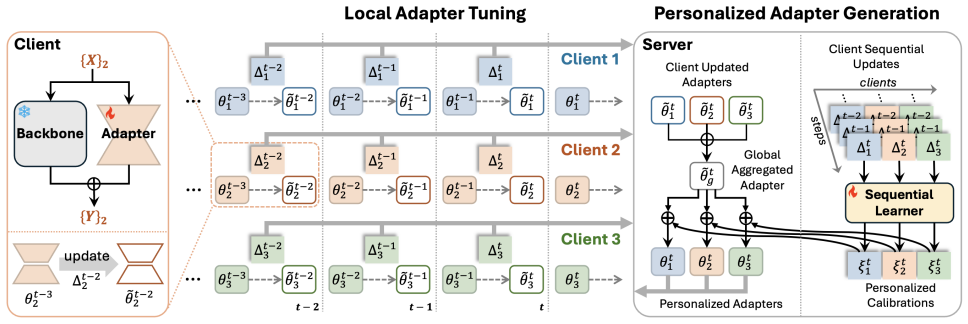
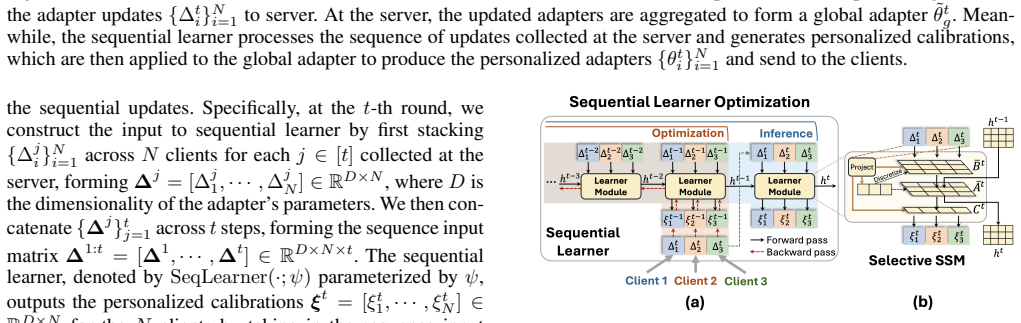
The load-bearing object is the sequential learner: a hypernetwork instantiated as a two-layer Selective SSM (Mamba) block, with the adapter's parameter dimension treated as the batch dimension so that the learner's size depends on the number of clients and the sequence length, not on adapter size. At each step the input is the stacked matrix of all clients' adapter updates for that round; input-dependent parameters capture cross-client interactions, while the recurrent hidden state carries cross-step dependencies. The training rule is the proxy-gradient update, where the server uses each received adapter update as a stand-in for the gradient of that client's local loss, giving $\Delta\psi = \sum_i (\nabla_\psi \xi_i^{t-1})^\top \Delta_i^t$.
What would settle it
Run pFedSeq with clients performing several local epochs or using momentum before communicating, holding all else fixed; if its advantage over the latest-update-only ablation ($L=1$) and over PeFLL shrinks or disappears, the gradient-proxy assumption is the component carrying the result.
Extended reading notes
Core claim
The paper's central claim is that personalized federated adapter tuning improves when the server models the recent history of adapter updates rather than only the latest round. The discovery is a concrete mechanism: a server-side sequential learner parameterized by Selective SSM maps the sequence of stacked client updates to per-client calibrations, and each personalized adapter is the global FedAvg adapter plus that client's calibration. The learner is optimized by a proxy-gradient rule that replaces each client's true local-loss gradient with the received adapter update, so training happens entirely at the server without local data. Empirically, the paper reports that pFedSeq reaches 95.30% on CIFAR-100, 94.30% on Tiny-ImageNet, 84.63% on DomainNet, and 45.25% on Omniglot, the highest numbers in Table 1, with the largest gains when clients have distinct feature distributions.
Load-bearing premise
The load-bearing premise is that each client's adapter update faithfully represents the gradient of that client's local loss, because the server uses those updates to train the sequential learner without ever seeing local data.
Editorial extensions
If this is right
- If pFedSeq's claim is correct, personalized federated tuning can be improved without any extra client communication, because the server reuses adapter updates it already receives.
- Modeling a longer history helps up to a point: performance rises with sequence length $L$ and then plateaus, giving a tunable trade-off between memory and accuracy.
- The sequential learner's size is independent of adapter dimension, scaling with client count and sequence length, which keeps server-side cost modest for large foundation models.
- Ablations attribute the gain to all three components — global aggregation, cross-step modeling, and cross-client modeling — with removal of global aggregation hurting most.
- The architecture choice matters: replacing Selective SSM with an MLP or LSTM lowers accuracy, so the input-dependent recurrence is doing real work.
Reading between the lines
- Beyond the paper, the same server-side sequential learner should transfer to other parameter-efficient modules such as prompts or adapters beyond LoRA, since the machinery operates on the update sequence rather than on adapter-specific structure.
- The proxy-gradient premise implies the gains are most secure when clients run one local epoch with plain SGD; multi-epoch training or momentum would make the update a less faithful gradient estimate and could shrink the gap over latest-update-only baselines.
- The reported learning curves suggest a positive feedback loop between better personalized adapters and better local updates, which implies the method may deliver its largest speedups in communication-limited regimes with few rounds.
Editorial analysis
A structured set of objections, weighed in public.
Referee Report
Summary. The paper proposes pFedSeq, a personalized federated adapter-tuning method in which the server maintains a sequential learner (implemented as a two-layer Mamba Selective SSM) that ingests clients' past adapter updates and outputs per-client calibrations, which are added to a Federated-Averaging-style global adapter. The server trains the sequential learner using the received adapter updates as proxies for local gradients. Experiments are reported on CIFAR-100, Tiny-ImageNet, DomainNet, and Omniglot under label-skew, feature-skew, and real-world heterogeneity, with ten PFL baselines adapted to a frozen ViT-B/16 plus LoRA setup. The paper also reports ablations of the global-aggregation, cross-step, and cross-client components, an ablation of the learner architecture (MLP, LSTM, Selective SSM), sensitivity to sequence length L and warm-up length W, and a per-round runtime comparison.
Significance. If the empirical claims hold, pFedSeq is a practical and communication-efficient contribution to personalized federated adapter tuning: it keeps the hypernetwork size independent of the adapter dimension, leverages a modern sequence model for cross-client and cross-step relations, and reports the strongest accuracy on all four benchmarks in its comparison. The paper also contains useful ablations and a computational-efficiency table. However, the headline empirical claim is weakened by the absence of the most directly relevant adapter-specific PFL baselines from the controlled comparison, and the component ablations show that global aggregation contributes substantially to the reported gains. These issues, rather than any internal mathematical inconsistency, are the main barriers to acceptance.
major comments (2)
- [Related Work; Experiments, Baseline Comparison (Table 1); Appendix Table 5] The main comparison omits the four adapter-specific PFL methods that the paper itself identifies in Related Work: FedDPA, pFedLoRA, FedL2P, and pFedPG. These are precisely the methods designed for the same federated-adapter-tuning setting, and all other baselines are adapted to the same frozen ViT-B/16 plus LoRA protocol. pFedPG appears only in Appendix Table 5 under its original prompt-tuning setup, which does not allow an apples-to-apples comparison. Given that the margins over the best included baselines are only 0.84, 0.60, 2.21, and 2.27 percentage points on CIFAR-100, Tiny-ImageNet, DomainNet, and Omniglot, the abstract's claim that pFedSeq 'outperforms state-of-the-art PFL methods' is under-supported. The authors should add these methods to the controlled comparison, or explicitly scope the claim to the methods evaluated and discuss the likely relationship to the omitted work.
- [Analysis of pFedSeq, Table 2] The ablation shows that the contribution specifically attributable to historical sequence modeling is modest on the label-skew datasets: removing cross-step modeling (variant B) costs 0.64 percentage points on CIFAR-100 and 1.53 on DomainNet, whereas removing global aggregation (variant A) costs 0.89 and 1.96 points. On CIFAR-100, the cross-step contribution is smaller than the 0.84-point margin over the second-best baseline pFedHN. The paper's central narrative—that 'looking back' at previous updates yields the improvement—would be substantially strengthened by reporting the component ablation on Tiny-ImageNet and Omniglot, and by including significance tests or confidence intervals; as presented, the label-skew results do not demonstrate that historical updates are the dominant driver of the method's advantage.
minor comments (5)
- [Method, Eq. (5) and Eq. (6)] The notation in Eq. (5) writes ξ^{t-1}_i = (SeqLearner(∆^{1:t-1}; ψ))_{:,i} for all t, but for t > L the implementation described in Eq. (6) feeds only the last L updates; the formula should use the capped sequence (e.g., ∆^{t-L:t-1}) to be consistent.
- [Abstract; Introduction; Experiments, Table 1] The claim of improvement 'up to 5.39%' is not directly traceable to the numbers in Table 1; the largest absolute gain over Local is 6.89 points on Omniglot, and the largest gain over the second-best method is 2.27 points. Please state how the 5.39% figure is computed.
- [Appendix C, Figure 9b] The caption states that both the MLP-based and LSTM-based variants are shown with an 'orange line'; the two curves are presumably different colors, so the caption should be corrected.
- [Experiments, Implementation Details] The paper reports 3 seeds and no significance testing; given that several headline margins are below one percentage point, a paired test across seeds or a repeated-measures analysis would make the comparisons more convincing.
- [General] No code is released; given the number of tuned baselines and the use of a relatively recent Mamba implementation, releasing code would materially improve reproducibility.
Circularity Check
No significant circularity: pFedSeq's sequential learner is a constructive server-side training loop; no claimed prediction reduces by construction to a fitted input, and the only author-overlapping citation is background.
full rationale
pFedSeq does not derive its central result from a parameter fitted to the target quantity. The sequential learner SeqLearner(·; ψ) consumes the history of adapter updates Δ1:t and emits calibrations ξt that are added to the FedAvg global adapter (Eqs. (2)-(3)); its parameters ψ are trained in Eq. (5) by backpropagating the received updates as a proxy for local gradients. This is an explicitly stated training feedback loop inherited from prior hypernetwork methods (Shamsian et al. 2021; Scott, Zakerinia, and Lampert 2024), not a self-definitional prediction: the learner's outputs are evaluated on held-out local test sets in Table 1, and the improvement of pFedSeq over pFedHN/PeFLL is an empirical result that could have gone the other way. The ablation variants and L/W sweeps are additional genuine ablations rather than renamed fits. The only citation with author overlap is Peng and Pan (2023), cited in Related Work as an example of using past gradient updates in meta-learning; it is not load-bearing for the pFedSeq architecture, training rule, or benchmark claim. Concerns that adapter-specific baselines such as FedDPA, pFedLoRA, FedL2P, and pFedPG are absent from Table 1 are legitimate empirical-support concerns, but they do not constitute circularity because the comparison is external rather than definitional. Under the requested rubric, the appropriate finding is no significant circularity, with a token score of 1 reflecting the presence of a non-load-bearing self-citation.
Assumptions & free parameters
free parameters (4)
- Maximum sequence length L =
20 (CIFAR-100, Tiny-ImageNet), 10 (DomainNet, Omniglot)
- Expanded state dimension M =
16
- Warm-up rounds W =
10
- Sequential learner learning rate =
0.001 (0.0005 for Omniglot)
assumptions (6)
- domain assumption Local adapter updates approximate local loss gradients.
- domain assumption Historical adapter updates contain transferable cross-client and cross-step information.
- domain assumption A shared frozen foundation model with trainable adapters is an appropriate PFL setup.
- domain assumption The server is trusted with unbounded history of adapter updates.
- domain assumption Dirichlet label-skew and domain-based feature-skew are representative heterogeneity scenarios.
- standard math Mamba's selective SSM can model cross-client and cross-step dependencies with linear-time recurrence.
Cite this review
Pith. "Pith review of Look Back for More: Harnessing Historical Sequential Updates for Personalized Federated Adapter Tuning." pith.science (2026). https://pith.science/paper/W62Y7N4J
@misc{pith2026250101653,
  author       = {Pith},
  title        = {Pith review of: Look Back for More: Harnessing Historical Sequential Updates for Personalized Federated Adapter Tuning},
  year         = {2026},
  howpublished = {\url{https://pith.science/paper/W62Y7N4J}},
  note         = {Machine review of arXiv:2501.01653}
}
read the original abstract
Personalized federated learning (PFL) studies effective model personalization to address the data heterogeneity issue among clients in traditional federated learning (FL). Existing PFL approaches mainly generate personalized models by relying solely on the clients' latest updated models while ignoring their previous updates, which may result in suboptimal personalized model learning. To bridge this gap, we propose a novel framework termed pFedSeq, designed for personalizing adapters to fine-tune a foundation model in FL. In pFedSeq, the server maintains and trains a sequential learner, which processes a sequence of past adapter updates from clients and generates calibrations for personalized adapters. To effectively capture the cross-client and cross-step relations hidden in previous updates and generate high-performing personalized adapters, pFedSeq adopts the powerful selective state space model (SSM) as the architecture of sequential learner. Through extensive experiments on four public benchmark datasets, we demonstrate the superiority of pFedSeq over state-of-the-art PFL methods.
Figures

Figures from the paper (7 more)


Reference graph
Works this paper leans on
-
[1]
, " * write output.state after.block = add.period write newline
ENTRY address archivePrefix author booktitle chapter edition editor eid eprint howpublished institution isbn journal key month note number organization pages publisher school series title type volume year label extra.label sort.label short.list INTEGERS output.state before.all mid.sentence after.sentence after.block FUNCTION init.state.consts #0 'before.a...
-
[2]
write newline
" write newline "" before.all 'output.state := FUNCTION n.dashify 't := "" t empty not t #1 #1 substring "-" = t #1 #2 substring "--" = not "--" * t #2 global.max substring 't := t #1 #1 substring "-" = "-" * t #2 global.max substring 't := while if t #1 #1 substring * t #2 global.max substring 't := if while FUNCTION word.in bbl.in capitalize " " * FUNCT...
-
[3]
Chrabaszcz, P.; Loshchilov, I.; and Hutter, F. 2017. A downsampled variant of imagenet as an alternative to the cifar datasets. arXiv preprint arXiv:1707.08819
arXiv 2017
-
[4]
Collins, L.; Hassani, H.; Mokhtari, A.; and Shakkottai, S. 2021. Exploiting shared representations for personalized federated learning. In International conference on machine learning, 2089--2099. PMLR
work page 2021
-
[5]
Deng, J.; Dong, W.; Socher, R.; Li, L.-J.; Li, K.; and Fei-Fei, L. 2009. Imagenet: A large-scale hierarchical image database. In 2009 IEEE conference on computer vision and pattern recognition, 248--255. Ieee
2009
-
[6]
Dosovitskiy, A.; Beyer, L.; Kolesnikov, A.; Weissenborn, D.; Zhai, X.; Unterthiner, T.; Dehghani, M.; Minderer, M.; Heigold, G.; Gelly, S.; et al. 2020. An Image is Worth 16x16 Words: Transformers for Image Recognition at Scale. In International Conference on Learning Representations
2020
-
[7]
Fallah, A.; Mokhtari, A.; and Ozdaglar, A. 2020. Personalized federated learning with theoretical guarantees: a model-agnostic meta-learning approach. In Proceedings of the 34th International Conference on Neural Information Processing Systems, 3557--3568
work page 2020
-
[8]
Finn, C.; Abbeel, P.; and Levine, S. 2017. Model-agnostic meta-learning for fast adaptation of deep networks. In International conference on machine learning, 1126--1135. PMLR
2017
Show all 45 references
-
[9]
G.; Lawrence, N
Flennerhag, S.; Moreno, P. G.; Lawrence, N. D.; and Damianou, A. 2018. Transferring Knowledge across Learning Processes. In International Conference on Learning Representations
2018
-
[10]
Gu, A.; and Dao, T. 2023. Mamba: Linear-time sequence modeling with selective state spaces. arXiv preprint arXiv:2312.00752
2023 arXiv
-
[11]
Hochreiter, S.; and Schmidhuber, J. 1997. Long short-term memory. Neural computation, 9(8): 1735--1780
1997
-
[12]
J.; Wallis, P.; Allen-Zhu, Z.; Li, Y.; Wang, S.; Wang, L.; Chen, W.; et al
Hu, E. J.; Wallis, P.; Allen-Zhu, Z.; Li, Y.; Wang, S.; Wang, L.; Chen, W.; et al. 2021. LoRA: Low-Rank Adaptation of Large Language Models. In International Conference on Learning Representations
2021
-
[13]
Huang, Y.; Chu, L.; Zhou, Z.; Wang, L.; Liu, J.; Pei, J.; and Zhang, Y. 2021. Personalized cross-silo federated learning on non-iid data. In Proceedings of the AAAI conference on artificial intelligence, volume 35, 7865--7873
2021
-
[14]
Ji, J.; Chen, X.; Wang, Q.; Yu, L.; and Li, P. 2019. Learning to learn gradient aggregation by gradient descent. In Proceedings of the 28th International Joint Conference on Artificial Intelligence, 2614--2620
2019
-
[15]
Jiang, Y.; Kone c n \`y , J.; Rush, K.; and Kannan, S. 2019. Improving federated learning personalization via model agnostic meta learning. arXiv preprint arXiv:1909.12488
2019 arXiv
-
[16]
B.; Avent, B.; Bellet, A.; Bennis, M.; Bhagoji, A
Kairouz, P.; McMahan, H. B.; Avent, B.; Bellet, A.; Bennis, M.; Bhagoji, A. N.; Bonawitz, K.; Charles, Z.; Cormode, G.; Cummings, R.; et al. 2021. Advances and open problems in federated learning. Foundations and trends in machine learning , 14(1--2): 1--210
2021
-
[17]
P.; Kale, S.; Mohri, M.; Reddi, S.; Stich, S.; and Suresh, A
Karimireddy, S. P.; Kale, S.; Mohri, M.; Reddi, S.; Stich, S.; and Suresh, A. T. 2020. Scaffold: Stochastic controlled averaging for federated learning. In International conference on machine learning, 5132--5143. PMLR
2020
-
[18]
Krizhevsky, A.; et al. 2009. Learning multiple layers of features from tiny images
2009
-
[19]
Kulkarni, V.; Kulkarni, M.; and Pant, A. 2020. Survey of personalization techniques for federated learning. In 2020 fourth world conference on smart trends in systems, security and sustainability (WorldS4), 794--797. IEEE
2020
-
[20]
Lee, R.; Kim, M.; Li, D.; Qiu, X.; Hospedales, T.; Husz \'a r, F.; and Lane, N. D. 2023. FedL2P: federated learning to personalize. In Proceedings of the 37th International Conference on Neural Information Processing Systems, 14818--14836
2023
-
[21]
C.-H.; and Voigt, T
Li, S.; Ye, F.; Fang, M.; Zhao, J.; Chan, Y.-H.; Ngai, E. C.-H.; and Voigt, T. 2024. Synergizing Foundation Models and Federated Learning: A Survey. arXiv preprint arXiv:2406.12844
2024
-
[22]
Li, S.; Zhou, T.; Tian, X.; and Tao, D. 2022. Learning to collaborate in decentralized learning of personalized models. In Proceedings of the IEEE/CVF Conference on Computer Vision and Pattern Recognition, 9766--9775
2022
-
[23]
Li, T.; Hu, S.; Beirami, A.; and Smith, V. 2021 a . Ditto: Fair and robust federated learning through personalization. In International conference on machine learning, 6357--6368. PMLR
2021
-
[24]
K.; Zaheer, M.; Sanjabi, M.; Talwalkar, A.; and Smith, V
Li, T.; Sahu, A. K.; Zaheer, M.; Sanjabi, M.; Talwalkar, A.; and Smith, V. 2020. Federated optimization in heterogeneous networks. Proceedings of Machine learning and systems, 2: 429--450
2020
-
[25]
Li, X.; JIANG, M.; Zhang, X.; Kamp, M.; and Dou, Q. 2021 b . FedBN: Federated Learning on Non-IID Features via Local Batch Normalization. In International Conference on Learning Representations
2021
-
[26]
Luo, J.; and Wu, S. 2022. Adapt to adaptation: Learning personalization for cross-silo federated learning. In IJCAI: proceedings of the conference, volume 2022, 2166. NIH Public Access
2022
-
[27]
Ma, X.; Zhang, J.; Guo, S.; and Xu, W. 2022. Layer-wised model aggregation for personalized federated learning. In Proceedings of the IEEE/CVF conference on computer vision and pattern recognition, 10092--10101
2022
-
[28]
H.; and Ferrante, E
Mansilla, L.; Echeveste, R.; Milone, D. H.; and Ferrante, E. 2021. Domain generalization via gradient surgery. In Proceedings of the IEEE/CVF international conference on computer vision, 6630--6638
2021
-
[29]
Mansour, Y.; Mohri, M.; Ro, J.; and Suresh, A. T. 2020. Three approaches for personalization with applications to federated learning. arXiv preprint arXiv:2002.10619
2020 arXiv
-
[30]
McMahan, B.; Moore, E.; Ramage, D.; Hampson, S.; and y Arcas, B. A. 2017. Communication-efficient learning of deep networks from decentralized data. In Artificial intelligence and statistics, 1273--1282. PMLR
2017
-
[31]
Peng, D.; and Pan, S. J. 2023. Clustered task-aware meta-learning by learning from learning paths. IEEE transactions on pattern analysis and machine intelligence, 45(8): 9426--9438
2023
-
[32]
Scott, J.; Zakerinia, H.; and Lampert, C. H. 2024. PeFLL: Personalized federated learning by learning to learn. In The Twelfth International Conference on Learning Representations
2024
-
[33]
Shamsian, A.; Navon, A.; Fetaya, E.; and Chechik, G. 2021. Personalized federated learning using hypernetworks. In International Conference on Machine Learning, 9489--9502. PMLR
2021
-
[34]
Smith, V.; Chiang, C.-K.; Sanjabi, M.; and Talwalkar, A. 2017. Federated multi-task learning. In Proceedings of the 31st International Conference on Neural Information Processing Systems, 4427--4437
2017
-
[35]
T Dinh, C.; Tran, N.; and Nguyen, J. 2020. Personalized federated learning with moreau envelopes. Advances in neural information processing systems, 33: 21394--21405
2020
-
[36]
Woisetschl \"a ger, H.; Isenko, A.; Wang, S.; Mayer, R.; and Jacobsen, H.-A. 2024. A survey on efficient federated learning methods for foundation model training. arXiv preprint arXiv:2401.04472
2024 arXiv
-
[37]
Xie, C.; Huang, D.-A.; Chu, W.; Xu, D.; Xiao, C.; Li, B.; and Anandkumar, A. 2024. PerAda: Parameter-Efficient Federated Learning Personalization with Generalization Guarantees. In Proceedings of the IEEE/CVF Conference on Computer Vision and Pattern Recognition, 23838--23848
2024
-
[38]
Yang, F.-E.; Wang, C.-Y.; and Wang, Y.-C. F. 2023. Efficient model personalization in federated learning via client-specific prompt generation. In Proceedings of the IEEE/CVF International Conference on Computer Vision, 19159--19168
2023
-
[39]
Yang, Y.; Long, G.; Shen, T.; Jiang, J.; and Blumenstein, M. 2024. Dual-Personalizing Adapter for Federated Foundation Models. arXiv preprint arXiv:2403.19211
2024 arXiv
-
[40]
Yi, L.; Yu, H.; Wang, G.; and Liu, X. 2023. Fedlora: Model-heterogeneous personalized federated learning with lora tuning. arXiv preprint arXiv:2310.13283
2023 arXiv
-
[41]
Yu, T.; Kumar, S.; Gupta, A.; Levine, S.; Hausman, K.; and Finn, C. 2020. Gradient surgery for multi-task learning. In Proceedings of the 34th International Conference on Neural Information Processing Systems, 5824--5836
2020
-
[42]
Zenke, F.; Poole, B.; and Ganguli, S. 2017. Continual learning through synaptic intelligence. In International conference on machine learning, 3987--3995. PMLR
2017
-
[43]
Zhang, J.; Hua, Y.; Wang, H.; Song, T.; Xue, Z.; Ma, R.; and Guan, H. 2023. Fedala: Adaptive local aggregation for personalized federated learning. In Proceedings of the AAAI Conference on Artificial Intelligence, volume 37, 11237--11244
2023
-
[44]
Zhang, M.; Sapra, K.; Fidler, S.; Yeung, S.; and Alvarez, J. M. 2021. Personalized Federated Learning with First Order Model Optimization. In International Conference on Learning Representations
2021
-
[45]
Zhuang, W.; Chen, C.; and Lyu, L. 2023. When foundation model meets federated learning: Motivations, challenges, and future directions. arXiv preprint arXiv:2306.15546
2023 arXiv
Reviewed August 10, 2026 · model on record in the stance chip above.
Discussion (0). Continue with ORCID to comment.