REVIEW 3 major objections 4 minor 1 cited by
Projected ensemble in a system with conserved charges with local support
T0 review · 3 major / 4 minor · reviewed 2026-08-10 · deepseek-v4-flash
Pith's one-line read Deep thermalization survives many-body localization: the projected ensemble of a subsystem converges to the maximum-entropy Scrooge ensemble for almost any measurement basis, unless the basis aligns with the locally conserved charges.
desk verdict New and worth refereeing: first projected-ensemble analysis for systems with extensively many local conserved charges, with solid numerics for k=2,3 and an openly conditional analytic derivation whose unproved input is the real soft spot. read the letter →
The pith
A machine-rendered reading of the paper's core claim, the machinery that carries it, and where it could break.
The reading
What carries the argument
The load-bearing identity is the equality between two integrals: the $k$-th moment of the projected ensemble after temporal averaging (Eq. 41) and the $k$-th moment of the Scrooge ensemble computed by Haar averaging (Eq. 45). The Scrooge ensemble is the named central object: the unique ensemble of pure states realizing a given reduced density matrix $\rho$ while minimizing accessible information, formally the distortion of the Haar ensemble $E_{\mathrm{Scrooge}}(\rho)=\{D\langle\psi|\rho|\psi\rangle,\ \sqrt{\rho}|\psi\rangle/\sqrt{\langle\psi|\rho|\psi\rangle}\}$. The projected-ensemble side of the equality is carried by the empirical Porter-Thomas structure of the temporal ensemble—each conditional bitstring probability $p_t(b|z_A)$ is independently exponentially distributed with mean $\mu(b)$ and uncorrelated across subsystem bitstrings $z_A$—and it is precisely this structure that, after a change of variables, turns the projected-ensemble integral into the Scrooge integral. The Scrooge side is evaluated by standard Haar integration with a Laplace-transform trick, so the whole proof reduces the physics of deep thermalization to a single statistical property of measurement-outcome probabilities.
What would settle it
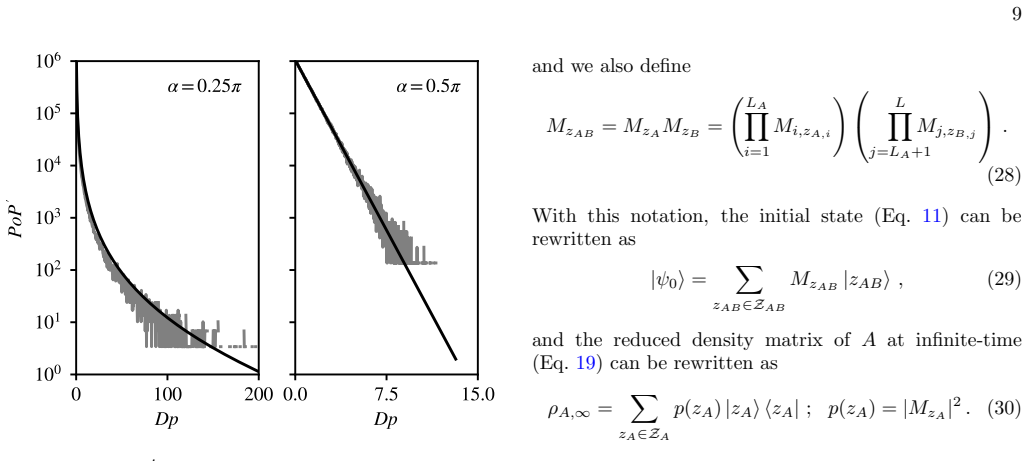
Compute the joint distribution of the conditional probabilities $p_t(b|z_A)$ and $p_t(b|z'_A)$ for distinct subsystem bitstrings in the late-time temporal ensemble of the $\ell$-bit model: if their correlation does not vanish as $L\to\infty$ at any fixed $\alpha>0$, the projected-ensemble integral in Eq. 41 is not the correct late-time matrix element and the Scrooge identity fails. At exact alignment the paper supplies a direct check of the framework: at $\alpha=0$ the projected-ensemble moments are exactly the product in Eq. C5, which differs from the Scrooge value in Eq. C6, so a numerical comparison of these two expressions over accessible system sizes settles the matter. An experiment-ready version is to measure the empirical distribution of bitstring probabilities on a many-body-localized quantum simulator: at $\alpha=\pi/2$ it must be exponential with mean $1/2^L$, and any other shape contradicts the Porter-Thomas assumption the proof rests on.
Extended reading notes
Core claim
On the paper's own terms, the central result is that deep thermalization reaches the Scrooge ensemble in a system with an extensive number of locally supported conserved charges. Using a strongly disordered Floquet spin chain with a many-body-localized regime and the phenomenological $\ell$-bit model, whose conserved charges are the strictly 1-local operators $\{\sigma_i^z\}$, the authors find numerically for the second and third moments that the trace distance between the projected ensemble and the Scrooge ensemble decays as a power law in time and then exponentially in system size, for measurement angles $\alpha \gtrsim 0.1\pi$; at $\alpha=0$, where the measurement is along the conserved charges, the projected ensemble instead reaches a different, exactly computed ensemble and the trace distance shows no decay with system size. For the $\ell$-bit model this numerical statement is elevated to a semi-analytical proof: under the $k$-th no-resonance condition, the late-time temporal average of the projected-ensemble moment matrix elements is exactly the integral in Eq. 41 whenever the conditional probabilities $p_t(b|z_A)$ are independent and exponentially distributed with means $\mu(b)=\sum_{z_B}|M_{z_B}|^2|\langle b|z_B\rangle|^2$, and that integral is term-by-term identical to the Haar-averaged Scrooge moment in Eq. 45.
Load-bearing premise
The proof assumes, on the basis of numerical evidence rather than derivation, that at late times the conditional bitstring probabilities fluctuate independently in time and follow the same exponential (Porter-Thomas) distribution with bitstring-dependent means, so that averaging the projected-ensemble moments over time reproduces the Scrooge moments; this fails when the measurement is aligned with a conserved charge, and if the residual correlations seen at small alignment angles survive for large systems, the claimed equality collapses.
Editorial extensions
If this is right
- Deep thermalization is not blocked by non-thermalizing dynamics: a many-body-localized system, which never thermalizes in the usual sense, still generates a universal maximum-entropy distribution of subsystem pure states at late times.
- When conserved charges are local, the limiting ensemble is essentially independent of the measurement basis, in contrast to the global-charge case where it varies continuously with the basis; this makes the local-versus-global structure of charges the controlling factor for the projected ensemble.
- The projected ensemble of the $\ell$-bit model forms an approximate Scrooge $k$-design (verified numerically for $k=2,3$), so repeated single-shot measurements on an MBL system at late times present a local observer with Scrooge-distributed pure states.
- Convergence is controlled and predictable in practice: trace distances decay as power laws in time with an angle-dependent exponent and then exponentially in system size at a rate $\lambda\approx0.23$ for $\alpha\gtrsim \pi/8$, the same rate in both models, so modest system sizes should already show near-Scrooge ensembles.
- The exactly solvable aligned case ($\alpha=0$) provides a controlled counterpoint: there the projected-ensemble moments differ from the Scrooge moments in a computable way (Eq. C5 versus Eq. C6), giving a sharp diagnostic of when measurement and conserved charges align.
Reading between the lines
- A generalization the paper leaves implicit: any dephasing dynamics with a complete set of local integrals of motion and a non-resonant spectrum—including non-chaotic and non-MBL integrable chains—should show the same Scrooge-level deep thermalization, since the proof uses only the Porter-Thomas independence of conditional probabilities, not chaos.
- A testable experimental signature follows: on a current-generation many-body-localized quantum simulator, the histogram of bitstring measurement probabilities at late times should be exponential with bitstring-dependent mean $\mu(b)$, which would certify Scrooge-level deep thermalization from repeated single-shot readouts alone, without state tomography.
- The measurement-angle dependence could be turned into a probe of the localized regime: because the residual deviation from Scrooge at $\alpha\gtrsim0.1\pi$ decays exponentially with system size while the $\alpha\to0$ deviation is controlled by correlations of conditional probabilities, measuring the second moment as a function of $\alpha$ could estimate the localization length or detect the onset
- If the Porter-Thomas independence follows from the no-resonance condition rather than from chaos, then integrable systems with resonant spectra (such as clean free-particle chains) should deviate from the Scrooge ensemble in a calculable way, providing a sharp test of the paper's mechanism on platforms that are already available.
Editorial analysis
A structured set of objections, weighed in public.
Referee Report
Summary. The paper studies the projected ensemble (PE) in a strongly disordered spin chain exhibiting many-body localization and in the phenomenological l-bit model with 1-local conserved charges. For initial product states, the authors find numerically that for k=2 and k=3 the late-time PE converges to the Scrooge ensemble built from the infinite-time reduced density matrix, with trace distances decaying exponentially in subsystem size L for measurement angles alpha not too close to zero. The main analytic contribution is a derivation, in Sec. VI, showing that if the conditional bitstring probabilities p_t(b|z_A) are independently Porter-Thomas distributed with mean mu(b), then the matrix elements of the k-th PE moment equal those of the Scrooge ensemble. The paper explicitly leaves the Porter-Thomas and independence assumptions as empirical inputs; the small-alpha regime (alpha close to 0), where the measurements overlap the conserved charges, is found to deviate from Scrooge behaviour in the accessible system sizes.
Significance. If the claimed equivalence holds, it identifies a new scenario for deep thermalization: a system with an extensive set of locally supported conserved charges still produces a basis-independent Scrooge projected ensemble at late times and large sizes, in contrast to systems with global conserved charges where a generalized Scrooge ensemble arises. The numerical results are solid within their stated range: trace-distance decay in L is seen for both the disordered Floquet chain and the l-bit model, for k=2 and k=3, and the conditional analytic step is a clean reduction of PE moments to Scrooge moments. The main weakness is that the load-bearing statistical input—independent Porter-Thomas behaviour of conditional bitstring probabilities—is numerically motivated but not proved, and the paper's own data show that the claimed regime 'not close to the conserved charges' is not sharply delineated. The manuscript is honest about these limitations and would be strengthened by either proving the ansatz in the random-phase ensemble or making the conditional nature of the claim explicit in the abstract and conclusion.
major comments (3)
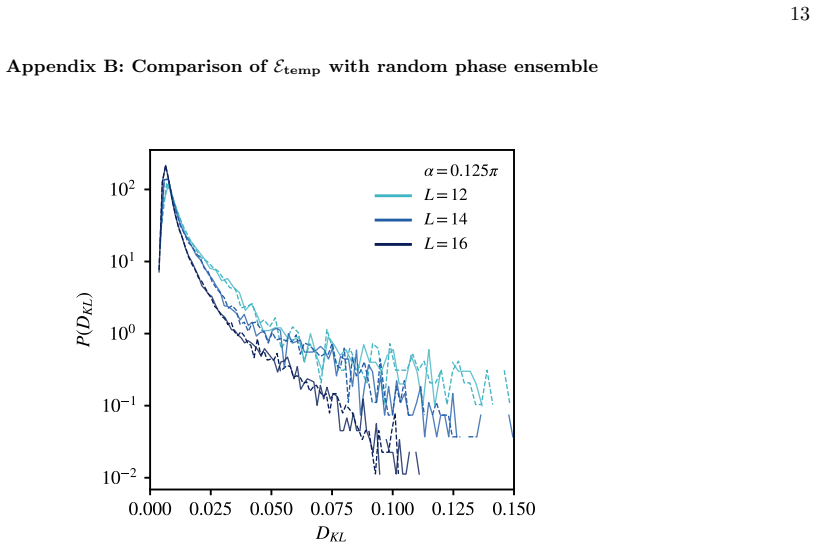
- [Sec. VI, Eqs. (38)-(41)] The analytic derivation of the PE moments is conditional on two unproved statistical inputs: (i) each p_t(b|z_A) is exponentially (Porter-Thomas) distributed with mean mu(b) from Eq. (39), and (ii) these variables are statistically independent across distinct z_A. The independence assumption is used precisely in Eq. (40), where the temporal average of the ratio in Eq. (38) is replaced by a product of independent Porter-Thomas densities, and again in the change of variables leading to Eq. (41). Without independence, the denominator [sum_{z_A} p(z_A) p_t(b|z_A)]^{k-1} couples all z_A and the identification with the Scrooge expression (45) does not follow. The authors themselves state in Sec. V and Sec. VII that these empirical results have not been proved. The central claim therefore holds conditionally, and the text should say so explicitly; ideally the random-phase ensemble of Appendix B, which already provides a cleaner stationary ensemble, could be used to test or prove the ansatz.
- [Sec. IV B and Fig. 4] The abstract and conclusion claim convergence to the Scrooge ensemble 'except when the measurement operator is close to the conserved charges', but no quantitative characterization of 'close' is given. The numerical evidence shows clean exponential decay for alpha ≳ 0.1 pi, a slower non-exponential trend for alpha = 0.05 pi, and a qualitatively different limit at alpha = 0 (Appendix C). Without a bound on how close to alpha = 0 the convergence can fail, or a statement that for any fixed alpha > 0 convergence holds for sufficiently large L, the claimed regime is not precisely defined and the central claim is not fully falsifiable. The authors should either specify the threshold and its L-dependence or explicitly restrict the claim to alpha bounded away from 0.
- [Sec. VI A, no-resonance condition] The derivation also relies on the k-th no-resonance condition and on temporal self-averaging of the matrix elements (Fig. 5). These are reasonable for the l-bit model, but the k-dependence of the condition and the assumed decay of temporal fluctuations with L are not discussed beyond the numerical evidence. Since the proof is already conditional on the Porter-Thomas ansatz, this additional assumption should at least be stated as an assumption, and preferably checked for k>3 where no numerical moments are reported.
minor comments (4)
- [Throughout] There are several typos that should be fixed: 'efffective' in Sec. I, 'with has' in Sec. VII, 'satisfies satisfies' in Sec. VI A, and 'p(b|zAA)' in Eq. (40).
- [Eq. (40) and Sec. V] The notation PoPb and PoP' is used with inconsistent spacing and font; using a single notation such as PoP_b and PoP would improve clarity.
- [Fig. 3 caption] The caption says the initial state has theta_1 and theta_2 specified, but the text in Sec. V and Eq. (11) samples these angles uniformly; it would be helpful to clarify whether the figure uses a fixed representative initial state or an average over states.
- [Sec. VII] The conclusion says numerical tests on the 'first three moments' confirm the k=3 design; since the paper reports k=2 and k=3 moments, this phrasing should be adjusted to avoid implying a separate k=1 check or a moment beyond the third.
Circularity Check
No significant circularity: the Scrooge-convergence claim is supported by direct numerical comparison and a transparently conditional analytic derivation whose Porter-Thomas input is an acknowledged empirical hypothesis, not a fitted or definitional surrogate for the target result.
full rationale
The paper's central derivation in Sec. VI is a genuine conditional implication rather than a reduction by construction. Starting from the exact expression for the projected-ensemble moment (Eq. 38), the authors introduce two statistical assumptions about the temporal ensemble: that each p_t(b|z_A) is Porter-Thomas distributed with mean mu(b) given by Eq. 39, and that these variables are independent across distinct z_A. Under these assumptions, the temporal average in Eq. 40 evaluates to the integral in Eq. 41, which is then shown to be identical to the independently computed Scrooge-ensemble moment in Eq. 45. This is a nontrivial mathematical identity: the input is a statement about bitstring probability distributions, while the output is an equality between two many-body ensemble moments. The Porter-Thomas ansatz is not fitted to the Scrooge moments, nor is it defined in terms of them; it is an empirical property of the same system, verified numerically in Sec. V (Figs. 6-9) and explicitly acknowledged as unproved in the conclusion. An unproved hypothesis is a rigor gap, not circularity. Moreover, the paper provides direct numerical evidence for Scrooge convergence that is independent of the Porter-Thomas ansatz: Sec. III and Sec. IV compute the trace distance (Eq. 16) between the projected-ensemble moments and the Scrooge moments over time and system size (Figs. 1-4), showing exponential decay with L for alpha >~ 0.1 pi. This external benchmark means the central claim does not rest solely on the conditional derivation. There are also no load-bearing self-citations: the Scrooge ensemble construction is cited from prior work, but the equality with the projected ensemble is derived here rather than imported, and no uniqueness or ansatz is smuggled in through a citation to the authors' own earlier results. The paper is unusually explicit about its limitation, stating in Sec. VII that 'we have not been able to prove these empirical results,' which further confirms that the Porter-Thomas input is an openly stated assumption rather than a hidden circular step. Accordingly, no specific circular reduction can be exhibited, and the appropriate finding is no significant circularity.
Assumptions & free parameters
assumptions (4)
- domain assumption The l-bit Hamiltonian satisfies the k-th no-resonance condition.
- domain assumption In the late-time temporal ensemble, the conditional bitstring probabilities p_t(b|z_A) are independent Porter-Thomas (exponential) random variables with mean mu(b) given by Eq. 39, and are uncorrelated across z_A.
- domain assumption The temporal ensemble average captures the late-time steady-state values of projected ensemble moments, with fluctuations vanishing as system size increases.
- standard math Standard techniques for Haar integration and the Scrooge moment formula from Ref. [19].
Cite this review
Pith. "Pith review of Projected ensemble in a system with conserved charges with local support." pith.science (2026). https://pith.science/paper/UXBB4M7M
@misc{pith2026250101823,
  author       = {Pith},
  title        = {Pith review of: Projected ensemble in a system with conserved charges with local support},
  year         = {2026},
  howpublished = {\url{https://pith.science/paper/UXBB4M7M}},
  note         = {Machine review of arXiv:2501.01823}
}
abstract
The investigation of ergodicity or lack thereof in isolated quantum many-body systems has conventionally focused on the description of the reduced density matrices of local subsystems in the contexts of thermalization, integrability, and localization. Recent experimental capabilities to measure the full distribution of quantum states in Hilbert space and the emergence of specific state ensembles have extended this to questions of {\textit{deep thermalization}}, by introducing the notion of the {\textit{projected ensemble}} -- ensembles of pure states of a subsystem obtained by projective measurements on its complement. While previous work examined chaotic unitary circuits, Hamiltonian evolution, and systems with global conserved charges, we study the projected ensemble in systems where there are an extensive number of conserved charges all of which have (quasi)local support. We employ a strongly disordered quantum spin chain which shows many-body localized dynamics over long timescales as well as the $\ell$-bit model, a phenomenological archetype of a many-body localized system, with the charges being $1$-local in the latter. In particular, we discuss the dependence of the projected ensemble on the measurement basis. Starting with random direct product states, we find that the projected ensemble constructed from time-evolved states converges to a Scrooge ensemble at late times and in the large system limit except when the measurement operator is close to the conserved charges. This is in contrast to systems with global conserved charges where the ensemble varies continuously with the measurement basis. We relate these observations to the emergence of Porter-Thomas distribution in the probability distribution of bitstring measurement probabilities.
Figures


Figures from the paper (5 more)


Forward citations
Cited by 1 Pith paper
-
Free Probability in a Minimal Quantum Circuit Model
In a solvable random-circuit model, all higher-order OTOCs decay at the same rate λ^{2t} (λ from a single-particle channel), and their late-time values match the free-cumulant decomposition predicted by full ETH.
Reference graph
Works this paper leans on
-
[1]
J. M. Deutsch, Quantum statistical mechanics in a closed system, Phys. Rev. A 43, 2046 (1991)
1991
-
[2]
Srednicki, Chaos and quantum thermalization, Phys
M. Srednicki, Chaos and quantum thermalization, Phys. Rev. E 50, 888 (1994)
1994
-
[3]
Rigol, V
M. Rigol, V. Dunjko, and M. Olshanii, Thermalization and its mechanism for generic isolated quantum systems, Nature 452, 854–858 (2008)
2008
-
[4]
D’Alessio, Y
L. D’Alessio, Y. Kafri, A. Polkovnikov, and M. Rigol, From quantum chaos and eigenstate thermalization to statistical mechanics and thermodynamics, Advances in Physics 65, 239–362 (2016)
2016
-
[5]
Haller, J
E. Haller, J. Hudson, A. Kelly, D. A. Cotta, B. Peaude- cerf, G. D. Bruce, and S. Kuhr, Single-atom imaging of fermions in a quantum-gas microscope, Nature Physics 11, 738 (2015)
2015
-
[6]
J. Choi, A. L. Shaw, I. S. Madjarov, X. Xie, R. Finkel- stein, J. P. Covey, J. S. Cotler, D. K. Mark, H.-Y. Huang, A. Kale, et al., Preparing random states and benchmark- ing with many-body quantum chaos, Nature 613, 468 (2023)
2023
- [7]
-
[8]
Ebadi, T
S. Ebadi, T. T. Wang, H. Levine, A. Keesling, G. Se- meghini, A. Omran, D. Bluvstein, R. Samajdar, H. Pich- ler, W. W. Ho, et al., Quantum phases of matter on a 256-atom programmable quantum simulator, Nature 595, 227 (2021)
2021
Show all 41 references
-
[9]
Opremcak, C
A. Opremcak, C. Liu, C. Wilen, K. Okubo, B. Chris- tensen, D. Sank, T. White, A. Vainsencher, M. Giustina, A. Megrant, et al., High-fidelity measurement of a su- perconducting qubit using an on-chip microwave photon counter, Physical Review X 11, 011027 (2021)
2021
-
[10]
A. L. Shaw, D. K. Mark, J. Choi, R. Finkelstein, P. Scholl, S. Choi, and M. Endres, Universal fluctuations and noise learning from hilbert-space ergodicity, arXiv preprint arXiv:2403.11971 (2024)
2024 arXiv
-
[11]
W. S. Bakr, J. I. Gillen, A. Peng, S. F¨ olling, and M. Greiner, A quantum gas microscope for detecting sin- gle atoms in a hubbard-regime optical lattice, Nature 462, 74 (2009)
2009
-
[12]
Bernien, S
H. Bernien, S. Schwartz, A. Keesling, H. Levine, A. Om- ran, H. Pichler, S. Choi, A. S. Zibrov, M. Endres, M. Greiner, et al., Probing many-body dynamics on a 51-atom quantum simulator, Nature 551, 579 (2017)
2017
-
[13]
A. M. Kaufman, M. E. Tai, A. Lukin, M. Rispoli, R. Schittko, P. M. Preiss, and M. Greiner, Quantum ther- malization through entanglement in an isolated many- body system, Science 353, 794 (2016)
2016
-
[14]
J. S. Cotler, D. K. Mark, H.-Y. Huang, F. Hernandez, J. Choi, A. L. Shaw, M. Endres, and S. Choi, Emergent quantum state designs from individual many-body wave functions, PRX quantum 4, 010311 (2023)
2023
-
[15]
L. P. Hughston, R. Jozsa, and W. K. Wootters, A com- plete classification of quantum ensembles having a given density matrix, Physics Letters A 183, 14 (1993)
1993
-
[16]
A. W. Harrow and S. Mehraban, Approximate uni- tary t-designs by short random quantum circuits using nearest-neighbor and long-range gates, Communications in Mathematical Physics , 1 (2023)
2023
-
[17]
A. W. Harrow, The church of the symmetric subspace, arXiv preprint arXiv:1308.6595 (2013)
2013 arXiv
-
[18]
Zyczkowski and H.-J
K. Zyczkowski and H.-J. Sommers, Induced measures in the space of mixed quantum states, Journal of Physics A: Mathematical and General 34, 7111 (2001)
2001
-
[19]
D. K. Mark, F. Surace, A. Elben, A. L. Shaw, J. Choi, G. Refael, M. Endres, and S. Choi, Maximum entropy principle in deep thermalization and in hilbert-space er- 15 godicity, Physical Review X 14, 041051 (2024)
2024
-
[20]
Jozsa, D
R. Jozsa, D. Robb, and W. K. Wootters, Lower bound for accessible information in quantum mechanics, Physical Review A 49, 668 (1994)
1994
-
[21]
Goldstein, J
S. Goldstein, J. L. Lebowitz, R. Tumulka, and N. Zanghi, On the distribution of the wave function for systems in thermal equilibrium, Journal of statistical physics 125, 1193 (2006)
2006
-
[22]
Chang, H
R.-A. Chang, H. Shrotriya, W. W. Ho, and M. Ippoliti, Deep thermalization under charge-conserving quantum dynamics, arXiv preprint arXiv:2408.15325 (2024)
2024 arXiv
-
[23]
Lucas, L
M. Lucas, L. Piroli, J. De Nardis, and A. De Luca, Gen- eralized deep thermalization for free fermions, Physical Review A 107, 032215 (2023)
2023
-
[24]
Bhore, J.-Y
T. Bhore, J.-Y. Desaules, and Z. Papi´ c, Deep thermaliza- tion in constrained quantum systems, Physical Review B 108, 104317 (2023)
2023
-
[25]
Pilatowsky-Cameo, C
S. Pilatowsky-Cameo, C. B. Dag, W. W. Ho, and S. Choi, Complete hilbert-space ergodicity in quantum dynamics of generalized fibonacci drives, Physical Review Letters 131, 250401 (2023)
2023
-
[26]
Ippoliti and W
M. Ippoliti and W. W. Ho, Dynamical purification and the emergence of quantum state designs from the pro- jected ensemble, PRX Quantum 4, 030322 (2023)
2023
-
[27]
Shrotriya and W
H. Shrotriya and W. W. Ho, Nonlocality of deep ther- malization, arXiv preprint arXiv:2305.08437 (2023)
2023 arXiv
-
[28]
Nandkishore and D
R. Nandkishore and D. A. Huse, Many-body localiza- tion and thermalization in quantum statistical mechan- ics, Annu. Rev. Condens. Matter Phys. 6, 15 (2015)
2015
-
[29]
D. A. Abanin and Z. Papi´ c, Recent progress in many- body localization, Annalen der Physik 529, 1700169 (2017)
2017
-
[30]
D. A. Abanin, E. Altman, I. Bloch, and M. Serbyn, Col- loquium: Many-body localization, thermalization, and entanglement, Rev. Mod. Phys. 91, 021001 (2019)
2019
-
[31]
Sierant, M
P. Sierant, M. Lewenstein, A. Scardicchio, L. Vidmar, and J. Zakrzewski, Many-body localization in the age of classical computing (2024), arXiv:2403.07111 [cond- mat.dis-nn]
2024 arXiv
-
[32]
Serbyn, Z
M. Serbyn, Z. Papi´ c, and D. A. Abanin, Local conserva- tion laws and the structure of the many-body localized states, Phys. Rev. Lett. 111, 127201 (2013)
2013
-
[33]
D. A. Huse, R. Nandkishore, and V. Oganesyan, Phe- nomenology of fully many-body-localized systems, Phys. Rev. B 90, 174202 (2014)
2014
-
[34]
J. Z. Imbrie, V. Ros, and A. Scardicchio, Local integrals of motion in many-body localized systems, Annalen der Physik 529, 1600278 (2017)
2017
-
[35]
V. Ros, M. M¨ uller, and A. Scardicchio, Integrals of mo- tion in the many-body localized phase, Nucl. Phys. B 891, 420 (2015)
2015
-
[36]
Serbyn, Z
M. Serbyn, Z. Papi´ c, and D. A. Abanin, Quantum quenches in the many-body localized phase, Phys. Rev. B 90, 174302 (2014)
2014
-
[37]
J. H. Bardarson, F. Pollmann, and J. E. Moore, Un- bounded growth of entanglement in models of many-body localization, Phys. Rev. Lett. 109, 017202 (2012)
2012
-
[38]
Serbyn, Z
M. Serbyn, Z. Papi´ c, and D. A. Abanin, Universal slow growth of entanglement in interacting strongly disordered systems, Phys. Rev. Lett. 110, 260601 (2013)
2013
-
[39]
Zhang, V
L. Zhang, V. Khemani, and D. A. Huse, A Floquet model for the many-body localization transition, Phys. Rev. B 94, 224202 (2016)
2016
-
[40]
Manju, A
C. Manju, A. Lakshminarayan, and U. Divakaran, Chaos controlled and disorder driven phase transitions induced by breaking permutation symmetry (2024)
2024
-
[41]
D. N. Page, Average entropy of a subsystem, Phys. Rev. Lett. 71, 1291 (1993)
1993
Reviewed August 10, 2026 · model on record in the stance chip above.
Discussion (0). Continue with ORCID to comment.