pith. machine review for the scientific record. sign in

cond-mat.dis-nn

Disordered Systems and Neural Networks

Glasses and spin glasses; properties of random, aperiodic and quasiperiodic systems; transport in disordered media; localization; phenomena mediated by defects and disorder; neural networks

0
cond-mat.dis-nn 2026-05-12 Recognition

Zero dual Lyapunov exponents mark critical states

Lyapunov Exponents as Duality-Invariant Signatures of Critical States

A proved incompatibility of localization in real and momentum space turns the Liu-Xia condition into an exact locator of critical lines and
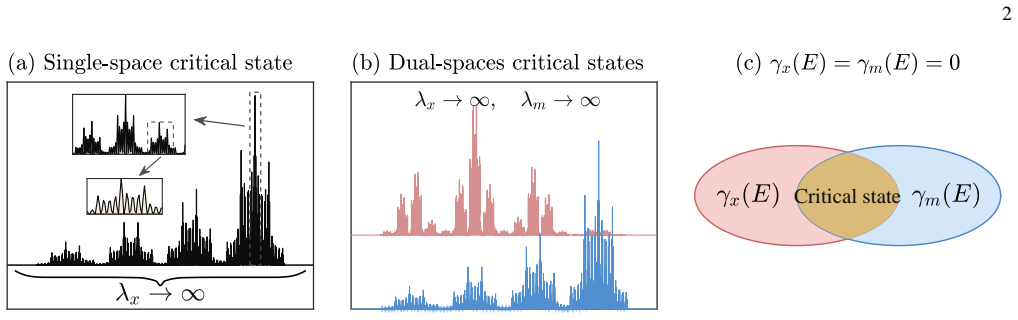
Figure from the paper full image
abstract click to expand
Critical eigenstates are usually identified through wave-function geometry in a chosen basis, such as participation ratios, multifractal spectra, or finite-size scaling. Here we formulate criticality instead as a dual-space Lyapunov property. We prove a Fourier exclusion principle: exponential localization in one representation is incompatible with exponential localization in its Fourier-dual representation. This turns the Liu--Xia condition, \(\gamma_x(E)=\gamma_m(E)=0\), from a phenomenological criterion into a rigorous length-scale statement: a critical state is characterized by the simultaneous absence of exponential confinement in real and momentum space. The criterion is invariant under bounded local gauge transformations of the transfer matrix and remains compatible with conventional single-space multifractal diagnostics. More importantly, it is exactly predictive. In analytically tractable quasiperiodic models, the same condition yields closed-form critical lines, an exact finite critical region with an additional critical branch, and a complex critical surface in a non-Hermitian non-self-dual spectrum. Thus the Liu--Xia condition provides not only a diagnostic of critical states, but an exact solvability principle for locating critical sets across distinct microscopic structures.
0
0
cond-mat.dis-nn 2026-05-12 2 theorems

Neural-ODEs enforce exact fixed points without losing approximation power

Exact Fixed-Point Constraints in Neural-ODEs with Provable Universality

A simple construction forces velocity to zero at chosen locations while a proof shows any remaining dynamics can still be matched exactly.

Figure from the paper full image
abstract click to expand
We introduce a technique that enables Neural-ODEs to approximate arbitrary velocity fields with a priori planted fixed-points. Specifically, a recipe is given to explicitly accommodate for a finite collection of points in the reference multi-dimensional space of the Neural-ODE where the velocity field is exactly equal to zero. In this way, the gradient-based training is rigorously constrained inside the prescribed hypothesis class while leaving the expressive power of the Neural-ODE unaltered. We rigorously prove the universality of the Neural-ODE under any local constraints in the velocity field and give a computationally convenient way of imposing the fixed points. Our method is then tested on two paradigmatic physical models.
0
0
cond-mat.dis-nn 2026-05-12 2 theorems

Negative parameter lets networks store one memory per neuron

Partial annealing and pattern decorrelation in associative neural networks

By making stored patterns less correlated, partial annealing reaches the theoretical maximum capacity and works for biased inputs too.

Figure from the paper full image
abstract click to expand
Using the Hopfield model as a benchmark case, the present work focuses on the investigation of partially annealed associative neural networks, wherein neural dynamics is coupled to slowly evolving patterns within the two-temperature-two-timescale framework. This setting inherently introduces a real parameter n, reminiscent of the number of replicas in the celebrated replica trick, that tunes the separation of timescales and the effective interaction between fast (i.e. the neurons) and slow (i.e. the synapses) degrees of freedom. By adapting Guerra's interpolation to the case, we derive the free energy without relying on analytical continuation. The obtained results demonstrate that negative values of n induce a progressive decorrelation of the stored patterns, thereby effectively reducing interference, promoting orthogonal configurations and ultimately conferring to the network the maximal storage alphac=1. Numerical simulations based on a mean field Monte Carlo dynamics have been employed to confirm this scenario and prove that partial annealing restores retrieval in challenging regimes, such as in the presence of biased patterns, outperforming standard decorrelation methods. These findings underscore the notion of partial annealing as an adaptive mechanism for enhancing memory organisation and retrieval in complex systems.
0
0
cond-mat.dis-nn 2026-05-12 2 theorems

Elasticity disorder slows sound and attenuates it as q^{d+1}

Attenuation of long-wavelength sound in quenched disordered media

Density disorder scatters waves the same way but leaves speed unchanged to leading order in the long-wavelength limit.

Figure from the paper full image
abstract click to expand
We derive analytically, and validate numerically, the dispersion renormalization and attenuation of acoustic waves propagating through quenched disordered media in the long-wavelength limit. We consider weak spatial fluctuations in elastic moduli and/or mass density and compute the disorder-induced self-energies within the leading (Born) approximation. For sufficiently weak disorder, the results depend only on the variances of the fluctuations and are therefore insensitive to the detailed form of the underlying random distribution. For spatially uncorrelated elasticity disorder we obtain Rayleigh-type attenuation, $\Gamma(q)\propto q^{d+1}$ , together with a reduction of the sound speed. In contrast, density disorder produces Rayleigh-type attenuation but does not renormalize the acoustic dispersion to leading order. Molecular dynamics simulations and normal-mode analyses of disordered one- and two-dimensional lattices quantitatively confirm the theoretical predictions.
0
0
cond-mat.dis-nn 2026-05-11 2 theorems

Coordination fluctuations alone produce the Boson peak

Microscopic origin of Boson peak in amorphous solids

Spring-node model shows only variations in bonds per particle create excess low-frequency vibrations; strength variations mainly damp modes.

Figure from the paper full image
abstract click to expand
We proposed a non-analytic model to explain the microscopic origin of the anomalous vibrational density of states (DOS), the Boson peak (BP), in amorphous solids based on the scalar dynamical matrix of a network with springs and nodes. We argue that disorder can be classified into two factors: fluctuation of spring strength and fluctuation of coordination numbers (the number of springs connected to a node). The results suggest that BP originates solely from fluctuation of coordination numbers, while the fluctuation of spring strength only contributes to the effect of damping and has very limited effect on low frequency DOS. This work converts complexity into simplicity and provides a direct answer to the puzzle of the microscopic origin of BP in amorphous solids.
0
0
cond-mat.dis-nn 2026-05-11 3 theorems

Context gating exponentially improves retrieval in memory models

Context-Gated Associative Retrieval: From Theory to Transformers

It separates memories and adds sparsity, and the same process explains in-context learning inside Llama-3.

Figure from the paper full image
abstract click to expand
Hopfield networks and their generalizations have established deep connections among biological associative memories, statistical physics, and transformers. Yet most models treat retrieval as a fixed query-to-memory mapping, ignoring the role of external context in recall. In this work, we propose a two-stage associative memory architecture, wherein a context-gate subcircuit reshapes the retrieval energy landscape before and during recall. We show theoretically that context gating increases inter-memory separation while inducing sparsity, translating into exponential improvements in retrieval. Crucially, we prove that the system admits a unique self-consistent fixed point, revealing that the resulting retrieval state is driven by both a direct contextual bias and a second-order retrieval-gate feedback loop. We then bridge this theory to transformers; specifically, we evaluate a first-order approximation on Llama-3, confirming that in-context learning acts as context-gated retrieval. Native dynamics mirror our theory: context localizes a memory subspace, enabling the zero-shot query to cleanly discriminate. Ultimately, this framework provides a mechanistic link between associative memory theory and LLM phenomenology.
0
0
cond-mat.dis-nn 2026-05-11 1 theorem

Minimal edge roughness makes domain walls pin stochastically

Stochastic Dynamics of Domain Wall on a Racetrack: Impact of Line-Edge Roughness

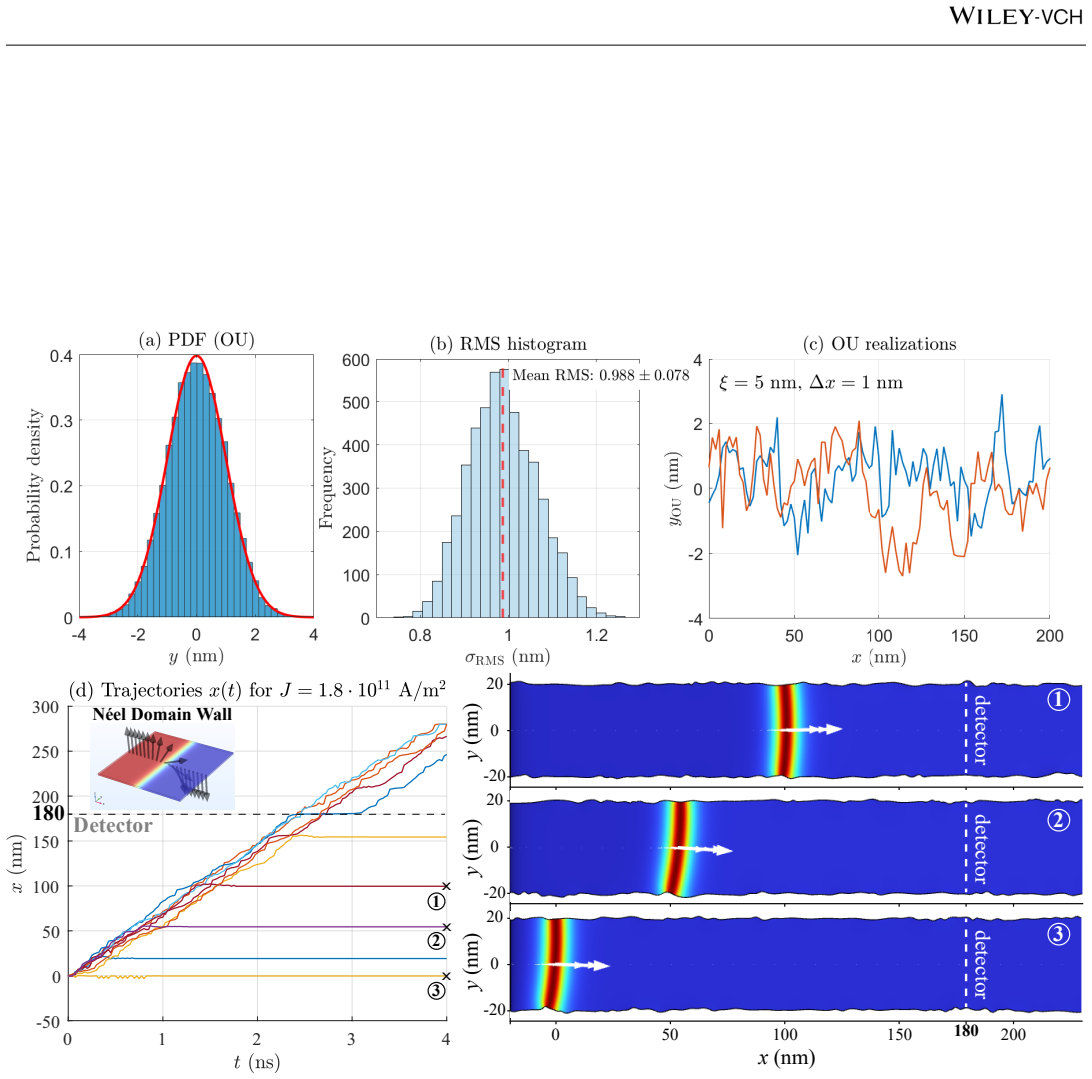
Spatial disorder alone produces random stopping points and sigmoidal current response, enabling p-bit behavior in racetracks without heat.

Figure from the paper full image
abstract click to expand
We investigate the impact of line-edge roughness on current-driven domain wall dynamics in ferromagnetic racetracks. Modeling the edge disorder as a spatially correlated Ornstein-Uhlenbeck process, we demonstrate that even minimal experimentally relevant roughness induces pronounced stochastic pinning of domain walls. Notably, this stochasticity of the current-driven motion arises purely from spatial disorder, even in the absence of thermal fluctuations. The probability of a domain wall to reach a given position exhibits a robust sigmoidal dependence on the applied current, reflecting an effective distribution of depinning thresholds. At the same time, the underlying dynamics is highly nontrivial: the mean velocity exhibits a nonlinear dependence on both time and current, while the mean-square displacement exhibits a ballistic regime at short times followed by saturation due to trapping at pinning sites. These results demonstrate that line-edge roughness provides a controllable source of stochasticity and enables p-bit-like functionality in racetrack systems, offering a pathway toward hardware implementations of probabilistic and neuromorphic computing.
0
0
cond-mat.dis-nn 2026-05-11 2 theorems

Outlier modes in deep network spectra grow consistently across widths

Spectral Dynamics in Deep Networks: Feature Learning, Outlier Escape, and Learning Rate Transfer

Mean-field scaling makes these dynamics width-independent and enables learning rate transfer, while large-output tasks restructure the bulk.

Figure from the paper full image
abstract click to expand
We study the evolution of hidden-weight spectra in wide neural networks trained by (stochastic) gradient descent. We develop a two-level dynamical mean-field theory (DMFT) that jointly tracks bulk and outlier spectral dynamics for spiked ensembles whose spike directions remain statistically dependent on the random bulk. We apply this framework to two settings: (1) infinite-width nonlinear networks in mean-field/$\mu$P scaling and (2) deep linear networks in the proportional high-dimensional limit, where width, input dimension, and sample size diverge with fixed ratios. Our theory predicts how outliers evolve with training time, width, output scale, and initialization variance. In deep linear networks, $\mu$P yields width-consistent outlier dynamics and hyperparameter transfer, including width-stable growth of the leading NTK mode toward the edge of stability (EoS). In contrast, NTK parameterization exhibits strongly width-dependent outlier dynamics, despite converging to a stable large-width limit. We show that this bulk+outlier picture is descriptive of simple tasks with small output channels, but that tasks involving large numbers of outputs (ImageNet classification or GPT language modeling) are better described by a restructuring of the spectral bulk. We develop a toy model with extensive output channels that recapitulates this phenomenon and show that edge of the spectrum still converges for sufficiently wide networks.
0
0
cond-mat.dis-nn 2026-05-11 2 theorems

Memristor nonlinearity pushes Hopfield capacity above classical limit

A Hardware-aware Hopfield Network with a Nonlinear Memristor Array for Robust Associative Memory with Superlinear Capacity

25x25 array demonstrates reliable reconstruction and simulations reveal K ~ 0.3 N^1.2 scaling under fixed budget

abstract click to expand
Associative memory retrieves complete patterns from partial or corrupted inputs and constitutes a primitive form of generative inference. Classical Hopfield networks (CHN) provide a canonical framework for associative memory but suffer from limited memory capacity. Recently, modern Hopfield networks (MHN) were introduced to achieve higher capacity by using explicit pattern-wise storage and neurons with the softmax activation function, which makes the MHN vulnerable to noise and the hardware implementation complicated due to its network size varying with the number of stored patterns. Here, we introduce a hardware-aware Hopfield network (HHN), in which the intrinsic nonlinear current-voltage characteristics of a charge-trap memristor are leveraged to engineer the energy landscape of the HN, increasing the memory capacity. Using a 25 x 25 nonlinear memristor array, we demonstrate reliable reconstruction of corrupted patterns with memory capacity far exceeding the classical limit (K ~ 0.14N, where N is the number of neurons). The HHN preserves Hopfield-type energy-minimization dynamics and remains robust to synaptic conductance noise. Large-scale simulations on high-dimensional image data reveal an empirical memory capacity scaling of K ~ 0.3 x N^1.2 under a fixed synaptic budget. These results establish HHN as a scalable hardware-native architecture for low-power associative memory and generative inference.
0
0
cond-mat.dis-nn 2026-05-08

Neural networks inherit energy functions from spin-glass models

Lecture Notes on Statistical Physics and Neural Networks

Lecture notes recast statistical physics as probability theory to connect phase transitions and renormalization to restricted Boltzmann mach

Figure from the paper full image
abstract click to expand
These lecture notes introduce some topics of classical statistical physics, particularly those that are relevant for neural networks and deep learning. Statistical physics is treated as a branch of probability theory or statistics, with the goal of making concepts such as phase transitions and the renormalization group accessible to readers without prior knowledge of physics. We introduce the Boltzmann-Gibbs distribution and the thermodynamic potentials on a finite configuration space, notably for Ising spins and spin-glass models on a lattice, and then define phase transitions as discontinuities that arise in the limit that the number of lattice points goes to infinity. We further introduce Hopfield networks and Boltzmann machines, which are governed by the same energy function as spin-glass models, and discuss the learning algorithm for restricted Boltzmann machines. In this algorithm hidden neurons are integrated out as in the renormalization group. Finally, modern deep learning is introduced, whose early developments were in part motivated by restricted Boltzmann machines in that they carry many layers of hidden neurons. A description of large language models is given.
0
0
cond-mat.dis-nn 2026-05-08

Moderate driving erases many-body localization in quasiperiodic Ising chains

Floquet-induced suppression of thermalization in a quasiperiodic Ising chain

The many-body critical phase instead spreads across much of the parameter space at these frequencies.

Figure from the paper full image
abstract click to expand
Many-body localized (MBL) systems are known to thermalize in periodically driven systems. In this work, we demonstrate that under proper driving protocol, this thermalization this thermalization can be resisted such that the MBL phase turns into a non-ergodic extended phase, known as the many-body critical (MBC) phase. Considering a kicked quasiperiodic Ising chain, we show that while at high-frequency driving the ergodic, MBL, and the MBC phases coexist, at moderate driving frequencies the MBL phase is completely suppressed and the MBC phase proliferates in the parameter space. Using quasienergy statistics, Floquet eigenstates, autocorrelation dynamics, and entanglement growth, we characterize the emergent phases and identify non-monotonic signatures revealing richness of the nonergodic phases. Our results establish Floquet driving as a powerful route to stabilizing nonergodic extended many-body phases beyond the conventional Floquet-MBL paradigm.
0
0
cond-mat.dis-nn 2026-05-08

SIC probe reveals fragmentation unique to quasiperiodic critical phases

Probing critical phases in quasiperiodic systems via subsystem information capacity

Stepwise ramps and subregion echoes in the extended Harper model separate critical states from extended and localized ones.

Figure from the paper full image
abstract click to expand
We systematically investigate the entanglement dynamics of quasiperiodic systems across their extended, critical, and localized phases, aiming to identify dynamical signatures that can clearly distinguish the critical phase from the other two. Focusing on the extended Harper model, we complement the half-chain entanglement entropy with the spatially resolved subsystem information capacity (SIC) and demonstrate that the critical phase exhibits a pronounced spatial heterogeneity that is absent in the extended and localized phases. In the steady state, the SIC reveals a stepwise ramp as a function of subsystem size, reflecting an underlying fragmentation of the chain into weakly connected subregions. Dynamically, information initially localized within such a subregion can undergo coherent long-lived oscillations, dubbed subregion echoes, whose period scales with the subregion length, in quantitative agreement with a quasiparticle picture of confined quasiparticle reflections. We trace this internal fragmentation to the incommensurately distributed zeros (IDZs) in the off-diagonal hopping terms of the Hamiltonian. To establish the generality of the SIC as a diagnostic tool, we further apply it to a mobility-edge phase with coexisting extended and localized states and to a critical phase that does not originate from IDZ fragmentation, and show that the SIC can cleanly distinguish these scenarios through their distinct steady-state profiles, initial-site sensitivities and the presence of subregion echoes. Our results establish the SIC as a powerful real-space probe for diagnosing critical phases and for uncovering the bottlenecked connectivity that underlies their multifractal structure.
0
0
cond-mat.dis-nn 2026-05-07

Flow equation for resonance density predicts thermalization

Resonance Proliferation Across Localization Transitions

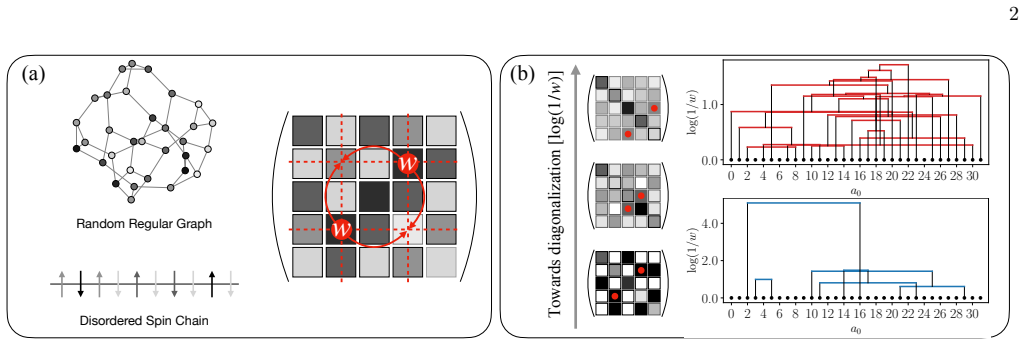
Within the statistical Jacobi approximation, the exponent θ(w) tracks resonance proliferation and signals delocalization when the flow loses

Figure from the paper full image
abstract click to expand
Models of many-body localization (MBL) exhibit slow numerical drifts towards delocalization with increasing system size, for which no satisfactory theory exists. Numerics indicates that these drifts are driven by the proliferation of many-body resonances at intermediate disorder strengths. We develop a statistical method to predict the distribution of resonance oscillation frequencies which captures how the formation of resonances at larger frequency scales subsequently affects the formation of resonances at lower frequencies. Working within the statistical Jacobi approximation (SJA), we derive a flow equation for a power-law exponent $\theta(w)$ characterizing the density of resonances at frequency scale $w$. A localized phase is described by a line of fixed points with $\theta(w)>0$, while an instability of the flow signals resonance proliferation and the onset of thermalization. The predicted $\theta(w)$ matches numerics on the Anderson model on random regular graphs and the L\'evy-Rosenzweig-Porter random matrix ensemble, both of which host resonance-driven delocalization transitions. We further connect the flow to eigenstate properties such as the participation ratio and to dynamical observables such as the return probability. The predicted $\theta(w)$ also matches what is numerically measured in real-space models of MBL at intermediate disorder strengths, representing a significant step towards explaining the finite-size drifts observed in MBL.
0
0
cond-mat.dis-nn 2026-05-07

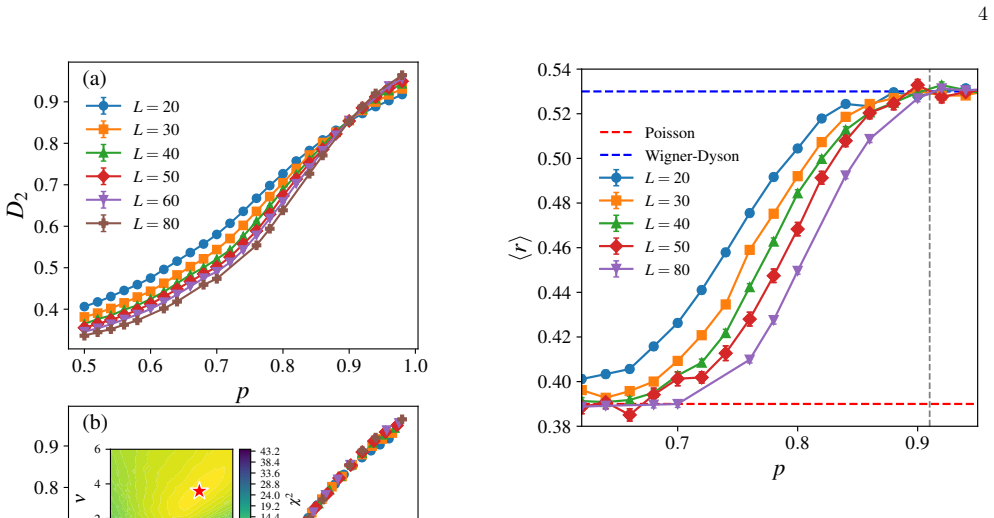
Activation mixture triggers scale-invariant signal flow in deep nets

Competing nonlinearities, criticality, and order-to-chaos transition in deep networks

At a critical per-neuron mixing ratio of Tanh and Swish, preactivation variance stops depending on depth while smoothness is preserved.

Figure from the paper full image
abstract click to expand
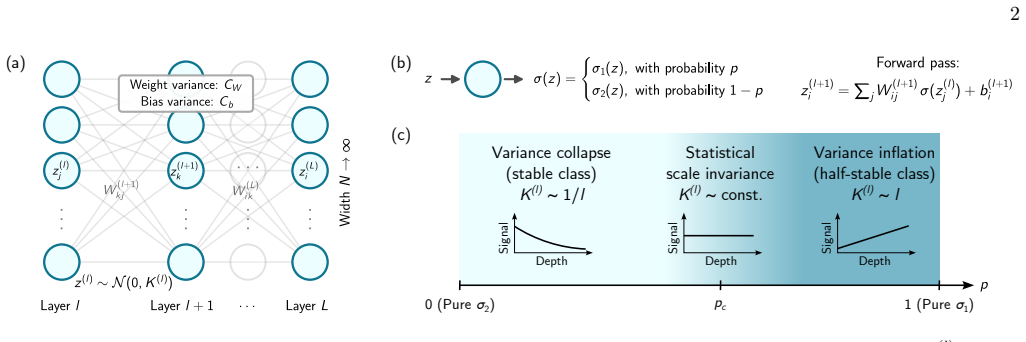
Deep neural networks owe their expressive power to nonlinear activation functions. The effective field theory of signal propagation at initialization reveals a few distinct universality classes of activations that exhibit different depth scaling. Tuning across these, especially with analytical control, is an open problem. We show that a statistical mixture of activations, where each neuron independently and randomly draws its activation from a two-component distribution with mixing fraction $p$, provides a new mechanism for a continuous phase transition. Applied to a mixture of Tanh and Swish, the transition is sharp in the depth scaling of the preactivation variance, separating a variance-collapsing from a variance-inflating phase; at $p_c$, the network acquires statistical scale invariance, with depth-independent variance, without sacrificing smoothness. This resolves a longstanding tension, where scale-invariant propagation has previously required the non-smooth ReLU family, rendering such networks ill-suited to curvature-based optimizers, physics-informed architectures, and neural-network quantum states. We corroborate the transition through variance propagation, parallel and perpendicular susceptibilities, and Lyapunov exponents. Training multilayer perceptrons on real datasets reveals non-monotonic test performance as a function of $p$, with an optimum near the theoretically predicted $p_c$, confirming that the initialization-level transition has direct consequences for learned representations. The quenched activation disorder acts as a structural regularizer, suppressing memorization of corrupted labels while preserving generalization. Our framework establishes statistical activation mixtures as a controlled tool for navigating the phase diagram of deep network universality classes.
1 0
0
cond-mat.dis-nn 2026-05-05

SYK free energy limit computed rigorously at high T

The free energy limit of the SYK model at high temperature

Sparse graph components and cavity method give exact annealed and quenched values matching physics calculations

Figure from the paper full image
abstract click to expand
The Sachdev-Ye-Kitaev (SYK) model is a disordered quantum mean-field model studied in condensed matter physics and the holographic theory of black holes. Its structural properties can be derived heuristically using a combination of the replica method and path integration techniques. Analyzing it mathematically rigorously, however, turned out to be notoriously difficult, even for basic questions such as computing the annealed free energy. In this paper we rigorously compute the free energy limit (annealed and quenched) for this model at high enough but constant temperature. Our results are in numerical agreement with the results derived by physics methods. Remarkably, though, our method of proof is novel and is different from the physics approach. It is based on (a) the theory of the component structure of sparse random graphs and (b) a variant of the cavity method, used widely in prior rigorous and heuristic treatments of classical spin glasses.
0
0
cond-mat.dis-nn 2026-05-05

Unphysical moves reach deeper glass states than cooling

Computational Methods towards Ultrastable Glasses

Review compares algorithms that produce low-energy amorphous solids, supplying both glass-transition benchmarks and routes to tougher glassy

Figure from the paper full image
abstract click to expand
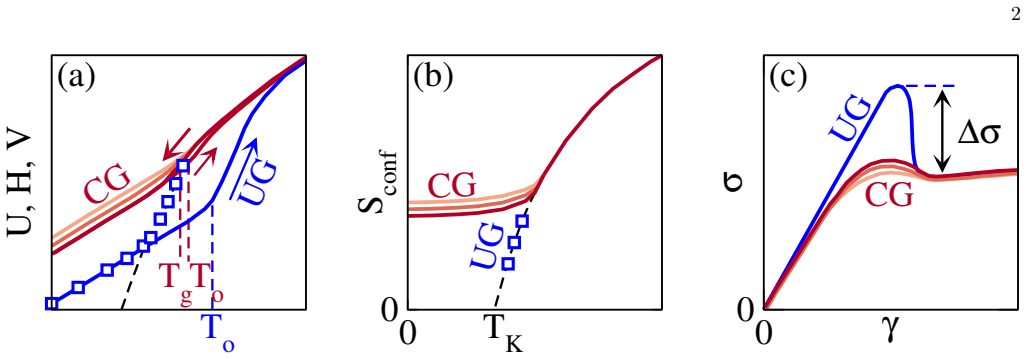
Ultrastable glasses, amorphous solids with exceptionally low-energy states and enhanced kinetic, thermodynamic and mechanical stability, have long been a subject of intense experimental interest. Over the past decade, their computational realization has emerged as a major goal in condensed matter physics, as numerical methods can exploit unphysical moves to access deeply supercooled and nonequilibrium glassy states far beyond the reach of conventional cooling protocols, thereby providing key insights into the nature of the glass transition and amorphous states and enabling the design of mechanically robust glassy materials. In this review, we outline the key steps underlying the most effective algorithms developed across the field. For each approach, we discuss its efficiency, limitations, and physical interpretation. We finally present a comparative analysis of the stability achieved across these methods, with the aim of equipping both newcomers and experts with an intuitive and comprehensive understanding of the field's current state and the opportunities it presents.
1 0
0
cond-mat.dis-nn 2026-05-04

Magnetic impurities encode spatial patterns into time signals

Reservoir computing by thin film embedded with magnetic impurities

Long-range forces in a thin film allow digit recognition from averaged magnetization alone.

Figure from the paper full image
abstract click to expand
The reservoir computing based on the thin film embedded with magnetic impurities in the presence of the long-range (the dipole-dipole) interaction is numerically investigated. We simulated the magnetization dynamics by taking into account the dipole-dipole interaction and performed the handwritten-digit recognition task. Although the training data is prepared by taking spatial average in the sample, the high classification accuracy is achieved. Our result demonstrates that the long range interaction effectively encodes the complex spatial input pattern into the time domain, even when only a spatially averaged output is accessible. The proposed system paves the way for easily realizable magnetic reservoir computing.
0
0
cond-mat.dis-nn 2026-05-04

Quasiperiodic modulation creates parity-dependent reentrant topology in SSH chains

Parity-dependent reentrant topology in a Su--Schrieffer--Heeger chain with power-law quasiperiodic modulation

Odd and even powers of the modulation exponent open topological phases from different trivial regimes in one-dimensional chains.

Figure from the paper full image
abstract click to expand
We investigate reentrant topological transitions in a one-dimensional Su--Schrieffer--Heeger chain with power-law quasiperiodically modulated intracell hopping. The modulation is characterized by a positive integer exponent $n$ and a tunable parameter $\beta$, which continuously interpolates between the smooth power-law quasiperiodic limit and a sign-function limit that becomes square-wave-like for odd $n$ and uniform for even $n$. By combining analytical calculations of the zero-mode inverse localization length with numerical evaluations of a real-space topological indicator, we determine the topological phase diagrams in the $\beta\to 0$, $\beta\to\infty$, and finite-$\beta$ regimes. We show that deterministic quasiperiodic modulation can induce TAI-like reentrant topological phases within finite parameter windows. The formation of these phases depends crucially on the parity of $n$: for positive modulation strength, odd-power modulations can induce reentrant topology from the clean trivial regime $|t_1|>1$, whereas even-power modulations allow such reentrance only from the negative clean trivial regime $t_1<-1$. Exact analytical expressions for the zero-mode inverse localization length are obtained for $n=1,2,3,4$, yielding explicit or implicit transition conditions. The finite-$\beta$ results demonstrate that the parity-dependent structure remains robust throughout the interpolation between the two limiting cases. This parity effect originates from whether the modulation preserves or removes the sign structure of $\cos x$. We further propose an electrical-circuit implementation and discuss experimentally accessible signatures of the reentrant trivial--topological--trivial transition.
0
0
cond-mat.dis-nn 2026-05-01

Hybrid algorithm recovers wildfire parameters from burned maps

Data-Driven Modelling to predict forest fire spread in the Patagonian region in Argentina

Genetic search plus XGBoost tunes a physics-based fire model to match observed scars across Patagonian landscapes.

Figure from the paper full image
abstract click to expand
Wildfires are among the most severe disturbances affecting forest ecosystems, with over 50,000 hectares burned in Patagonia, Argentina, during 2025 alone. This study implements a Reaction-Diffusion-Convection (RDC) model to simulate wildfire spread in the Steffen and Martin Lakes area, a region severely impacted by fires. By integrating high-resolution maps of slope, wind velocity, and vegetation, we conducted three computational experiments of increasing complexity to simulate fire propagation across heterogeneous landscapes. We employed a Genetic Algorithm (GA) to recover reference model parameters by maximizing the spatial overlap between simulated and reference burned areas. Subsequently, parameter estimates were refined using XGBoost to improve accuracy. Results demonstrate that the GA accurately recovers reference parameters across all scenarios, while the XGBoost fine-tuning significantly enhances accuracy in simpler cases. This integrated framework offers a systematic approach for estimating difficult-to-measure wildfire parameters, demonstrating the potential of hybrid computational methods for wildfire modeling and forest management.
0
0
cond-mat.dis-nn 2026-05-01

Fock-space graph, not real-space locality, sets East model phases

Locality versus Fock-space structure in East-type models

Randomized connectivity that keeps magnetization sectors intact still produces a clear delocalized-to-localized transition.

Figure from the paper full image
abstract click to expand
Local kinetic constraints in quantum many-body systems can generate slow dynamics or complete many-body localisation. Here we focus on a modification of the quantum East model: Inspired by random matrix theory, we randomise the connectivity in Fock space (rendering it nonlocal in real space) while preserving its organisation into neighbouring magnetisation sectors. We find that there is still a transition between two distinct phases, one delocalised and the other localised. We conclude that, for East-type constrained models, the essential ingredient is the structure of the graph in Fock space rather than geometric locality of spin flips.
0
0
cond-mat.dis-nn 2026-05-01

Synergy stretches criticality without disorder

The Synergistic Route to Stretched Criticality

Complementary reinforcement pathways in spreading models generate broad relaxation rates and Griffiths-like slow dynamics across networks.

Figure from the paper full image
abstract click to expand
Griffiths phases are typically associated with quenched disorder, while frustration gives rise to multistability and spin-glass behavior. Whether extended criticality can arise in other contexts remains an open question. Here, we show that synergistic interactions provide a distinct route to non-conventional critical phenomena. By combining spreading mechanisms that reinforce activity through complementary pathways, we uncover a broad distribution of relaxation rates, leading to Griffiths-like slow dynamics and extended criticality. We demonstrate that this mechanism is robust across networks and emerges both in systems with explicit higher-order interactions and in purely pairwise systems with nonlinear dynamics.
0
0
cond-mat.dis-nn 2026-05-01

BBP transition turns discontinuous when noise density vanishes fast

Discontinuous BBP transitions

Overlap jumps at the threshold and informative eigenvectors appear earlier with high sample variability when eigenvalue density thins faster

Figure from the paper full image
abstract click to expand
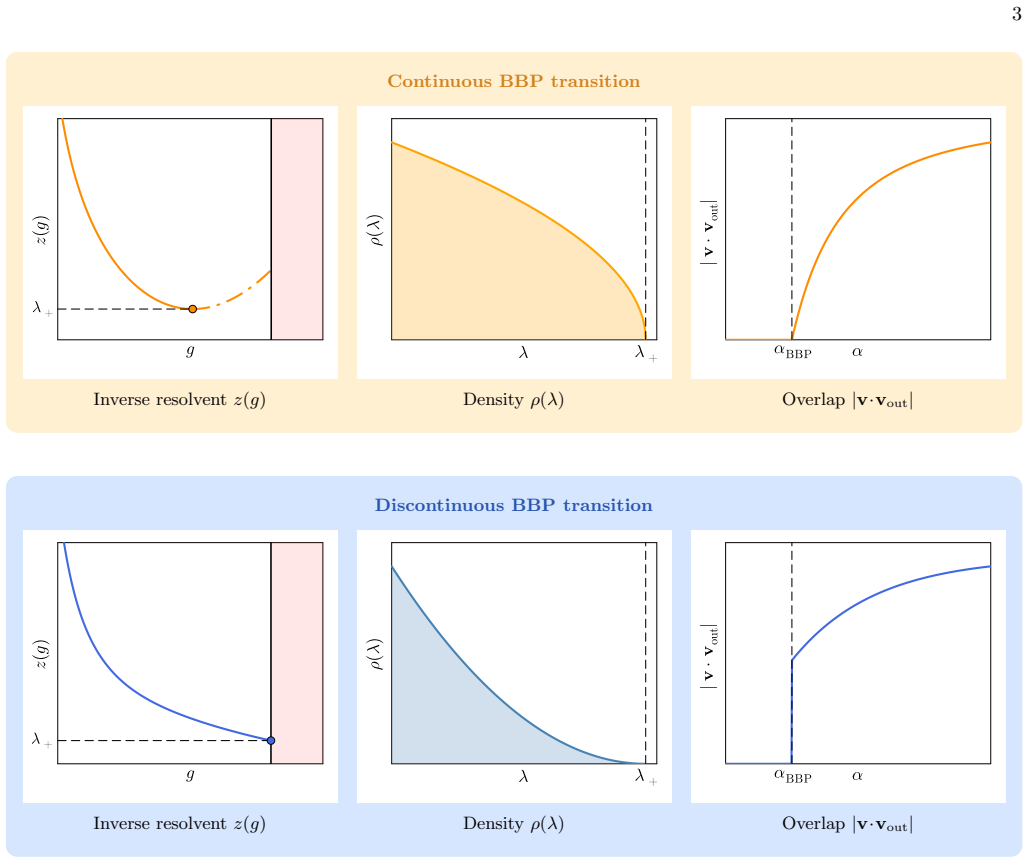
The Baik-Ben Arous-Peche (BBP) transition sets fundamental limits for detecting low-rank structure in noisy high-dimensional data and underlies a wide range of spectral methods in many fields from physics to statistics and data sciences. In standard settings, this transition is continuous, implying that signal recovery emerges gradually above a sharp threshold. We show that BBP transitions can instead be discontinuous in very general settings and provide a full theory of this phenomenon. When the eigenvalue density vanishes faster than linearly at the spectral edge, the overlap between the leading eigenvector and the signal jumps discontinuously at the critical point. We study this mechanism in deformed Gaussian and reweighted Wishart ensembles. We analyze in detail the finite-size effects, which play a central and qualitatively new role in the discontinuous BBP transition. Unlike the continuous BBP transition, we establish the existence of an extended pre-critical region where informative eigenvectors emerge well before the asymptotic threshold. The main consequence-and difference from the continuous BBP transition-is that signal recovery can occur at significantly lower signal-to-noise ratio and it is accompanied by strong sample-to-sample variability. Our results show the relevance and the novelty of the discontinuous BBP transition, and highlight the practical implications for signal detection.
0
0
cond-mat.dis-nn 2026-05-01

Transformers sample 180x180 spins with 20x higher efficiency

Sampling two-dimensional spin systems with transformers

Generating groups of spins and approximating probabilities reaches larger lattices than prior neural samplers.

Figure from the paper full image
abstract click to expand
Autoregressive Neural Networks based on dense or convolutional layers have recently been shown to be a viable strategy for generating classical spin systems. Unlike these methods, sampling with transformers is commonly considered to be computationally inefficient. In this work, we propose a novel approach to transformer-based neural samplers in which we generate not a single spin per step but groups of spins. As an additional improvement, we construct a model of approximated probabilities, further improving the efficiency of the algorithm. Despite our approach being computationally heavier than dense networks or CNN-based approaches, we were able to sample larger systems of up to $180 \times 180$ spins in case of the Ising model. The Effective Sample Size of our sampler is $\sim 20$ times larger than that of the previous state-of-the-art neural sampler when trained for the $128 \times 128$ Ising model at critical temperature. Finally, we also test our algorithm on the 2D Edwards-Anderson model, where we train $64\times 64$ spin systems.
0
0
cond-mat.dis-nn 2026-04-30

Quasiperiodic driving yields prethermal time quasicrystals

Emergence of prethermal time quasicrystalline order in a quasiperiodically driven non-interacting spin chain

Incommensurate frequencies produce spectral peaks and delay heating in a non-interacting spin chain, creating long-lived temporal order.

Figure from the paper full image
abstract click to expand
We study prethermal time quasicrystalline (TQC) order in a quasiperiodically driven chain of non-interacting spin-1/2 particles. The drive consists of two parts, switched on and off periodically with frequency $\omega_d$: (i) disordered Ising interactions, with exchange couplings chosen from a symmetric interval $[-J/2, J/2]$, allowing random antiferromagnetic or ferromagnetic nearest-neighbor couplings, together with a random transverse field; and (ii) a rotating transverse magnetic field with frequency $\Omega$. The ratio $\omega_d/\Omega$ is chosen to be irrational, producing multiple incommensurate frequencies and yielding quasiperiodic dynamics beyond Floquet theory. Using exact diagonalization, we analyze the time autocorrelation function, dynamical structure factor, and entanglement entropy (EE). In the high-frequency regime, robust spectral peaks at incommensurate frequencies (not integer multiples of the fundamental drives) signal quasiperiodic time-translation symmetry breaking (QTTSB). The EE exhibits sublinear power-law growth followed by a prethermal plateau, indicating suppressed resonant heating due to an energy scale mismatch. The nonequilibrium lifetime increases rapidly with driving frequency. Unlike symmetric disorder sampling, an asymmetric distribution of the Ising exchange couplings induces collective spin rigidity, enhancing the system's resistance to heating. The TQC phase remains stable against next-nearest-neighbor (NNN) exchange perturbations and rotational imperfections, with robustness comparable to discrete time crystals (TCs) under periodic driving. Our results establish this quasiperiodically driven system as a platform for long-lived nonequilibrium temporal order, revealing the interplay of disorder, collective rigidity, and quasiperiodic driving.
0
0
cond-mat.dis-nn 2026-04-30

Edge ratio to sign flips yields length scales on networks

Effective length scales, dispersion relations, and discrete densities of states for Laplacian eigenvectors on complex networks

Method turns Laplacian eigenvalues into dispersion relations for nine real and model graphs including power grids and food webs.

Figure from the paper full image
abstract click to expand
To construct dispersion relations for diffusion or oscillation processes on random networks, it is necessary to obtain effective length scales for the eigenvectors of a graph Laplacian matrix, whose eigenvalues represent inverse time scales. For this purpose, we adapt a method originally introduced in condensed-matter physics to estimate correlation lengths for disordered materials as the ratio of volume to interface area [P. Debye, H.R. Anderson and H. Brumberger, J. Appl. Phys. 28, 679 (1957)]. In a graph setting of vertices connected by edges, we interpret this as the ratio of twice the total number of edges to the number of edges connecting vertices bearing values of different sign on the particular eigenvector. After describing the method and the necessary concepts in pedagogical detail, we apply it to nine different graphs representing natural and artificial networks, including two tree graphs without and with random shortcuts, the nervous system of a roundworm, a food web, a social network of dolphins, an electrical power grid, and a model porous material. The results identify both distributed and localized eigenvectors. They are given in graphical format showing example eigenvectors, dispersion relations, and discrete densities of states, as well as tables summarizing the main numerical results.
0
0
cond-mat.dis-nn 2026-04-29

Range split lets first-order theory match Lennard-Jones data

Excluded volume and molecular field in the Lennard-Jones fluid: a modified first-order perturbation theory

Retaining density and temperature derivatives in the long-range term produces an equation of state that tracks high-accuracy simulations, so

Figure from the paper full image
abstract click to expand
The equation of state and, more generally, the thermodynamics of the Lennard-Jones fluid have long served as a benchmark problem in the statistical theory of fluids. Among available theoretical approaches, first-order perturbation theory occupies a special position: only at this level does the correction to the Helmholtz free energy admit an exact statistical-mechanical expression. In this work, we present a systematic, simulation-based assessment of a non-classical first-order perturbation theory in which the reference system incorporates the entire short-range part of the interaction, while the perturbation is confined to the remaining long-range tail. We show that this range-based decomposition transforms the perturbation contribution into a small, smoothly varying, near-mean-field quantity over a broad supercritical thermodynamic domain. When its density and temperature derivatives are consistently retained, the resulting equation of state reproduces high-accuracy reference data with excellent fidelity. The results demonstrate that the success of first-order perturbation theory is governed primarily by the physical content of the reference system and by the consistent treatment of its state dependence, rather than by the formal truncation order of the expansion.
0
0
cond-mat.dis-nn 2026-04-29

3D cell packings learn target stress patterns by tuning shape indices

Training cell stress patterns in 3D cellular packings

A contrastive algorithm shows rigidity and rearrangements let tissues achieve prescribed internal stresses, with sequential training as a st

Figure from the paper full image
abstract click to expand
The task of learning patterns is typically associated with systems that update parameters on fixed architectures, such as neural networks, where learning proceeds through continuous optimization. Here, we demonstrate that pattern learning can also emerge in reconfigurable cellular tissue, where both mechanical parameters and network topology evolve. Using a three-dimensional vertex model, we show that cellular packings can be trained to realize prescribed cell stress patterns through a contrastive learning algorithm to update hidden-cell shape indices. We find that learning is intrinsically collective, requiring coordinated, system-wide parameter adjustments, with learnability governed by an interplay between mechanical state, capacity, and training protocol. In particular, the rigidity of the tissue controls an effective exploration-exploitation tradeoff: fluid-like regimes enhance exploration through cellular rearrangements, while rigid regimes constrain dynamics and favor exploitation of existing configurations. These rearrangements introduce discontinuous learning dynamics, enabling the system to transition between distinct local minima in the cost function landscape. As the ratio of target cells to the total number cells in the packing or constraint load increases, learning becomes slower, more heterogeneous, and increasingly dependent on rare rearrangements that allow escape from geometrically constrained states. Finally, training cells in sequence, in contrast to parallel protocols, provides an alternative route that can be more robust but generally takes longer to train for the constraint loads studied. These results suggest a learning phase diagram governed by constraint load, cell packing rigidity, and training protocol. By enabling the training of localized internal states, this work positions tissues not only as adaptive materials, but as nonconventional AI platforms.
0
0
cond-mat.dis-nn 2026-04-28

Hyperbolic plane shows extended critical line in Anderson localization

Theory of Anderson localization on the hyperbolic plane

A two-parameter flow in curvature and conductivity separates metallic and insulating phases instead of an isolated point.

Figure from the paper full image
abstract click to expand
The two-dimensional hyperbolic plane, $\mathbb{H}^2$, is an unusual system in that dimensionality changes with scale: locally two-dimensional and planar at short distances, but effectively infinite-dimensional at large scales, it provides an interesting paradigm for the study of (quantum) phase transitions, notably the disorder-driven Anderson transition. Generalizing previous work, which treated short and large distance scales separately, we develop a unified framework interpolating between the principles of low- and high-dimensional Anderson localization. As a main result, we derive a two-parameter flow in a plane spanned by scale-dependent curvature (setting the system's effective dimensionality) and conductivity, with an extended critical line separating metallic and insulating phases.
1 0
0
cond-mat.dis-nn 2026-04-28

Mean-field approximation overestimates crack film conductivity by 13-79%

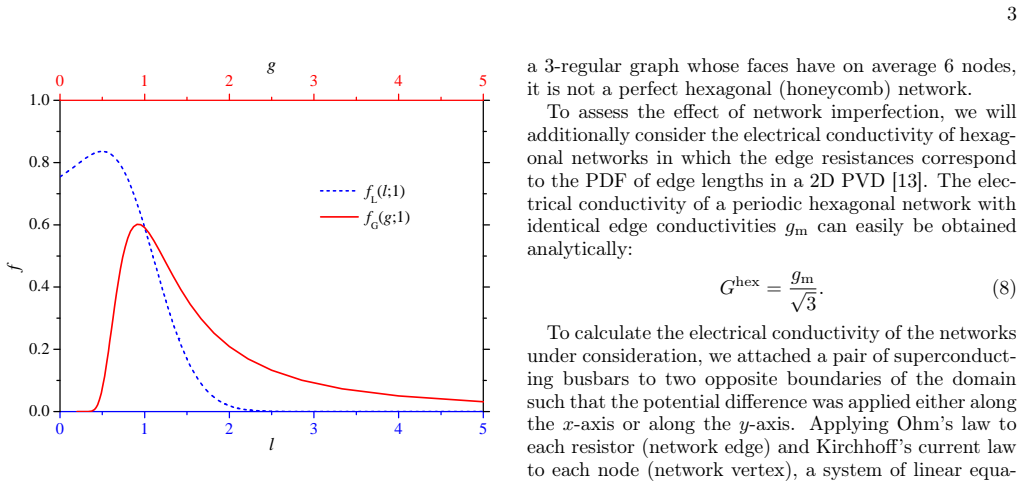
Electrical conductivity of crack-template-based transparent conducting films: mean-field approximation, effective medium theory, and simulation

Simulations of Poisson-Voronoi edge networks find the largest errors when using uniform conductivity from effective medium theory.

Figure from the paper full image
abstract click to expand
In our work, crack-template-based transparent conducting films were modeled as networks corresponding to the edges of a two-dimensional Poisson--Voronoi diagram. Two types of networks were considered: the original one, in which the conductivity of each edge was inversely proportional to its length, and the effective one, where all edges had the same conductivity obtained from the effective medium theory. The mean field approximation was used for analytical evaluation of the electrical conductivity. Direct numerical calculations for the Poisson--Voronoi diagram showed that the mean field approximation overestimated the conductivity of the original network by approximately 13\%, and of the effective network by 79\%. In addition, a hexagonal network with an edge conductivity distribution corresponding to the Poisson--Voronoi diagram was studied: for it, the predictions of the effective medium theory turned out to be more accurate than for the Poisson--Voronoi diagram, which was explained by the greater structural homogeneity of the periodic hexagonal lattice. Our results showed that when modeling crack-template-based transparent conducting films, especially in the case of hierarchical cracks with variable width (where the resistance was not simply proportional to the length), the application of the mean field approximation could potentially lead to significant errors.
0
0
cond-mat.dis-nn 2026-04-28

Neural network solved to 1/sqrt(N) without weight averaging

Solution of a large nonlinear recurrent neural network at fixed connectivity

Analytical moments and responses link connectivity to activity correlations in large recurrent nets.

abstract click to expand
We calculate the moments and response functions of a nonlinear random recurrent neural network in the large $N$ limit. Our approach does not require averaging over synaptic weights and gives the first nontrivial term in a $1/\sqrt{N}$ expansion of general intensive-order correlation functions, proving a recent conjecture by Shen and Hu as a special case. Our results provide an analytical link between synaptic connectivity, correlations in spontaneous activity, and the response of a network to small perturbations.
0
0
cond-mat.dis-nn 2026-04-27

Nonlinear recurrent networks share covariance with linear equivalents

Linear equivalence of nonlinear recurrent neural networks

At large N the activity covariance matrix matches a linear network driven by independent noise whose spectrum is set by mean-field order par

Figure from the paper full image
abstract click to expand
Large nonlinear recurrent neural networks with random couplings generate high-dimensional, potentially chaotic activity whose structure is of interest in neuroscience and other fields. A fundamental object encoding the collective structure of this activity is the $N \times N$ covariance matrix. Prior analytical work on the covariance matrix has been limited to low-dimensional summary statistics. Recent work proposed an ansatz in which, at large $N$, the covariance matrix for a typical quenched realization takes the same form as that of a linear network with the same couplings, driven by independent noise, with DMFT order parameters setting the transfer function and the noise spectrum. Here, we derive this ansatz using the two-site cavity method, providing two derivations with complementary perspectives. The first decomposes each unit's activity into a linear response to its local field and a nonlinear residual, and shows that cross-covariances between residuals at distinct sites are strongly suppressed, so the residuals act as independent noise driving a linear network. The second derives a self-consistent matrix equation for the covariance matrix. A naive Gaussian closure for the joint statistics of local fields at distinct sites misses cross terms that, in a linear network, would be generated by an external drive. The cavity method recovers these terms from non-Gaussian contributions, revealing an emergent external drive. Higher-order cross-site moments follow a Wick-like decomposition into products of pairwise covariances at leading order, reducing them to the linear-equivalent form. We verify the predictions in simulations. These results extend linear equivalence from feedforward high-dimensional nonlinear systems, where the activations are independent of the weights, to recurrent networks, where the activations are correlated with the couplings that generate them.
0
0
cond-mat.dis-nn 2026-04-27

Autoencoder reconstructs magnetization from NV magnetometry data

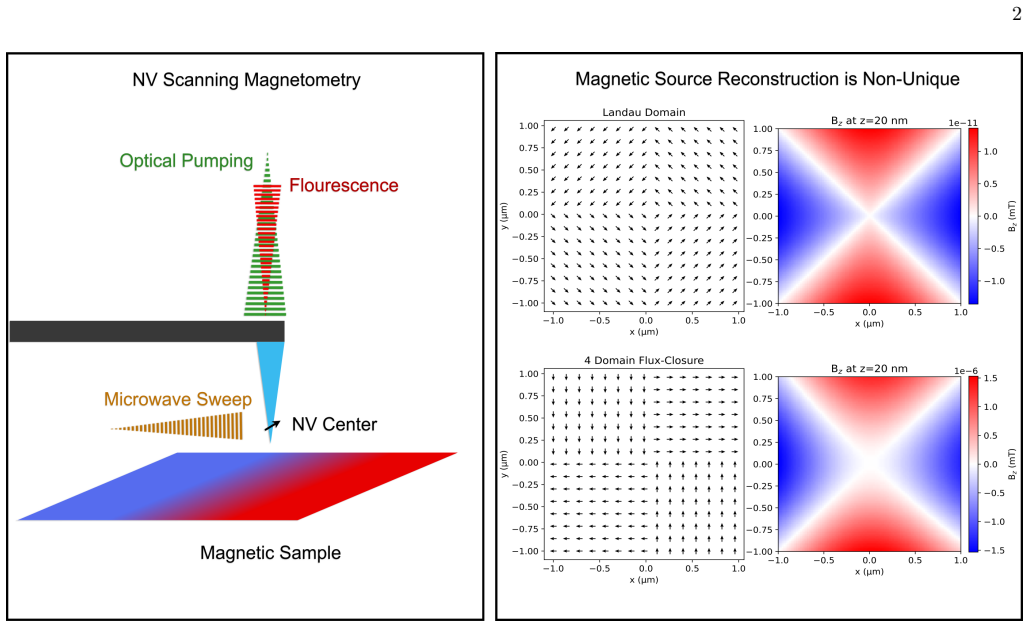
Physics-Informed Deep Image Prior Reconstruction of In-Plane Magnetization from Scanning NV Magnetometry

Physics-informed deep image prior uses spatial masks to solve ill-posed inverse problem in Permalloy films without training data.

Figure from the paper full image
abstract click to expand
Reconstructing magnetization in nanoscale magnetic thin films is essential for developing next-generation memory, sensors, and various spintronic technologies. However, this remains challenging due to the ill-posed nature of the stray field inverse problem, i.e., there are infinitely many magnetization solutions to a given stray field distribution. Here, we demonstrate that a physics-informed deep image prior (DIP) framework, using a simple convolutional autoencoder conditionally achieves a reasonable qualitative and quantitative reconstruction of complex in-plane magnetization patterns from scanning NV magnetometry. We find that the orientation of user-defined masks implemented to restrict the reconstruction solution space dramatically affects convergence. The optimal alignment of the mask improves the reconstruction signal-to-noise ratio by up to $\SI{3}{\decibel}$, thereby also serving as a diagnostic tool. The DIP approach requires no pre-trained datasets and is considered computationally less intensive as compared to supervised learning approaches. We analyze both Landau and dipole domain structures in lithographically patterned Permalloy nanostructures by incorporating experimentally-guided spatial constraints. Complementary magnetic force microscopy measurements were carried out to support the Scanning NV measurements.
0
0
cond-mat.dis-nn 2026-04-27

1 nm interfaces suppress magnetism in thin CoZr layers

Finite-size effects in amorphous thin Co₇₀Zr₃₀ layers

Finite-size effects lower moment and ordering temperature, with Griffiths phases describing the behavior near the transition.

Figure from the paper full image
abstract click to expand
Profound finite size effects are observed in both the moment and ordering temperature in thin Co$_{70}$Zr$_{30}$ layers. The results are consistent with the presence of interface regions with reduced magnetic interactions and moment. The extension of this region is determined to be around 1 nm thick at each interface. Above and near the apparent critical temperature, the magnetic properties can be understood in terms of Griffith phases.
1 0
0
cond-mat.dis-nn 2026-04-27 2 theorems

Scale-free subnetwork emerges in rewired graphs above triangle threshold

Motif enrichment as a driver of scale-free behavior in rewired random regular graphs

Dense clusters connect via a power-law network with degree exponent 2 independent of size, driven by triangle-induced attachment.

Figure from the paper full image
abstract click to expand
We study the statistics of rewired random regular graphs (RRGs) in a mixed ensemble, where the average number of triangles is controlled by the fugacity $\lambda$, while the number of vertices and the vertex degree are fixed. This model exhibits a phase transition at critical fugacity $\lambda_{cr}$ from a triangle-poor phase (TPP), in which the number of triangles is independent of the system size, to a triangle-rich phase (TRP), in which the number of triangles scales linearly with the system size. We estimate $\lambda_{cr}$ by comparing the entropy of TPP with the energy of TRP. Above $\lambda_{cr}$, the RRG becomes a two-phase system in which dense clusters are connected by a sparse scale-free sub-network characterized by a degree distribution, $P(d) \sim d^{-\gamma}$, with $\gamma \approx 2$, independent of the size of the whole graph and its degree. We attribute this behavior to an "emergent preferential attachment" induced by triangle motifs, describe the mechanism underlying its formation, and derive the exponent $\gamma$ within a mean-field approach. We show that most inter-cluster triangles are isosceles, with the base lying inside one cluster and the apex belonging to the inter-cluster network. Finally, we speculate on a possible connection between these triangles and Efimov states in a conformally invariant potential.
0
0
cond-mat.dis-nn 2026-04-27

Triangle enrichment creates scale-free inter-cluster networks

Motif enrichment as a driver of scale-free behavior in rewired random regular graphs

Above a critical fugacity, rewired regular graphs form cluster webs whose connecting links follow a power law of exponent 2 due to motif-pre

Figure from the paper full image
abstract click to expand
We study the statistics of rewired random regular graphs (RRGs) in a mixed ensemble, where the average number of triangles is controlled by the fugacity $\lambda$, while the number of vertices and the vertex degree are fixed. This model exhibits a phase transition at critical fugacity $\lambda_{cr}$ from a triangle-poor phase (TPP), in which the number of triangles is independent of the system size, to a triangle-rich phase (TRP), in which the number of triangles scales linearly with the system size. We estimate $\lambda_{cr}$ by comparing the entropy of TPP with the energy of TRP. Above $\lambda_{cr}$, the RRG becomes a two-phase system in which dense clusters are connected by a sparse scale-free sub-network characterized by a degree distribution, $P(d) \sim d^{-\gamma}$, with $\gamma \approx 2$, independent of the size of the whole graph and its degree. We attribute this behavior to an "emergent preferential attachment" induced by triangle motifs, describe the mechanism underlying its formation, and derive the exponent $\gamma$ within a mean-field approach. We show that most inter-cluster triangles are isosceles, with the base lying inside one cluster and the apex belonging to the inter-cluster network. Finally, we speculate on a possible connection between these triangles and Efimov states in a conformally invariant potential.
0
0
cond-mat.dis-nn 2026-04-27

2D light delocalizes above critical atom density in waveguides

Delocalization transition for light in two dimensions

Near-field dipole interactions reverse expected localization, producing a transition with critical exponent 1.4

Figure from the paper full image
abstract click to expand
Common belief, confirmed by existing experiments, is that arbitrarily weak disorder should lead to spatial localization of eigenmodes of scalar wave equations when wave propagation is two-dimensional (2D). We predict that contrary to this belief, a localization-delocalization transition can take place for light scattered by two-level atoms placed at random positions in the middle plane of a parallel-plate 2D waveguide fed by its fundamental transverse-magnetic (TM) mode (electric field polarized perpendicular to the waveguide and atomic planes). This transition, driven by near-field dipole-dipole interactions between atoms, occurs upon increasing the areal number density of atoms beyond some critical value. A finite-size scaling analysis of the transition yields an estimate of its critical exponent ${\nu}$ = 1.4 $\pm$ 0.2.
0
0
cond-mat.dis-nn 2026-04-24

Periodic drive creates two Floquet mobility edges

Floquet mobility edges and transport in a periodically driven generalized Aubry-Andr\'e model

Tunable delocalized-localized and multifractal-localized transitions switch transport from superdiffusive to subdiffusive.

Figure from the paper full image
abstract click to expand
We investigate the effect of a periodic electric field drive on the generalized Aubry-Andr\'e model, also known as the Ganeshan-Pixley-Das Sarma (GPD) model, which is well known as a host of mobility edges. Our study of the Floquet spectrum of the driven GPD model uncovers the emergence of two distinct Floquet mobility edges, a delocalized--localized (DL) edge in the bounded regime, and a multifractal--localized (ML) edge in the unbounded regime. Using analytical results derived from Avila's global theory applied to the high frequency effective Hamiltonian, together with numerical diagnostics such as the fractal dimension and inverse participation ratio, we demonstrate that these mobility edges can be effectively controlled by the amplitude and frequency of the electric field drive. We also identify drive-induced localization at specific values of the driving parameters, corresponding to dynamical localization points in the absence of quasiperiodic potential. Furthermore, the dynamical study of the periodically driven GPD model demonstrates superdiffusive to almost ballistic transport in the bounded regime corresponding to the DL edges, whereas subdiffusive transport is observed in the unbounded regime associated with the ML edges. We also analyze deviations from the high-frequency effective description by explicitly examining the low-frequency driving regime, where significant and counterintuitive deviations in both spectral properties and transport behavior are observed. Our study highlights the interplay of a quasiperiodic potential and a periodically varying electric field drive as a powerful mechanism to engineer mobility edges and control transport in systems with rich spectral features.
0
0
cond-mat.dis-nn 2026-04-24

Unbound states survive near-infinite quasiperiodic depths

Unbound States and Mixed Bound--Unbound Phases in Near-Infinitely Deep Potentials

Their window narrows to -2t-V < E < 2t-V; non-Hermitian gain and loss create mixed phases whose edges follow the Lyapunov exponent.

Figure from the paper full image
abstract click to expand
We investigate the robustness of unbound states in one-dimensional quasiperiodic models with near-infinitely deep potentials. By constructing a deeper extension of the Liu-Xia model and combining inverse participation ratio (IPR) calculations with Lyapunov-exponent analysis based on Avila's global theory, we show that increasing the potential depth does not eliminate unbound states. Instead, it shifts and narrows their energy window to $-2t-V<E<2t-V$. We further extend the analysis to non-Hermitian quasiperiodic potentials with gain and loss. In these systems, unbound states survive within analytically determined real-energy intervals, but they no longer occupy the whole interval uniformly; rather, they coexist with bound states and form a mixed bound-unbound phase. The corresponding boundaries between the mixed region and the pure bound-state regions are obtained exactly from the Lyapunov exponent. These results demonstrate that unbound states in extreme quasiperiodic potentials are controlled not only by the potential depth but also by the spectral and localization structures induced by non-Hermiticity.
0
0
cond-mat.dis-nn 2026-04-23

Stable glasses keep TLSs when bonding drives stability

The two-level systems in cryogenic solids, or how to avoid stressful memories

Amber retains excitations after geological ageing while vapor-deposited films lose them through reduced configurational entropy.

Figure from the paper full image
abstract click to expand
Structural glasses prepared by bulk quenching a liquid melt universally exhibit puzzling low-energy excitations commonly known as the ``two-level systems'' (TLSs). Recent studies indicate that ultrastable glassy films made by vapor deposition exhibit substantially fewer TLSs and, at the same time, are more stable enthalpically than conventional glasses made by quenching a melt. A similar phenomenon is observed in very stable glasses of model liquid mixtures prepared using swap Monte Carlo sampling. However, in a separate set of enthalpically stable solids, exemplified by amber matured over geological times, the two-level systems persist. In addressing this seeming conflict, we emphasize that a depletion of the TLSs, if any, means the configurational entropy of the material is lower than that of conventional glasses made by bulk-quenching a melt. Ageing does induce reduction in configurational entropy, but amber, we speculate, achieves enthalpic stabilization through increased bonding, not ageing. We separately comment on the discrepancy among existing predictions for the extent of cooperativity of the two-level systems. Several experiments are suggested to test the present picture.
0
0
cond-mat.dis-nn 2026-04-23

Generative networks extract Hamiltonian from spin data alone

Autonomous Emergence of Hamiltonian in Deep Generative Models

Trained on thermal snapshots without priors, the model recovers interaction parameters at 99.7% similarity and explains 87% of the force

Figure from the paper full image
abstract click to expand
The unprecedented predictive success of deep generative models in complex many-body systems, such as AlphaFold3, raises an epistemological question: do these networks merely memorize data distributions via high-dimensional interpolation, or do they autonomously deduce the underlying physical laws? To address this, we introduce a rigorous algebraic framework to extract the implicit physical interactions learned by generative models. By establishing an exact equivalence between the zero-noise limit of a Riemannian diffusion score field and the thermodynamic restoring force, we utilize the trained neural network as a direct force estimator. Applying this framework to a sequence-dependent, frustrated 1D $O(3)$ spin glass, we probe the latent representations of an $O(3)$-equivariant attention architecture trained solely on thermal equilibrium snapshots. Without incorporating any energetic priors, an overdetermined linear inversion successfully recovers the microscopic Hamiltonian parameters of the spin system. The inferred Hamiltonian parameters exhibit a $99.7\%$ cosine similarity with the ground-truth interaction parameters. Furthermore, these sparse local parameters alone are sufficient to explain $87\%$ of the variance in the continuous force field predicted by the network. Our results provide quantitative, falsifiable evidence that deep generative architectures do not merely perform statistical pattern matching, but autonomously discover and internalize the underlying physical rules.
0
0
cond-mat.dis-nn 2026-04-23

Flat bands stay localized in gaps despite disorder

Interplay of Flat-band and Anderson localizations in disordered moire superlattices

In moiré superlattices, confined flat bands resist Anderson localization while overlapping ones show inverse transitions or coexistence at强强

Figure from the paper full image
abstract click to expand
Disorder in moire superlattices simultaneously degrades flat-band localization and induces Anderson localization, yet how these two regimes interact has remained unclear. Here, we introduce a combined framework linking localization-length scaling with differential probability density analysis to map localization transitions in partially disordered one-dimensional silicon moire lattices. It is found that flat bands confined within the interband gap keep their strong localization even as disorder grows. In contrast, flat bands intersecting dispersive bands exhibit rich behaviors: the low-frequency branch undergoes an inverse Anderson transition, while the high-frequency branch supports coexisting flat-band and Anderson localization at strong disorder. Our results deliver the direct evidence of competing localization mechanisms in disordered moire systems and offer guiding principles for engineering robust, nonideal moire photonic devices.
0
0
cond-mat.dis-nn 2026-04-22

Daydreaming rule enlarges basins for biased patterns

Daydreaming algorithm for Biased Patterns

Centered reformulation outperforms pseudo-inverse by shaping the energy landscape differently in Hopfield models

Figure from the paper full image
abstract click to expand
The \emph{Daydreaming} algorithm was proposed as a learning rule that simultaneously reinforces stored patterns and suppresses spurious attractors to improve the storage capacity of the Hopfield model. Its effectiveness has been reported for both uncorrelated and correlated data. However, the existing formulation has mainly assumed unbiased patterns, and the formulation for biased patterns has not yet been sufficiently established. Biased patterns are known to be much more problematic for models of associative memories. In this study, we reformulate Daydreaming for biased patterns by starting from the underlying rationale of the pseudo-inverse rule. Specifically, we introduce the retrieval dynamics and an energy function based on the centered representation, and we derive a corresponding update rule for centered Daydreaming. We compare the centered pseudo-inverse rule with centered Daydreaming for biased patterns and examine the retrieval maps and eigenvalue distributions of the coupling matrices. Our results confirm that centered Daydreaming yields a larger basin of attraction than the centered pseudo-inverse rule. Moreover, as in previous studies, although both approaches aim to stabilize the stored patterns as fixed points, our results suggest that they shape the energy landscape through different mechanisms.
0
0
cond-mat.dis-nn 2026-04-21

Charge transport capacity grows with L via resonances in MBL models

Charge Transport Capacity as a Probe of Resonances in Models of Many-Body Localization

A new bound reveals that many-body resonances become more probable at larger sizes, explaining numerical drift toward thermalization.

Figure from the paper full image
abstract click to expand
The fate of Many-Body Localization (MBL) in the thermodynamic limit remains elusive, partly because numerical studies suffer from unexplained finite-size effects. We introduce and numerically study the charge transport capacity (CTC) -- a quantity that upper bounds the number of particles that can ever be transported across a central cut of a 1D lattice. For ergodic systems, the CTC is linear with the system size $L$, while we expect it to be $O(1)$ for localized models. Surprisingly, in the interacting Anderson model for numerically accessible $L$, the disorder-averaged CTC is small, but grows with $L$ at an increasing rate. Moreover, this growth rate appears to be independent of the disorder strength $W$ at very large $W$. We find that, for these system sizes, this growth occurs because, as $L$ increases, many-body resonances that transport more charge across the cut become more likely. Using a perturbative model for the weakly interacting regime, we provide an understanding of the microscopic origins of the growth of these charge transport resonances (CTRs). We find that the CTRs are sensitive to charge configurations over a spatial region whose size is set by the range of the resonance, not by $W$, and that numerics cannot access system sizes where their behavior will converge. However, this effective model is consistent with a regime of strong disorder where, for large $L$, resonances are exponentially suppressed in their size. Finally, we study measures of average charge transport and suggest that for strong enough disorder, average product states can only transfer $O(1)$ charge. Our work suggests that the unsettled growth of short-ranged many-body resonances with $L$ contributes to the numerical drift towards thermalization at numerically accessible system sizes, and provides an understanding of how they can remain controlled or eventually destabilize the MBL phase.
2 0
0
cond-mat.dis-nn 2026-04-21

Inhomogeneous noise can improve signal detection

BBP transition and the leading eigenvector of the spiked Wigner model with inhomogeneous noise

Non-monotonic BBP line for truncated power-law variances shows better detectability than uniform noise over a range of strengths.

Figure from the paper full image
abstract click to expand
The spiked Wigner ensemble is a prototypical model for high-dimensional inference. We study the spectral properties of an inhomogeneous rank-one spiked Wigner model in which the variance of each entry of the noise matrix is itself a random variable. In the high-dimensional limit, we derive exact equations for the spectral edges, the outlier eigenvalue, and the distribution of the components of the outlier eigenvector. These equations determine the BBP transition line that separates the gapped phase, where the signal is detectable, from the gapless phase. In the gapped regime, the distribution of the outlier eigenvector provides a natural estimator of the spike. We solve the equations for a noise matrix whose variances are generated from a truncated power-law distribution. In this case, the BBP transition line is non-monotonic, showing that an inhomogeneous noise can enhance signal detectability.
0
0
cond-mat.dis-nn 2026-04-21

Per-instance rescaling restores scaling of Ising transition rates on random graphs

Transition path sampling in Ising models on heterogeneous graphs

For Erdős-Rényi graphs this enables consistent finite-size scaling and direct comparison to the static free-energy barrier.

Figure from the paper full image
abstract click to expand
Activated transitions have rates that are often exponentially small in system size. Extracting the associated activation barriers is challenging in practice, especially in the deeply metastable regimes and in the presence of disorder. Here, we use transition path sampling to evaluate transition probabilities between ferromagnetic states in the Ising model on finite sparse random graphs, which are perhaps the simplest example of a disordered system with metastable states. To interpret the transient onset of the transition probability curve, we introduce a minimal three-state kinetic description that highlights the role of intermediate configurations. We validate the method on the heterogeneous Zachary Karate Club network, where distinct dynamical regimes emerge as temperature varies. We then apply the method to random regular graphs and Erd\H{o}s-R\'{e}nyi graphs, showing that sample-to-sample fluctuations are weak in the former but that quenched topological disorder induces sizable instance variability in the latter. For Erd\H{o}s-R\'{e}nyi graphs, we introduce an instance-dependent temperature rescaling that restores a consistent finite-size scaling of dynamical rates and enables a direct comparison with the corresponding static free-energy barrier.
0
0
cond-mat.dis-nn 2026-04-21

Memristive networks spike like neurons at resonant frequencies

Intrinsic Neuro-Synaptic Spiking Dynamics and Resonance in Memristive Networks

Nonlinear spiking peaks when input matches the network's natural timescale, with optimal computation just before resonance.

Figure from the paper full image
abstract click to expand
Self-organizing memristive networks are physical circuits that dynamically reconfigure their circuitry in response to external input signals. Their adaptive behavior arises from intrinsic neuro-synaptic dynamics combined with a heterogeneous network topology. In this work, we demonstrate that such networks naturally generate neuronal population spiking dynamics similar to those observed in biological neuronal systems. This study investigates the intrinsic and emergent dynamics of memristive networks mathematically and numerically for both DC and AC input signals. Nonlinear spike-like features are maximized when the frequency of the input driving signal matches the network's intrinsic dynamical timescale, where nonlinear resonance is observed. Furthermore, the optimal frequency for computation is found to be the maximal frequency before the onset of resonance.
0
0
cond-mat.dis-nn 2026-04-21

Replica theory solves when ensembles beat single Boltzmann machines

Replica Theory of Spherical Boltzmann Machine Ensembles

Exact solution for the spherical case shows gains over loss minimization for nearly finite-dimensional data and matches deep-network runs.

Figure from the paper full image
abstract click to expand
Training in machine learning generally consists in finding one model, whose parameters minimize a data-dependent loss. Yet, empirical work shows that ensemble learning, an approach in which multiple models are sampled, can improve performance. Here, we provide an analytical framework to understand these observations in the case of Boltzmann machines, exploiting a duality between ensemble learning and large deviations of the free energy in spin-glass models. Replica calculations allow us to fully solve the case of spherical Boltzmann machine ensembles, and clarify when ensemble learning improves over standard loss minimization, in particular for nearly finite-dimensional data. Our framework can also be applied to complex data distributions, in agreement with numerical simulations on deep networks.
3 0
0
cond-mat.dis-nn 2026-04-21

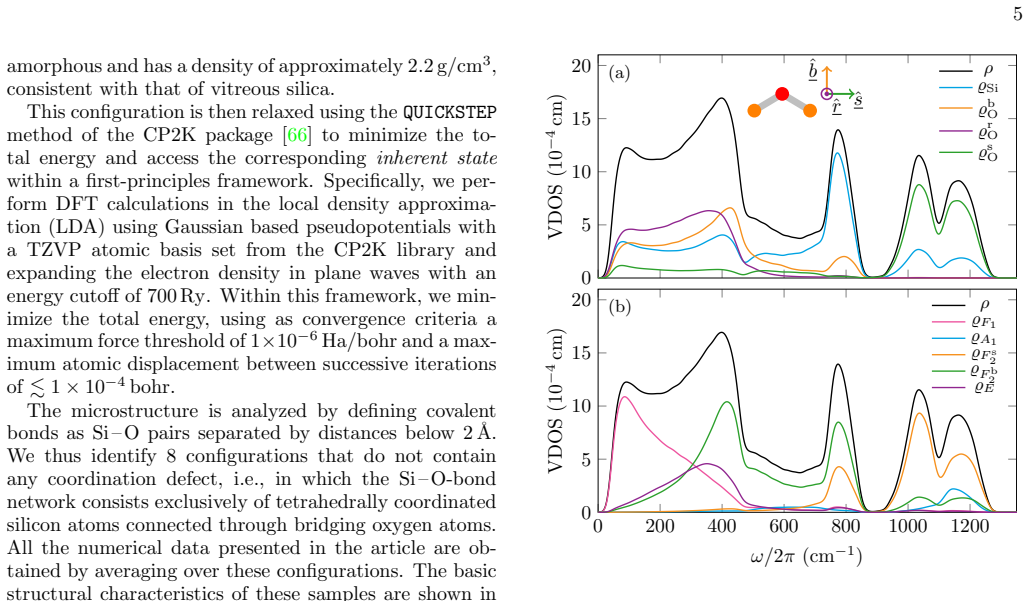
Six orthogonal subspaces organize silica glass vibrations

The vibrational spectrum of vitreous silica: rigorous decomposition via recursive orthogonal splitting analysis

Recursive splitting via stiffness contrasts captures low-frequency structure and all major peaks

Figure from the paper full image
abstract click to expand
Our understanding of vibrations in solids currently rests on concepts and techniques designed for crystals and explicitly relying on periodicity, hence inapplicable to amorphous materials. As a consequence, no established framework enables a systematic decomposition of the vibrational spectrum of amorphous solids into contributions associated with well-defined types of atomic motions. This methodological gap obscures the interpretation of various experimental probes of linear response, based on the measurements of acoustic, thermal, or optical properties. Here, we construct such a framework-Recursive Orthogonal Splitting Analysis (ROSA)-which decomposes the vibrational space by recursive applications of the projection formalism. Each step of the procedure exploits a dominant stiffness contrast to split a vibrational displacement subspace into two weakly coupled orthogonal complements. We illustrate ROSA by applying it to the archetypal covalent glass-vitreous silica. Successively separating bond-stretching, symmetric and antisymmetric oxygen motions, isotropic and deviatoric tetrahedral strains, and distinct classes of tetrahedral bending, reveals a hierarchical structure of the space of vibrational degrees of freedom, involving six mutually orthogonal subspaces. These subspaces selectively capture all salient spectral features, including the two-humped structure in the low-frequency range, the peak near 800 cm -1 , and the high-frequency doublet. In the low-frequency range, rigid-unit tetrahedral rotations do not constitute independent degrees of freedom but are kinematically enslaved to bending coordinates by no-stretch constraints. Because ROSA relies solely on the existence of contrasted stiffness scales associated with the point symmetry of local structural units, and on their separation by enforcing geometric constraints via the projection formalism, it is directly applicable to a broad class of covalent network glasses.
0
0
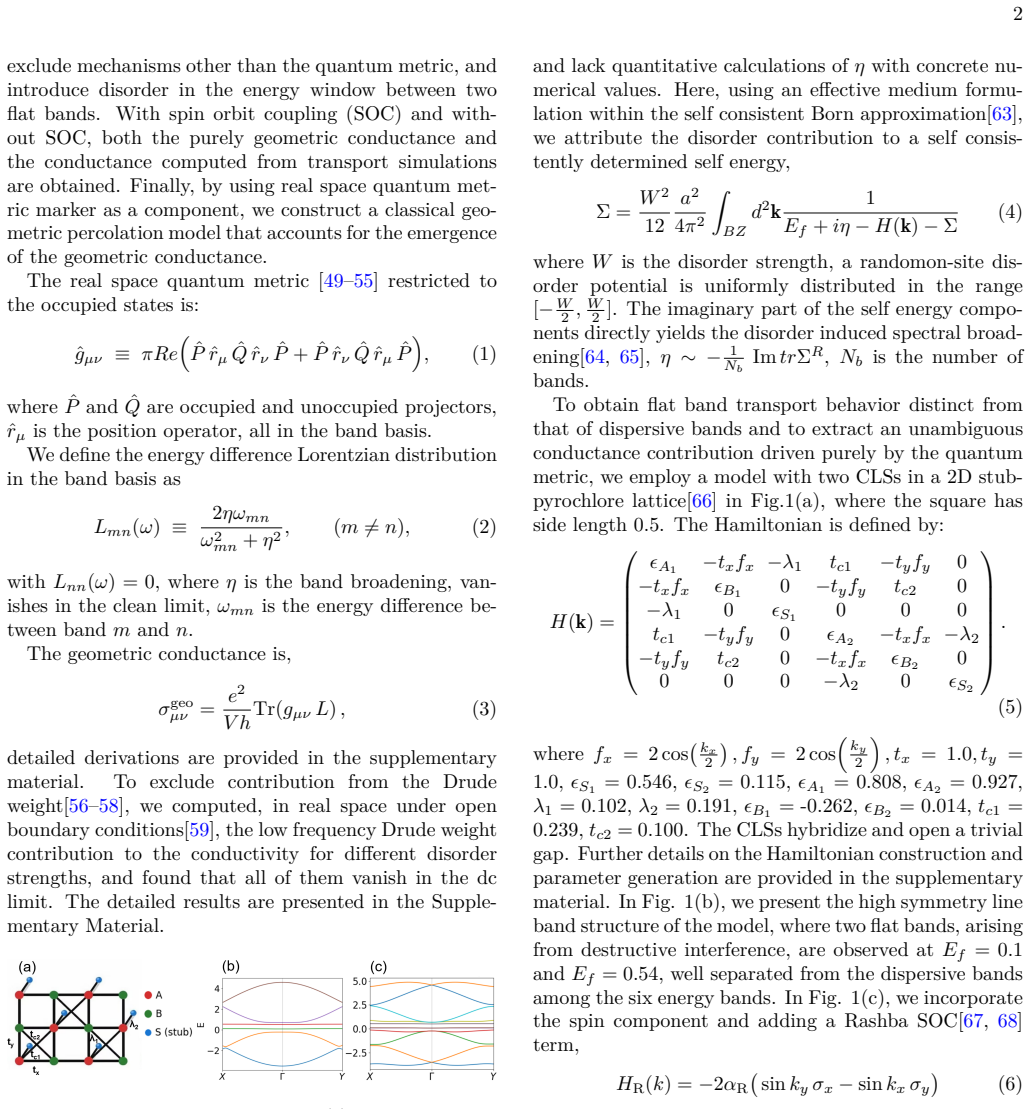
cond-mat.dis-nn 2026-04-20

Quantum metric puddles percolate to delocalize flat bands

Percolation from Quantum Metric in Flat-Band Delocalization

A bond-percolation model built from the real-space quantum metric reproduces the critical delocalized regime exactly in a disordered 2D flat

Figure from the paper full image
abstract click to expand
The quantum metric is a fundamental ingredient of band quantum geometry and has recently at tracted intense interest, with most of its transport signatures appearing in the intrinsic second order nonlinear conductivity. In the clean limit, previous works argued that linear response conductivity is insensitive to the quantum metric, while the Berry curvature yields an intrinsic anomalous Hall con tribution. Here we combine analytic derivations with new numerics to show that disorder modifies the linear response conductivity dominated by geometric conductivity which is determined by the real space quantum metric. Focusing on a two dimensional multi-flatband stub-pyrochlore lattice, we identify a critical delocalized regime sandwiched between flat band localization and Anderson localization, characterized by finite geometric conductivity. Upon including spin orbit coupling, this regime evolves into a diffusive metallic phase, constituting a two dimensional inverse Anderson transition. Moreover, exploiting the connection between the real space quantum metric marker and the Wannier function spread, we construct a bond-percolation model on a square lattice. The resulting percolation region quantitatively coincides the critical delocalized regime, the exponent of which supports a classical percolation universality class. These findings suggest that flat band de localization can be understood as a classical percolation of quantum metric puddles. This advances our understanding of quantum geometric contributions to transport and establishes linear response measurements as a new avenue for accessing the quantum metric.
1 0
0
cond-mat.dis-nn 2026-04-17

p-spin glass skips one-step replica symmetry breaking

The Phase Transitions in a p spin Glass Model: A Numerical Study

Simulations on long-range proxies show direct transition to full RSB and hint at zero Kauzmann temperature in three dimensions

Figure from the paper full image
abstract click to expand
We investigate the balanced $M=4$, $p=4$ spin-glass model for a one-dimensional long-range proxy for the finite dimensional short-range $p$-spin glass model to examine the nature of the glass transition beyond mean-field theory. We perform large-scale Monte Carlo equilibrated simulations for both fully connected and power-law diluted versions of the model. The critical temperatures extracted from the finite-size scaling (FSS) analysis of spin-glass susceptibility are in good agreement with theoretical predictions for $\sigma = 0, 0.25$, and 0.55. For these values of the long-range exponent $\sigma$ (which is the power of the decrease of the interactions between the spins with their separation), one might have expected that mean-field theory would provide a good description of the system. However, the spin-overlap distribution and the value of the $\lambda$-parameter do not provide numerical evidence for a one-step replica symmetry breaking (1RSB) phase transition. Instead, our results indicate a direct transition from the paramagnetic state to a full replica symmetry broken phase, with a renormalized value of $\lambda\equiv \omega_2/\omega_1 < 1$ suggesting a continuous FRSB transition, despite this ratio being equal to 2 at mean-field level. A value of $\lambda > 1$ is required for the discontinuous 1RSB transition. We argue that strong finite-size effects and closely spaced transition temperatures remove the expected 1RSB transition for the system sizes which we can study. For values of the exponent $\sigma = 0.85$, which roughly corresponds to a three dimensional system, we find that the renormalized value of $\lambda$ is again less than 1, with no signs of either the 1RSB transition or the continuous FRSB transition, suggesting that the Kauzmann temperature $T_K$ in three dimensions might be zero and the complete absence of phase transitions in structural glasses.
0
0
cond-mat.dis-nn 2026-04-17

The paper derives exact magnetization curves for sites of different coordination numbers…

Understanding jump discontinuity in disordered system

In the diluted Bethe-lattice random-field Ising model the magnetization jump is the sum of contributions from sites with coordination 4, 3…

Figure from the paper full image
abstract click to expand
The response of a complex system to a slow varying external force often displays a jump discontinuity in the order parameter near the critical point. However, this discontinuity is not usually a single jump but rather breaks into smaller jumps which makes it difficult to locate the critical point on approaching its vicinity based only on simulations, in the absence of exact results. Our work is a small effort in understanding these breaks in jump through the hysteretic response of a classical Ising spin system to an external field, $h$, in the context of a nonequilibrium zero-temperature random field Ising model on dilute systems. We consider a Bethe lattice with coordination number, $z = 4$, and dilute a fraction $(1-c)$ of the sites. Therefore the lattice now consists of sites with varying $z = 4, 3, 2, 1$ and possibly few isolated sites $(z=0)$, depending on the concentration $c$. We obtain the exact solution of the magnetization curve, $m(h)$ vs $h$, for the entire lattice as well as for each sublattice of different $z$ coordinated sites, $m_4(h), m_3(h), m_2(h), m_1(h), m_0(h)$. The discontinuity in total magnetization is the result of the superposition of the jumps of different $z$ coordinated sites and observed at the same value of external field, $h_{crit}$. The dominant contribution to the jump comes from those sites with higher concentration and larger $z$. However, the triggering sites responsible for large jumps are mostly $z\ge3$. We test this on cubic lattices as well, where exact results are not available. We hope our analysis will help in understanding fluctuations around a jump in numerical simulations as well as experiments.
0
0
cond-mat.dis-nn 2026-04-16

Spin glasses equilibrate faster in 2D than 3D

Dynamics of spin glasses in two dimensions

CuMn multilayers show correlation lengths growing more rapidly once they cross into two-dimensional dynamics and reach equilibrium at long t

Figure from the paper full image
abstract click to expand
Spin glass dynamics is a strong function of spatial dimensionality $D$. The lower critical dimension is close to 2.5, so that, in two dimensions, the condensation temperature $T_\text{g}=0$, and only fluctuations are present at finite temperatures. However, by using thin film multilayers, one can explore the dynamics in both $D=3$ and $D=2$ dimensions. Spin glass thin film multilayers transition from $D=3$ dynamics at short to intermediate times to $D = 2$ dynamics at long times. Correlation lengths of CuMn 4.5 nm multilayers at long times are shown to be grow more rapidly in $D=2$ as compared to $D=3$, and for the longest measurement time, experimentally reach equilibrium in qualitative agreement with simulations.
0
0
cond-mat.dis-nn 2026-04-15

Replacing each bond in a lattice with a tight-binding chain creates multiple classes of…

Localization and Flat Bands in Edge-Inflated Lattices

Zero-energy mode count matches the matching deficiency N-2ν(G), showing local tree structure controls low-energy nullity without periodicity

Figure from the paper full image
abstract click to expand
We study localization and flat-band formation in lattices generated by repeated edge inflation of square, honeycomb, and triangular parent lattices. Replacing each bond by a finite tight-binding chain produces several distinct classes of flat bands: chain-induced flat bands at the eigenenergies of the inserted chains, symmetry-protected zero-energy flat bands in bipartite edge-inflated lattices, and nearly flat junction bands near the spectral edges for sufficiently long chains. We analyze these mechanisms for ordered Lieb-$L$, super$^{L}$honeycomb, and super$^{L}$triangular lattices, and examine their response to bond disorder, site disorder, random magnetic flux, and randomness in the inflation process itself. While bond and site disorder broaden most flat bands, the zero-energy chiral band and the junction-induced flat bands remain robust under certain perturbations. Remarkably, substantial flat-band features also persist in randomly edge-inflated graphs, even in the absence of translational symmetry. In particular, the number of zero-energy states is found to be well estimated by the matching deficiency $N-2\nu(G)$, indicating that local tree-like structure continues to control the low-energy nullity. These results identify edge-inflated lattices as a broad class of systems in which geometry alone generates robust localization in both ordered and random settings.
0
0
cond-mat.dis-nn 2026-04-15

Spin-orbit coupling lowers quantum percolation threshold

Quantum percolation in honeycomb lattices under random spin-orbit coupling

In diluted honeycombs the delocalization threshold drops with random coupling strength and saturates in the symplectic class.

Figure from the paper full image
abstract click to expand
We investigate quantum percolation in a honeycomb lattice with site dilution and random spin-orbit coupling. Using exact diagonalization combined with finite-size scaling analysis, we study the metal-insulator transition, extracting the quantum percolation threshold $p_q$, and the correlation-length exponent, $\nu$. In the absence of spin-orbit coupling, we find that $p_q$ remains finite and demonstrate that the quantum threshold is significantly higher than the classical site-percolation threshold $p_c$ of the honeycomb lattice. When spin-orbit coupling is present, the spectral statistics exhibit a crossover from the Gaussian orthogonal ensemble to the Gaussian symplectic ensemble, reflecting the change in symmetry class. Simultaneously, the quantum percolation threshold shifts systematically to lower occupation probabilities, indicating that the spin-orbit coupling favors delocalization. For sufficiently strong spin-orbit coupling, $p_q$ tends to saturate, while the critical exponent approaches the expected one of the two-dimensional symplectic universality class.
0
0
cond-mat.dis-nn 2026-04-15

Tilted potential embeds mobility edges inside Hofstadter butterfly

Mobility-edge-embedded Hofstadter butterfly from a tilt-induced quasiperiodic potential

Rotating a periodic potential relative to square-lattice axes yields fractal spectra whose bands host edges between extended and localized 2

Figure from the paper full image
abstract click to expand
The Hofstadter butterfly (HB) and mobility edges (MEs) are hallmark phenomena of quasiperiodic systems, yet their interplay remains elusive. Here, we demonstrate their convergence within a tilt-induced quasiperiodic potential on a square lattice, giving rise to a ``mobility-edge-embedded Hofstadter butterfly'' (MEE-HB). This potential is generated by aligning a periodic potential at an angle relative to the lattice axes--a configuration readily accessible in optical lattice experiments. Using a tight-binding model, we show that the MEE-HB manifests as a fractal energy splitting pattern hosting MEs that separate extended and localized states. Our Harper-like equation shows that the fractal pattern originates from 1D quasiperiodic potentials, while MEs stem from effective long-range hopping. Notably, the MEE-HB exhibits a fractal dimension of 0.8--1.0, significantly exceeding the 0.4--0.6 range of the standard butterfly, indicating a denser spectral set. Our findings establish tilt-induced potentials as a versatile platform for exploring the interplay between fractal structures and localization.
0
0
cond-mat.dis-nn 2026-04-14

Percolation transition found before crystallization in silicon glass

Nexus-CAT: A Computational Framework to Define Long-Range Structural Descriptors in Glassy Materials from Percolation Theory

Open-source toolkit reveals long-range connectivity shifts initiate pressure-driven changes in amorphous silicon

Figure from the paper full image
abstract click to expand
Nexus-CAT (Cluster Analysis Toolkit) is an open-source Python package for cluster detection and percolation analysis of atomistic simulation trajectories. Standard structural tools, such as the pair distribution function or structure factor, fail to capture the long-range connectivity changes underlying amorphous-amorphous transitions in glassy materials. Nexus-CAT addresses this gap by reading extended XYZ trajectory files and identifying clusters via a Union-Find algorithm with path-compression. Four clustering strategies, i.e., distance-based, bonding, coordination-filtered, and shared-neighbor, are implemented through a Strategy Factory design pattern, enabling the treatment of diverse network topologies. The program computes key percolation properties with percolation detection based on a rigorous period vector algorithm. The package is validated against theoretical predictions and applied to glasses with different bonding environments, namely vitreous silica, vitreous ice, and amorphous silicon. One original result is the observation of a percolation transition prior to crystallization in the latter, indicating that pressure-induced crystallization is initially driven by an amorphous transformation with similar coordination number. The code is also designed to be readily extended to gels, cements, and other disordered materials. Nexus-CAT is fully available on GitHub and PyPI.
0
0
cond-mat.dis-nn 2026-04-13

Localization stays hierarchical in disordered Apollonian networks

Hierarchical localization in disordered Apollonian networks

Spectral edge states localize on early high-degree sites while zero-energy states favor low-degree nodes, robust for both disorder types.

Figure from the paper full image
abstract click to expand
We investigate localization properties of the Apollonian network (AN) in the presence of diagonal and off-diagonal disorder. By employing a site-resolved localization measure, we show that the localization degree is strongly dependent on the energy and tied to the hierarchical topology of the network. At the spectral edges, eigenstates are strongly localized on highly connected sites originating from previous generations, a behavior that persists under both disorder mechanisms. In contrast, around zero energy localization is associated with the lowest-degree sites. As disorder breaks the underlying C3 symmetry of the AN, it promotes spatial reconfiguration of these states while preserving their support on low-degree nodes. For diagonal disorder, localization is enhanced over a broad range of negative energies, whereas off-diagonal disorder induces weakening of localization in this region. Finally, we show that the hub dominates the spectral edges but has negligible contribution near the band center, indicating that its associated localized states are robust against disorder. These results highlight how topology and disorder jointly shape localization in complex networks.
0
0
cond-mat.dis-nn 2026-04-13

Random Peierls phases localize every eigenstate in a ladder

Anderson localization via Peierls phase modulation

Quasiperiodic versions of the same phase modulation produce a tunable transition with delocalized, localized, and mixed regimes.

Figure from the paper full image
abstract click to expand
We investigate a two leg ladder system subjected to an external magnetic field. In the absence of a magnetic field, the system is described by a clean tight binding model, with no disorder in either the onsite potential or the hopping amplitudes. The effect of magnetic field in this system is studied by introducing the Peierls phases in the hopping amplitudes along a leg (appropriate when the Landau gauge is chosen). For a uniform magnetic field, characterized by a constant Peierls phase, we find that all eigenstates remain delocalized. In contrast, random Peierls phases, representing a random magnetic field, lead to complete localization of the eigenstates. We further show that a quasiperiodic modulation of the Peierls phase can drive a transition from a fully delocalized to a fully localized phase upon tuning the quasiperiodicity. For a two parameter quasiperiodic Peierls phase, varying analogously to a generalized Aubry Andre type potential, we construct the phase diagram of the system. The phase diagram exhibits regions of delocalized and localized phases, separated by intermediate regimes of mixed phase. We also perform a semiclassical analysis that qualitatively yields a similar phase diagram, capturing the localization transition. Our results demonstrate a mechanism for controlling transport properties via the Peierls phase engineering.
0
0
cond-mat.dis-nn 2026-04-13

Z2 gauge constraints map spin-glass disorder to Ising CFT with zero upper critical dim

Emergent Topological Universality and Marginal Replica Symmetry Breaking in Gauge-Correlated Spin Glasses

The mapping produces an infinite-order BKT transition and instability to 1-step replica symmetry breaking, confirmed by scaling at L=1024.

Figure from the paper full image
abstract click to expand
Recent tensor-network samplings of modified Nishimori spin glasses have revealed robust finite-temperature critical transitions in two dimensions, defying the standard Edwards-Anderson lower critical dimension boundary ($d_{l}\approx2.5$). We present a theoretical framework demonstrating that the discrete $Z_{2}$ gauge constraints utilized to bypass Monte Carlo kinetic traps fundamentally alter the system's universality class. By mapping the algorithmic disorder distribution to the 2D Ising Conformal Field Theory (CFT), we prove the emergent spatial variance generates a fractional momentum operator that drives the dynamic upper critical dimension to zero ($d_{u}\rightarrow0$). This marginal topology dynamically suppresses the replica-coupling vertices, yielding an infinite-order Berezinskii-Kosterlitz-Thouless (BKT) transition and a non-integrable replicon divergence that predicts a massive instability toward 1-step Replica Symmetry Breaking (1-RSB). Leveraging a spectral Corner Transfer Matrix Renormalization Group (CTMRG) architecture up to macroscopic scales ($L=1024$), we quantitatively validate the topological scaling argument $\mathcal{G}((T-T_{c})\ln(L/L_{0}))$. By isolating the continuum field theory from microscopic lattice artifacts, we recover the fundamental lattice metric $L_{0}\approx 0.94$, unequivocally confirming the existence of a distinct, topologically driven spin-glass phase.
0
0
cond-mat.dis-nn 2026-04-13

Stop-gradient stabilizes class separation despite frustrated samples

A Minimal Model of Representation Collapse: Frustration, Stop-Gradient, and Dynamics

A minimal embedding model shows slow collapse after early gains and how stopping gradients at the projection head keeps representations from

Figure from the paper full image
abstract click to expand
Self-supervised representation learning is central to modern machine learning because it extracts structured latent features from unlabeled data and enables robust transfer across tasks and domains. However, it can suffer from representation collapse, a widely observed failure mode in which embeddings lose discriminative structure and distinct inputs become indistinguishable. To understand the mechanisms that drive collapse and the ingredients that prevent it, we introduce a minimal embedding-only model whose gradient-flow dynamics and fixed points can be analyzed in closed form, using a classification-representation setting as a concrete playground where collapse is directly quantified through the contraction of label-embedding geometry. We illustrate that the model does not collapse when the data are perfectly classifiable, while a small fraction of frustrated samples that cannot be classified consistently induces collapse through an additional slow time scale that follows the early performance gain. Within the same framework, we examine collapse prevention by adding a shared projection head and applying stop-gradient at the level of the training dynamics. We analyze the resulting fixed points and develop a dynamical mean-field style self-consistency description, showing that stop-gradient enables non-collapsed solutions and stabilizes finite class separation under frustration. We further verify empirically that the same qualitative dynamics and collapse-prevention effects appear in a linear teacher-student model, indicating that the minimal theory captures features that persist beyond the pure embedding setting.
0
0
cond-mat.dis-nn 2026-04-10 Recognition

Local equilibria train flow matching models without backprop

FlowEqProp: Training Flow Matching Generative Models with Gradient Equilibrium Propagation

Quadratic springs encode velocity fields in equilibrium displacements, enabling stable digit generation on small networks using only local更新

Figure from the paper full image
abstract click to expand
We introduce Gradient Equilibrium Propagation (GradEP), a mechanism that extends Equilibrium Propagation (EP) to train energy gradients rather than energy minima, enabling EP to be applied to tasks where the learning objective depends on the velocity field of a convergent dynamical system. Instead of fixing the input during dynamics as in standard EP, GradEP introduces a spring potential that allows all units, including the visible units, to evolve, encoding the learned velocity in the equilibrium displacement. The spring and resulting nudge terms are both purely quadratic, preserving EP's hardware plausibility for neuromorphic implementation. As a first demonstration, we apply GradEP to flow matching for generative modelling - an approach we call FlowEqProp - training a two-hidden-layer MLP (24,896 parameters) on the Optical Recognition of Handwritten Digits dataset using only local equilibrium measurements and no backpropagation. The model generates recognisable digit samples across all ten classes with stable training dynamics. We further show that the time-independent energy landscape enables extended generation beyond the training horizon, producing sharper samples through additional inference-time computation - a property that maps naturally onto neuromorphic hardware, where longer relaxation yields higher-quality outputs. To our knowledge, this is the first demonstration of EP training a flow-based generative model.
0
0
cond-mat.dis-nn 2026-04-10 1 theorem

3D fractals exhibit localization-non-ergodic transition at critical density

Localization--non-ergodic transition in controllable-dimension fractal networks from diffusion-limited aggregation

Tuning the aggregation parameter in diffusion-limited aggregates embedded in three dimensions creates a sub-extensive number of critical eig

Figure from the paper full image
abstract click to expand
Our study connects the physics of disordered integer-dimensional systems and regular self-similar objects by studying spectral properties of fractal agglomerates with tunable dimension. The latter is controlled by parameter $\alpha$ of the algorithm that generates the agglomerates. We consider the nearest-neighbor tight-binding model on the agglomerates embedded in 2D and 3D, and observe that all eigenstates are localized in the 2D case, whereas in the 3D case, there is a localization--non-ergodic transition upon increasing $\alpha$,i.e., going from sparse to dense fractals: a sub-extensive number of critical states emerge in the spectrum at a certain critical value of $\alpha$. The complex geometry of the agglomerates is also responsible for a peculiar hierarchy of compact localized states and singularities in the density of states, which are typical for ordered fractals.
0
0
cond-mat.dis-nn 2026-04-10 3 theorems

Four-valued logic matches cusp catastrophe via bilattice isomorphism

Bilattice-Catastrophe Isomorphism for Four-Valued Logic in Digital Systems

The correspondence shows X and Z as topological invariants required by any minimal algebra for hybrid interfaces.

abstract click to expand
Belnap's four-valued logic, distinguished by its inherent bilattice structure, provides a natural algebraic bridge between discrete Four-valued logic (4VL) in circuit and continuous catastrophe theory (CT). Building on the rigorous verification of the bilattice-catastrophe isomorphism theorem, we establish a categorical correspondence spanning the catastrophe category, interlaced bilattice category, and 4VL category, with the cusp catastrophe emerging as the canonical CT counterpart to 4VL.This unification provides a foundational framework for explaining 4VL's robustness. Crucially, we demonstrate that the four-valued algebra FOUR is the minimal complete algebraic structure capable of describing continuous-discrete interfaces with involution symmetry. Unlike the empirical adoption of X and Z in engineering practice, our work reveals their mathematical necessity: X and Z are topological invariants of discretized continuous dynamical systems, encoding fundamental properties of catastrophe-induced discontinuities. The work enables cross-disciplinary extensions to uncertainty propagation, complex system modeling, and fault-tolerant design.
0
0
cond-mat.dis-nn 2026-04-09

Sphere geometry sets entropy in continuous memory networks

Geometric Entropy and Retrieval Phase Transitions in Continuous Thermal Dense Associative Memory

Capacity reaches 0.5 at zero temperature; Gaussian and Epanechnikov kernels produce qualitatively different retrieval boundaries

Figure from the paper full image
abstract click to expand
We study the thermodynamic memory capacity of modern Hopfield networks (Dense Associative Memory models) with continuous states under geometric constraints, extending classical analyses of pairwise associative memory. We derive thermodynamic phase boundaries for Dense Associative Memory networks with exponential capacity $M = e^{\alpha N}$, comparing Gaussian (LSE) and Epanechnikov (LSR) kernels. For continuous neurons on an $N$-sphere, the geometric entropy depends solely on the spherical geometry, not the kernel. In the sharp-kernel regime, the maximum theoretical capacity $\alpha = 0.5$ is achieved at zero temperature; below this threshold, a critical line separates retrieval from non-retrieval. The two kernels differ qualitatively in their phase boundary structure: for LSE, a critical line exists at all loads $\alpha > 0$. For LSR, the finite support introduces a threshold $\alpha_{\text{th}}$ below which no spurious patterns contribute to the noise floor, and no critical line exists -- retrieval is perfect at any temperature. These results advance the theory of high-capacity associative memory and clarify fundamental limits of retrieval robustness in modern attention-like memory architectures.
0
0
cond-mat.dis-nn 2026-04-09 2 theorems

Closed-form neural weights derived for Z_N cluster SPT states

Projector, Neural, and Tensor-Network Representations of mathbb{Z}_N Cluster and Dipolar-cluster SPT States

Projector scheme yields equivalent NQS, MPS and three-index TPS forms, with TPS potentially lighter than MPS for modulated phases.

Figure from the paper full image
abstract click to expand
The $\mathbb{Z}_N$ cluster-state wavefunction, a paradigmatic example of symmetry-protected topological (SPT) order with $\mathbb{Z}_N \times \mathbb{Z}_N$ symmetry, is expressed in various equivalent ways. We identify the projector-based scheme called the $P$-representation as the efficient way to express cluster and dipolar cluster state's wavefunctions. Employing the restricted Boltzmann machine scheme to re-write the interaction matrix in the $P$-representation in terms of neural weight matrices allows us to develop the neural quantum state (NQS) and the matrix product state (MPS) representations of the same state. The NQS and MPS representations differ only in the way the weight matrices are split and grouped together in a matrix product. For both $\mathbb{Z}_N$ cluster and dipolar cluster states, we derive in closed form the weight function $W(s,h)$ that couples physical spins $s$ to hidden variables $h$, generalizing the previous construction for $Z_2$ cluster states to $\mathbb{Z}_N$. For the dipolar cluster state protected by two charge and two dipole symmetries, the procedure we have developed leads to the tensor product state (TPS) representation of the wavefunction where each local tensor carries three virtual indices connecting a given site to two nearest neighbors and one further neighbor. We benchmark the resulting TPS construction against conventional MPS representation using density-matrix renormalization group simulations and argue that the TPS could offer a more efficient representation for some modulated SPT states. As a by-product of the investigation, we generalize the previous $Z_2$ matrix product operator construction of the Kramers-Wannier (KW) operator to $\mathbb{Z}_N$ and interprets it as the dipolar generalization of the discrete Fourier transform on $\mathbb{Z}_N$ variables. The new interpretation naturally explains why the KW map is non-invertible.
0
0
cond-mat.dis-nn 2026-04-08 2 theorems

Averaging geometric phases gives polarization statistics in disordered periodic lattices

Disorder averaging in random lattice models with periodic boundary conditions: Application to models with uncorrelated and correlated disorder

The approach yields variance, kurtosis, and a degeneracy-based delocalization test, verified on Anderson and power-law correlated chains.

Figure from the paper full image
abstract click to expand
Periodic boundary conditions are not always used in the study of disordered systems, but it can be advantageous to apply them to mimick thermodynamically large systems. In this case, polarization and its cumulants can not be obtained directly, but through the tools of the modern theory of polarization. This theory casts the polarization in crystalline systems as a geometric phase, rather than an operator expectation value. We develop disorder averaging techniques within the context of this theory which can calculate the variance of the polarization, its higher order moments, and the excess kurtosis (or Binder cumulant). We also derive an indicator of delocalization based on the degeneracy as a function of boundary conditions. We apply the computational techniques to two model systems. To test localization, we use a one-dimensional disordered model which is fully Anderson localized. Our calculations verify this. We also apply our techniques to the one dimensional de Moura-Lyra model, developed to study power law correlated (controlled by a parameter, $\alpha$) disorder. While this model is a pathological one, our method is validated. We also point out the significance of pairwise degeneracies found in the parameter range, $\alpha>2$ and near the band center (or near half filling), where the model was conjectured to exhibit a mobility edge.
0
0
cond-mat.dis-nn 2026-04-08 2 theorems

Solver reaches mean-field dynamics at times of 10 million

DYNAMITE: A high-performance framework for solving Dynamical Mean-Field Equations

Linear-time framework accesses aging and relaxation regimes in complex landscapes that prior methods could not reach.

Figure from the paper full image
abstract click to expand
Understanding the dynamics of systems evolving in complex and rugged energy landscapes is central across physics, economics, biology, and computer science. Disordered mean-field models provide a powerful framework, as exact Dynamical Mean-Field Equations (DMFE) can be derived. However, solving the DMFE -- a set of coupled integral-differential equations for two-time functions -- remains a major numerical challenge. So far, large-time solutions of DMFE rely either on analytical approaches, such as the Cugliandolo--Kurchan ansatz based on assumptions like weak ergodicity breaking (which is known to fail in some cases), or on numerical integrations that reliably reach times $O(10^3)$ and extend further only via poorly controlled approximations. Consequently, no general method currently exists to solve DMFE at very long times, limiting the study of slow dynamics in complex landscapes. We present \textsc{Dynamite} (DYNAmical Mean-fIeld Time Evolution solver), a high-performance framework for solving DMFE up to unprecedented times $t=O(10^7)$. It combines non-uniform interpolation, adaptive time stepping, and numerical `renormalization' of memory, enabling accurate evaluation of history integrals. Its asymptotic runtime is linear, with sublinear memory scaling. Stability and precision are ensured via an adaptive Runge--Kutta scheme and periodic sparsification of the past. \textsc{Dynamite} achieves orders-of-magnitude speedups over uniform-grid methods while maintaining accuracy and reproducibility on CPU and GPU architectures. Benchmarks on glassy mean-field models, including the mixed spherical $p$-spin system, demonstrate access to aging and relaxation regimes previously out of reach. The framework provides a reproducible and extensible foundation for studying long-memory dynamical systems.
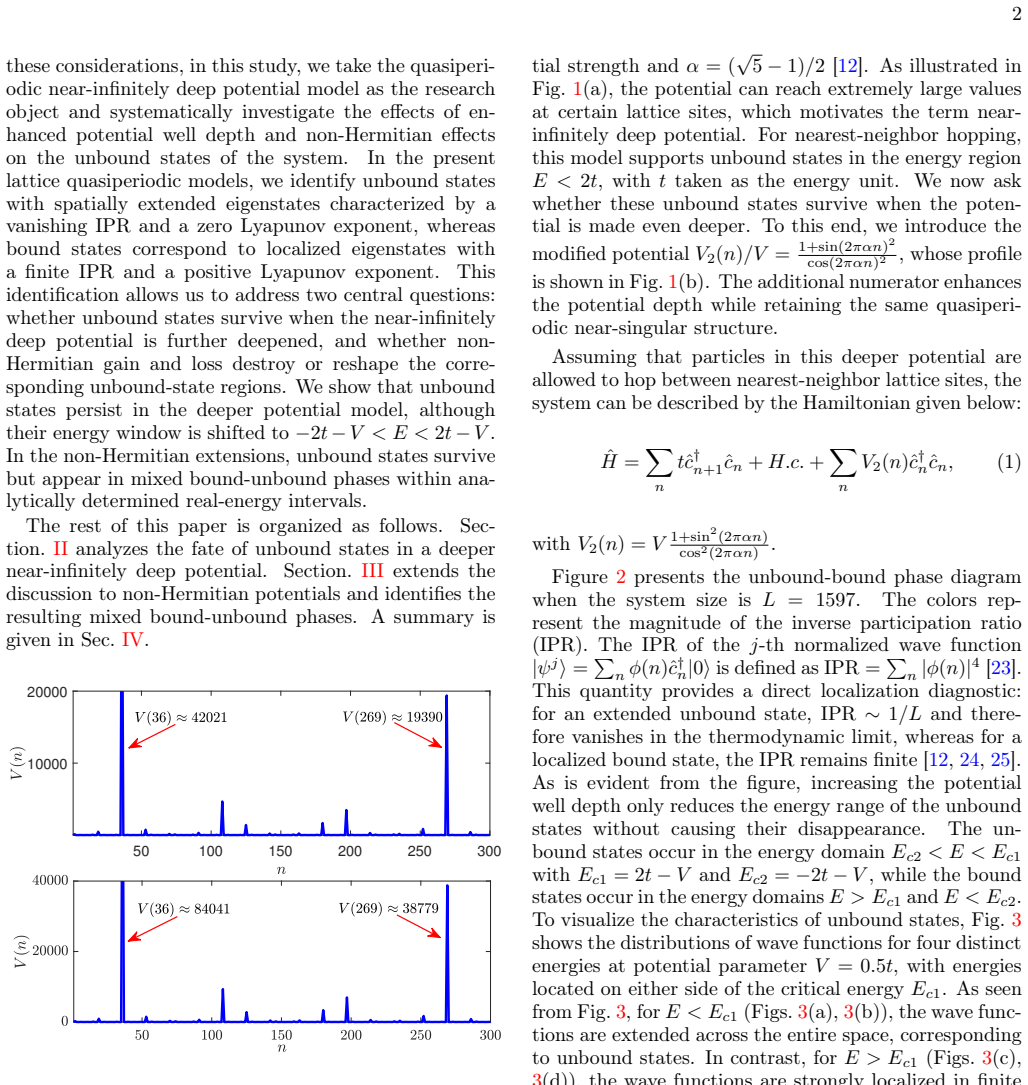
0
0
cond-mat.dis-nn 2026-04-08 Recognition

Degree-incidence coupling generates massive excitations in graphs

Mass generation in graphs

The mass gap and particle localization depend on graph density, allowing matter-like structures to emerge from connectivity alone.

Figure from the paper full image
abstract click to expand
We demonstrate a mechanism for the production of massive excitations in graphs. We treat the number of neighbors at each vertex in the graph (degree) as a scalar field. Then we introduce a mechanism inspired by the Higgs mechanism in quantum field theory(QFT), that couples the degree field to a vector-like field, introduced via the graph edges, represented mathematically by the incident matrices of the graph. The coupling between the two fields produces a massless ground state and massive excitations, separated by a mass gap. The excitations can be treated as emergent massive particles, propagating inside the graph. We study how the size of the graph and its density, represented by the ratio of edges over vertices, affects the mass gap and the localization properties of the massive excitations. We show that the most massive excitations, corresponding to the heaviest emergent particles, localize on regions of the graph with high density, consisting of vertices with a large degree. On the other hand, the least massive excitations, corresponding to the lightest emergent particles localize on a few vertices but with a smaller degree. Excitations with intermediate masses are less localized, spreading on more vertices instead. Our study shows that emergence of matter-like structures with various mass properties, is possible in discrete physical models, relying only on a few fundamental properties like the connectivity of the models.
0
0
cond-mat.dis-nn 2026-04-07 2 theorems

KANs predict crystal energies and reveal periodic table trends

Interpretation of Crystal Energy Landscapes with Kolmogorov-Arnold Networks

A composition-only model matches top accuracy while its internal functions match known chemical rules without being given any physics.

Figure from the paper full image
abstract click to expand
Characterizing crystalline energy landscapes is essential to predicting thermodynamic stability, electronic structure, and functional behavior. While machine learning (ML) enables rapid property predictions, the "black-box" nature of most models limits their utility for generating new scientific insights. Here, we introduce Kolmogorov-Arnold Networks (KANs) as an interpretable framework to bridge this gap. Unlike conventional neural networks with fixed activation functions, KANs employ learnable functions that reveal underlying physical relationships. We developed the Element-Weighted KAN, a composition-only model that achieves state-of-the-art accuracy in predicting formation energy, band gap, and work function across large-scale datasets. Crucially, without any explicit physical constraints, KANs uncover interpretable chemical trends aligned with the periodic table and quantum mechanical principles through embedding analysis, correlation studies, and principal component analysis. These results demonstrate that KANs provide a powerful framework with high predictive performance and scientific interpretability, establishing a new paradigm for transparent, chemistry-based materials informatics.
0
0
cond-mat.dis-nn 2026-04-07 2 theorems

Disorder protects holographic geometry in tensor networks

Breaking the Entanglement-Structure Trade-off: Many-Body Localization Protects Emergent Holographic Geometry in Random Tensor Networks

Strong on-site disorder in an XXZ chain keeps mutual information correlations encoding geometry alive far longer than random evolution.

Figure from the paper full image
abstract click to expand
We present a systematic numerical investigation of the "entanglement geometry gravity" chain in random tensor networks (RTN) established by the ER EPR conjecture and Jacobson's thermodynamic derivation. First, we verify the kinematic foundation: the entanglement first law $\delta\langle K\rangle=\delta S$ (slope=1.000), the encoding of geometry by mutual information (correlation=0.92), and the locality of holographic perturbations (3.3x). We also confirm that gravitational dynamics (JT gravity) does not emerge, identifying a sharp kinematics-dynamics boundary. Second, and more importantly, we discover that many-body localization (MBL) is the mechanism that protects emergent holographic geometry from thermalization. Replacing Haar-random evolution (geometry lifetime $t\sim6$) with an XXZ Hamiltonian plus on-site disorder, we observe a finite-size crossover at disorder strength $W_c\approx10-12$ above which mutual-information-lattice correlations persist indefinitely ($r>0.5$ for $t>50$). We map the full parameter space: the optimal regime is a near-Ising anisotropy $\Delta\approx50$ with $W=30$ yielding $r=0.779\pm0.002$ (confirmed by a fine scan over $\Delta\in[30,70]$); only holographic (RTN) initial states sustain geometry, while product, N\'eel, and Bell-pair states do not. MBL preserves the spatial structure of entanglement (adjacent/non-adjacent MI ratio ~2.6-4.2x vs. 1.0x in the thermal phase), rather than its total amount. A comparison with classical cellular automata reveals that MBL uniquely breaks the entanglement-structure trade-off imposed by quantum monogamy: classical systems achieve spatial structure only at the cost of negligible mutual information, while MBL sustains both.
1 0
0
cond-mat.dis-nn 2026-04-07 3 theorems

Bott metric equals trace of integrated quantum metric at large scales

The Bott Metric: A Real-Space Bridge Between Topology and Quantum Metric

Amplitude data from plaquette operators gives real-space access to quantum geometry in non-periodic systems

Figure from the paper full image
abstract click to expand
The Bott index has become an indispensable tool to probe the topology of quantum matter, particularly in systems lacking translational symmetry. Constructed from a plaquette operator, it retains the phase information while discarding the amplitude. Here we introduce and develop the Bott metric, which captures this complementary amplitude information and provides a measure of the underlying quantum metric of the system. We show that, in the thermodynamic limit, the Bott metric converges to the trace of the integrated quantum metric. Our framework provides a new route to reveal the quantum metric structure in non-periodic systems, which we illustrate using representative examples ranging from disordered to amorphous models. More broadly, our definition of the Bott metric unifies the notion of topological invariants and quantum metric under the same overarching plaquette operator construction.
0
0
cond-mat.dis-nn 2026-04-07 2 theorems

Frequency spread kills finite-T spin-glass transition in oscillator model

A solvable model of noisy coupled oscillators with fully random interactions

Any nonzero width in natural frequencies prevents glassy order above zero temperature while a zero-T phase survives in this solvable system.

Figure from the paper full image
abstract click to expand
We introduce a solvable spherical model of coupled oscillators with fully random interactions and distributed natural frequencies. Using the dynamical mean-field theory, we derive self-consistent equations for the steady-state response and correlation functions. We show that any finite width of the natural-frequency distribution suppresses the finite-temperature spin-glass transition, because the resulting low-frequency singularity of the correlation function is incompatible with the spherical constraint. At zero temperature, however, a spin-glass phase persists for arbitrary frequency dispersion. This residual zero-temperature glassiness is likely a special feature of the spherical dynamics and would be destroyed by local nonlinearities. The model thus provides a solvable oscillator framework for studying how nonequilibrium perturbations suppress finite-temperature glassy freezing.
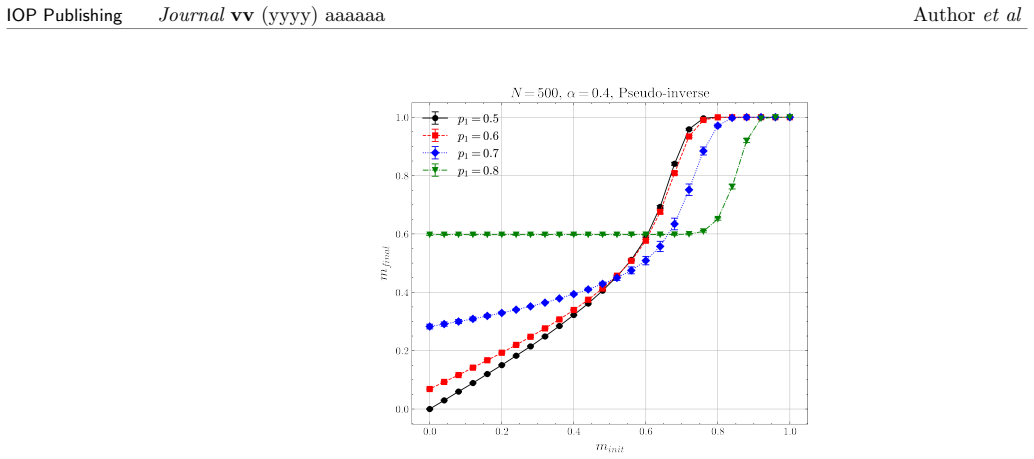
0
0
cond-mat.dis-nn 2026-04-06 2 theorems

Overparameterization modestly speeds escape from SGD plateaus

Escape dynamics and implicit bias of one-pass SGD in overparameterized quadratic networks

Conserved quantities in overlap ODEs select the zero-loss solution nearest random initialization in quadratic networks

Figure from the paper full image
abstract click to expand
We analyze the one-pass stochastic gradient descent dynamics of a two-layer neural network with quadratic activations in a teacher--student framework. In the high-dimensional regime, where the input dimension $N$ and the number of samples $M$ diverge at fixed ratio $\alpha = M/N$, and for finite hidden widths $(p,p^*)$ of the student and teacher, respectively, we study the low-dimensional ordinary differential equations that govern the evolution of the student--teacher and student--student overlap matrices. We show that overparameterization ($p>p^*$) only modestly accelerates escape from a plateau of poor generalization by modifying the prefactor of the exponential decay of the loss. We then examine how unconstrained weight norms introduce a continuous rotational symmetry that results in a nontrivial manifold of zero-loss solutions for $p>1$. From this manifold the dynamics consistently selects the closest solution to the random initialization, as enforced by a conserved quantity in the ODEs governing the evolution of the overlaps. Finally, a Hessian analysis of the population-loss landscape confirms that the plateau and the solution manifold correspond to saddles with at least one negative eigenvalue and to marginal minima in the population-loss geometry, respectively.
0
0
cond-mat.dis-nn 2026-04-06 2 theorems

Cubic equation gives spin isotropization time under SU(2) fields

Mesoscopic scattering dynamics under generic uniform SU(2) gauge fields: Spin-momentum relaxation and coherent backscattering

It recovers Dyakonov-Perel, short spin-orbit, and persistent helix regimes from one expression

Figure from the paper full image
abstract click to expand
We investigate the time- and momentum-resolved dynamics of matter waves undergoing elastic scattering from a disordered potential in the presence of spatially uniform SU(2) gauge fields. We derive the disorder-averaged density matrix as a function of time and momentum within the weak-localization regime. By accurately approximating the frequency dependence of the ladder and maximally crossed diagram series beyond the diffusive approximation, we describe short-time spin-momentum dynamics on timescales comparable to the scattering mean free time, for arbitrary strengths of the SU(2) gauge fields and disorder. We also present a cubic equation that determines the spin isotropization time, which gives accurate asymptotic forms in the limits where the spin-orbit length is much longer (Dyakonov-Perel spin relaxation regime) or much shorter than the scattering mean free path, as well as in the SU(2)-symmetric (persistent spin helix) limit. In comparison with numerical calculations, we reproduce both the relaxation of the momentum distribution and the transient backscattering peak with a momentum offset coexisting with the robust coherent backscattering dip, supporting the reliability of our calculations.
0
0
cond-mat.dis-nn 2026-04-06 Recognition

Bias cuts dense memory capacity by (1-b²)^P factor

Dense Associative Memory with biased patterns: a Replica Symmetric analysis

Replica symmetric calculation shows the multiplicative drop while superlinear scaling with network size survives in higher-order models.

abstract click to expand
We investigate dense higher-order associative memories in the high storage regime when the stored patterns are biased, namely when the entries of the patterns are not symmetrically distributed around zero. In this setting, the standard Hebbian prescription must be modified by recentering and rescaling the pattern entries, and an additional term must be introduced in the Hamiltonian to enforce consistency between the average activity of the network and that of the stored patterns. As a first step, we perform a signal-to-noise analysis in the zero-temperature limit and show that the bias reduces the effective storage capacity through a multiplicative correction factor (1-b^2)^P, while preserving the superlinear scaling with the system size. We then derive the quenched statistical pressure within the Replica Symmetric framework by means of Guerra's interpolation method and obtain the corresponding self consistency equations for the relevant order parameters. The analytical treatment confirms the heuristic prediction of the signal-to-noise argument, showing that the same bias dependent renormalization naturally emerges in the variance of the cross-talk noise. Finally, we discuss the resulting phase behavior of the model and its implications for retrieval performance in the model.
0
0
cond-mat.dis-nn 2026-03-31 2 theorems

Modulated hopping amplitudes cause slow dynamics in quasiperiodic MBL

Uncovering the Microscopic Mechanism of Slow Dynamics in Quasiperiodic Many-Body Localized Systems

Interactions between single-particle hoppings at different positions create persistent beats deep in the localized regime.

Figure from the paper full image
abstract click to expand
We study the number entropy and quasiparticle width in one-dimensional quasiperiodic many-body localized (MBL) systems and observe slow dynamics that have previously been investigated in detail only in random systems. In contrast, quasiperiodic systems exhibit more structured growth of both observables. We identify the modulation of the Rabi oscillation amplitude of single-particle hoppings as the mechanism underlying the slow growth even deep in the MBL regime. This quantum amplitude modulation and associated beats arise from the interaction between single-particle hopping processes at different positions in the chain. Interestingly, this mechanism is not weakened by increasing the distance between particles and is generic to many-body quantum systems. We develop an analytical model based on the aforementioned mechanism that explains the observed dynamics at all accessible timescales and provides a microscopic picture of the slow dynamics in the MBL regime. Our results are consistent with the stability of the MBL phase in the thermodynamic limit.
0

browse all of cond-mat.dis-nn → full archive · search · sub-categories