REVIEW 2 major objections 4 minor 1 cited by
Search for continuous gravitational wave signals from luminous dark photon superradiance clouds with LVK O3 observations
T0 review · 2 major / 4 minor · reviewed 2026-08-10 · deepseek-v4-flash
Pith's one-line read No gravitational-wave signal found from dark photon clouds
desk verdict The CW search is solid and worth publishing; the headline dark-photon exclusion is an artifact of a radio fraction that the authors' own analysis disfavors. read the letter →
The pith
A machine-rendered reading of the paper's core claim, the machinery that carries it, and where it could break.
The reading
What carries the argument
The load-bearing object is the kinetically mixed dark photon superradiance cloud, characterized by the boson mass $m$ and the kinetic-mixing parameter $\varepsilon$. The cloud extracts black-hole spin, radiates gravitational waves with strain $h_0(\tau)=h_0^s/(1+\tau/\tau_{\mathrm{GW}})$, and produces a pair plasma whose electromagnetic luminosity $L\simeq0.13\,\varepsilon^2\alpha c^5 M_c/(GM)$ lets it mimic a pulsar. The argument is carried by a strain luminosity function (Eq. 34) that integrates the expected continuous-wave amplitude over the Galactic disk black-hole distribution, with four $\theta$-function conditions enforcing that the cloud is plasma-producing ($\Theta_{\mathrm{pl}}$), radio-visible to surveys ($\Theta_{\mathrm{EM}}$), spinning up slowly enough for a monochromatic search ($\Theta_{\dot f}$), and decaying primarily by gravitational waves ($\Theta_{\mathrm{ev}}$). This machinery converts per-source strain upper limits into the expected event count $N_{\mathrm{ev}}(h_0>h_0^{95\%}\mid m,\varepsilon)$ used to mark parameter points as observable.
What would settle it
Measure or bound the radio pulsating fraction $f_r$ of dark-photon clouds: the disfavored region requires $f_r\sim10^{-5}$ to make all clouds radio-visible, while a value near $10^{-9}$ (which the paper's own catalog statistics suggest) drops the expected events below 10 and removes the claimed exclusion.
Extended reading notes
Core claim
The paper's central claim is that the absence of a continuous gravitational-wave signal from 34 previously unsearched radio pulsar candidates, combined with existing limits for 10 more sources, disfavors a slice of dark photon parameter space under stated assumptions. A superradiance cloud with dark photon mass $m$ radiates gravitational waves at frequency $f_{\mathrm{GW}}\simeq mc^2/(\pi\hbar)$, while the kinetic mixing $\varepsilon$ powers an electromagnetic cascade whose luminosity is $L\simeq0.13\,\varepsilon^2\alpha c^5 M_c/(GM)$. Integrating the expected strain over a population of $10^8$ isolated disk black holes, the paper estimates that for couplings between about $10^{-9}$ and $3\times10^{-7}$ (down to $3\times10^{-10}$ under optimistic population parameters) more than 10 events should have exceeded the measured upper limits for masses near $2\times10^{-13}$ to $1.4\times10^{-12}$ eV/$c^2$, yet none were found. The disfavored region is presented as a conservative observable threshold rather than a hard exclusion, because the prediction depends on the unknown black-hole population and on the fraction of the cloud's electromagnetic luminosity emitted as pulsating radio waves.
Load-bearing premise
The exclusion assumes that about $10^{-5}$ of the cloud's electromagnetic luminosity is emitted as pulsating radio waves, so every cloud is visible in existing radio surveys; the paper notes that its own catalog statistics favor a much smaller fraction around $10^{-9}$, which would erase most of the disfavored region.
Editorial extensions
If this is right
- For the 34 sources analyzed for the first time, the 95% confidence upper limits lie between $1.05\times10^{-26}$ and $9\times10^{-26}$, more than an order of magnitude below the maximum strain a young dark-photon cloud could emit, so a detection was within reach of O3 data.
- If the central claim is correct, dark photon masses near $5\times10^{-13}$ eV/$c^2$ with $\varepsilon\sim5\times10^{-9}$ should have produced roughly 3600 observable events rather than zero.
- Vector clouds remain observable even for moderately spinning black holes: lowering the maximum spin from 1 to 0.5 reduces the expected event count by only a few tens of percent, unlike the scalar case.
- The same analytic framework can be applied to all-sky continuous-wave searches, giving constraints that are independent of the electromagnetic coupling for $\varepsilon$ below about $10^{-7}$.
- The small number of frequency doublets and triplets in pulsar catalogs disfavors a radio pulsating fraction $f_r\sim10^{-5}$ and suggests $f_r\sim10^{-9}$, which would make most clouds radio-quiet.
Reading between the lines
- If $f_r$ is actually near $10^{-9}$ as the catalog statistics suggest, the target-selection strategy largely collapses: most clouds would be radio-quiet, the expected number above the strain limits would fall well below 10, and the disfavored region in Fig. 5 would mostly disappear.
- The paper's analytic population model could be combined with simulated Galactic black-hole catalogs that include natal kicks and a bulge component; this would change source distances and event counts, and the paper leaves such a full treatment to future work.
- The same event-count machinery could be reversed to forecast detection prospects for O4 and third-generation detectors, particularly at high gravitational-wave frequencies and low couplings where this search is weakest.
- Independent confirmation could come from high-energy observations: the same clouds are predicted to shine in X-rays and gamma-rays, so cross-matching a wide-field X-ray catalog against the anomalous pulsars would test the radio-only selection.
Editorial analysis
A structured set of objections, weighed in public.
Referee Report
Summary. This paper reports a targeted search for continuous gravitational-wave (CW) emission from black-hole superradiance clouds of kinetically mixed dark photons. The authors select 44 radio pulsars from the ATNF catalog whose frequencies are coincident with other sources or whose frequency derivatives are positive, treating them as candidate 'dark photon pulsars'; for 34 previously unsearched sources they run narrow-band, binary-resampling, and semicoherent pipelines on LIGO O3 data. They find no outliers and set 95% confidence upper limits on the strain amplitude between 1.05e-26 and 9e-26. They then construct an analytic model of the Galactic disk black-hole population (Eqs. 25-29) and compute, for each dark photon mass and kinetic mixing, the number of radio-visible clouds expected to emit strain above the measured ULs (Eqs. 30-35). Based on a threshold of 10 expected events, the paper concludes (abstract, Sec. V, Fig. 5) that the null result disfavors dark photon masses about 10^-13 to 10^-12 eV and kinetic couplings about 10^-9 to 10^-7, subject to assumptions on the black-hole population and the cloud's pulsating radio fraction, which is fixed to 10^-5 in the main calculation.
Significance. If the central interpretation were robust, this would be a valuable exclusion of a previously weakly constrained dark photon window (kinetic couplings down to about 10^-9, roughly two orders of magnitude below CMB bounds). The paper has genuine strengths: the CW analysis is competently executed with established pipelines and injection-calibrated ULs; the population framework of Eqs. (30)-(35) is a reusable analytic tool for future all-sky interpretations; the data provenance and appendix documentation are thorough; and the body is unusually candid about its limitations (Sec. IV A, Sec. V). Those caveats, however, are the crux of the matter: the headline 'disfavored' region is computed at fr = 10^-5, a value that the paper's own radio census (Sec. IV C) argues against, and the statistical content of the N_events = 10 exclusion criterion is not specified. The search itself and its ULs stand independently of these issues and are a solid legacy for future searches; the interpretation needs revision before the central claim can be accepted as stated.
major comments (2)
- [Sec. IV B (Eqs. 31, 34-35), Sec. IV C, Figs. 5 and 7, Sec. V] The headline 'disfavored' region (Fig. 5, abstract, Sec. V) is obtained with the radio pulsating fraction fixed to fr = 10^-5 inside the Theta_EM condition of Eq. (31). Sec. IV C, using the same ATNF catalog from which the targets were drawn, states that for epsilon = 10^-8 a fraction fr about 10^-5 would imply about 10^3 anomalous radio pulsars while only a few frequency doublets/triplets are observed, and that this 'disfavors radio flux fractions of the order of fr ~ 10^-5, and instead suggests ... fr ~ 10^-9'. Because Fr is proportional to fr (Eq. 31) and the radio-visible volume entering Eq. (34) shrinks accordingly, lowering fr to 10^-9 shifts the Fig. 6 distributions by four orders of magnitude in flux and removes essentially the whole Theta_EM-filtered population from N_events in Eq. (35), so the N_events = 10 threshold of Fig. 5 would no longer be met. Fig. 7 tests fr = 10^-7 (and the text adds 10^-3) but not 10^-9, and the Sec. V robustness claim is explicitly conditioned on fr being at least about 10^-7, which does not cover the value that the paper's own radio census favors. The authors should recompute N_events and Fig. 5 at fr about 10^-9 and at intermediate values, and the abstract and conclusions should present the disfavored region only under the fr values for which it actually survives.
- [Sec. IV B (Eq. 35), Fig. 5] The 'disfavor' criterion of Fig. 5 (N_events at least 10) compares a Galactic-total expected number, namely all disk BHs at a given source frequency with strain above that source's UL and passing Theta_EM, with a null observation in a sample that contains only one or two searched targets per frequency (Table II). The connection between these two quantities is never quantified: if the model predicts ten radio-visible clouds at a frequency but only one or two of them (those found in the ATNF catalog) were searched, the non-detection is not a Poisson e^-10 exclusion, and the resulting bound depends on catalog completeness, which the paper itself notes is questionable. The analysis should count only events that would actually have passed the Sec. III B selection criteria and been searched, or it should present the result as an explicit joint radio-plus-CW likelihood. As written, the statistical meaning of the N_events = 10 threshold behind the 'disfavor' claim is not defined.
minor comments (4)
- [Sec. III B, Eq. (19), Table V] Most of the 16 'spin-up' targets in Table V are globular-cluster pulsars (for example, the J0024-7204 sources in 47 Tuc, J1748-2446C in Terzan 5, and J1801-0857A in NGC 6440); for these, the positive observed fdot can be dominated by the line-of-sight acceleration term a_rad/c in Eq. (19) rather than by an intrinsic cloud spin-up. The paper excludes binaries from this class but does not discuss cluster acceleration; this weakens the 'anomalous spin-up' motivation for these targets specifically, although it does not affect the validity of the CW search or the ULs.
- [Fig. 1 caption] The caption of Fig. 1 directs the reader to Table II for the galactocentric coordinates of the sources, but Table II lists frequencies, methods, and strain ULs and contains no coordinates; the positions are shown in the figure itself and the sky coordinates are in Tables V-VII. The cross-reference should be corrected or removed.
- [Title, abstract, throughout] The detector acronym is rendered with a spurious space ('L VK') in the title, in the abstract, and in several places in the body; this should be corrected to 'LVK'.
- [Sec. IV B (Theta_ev), Fig. 5] The high-epsilon boundary of the disfavored region in Fig. 5 is set by the Theta_ev condition, which the text itself describes as possibly overly conservative ('it is therefore possible that our estimates are overly pessimistic at larger values of epsilon'). The caption or surrounding text should label this boundary as a modeling choice rather than as an observational exclusion.
Circularity Check
No significant circularity: the CW upper limits and the dark-photon population interpretation are derived from independent data and stated physical assumptions, not from the conclusions they support.
full rationale
The paper's central derivation chain is self-contained rather than circular. The gravitational-wave upper limits in Sec. III are obtained by standard narrow-band, resampling, semicoherent, and previously published targeted/all-sky searches of LVK O3 data, with no dark-photon parameter fitted to the strain results. The interpretation in Sec. IV starts from a Galactic BH population model with parameters taken from the literature (mass, spin, age, spatial distributions), combines it with the SuperRad code and the prior electromagnetic-luminosity model of Ref. [46], and computes expected event counts via Eqs. (34)-(35). Those inputs are stated assumptions or previously published numerical results, not quantities defined by the present paper's conclusion. The parameter fr (radio fraction) is an explicitly assumed free parameter fixed to 10^-5; Sec. IV C notes that the same radio catalog may suggest fr ~ 10^-9, and the conclusions explicitly warn that the resulting constraints are not fully robust. That is a limitation and an internal consistency caveat, but it is not a circular reduction: the 'disfavored region' is not defined in terms of the observed CW absence, nor is any fitted parameter renamed as a prediction. No self-definitional step, no uniqueness theorem imported from the authors' prior work, and no ansatz smuggled in via citation were found.
Assumptions & free parameters
free parameters (5)
- radio pulsating fraction fr =
10^-5 (also 10^-7 and 10^-9 considered)
- Black hole mass upper cutoff Mmax =
30 or 20 Msun
- Black hole spin upper cutoff χmax =
1, 0.5, or 0.3
- Total number of isolated Galactic BHs NBH =
10^8
- Event-count threshold for 'disfavor' =
10 events
assumptions (4)
- domain assumption Cloud mass decays as Mc(τ)=Ms_c/(1+τ/τGW) with GW emission dominating for ε below a critical value (Eq. 3, Θev in Sec IV B)
- ad hoc to paper Dark photon clouds emit a pulsating radio component at frequency fEM=fGW/2 with a fraction fr of total EM luminosity, analogous to pulsar magnetospheres
- domain assumption The selected 'anomalous' pulsars (frequency doublets/triplets or positive spin-up) are candidate dark photon clouds rather than ordinary pulsars with coincidental frequencies
- domain assumption SuperRad numerical results for vector superradiance growth, saturation, and waveform (Ref [86]) are accurate
Cite this review
Pith. "Pith review of Search for continuous gravitational wave signals from luminous dark photon superradiance clouds with LVK O3 observations." pith.science (2026). https://pith.science/paper/5J3R3PA4
@misc{pith2026250102052,
  author       = {Pith},
  title        = {Pith review of: Search for continuous gravitational wave signals from luminous dark photon superradiance clouds with LVK O3 observations},
  year         = {2026},
  howpublished = {\url{https://pith.science/paper/5J3R3PA4}},
  note         = {Machine review of arXiv:2501.02052}
}
abstract
Superradiance clouds of kinetically-mixed dark photons around spinning black holes can produce observable multi-messenger electromagnetic and gravitational wave signals. The cloud generates electric fields of up to a Teravolt-per-meter, which lead to a cascade production of charged particles, yielding a turbulent quasi-equilibrium plasma around the black hole, and resulting in electromagnetic fluxes ranging from supernova to pulsar-like luminosities. For stellar mass black holes, such systems resemble millisecond pulsars and are expected to emit pulsating radio waves and continuous gravitational waves (CWs) within the LIGO-Virgo-KAGRA (LVK) sensitivity band. We select 44 sources with approximately coincident frequencies or positive frequency drifts from existing pulsar catalogs as potential candidates of long-lasting superradiance clouds around old galactic black holes. For a subset of 34 sources that are well measured and have not been previously targeted, we perform the first search for CW emission in LVK data from the third observing run. We find no evidence of a CW signal and place 95% confidence level upper limits on the emitted strain amplitude. We interpret these results, together with limits from previous searches, in terms of the underlying dark photon theory by performing an analysis of the expected signals from superradiance clouds from galactic black holes. We find that, even for moderately spinning black holes, the absence of an observed CW signal disfavors a discrete set of dark photon masses between about $10^{-13}$ $\rm{eV}/c^2$ and $10^{-12}$ $\rm{eV}/c^2$ and kinetic mixing couplings in the range of $10^{-9}$-$10^{-7}$, subject to assumptions about the properties of the black hole population and the cloud's electromagnetic emission.
Figures


Figures from the paper (5 more)




Forward citations
Cited by 1 Pith paper
-
Search for continuous gravitational waves from the pulsar J0435+3233
A LIGO O4a search for continuous gravitational waves from millisecond pulsar J0435+3233 finds no signal, setting h0<5.8×10^-27 at 95% confidence and an ellipticity limit of 1.6×10^-8.
Reference graph
Works this paper leans on
-
[1]
IV B, we start from the definition given in Eq
Strain density distribution To obtain the final expression for the strain density distribution of a signal of strain h0 from Galactic disk BHs given in Sec. IV B, we start from the definition given in Eq. (30), dnh dh0 (h0 | m, ε) = 1 N χmaxtmax Z dM M 1.35 min M 2.35 Z dχ Z d⃗ rdndisk d⃗ r Z dt δ[¯h0(M, χ, τobs, d| m) − h]Θ ˙f ΘEMΘplΘev. (D1) The strain ...
-
[2]
IV B (excluding the three sources that are known to be in a binary system, since we are only considering the population of isolated BHs)
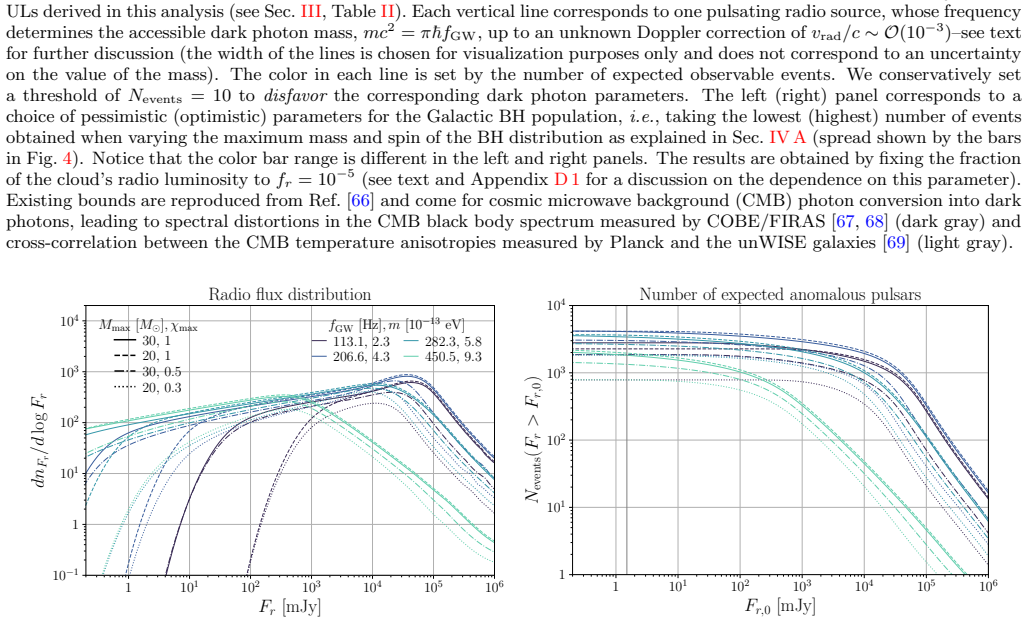
Expected events for other sources In this section we show the number of expected observable events for the sources that have not being analyzed with the narrow-band method, to complement the results shown in Sec. IV B (excluding the three sources that are known to be in a binary system, since we are only considering the population of isolated BHs). The re...
-
[3]
Same as Fig
Radio flux density distribution Similarly to the derivation presented in Appendix D 1, to obtain the radio luminosity function of dark photon superradiance clouds from Galactic disk BHs, we start from the density distribution of a signal with radio flux Fr dnFr dFr (Fr | m, ε) = Z d⃗ rdM dχdτ dnBH d⃗ rdM dχdτ δ ¯Fr(M, χ, τobs, d| m, ε) − Fr ΘplΘev = 1 N χ...
-
[4]
R. Abbott et al. (KAGRA, VIRGO, LIGO Scientific), GWTC-3: Compact Binary Coalescences Observed by LIGO and Virgo during the Second Part of the Third Observing Run, Phys. Rev. X 13, 041039 (2023), arXiv:2111.03606 [gr-qc]
arXiv 2023
-
[5]
LIGO Scientific Collaboration, Advanced LIGO, Clas- sical and Quantum Gravity 32, 074001 (2015), arXiv:1411.4547 [gr-qc]
arXiv 2015
-
[6]
F. Acernese et al. , Advanced Virgo: a second- generation interferometric gravitational wave detector, Classical and Quantum Gravity 32, 024001 (2015), arXiv:1408.3978 [gr-qc]
arXiv 2015
-
[7]
T. Akutsu et al. (KAGRA), Overview of KAGRA: De- tector design and construction history, PTEP 2021, 05A101 (2021), arXiv:2005.05574 [physics.ins-det]
arXiv 2021
-
[8]
Public alerts can be found at https://gracedb.ligo. org/
Show all 149 references
-
[9]
B. P. Abbott et al. (LIGO Scientific, Virgo), GWTC- 1: A Gravitational-Wave Transient Catalog of Compact Binary Mergers Observed by LIGO and Virgo during the First and Second Observing Runs, Phys. Rev. X 9, 031040 (2019), arXiv:1811.12907 [astro-ph.HE]
2019 arXiv
-
[10]
Abbott et al
R. Abbott et al. (LIGO Scientific, Virgo), GWTC-2: Compact Binary Coalescences Observed by LIGO and Virgo During the First Half of the Third Observing Run, Phys. Rev. X 11, 021053 (2021), arXiv:2010.14527 [gr- qc]
2021 arXiv
-
[11]
O. J. Piccinni, Status and Perspectives of Continuous Gravitational Wave Searches, Galaxies 10, 72 (2022), arXiv:2202.01088 [gr-qc]
2022 arXiv
-
[12]
S. W. Hawking and W. Israel, Three Hundred Years of Gravitation (Cambridge University Press, 1989) Chap. 9
1989
-
[13]
Riles, Searches for continuous-wave gravitational ra- diation, Living Rev
K. Riles, Searches for continuous-wave gravitational ra- diation, Living Rev. Rel. 26, 3 (2023), arXiv:2206.06447 [astro-ph.HE]
2023 arXiv
-
[14]
Arvanitaki and S
A. Arvanitaki and S. Dubovsky, Exploring the String Axiverse with Precision Black Hole Physics, Phys. Rev. D 83, 044026 (2011), arXiv:1004.3558 [hep-th]
2011 arXiv
-
[15]
Wette, Searches for continuous gravitational waves from neutron stars: A twenty-year retrospective, As- tropart
K. Wette, Searches for continuous gravitational waves from neutron stars: A twenty-year retrospective, As- tropart. Phys. 153, 102880 (2023), arXiv:2305.07106 [gr-qc]
2023
-
[16]
Arvanitaki, S
A. Arvanitaki, S. Dimopoulos, S. Dubovsky, N. Kaloper, and J. March-Russell, String Axiverse, Phys. Rev. D81, 123530 (2010), arXiv:0905.4720 [hep-th]
2010 arXiv
-
[17]
narrow-band
In prac- tice, the systems with large ˙f typically decay very quickly and do not significantly contribute to the total number of expected signals. We therefore find that the cut on ˙f does not significantly affect the final result. 16 For simplicity, we ignore GW and EM emissi...
1922
-
[18]
Y. B. Zel’dovich, Generation of waves by a rotating body, Journal of Experimental and Theoretical Physics Letters 14, 270 (1971)
1971
-
[19]
C. W. Misner, Interpretation of Gravitational-Wave Ob- servations, Physical Review Letters 28, 994 (1972)
1972
-
[20]
A. A. Starobinskii, Amplification of waves during reflec- tion from a rotating black hole, Soviet Phys JETP 37, 28 (1973)
1973
-
[21]
S. L. Detweiler, Klein-Gordon equation and rotating Black Holes, Phys. Rev. D 22, 2323 (1980)
1980
-
[22]
J. D. Bekenstein and M. Schiffer, The Many faces of su- perradiance, Phys. Rev. D 58, 064014 (1998), arXiv:gr- qc/9803033
1998
-
[23]
Brito, V
R. Brito, V. Cardoso, and P. Pani, Superradiance: New Frontiers in Black Hole Physics, Lect. Notes Phys. 906, pp.1 (2015), arXiv:1501.06570 [gr-qc]
2015 arXiv
-
[24]
Arvanitaki, M
A. Arvanitaki, M. Baryakhtar, and X. Huang, Dis- covering the QCD Axion with Black Holes and Grav- itational Waves, Phys. Rev. D 91, 084011 (2015), arXiv:1411.2263 [hep-ph]
2015 arXiv
-
[25]
Arvanitaki, M
A. Arvanitaki, M. Baryakhtar, S. Dimopoulos, S. Dubovsky, and R. Lasenby, Black Hole Mergers and the QCD Axion at Advanced LIGO, Phys. Rev. D 95, 043001 (2017), arXiv:1604.03958 [hep-ph]
2017 arXiv
-
[26]
Brito, S
R. Brito, S. Ghosh, E. Barausse, E. Berti, V. Cardoso, I. Dvorkin, A. Klein, and P. Pani, Gravitational wave searches for ultralight bosons with LIGO and LISA, Phys. Rev. D 96, 064050 (2017), arXiv:1706.06311 [gr- qc]
2017 arXiv
-
[27]
Baryakhtar, R
M. Baryakhtar, R. Lasenby, and M. Teo, Black Hole Superradiance Signatures of Ultralight Vectors, Phys. Rev. D 96, 035019 (2017), arXiv:1704.05081 [hep-ph]
2017 arXiv
-
[28]
K. K. Y. Ng, O. A. Hannuksela, S. Vitale, and T. G. F. Li, Searching for ultralight bosons within spin measure- ments of a population of binary black hole mergers, Phys. Rev. D 103, 063010 (2021), arXiv:1908.02312 [gr- qc]
2021 arXiv
-
[29]
K. K. Y. Ng, S. Vitale, O. A. Hannuksela, and T. G. F. Li, Constraints on Ultralight Scalar Bosons within Black Hole Spin Measurements from the LIGO- Virgo GWTC-2, Phys. Rev. Lett. 126, 151102 (2021), arXiv:2011.06010 [gr-qc]
2021 arXiv
-
[30]
Cardoso, O
V. Cardoso, O. J. C. Dias, G. S. Hartnett, M. Middle- ton, P. Pani, and J. E. Santos, Constraining the mass of dark photons and axion-like particles through black-hole superradiance, JCAP 2018 (03), 043, arXiv:1801.01420 [gr-qc]
2018 arXiv
-
[31]
Baryakhtar, M
M. Baryakhtar, M. Galanis, R. Lasenby, and O. Simon, Black hole superradiance of self-interacting scalar fields, Phys. Rev. D 103, 095019 (2021), arXiv:2011.11646 [hep-ph]
2021 arXiv
-
[32]
S. Hoof, D. J. E. Marsh, J. Sisk-Reyn´ es, J. H. Matthews, and C. Reynolds, Getting More Out of Black Hole Su- perradiance: a Statistically Rigorous Approach to Ul- tralight Boson Constraints, (2024), arXiv:2406.10337 [hep-ph]
2024
-
[33]
Payne, L
E. Payne, L. Sun, K. Kremer, P. D. Lasky, and E. Thrane, The Imprint of Superradiance on Hierarchi- cal Black Hole Mergers, Astrophys. J. 931, 79 (2022), arXiv:2107.11730 [gr-qc]
2022 arXiv
-
[34]
Yoshino and H
H. Yoshino and H. Kodama, Gravitational radiation from an axion cloud around a black hole: Superradi- ant phase, PTEP 2014, 043E02 (2014), arXiv:1312.2326 [gr-qc]
2014 arXiv
-
[35]
Palomba et al
C. Palomba et al. , Direct constraints on ultra-light 28 boson mass from searches for continuous gravita- tional waves, Phys. Rev. Lett. 123, 171101 (2019), arXiv:1909.08854 [astro-ph.HE]
2019 arXiv
-
[36]
Abbott et al
R. Abbott et al. (LIGO Scientific, Virgo, KAGRA), All-sky search for gravitational wave emission from scalar boson clouds around spinning black holes in LIGO O3 data, Phys. Rev. D 105, 102001 (2022), arXiv:2111.15507 [astro-ph.HE]
2022 arXiv
-
[37]
Abbott et al
R. Abbott et al. (KAGRA, LIGO Scientific, VIRGO), Search for continuous gravitational wave emission from the Milky Way center in O3 LIGO-Virgo data, Phys. Rev. D 106, 042003 (2022), arXiv:2204.04523 [astro- ph.HE]
2022 arXiv
-
[38]
S. J. Zhu, M. Baryakhtar, M. A. Papa, D. Tsuna, N. Kawanaka, and H.-B. Eggenstein, Characterizing the continuous gravitational-wave signal from boson clouds around Galactic isolated black holes, Phys. Rev. D 102, 063020 (2020), arXiv:2003.03359 [gr-qc]
2020 arXiv
-
[39]
Tsukada, T
L. Tsukada, T. Callister, A. Matas, and P. Meyers, First search for a stochastic gravitational-wave background from ultralight bosons, Phys. Rev. D 99, 103015 (2019), arXiv:1812.09622 [astro-ph.HE]
2019 arXiv
-
[40]
C. Yuan, Y. Jiang, and Q.-G. Huang, Constraints on an ultralight scalar boson from Advanced LIGO and Advanced Virgo’s first three observing runs using the stochastic gravitational-wave background, Phys. Rev. D 106, 023020 (2022), arXiv:2204.03482 [astro-ph.CO]
2022 arXiv
-
[41]
Tsukada, R
L. Tsukada, R. Brito, W. E. East, and N. Siemonsen, Modeling and searching for a stochastic gravitational- wave background from ultralight vector bosons, Phys. Rev. D 103, 083005 (2021), arXiv:2011.06995 [astro- ph.HE]
2021 arXiv
-
[42]
Yoshino and H
H. Yoshino and H. Kodama, Probing the string axiverse by gravitational waves from Cygnus X-1, PTEP 2015, 61E01 (2015), arXiv:1407.2030 [gr-qc]
2015 arXiv
-
[43]
L. Sun, R. Brito, and M. Isi, Search for ultralight bosons in Cygnus X-1 with Advanced LIGO, Phys. Rev. D 101, 063020 (2020), [Erratum: Phys.Rev.D 102, 089902 (2020)], arXiv:1909.11267 [gr-qc]
2020 arXiv
-
[44]
Collaviti, L
S. Collaviti, L. Sun, M. Galanis, and M. Baryakhtar, Observational prospects of self-interacting scalar su- perradiance with next-generation gravitational-wave detectors, Class. Quant. Grav. 42, 025006 (2025), arXiv:2407.04304 [gr-qc]
2025 arXiv
-
[45]
Jones, L
D. Jones, L. Sun, N. Siemonsen, W. E. East, S. M. Scott, and K. Wette, Methods and prospects for gravitational- wave searches targeting ultralight vector-boson clouds around known black holes, Phys. Rev. D 108, 064001 (2023), arXiv:2305.00401 [gr-qc]
2023 arXiv
-
[46]
Jones, N
D. Jones, N. Siemonsen, L. Sun, W. E. East, A. L. Miller, K. Wette, and O. J. Piccinni, Methodology for constraining ultralight vector bosons with gravitational wave searches targeting merger remnant black holes, Phys. Rev. D 111, 063028 (2025), arXiv:2412.00320 [gr- qc]
2025 arXiv
-
[47]
Ghosh, E
S. Ghosh, E. Berti, R. Brito, and M. Richartz, Follow- up signals from superradiant instabilities of black hole merger remnants, Phys. Rev. D 99, 104030 (2019), arXiv:1812.01620 [gr-qc]
2019 arXiv
-
[48]
M. Isi, L. Sun, R. Brito, and A. Melatos, Directed searches for gravitational waves from ultralight bosons, Phys. Rev. D 99, 084042 (2019), [Erratum: Phys.Rev.D 102, 049901 (2020)], arXiv:1810.03812 [gr-qc]
2019 arXiv
-
[49]
Siemonsen, C
N. Siemonsen, C. Mondino, D. Egana-Ugrinovic, J. Huang, M. Baryakhtar, and W. E. East, Dark photon superradiance: Electrodynamics and multi- messenger signals, Phys. Rev. D 107, 075025 (2023), arXiv:2212.09772 [astro-ph.HE]
2023 arXiv
-
[50]
Abbott et al
R. Abbott et al. (KAGRA, VIRGO, LIGO Scientific), Open Data from the Third Observing Run of LIGO, Virgo, KAGRA, and GEO, Astrophys. J. Suppl. 267, 29 (2023), arXiv:2302.03676 [gr-qc]
2023 arXiv
-
[51]
Baumann, H
D. Baumann, H. S. Chia, and R. A. Porto, Probing Ul- tralight Bosons with Binary Black Holes, Phys. Rev. D 99, 044001 (2019), arXiv:1804.03208 [gr-qc]
2019 arXiv
-
[52]
Baumann, G
D. Baumann, G. Bertone, J. Stout, and G. M. Tomaselli, Sharp Signals of Boson Clouds in Black Hole Bi- nary Inspirals, Phys. Rev. Lett. 128, 221102 (2022), arXiv:2206.01212 [gr-qc]
2022 arXiv
-
[53]
Xie and F
N. Xie and F. P. Huang, Imprints of ultralight ax- ions on the gravitational wave and pulsar timing mea- surement, Sci. China Phys. Mech. Astron. 67, 210411 (2024), arXiv:2207.11145 [hep-ph]
2024 arXiv
-
[54]
O. A. Hannuksela, K. W. K. Wong, R. Brito, E. Berti, and T. G. F. Li, Probing the existence of ultralight bosons with a single gravitational-wave measurement, Nature Astron. 3, 447 (2019), arXiv:1804.09659 [astro- ph.HE]
2019 arXiv
-
[55]
S. A. Abel, M. D. Goodsell, J. Jaeckel, V. V. Khoze, and A. Ringwald, Kinetic Mixing of the Photon with Hidden U(1)s in String Phenomenology, JHEP 07, 124, arXiv:0803.1449 [hep-ph]
-
[56]
Arvanitaki, N
A. Arvanitaki, N. Craig, S. Dimopoulos, S. Dubovsky, and J. March-Russell, String Photini at the LHC, Phys. Rev. D 81, 075018 (2010), arXiv:0909.5440 [hep-ph]
2010 arXiv
-
[57]
Goodsell, J
M. Goodsell, J. Jaeckel, J. Redondo, and A. Ring- wald, Naturally Light Hidden Photons in LARGE Volume String Compactifications, JHEP 11, 027, arXiv:0909.0515 [hep-ph]
-
[58]
P. G. Camara, L. E. Ibanez, and F. Marchesano, RR photons, JHEP 09, 110, arXiv:1106.0060 [hep-th]
-
[59]
Pospelov, A
M. Pospelov, A. Ritz, and M. B. Voloshin, Bosonic super-WIMPs as keV-scale dark matter, Phys. Rev. D 78, 115012 (2008), arXiv:0807.3279 [hep-ph]
2008 arXiv
-
[60]
Arias, D
P. Arias, D. Cadamuro, M. Goodsell, J. Jaeckel, J. Re- dondo, and A. Ringwald, WISPy Cold Dark Matter, JCAP 06, 013, arXiv:1201.5902 [hep-ph]
-
[61]
A. E. Nelson and J. Scholtz, Dark Light, Dark Matter and the Misalignment Mechanism, Phys. Rev. D 84, 103501 (2011), arXiv:1105.2812 [hep-ph]
2011 arXiv
-
[62]
P. W. Graham, J. Mardon, and S. Rajendran, Vector Dark Matter from Inflationary Fluctuations, Phys. Rev. D 93, 103520 (2016), arXiv:1504.02102 [hep-ph]
2016 arXiv
-
[63]
Agrawal, N
P. Agrawal, N. Kitajima, M. Reece, T. Sekiguchi, and F. Takahashi, Relic Abundance of Dark Pho- ton Dark Matter, Phys. Lett. B 801, 135136 (2020), arXiv:1810.07188 [hep-ph]
2020 arXiv
-
[64]
W. E. East and J. Huang, Dark photon vortex formation and dynamics, JHEP 12, 089, arXiv:2206.12432 [hep- ph]
-
[65]
L. B. Okun, LIMITS OF ELECTRODYNAMICS: PARAPHOTONS?, Sov. Phys. JETP 56, 502 (1982)
1982
-
[66]
Holdom, Two U(1)’s and Epsilon Charge Shifts, Phys
B. Holdom, Two U(1)’s and Epsilon Charge Shifts, Phys. Lett. B 166, 196 (1986)
1986
-
[67]
Caputo, A
A. Caputo, A. J. Millar, C. A. J. O’Hare, and E. Vitagliano, Dark photon limits: A handbook, Phys. Rev. D 104, 095029 (2021), arXiv:2105.04565 [hep-ph]
2021 arXiv
-
[68]
Antypas et al
D. Antypas et al. , New Horizons: Scalar and Vector 29 Ultralight Dark Matter, (2022), arXiv:2203.14915 [hep- ex]
2022
-
[69]
O’Hare, cajohare/axionlimits: Axionlimits, https: //cajohare.github.io/AxionLimits/ (2020)
C. O’Hare, cajohare/axionlimits: Axionlimits, https: //cajohare.github.io/AxionLimits/ (2020)
2020
-
[70]
Mirizzi, J
A. Mirizzi, J. Redondo, and G. Sigl, Microwave Back- ground Constraints on Mixing of Photons with Hidden Photons, JCAP 03, 026, arXiv:0901.0014 [hep-ph]
-
[71]
Caputo, H
A. Caputo, H. Liu, S. Mishra-Sharma, and J. T. Ru- derman, Dark Photon Oscillations in Our Inhomoge- neous Universe, Phys. Rev. Lett. 125, 221303 (2020), arXiv:2002.05165 [astro-ph.CO]
2020 arXiv
-
[72]
McCarthy, D
F. McCarthy, D. P ˆ ırvu, J. C. Hill, J. Huang, M. C. Johnson, and K. K. Rogers, Dark photon limits from patchy dark screening of the cosmic microwave back- ground, Phys. Rev. Lett. 133, 141003 (2024)
2024
-
[73]
Abbott et al
R. Abbott et al. (KAGRA, LIGO Scientific, VIRGO), All-sky search for continuous gravitational waves from isolated neutron stars using Advanced LIGO and Ad- vanced Virgo O3 data, Phys. Rev. D 106, 102008 (2022), arXiv:2201.00697 [gr-qc]
2022 arXiv
-
[74]
Tenorio, D
R. Tenorio, D. Keitel, and A. M. Sintes, Search Methods for Continuous Gravitational-Wave Signals from Un- known Sources in the Advanced-Detector Era, Universe 7, 474 (2021), arXiv:2111.12575 [gr-qc]
2021 arXiv
-
[75]
Ashton, R
G. Ashton, R. Prix, and D. I. Jones, Statistical charac- terization of pulsar glitches and their potential impact on searches for continuous gravitational waves, Phys. Rev. D 96, 063004 (2017), arXiv:1704.00742 [gr-qc]
2017 arXiv
-
[76]
Mukherjee, C
A. Mukherjee, C. Messenger, and K. Riles, Accretion- induced spin-wandering effects on the neutron star in Scorpius X-1: Implications for continuous gravita- tional wave searches, Phys. Rev. D 97, 043016 (2018), arXiv:1710.06185 [gr-qc]
2018 arXiv
-
[77]
Abbott et al
R. Abbott et al. (LIGO Scientific, KAGRA, VIRGO), Narrowband Searches for Continuous and Long- duration Transient Gravitational Waves from Known Pulsars in the LIGO-Virgo Third Observing Run, As- trophys. J. 932, 133 (2022), arXiv:2112.10990 [gr-qc]
2022 arXiv
-
[78]
Abbott et al
R. Abbott et al. (LIGO Scientific, VIRGO, KAGRA), Searches for Gravitational Waves from Known Pulsars at Two Harmonics in the Second and Third LIGO- Virgo Observing Runs, Astrophys. J. 935, 1 (2022), arXiv:2111.13106 [astro-ph.HE]
2022 arXiv
-
[79]
Astone, A
P. Astone, A. Colla, S. D’Antonio, S. Frasca, C. Palomba, and R. Serafinelli, Method for narrow- band search of continuous gravitational wave signals, Phys. Rev. D 89, 062008 (2014), arXiv:1403.1484 [astro- ph.IM]
2014 arXiv
-
[80]
Mastrogiovanni, P
S. Mastrogiovanni, P. Astone, S. D’Antonio, S. Frasca, G. Intini, P. Leaci, A. Miller, C. Palomba, O. J. Piccinni, and A. Singhal, An improved algorithm for narrow- band searches of continuous gravitational waves, Class. Quant. Grav. 34, 135007 (2017), arXiv:1703.03493 [gr- qc]
2017 arXiv
-
[81]
Singhal et al., A resampling algorithm to detect con- tinuous gravitational-wave signals from neutron stars in binary systems, Class
A. Singhal et al., A resampling algorithm to detect con- tinuous gravitational-wave signals from neutron stars in binary systems, Class. Quant. Grav. 36, 205015 (2019)
2019
-
[82]
Mirasola, P
L. Mirasola, P. Leaci, P. Astone, L. D’Onofrio, S. Dall’Osso, A. De Falco, M. Lai, S. Mastrogiovanni, C. Palomba, A. Riggio, and A. Sanna, New semicoher- ent targeted search for continuous gravitational waves from pulsars in binary systems, Phys. Rev. D 110, 123043 (2024)
2024
-
[83]
D’Antonio, C
S. D’Antonio, C. Palomba, et al., Semicoherent method to search for continuous gravitational waves, Phys. Rev. D 108, 122001 (2023), arXiv:2311.06021 [gr-qc]
2023 arXiv
-
[84]
E. Stueckelberg, Die Wechselwirkungskr¨ afte in der Elek- trodynamik und in der Feldtheorie der Kernkr¨ afte (Teil II und III) [40], in An Unconventional Figure of Twen- tieth Century Physics (Birkh¨ auser Basel, Basel, 2009) p. 273
2009
-
[85]
S. R. Dolan, Instability of the Proca field on Kerr space- time, Phys. Rev. D 98, 104006 (2018), arXiv:1806.01604 [gr-qc]
2018 arXiv
-
[86]
W. E. East and F. Pretorius, Superradiant Instabil- ity and Backreaction of Massive Vector Fields around Kerr Black Holes, Phys. Rev. Lett. 119, 041101 (2017), arXiv:1704.04791 [gr-qc]
2017 arXiv
-
[87]
W. E. East, Massive Boson Superradiant Instability of Black Holes: Nonlinear Growth, Saturation, and Gravi- tational Radiation, Phys. Rev. Lett.121, 131104 (2018), arXiv:1807.00043 [gr-qc]
2018 arXiv
-
[88]
Siemonsen and W
N. Siemonsen and W. E. East, Gravitational wave sig- natures of ultralight vector bosons from black hole superradiance, Phys. Rev. D 101, 024019 (2020), arXiv:1910.09476 [gr-qc]
2020 arXiv
-
[89]
Siemonsen, T
N. Siemonsen, T. May, and W. E. East, Modeling the black hole superradiance gravitational waveform, Phys. Rev. D 107, 104003 (2023), arXiv:2211.03845 [gr-qc]
2023 arXiv
-
[90]
W. E. East, Superradiant instability of massive vec- tor fields around spinning black holes in the rel- ativistic regime, Phys. Rev. D 96, 024004 (2017), arXiv:1705.01544 [gr-qc]
2017 arXiv
-
[91]
T. May, W. E. East, and N. Siemonsen, Self-gravity effects of ultralight boson clouds formed by black hole superradiance, Phys. Rev. D 111, 044062 (2025), arXiv:2410.21442 [gr-qc]
2025 arXiv
-
[92]
Xin and E
S. Xin and E. R. Most, Dark magnetohydrodynamics: Black hole accretion in superradiant dark photon clouds, Phys. Rev. D 111, 063050 (2025), arXiv:2406.02992 [astro-ph.HE]
2025 arXiv
-
[93]
G. V. Dunne, H. Gies, and R. Schutzhold, Catalysis of Schwinger Vacuum Pair Production, Phys. Rev. D 80, 111301 (2009), arXiv:0908.0948 [hep-ph]
2009 arXiv
-
[94]
Monin and M
A. Monin and M. B. Voloshin, Semiclassical Calculation of Photon-Stimulated Schwinger Pair Creation, Phys. Rev. D 81, 085014 (2010), arXiv:1001.3354 [hep-th]
2010 arXiv
-
[95]
B. P. Abbott, R. Abbott, T. D. Abbott, F. Acernese, K. Ackley, C. Adams, T. Adams, P. Addesso, R. X. Adhikari, V. B. Adya, et al. , First narrow-band search for continuous gravitational waves from known pulsars in advanced detector data, Phys. Rev. D 96, 122006 (2017), arXiv:1...
2017 arXiv
-
[96]
B. P. Abbott, R. Abbott, T. D. Abbott, S. Abraham, F. Acernese, K. Ackley, C. Adams, R. X. Adhikari, V. B. Adya, C. Affeldt, and et al., Narrow-band search for gravitational waves from known pulsars using the second LIGO observing run, Phys. Rev. D 99, 122002 (2019), arXiv:190...
2019 arXiv
-
[97]
J. Aasi, B. P. Abbott, R. Abbott, M. R. Aber- nathy, F. Acernese, K. Ackley, C. Adams, T. Adams, P. Addesso, R. X. Adhikari, V. Adya, et al. , Narrow- band search of continuous gravitational-wave signals from Crab and Vela pulsars in Virgo VSR4 data, Phys. Rev. D 91, 022004 (2...
2015 arXiv
-
[98]
R. N. Manchester, G. B. Hobbs, A. Teoh, and M. Hobbs, The Australia Telescope National Facility pulsar cat- 30 alogue, Astron. J. 129, 1993 (2005), arXiv:astro- ph/0412641
2005
-
[99]
http://www.atnf.csiro.au/research/pulsar/ psrcat
-
[100]
Jaranowski and A
P. Jaranowski and A. Krolak, Data analysis of grav- itational wave signals from spinning neutron stars. 3. Detection statistics and computational requirements, Phys. Rev. D 61, 062001 (2000), arXiv:gr-qc/9901013
2000 arXiv
-
[101]
Astone, S
P. Astone, S. D’Antonio, S. Frasca, and C. Palomba, A method for detection of known sources of continuous gravitational wave signals in non-stationary data, Class. Quant. Grav. 27, 194016 (2010)
2010
-
[102]
Leaci, P
P. Leaci, P. Astone, S. D’Antonio, S. Frasca, C. Palomba, O. Piccinni, and S. Mastrogiovanni, Novel directed search strategy to detect continuous gravi- tational waves from neutron stars in low- and high- eccentricity binary systems, Phys. Rev. D 95, 122001 (2017), arXiv:1607....
2017 arXiv
-
[103]
G. B. Hobbs, R. T. Edwards, and R. N. Manchester, tempo2, a new pulsar-timing package – I. An overview, Monthly Notices of the Royal Astronomical Society369, 655 (2006)
2006
-
[104]
R. T. Edwards, G. B. Hobbs, and R. N. Manchester, tempo2, a new pulsar timing package – II. The timing model and precision estimates, Monthly Notices of the Royal Astronomical Society 372, 1549 (2006)
2006
-
[105]
Astone, A
P. Astone, A. Colla, S. D’Antonio, S. Frasca, and C. Palomba, Method for all-sky searches of contin- uous gravitational wave signals using the frequency- Hough transform, Phys. Rev. D 90, 042002 (2014), arXiv:1407.8333 [astro-ph.IM]
2014 arXiv
-
[106]
J. K. Swiggum et al. , The Green Bank North Celes- tial Cap Survey. VII. 12 New Pulsar Timing Solutions, Astrophys. J. 944, 154 (2023), arXiv:2212.03926 [astro- ph.HE]
2023 arXiv
-
[107]
Astone, S
P. Astone, S. Frasca, and C. Palomba, The short FFT database and the peak map for the hierarchical search of periodic sources, Class. Quant. Grav. 22, S1197 (2005)
2005
-
[109]
Abbott et al
R. Abbott et al. (LIGO Scientific, Virgo, VIRGO), All-sky search in early O3 LIGO data for continu- ous gravitational-wave signals from unknown neutron stars in binary systems, Phys. Rev. D 103, 064017 (2021), [Erratum: Phys.Rev.D 108, 069901 (2023)], arXiv:2012.12128 [gr-qc]
2021 arXiv
-
[110]
Singh and M
A. Singh and M. A. Papa, Opportunistic Search for Continuous Gravitational Waves from Compact Objects in Long-period Binaries, Astrophys. J. 943, 99 (2023), arXiv:2208.14117 [gr-qc]
2023 arXiv
-
[111]
Berti, R
E. Berti, R. Brito, C. F. B. Macedo, G. Raposo, and J. L. Rosa, Ultralight boson cloud depletion in binary systems, Phys. Rev. D 99, 104039 (2019), arXiv:1904.03131 [gr-qc]
2019 arXiv
-
[112]
Baumann, H
D. Baumann, H. S. Chia, R. A. Porto, and J. Stout, Gravitational Collider Physics, Phys. Rev. D 101, 083019 (2020), arXiv:1912.04932 [gr-qc]
2020 arXiv
-
[113]
Baumann, H
D. Baumann, H. S. Chia, J. Stout, and L. ter Haar, The Spectra of Gravitational Atoms, JCAP 12, 006, arXiv:1908.10370 [gr-qc]
1908 arXiv
-
[114]
D’Onofrio, P
L. D’Onofrio, P. Astone, S. D. Pra, S. D’Antonio, M. D. Giovanni, R. D. Rosa, P. Leaci, S. Mastrogiovanni, L. Mirasola, F. Muciaccia, C. Palomba, and L. Pierini, Two sides of the same coin: the F -statistic and the 5-vector method, Classical and Quantum Gravity 42, 015005 (2024)
2024
-
[115]
Chakrabarti, J
S. Chakrabarti, J. D. Simon, P. A. Craig, H. Reggiani, T. D. Brandt, P. Guhathakurta, P. A. Dalba, E. N. Kirby, P. Chang, D. R. Hey, A. Savino, M. Geha, and I. B. Thompson, A Noninteracting Galactic Black Hole Candidate in a Binary System with a Main-sequence Star, AJ 166, 6 (...
2023 arXiv
-
[116]
Tanikawa, K
A. Tanikawa, K. Hattori, N. Kawanaka, T. Kinu- gawa, M. Shikauchi, and D. Tsuna, Search for a Black Hole Binary in Gaia DR3 Astrometric Binary Stars with Spectroscopic Data, Astrophys. J. 946, 79 (2023), arXiv:2209.05632 [astro-ph.SR]
2023 arXiv
-
[117]
K. e. a. El-Badry, A Sun-like star orbiting a black hole, MNRAS 518, 1057 (2023), arXiv:2209.06833 [astro- ph.SR]
2023 arXiv
-
[118]
K. e. a. El-Badry, A red giant orbiting a black hole, MN- RAS 521, 4323 (2023), arXiv:2302.07880 [astro-ph.SR]
2023 arXiv
-
[119]
Gaia Collaboration, Discovery of a dormant 33 solar- mass black hole in pre-release Gaia astrometry, A&A 686, L2 (2024), arXiv:2404.10486 [astro-ph.GA]
2024 arXiv
-
[120]
K. C. Sahu et al. (OGLE, MOA, PLANET, µFUN, MiNDSTEp Consortium, RoboNet), An Isolated Stellar-mass Black Hole Detected through Astro- metric Microlensing, Astrophys. J. 933, 83 (2022), arXiv:2201.13296 [astro-ph.SR]
2022 arXiv
-
[121]
C. Y. Lam, J. R. Lu, A. Udalski, I. Bond, D. P. Ben- nett, J. Skowron, P. Mr´ oz, R. Poleski, T. Sumi, M. K. Szyma´ nski, S. Koz lowski, P. Pietrukowicz, I. Soszy´ nski, K. Ulaczyk, L. Wyrzykowski, S. Miyazaki, D. Suzuki, N. Koshimoto, N. J. Rattenbury, M. W. Hosek, F. Abe, R....
2022 arXiv
-
[122]
Tsuna, N
D. Tsuna, N. Kawanaka, and T. Totani, X-ray De- tectability of Accreting Isolated Black Holes in Our Galaxy, Mon. Not. Roy. Astron. Soc. 477, 791 (2018), arXiv:1801.04667 [astro-ph.HE]
2018 arXiv
-
[123]
S. L. Shapiro and S. A. Teukolsky, Black holes, white dwarfs and neutron stars. The physics of compact ob- jects (John Wiley & Sons, Ltd, New York, 1983)
1983
-
[124]
D. P. Caputo, N. de Vries, A. Patruno, and S. Portegies Zwart, On Estimating the Total Number of Intermedi- ate Mass Black Holes, MNRAS 468, 4000 (2017)
2017
-
[125]
R. P. Fender, T. J. Maccarone, and I. Heywood, The closest black holes, MNRAS 430, 1538 (2013), arXiv:1301.1341 [astro-ph.HE]
2013 arXiv
-
[126]
Wiktorowicz, Lukasz Wyrzykowski, M
G. Wiktorowicz, Lukasz Wyrzykowski, M. Chruslinska, J. Klencki, K. A. Rybicki, and K. Belczynski, Popula- tions of stellar-mass black holes from binary systems, The Astrophysical Journal 885, 1 (2019)
2019
-
[127]
Olejak, K
A. Olejak, K. Belczynski, T. Bulik, and M. Sobolewska, Synthetic catalog of black holes in the Milky Way, Astron. Astrophys. 638, A94 (2020), arXiv:1908.08775 [astro-ph.SR]. 31
2020 arXiv
-
[128]
T. C. Licquia and J. A. Newman, Improved Estimates of the Milky Way’s Stellar Mass and Star Formation Rate from Hierarchical Bayesian Meta-Analysis, ApJ 806, 96 (2015), arXiv:1407.1078 [astro-ph.GA]
2015 arXiv
-
[129]
Dirson, J
L. Dirson, J. P´ etri, and D. Mitra, The Galactic popula- tion of canonical pulsars, Astron. Astrophys. 667, A82 (2022), arXiv:2206.13837 [astro-ph.HE]
2022 arXiv
-
[130]
E. E. Salpeter, The Luminosity Function and Stellar Evolution., ApJ 121, 161 (1955)
1955
-
[131]
Bastian, K
N. Bastian, K. R. Covey, and M. R. Meyer, A Uni- versal Stellar Initial Mass Function? A Critical Look at Variations, ARA&A 48, 339 (2010), arXiv:1001.2965 [astro-ph.GA]
2010 arXiv
-
[132]
D. M. Nataf, The Interstellar Extinction Towards the Milky Way Bulge with Planetary Nebulae, Red Clump, and RR Lyrae Stars, PASA 33, e024 (2016), arXiv:1603.06951 [astro-ph.SR]
2016 arXiv
-
[133]
Johnston, D
S. Johnston, D. A. Smith, A. Karastergiou, and M. Kramer, The Galactic population and properties of young, highly-energetic pulsars, Mon. Not. Roy. Astron. Soc. 497, 1957 (2020), arXiv:2007.08681 [astro-ph.HE]
2020 arXiv
-
[134]
V. M. Kaspi and A. Beloborodov, Magnetars, Ann. Rev. Astron. Astrophys. 55, 261 (2017), arXiv:1703.00068 [astro-ph.HE]
2017 arXiv
-
[135]
R. N. Manchester, A. G. Lyne, F. Camilo, J. F. Bell, V. M. Kaspi, N. D’Amico, N. P. F. McKay, F. Craw- ford, I. H. Stairs, A. Possenti, M. Kramer, and D. C. Sheppard, The Parkes multi-beam pulsar survey - I. Ob- serving and data analysis systems, discovery and timing of 100 pu...
2001
-
[136]
J. M. Cordes, P. C. C. Freire, D. R. Lorimer, F. Camilo, D. J. Champion, D. J. Nice, R. Ramachandran, J. W. T. Hessels, W. Vlemmings, J. van Leeuwen, S. M. Ran- som, N. D. R. Bhat, Z. Arzoumanian, M. A. McLaugh- lin, V. M. Kaspi, L. Kasian, J. S. Deneva, B. Reid, S. Chatterjee...
2006 arXiv
-
[137]
Pierini et al
L. Pierini et al. , Impact of signal clusters in wide-band searches for continuous gravitational waves, Phys. Rev. D 106, 042009 (2022), arXiv:2209.09071 [gr-qc]
2022 arXiv
-
[138]
Sweeney, P
D. Sweeney, P. Tuthill, S. Sharma, and R. Hirai, The Galactic underworld: the spatial distribution of com- pact remnants, Mon. Not. Roy. Astron. Soc. 516, 4971 (2022), arXiv:2210.04241 [astro-ph.GA]
2022 arXiv
-
[139]
D. N. Burrows et al., The Swift X-ray Telescope, Space Sci. Rev. 120, 165 (2005), arXiv:astro-ph/0508071
2005 arXiv
-
[140]
Predehl, eROSITA on SRG, Astronomische Nachrichten 338, 159 (2017)
P. Predehl, eROSITA on SRG, Astronomische Nachrichten 338, 159 (2017)
2017
-
[141]
B. P. Abbott et al. (KAGRA, LIGO Scientific, Virgo), Prospects for observing and localizing gravitational- wave transients with Advanced LIGO, Advanced Virgo and KAGRA, Living Rev. Rel. 19, 1 (2016), arXiv:1304.0670 [gr-qc]
2016 arXiv
-
[142]
Punturo et al
M. Punturo et al. , The Einstein Telescope: A third-generation gravitational wave observatory, Class. Quant. Grav. 27, 194002 (2010)
2010
-
[143]
Hild et al
S. Hild et al. , Sensitivity Studies for Third-Generation Gravitational Wave Observatories, Class. Quant. Grav. 28, 094013 (2011), arXiv:1012.0908 [gr-qc]
2011 arXiv
-
[144]
Reitze et al
D. Reitze et al. , Cosmic Explorer: The U.S. Contribu- tion to Gravitational-Wave Astronomy beyond LIGO, Bull. Am. Astron. Soc. 51, 035 (2019), arXiv:1907.04833 [astro-ph.IM]
2019 arXiv
-
[145]
Evans et al
M. Evans et al. , A Horizon Study for Cosmic Ex- plorer: Science, Observatories, and Community, (2021), arXiv:2109.09882 [astro-ph.IM]
2021 arXiv
-
[146]
Amaro-Seoane et al
P. Amaro-Seoane et al. , Laser interferometer space an- tenna (2017), arXiv:1702.00786 [astro-ph.IM]
2017 arXiv
-
[147]
Kawamura et al
S. Kawamura et al. , The Japanese space gravitational wave antenna: DECIGO, Class. Quant. Grav. 28, 094011 (2011)
2011
-
[148]
Ajith et al
P. Ajith et al. , The Lunar Gravitational-wave An- tenna: Mission Studies and Science Case, (2024), arXiv:2404.09181 [gr-qc]
2024
-
[149]
Leaci and R
P. Leaci and R. Prix, Directed searches for continuous gravitational waves from binary systems: parameter- space metrics and optimal Scorpius X-1 sensitivity, Phys. Rev. D 91, 102003 (2015), arXiv:1502.00914 [gr- qc]
2015 arXiv
-
[150]
O. J. Piccinni, P. Astone, S. D’Antonio, S. Frasca, G. In- tini, P. Leaci, S. Mastrogiovanni, A. Miller, C. Palomba, and A. Singhal, A new data analysis framework for the search of continuous gravitational wave signals, Class. Quant. Grav. 36, 015008 (2019), arXiv:1811.04730 [gr- qc]
2019 arXiv
Reviewed August 10, 2026 · model on record in the stance chip above.
Discussion (0). Continue with ORCID to comment.