REVIEW 3 major objections 6 minor 1 cited by
The Solar Ultraviolet Imaging Telescope on board Aditya-L1
T0 review · 3 major / 6 minor · reviewed 2026-08-10 · deepseek-v4-flash
Pith's one-line read The paper claims that SUIT on Aditya-L1 is the first instrument to image the full solar disk continuously in the 200–400 nm range at 1.4 arcseconds, and that it will deliver spatially resolved measurements of solar broadband ultraviolet…
desk verdict SUIT is a genuine first: a full-disk 200–400 nm solar imager, and the paper reports the hardware in enough detail to be the standard reference; the irradiance-measurement claim, however, is not yet backed by in-orbit radiometric verification. read the letter →
The pith
A machine-rendered reading of the paper's core claim, the machinery that carries it, and where it could break.
The reading
What carries the argument
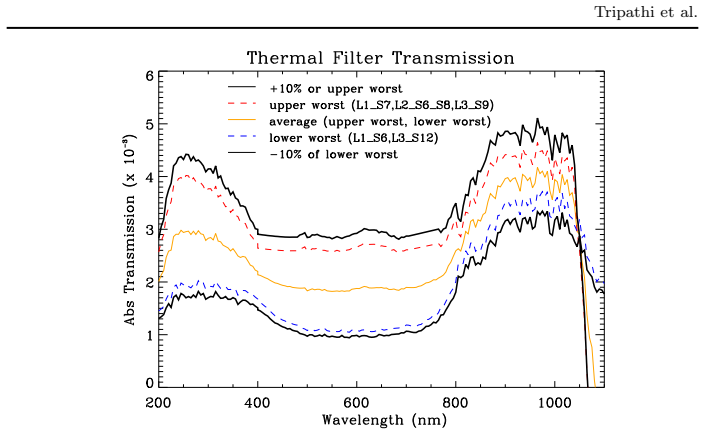
The load-bearing mechanism is the telescope and its two-stage spectral selection: a custom-coated thermal filter at the entrance aperture that blocks about 99.75% of visible and 99.5% of infrared light while transmitting roughly 0.2–0.3% of the 200–400 nm band, followed by two independently rotating filter wheels carrying eleven science filters (eight narrow-band, three broad-band) and five complementary blocking filters. Images are recorded by a back-thinned, UV-enhanced 4096×4096 CCD cooled to −55 °C, with the field of view of 1.5 solar radii at 0.7 arcsecond pixels. The effective-area model, $EA(\lambda) = A \cdot TF(\lambda) \cdot PMR(\lambda) \cdot SMR(\lambda) \cdot SF(\lambda) \cdot CF(\lambda) \cdot L(\lambda) \cdot QE(\lambda)$, combines the measured transmission and reflectivity of every element along the ray path and is the basis for converting raw counts into photometry; a field-corrector lens on a piezo stage and tilted filter mounts suppress ghost images.
What would settle it
Compare SUIT's full-disk photometry in each of its 200–400 nm filter bands with contemporaneous, independently calibrated measurements of solar spectral irradiance in the same wavelength range (for example, from a solar ultraviolet radiometer on another platform); if the SUIT-derived fluxes disagree by more than the stated calibration uncertainties, the effective-area model is falsified. A simpler in-flight check is to measure the point-spread function on a sharp solar feature: a FWHM clearly broader than about 1.4 arcseconds would falsify the imaging-performance claim.
Extended reading notes
Core claim
The central claim is that SUIT provides, for the first time, near-simultaneous full-disk and region-of-interest images of the Sun in the 200–400 nm range, at 1.4 arcsecond resolution and 0.7 arcsecond pixels, slicing through the photosphere and chromosphere with 11 filters that include the Mg ii h and k and Ca ii H lines. By combining a thermal filter at the entrance aperture with two filter wheels and a 4096×4096 UV-enhanced CCD, the instrument is designed to measure the spatially resolved contribution of solar features to the near- and mid-ultraviolet solar spectral irradiance, a quantity that has until now only been estimated from disk-integrated measurements or models. The paper also claims that the onboard flare detection and region-of-interest tracking, with a 4-second cadence, will capture flare energy distributions in the near ultraviolet, and that the instrument's calibration, the effective-area model built from measured transmissions, reflectivities, and quantum efficiencies, supports photometric science.
Load-bearing premise
The prediction that SUIT will deliver science-ready photometry depends on the assumption that the ground-based calibration of the thermal filter, science filters, mirrors, and CCD, the effective-area model, remains valid after launch, during five years at L1, and after radiation exposure.
Editorial extensions
If this is right
- SUIT's full-disk 200–400 nm images will let researchers separate the disk-integrated ultraviolet irradiance into contributions from active regions, sunspots, and quiet Sun for the first time.
- Combined with Aditya-L1's other remote-sensing and in-situ instruments, SUIT observations will cover the solar atmosphere from photosphere to corona and the solar wind at L1 from one platform.
- The combination of Mg ii h and k and Ca ii H narrow-band filters with a 4-second region-of-interest cadence provides a new channel for studying chromospheric dynamics and flare energy release in the near ultraviolet.
- The 1.4 arcsecond resolution across the full disk enables studies of MHD waves and their role in energy transfer between the photosphere and the overlying chromosphere.
- Science-ready Level-1 and radiometrically calibrated Level-2 data products will be publicly archived, making the 200–400 nm window available to the whole community.
Reading between the lines
- If the effective-area calibration holds in flight, SUIT's spatially resolved fluxes can be integrated to produce a daily solar spectral irradiance record in the near ultraviolet with detail that disk-averaged instruments cannot give.
- The simultaneous Mg ii h and k and Ca ii H filters might be used as a chromospheric heating diagnostic without needing a spectrograph, by comparing the line-to-continuum ratio across the disk.
- A natural test of the photometric calibration is to compare SUIT's broadband flux in overlapping bands with quasi-contemporaneous measurements from other space-based ultraviolet instruments; disagreement beyond stated uncertainties would pinpoint degradation of the thermal filter or mirrors.
- The onboard flare trigger, which uses signals from the HEL1OS and SoLEXS instruments to repoint the region of interest, foreshadows a standard operating mode for multi-wavelength flare campaigns that could be adopted by future solar observatories.
Editorial analysis
A structured set of objections, weighed in public.
Referee Report
Summary. The paper describes the Solar Ultraviolet Imaging Telescope (SUIT) on Aditya-L1, a two-mirror off-axis Ritchey-Chrétien telescope with an effective focal length of 3500 mm, a 4096x4096 UV-enhanced CCD, 0.7 arcsec/pixel plate scale, and 1.5 R_sun field of view. It presents the optical design, CODE V tolerance analysis, measured PSFs for the eleven science filters, the effective-area model EA(λ), component-level ground measurements (thermal filter transmission, mirror reflectance, filter profiles, lens transmission, CCD QE), mechanisms, electronics, structural and thermal design, and the data pipeline. The central scientific claim is that SUIT provides, for the first time, near-simultaneous full-disk and region-of-interest images of the Sun in 200-400 nm, enabling spatially resolved measurements of solar broad-band NUV/MUV radiation and thereby constraining solar ultraviolet irradiance variability relevant to Earth's atmosphere.
Significance. If the claims hold, SUIT opens a genuinely new observational window: no previous instrument has combined full-disk coverage with 1.4 arcsec resolution and 11 filters across 200-400 nm, a wavelength range central to solar atmospheric coupling and Earth's atmospheric chemistry. The paper's strengths include detailed, measured component characterizations (thermal filter transmission over 30 samples, mirror reflectivity, filter profiles, CCD QE), an end-to-end measured PSF for each science filter, a transparent effective-area formula, and a thorough description of mechanisms, electronics, and thermal design. The design and ground-calibration work are reported in enough detail to be reproducible, and companion papers provide additional depth on the thermal filter, detector, and flare-trigger intelligence. The main limitation is that no in-orbit or first-light data are presented, so the absolute radiometric/irradiance capability remains a pre-flight expectation rather than a demonstrated result.
major comments (3)
- [Section 3, Eq. (1)] The effective-area formula labels A as the area of the entrance aperture and gives A = 0.01561 m^2, but Section 2 and Table 2 specify an entrance aperture diameter of 146 mm, whose area is 0.01675 m^2. The value 0.01561 m^2 corresponds to a 141 mm diameter, i.e., the primary mirror clear aperture. Because Eq. (1) is the basis for all absolute flux and SSI-related predictions, this inconsistency must be resolved: either correct the label or justify using the primary-mirror area in the effective-area model.
- [Abstract and Sections 2, 3, 10] The paper states that SUIT 'continuously provides' full-disk images and 'allows the measurements of spatially resolved solar broad-band radiation' for SSI variability, but it presents no first-light or in-orbit calibration data even though the mission launched in September 2023. The in-orbit validity of the pre-flight EA(λ) model in Section 3 is not demonstrated: the LED calibration unit (Section 4.3) samples only 258 nm and 356 nm and cannot constrain wavelength-dependent degradation or out-of-band leakage across 200-400 nm. I recommend explicitly stating that the science capabilities are pre-flight expectations and, if available, adding a brief commissioning status, while separating the demonstrated imaging capability from the not-yet-demonstrated absolute radiometric/irradiance capability.
- [Section 9] The data product description is internally inconsistent: 'Level 1 data is fully science-ready data' is immediately followed by 'Level-2 processing produces data products that will be fully calibrated for radiometric calibration.' Please clarify which level contains the radiometric calibration and what 'science-ready' means; this matters for user expectations of the photometric accuracy that underpins the SSI claim.
minor comments (6)
- [Tables 1, 4 and text] Filter nomenclature is inconsistent between Table 1 (NB1-NB8, BB1-BB3), the text (NB01, NB02, ...), and Table 4 (NB04, BP02, BP03, BP04); standardize the IDs across tables and text.
- [Section 4.1] The text says the TF blocks 99.75% of visible light (0.25% transmission) but later says visible transmission falls to ≈0.1%; reconcile these numbers or specify different spectral sub-ranges.
- [Table 2] Table 2 contains the incomplete line 'Filters Entrance aperture blocking (out band)'; either complete the entry or delete it.
- [Section 3] Eq. (1) is unnumbered; number it and all other display equations for cross-referencing.
- [Section 4.5] The sentence 'the optical surfaces were polished the optical surfaces to 1.5 nm RMS micro-roughness' contains a duplicated phrase; rephrase.
- [References] References to companion papers (Sarkar et al. 2024; Sreejith et al. 2024; Tripathi et al. 2025) are marked 'in preparation'; if they are now published or accepted, update the citations before publication.
Circularity Check
No significant circularity: instrument description grounded in direct measurements and external benchmarks.
full rationale
This paper is an instrument description, not a derivation of a scientific result from fitted inputs. Its central claims are that SUIT provides near-simultaneous full-disk and region-of-interest images in 200–400 nm with 11 filters, and that this opens a new observational window for spatially resolved NUV/MUV irradiance studies. The load-bearing technical quantity, the effective area EA(lambda) in Eq. (1), is the product of laboratory-measured component responses (thermal filter transmission, mirror reflectivities, filter transmissions, lens transmission, and CCD quantum efficiency). Each component characterization is reported with its own measurements (e.g., the thermal filter transmission from 30 representative samples in Figure 8, mirror reflectance in Figure 10, filter transmission profiles in Figure 12, CCD QE in Figure 15), and the effective-area model is not fitted to any target radiance or irradiance result. The 'for the first time' claim is supported by a survey of previous facilities (SMM/UVSP, IRIS, Sunrise/SuFI, SUSI) cited from the external literature, so it does not rest on self-citation. The cited companion papers by the SUIT team (Ghosh et al. 2022; Varma et al. 2023a,b; Sarkar et al. 2024; Sreejith et al. 2024; Tripathi et al. 2025) describe component development, detector characterization, onboard flare intelligence, and the science plan; none is invoked as an external uniqueness theorem or as a substitute for the present measurements. The absence of in-orbit calibration data and first-light verification is a genuine validation gap for the radiometric science goals, but it is not a circularity: an unverified forward model is not a loop in which an output is defined or fitted in terms of itself. The paper therefore exhibits no self-definitional, fitted-input-as-prediction, self-citation-load-bearing, uniqueness-importation, ansatz-smuggling, or renaming circularity.
Assumptions & free parameters
assumptions (3)
- domain assumption The ground-measured transmission, reflectivity, and QE profiles are accurate for the flight instrument after launch and in orbit.
- standard math The optical prescription and CODE V tolerance analysis correctly predict the delivered image quality.
- domain assumption The CCD272-84 detector characterization is representative of the flight device.
Cite this review
Pith. "Pith review of The Solar Ultraviolet Imaging Telescope on board Aditya-L1." pith.science (2026). https://pith.science/paper/EV2GQUFT
@misc{pith2026250102274,
  author       = {Pith},
  title        = {Pith review of: The Solar Ultraviolet Imaging Telescope on board Aditya-L1},
  year         = {2026},
  howpublished = {\url{https://pith.science/paper/EV2GQUFT}},
  note         = {Machine review of arXiv:2501.02274}
}
read the original abstract
The Solar Ultraviolet Imaging Telescope (SUIT) is an instrument on the Aditya-L1 mission of the Indian Space Research Organization (ISRO) launched on September 02, 2023. SUIT continuously provides, near-simultaneous full-disk and region-of-interest images of the Sun, slicing through the photosphere and chromosphere and covering a field of view up to 1.5 solar radii. For this purpose, SUIT uses 11 filters tuned at different wavelengths in the 200{--}400~nm range, including the Mg~{\sc ii} h~and~k and Ca~{\sc ii}~H spectral lines. The observations made by SUIT help us understand the magnetic coupling of the lower and middle solar atmosphere. In addition, for the first time, it allows the measurements of spatially resolved solar broad-band radiation in the near and mid ultraviolet, which will help constrain the variability of the solar ultraviolet irradiance in a wavelength range that is central for the chemistry of the Earth's atmosphere. This paper discusses the details of the instrument and data products.
Figures


Figures from the paper (18 more)




Forward citations
Cited by 1 Pith paper
-
The Study of Quasi-Periodic Pulsations in Solar and Stellar Flares with SKA
SKA’s radio imaging spectroscopy and polarisation will enable decisive tests of QPP mechanisms in solar and stellar flares, including weak events and solar–stellar comparisons.
Reference graph
Works this paper leans on
-
[1]
Barthol, P., Gandorfer, A., Solanki, S.K., Sch¨ ussler, M., Chares, B., Curdt, W., Deutsch, W., Feller, A., Germerott, D., Grauf, B., Heerlein, K., Hirzberger, J., Kolleck, M., Meller, R., M¨ uller, R., Riethm¨ uller, T.L., Tomasch, G., Kn¨ olker, M., Lites, B.W., Card, G., Elmore, D., Fox, J., Lecinski, A., Nelson, P., Summers, R., Watt, A., Mart ´ ınez ...
work page 2011
-
[2]
DOI. ADS. Bohlin, J.D., Frost, K.J., Burr, P.T., Guha, A.K., Withbroe, G.L.: 1980, Solar Maximum Mission. Sol. Phys. 65,
work page 1980
-
[3]
DOI. ADS. Krivova, N.A., Solanki, S.K., Fligge, M., Unruh, Y.C.: 2003, Reconstruction of solar irradiance variations in cycle 23: Is solar surface magnetism the cause? Astron. Astrophys. 399, L1. DOI. ADS. Laureijs, R., Amiaux, J., Arduini, S., Augu` eres, J.-L., Brinchmann, J., Cole, R., Cropper, M., Dabin, C., Duvet, L., Ealet, A., Garilli, B., Gondoin,...
arXiv 2003
-
[5]
DOI. ADS. Cropper, M., Cole, R., James, A., Mellier, Y., Martignac, J., Di Giorgio, A.-M., Paltani, S., Genolet, L., Fourmond, J.-J., Cara, C., Amiaux, J., Guttridge, P., Walton, D., Thomas, P., Rees, K., Pool, P., Endicott, J., Holland, A., Gow, J., Murray, N., Duvet, L., Augueres, J.-L., Laureijs, R., Gondoin, P., Kitching, T., Massey, R., Hoekstra, H.:...
work page 2012
-
[9]
DOI. ADS. Rochus, P., Auch` ere, F., Berghmans, D., Harra, L., Schmutz, W., Sch¨ uhle, U., Addison, P., Appourchaux, T., Aznar Cuadrado, R., Baker, D., Barbay, J., Bates, D., BenMoussa, A., Bergmann, M., Beurthe, C., Borgo, B., Bonte, K., Bouzit, M., Bradley, L., B¨ uchel, V., Buchlin, E., B¨ uchner, J., Cab´ e, F., Cadiergues, L., Chaigneau, M., Chares, ...
work page 2020
-
[12]
DOI. ADS. Solanki, S.K., del Toro Iniesta, J.C., Woch, J., Gandorfer, A., Hirzberger, J., Alvarez-Herrero, A., Appourchaux, T., Mart ´ ınez Pillet, V., P´ erez-Grande, I., Sanchis Kilders, E., Schmidt, W., G´ omez Cama, J.M., Michalik, H., Deutsch, W., Fernandez-Rico, G., Grauf, B., Gizon, L., Heerlein, K., Kolleck, M., Lagg, A., Meller, R., M¨ uller, R.,...
work page 2020
-
[14]
DOI. ADS. Tripathi et al., D.: 2025, Critical Science Plan with SUIT. Sol. Phys. in prepatation. Varma, M., Padinhatteeri, S., Sinha, S., Tyagi, A., Burse, M., Yadav, R., Kumar, G., Ramaprakash, A., Tripathi, D., Sankarasubramanian, K., Nagaraju, K., Vadodariya, K., Tadepalli, S., Deogaonkar, R., Olekar, M., Azaruddin, M., Unnikrishnan, A.: 2023a, The Sol...
work page 2025
-
[17]
DOI. ADS. M¨ uller, D., St. Cyr, O.C., Zouganelis, I., Gilbert, H.R., Marsden, R., Nieves-Chinchilla, T., Antonucci, E., Auch` ere, F., Berghmans, D., Horbury, T.S., Howard, R.A., Krucker, S., Maksimovic, M., Owen, C.J., Rochus, P., Rodriguez-Pacheco, J., Romoli, M., Solanki, S.K., Bruno, R., Carlsson, M., Fludra, A., Harra, L., Hassler, D.M., Livi, S., L...
work page 2020
Show all 16 references
-
[35]
DOI. ADS. Ghosh, A., Kesharwani, R., Khan, A.R., Padinhatteeri, S., Tripathi, D., Ramaprakash, A.N., Patel, K., Jalluri, T.D.P.V., Madhumalathi, G.R., Venkateshwaran, R., Elumalai, S., Gupta, SOLA: manuscript.tex; 13 January 2025; 1:18; p. 34 SUIT on board Aditya-L1 K., Nair, ...
2025
-
[73]
DOI. ADS. SOLA: manuscript.tex; 13 January 2025; 1:18; p. 37
2025
-
[207]
DOI. ADS. Singh, K.P., Tandon, S.N., Agrawal, P.C., Antia, H.M., Manchanda, R.K., Yadav, J.S., Seetha, S., Ramadevi, M.C., Rao, A.R., Bhattacharya, D., Paul, B., Sreekumar, P., Bhattacharyya, S., Stewart, G.C., Hutchings, J., Annapurni, S.A., Ghosh, S.K., Murthy, J., Pati, A.,...
2014
-
[256]
DOI. ADS. Woodgate, B.E., Tandberg-Hanssen, E.A., Bruner, E.C., Beckers, J.M., Brandt, J.C., Henze, W., Hyder, C.L., Kalet, M.W., Kenny, P.J., Knox, E.D., Michalitsianos, A.G., Rehse, R., Shine, R.A., Tinsley, H.D.: 1980, The ultraviolet spectrometer and polarimeter on the Sol...
1980
-
[311]
DOI. ADS. Solanki, S.K., Barthol, P., Danilovic, S., Feller, A., Gandorfer, A., Hirzberger, J., Riethm¨ uller, T.L., Sch¨ ussler, M., Bonet, J.A., Mart ´ ınez Pillet, V., del Toro Iniesta, J.C., Domingo, V., Palacios, J., Kn¨ olker, M., Bello Gonz´ alez, N., Berkefeld, T., Fra...
2010
-
[583]
ADS. Tripathi, D., Chakrabarty, D., Nandi, A., Raghvendra Prasad, B., Ramaprakash, A.N., Shaji, N., Sankarasubramanian, K., Satheesh Thampi, R., Yadav, V.K.: 2023, The Aditya-L1 mission of ISRO. In: Cauzzi, G., Tritschler, A. (eds.) The Era of Multi-Messenger Solar Physics, IA...
2023
-
[2733]
DOI. ADS. Ermolli, I., Matthes, K., Dudok de Wit, T., Krivova, N.A., Tourpali, K., Weber, M., Unruh, Y.C., Gray, L., Langematz, U., Pilewskie, P., Rozanov, E., Schmutz, W., Shapiro, A., Solanki, S.K., Woods, T.N.: 2013, Recent variability of the solar spectral irradiance and i...
2013
-
[3945]
DOI. ADS. Feller, A., Gandorfer, A., Iglesias, F.A., Lagg, A., Riethm¨ uller, T.L., Solanki, S.K., Katsukawa, Y., Kubo, M.: 2020, The SUNRISE UV Spectropolarimeter and imager for SUNRISE III. In: Evans, C.J., Bryant, J.J., Motohara, K. (eds.) Ground-based and Airborne Instrume...
2020
Reviewed August 10, 2026 · model on record in the stance chip above.
Discussion (0). Continue with ORCID to comment.