REVIEW 4 major objections 6 minor 53 references
CHAT: Beyond Contrastive Graph Transformer for Link Prediction in Heterogeneous Networks
T0 review · 4 major / 6 minor · reviewed 2026-08-10 · deepseek-v4-flash
Pith's one-line read CHAT, a sampling-based graph transformer that requires no predefined meta-paths, claims to outperform general link-prediction baselines and domain-specific drug-target interaction models on three datasets.
desk verdict Good meta-path-free transformer, but the evaluation evidence is too thin to support the 'consistently outperforms' headline. read the letter →
The pith
A machine-rendered reading of the paper's core claim, the machinery that carries it, and where it could break.
The reading
What carries the argument
Concentrated graph random-walk sampling is the machinery that carries the argument. Starting from a head node, the sampler walks to tail nodes and replaces every string of non-interest nodes between interest nodes by a tuple of edge types, so a subgraph becomes an alternating sequence of interest nodes and concentrated-edge tokens. This keeps the sequence short, removes the need for predefined meta-paths, and, per the paper's Theorem A.1, generalizes meta-path sampling: any meta-path is a sub-sequence the concentrated sampler can generate when the inner-node tolerance and walk length are large enough. The connection-aware transformer, supervised contrastive loss, attentive observation-probability loss, and ensemble predictor are the components that turn these concentrated sequences into link predictions.
What would settle it
Run CHAT and every deep-learning baseline under an identical, pre-registered protocol: the same negative samples per positive link, the same fold splits, and a defined hyperparameter search of at least 50 random configurations per model. If any baseline's best AUC or AUPR exceeds CHAT's on DTI-708 or DTI-258K under those conditions, the paper's central claim of consistent superiority is falsified.
Extended reading notes
Core claim
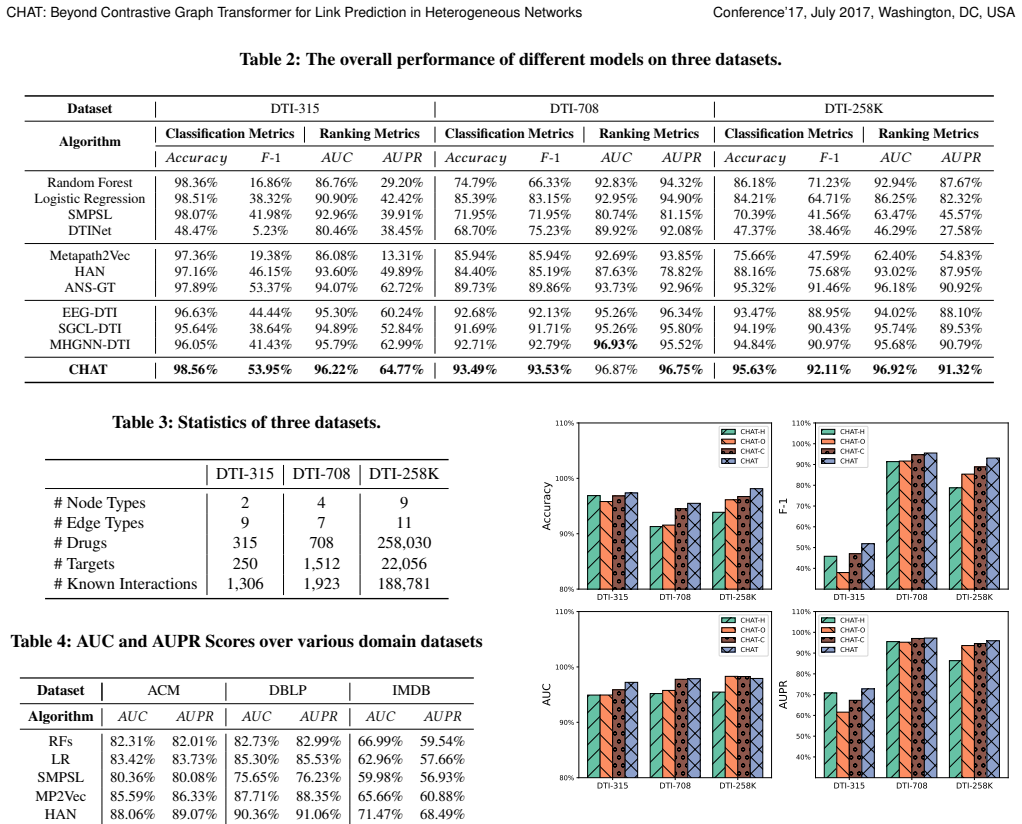
The central claim is that a meta-path-free, sampling-based graph transformer can beat specialized DTI prediction models. CHAT samples concentrated random walks that keep only head and tail nodes, converting any number of intervening non-interest nodes into a single concentrated edge formed by a tuple of edge types; the paper argues this construction is a generalization of meta-path-based sampling. The connection-aware transformer encodes both node features and these edge-type tuples, using shortest-path distances to the head node as position encodings, and is trained with a supervised contrastive link-prediction loss plus a connection-aware observation-probability loss. An ensemble link predictor averages predictions over multiple sampled sequences. On DTI-315, DTI-708, and DTI-258K, the paper reports CHAT ahead of ten baselines on AUC and AUPR in almost all settings, including DTI-specialized models, and reports similar gains on ACM, DBLP, and IMDB.
Load-bearing premise
The reported superiority assumes the evaluation was fair: deep-learning baselines were tuned only "to the best of our attempts" without a defined search procedure, and on DTI-258K GNN-based approaches sampled only nodes of interest while metrics are reported as fair; if baseline tuning or negative sampling differed, the margins in Tables 2 and 4 could change.
Editorial extensions
If this is right
- If the results hold, link prediction in heterogeneous networks no longer depends on manually curated meta-paths; a general sampler plus transformer can cover the same or a wider range of connectivity.
- Long-range dependencies can be captured by attention up to the walk length without the over-smoothing that comes from stacking many GNN layers.
- Sampling bounds memory and runtime, making the approach feasible on large networks like DTI-258K where full-graph transformer attention is infeasible.
- Because CHAT outperforms DTI-specialized baselines, domain knowledge may be encoded implicitly by the learned attention over concentrated edge-type tuples rather than by hand.
- The paper's additional ACM, DBLP, and IMDB experiments also show CHAT ahead of all baselines, suggesting the improvement transfers across domains.
Reading between the lines
- The concentrated-edge representation suggests a soft meta-path space: attention weights over edge-type tuples can be read as learned meta-paths, so a practitioner could extract the most important connection patterns from a trained CHAT model instead of enumerating them by hand; the paper's interpretability study hints at this but does not develop it as a general extraction procedure.
- Because the sampler keeps only one head node per sequence to avoid biased training, head-to-head co-occurrence information is discarded; a future variant that corrects for sampling bias might recover that signal and further improve predictions.
- The comparison to domain-specific DTI models would be sharpened by a pre-registered hyperparameter search and by varying the positive-negative link ratio; those are protocol choices, not claims of the paper.
- If concentrated sampling truly generalizes meta-paths, CHAT could serve as a drop-in replacement in other meta-path-heavy applications, such as recommender networks and knowledge graphs, where the paper's DTI and academic-network evidence suggests but does not establish transfer.
Signed reviews
Editorial analysis
A structured set of objections, weighed in public.
Referee Report
Summary. The paper proposes CHAT, a contrastive heterogeneous graph transformer for link prediction that avoids predefined meta-paths by using a 'concentrated' random-walk sampling scheme, a connection-aware transformer, a dual loss (supervised contrastive link prediction and observation probability), and an ensemble link predictor. The method is evaluated on three drug-target interaction datasets (DTI-315, DTI-708, DTI-258K) and three additional heterogeneous network datasets (ACM, DBLP, IMDB), comparing against ten baselines including general and DTI-specialized methods. The paper claims that CHAT consistently outperforms both conventional and state-of-the-art DTI approaches, and also presents ablation, interpretability, sensitivity, and scalability analyses.
Significance. If the empirical claims are validated, CHAT offers a useful design for meta-path-free link prediction in heterogeneous networks, with the concentrated sampling and connection-aware encoding being plausible contributions. The paper provides a clear architecture description, a theoretical argument that concentrated sampling generalizes meta-path-based methods, a public code link, and ablations that support the contribution of the main modules. However, the headline claim of consistent superiority is currently undermined by evaluation-protocol opacity and by at least one reported counterexample; the significance of the result depends on fixing these empirical issues.
major comments (4)
- [Section 5.3.1, Table 2] The claim that CHAT 'consistently outperforms' all baselines is not supported by the reported numbers: on DTI-708, MHGNN-DTI achieves AUC 96.93% while CHAT achieves 96.87%. This counterexample should be acknowledged, and the abstract and introduction should be reworded to describe the results accurately, for example 'outperforms the majority of baselines' or 'outperforms baselines on most datasets and metrics.'
- [Appendix A.1] The DTI-258K evaluation protocol for GNN baselines is not fully specified: the sentence 'a sampling of only nodes under interests are conducted for GNN-based approaches due to scalability, while evaluation metrics are calculated under a fair setting to other approaches' does not state how the sampled node set is chosen, whether the same train/validation/test edges are used for all methods, or whether the negative sampling distribution is identical. Since CHAT's concentrated sampling uses the full graph to form random-walk sequences, restricting GNN baselines to a sampled subset could starve them of information and make the head-to-head comparison unfair. The authors must describe the exact sampling procedure, the number of nodes retained, and confirm that all methods use the same edge splits and negative sampling.
- [Section 5.2 and Appendix A.1] No standard deviations, confidence intervals, or significance tests are reported anywhere in the experimental section, despite several metric differences being small (e.g., DTI-708 AUPR 96.75% vs 95.52% for CHAT vs MHGNN-DTI). The claim of 'significant improvement' in Section 5.4 is therefore unsupported. Please report multiple runs with standard deviations and perform appropriate statistical tests, or explicitly state that the improvements are not statistically evaluated.
- [Appendix, Algorithm 1] The pseudocode for concentrated graph sampling is incorrect as written: in the while loop, the line 'sample ← sample ∪ {˜e_x,y}' appends only the sampled edge-type tuple, but the sampled tail node y itself is never appended. Consequently the 'last node of sample' in the next iteration would not be a node but an edge, and the walk cannot continue, contradicting Eq. (3) which alternates node and connection tokens. The pseudocode should append both the concentrated edge tuple and the sampled tail node, e.g., 'sample ← sample ∪ {˜e_x,y, y}'.
minor comments (6)
- [Section 4.2.1, Eq. (3)] The notation is slightly inconsistent: Eq. (3) defines a sequence matrix with 2L−1 tokens, implying L is the number of nodes of interest, while earlier L is described as the random-walk length. Clarify whether L counts all nodes or only nodes of interest, and adjust the dimension accordingly.
- [Section 4.3, Eq. (11)] The symbol A(v_h) is used to denote 'the sampled sequences starting at v_h', but A(i) in Eq. (6) denotes the set of all links in sequence i; using A for two different concepts in the same paper is confusing. Please introduce a distinct notation for the set of sampled sequences.
- [Section 5.3.1] The sentence 'our proposed CHAT model surpasses even these domain-centric methods' is contradicted by the DTI-708 AUC cell discussed in the major comments; either soften the claim or add a footnote explaining why that single-cell reversal is not meaningful.
- [Figure 3] The y-axes of the ablation panels start at 80% (and 40% for F-1), which visually amplifies small differences. Consider starting the axes at zero or adding numeric labels so that the reader can judge the magnitude of the performance drops.
- [Section 1, contributions list] There is a typo: 'CHAT equipts a novel dual-faceted loss function' should read 'equips'.
- [Section 5.4, additional experiments] The statement that CHAT demonstrates 'a significant improvement' over baselines in Table 4 is not backed by statistical significance testing; please rephrase or add the missing statistical analysis.
Circularity Check
No significant circularity: CHAT's predictions are evaluated against external benchmarks and its components are defined independently of the reported results.
full rationale
The paper's derivation chain is algorithmic and empirically evaluated rather than circular. CHAT's concentrated graph sampling is defined directly from random walks over the heterogeneous network, with non-interest nodes converted into edge-type tuples; the connection-aware transformer encodes these sampled sequences; the dual loss combines a supervised contrastive objective adapted from Khosla et al. and an observation-probability objective adapted from Grover and Leskovec; the ensemble predictor averages over multiple samples. None of these components is defined in terms of the evaluation metrics or fitted to the test labels. The claim that concentrated sampling generalizes meta-path-based approaches is supported by Theorem A.1, which explicitly constructs sub-meta-paths as special cases of concentrated sequences under stated conditions on k and L; this is a mathematical inclusion argument, not a restatement of the conclusion. No parameter is fitted to a subset of data and then renamed a prediction, and no uniqueness theorem is imported from the authors' prior work to force the architecture. The self-citations [45]-[47] are background references and baseline definitions (e.g., SMPSL in [46]); they do not carry the central superiority claim. The headline performance claim rests on Tables 2 and 4, which compare against external datasets and baselines; any issues with the DTI-708 AUC cell or the DTI-258K baseline sampling protocol are concerns about evaluation fairness and statistical significance, not circularity. Thus no load-bearing step reduces to its own inputs.
Assumptions & free parameters
free parameters (6)
- Loss scaling weight w =
1 (searched 0.1 to 100)
- Temperature tau =
not reported
- Random walk length L =
100 (maximum explored sequence length)
- Samples per head node m =
1000
- Maximum inner nodes k =
not reported
- Embedding dimensions and transformer depth =
512/256/128 dims, 4 layers, 8 heads
assumptions (4)
- standard math Self-attention and supervised contrastive learning behave as described in the cited works.
- domain assumption Random-walk samples are representative of whole-network connectivity.
- ad hoc to paper Edge-type tuples preserve enough connection semantics when non-interest nodes are removed.
- ad hoc to paper Keeping only one head node per sequence avoids biased training.
Cite this review
Pith. "Pith review of CHAT: Beyond Contrastive Graph Transformer for Link Prediction in Heterogeneous Networks." pith.science (2026). https://pith.science/paper/LVJCKBTR
@misc{pith2026250102760,
  author       = {Pith},
  title        = {Pith review of: CHAT: Beyond Contrastive Graph Transformer for Link Prediction in Heterogeneous Networks},
  year         = {2026},
  howpublished = {\url{https://pith.science/paper/LVJCKBTR}},
  note         = {Machine review of arXiv:2501.02760}
}
read the original abstract
Link prediction in heterogeneous networks is crucial for understanding the intricacies of network structures and forecasting their future developments. Traditional methodologies often face significant obstacles, including over-smoothing-wherein the excessive aggregation of node features leads to the loss of critical structural details-and a dependency on human-defined meta-paths, which necessitate extensive domain knowledge and can be inherently restrictive. These limitations hinder the effective prediction and analysis of complex heterogeneous networks. In response to these challenges, we propose the Contrastive Heterogeneous grAph Transformer (CHAT). CHAT introduces a novel sampling-based graph transformer technique that selectively retains nodes of interest, thereby obviating the need for predefined meta-paths. The method employs an innovative connection-aware transformer to encode node sequences and their interconnections with high fidelity, guided by a dual-faceted loss function specifically designed for heterogeneous network link prediction. Additionally, CHAT incorporates an ensemble link predictor that synthesizes multiple samplings to achieve enhanced prediction accuracy. We conducted comprehensive evaluations of CHAT using three distinct drug-target interaction (DTI) datasets. The empirical results underscore CHAT's superior performance, outperforming both general-task approaches and models specialized in DTI prediction. These findings substantiate the efficacy of CHAT in addressing the complex problem of link prediction in heterogeneous networks.
Figures


Figures from the paper (2 more)


Reference graph
Works this paper leans on
-
[1]
Abien Fred Agarap. 2018. Deep learning using rectified linear units (relu). arXiv preprint arXiv:1803.08375 (2018)
arXiv 2018
-
[2]
Stephen H Bach, Matthias Broecheler, Bert Huang, and Lise Getoor. 2017. Hinge- loss markov random fields and probabilistic soft logic. (2017)
work page 2017
-
[3]
Stephen P Borgatti, Ajay Mehra, Daniel J Brass, and Giuseppe Labianca. 2009. Network analysis in the social sciences. science 323, 5916 (2009), 892–895
work page 2009
-
[4]
Lei Cai and Shuiwang Ji. 2020. A multi-scale approach for graph link prediction. In Proceedings of the AAAI conference on artificial intelligence, V ol. 34. 3308– 3315
work page 2020
-
[5]
Lei Cai, Jundong Li, Jie Wang, and Shuiwang Ji. 2021. Line graph neural net- works for link prediction. IEEE Transactions on Pattern Analysis and Machine Intelligence 44, 9 (2021), 5103–5113
work page 2021
-
[6]
Deli Chen, Yankai Lin, Wei Li, Peng Li, Jie Zhou, and Xu Sun. 2020. Measuring and relieving the over-smoothing problem for graph neural networks from the topological view. In Proceedings of the AAAI conference on artificial intelligence, V ol. 34. 3438–3445
work page 2020
-
[7]
Ting Chen, Simon Kornblith, Mohammad Norouzi, and Geoffrey Hinton. 2020. A simple framework for contrastive learning of visual representations. In Interna- tional conference on machine learning. PMLR, 1597–1607
work page 2020
-
[8]
Jacob Devlin, Ming-Wei Chang, Kenton Lee, and Kristina Toutanova. 2018. Bert: Pre-training of deep bidirectional transformers for language understanding. arXiv preprint arXiv:1810.04805 (2018)
arXiv 2018
Show all 53 references
-
[9]
Xibin Dong, Zhiwen Yu, Wenming Cao, Yifan Shi, and Qianli Ma. 2020. A survey on ensemble learning. Frontiers of Computer Science 14 (2020), 241–258
2020
-
[10]
Yuxiao Dong, Nitesh V Chawla, and Ananthram Swami. 2017. metapath2vec: Scalable representation learning for heterogeneous networks. In Proceedings of the 23rd ACM SIGKDD international conference on knowledge discovery and data mining. 135–144
2017
-
[11]
Gang Fu, Ying Ding, Abhik Seal, Bin Chen, Yizhou Sun, and Evan Bolton
-
[12]
Lise Getoor, Nir Friedman, Daphne Koller, and Avi Pfeffer. 2001. Learning probabilistic relational models. Relational data mining (2001), 307–335
2001
-
[13]
Aditya Grover and Jure Leskovec. 2016. node2vec: Scalable feature learning for networks. In Proceedings of the 22nd ACM SIGKDD international conference on Knowledge discovery and data mining. 855–864
2016
-
[14]
Trevor Hastie, Robert Tibshirani, and Jerome H Friedman. 2009. The elements of statistical learning: data mining, inference, and prediction. V ol. 2. Springer
2009
-
[15]
Geoffrey Hinton, Oriol Vinyals, and Jeff Dean. 2015. Distilling the knowledge in a neural network. arXiv preprint arXiv:1503.02531 (2015)
2015 arXiv
-
[16]
Pili Hu and Wing Cheong Lau. 2013. A survey and taxonomy of graph sampling. arXiv preprint arXiv:1308.5865 (2013)
2013 arXiv
-
[17]
Ziniu Hu, Yuxiao Dong, Kuansan Wang, and Yizhou Sun. 2020. Heterogeneous graph transformer. In Proceedings of the web conference 2020. 2704–2710
2020
-
[18]
Shangrong Huang, Jian Zhang, Lei Wang, and Xian-Sheng Hua. 2015. Social friend recommendation based on multiple network correlation. IEEE transactions on multimedia 18, 2 (2015), 287–299
2015
-
[19]
Paul Jaccard. 1901. Étude comparative de la distribution florale dans une portion des Alpes et des Jura. Bull Soc Vaudoise Sci Nat 37 (1901), 547–579
1901
-
[20]
Prannay Khosla, Piotr Teterwak, Chen Wang, Aaron Sarna, Yonglong Tian, Phillip Isola, Aaron Maschinot, Ce Liu, and Dilip Krishnan. 2020. Supervised contrastive learning. Advances in neural information processing systems 33 (2020), 18661– 18673
2020
-
[21]
Devin Kreuzer, Dominique Beaini, Will Hamilton, Vincent Létourneau, and Pru- dencio Tossou. 2021. Rethinking graph transformers with spectral attention. Advances in Neural Information Processing Systems 34 (2021), 21618–21629
2021
-
[22]
Ajay Kumar, Shashank Sheshar Singh, Kuldeep Singh, and Bhaskar Biswas. 2020. Link prediction techniques, applications, and performance: A survey. Physica A: Statistical Mechanics and its Applications 553 (2020), 124289
2020
-
[23]
Mei Li, Xiangrui Cai, Sihan Xu, and Hua Ji. 2023. Metapath-aggregated heteroge- neous graph neural network for drug–target interaction prediction. Briefings in Bioinformatics 24, 1 (2023), bbac578
2023
-
[24]
Yang Li, Guanyu Qiao, Xin Gao, and Guohua Wang. 2022. Supervised graph co-contrastive learning for drug–target interaction prediction. Bioinformatics 38, 10 (2022), 2847–2854
2022
-
[25]
Xuan Lin, Zhe Quan, Zhi-Jie Wang, Tengfei Ma, and Xiangxiang Zeng. 2020. KGNN: Knowledge Graph Neural Network for Drug-Drug Interaction Prediction.. In IJCAI, V ol. 380. 2739–2745
2020
-
[26]
Yong Liu, Min Wu, Chunyan Miao, Peilin Zhao, and Xiao-Li Li. 2016. Neighbor- hood regularized logistic matrix factorization for drug-target interaction prediction. PLoS computational biology 12, 2 (2016), e1004760
2016
-
[27]
Yunan Luo, Xinbin Zhao, Jingtian Zhou, Jinglin Yang, Yanqing Zhang, Wenhua Kuang, Jian Peng, Ligong Chen, and Jianyang Zeng. 2017. A network integration approach for drug-target interaction prediction and computational drug reposi- tioning from heterogeneous information. Natur...
2017
-
[28]
Alexandra Marin and Barry Wellman. 2011. Social network analysis: An intro- duction. The SAGE handbook of social network analysis 11 (2011), 25
2011
-
[29]
Luis Müller, Mikhail Galkin, Christopher Morris, and Ladislav Rampášek. 2023. Attending to graph transformers. arXiv preprint arXiv:2302.04181 (2023)
2023 arXiv
-
[30]
Jiajie Peng, Yuxian Wang, Jiaojiao Guan, Jingyi Li, Ruijiang Han, Jianye Hao, Zhongyu Wei, and Xuequn Shang. 2021. An end-to-end heterogeneous graph representation learning-based framework for drug–target interaction prediction. Briefings in bioinformatics 22, 5 (2021), bbaa430
2021
-
[31]
Miao Peng, Ben Liu, Qianqian Xie, Wenjie Xu, Hua Wang, and Min Peng. 2022. SMiLE: Schema-augmented Multi-level Contrastive Learning for Knowledge Graph Link Prediction. arXiv preprint arXiv:2210.04870 (2022)
2022 arXiv
-
[32]
Liat Perlman, Assaf Gottlieb, Nir Atias, Eytan Ruppin, and Roded Sharan. 2011. Combining drug and gene similarity measures for drug-target elucidation. Journal of computational biology 18, 2 (2011), 133–145
2011
-
[33]
Ladislav Rampášek, Michael Galkin, Vijay Prakash Dwivedi, Anh Tuan Luu, Guy Wolf, and Dominique Beaini. 2022. Recipe for a general, powerful, scalable graph transformer. Advances in Neural Information Processing Systems35 (2022), 14501–14515
2022
-
[34]
Omer Sagi and Lior Rokach. 2018. Ensemble learning: A survey. Wiley In- terdisciplinary Reviews: Data Mining and Knowledge Discovery 8, 4 (2018), e1249
2018
-
[35]
Gerard Salton. 1983. Introduction to modern information retrieval. McGraw-Hill (1983)
1983
-
[36]
Lucre¸ tia Udrescu, Laura Sbârcea, Alexandru Topîrceanu, Alexandru Iovanovici, Ludovic Kurunczi, Paul Bogdan, and Mihai Udrescu. 2016. Clustering drug-drug interaction networks with energy model layouts: community analysis and drug repurposing. Scientific reports 6, 1 (2016), 32745
2016
-
[37]
Ashish Vaswani, Noam Shazeer, Niki Parmar, Jakob Uszkoreit, Llion Jones, Aidan N Gomez, Łukasz Kaiser, and Illia Polosukhin. 2017. Attention is all you need. Advances in neural information processing systems 30 (2017)
2017
-
[38]
Xiao Wang, Houye Ji, Chuan Shi, Bai Wang, Yanfang Ye, Peng Cui, and Philip S Yu. 2019. Heterogeneous graph attention network. In WWW. 2022–2032
2019
-
[39]
Ming Wen, Zhimin Zhang, Shaoyu Niu, Haozhi Sha, Ruihan Yang, Yonghuan Yun, and Hongmei Lu. 2017. Deep-learning-based drug–target interaction prediction. Journal of proteome research16, 4 (2017), 1401–1409
2017
-
[40]
Ruiyun Rayna Xu, Hailiang Chen, and J Leon Zhao. 2022. SocioLink: Leverag- ing Relational Information in Knowledge Graphs for Startup Recommendations. Journal of Management Information Systems forthcoming (2022)
2022
-
[41]
Chengxuan Ying, Tianle Cai, Shengjie Luo, Shuxin Zheng, Guolin Ke, Di He, Yanming Shen, and Tie-Yan Liu. 2021. Do transformers really perform badly for graph representation? Advances in Neural Information Processing Systems 34 (2021), 28877–28888
2021
-
[42]
Yuning You, Tianlong Chen, Yongduo Sui, Ting Chen, Zhangyang Wang, and Yang Shen. 2020. Graph contrastive learning with augmentations. Advances in neural information processing systems 33 (2020), 5812–5823
2020
-
[43]
Chuxu Zhang, Dongjin Song, Chao Huang, Ananthram Swami, and Nitesh V Chawla. 2019. Heterogeneous graph neural network. In Proceedings of the 25th ACM SIGKDD international conference on knowledge discovery & data mining. 793–803
2019
-
[44]
Muhan Zhang, Pan Li, Yinglong Xia, Kai Wang, and Long Jin. 2020. Revisiting graph neural networks for link prediction. (2020)
2020
-
[45]
Shengming Zhang, Yanchi Liu, Xuchao Zhang, Wei Cheng, Haifeng Chen, and Hui Xiong. 2022. CAT: Beyond Efficient Transformer for Content-Aware Anom- aly Detection in Event Sequences. In Proceedings of the 28th ACM SIGKDD Conference on Knowledge Discovery and Data Mining. 4541–4550
2022
-
[46]
Shengming Zhang and Yizhou Sun. 2023. Meta-Path-based Probabilistic Soft Logic for Drug-Target Interaction Prediction. arXiv preprint arXiv:2306.13770 (2023). Conference’17, July 2017, Washington, DC, USA Shengming Zhang, Le Zhang, Jingbo Zhou, and Hui Xiong
2023 arXiv
-
[47]
Shengming Zhang, Hao Zhong, Zixuan Yuan, and Hui Xiong. 2021. Scalable heterogeneous graph neural networks for predicting high-potential early-stage startups. In Proceedings of the 27th ACM SIGKDD Conference on Knowledge Discovery & Data Mining. 2202–2211
2021
-
[48]
Zaixi Zhang, Qi Liu, Qingyong Hu, and Chee-Kong Lee. 2022. Hierarchical graph transformer with adaptive node sampling. Advances in Neural Information Processing Systems 35 (2022), 21171–21183
2022
-
[49]
Zehua Zhang, Shilin Sun, Guixiang Ma, and Caiming Zhong. 2023. Line graph contrastive learning for link prediction. Pattern Recognition 140 (2023), 109537
2023
-
[50]
Guorui Zhou, Na Mou, Ying Fan, Qi Pi, Weijie Bian, Chang Zhou, Xiaoqiang Zhu, and Kun Gai. 2019. Deep interest evolution network for click-through rate prediction. In Proceedings of the AAAI conference on artificial intelligence, V ol. 33. 5941–5948
2019
-
[51]
Zhaocheng Zhu, Zuobai Zhang, Louis-Pascal Xhonneux, and Jian Tang. 2021. Neural bellman-ford networks: A general graph neural network framework for link prediction. Advances in Neural Information Processing Systems (2021). CHA T: Beyond Contrastive Graph T ransformer for Link ...
2021
-
[53]
For deep-learning-based ap- proaches, we follow the patterns in other two datasets that explores meta-paths w.r.t
that takes 51 meta-paths together with 51 shortest path met- rics, in total 102 dimensional features as the input for meta-path-as- feature-based approaches (Meta-path+Logistic Regression, Meta- path+Random Forest, and SMPSL). For deep-learning-based ap- proaches, we follow th...
-
[2016]
BMC bioinformatics 17, 1 (2016), 1–10
Predicting drug target interactions using meta-path-based semantic network analysis. BMC bioinformatics 17, 1 (2016), 1–10
2016
Reviewed August 10, 2026 · model on record in the stance chip above.
Discussion (0). Continue with ORCID to comment.