REVIEW 3 major objections 4 minor 33 references
Pseudo-Newtonian simulation of a thin accretion disk around a Reissner-Nordstr\"om naked singularity
T0 review · 3 major / 4 minor · reviewed 2026-08-10 · deepseek-v4-flash
Pith's one-line read A thin accretion disk can keep feeding a Reissner-Nordström naked singularity past the radius where viscous torque vanishes, by bulging over the top and forming a rotating ring near the zero-gravity sphere.
desk verdict First thin-disk simulation around an RN naked singularity gives a plausible over-the-top accretion mechanism, but the pseudo-Newtonian potential needs GR validation and the numerics need a convergence study. read the letter →
The pith
A machine-rendered reading of the paper's core claim, the machinery that carries it, and where it could break.
The reading
What carries the argument
The central object is the pseudo-Newtonian potential $V(r) = -M/r + Q^2/(2r^2)$, which reproduces in Newtonian mechanics the exact radial dependence of the RN Keplerian orbital frequency $\Omega_{RN}(r) = \sqrt{1 - r_0/r}\,\sqrt{M/r^3}$ for all $r > r_0$, including the zero at $r_0 = Q^2/M$ and the maximum at $4r_0/3$. The effective potential $U(r) = V(r) + \ell^2/(2r^2)$ yields the same circular-orbit relation, so the simulated disk follows the test-particle frequency. Because the viscous stress is proportional to $d\Omega/dr$, the sign change of $d\Omega/dr$ is what creates the zero-torque obstacle, and the disk's vertical response to the resulting pressure build-up is the mechanism that carries the over-the-top accretion. The equations are evolved with Newtonian hydrodynamics and an $\alpha$-viscosity prescription.
What would settle it
A concrete check is to compare the vertical and epicyclic frequencies of the pseudo-Newtonian potential against the exact RN values at the bulge radii; a significant mismatch would mean the bulge and ring are artifacts of the potential. A full general-relativistic hydrodynamic simulation of the same thin disk, run to the same times, would settle whether the over-the-top accretion and the toroidal structure survive in the true RN spacetime.
Extended reading notes
Core claim
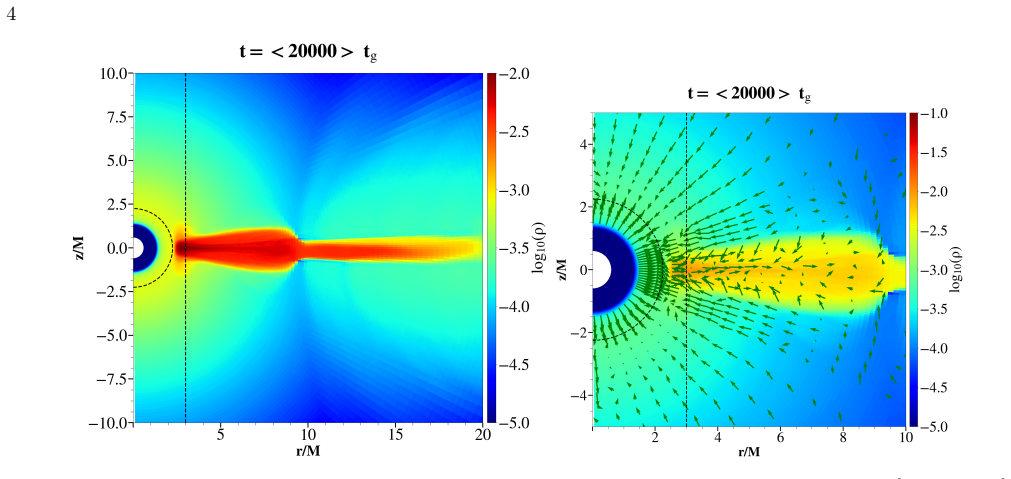
The central discovery is that a thin disk around an RN naked singularity negotiates the vanishing viscous torque by changing its shape. At the radius of maximum orbital frequency, $r = 4r_0/3$, the disk thickens, and accretion proceeds across that radius at high latitudes, well above and below the equatorial plane. Beyond the maximum, the flow continues down to the vicinity of the zero-gravity sphere, where matter gathers into a quasi-toroidal, rotating structure. The simulated angular velocity profile matches the test-particle Keplerian frequency, its maximum sits close to $4r_0/3$, and the inner torus resembles fluid figures of equilibrium derived analytically in full general relativity.
Load-bearing premise
The load-bearing premise is that the pseudo-Newtonian potential $V(r) = -M/r + Q^2/(2r^2)$ with Newtonian hydrodynamics correctly captures the gravity of the RN naked singularity for a thin disk, in particular the vertical structure of the disk and the behavior of the flow near the zero-gravity sphere.
Editorial extensions
If this is right
- Accretion onto a naked singularity can continue even where the viscous torque vanishes, through high-latitude flow over a thickened disk bulge.
- For charge-to-mass ratios $q \gtrsim 1$, the inner edge of the accretion structure lies inside the Schwarzschild ISCO, and the maximum orbital frequency is much higher than the Schwarzschild ISCO frequency.
- The rotating ring near the zero-gravity sphere could serve as an observational signature that distinguishes an RN naked singularity from a black hole in horizon-scale images.
- The simulated torus matches the shape of fluid figures of equilibrium obtained in full GR, suggesting the pseudo-Newtonian model captures the equilibrium geometry of the inner flow.
Reading between the lines
- The same 'bulge and go over the top' mechanism should appear in any axisymmetric potential whose orbital frequency has an interior maximum, so it may generalize to other exotic compact objects or modified gravity models.
- The paper does not compute radiation from the torus; computing its luminosity and spectrum would give a concrete prediction testable with current interferometers.
- If the vertical gravity of the pseudo-Newtonian potential differs from RN, the height of the bulge and the ring location could shift; a full-GR run is the direct test.
- Because the simulation uses a non-radiative, purely hydrodynamic disk, the role of magnetic stresses (MRI) in the over-the-top crossing remains an open question.
Signed reviews
Editorial analysis
A structured set of objections, weighed in public.
Referee Report
Summary. The paper presents the first pseudo-Newtonian simulations of a thin accretion disk around a Reissner-Nordström naked singularity. The gravity is modeled by the potential V(r) = -M/r + Q^2/(2r^2), which reproduces the RN Keplerian orbital frequency and its maximum at r = 4r0/3. Using the PLUTO code in axisymmetric 2D Newtonian hydrodynamics with α-viscosity, the authors follow a disk initially at r > 10M for several values of q > sqrt(9/8), focusing on q = 1.5. They find that the disk thickens near the radius of maximum angular frequency, that accretion continues inward at high latitudes through this bulge, and that matter accumulates in a quasi-toroidal structure near the zero-gravity radius r0. They suggest that such a rotating ring could be an observational signature of a naked singularity and that, for charges close to unity, the inner edge of the structure would lie well inside the Schwarzschild ISCO.
Significance. If the central mechanism is correct, the paper resolves a conceptual obstruction: a thin disk with outward angular-momentum transport cannot cross the radius where the viscous torque vanishes, yet the simulations show accretion continuing over the top of a pressure-supported bulge. This is an interesting and nontrivial scenario with a testable prediction (a compact rotating ring). The authors are appropriately modest in Section 5 about the pseudo-Newtonian approximation, and Fig. 4 directly addresses the angular-momentum transport claim by comparing fluxes in different polar-angle wedges. However, the load-bearing assumption that Eq. (5) captures the relevant vertical and thick-disk dynamics is not independently validated, and no grid-convergence study is reported. The paper is therefore a useful first step rather than a definitive statement about RN accretion; with added validation it could be of real interest to the accretion and alternative-gravity communities.
major comments (3)
- [Section 2, Eq. (5); Section 4, Fig. 3] The pseudo-Newtonian potential in Eq. (5) is constructed specifically to reproduce the RN Keplerian frequency, so the simulated equatorial Ω(r) matching Eq. (4) in Fig. 3 is a consistency check rather than an independent validation. The central mechanism operates in the thick-disk regime, where the paper states h/r ~ 1/2 at the inner edge, and there the off-midplane shape of the effective potential, pressure gradients, and relativistic terms absent from Newtonian hydrodynamics can all alter the result. The authors' own caveat in Section 5 that the calculations may be superseded by full GR acknowledges this vulnerability. I ask for a quantitative test of Eq. (5) in this regime: for example, compare the simulated torus density and velocity field with the full-GR fluid equilibria of Mishra et al. (2024a) beyond the qualitative remark that the structure is 'reminiscent,' or repeat one run with a formulation that includes the RN lapse and connection terms. Without such a test, the over-the-top accretion and the torus could be artifacts of the pseudo-Newtonian approximation.
- [Section 3] No grid-convergence study is reported. All runs use a single computational grid with R × θ = 217 × 200 cells, and the central conclusions (the bulge, over-the-top accretion, and the torus) are drawn from that one resolution. The claim that the disk 'negotiates' the zero-torque radius by thickening should be demonstrated to persist with higher resolution, especially in the polar-angle direction where the bulge is resolved. I also ask for a time-convergence or steady-state assessment: the averages are taken over t ∈ [19000, 21000] tg, but the text says the inner disk 'builds up' during the simulation, so the structure may still be evolving rather than quasi-steady.
- [Section 4 and Fig. 2] The low-density, non-rotating background fluid is present throughout the grid, and the authors explicitly show that it accretes radially from both sides into a spherical shell around r0 (Fig. 2, right panel, and Fig. 3, left panel). Because this shell forms at the same radius where the quasi-toroidal accretion structure accumulates, the paper should quantify whether the inner torus and the high-latitude fluxes in Fig. 4 are contaminated by the background. A direct test would be to recompute Mdot and Jdot after masking the background (for example, by a density or angular-momentum threshold), or to run at least one case with a much lower background density. The statement in Section 4 that the shell is 'not related to the accretion disk at all (at least at the time interval used for computing the average)' is not backed by a quantitative separation of the two components.
minor comments (4)
- [Section 4] There is a typo in the text: 'Fiq. 3' should be 'Fig. 3'.
- [Section 4 and Fig. 4] The text refers to a 'wedge of azimuthal angle range [68°,112°],' but in spherical coordinates θ is the polar/co-latitudinal angle; the terminology should be made consistent with the Fig. 4 caption, which uses 'co-latitudinal intervals.'
- [Section 3] The sentence 'in the co-latitudinal direction we set a uniform grid with two different resolutions' is confusing; the grid has uniform spacing within each of three zones but different spacings between zones. Please rephrase to describe the three-zone angular grid more clearly.
- [Section 2, Eq. (5)] It would be helpful to state explicitly that the spherical potential also reproduces the midplane vertical epicyclic frequency (because in a spherical Newtonian potential the vertical frequency equals the orbital frequency), while noting that the off-midplane effective potential and the missing lapse/connection terms are the main sources of uncertainty. This would clarify the scope of the approximation.
Circularity Check
No significant circularity: the pseudo-Newtonian potential is an input designed to reproduce the RN Keplerian frequency, while the disk thickening, high-latitude accretion, and toroidal accumulation are emergent hydrodynamic outcomes.
full rationale
The derivation chain is self-contained. The pseudo-Newtonian potential V(r) = -M/r + Q^2/(2r^2) (Eq. 5) is explicitly constructed so that the effective potential (Eq. 6) yields exactly the RN Keplerian orbital frequency (Eq. 4), including its maximum at 4r0/3 and zero at r0. The simulation's equatorial Ω(r) matching this input profile (Section 4, Fig. 3) is therefore a consistency check of the near-Keplerian thin-disk setup, not an independent prediction, and the paper does not use this match as evidence for the central new claims. The central claims—the disk thickens at the zero-torque circle, accretion proceeds at higher latitudes, and matter accumulates in a toroidal structure near the zero-gravity sphere—are emergent from the PLUTO hydrodynamic evolution, depending on vertical pressure support, viscous angular-momentum transport, and the resulting redistribution of material; none of these features is encoded in the functional form of V(r) itself. The comparison to the fluid figures of equilibrium in Mishra et al. (2024a) is qualitative and rests on full-GR analytic calculations, so it is an external benchmark rather than a self-citation carrying the argument. The Section 5 caveat that the pseudo-Newtonian calculations may be superseded by full GR is an acknowledged modeling limitation, which is a validity concern about the approximation in the thick-disk regime, not a circularity. No fitted parameter is renamed as a prediction, no uniqueness theorem is imported from the authors' prior work, and no ansatz is smuggled in via citation. Accordingly, the paper exhibits no significant circularity.
Assumptions & free parameters
free parameters (3)
- charge-to-mass ratio q =
1.5 (focus case); 1.1 and 1.8 scanned
- alpha viscosity =
5e-3
- initial disk aspect ratio epsilon =
0.065
assumptions (5)
- domain assumption RN metric with q > sqrt(9/8) has stable circular orbits down to the zero-gravity radius r0 and no ISCO or photon orbits.
- ad hoc to paper The pseudo-Newtonian potential V(r) = -M/r + Q^2/(2r^2) with Newtonian hydrodynamics accurately represents accretion dynamics around an RN naked singularity.
- domain assumption In a thin disk the fluid orbital frequency equals the test-particle Keplerian value up to corrections of order h/r.
- domain assumption Angular momentum transport is described by the Shakura-Sunyaev alpha viscosity, with the leading stress proportional to dOmega/dr.
- ad hoc to paper The low-density numerical background and boundary conditions do not contaminate the inner disk and torus structures.
Cite this review
Pith. "Pith review of Pseudo-Newtonian simulation of a thin accretion disk around a Reissner-Nordstr\"om naked singularity." pith.science (2026). https://pith.science/paper/GV7X3VTX
@misc{pith2026250103178,
  author       = {Pith},
  title        = {Pith review of: Pseudo-Newtonian simulation of a thin accretion disk around a Reissner-Nordstr\"om naked singularity},
  year         = {2026},
  howpublished = {\url{https://pith.science/paper/GV7X3VTX}},
  note         = {Machine review of arXiv:2501.03178}
}
read the original abstract
We present the first numerical simulations of a thin accretion disk around a Reissner-Nordstr\"om (RN) naked singularity (a charged point mass). The gravity of the RN naked singularity is modeled with a pseudo-Newtonian potential that reproduces exactly the radial dependence of the RN Keplerian orbital frequency; in particular, orbital angular velocity vanishes at the zero gravity radius and has a maximum at 4/3 of that radius. Angular momentum is transported outwards by viscous stresses only outside the location of this maximum. Nonetheless, even at that radius, accretion proceeds at higher latitudes, the disk having thickened there owing to excess pressure. The accretion stops at a certain distance away from the singularity, with the material accumulating in a toroidal structure close to the zero-gravity sphere. The shape of the structure obtained in our simulations is reminiscent of fluid figures of equilibrium analytically derived in full general relativity for the RN singularity. The presence of a rotating ring, such as the one found in our simulations, could be an observational signature of a naked singularity. For charge to mass ratios close to but larger than unity, the inner edge of the quasi-toroidal inner accretion structure would be located well within the Schwarzschild marginally stable orbit (ISCO), and the maximum orbital frequency in thin accretion disks would be much higher than the Schwarzschild ISCO frequency.
Figures


Figures from the paper (1 more)

Reference graph
Works this paper leans on
-
[1]
Abramowicz, M. A. 2009, A&A, 500, 213, doi: 10.1051/0004-6361/200912155
-
[2]
Balbus, S. A., & Hawley, J. F. 1991, ApJ, 376, 214, doi: 10.1086/170270
doi:10.1086/170270 1991
-
[3]
Buchdahl, H. A. 1970, MNRAS, 150, 1, doi: 10.1093/mnras/150.1.1
-
[4]
Dihingia, I. K., Uniyal, A., & Mizuno, Y. 2024, arXiv e-prints, arXiv:2410.13406, doi: 10.48550/arXiv.2410.13406
-
[5]
2019a, ApJL, 875, L1, doi: 10.3847/2041-8213/ab0ec7 —
EHTC, Akiyama, K., Alberdi, A., Alef, W., et al. 2019a, ApJL, 875, L1, doi: 10.3847/2041-8213/ab0ec7 —. 2019b, ApJL, 875, L6, doi: 10.3847/2041-8213/ab1141 —. 2019c, ApJL, 875, L5, doi: 10.3847/2041-8213/ab0f43 —. 2022a, ApJL, 930, L12, doi: 10.3847/2041-8213/ac6674 —. 2022b, ApJL, 930, L17, doi: 10.3847/2041-8213/ac6756 —. 2022c, ApJL, 930, L16, doi: 10....
-
[6]
2020, European Physical Journal C, 80, 1017, doi: 10.1140/epjc/s10052-020-08575-7
Yazadjiev, S. 2020, European Physical Journal C, 80, 1017, doi: 10.1140/epjc/s10052-020-08575-7
-
[7]
S., Malafarina, D., & Narayan, R
Joshi, P. S., Malafarina, D., & Narayan, R. 2014, Classical and Quantum Gravity, 31, 015002, doi: 10.1088/0264-9381/31/1/015002
-
[8]
Kita, D. B. 1995, PhD thesis, The University of Wisconsin – Madison. 8
work page 1995
Show all 33 references
-
[9]
2000, arXiv e-prints, astro-ph/0006266 Klu´ zniak, W., & Krajewski, T
Kluzniak, W., & Kita, D. 2000, arXiv e-prints, astro-ph/0006266 Klu´ zniak, W., & Krajewski, T. 2024, PhRvL, 133, 241401, doi: 10.1103/PhysRevLett.133.241401
2000 arXiv
-
[10]
I., & Woosley, S
MacFadyen, A. I., & Woosley, S. E. 1999, ApJ, 524, 262, doi: 10.1086/307790
1999 doi
-
[11]
2007, ApJS, 170, 228, doi: 10.1086/513316
Mignone, A., Bodo, G., Massaglia, S., et al. 2007, ApJS, 170, 228, doi: 10.1086/513316
2007 doi
-
[12]
2023, in Proceedings of RAGtime 23-25: Workshops on Black Holes and Neutron Stars, ed
Mishra, R., & Klu´ zniak, W. 2023, in Proceedings of RAGtime 23-25: Workshops on Black Holes and Neutron Stars, ed. Z. Stuchlik, G. Torok, V. Karas, & D. Lancova, 151–166
2023
-
[13]
2024a, PhRvD, 110, 124030, doi: 10.1103/PhysRevD.110.124030
Mishra, R., Krajewski, T., & Klu´ zniak, W. 2024a, PhRvD, 110, 124030, doi: 10.1103/PhysRevD.110.124030
-
[14]
2023, MNRAS, 523, 4708, doi: 10.1093/mnras/stad1691
Mishra, R., ˇCemelji´ c, M., & Klu´ zniak, W. 2023, MNRAS, 523, 4708, doi: 10.1093/mnras/stad1691
2023 doi
-
[15]
Mishra, R., Vieira, R. S. S., & Klu´ zniak, W. 2024b, MNRAS, 530, 3038, doi: 10.1093/mnras/stae941
-
[16]
D., & Oikonomou, V
Nojiri, S., Odintsov, S. D., & Oikonomou, V. K. 2017, PhR, 692, 1, doi: 10.1016/j.physrep.2017.06.001 Nordstr¨ om, G. 1918, Koninklijke Nederlandse Akademie van Wetenschappen Proceedings Series B Physical Sciences, 20, 1238
2017 doi
-
[17]
R., & Snyder, H
Oppenheimer, J. R., & Snyder, H. 1939, Physical Review, 56, 455, doi: 10.1103/PhysRev.56.455 Paczy´ nski, B., & Wiita, P. J. 1980, A&A, 88, 23
1939 doi
-
[18]
H., & Wielgus, M
Paugnat, H., Lupsasca, A., Vincent, F. H., & Wielgus, M. 2022, A&A, 668, A11, doi: 10.1051/0004-6361/202244216
2022 doi
- [19]
-
[20]
2011, PhRvD, 83, 024021, doi: 10.1103/PhysRevD.83.024021
Pugliese, D., Quevedo, H., & Ruffini, R. 2011, PhRvD, 83, 024021, doi: 10.1103/PhysRevD.83.024021
2011 doi
-
[21]
1916, Annalen der Physik, 355, 106, doi: 10.1002/andp.19163550905
Reissner, H. 1916, Annalen der Physik, 355, 106, doi: 10.1002/andp.19163550905
1916 doi
-
[22]
I., & Sunyaev, R
Shakura, N. I., & Sunyaev, R. A. 1973, A&A, 24, 337
1973
-
[23]
L., & Teukolsky, S
Shapiro, S. L., & Teukolsky, S. A. 1991, PhRvL, 66, 994, doi: 10.1103/PhysRevLett.66.994
1991 doi
-
[24]
Starobinsky, A. A. 1980, Physics Letters B, 91, 99, doi: 10.1016/0370-2693(80)90670-X Stuchl ´ ık, Z., Pugliese, D., Schee, J., & Kuˇ c´ akov´ a, H. 2015, European Physical Journal C, 75, 451, doi: 10.1140/epjc/s10052-015-3663-7
1980 doi
-
[25]
2023, Classical and Quantum Gravity, 40, 165007, doi: 10.1088/1361-6382/acd97b ˇCemelji´ c, M
Vagnozzi, S., Roy, R., Tsai, Y.-D., et al. 2023, Classical and Quantum Gravity, 40, 165007, doi: 10.1088/1361-6382/acd97b ˇCemelji´ c, M. 2019, A&A, 624, A31, doi: 10.1051/0004-6361/201834580 ˇCemelji´ c, M., & Brun, A. S. 2023, A&A, 679, A16, doi: 10.1051/0004-6361/202243517 ...
2023 doi
-
[26]
Vieira, R. S. S., & Klu´ zniak, W. 2023, MNRAS, 523, 4615, doi: 10.1093/mnras/stad1718
2023 doi
-
[27]
2014, PhRvD, 90, 024035, doi: 10.1103/PhysRevD.90.024035
Abramowicz, M. 2014, PhRvD, 90, 024035, doi: 10.1103/PhysRevD.90.024035
2014 doi
-
[28]
H., Wielgus, M., Abramowicz, M
Vincent, F. H., Wielgus, M., Abramowicz, M. A., et al. 2021, A&A, 646, A37, doi: 10.1051/0004-6361/202037787
2021 doi
-
[29]
S., & Ellis, G
Virbhadra, K. S., & Ellis, G. F. 2002, PhRvD, 65, 103004, doi: 10.1103/PhysRevD.65.103004
2002 doi
- [30]
- [31]
-
[32]
2021, PhRvD, 104, 124058, doi: 10.1103/PhysRevD.104.124058
Wielgus, M. 2021, PhRvD, 104, 124058, doi: 10.1103/PhysRevD.104.124058
2021 doi
-
[33]
Woosley, S. E. 1993, ApJ, 405, 273, doi: 10.1086/172359
1993 doi
Reviewed August 10, 2026 · model on record in the stance chip above.
Discussion (0). Continue with ORCID to comment.