REVIEW 4 major objections 5 minor 2 cited by
SoK: A Review of Cross-Chain Bridge Hacks in 2023
T0 review · 4 major / 5 minor · reviewed 2026-08-10 · deepseek-v4-flash
Pith's one-line read Cross-chain bridge hacks in 2022–2023 fall into two coherent classes—custodian attacks and communicator attacks—each with its own root causes and mitigations.
desk verdict A useful but incomplete taxonomy of bridge hacks; the omitted debt-issuer attack surface, exemplified by Wormhole, undercuts the 'comprehensive' claim. read the letter →
The pith
A machine-rendered reading of the paper's core claim, the machinery that carries it, and where it could break.
The reading
What carries the argument
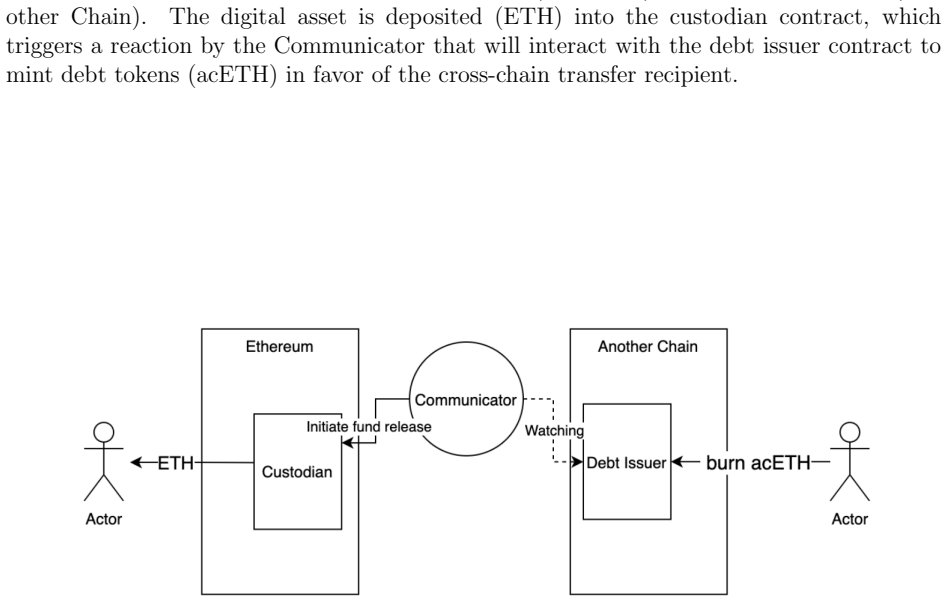
The organizing device is the three-component bridge model inherited from the authors' earlier SoK: a custodian contract on the source chain that locks assets, a debt issuer contract on the destination chain that mints and burns the pegged tokens, and a communicator that observes events on one chain and relays them to the other. The paper then maps each reviewed hack onto either the custodian or the communicator, treating the debt issuer as not being the target in this period. The work the taxonomy does is to collapse many superficially different exploits into two attack surfaces, so that solutions can be stated per surface rather than per incident.
What would settle it
A documented 2022–2023 bridge hack in which funds are stolen entirely through a vulnerability in the debt issuer contract (for example, a logic bug that mints debt tokens without a corresponding lock or burn) while the custodian and communicator behave as designed would fall outside the proposed classification and show the taxonomy incomplete. Curating a list of such hacks would settle whether the custodian/communicator partition is exhaustive.
Extended reading notes
Core claim
The central claim is that a three-component model of bridge architecture—custodian, communicator, and debt issuer—accounts for the bridge hacks of the reviewed period, and that every analyzed exploit targets either the custodian or the communicator. Custodian attacks proceed by manipulating Merkle proofs (Binance Bridge, almost $600 million), exploiting missing input validation in legacy code paths (Nomad, about $190 million; Qubit Finance, about $80 million), or compromising admin private keys (Wintermute, about $160 million). Communicator attacks proceed by compromising validator private keys (Harmony Horizon, about $100 million; Ronin, about $600 million) or by exploiting voting flaws in the off-chain communicator network (Celer, up to $30 million at risk). The paper's contribution is the classification itself plus the observation that each class has recurring root causes—verification edge cases, default-value assumptions, legacy code, key management, and missing checks in off-chain logic—each of which maps to a concrete mitigation.
Load-bearing premise
The analysis assumes that every cross-chain bridge hack fits the three-component model and that every reviewed exploit is either a custodian attack or a communicator attack; if a real attack succeeds by exploiting debt-issuer logic, governance, or economic manipulation alone, the taxonomy and its countermeasures would not cover it.
Editorial extensions
If this is right
- If the classification holds, security audits of bridges should treat the custodian and communicator as separate threat surfaces and dedicate specific checks to each: Merkle proof edge cases and default-value handling for the former, key-management and off-chain logic for the latter.
- Upgrade procedures should be treated as security-critical, since the Nomad and Qubit exploits both arose from legacy paths that remained active after new functionality was added.
- Monitoring and incident response should focus on communicator behavior, such as unexpected validator votes or large transfers, because the Ronin and Harmony attacks went undetected for days.
- The pattern points toward industry standards like minimum multi-sig thresholds, key-storage requirements, and mandatory off-chain code review, which the paper explicitly calls for.
- The Celer case suggests that bug-bounty programs need to cover off-chain communicator code, not only on-chain contracts.
Reading between the lines
- One implication the paper leaves implicit is that the custodian/communicator split could be used as a checklist for automated vulnerability scanners, with each class of exploit mapped to detectable code patterns in contracts and off-chain services.
- The paper's period boundary (hacks after its predecessor SoK) means the taxonomy is a snapshot; a testable extension is to apply the same classification to bridge hacks from 2024 onward and see whether new attacks still fit.
- The repeated failure mode of "system as strong as its weakest component" suggests that economic incentives of communicators—rewarded for honest relaying, punished for malicious behavior—deserve as much attention as cryptographic and contract-level controls.
- Because the debt issuer is identified as a component but no 2022–2023 attacks are assigned to it, the model implicitly predicts that bridges are most vulnerable where assets are locked and where messages are relayed; debt-issuer logic bugs may emerge as the next frontier if those surfaces harden.
Editorial analysis
A structured set of objections, weighed in public.
Referee Report
Summary. The paper is a SoK-style review of selected cross-chain bridge hacks from 2022 and 2023. It first introduces a three-component bridge architecture (custodian, communicator, and debt issuer), then analyzes six incidents: Binance Bridge, Nomad, Qubit Finance, Wintermute, Harmony Horizon, Ronin, and Celer. Each incident is assigned to either a custodian attack (Section 3) or a communicator attack (Section 4), and each section ends with proposed countermeasures. The stated goal is that understanding these attacks can enhance bridge security and inform industry-wide standards.
Significance. If the classifications and incident narratives are accurate, the paper is a useful practitioner-oriented survey: it gives concrete, step-by-step exploit descriptions that are traceable to public incident reports, and it highlights a reproducible set of operational lessons (key management, off-chain code review, monitoring, and decentralization). The paper also makes a transparent connection to the authors' prior SoK in [4], which is appropriate for a follow-up survey. However, the contribution is closer to an incident compendium than to a systematic taxonomy: the paper does not justify the completeness of its two-category classification, contains a factual dating error for one incident, and does not specify an incident-selection methodology. These limitations currently constrain the strength of the claim that the findings can support industry-wide standards.
major comments (4)
- [Section 3.3.1] The paper dates the Wintermute hack to June 2022, but the cited references [27, 28] and all public incident reports place it in September 2022. Since this is a review whose value depends on accurate incident metadata, the date should be corrected and the chronology in Section 5 should be adjusted accordingly.
- [Sections 2, 3, and 4] Section 2 defines the bridge architecture as having three components—custodian, communicator, and debt issuer—and states that a communicator signature is mandatory for the debt issuer to mint. Yet Sections 3 and 4 treat only custodian and communicator attacks, and no argument is given that debt-issuer attacks are impossible or out of scope. The February 2022 Wormhole hack, which falls within the paper's stated 2022 window and is not discussed, exploited a missing signature check in the Solana-side minting contract, i.e. the debt-issuer component, allowing 120,000 wETH to be minted without a corresponding lock. This is a concrete counterexample to the implicit two-way classification and should either be analyzed or explicitly excluded with justification.
- [Section 5] The related-work section states that the paper 'focused on attacks that occurred from December 2022 until May 2023,' but the analyzed corpus includes Qubit (January 2022), Ronin (March 2022), and Wintermute (September 2022). The abstract says 2022 and 2023, the title says 2023, and the introduction says the work covers hacks after [4]; these statements are mutually inconsistent and leave the actual scope and selection criterion unclear.
- [Sections 3 and 4] No inclusion criteria or incident-selection methodology is provided for the six case studies. As a SoK, the paper should state how incidents were identified, screened, and validated; without this, the proposed classification and the claim that the findings can inform industry-wide standards are not fully supported, because the reader cannot assess whether the surveyed set is representative or complete.
minor comments (5)
- [Section 3.2.1] The text twice refers to the 'Merle root' rather than the 'Merkle root'.
- [Section 4.2.1] 'Stage Guardian Network' appears to be a typo for 'State Guardian Network'.
- [Section 4.1.3] 'Axie Infinitie's' should be 'Axie Infinity's'.
- [Section 4.1.3] The passage says the attacker 'gained control of five validator private keys,' but the following sentences explain that the Axie DAO validator's signature was obtained through the gas-free RPC node; the paper should clarify whether the key was compromised or only its signing capability was abused.
- [Title and Abstract] The title promises a review of hacks 'in 2023,' while the abstract and body cover 2022 and 2023; the wording should be aligned.
Circularity Check
No significant circularity: the paper applies an architecture from the authors' prior SoK, but the hack classifications are based on external public incidents and no prediction reduces to the framework's definitions.
full rationale
The claimed derivation chain is a classification review, not a parameterized model. Section 2 defines custodian, communicator, and debt-issuer components; Sections 3 and 4 assign several externally documented incidents to the first two categories. There are no fitted parameters, no equations, and no quantity is 'predicted' from the framework; the classifications are applications of a stated architectural model to independently reported exploit details. The only self-citation appears in Section 5: the paper 'continues the line of work initiated by Lee et al. [4]' and states that [4] 'set out a general bridge architecture design.' That prior work is a published IEEE SoK with its own analysis of documented hacks; it is not invoked as a uniqueness theorem, it does not forbid alternative taxonomies such as debt-issuer attacks, and the current paper's conclusions do not logically reduce to it. The absence of a debt-issuer attack section is a completeness limitation of the binary custodian/communicator organization, but it is not a circular reduction because the paper never claims the two categories are exhaustive by construction. Hence no circular step meeting the quoted-reduction standard is present; the self-citation is minor and non-load-bearing.
Assumptions & free parameters
assumptions (3)
- domain assumption Cross-chain bridges can be decomposed into custodian, communicator, and debt issuer components.
- domain assumption The selected hacks are representative of bridge attack patterns.
- domain assumption Public incident reports (rekt.news, threadreaderapp, Medium, company blogs) accurately describe the attacks.
Cite this review
Pith. "Pith review of SoK: A Review of Cross-Chain Bridge Hacks in 2023." pith.science (2026). https://pith.science/paper/EHNWI2CD
@misc{pith2026250103423,
  author       = {Pith},
  title        = {Pith review of: SoK: A Review of Cross-Chain Bridge Hacks in 2023},
  year         = {2026},
  howpublished = {\url{https://pith.science/paper/EHNWI2CD}},
  note         = {Machine review of arXiv:2501.03423}
}
abstract
Blockchain technology has revolutionized industries by enabling secure and decentralized transactions. However, the isolated nature of blockchain ecosystems hinders the seamless transfer of digital assets across different chains. Cross-chain bridges have emerged as vital web3 infrastructure to address this challenge by facilitating interoperability between distinct blockchains. Cross-chain bridges remain vulnerable to various attacks despite sophisticated designs and security measures. The industry has experienced a surge in bridge attacks, resulting in significant financial losses. The largest hack impacted Axie Infinity Ronin Bridge, with a loss of almost \$600 million USD. This paper analyzes recent cross-chain bridge hacks in 2022 and 2023 and examines the exploited vulnerabilities. By understanding the attack nature and underlying weaknesses, the paper aims to enhance bridge security and propose potential countermeasures. The findings contribute to developing industry-wide standards for bridge security and operational resilience. Addressing the vulnerabilities and weaknesses exploited in recent cross-chain bridge hacks fosters trust and confidence in cross-chain interoperability.
Figures


Figures from the paper (7 more)


Forward citations
Cited by 2 Pith papers
-
Hedge Funds on a Swamp: Analyzing Patterns, Vulnerabilities, and Defense Measures in Blockchain Bridges
A data-driven study of blockchain bridge attacks concludes that most losses come from trusted signer compromise and code validation bugs, while trustless designs have so far escaped major exploits.
-
Towards Secure and Trustworthy DAOs for Cross-Chain Governance
The paper proposes a layered, unvalidated security architecture for cross-chain DAO governance, folding known attacks and known cryptographic primitives into a new module diagram.
Reference graph
Works this paper leans on
-
[4]
SoK: Not quite water under the bridge: Review of cross-chain bridge hacks
Sung-Shine Lee, Alexandr Murashkin, Martin Derka, and Jan Gorzny. SoK: Not quite water under the bridge: Review of cross-chain bridge hacks. In IEEE International Con- ference on Blockchain and Cryptocurrency, ICBC 2023, Dubai, United Arab Emirates, May 1-5, 2023, pages 1–14. IEEE, 2023
work page 2023
-
[1]
Ethereum: A secure decentralised generalised transaction ledger, 2014
Gavin Wood. Ethereum: A secure decentralised generalised transaction ledger, 2014. https://ethereum.github.io/yellowpaper/paper.pdf
work page 2014
-
[2]
Crypto research, data, and tools, Aug 2022
Ally Zach. Crypto research, data, and tools, Aug 2022. https://messari.io/repor t/a-year-of-bridge-exploits
work page 2022
-
[3]
Rekt - ronin network - rekt, Mar 2022
Rekt news. Rekt - ronin network - rekt, Mar 2022. https://rekt.news/ronin-rekt/. 19
work page 2022
-
[5]
ERC-20: Token standard, Nov 2015
Vitalik Buterin Fabian Vogelsteller. ERC-20: Token standard, Nov 2015. https: //eips.ethereum.org/EIPS/eip-20
work page 2015
-
[6]
ERC-721: Non- fungible token standard, Jan 2018
William Entriken, Dieter Shirley, Jacob Evans, and Nastassia Sachs. ERC-721: Non- fungible token standard, Jan 2018. https://eips.ethereum.org/EIPS/eip-721
work page 2018
-
[7]
ERC-1155: Multi token standard, Jun 2018
Witek Radomski, Andrew Cooke, Philippe Castonguay, James Therien, Eric Binet, and Ronan Sandford. ERC-1155: Multi token standard, Jun 2018. https://eips.ethereu m.org/EIPS/eip-1155
work page 2018
-
[8]
Commit-chains: Secure, scalable off-chain payments
Rami Khalil, Alexei Zamyatin, Guillaume Felley, Pedro Moreno-Sanchez, and Arthur Gervais. Commit-chains: Secure, scalable off-chain payments. Cryptology ePrint Archive, Paper 2018/642, 2018. https://eprint.iacr.org/2018/642
work page 2018
Show all 45 references
-
[9]
Ideal properties of rollup escape hatches
Jan Gorzny, Po-An Lin, and Martin Derka. Ideal properties of rollup escape hatches. In Kaiwen Zhang, Abdelouahed Gherbi, and Paolo Bellavista, editors, Proceedings of the 3rd International Workshop on Distributed Infrastructure for the Common Good, DICG 2022, Quebec, Quebec Ci...
2022
-
[10]
On the size of pairing-based non-interactive arguments
Jens Groth. On the size of pairing-based non-interactive arguments. In Marc Fischlin and Jean-S´ ebastien Coron, editors, Advances in Cryptology - EUROCRYPT 2016 - 35th Annual International Conference on the Theory and Applications of Cryptographic Techniques, Vienna, Austria,...
2016
-
[11]
zkBridge: Trustless cross-chain bridges made practical
Tiancheng Xie, Jiaheng Zhang, Zerui Cheng, Fan Zhang, Yupeng Zhang, Yongzheng Jia, Dan Boneh, and Dawn Song. zkBridge: Trustless cross-chain bridges made practical. In Heng Yin, Angelos Stavrou, Cas Cremers, and Elaine Shi, editors, Proceedings of the 2022 ACM SIGSAC Conferenc...
2022
-
[12]
Protocol overview, Mar 2023
Telepathy. Protocol overview, Mar 2023. https://docs.telepathy.xyz/protocol/ overview
2023
-
[13]
Menezes, Paul C
Alfred J. Menezes, Paul C. van Oorschot, and Scott A. Vanstone. Handbook of Applied Cryptography. CRC Press, Dec 2018
2018
-
[14]
Rekt - BNB Bridge - rekt, Oct 2022
Rekt News. Rekt - BNB Bridge - rekt, Oct 2022. https://rekt.news/bnb-bridge-r ekt/
2022
-
[15]
Analysis of the binance bridge hack
samczsun. Analysis of the binance bridge hack. https://threadreaderapp.com/thre ad/1578167198203289600.html
-
[16]
Thread by @frankresearcher on binance hack, Oct 2022
Igor Igambediev. Thread by @frankresearcher on binance hack, Oct 2022. https: //threadreaderapp.com/thread/1578148293032706048.html. 20
2022
-
[17]
https://github.com/bnb-chain/bnc-tendermint-iavl
GitHub - IA VL+ tree. https://github.com/bnb-chain/bnc-tendermint-iavl
-
[18]
Analysis of nomad hack, Aug 2022
Zellic. Analysis of nomad hack, Aug 2022. https://threadreaderapp.com/thread/1 554296729050025984.html
2022
-
[19]
Analysis of nomad hack, Aug 2022
samczsun. Analysis of nomad hack, Aug 2022. https://threadreaderapp.com/thre ad/1554252024723546112.html
2022
-
[20]
https://docs.soliditylang.org/en/v0.8.23/
Solidity. https://docs.soliditylang.org/en/v0.8.23/
-
[21]
Qubit bridge collapse exploited to the tune of $80 million
CertiK. Qubit bridge collapse exploited to the tune of $80 million. Jan 2022. https: //certik.medium.com/qubit-bridge-collapse-exploited-to-the-tune-of-80-m illion-a7ab9068e1a0
2022
-
[22]
Explained: The Qubit hack (January 2022), Jan 2022
Rob Behnke. Explained: The Qubit hack (January 2022), Jan 2022. https://www.ha lborn.com/blog/post/explained-the-qubit-hack-january-2022
2022
-
[23]
Hack track: Analysis of Qubit finance exploit, Feb 2022
Merkle Science. Hack track: Analysis of Qubit finance exploit, Feb 2022. https: //blog.merklescience.com/hacktrack/analysis-of-qubit-finance-exploit
2022
-
[24]
Protocol exploit report - Qubit finance
Qubit Finance. Protocol exploit report - Qubit finance. Medium, Jan 2022. https: //medium.com/@QubitFin/protocol-exploit-report-305c34540fa3
2022
-
[25]
https://github.com/bnb-chain/BEPs/blob /master/BEP20.md
BEP-20 standard proposal, Aug 2020. https://github.com/bnb-chain/BEPs/blob /master/BEP20.md
2020
-
[26]
SafeERC20
OpenZeppelin. SafeERC20. https://docs.openzeppelin.com/contracts/4.x/api/ token/erc20#SafeERC20
-
[27]
Rekt - Wintermute - rekt 2, Sept 2022
Rekt news. Rekt - Wintermute - rekt 2, Sept 2022. https://rekt.news/wintermute -rekt-2/
2022
-
[28]
Explained: The Wintermute hack (September 2022), Sept 2022
Rob Behnke. Explained: The Wintermute hack (September 2022), Sept 2022. https:// www.halborn.com/blog/post/explained-the-wintermute-hack-september-2022
2022
-
[29]
Profanity
johguse. Profanity. https://github.com/johguse/profanity
-
[30]
A vulnerability disclosed in profanity, an ethereum vanity address tool
1inch Network. A vulnerability disclosed in profanity, an ethereum vanity address tool. 1inch Network Blog, Sept 2022. https://blog.1inch.io/a-vulnerability-disclos ed-in-profanity-an-ethereum-vanity-address-tool/
2022
-
[31]
Exploiting the profanity flaw - amber group - medium
Amber Group. Exploiting the profanity flaw - amber group - medium. Amber Group, Sept 2022. https://medium.com/amber-group/exploiting-the-profanity-flaw-e 986576de7ab
2022
-
[32]
Explained: The Harmony Horizon bridge hack, Jun 2022
Rob Behnke. Explained: The Harmony Horizon bridge hack, Jun 2022. https://www. halborn.com/blog/post/explained-the-harmony-horizon-bridge-hack
2022
-
[33]
An incident response update on the horizon bridge hack, Jun 2022
Stephen Tse. An incident response update on the horizon bridge hack, Jun 2022. https: //threadreaderapp.com/thread/1540896630320246785.html. 21
2022
-
[34]
Harmony bridge update, Jun 2022
Rugdoc.io. Harmony bridge update, Jun 2022. https://threadreaderapp.com/thre ad/1540151942214651904.html
2022
-
[35]
Hack track: Analysis of ronin network exploit, Mar 2022
Merkle Science. Hack track: Analysis of ronin network exploit, Mar 2022. https: //blog.merklescience.com/hacktrack/hack-track-analysis-of-ronin-network -exploit-merkle-science
2022
-
[36]
Election fraud? double voting in Celer’s state guardian network
Felix Wilhelm. Election fraud? double voting in Celer’s state guardian network. Jump Crypto, May 2023. https://jumpcrypto.com/writing/election-fraud-double-v oting-in-celers-state-guardian-network/
2023
-
[37]
Modeling cross- blockchain process using queueing theory: The case of cosmos
Ou Wu, Shanshan Li, Yanze Wang, Haoming Li, and He Zhang. Modeling cross- blockchain process using queueing theory: The case of cosmos. In 28th IEEE Interna- tional Conference on Parallel and Distributed Systems, ICPADS 2022, Nanjing, China, January 10-12, 2023, pages 274–281....
2022
-
[38]
Do you need a distributed ledger technology interoperability solution? Distributed Ledger Technologies: Research and Practice, 2(1):1–37, Mar 2023
Rafael Belchior, Luke Riley, Thomas Hardjono, Andr´ e Vasconcelos, and Miguel Correia. Do you need a distributed ledger technology interoperability solution? Distributed Ledger Technologies: Research and Practice, 2(1):1–37, Mar 2023
2023
-
[39]
An overview on cross-chain: Mechanism, platforms, challenges and advances
Wei Ou, Shiying Huang, Jingjing Zheng, Qionglu Zhang, Guang Zeng, and Wenbao Han. An overview on cross-chain: Mechanism, platforms, challenges and advances. Computer Networks, 218:109378, 2022. https://www.sciencedirect.com/science/ article/pii/S1389128622004121
2022
-
[40]
Knottenbelt
Alexei Zamyatin, Mustafa Al-Bassam, Dionysis Zindros, Eleftherios Kokoris-Kogias, Pedro Moreno-Sanchez, Aggelos Kiayias, and William J. Knottenbelt. SoK: Communi- cation across distributed ledgers. In Nikita Borisov and Claudia D ´ ıaz, editors, Finan- cial Cryptography and Da...
2021
-
[41]
Xscope: Hunting for cross-chain bridge attacks
Jiashuo Zhang, Jianbo Gao, Yue Li, Ziming Chen, Zhi Guan, and Zhong Chen. Xscope: Hunting for cross-chain bridge attacks. In 37th IEEE/ACM International Conference on Automated Software Engineering, ASE 2022, Rochester, MI, USA, October 10-14, 2022, pages 171:1–171:4. ACM, 2022
2022
-
[42]
Hephaestus: Modelling, Analysis, and Performance Evaluation of Cross-Chain Transactions
Rafael Belchior, Peter Somogyvari, Jonas Pfannschmid, Andr´ e Vasconcelos, and Miguel Correia. Hephaestus: Modelling, Analysis, and Performance Evaluation of Cross-Chain Transactions. Jan 2023. http://dx.doi.org/10.36227/techrxiv.20718058.v2
2023 doi
-
[43]
Hyper- ledger cactus whitepaper, Mar 2022
Hart Montgomery, Hugo Borne-Pons, Jonathan Hamilton, Mic Bowman, Peter Somo- gyvari, Shingo Fujimoto, Takuma Takeuchi, Tracy Kuhrt, and Rafael Belchior. Hyper- ledger cactus whitepaper, Mar 2022. https://github.com/hyperledger/cacti/blo b/main/whitepaper/whitepaper.md
2022
-
[44]
Crosschain risk framework, Dec 2022
Arjun Chand, Ermyas Abebe, and David Hyland-Wood. Crosschain risk framework, Dec 2022. https://crosschainriskframework.github.io/framework/20categori es/categories-of-risk/. 22
2022
-
[45]
L2bridge risk framework, 2022
Bartek Kiepuszewski. L2bridge risk framework, 2022. https://gov.l2beat.com/t/l 2bridge-risk-framework/. 23
2022
Reviewed August 10, 2026 · model on record in the stance chip above.
Discussion (0). Continue with ORCID to comment.